
English retelling practice: 5 keywords, recording and one correction
Published
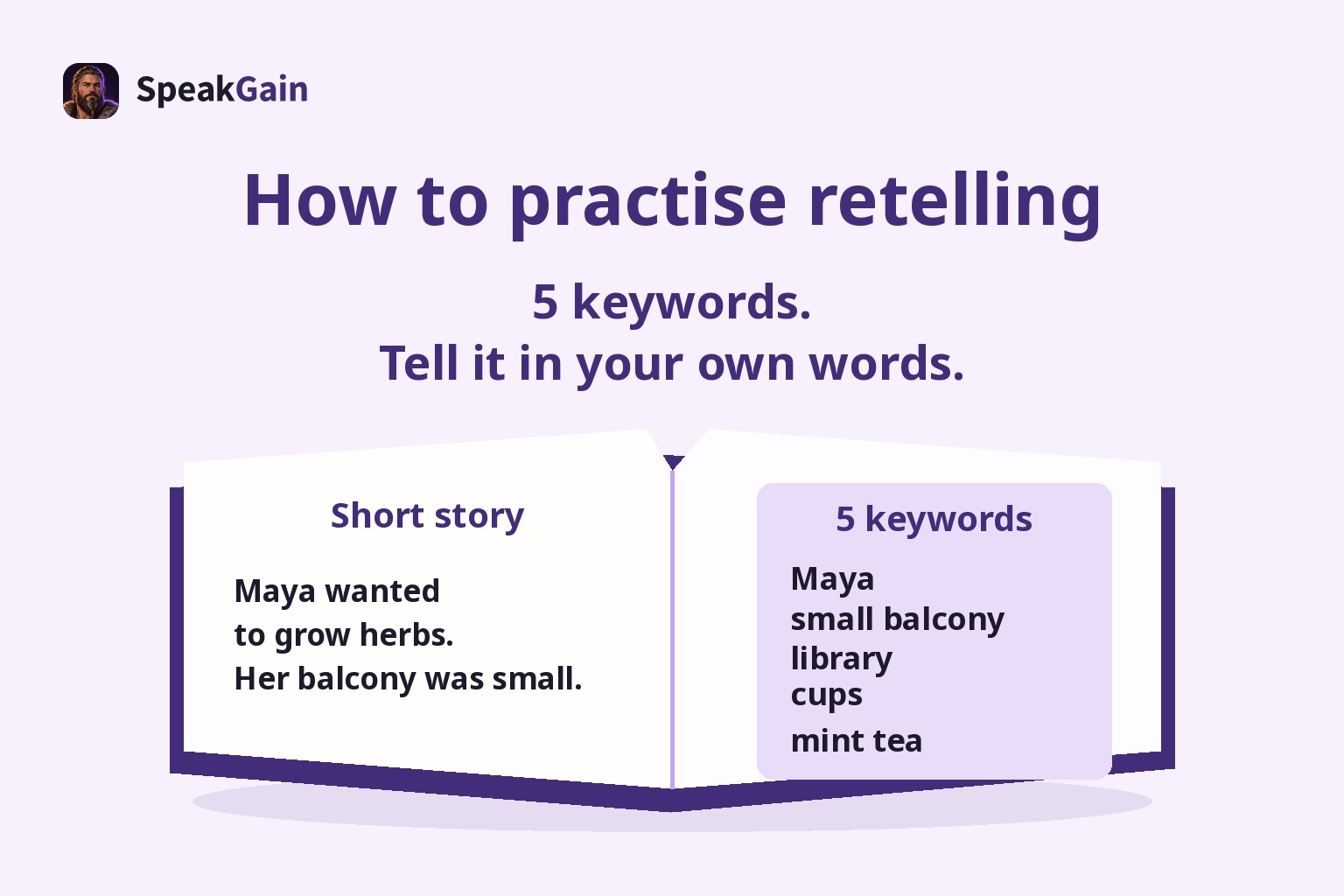
Retelling means speaking again about something you have read or heard, using your own words while keeping the meaning. In this guide, reproduction means reconstructing the original content with wording closer to the source. Practise alone by choosing a short text, reading or listening two or three times, noting five keywords, speaking from those notes, recording yourself, fixing one thing and speaking again. Our starting suggestion is three to five understandable sentences, roughly 40–70 words; this is an editorial guideline, not a research-established optimum.
A classroom retelling assignment does not automatically require memorising the entire passage. Check the conditions, then explain who did what, why and with what result. Adult learners can use the same process to explain a short article or story without reading it aloud.
Reproduction, retelling, summary and shadowing: the differences
The table gives this article’s working distinctions, rather than universal research definitions. A speaker in Japan’s MEXT foreign-language working-group minutes distinguishes reproduction focused on source expressions from retelling in which students select their wording. Those meeting remarks are not a nationwide assessment rule.
| Practice | What you do | Wording | Main challenge | When to use it |
|---|---|---|---|---|
| Reproduction | Reconstruct content and expressions after reading/listening ends | Mostly source vocabulary and patterns | Recalling meaning and form | You need a bridge from understanding to speaking |
| Retelling | Hide the text and tell its content again | Source phrases plus sentences you assemble | Selecting and connecting information | You understand a text but struggle to explain it |
| Summary | Select essential information for a purpose or length | Source wording or paraphrases, spoken or written | Deciding what to retain or omit | You need to communicate the main points briefly |
| Shadowing | Follow incoming audio without stopping it | Usually the source words | Listening while tracking the sounds | Familiar written words are hard to catch in speech |
A Keirinkan classroom report describes a progression from reproduction to retelling, supported by pictures and keywords. But the “oral reproduction” task in Kamali et al. (2020), section 3.5 asks learners to reproduce passage content using target vocabulary; it is not a synonym for verbatim recitation. Labels overlap. Check how much detail and reformulation a particular assignment requires.
Retelling may involve shortening, but it succeeds only if the important relationships survive. A summary deliberately selects information for its purpose; a retelling may retain more events and details. Hamada’s explanation of shadowing, pp.19–20 describes tracking incoming audio. For that distinct practice, see how to practise English shadowing. Teachers planning lessons can consult Tokyo Shoseki’s classroom examples and MEXT’s English-education case site; the rest of this guide is for learners practising alone.
Seven steps for a solo practice session
| Step | Action | Check before moving on |
|---|---|---|
| 1 | Choose a short text | You can identify its people, events and ending |
| 2 | Listen/read two or three times | You understand the action, reason and result |
| 3 | Write five keyword notes | They prompt the story without providing full sentences |
| 4 | Hide the text and speak from the notes | You reach the ending with words you know |
| 5 | Record yourself | Your own voice is clear on playback |
| 6 | Compare with the source; fix one thing | You identify one omission, changed meaning or sticking point |
| 7 | Speak again from the same notes | Your correction appears in the new recording |
The first goal is to complete the story and make one observable correction, rather than match the source’s length or sound perfectly fluent. Use any recording tool that lets you save and hear your own speech. If an assignment specifies a submission format, follow it.
Step 1: choose a short text you understand
Why: We favour a manageable text so that understanding and speaking can be checked separately. A long passage makes it harder to tell whether you forgot the content or could not formulate it in English.
How: Start with one scene, one or two characters and a clear ending. Reading should reveal the main story without looking up most of its vocabulary. For listening practice, have an accurate matching transcript. Level labels alone are less useful than asking whether you can explain the events in a language you know well.
Example: We wrote this original 46-word story for the article; it is not copied from a textbook.
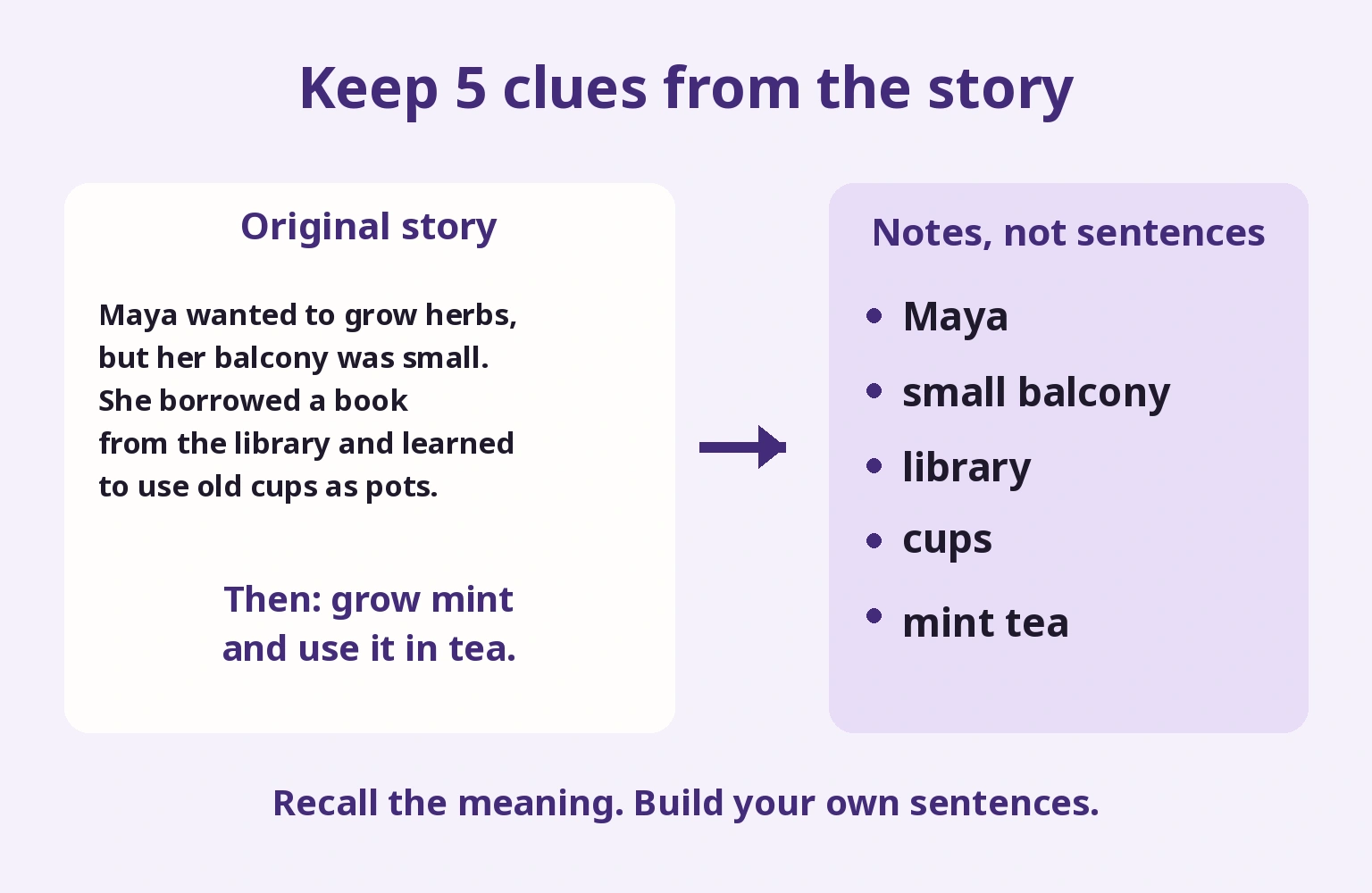
Maya wanted to grow herbs, but her balcony was small. She borrowed a book from the library and learned to use old cups as pots. On Sunday, she planted mint in two cups. She put them by the window. Now she uses the mint in tea.
Later, the notes will be Maya / small balcony / library / cups / mint tea. “Five keywords” here means five short clues, not exactly five individual English words.
Common mistake: Choosing an entire difficult news report, then spending the session learning names. If you cannot explain the text after reading it, simplify it or study its vocabulary separately. Increase length after you can finish the recording-and-comparison loop.
Step 2: listen or read two or three times
Why: Unclear content makes speaking errors difficult to diagnose. Kai (2008), public abstract reports differences by proficiency and benefits associated with additional reading in narrative comprehension. It does not establish that three encounters are sufficient for everyone.
How: On the first pass, follow the whole story. On the second, identify the problem, action and result. Use a third pass for an unresolved part if needed. Check the transcript if the audio is unclear. Return to an easier source if the story still does not make sense.
Example: What did Maya want to grow? Where did she learn the method? How does she use the mint? The answers are herbs, a library book and tea. The later notes “library” and “cups” represent different roles: a source of information and a container for growing.
Common mistake: Translating every line but losing the sequence, or remembering only “a story about plants”. Maya grew mint; she did not buy it at the library. Check who did what, contrasts and the ending. To investigate a short part you cannot hear, use English dictation practice, then return to the story.
Step 3: write five clues, not complete sentences
Why: Full-sentence notes turn the next attempt into reading aloud. We suggest cues that retrieve the content while leaving you to construct the wording. Five is a practical limit, not a scientifically optimal number.
How: Note the person, problem, trigger, action and result in order. Use single words, short phrases, a number or an arrow. Avoid writing a subject and predicate for every event. Choose meaningful cues instead of collecting the hardest adjectives.
Example: Maya / small balcony / library / cups / mint tea. “Cups” should remind you that old cups became pots; you can add “2” if the number matters. If “Maya” alone is insufficient, “Maya → herbs” is a useful short cue. This is still different from a shortened script.
Common mistake: Keeping difficult words but losing the character’s actions. Notes in your first language are acceptable as an initial support; gradually replace them with English cues. Do not turn a complete first-language script into a word-by-word translation exercise. In class, respect the permitted language and number of notes.
Step 4: speak from the notes; paraphrase when stuck
Why: Retelling requires building sentences from recalled meaning. You do not need to replace every source word. Useful original phrases, names and necessary nouns can remain.
How: Close the source and use only the memo. An initial attempt close to the original is a reasonable reproduction stage. Next, express the same story in short sentences you can assemble. If a word is missing, explain its meaning using familiar words. Do not invent facts to fill the gap.
Example: A reproduction attempt might keep “She borrowed a book from the library.” Here is one possible retelling:
Maya had a small balcony, but she wanted to grow herbs. A library book gave her an idea. She grew mint in two old cups by the window. Now she puts the mint in her tea.
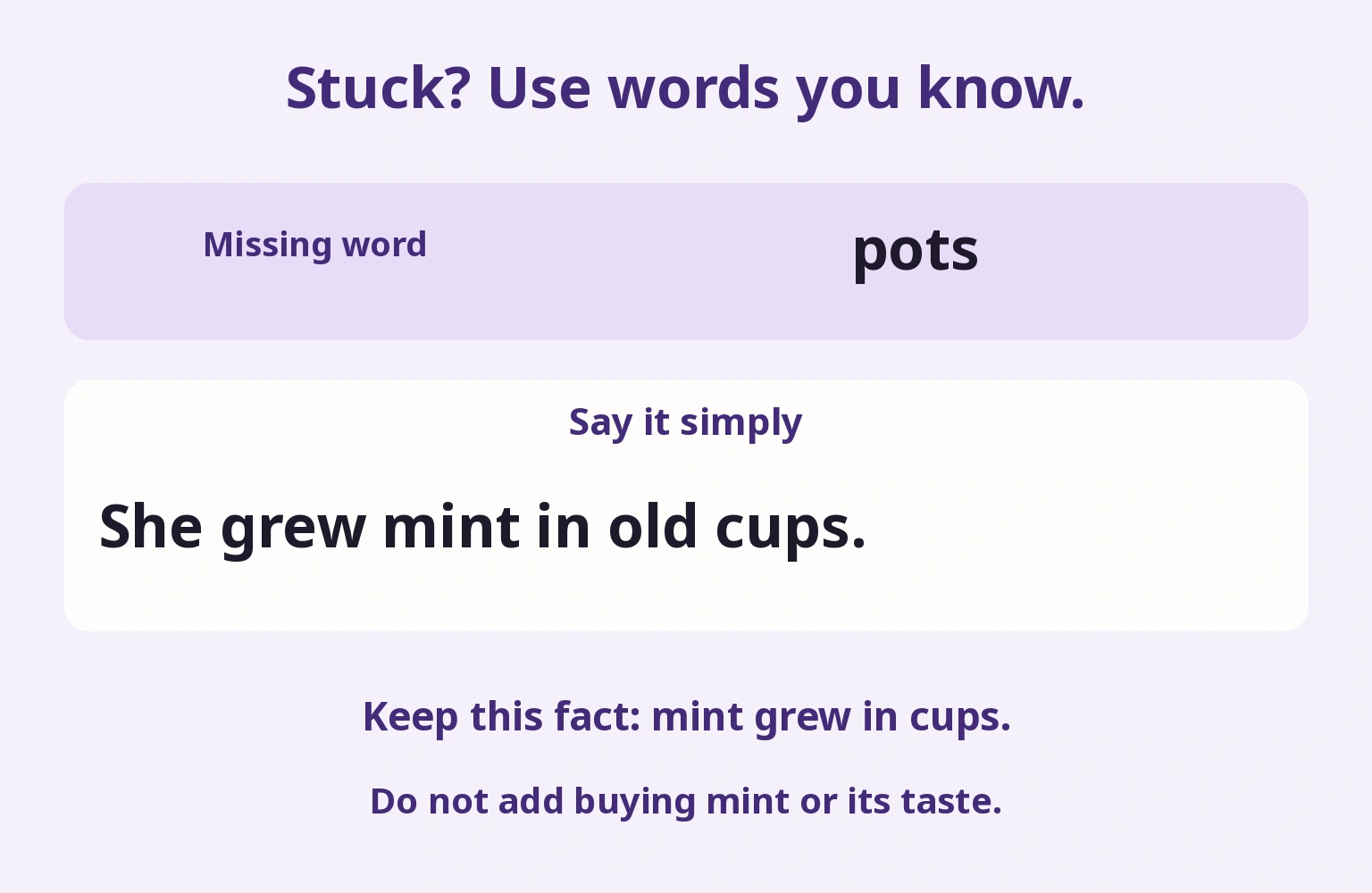
If “pots” will not come, say She grew mint in old cups.. “She got an idea from a library book” preserves the book’s role but omits borrowing it. Restore that detail later if the assignment asks for it.
Common mistake: Waiting silently for the exact wording, searching for a different synonym for every word, or substituting an opinion for the story. “Maya bought mint” changes the action. “It was delicious” adds an unsupported judgement. Freedom to paraphrase is not freedom to rewrite the facts.
Step 5: record your voice without the source text
Why: You may feel that you reached the ending while actually omitting it or repeating a sentence. Recording helps identify the next correction; recording alone does not automatically improve proficiency.
How: Record the attempt in step 4. First test a few seconds to ensure your voice is audible. Stop the model audio and record only yourself. Keep going to the ending instead of deleting each hesitant attempt. Label the recording with the text and attempt number.
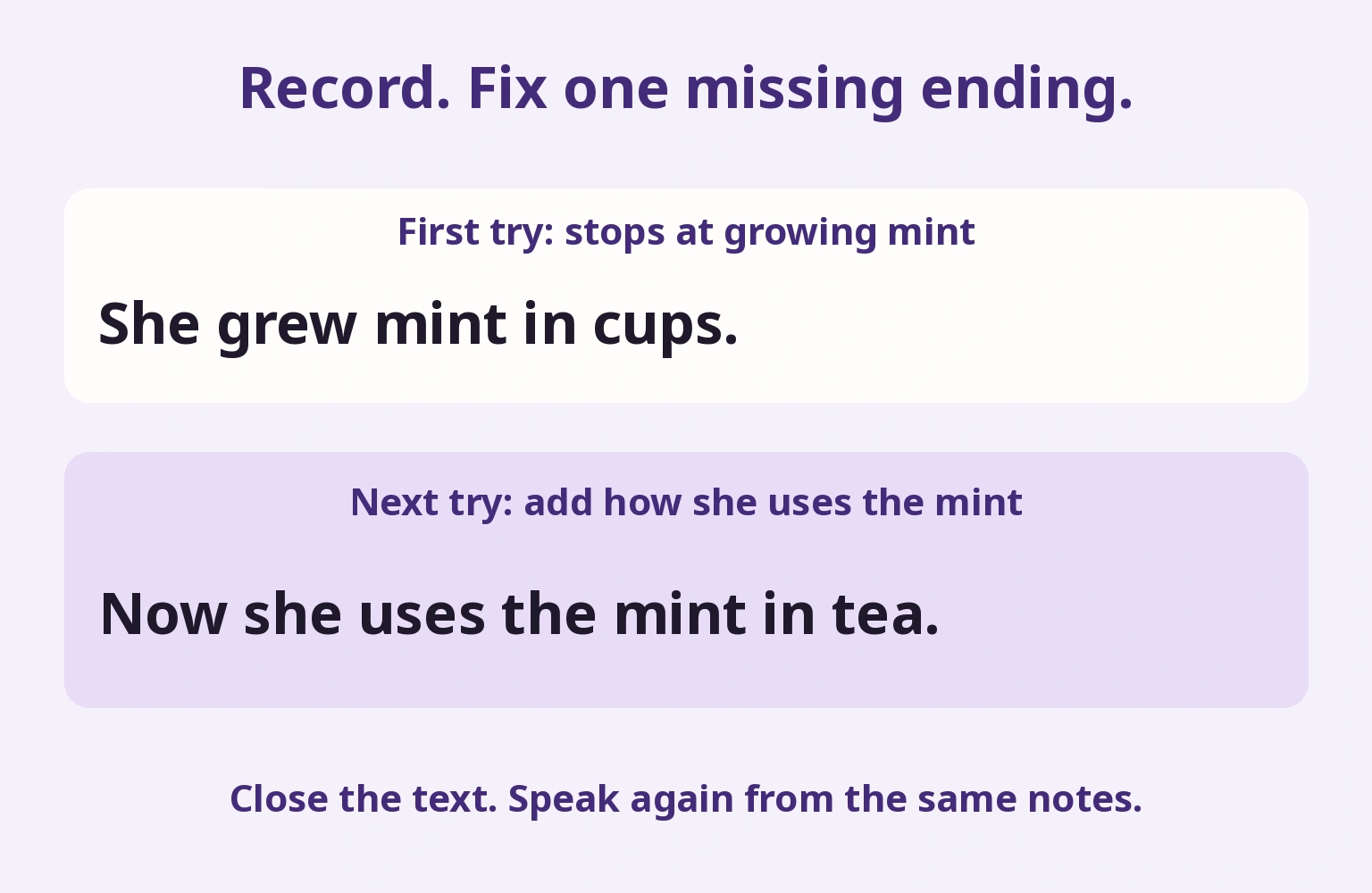
Example: If your recording ends with “She grew mint in cups”, it omits the use in tea, even if you glanced at the final memo item. A long pause around “library” is another possible target. These are illustrative examples, not reported learner results.
Common mistake: Reading the passage while recording and treating it as evidence of speaking from notes. Reading aloud can be preparation, but the text must be hidden for this attempt. Fix microphone distance before judging an inaudible recording.
Step 6: compare meanings first and fix one thing
Why: Different words are not automatically errors. Retelling checks whether the listener receives the same important events and relationships. We suggest one correction that can be tested in the next attempt.
How: Listen to yourself, then open the source. Check missing content, altered meaning and places where sentence construction stalled, in that order. Grammar and intelligibility can follow. You need not transcribe the whole recording; a troublesome phrase may be enough.
| Recording | What to notice | Next correction |
|---|---|---|
| She grew mint in cups. — then stops | The ending is missing | Add Now she uses the mint in tea. |
| She bought mint at the library. | The place and action have changed | Explain that a book provided the method |
| She grew mint in two old cups. | This part’s meaning survives | Do not correct it merely for differing from the source |
| She grow mint… — long pause | Constructing the action is difficult | Practise “She grew mint in two cups”, then restore it to the story |
Common mistake: Counting matching vocabulary without checking relationships. “Library” and “mint” can both appear in a false account of buying mint there. If you cannot judge a grammatical choice, consult the material or a teacher. Self-comparison is not formal assessment.
Step 7: speak again and check the correction
Why: Seeing a correction is different from producing it. We recommend practising the repaired phrase briefly, then returning it to the complete story. A smoother second attempt may reflect familiarity with this text, rather than a general improvement in English.
How: Hide the source again and record from the same five cues. Check whether your correction appeared and whether another important fact disappeared. Keep both recordings and write one line about progress and one about the next target. Try a different short story the next day.
Example: “Attempt 1: omitted tea. Attempt 2: included the ending. Next: say where she got the idea without a long pause.” An attempt close to the source is not automatically a failure; with a new story, check whether you can speak before memorising it.
Common mistake: Reciting the same passage dozens of times without trying another. End the session when the chosen correction is checked, unless the assignment specifies more attempts.
Hear one key sentence again with SpeakGain
We saved Now she uses the mint in tea. from our story through SpeakGain’s normal Add flow. The chosen voice was Deep-voiced Viking. This player uses the AI audio generated once for that card, as a reference for speaking the ending sentence, rather than a reading of the whole story.
Open or save the practice audio
On the device, we opened the card’s Knowledge from Card library and used Learn this card to reach Listening. The sentence was hidden; Reveal answer then displayed the saved sentence, an explanation link, playback controls and review-interval choices.
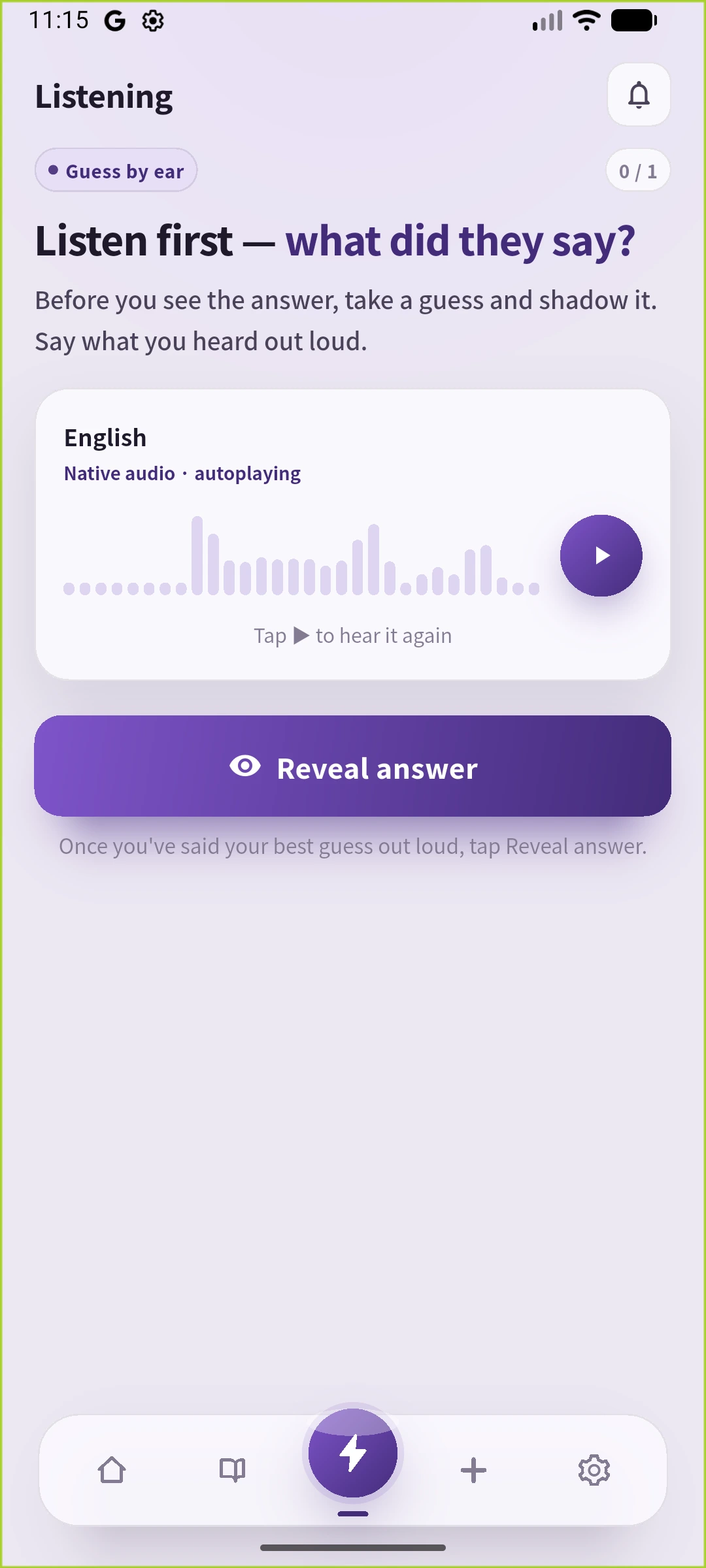
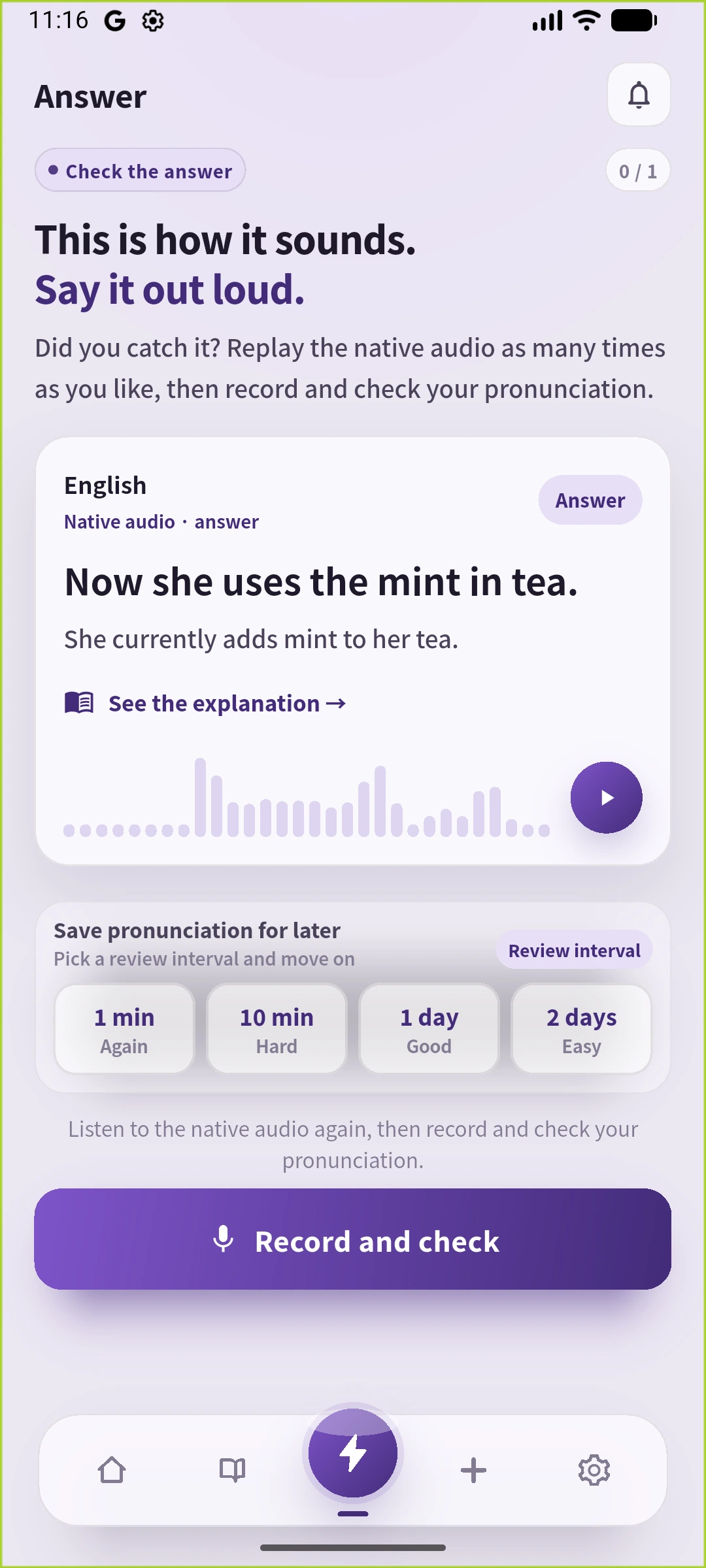
Native audio is the interface label for reference audio; this example is AI-generated rather than a human recording. We also saw the Record and check pronunciation entry, but did not submit a recording or inspect an assessment result. Record and compare your whole retelling using your own recording tool, as described above. This is not a claim that SpeakGain summarizes, evaluates or scores a retelling.
Classroom time limits and an independent practice plan
Check the speaking time, whether notes are allowed, required details or vocabulary, and whether an opinion is requested. Tokyo Shoseki’s examples include one-minute activities and short-memo conditions, but these are examples rather than universal rules.
For a 30-second assignment, include the person/problem, action and result, then time an actual recording. Here that means a small balcony, an idea from a library book, growing mint in cups and using it in tea. If time remains, add Sunday and the two cups. If it is too long, trim embellishment rather than the ending. Keep required words in the memo when permitted.
Do not rely on unusually fast speech. Choose a shorter formulation and record one complete attempt. Add an opinion only when requested, clearly separate from the source facts.
For self-study, our ten-minute suggestion is three minutes for selection/understanding, one for notes, two for the first recording, two for comparison/correction and two for another attempt. It is an editorial schedule, not a proven minimum dose. On busy days shorten the story while retaining comparison and another attempt. Later in the week, try another story of similar difficulty to check dependence on memory. See how to choose an English study method and reading English aloud for planning and preparation.
Methods we do not recommend
- Memorising the passage and declaring own-word retelling complete. Recitation or reproduction can have a separate purpose; test reconstruction with a new text. Memorising English sentences discusses that different goal.
- Reconstructing a long text whose meaning you do not understand. Shorten it and return to comprehension.
- Replacing every word with a synonym. Keep necessary names and nouns and use familiar patterns.
- Repeating without listening to the recording. Check at least one point before adding attempts.
- Writing a full first-language script and translating it word by word. Use your first language to understand meaning, then retain short cues.
What can research say about benefits?
Retelling can be used to practise retrieving and expressing understood content. Reading comprehension, vocabulary retention, speaking speed and conversational response are different outcomes; it is not evidence that this exercise alone makes someone fluent.
Kai (2008), public abstract examines narrative comprehension in intermediate and advanced Japanese learners of English and reports variation by proficiency, information importance and additional reading. We inspected the abstract and do not infer numerical gains, whole-conversation improvement or efficacy of this seven-step routine.
Kamali et al. (2020) studies 66 advanced EFL learners, target-word oral reproduction, summary writing and a reading condition, measuring vocabulary recognition and recall. Vocabulary gains were reported in the output conditions. Advanced participants, selected vocabulary and long texts differ from beginners practising this 46-word story; the study does not guarantee transfer to conversation.
Our editorial judgement is to use retelling as a check on whether you can explain understood information. Compare the ending and causal links, and use another text to separate practice familiarity from a broader ability. Do not extrapolate one change to all of your English skills.
Does this help with VERSANT or Eiken interviews?
VERSANT Part E is a related story-reconstruction task, but test practice must follow its official timing and note conditions; see VERSANT preparation. Connecting events also relates to picture narration in Eiken Grade 2, which is a different task from retelling a read passage; see Eiken Grade 2 interview preparation.
Frequently asked questions
What is the difference between reproduction and retelling?
Here, reproduction stays closer to source wording; retelling preserves content while you construct the sentences. Research and classroom labels overlap, so check the assignment.
How long should the text be?
Our starting suggestion is three to five understandable sentences, about 40–70 words. Choose a shorter text if necessary. Understanding the action and ending matters more than the count.
Can I take notes in my first language?
Yes, as initial support in self-study. Keep short cues, not a script; gradually try English cues. Follow classroom restrictions when assigned.
May I use words from the original?
Yes. Necessary nouns and useful phrases may remain. You do not have to replace every word; close the source and build from the meaning.
What if I get stuck?
Use familiar words to convey the same event. For example, She grew mint in old cups. avoids needing “pots”. Do not invent an action or ending; repair omissions afterwards.
What if the assignment has a time limit?
Include required information, record once and measure the time. Trim secondary details if needed; add source details when there is room. Avoid relying on rushed speech.
Does practising alone work?
You can check omissions and pauses alone. Research findings depend on learners and tasks; the routine does not guarantee conversational gains. Ask for feedback where your judgement is uncertain.
Can I also do shadowing that day?
Yes, with separate goals. Shadowing follows the audio; retelling stops it and reconstructs the content. Keep the workload small enough to check both.
Our verdict: speak from five clues, fix one thing, speak again
We would start with a short, understandable story, use original expressions as a bridge, then speak from five cues. Close the text and check who did what, why and with what result. Fix one thing, repeat from the same memo, then try another story on a later day.
For today’s example, write Maya / small balcony / library / cups / mint tea, hide the passage and speak. If you missed the use in tea, restore it in the next attempt. Completing a short comparison-and-correction loop is a better starting target than memorising a long passage perfectly.