
Versant preparation: current and old formats, part-by-part answers and solo practice
Published
The Versant English Speaking and Listening Test measures how well you understand spoken English and respond through short answers, repetition, retelling and opinions. Start independent preparation by checking the exact test name, then practising listen → respond immediately → record → listen back → fix one thing. Our editorial recommendation is to begin with repetition and short answers, then add timed 30-second retelling and 40-second opinions; this is a practice plan, not a score promise (official format, checked 13 October 2026).
If you also need TOEFL iBT, use TOEFL Speaking preparation to check its current repetition and interview timing and solo routines.
If an employer has invited you, the first job is to identify the product, not memorise a long model answer. This article focuses on speaking. Test facts come from Pearson and its official Japanese distributor; practice routines and answer patterns are our editorial suggestions. All English examples are original practice material, not official questions or certified high-scoring responses. For a wider study schedule, see how to study English.
For independent practice behind Part E, follow the retelling and reproduction steps with a short story, five cues and a recording comparison.
If you need DET for study abroad or admissions, check our Duolingo English Test preparation guide for its current format and speaking practice.
Which Versant test are you taking?
Read the full name in your invitation. The Japanese official site lists Speaking and Listening, Writing and Placement (4-skills). Pearson’s catalogue also includes 4-Skills Essentials and Professional English. Availability and the assigned product depend on your organisation and market. A four-skills invitation does not automatically mean the same tasks as another four-skills product.
The current Japanese Speaking and Listening page describes approximately 20 minutes and 40 questions. Pearson’s current candidate guide says 17 minutes. Follow your own invitation and on-screen instructions, allowing additional setup time. Sources checked 13 October 2026.
Current parts, question counts and response limits
This table combines the current guide and Japanese official format, checked 13 October 2026. “Manner” means Manner of Speaking.
| Part | Items | Response limit / time to start | Skills measured |
|---|---|---|---|
| A: short answer | 8 | 15 seconds; start within 6 seconds | Listening |
| B: repeat a sentence | 16 | 15 seconds; start within 6 seconds | Listening, Speaking, Manner |
| C: question about a conversation | 6 | Start within 8 seconds; total response duration not stated in the current guide | Listening |
| D: questions about a passage | 6, three per passage | Start each answer within 8 seconds; total response duration not stated in the current guide | Listening |
| E: retell a passage | 2 | 30 seconds | Listening, Speaking, Manner |
| F: give your opinion | 2 | 40 seconds | Speaking, Manner |
The 6- and 8-second deadlines concern starting, not finishing. Do not fill the missing C/D duration with a number from another product. The guide and Japanese page provide the 40-item baseline. The technical validation report gives approximate counts, including 2–3 items each for E/F, and notes that unscored trial items can alter counts. Your invitation remains the final check.
Legacy Speaking Test: do not mix the versions
The old official English Test guide has Reading 8 → Repeat 16 → Short Answers 24 → Sentence Builds 10 → Story Retelling 3 → Open Questions 2, approximately 63 items. Reading and Sentence Builds therefore identify a different format from the current Speaking and Listening baseline. The old guide labels F unscored; current F contributes to Speaking and Manner. An accessible old PDF does not prove that every market still sells that product.
The legacy validation summary distinguishes historical Versant 20–80 results from GSE 10–90. Format and reporting scale are separate changes: a 63-item test may have a GSE report. Do not infer the scale from the item count or subtract old 20–80 points from new GSE points.
If your invitation explicitly assigns the old format, use its guide. For reading, immediately read the requested sentence, record, listen back and correct one phrase boundary. For sentence builds, listen to the three phrases, immediately assemble and record a grammatical sentence, listen back and correct one subject–verb relationship. Our example is after lunch / the team / will meet → The team will meet after lunch. The common mistakes are reading the wrong sentence and adding words not supplied. Neither task replaces current C/D comprehension practice.
What does the score mean?
Current Japanese Speaking and Listening reports use GSE 10–90 for overall and subscores. The official Japanese explanation describes Speaking 50% and Listening 50% in the overall result; speaking covers content and delivery. Manner combines fluency, pronunciation and intelligibility. Pearson’s sample report shows Overall, Speaking, Listening and Manner of Speaking with ability descriptions and CEFR information.
Our reading order is: confirm product and scale; check your employer’s overall/subskill requirements and deadline; read the ability descriptions; choose one practice problem. Missing details suggest C/D practice; correct content with frequent breaks suggests reviewing B/E/F recordings. These are editorial study choices, not a way to calculate an official score from your recording. There is no universal hiring pass mark or “say this sentence for this score” rule here.
Results usually become available within minutes; the Japanese site notes that server or connection conditions can delay them for hours. An administrator may restrict access to results. Contact the inviting organisation if you cannot view yours (official FAQ, checked 13 October 2026).
A solo routine: first answer once, then make one correction
Hide the answer before the first attempt. Keep first-listen performance separate from a response you have memorised after repeated listening. The following is our practice routine, not an official study-time requirement.
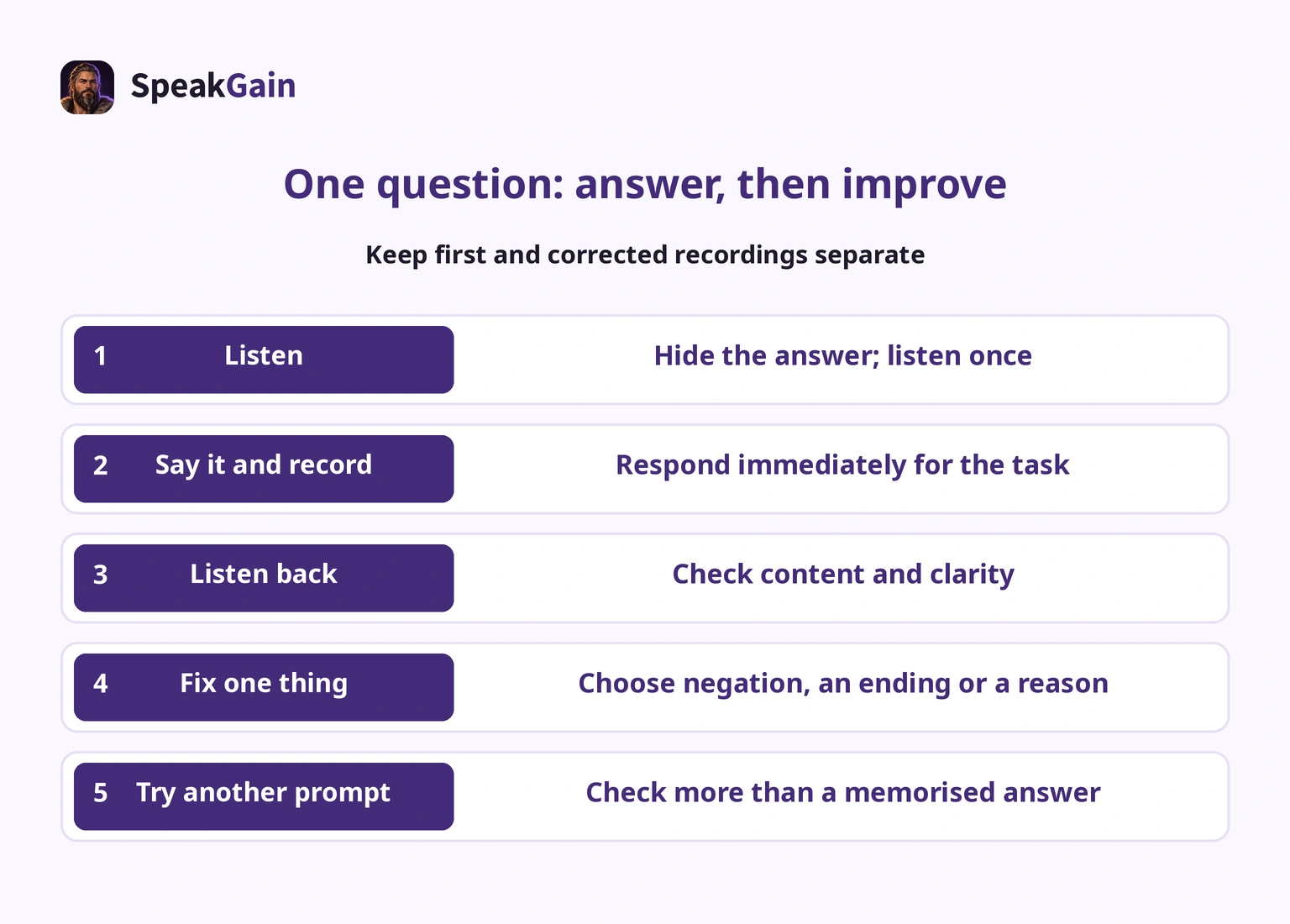
- Listen once to a short source whose accurate transcript you can check. Use the official guide and demo to learn the assigned format.
- Respond immediately in the appropriate way while recording: short answer, exact repetition, retelling or opinion.
- Compare the recording with the source. Separate inaccurate content from speech that is hard to follow.
- Fix one omission, tense, phrase boundary or reason; make another recording.
- Try a different prompt to check transfer rather than memorisation.
A device’s ordinary recorder is enough for this independent routine. Corrections happen after practice, whereas the actual test only moves forward and does not permit rerecording. The guide recommends normal speed and volume. Filling time by rushing is not the practice goal.
Part A: give the requested word or short phrase
Task: hear a short question and answer with a word or short phrase; this is a Listening task (guide).
Our tip and example: identify whether the question asks when, where, what or which. Do you use an umbrella on a rainy day or a sunny day? → A rainy day. A long introductory phrase adds nothing to the requested choice.
Solo practice: listen to the question → answer immediately and record → listen to both → fix one misheard question word. Change the question type next time. Shuffle self-made questions and use them later, so you are not merely recalling the answer you just wrote.
Common mistakes: answering after hearing only the first noun, missing negation/comparison, or adding a long reason to a short-answer task. Check relevance before length.
Part B: keep the sentence, rather than paraphrasing it
Task: repeat the sentence you hear. The official guide also encourages attention to rhythm, pauses and intonation.
Our tip and example: hear The meeting starts after lunch. as The meeting starts / after lunch. The slash marks a practice chunk; do not say it. Changing the sentence to The meeting started before lunch. alters both tense and the time relationship.
Solo practice: listen once → immediately repeat without looking, recording your answer → compare source and recording → correct one missing word or ending → try another sentence. Start with short sentences and check negation, tense and prepositions before increasing length.
Dictation can diagnose a listening gap during the correction stage, but finish by repeating aloud. Shadowing can help examine rhythm; speaking alongside audio and reproducing a sentence after it ends are different checks.
Common mistakes: inventing plausible words for an unheard section, stressing every word equally, and restarting the opening until the ending is lost. We do not recommend training yourself to fill gaps with guesses: check the transcript after the attempt and choose one listening target.
Part C: match the answer to the conversation question
Task: hear a two-person conversation and answer a question with a few words or a short sentence.
Our tip and example: The room is too noisy. → Let’s meet in the library instead. For Where will they meet?, answer In the library. Distinguish the initial problem from the final decision.
Solo practice: listen to conversation and question → answer immediately and record → listen back → correct one detail corresponding to the question. Next time ask Why…? or When…? about the same kind of scene.
Common mistakes: giving the first location mentioned, confusing a suggestion with a decision, and deciding an answer before hearing the question. Words such as instead, but and actually can signal a change; follow the information after them.
Part D: answer the three passage questions separately
Task: hear a passage, then answer three questions about it. D requires short comprehension answers; E requires your own reconstruction of the passage.
Our tip and example: track the situation, action and result. Nora missed her bus. She called her colleague. Her colleague picked her up. For What did Nora do after missing the bus?, answer She called her colleague. The final pickup is not the answer to the intermediate-action question.
Solo practice: hear passage and questions → immediately record each short answer → compare all three with the passage → fix one sequence, person or reason. Self-made questions should have answers supported by the text; change their order on a later day. Use official samples to check real task length and difficulty.
Common mistakes: continuing too long on the first answer, confusing pronoun references, and inventing a reason absent from the passage. Do not give the same summary to all three questions.
Part E: retell the relationships in 30 seconds
Task: retell the passage in your own words. Official guidance highlights people, places, events and outcome, using complete grammatical sentences.
Our tip and example: begin with person/situation → action → result, then retain relevant details you heard. Nora missed the bus, so she called a colleague. The colleague gave her a ride. This is a minimal relationship example, not a complete 30-second certified answer. Retain more supported detail when practising a longer passage.
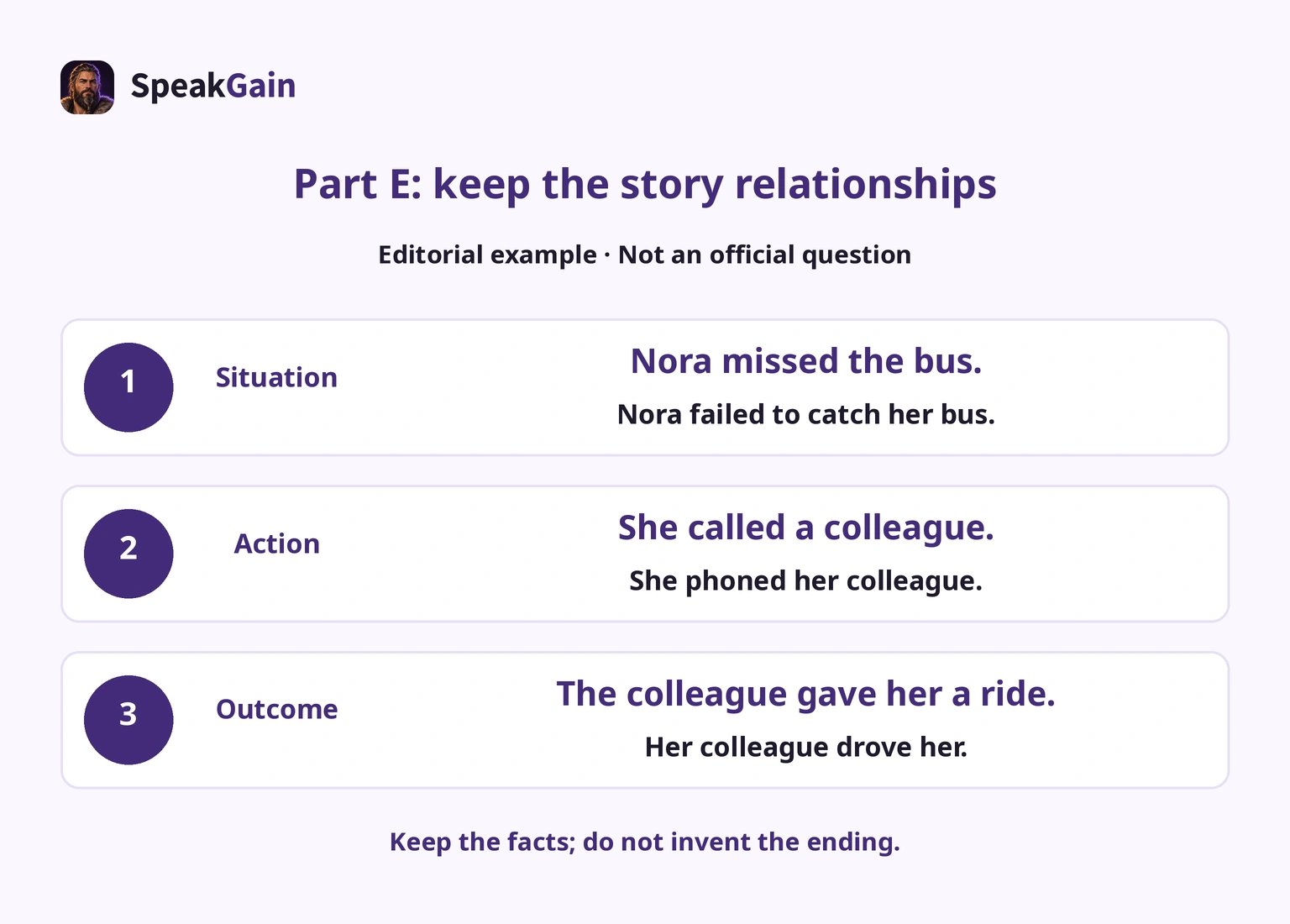
Solo practice: listen once → immediately record a retelling within 30 seconds → listen to source and recording → fix one missing action or outcome. Do not write a full script before the first attempt. Use keywords only during correction, hide them for the next recording, and finish with a different passage.
Common mistakes: becoming silent while retrieving every name, changing the sequence, and inventing an ending. Connect actions in sentences; adding personal reactions to fill time is not retelling.
Part F: state your position, then explain it in 40 seconds
Task: answer an opinion/ideas question with detail. Current F is scored for Speaking and Manner; the old unscored Open Questions rule does not apply.
Our tip and example: answer → reason → example. Do you prefer short meetings or long meetings? Why? → I prefer a short meeting because everyone can stay focused. Then: For example, we can discuss one problem and decide the next step. This is a short original pattern, not a score-bearing model answer. If the actual question asks for two advantages and two disadvantages, that instruction takes priority over our pattern.
Solo practice: listen to the question → respond immediately and record within 40 seconds → listen back for a reason supporting the position → fix one reason or example → try a new question or opposite position. Use English you can produce, rather than translating a finished long essay before reading it.
Common mistakes: spending time on a memorised introduction, repeating a position without support, and reciting unrelated answers. We recommend practising a flexible reason, not memorising long model responses.
Revisit one short reason with SpeakGain
SpeakGain can help you save and revisit the opening line of an opinion. We saved the original sentence below through the normal Add flow. On the device, opening the library card and starting its lesson led to Listening: the English sentence was hidden while audio played. Reveal answer then opened Answer.
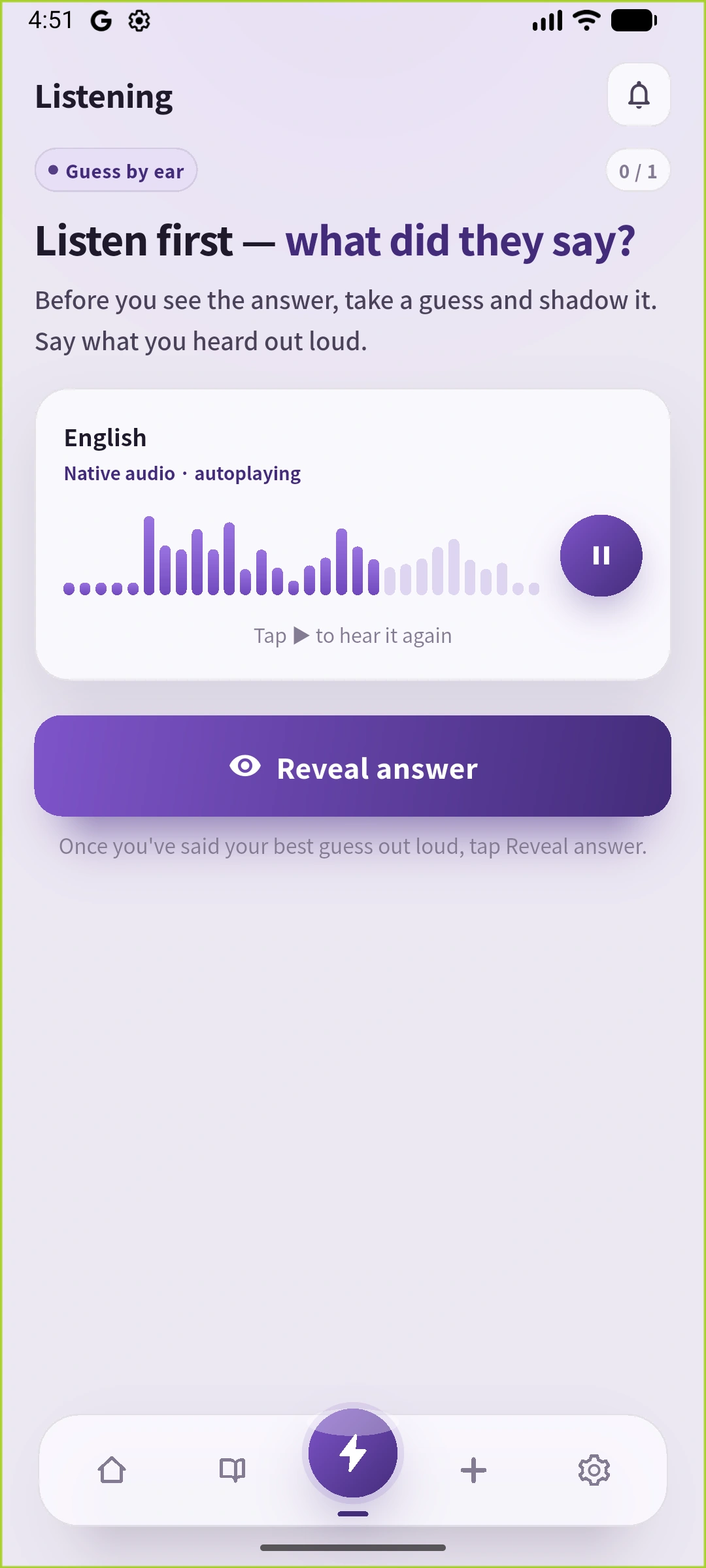
Answer showed the same sentence, an English explanation, replay and the Again, Hard, Good and Easy review choices. Record and check was visible, but tapping it did not start recording in this environment. Use your device’s ordinary recorder to record and listen back to your own responses.
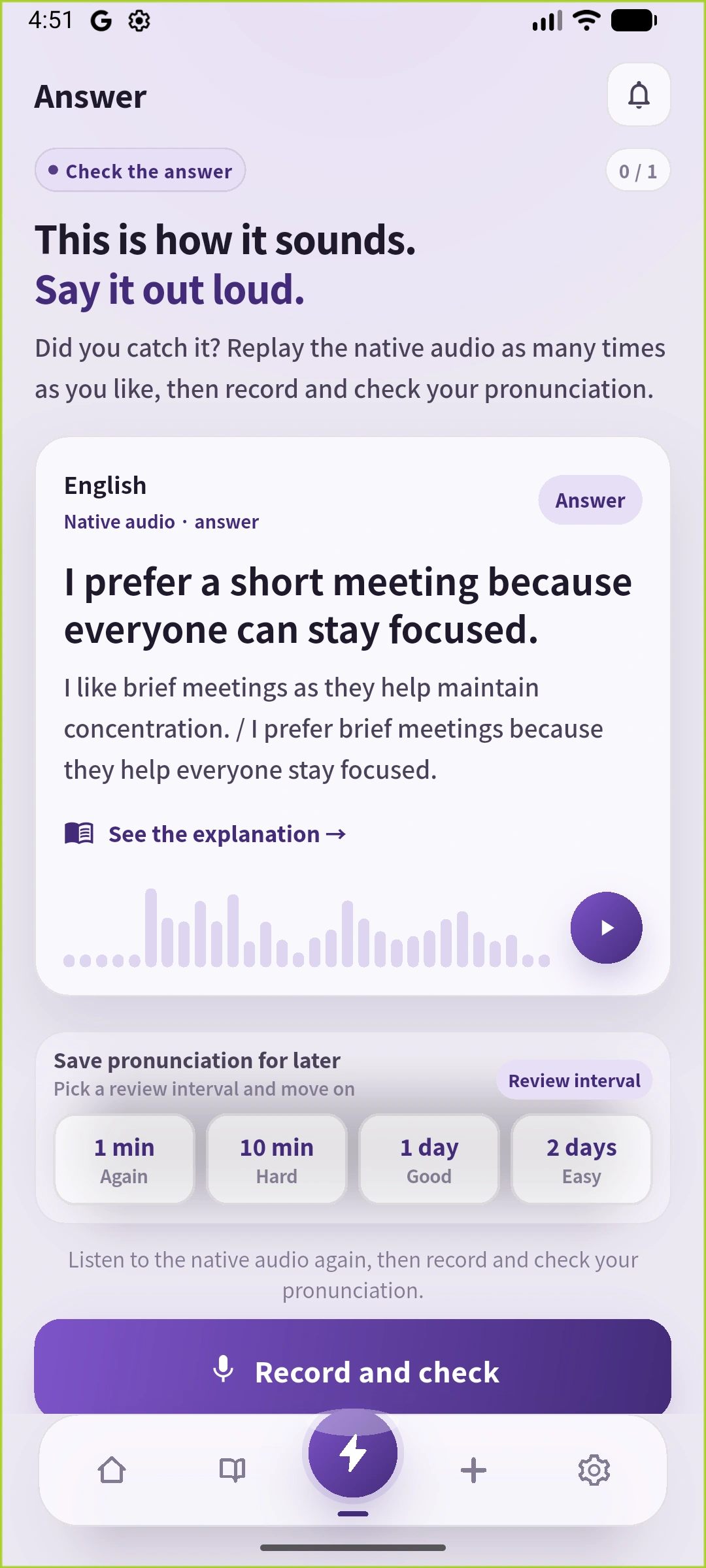
I prefer a short meeting because everyone can stay focused. — An opening position followed by a reason about keeping the group focused.
This clip is a short reason to practise, not a complete 40-second opinion answer, a human recording or an official question. We use only the saving, replay, answer reveal and review controls verified here; SpeakGain is not presented as a Versant mock test, scoring tool or speech evaluator.
A practice plan before the test
Four weeks is an editorial scheduling example, not a required period or predicted score gain. Start with a recording and adjust the allocation to your current needs.
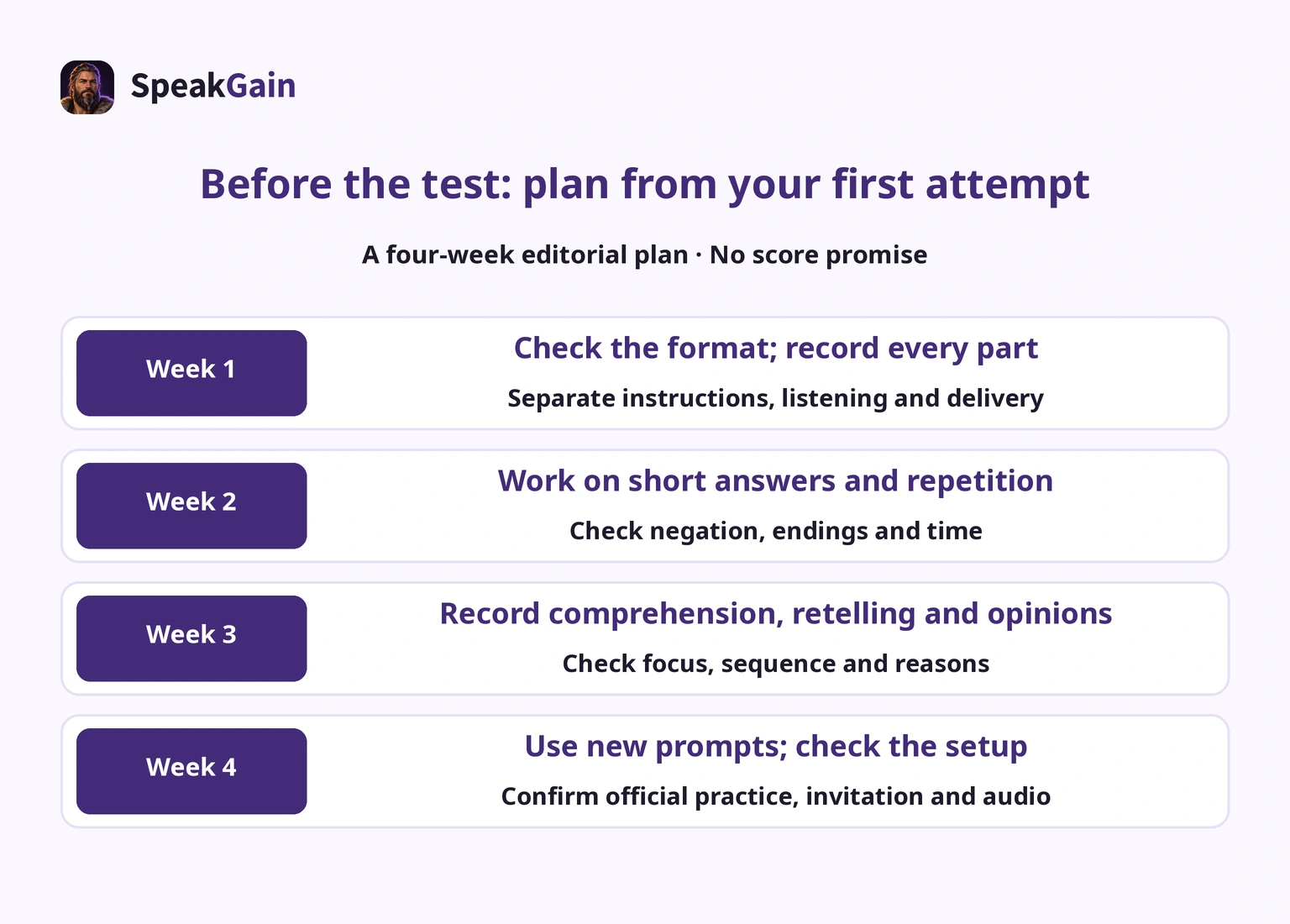
| Stage | Practice | What to check |
|---|---|---|
| Week 1 | Exact product, official sample, one attempt at every part | Separate instruction errors, listening gaps and broken delivery |
| Week 2 | Short answers and repetition, one correction at a time | Preserve negation/endings/time relationships without seeing answers |
| Week 3 | C/D details, E 30 seconds, F 40 seconds | Answer the question, retain sequence and connect reasons |
| Week 4 | Unseen prompts, official practice flow, equipment check | Work once without restarting; confirm invitation and audio setup |
For a 20-minute session, try 8 minutes of short answers/repetition,7 minutes on E or F, and 5 minutes of listening back and one correction. Shorten the session if needed; carry a correction into tomorrow instead of counting completed questions. With one week left, choose two observed problems rather than compressing four weeks of volume. Check setup the day before instead of adding a large new phrase bank.
TOEIC Speaking preparation and IELTS Speaking preparation cover different tasks and assessment settings. Reason-and-example practice can transfer, but their timing, preparation rules and scoring do not become Versant rules.
Home-test checklist: use official requirements
Your invitation determines the permitted method. The current guide lists the following (checked 13 October 2026):
- Test instructions and a Test Identification Number from the administrator.
- A computer with an up-to-date browser, or a smartphone using the official app, as permitted.
- A good internet connection.
- A headset with a microphone boom; check its connection and audio input.
- A quiet room without interruptions; loud fans or air-conditioning can interfere.
- The opening system checks to confirm audio, microphone and recording work.
- Normal speaking speed and volume, avoiding shouting or whispering.
- Advance instructions if remote monitoring is assigned.
Check detailed OS/browser requirements through Pearson’s system requirements and your invitation. We do not invent a universal camera rule, bandwidth minimum or headset restriction here. Once started, a TIN cannot be used again; do not start the real test merely to experiment with equipment. Contact your administrator if something goes wrong (FAQ).
Writing or four skills: use the matching guide
These six speaking parts do not complete preparation for Writing or Placement. Find the exact product in the official guide list. Separate typed tasks from spoken tasks. Our writing practice suggestion is to complete one timed attempt, then correct one content omission, grammar point or spelling error. Repetition and written passage reconstruction are not interchangeable, and the speaking examples here are not official Writing answers.
Frequently asked questions
Can I prepare alone?
Yes, you can learn the format and record short answers, repetition, retelling and opinions. Use official samples and compare first and corrected recordings. That does not let you calculate your official score or predict a completion date.
How many weeks do I need?
It depends on your starting ability and purpose. Our four-week plan is an allocation example. Try every part first, separate listening and speaking problems, then prioritise within the days available.
What is a good score or pass mark?
Ask the recipient which product, scale, overall and subskill conditions it requires. Current Japanese Speaking and Listening uses GSE 10–90 with ability descriptions. Do not manufacture a hiring threshold from old 20–80 guidance or unofficial TOEIC conversions.
How is it different from TOEIC?
TOEIC L&R measures listening and reading; the Versant product discussed here requires spoken responses to audio. TOEIC Speaking is another comparison. See our TOEIC Speaking article and do not convert points between them.
What do I need at home?
The guide lists administrator instructions/TIN, a permitted device, internet, a boom-mic headset, a quiet room and audio checks. Confirm delivery and any additional requirements in your own invitation.
How often can I retake it?
A started TIN cannot be reused. Ask the administrator or seller about another test, deadlines and permitted attempts. There is no universal unlimited-retake rule for employer selection in this article.
Is there an official mock? Can SpeakGain score it?
Pearson offers an official demo and paid practice tests. The Japanese app sample is unscored. SpeakGain is not presented as a Versant mock, scoring system, speech evaluator or conversion tool. Choose official material matching your assigned product when you need format and score information.
Is a longer answer always better?
No. A/C/D request brief answers; E requires retelling, F opinions with detail. Match the task rather than fill every available second.
Editorial verdict
We would confirm the product → record one attempt at every part → correct the weakest task → try a different prompt. Make a repetition sentence and a reasoned opinion available without looking before collecting a huge phrase bank. Short answers, exact repetition, factual retelling and supported opinions need different responses. Long-answer memorisation, invented listening gaps and unofficial score conversions are not our recommended preparation.
Official facts were checked 13 October 2026 using the current/legacy guides, Japanese format page, validation report and official preparation/FAQ linked above. Versant is a Pearson trademark. These examples and illustrations are independently authored editorial material, not official Pearson or distributor preparation resources.
If a Japanese employer asks you to take PROGOS, our PROGOS preparation guide explains the official format and CEFR result labels, then shows solo practice for workplace answers.