
PROGOS preparation: format, CEFR results and business answers
Published
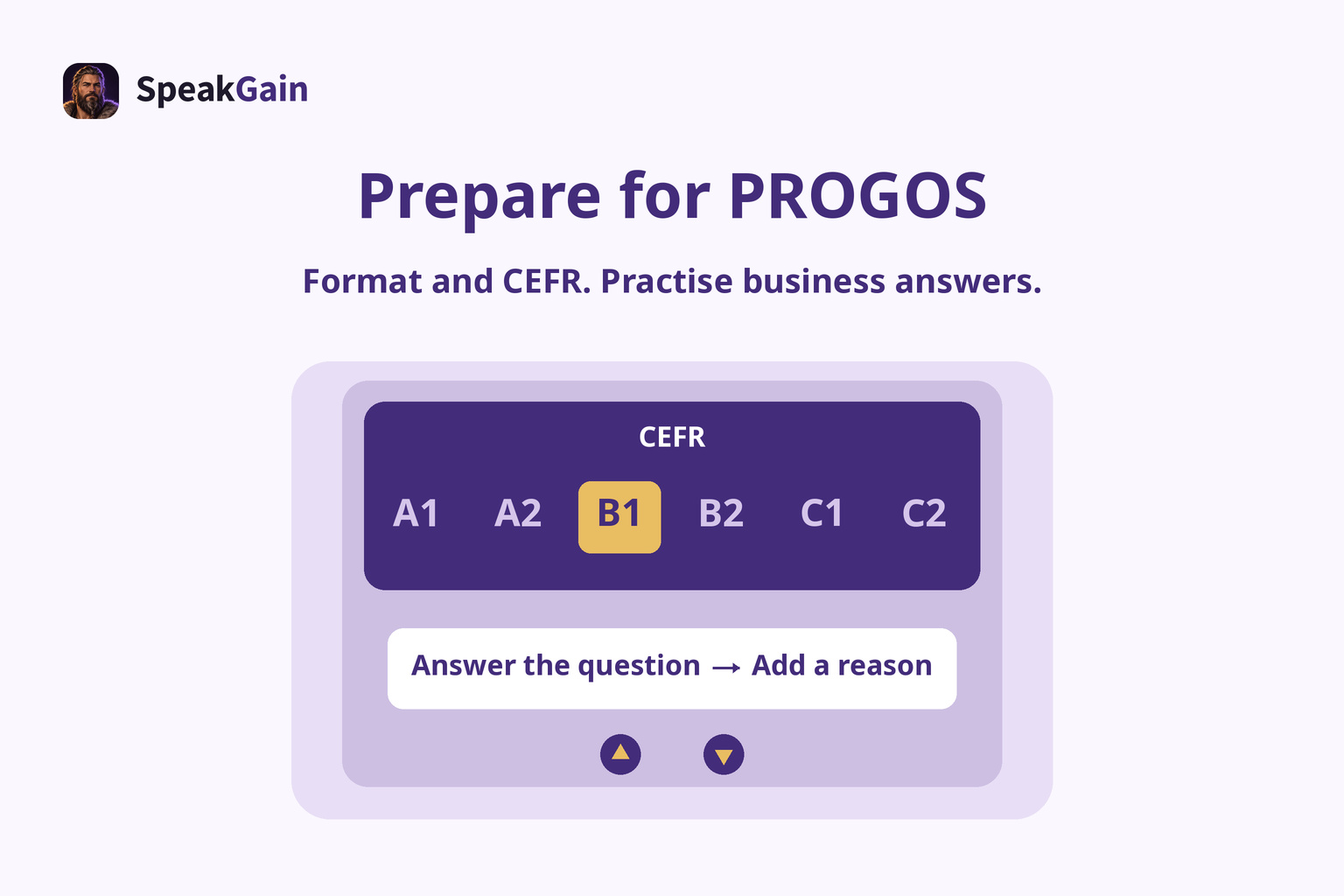
PROGOS is an AI-scored test of speaking in business situations. Its official manual reports an overall result in nine bands, from Pre-A1 to B2 High and above, combining the quality of speech with task achievement and how adequately the answer addresses the question. Start with the official samples, then record a short workplace answer and revise one point. Official overview; result explanation, checked 14 October 2026.
If a Japanese employer asks you to take PROGOS for training, recruitment or promotion, first confirm the invitation, deadline and result they accept. The examples and three-week plan below are our editorial exercises, not official questions or certified answers.
Format: five parts in about 20 minutes
The official test flow describes about 20 minutes of testing; login, registration and equipment checks need additional time. The current official samples, linked from the test-taker manual, specify the following.
| Part | Task | Questions or responses | Preparation | Response |
|---|---|---|---|---|
| 1 | Interview: answer spoken questions | 10 | None | 20 seconds each |
| 2 | Read the displayed text aloud | 8 | None | 10 seconds each |
| 3 | Presentation covering specified points | 1 | 40 seconds | 60 seconds |
| 4 | Explain a graph or graphic | 1 | 40 seconds | 60 seconds |
| 5 | Role-play: respond within a situation | One situation, four responses | Initially 40 seconds | 30 seconds per response |
The overview calls Part 5 “four questions”; the sample labels it one question including related questions, then instructs four response rounds. We distinguish the scenario from its responses. Part 1 questions are audio-only; Part 2 requires reading the displayed text. Use the official samples to experience the instructions. We do not reproduce their questions.
CEFR and the official PROGOS labels
The general CEFR scale and PROGOS’s reporting bands are different. This short table summarizes the Council of Europe Global Scale, particularly speaking; it is not an employer’s pass requirement.
| General CEFR level | Brief description |
|---|---|
| A1 | Basic exchanges about familiar matters when the other person speaks slowly and helps |
| A2 | Simple, direct information exchange in familiar routine tasks |
| B1 | Connected explanations of familiar topics, with brief reasons for opinions or plans |
| B2 | Clear, detailed explanations across topics; viewpoints including advantages and disadvantages |
| C1 | Fluent, flexible language for professional and other purposes without much obvious searching |
| C2 | Fluent, precise expression, including fine differences of meaning in complex situations |
PROGOS’s nine overall labels are Pre-A1, A1, A1 High, A2, A2 High, B1, B1 High, B2, B2 High and above. These are shown in the official level explanation and its supporting test-taker material. A generic CEFR A1–C2 row in our illustration is not a PROGOS score screen. Its highest result label does not separately certify C1 or C2.
The six categories are Range, Accuracy, Fluency, Interaction, Coherence and Phonology. The official explanation and feedback manual describe category results and learning advice. Overall results also account for achievement and answer adequacy; do not average the categories yourself. The Web manual describes five category bands, but its upper-label wording differs from the same site’s PDF. Read the labels actually shown on your report. Exact weights and the calculation formula are not stated in the checked official pages.
Our suggestion: turn one weak category into a specific recording check. “I switched to present tense while describing yesterday” is more actionable than repeatedly staring at a level. This is self-review, not a way to predict the next result.
Part 1: answer the question in your first sentence
Required: respond to a spoken question; the official sample describes adequacy and overall answer quality. Our structure: direct answer, then a relevant reason or detail. Our original prompt is What is your team’s priority this quarter?
Our main goal this quarter is to reduce delivery delays. We plan to check each order earlier so we can spot problems before shipping.
The first sentence identifies the goal; the next explains the method. Solo practice: make five questions about work, plans, choices and reasons. Start speaking without drafting a script, stop at 20 seconds, listen and revise one sentence. Shuffle the questions tomorrow. Common mistakes: a long introduction; explaining your job when asked for a date; repeating an opinion when asked why. Check whether the first sentence answers the actual question.
Part 2: preserve the text and its meaning
Required: read the displayed sentence, not a paraphrase or an opinion. Our reading approach: understand the action and its relationship to the rest of the sentence. Original practice text:
Please confirm the delivery date before you contact the customer.
The action is confirming the date; before establishes the order. Solo practice: display a short work message, read it within ten seconds, compare the recording with the text and correct an omitted word or ending. Then use a new sentence. Common mistakes: rushing with equal emphasis on every word or dropping before, which changes the instruction. Practising isolated words should lead back to the whole sentence.
Part 3: allocate the required points before speaking
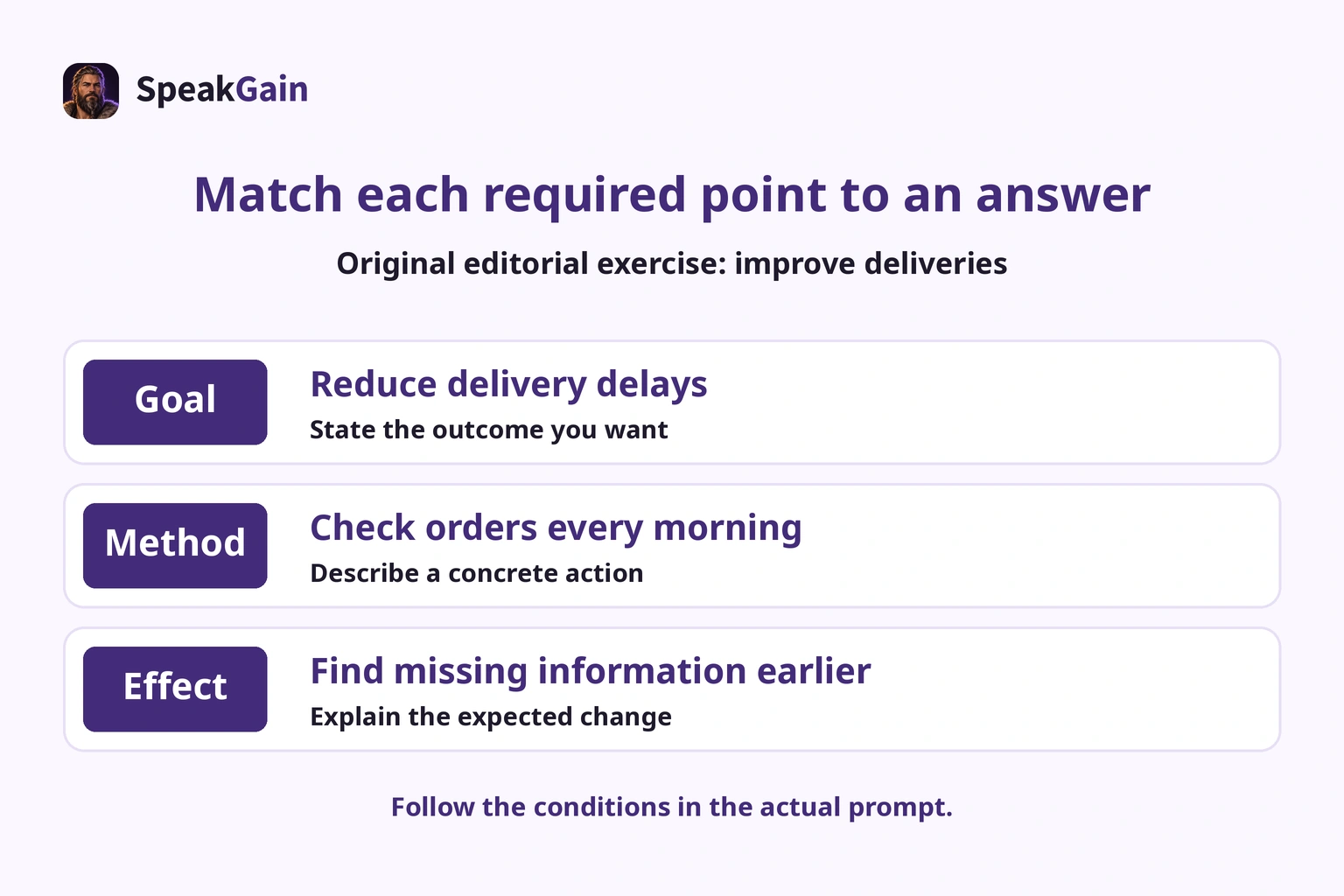
Required: cover the assigned topic and conditions. The official sample specifies three points. Our structure: introduce the topic, address each requested point, then close if useful. Our original exercise asks for a delivery-improvement proposal’s goal, method and expected effect.
Our main goal this quarter is to reduce delivery delays. First, we will check orders every morning. This should help us find missing information earlier and give customers more reliable updates.
This is a short outline, not a complete 60-second answer. Add relevant details only after covering the conditions.
Solo practice: take 40 seconds to assign one keyword to each condition, then record up to 60 seconds. Tick off the points while listening. Change the topic next time. Common mistakes: spending the whole answer on the first point; writing a long script during preparation. We favour a short content map. For broader work presentations, see presenting in English.
Part 4: separate visible facts from explanations you invent
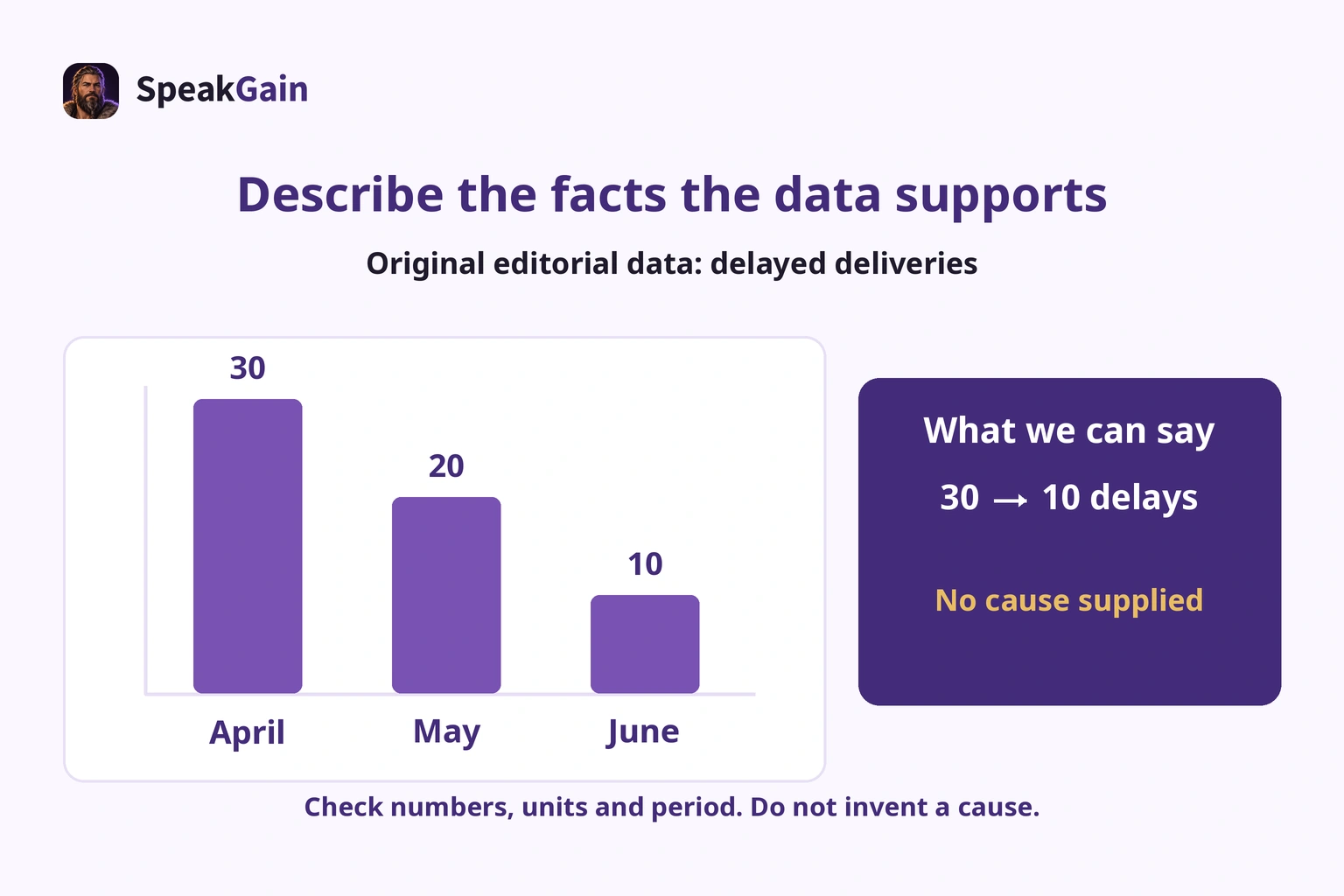
Required: explain information in a graph or graphic. Our structure: subject, main comparison or change, numerical detail, overall summary. Our original data shows delayed deliveries: April 30, May 20, June 10. No cause is supplied.
The chart shows the number of delayed deliveries from April to June. The number fell from thirty to ten. June had the fewest delays.
Solo practice: use a small non-confidential chart you made. Check title, units, period and main differences in 40 seconds, then record within 60. Match every spoken number to the chart. Change one value and repeat. Common mistakes: listing numbers without comparison, changing counts into percentages or claiming a new system caused the decrease when the data does not say so.
Part 5: respond to the latest question
Required: participate in the role-play rather than deliver one uninterrupted speech. Our structure: answer the other person’s question, then explain or specify. In our exercise, colleagues discuss how to contact a customer about a delay.
I suggest calling the customer first. We can explain the delay and agree on a new delivery date.
If asked why, a relevant next answer is A call lets us answer their questions immediately. Solo practice: create questions about the proposal, reason, alternative and next action. After preparation, answer each within 30 seconds. These are editorial question types, not an official sequence. Common mistakes: repeating the first proposal when asked for an alternative, or ignoring a new constraint. Extend this practice with speaking up in English meetings.
Listen to one workplace sentence with SpeakGain
Use the sentence from Parts 1 and 3 as a short practice unit before building a longer answer. On the device, we saved it through Create, opened the card from Library and selected Learn this card in Knowledge. Listening played audio while hiding the sentence. Reveal answer opened Answer, showing the same sentence and a generated explanation. Answer also displayed an audio button and the Again, Hard, Good and Easy review-interval choices.
The clip below is AI-generated Viking audio made from this sentence, not a human native-speaker recording or official PROGOS audio. Despite the audio label visible in the app, the clip used here is AI-generated. Listen, say the sentence without reading, then add your own reason.
Our main goal this quarter is to reduce delivery delays.
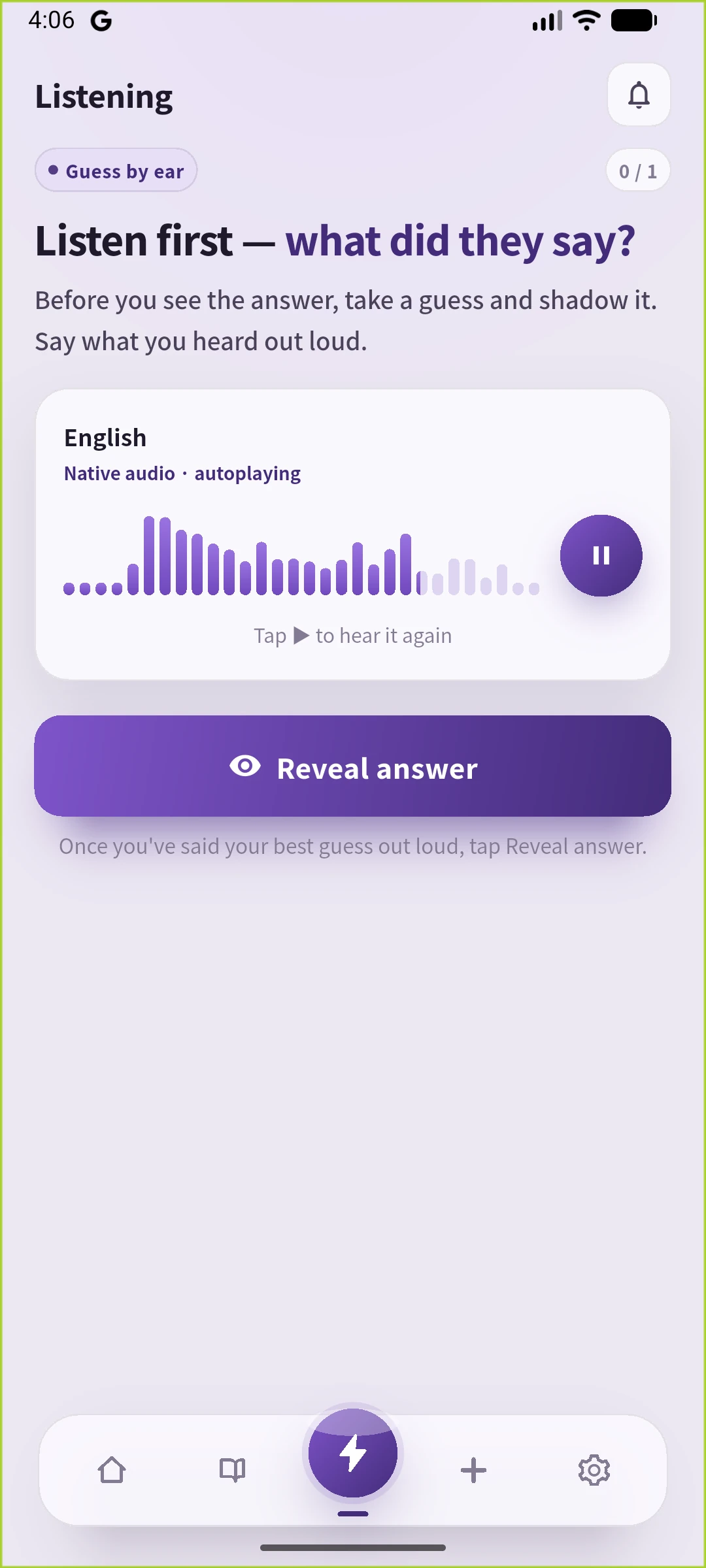
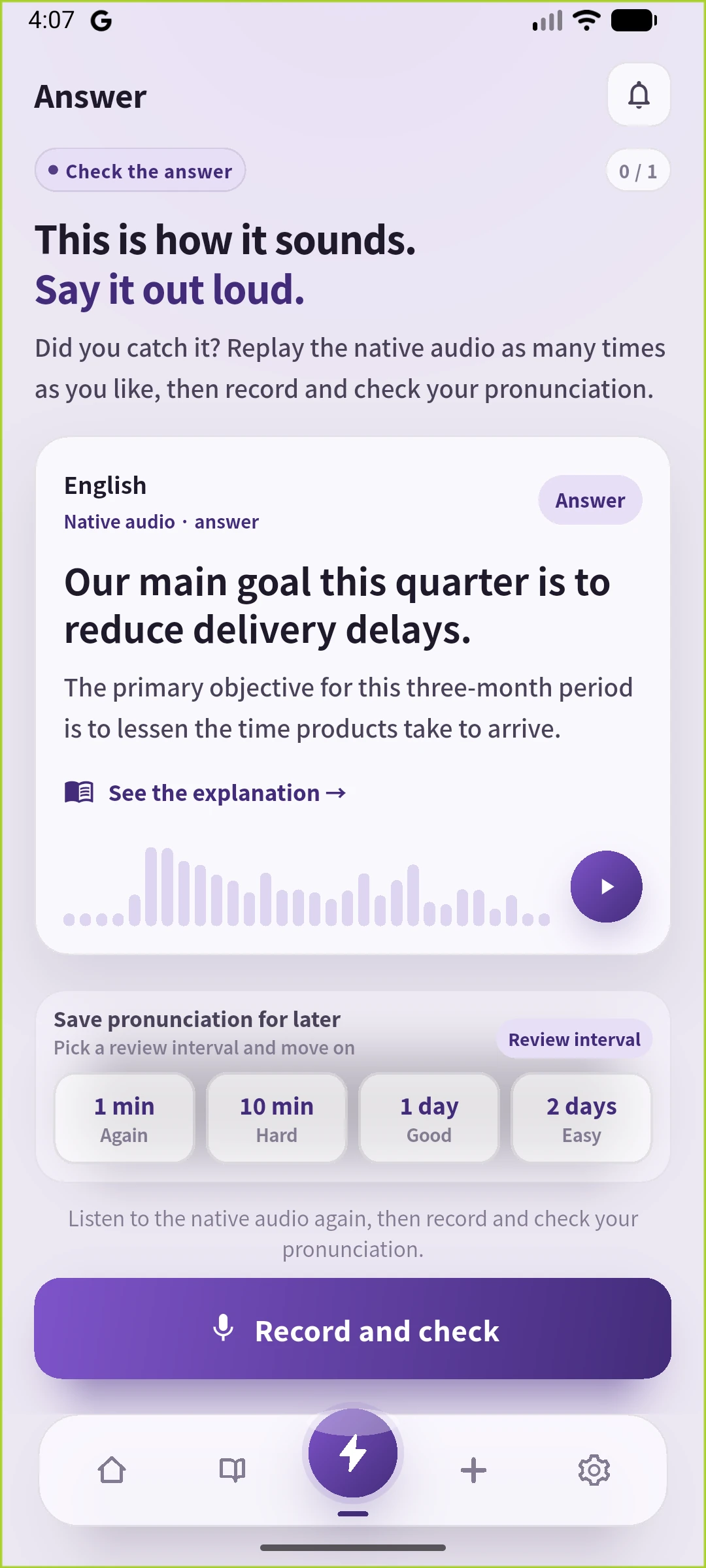
We verified saving one sentence, listening and revealing the answer. We do not use SpeakGain as a PROGOS mock test, answer or pronunciation scorer, or CEFR judge. Practise timed answers for each part and review your own recordings separately using the steps in this article.
Review content first; practise for 15 minutes a day
Listen for an answer to the question, coverage of conditions and facts, then the link between reasons and conclusions, then unclear speech. Choose one correction: move the answer forward, fix a verb, or add a unit. Keep both recordings. This is an editorial review order, not the scoring algorithm. Record only your own exercises: the official FAQ permits notes but prohibits copying or recording test questions. See solo speaking practice.
| Week | Focus | Check before moving on |
|---|---|---|
| 1 | Official format; Parts 1–2; one original exercise for every part | Distinguish a wrong focus, omitted word and missing condition |
| 2 | Parts 3–4: organize conditions and visible facts | Cover points and avoid invented causes |
| 3 | Part 5 and weak tasks; new prompts; equipment checks | Respond to changed questions within the time limit |
Daily allocation: 2 minutes checking the task, 5 speaking and recording, 5 listening, 3 correcting and recording again. On Parts 3–4 days, keep preparation and answer timers separate.
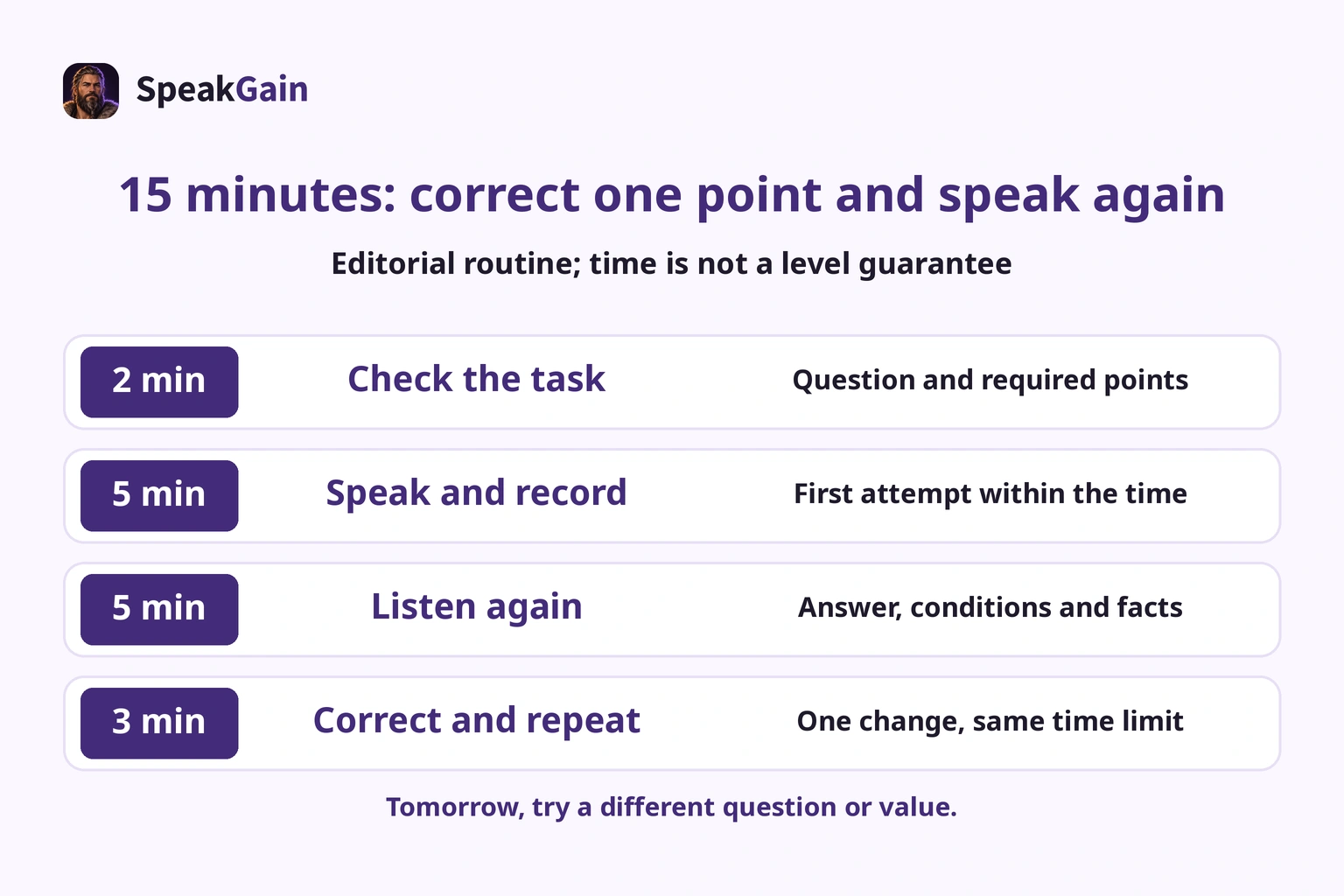
Three weeks is a scheduling example, not a promise of B1 or B2. With one week left, choose two problems from the first recording instead of compressing the whole plan.
Methods we do not recommend
We do not recommend memorizing long model answers: changed questions can make them irrelevant. Nor do we recommend filling a template without checking the task: reading aloud requires the given text, while chart explanations must preserve facts. Avoid unrelated speech merely to fill time. The guidelines encourage speaking, but the FAQ warns that irrelevant answers may prevent correct scoring. Learn short reusable phrases, then change the content to fit the question. Do not use unofficial score conversions to decide whether an employer’s condition is met.
Taking the test: invitation, device, fees and interruptions
The corporate flow uses an organization URL, an emailed access code, test selection, registration and checks. Results are accessed through history after notification; organization settings may prevent test-taker viewing. The current environment list supports PC, smartphone and tablet for automatic scoring; online monitoring is PC-based, with additional camera/headset requirements. Check your actual invitation and supported browser/OS. System checks include browser, microphone and speaker; permissions and company network restrictions can interfere. A quiet, interruption-free place is our practical suggestion; a numerical room-noise threshold is not stated in the checked official pages.
The officially linked individual-app page says the app is free and plans paid conversion at an unspecified date. Corporate conditions differ. The overview itself lists ¥550 in its FAQ and ¥1,100 in its fee section: we do not choose one as the definitive charge. Confirm the application terms. The 2022 app announcement describes one free attempt per day for the time being, subject to change; a clear current daily allowance is not stated on the checked current landing page. Personal practice results are not automatically accepted in place of a company-requested test.
The guidelines specify no pause, audio once and timed progression. The FAQ distinguishes restarting an interrupted part from retaking a completed attempt: retakes are generally disallowed, with recognized operator-fault exceptions. Do not assume unlimited retries.
Compare the requirement, not unofficial conversions
| Test | Official time used here | Result display |
|---|---|---|
| PROGOS automatic scoring | About 20 minutes | Nine overall bands and six categories |
| TOEIC Speaking | About 20 minutes | 0–200 |
| Versant Speaking and Listening | 17 minutes in Pearson’s guide | GSE 10–90 |
Sources: PROGOS flow/results, IIBC, Pearson guide/Japanese score explanation. Follow the employer’s accepted test. For different tasks, use our TOEIC Speaking guide and Versant guide; do not transfer their timing or assume equivalent results.
FAQ
How long does PROGOS take?
About 20 minutes of testing, plus setup. Official flow.
Is it free? Can I take it on a phone?
The individual-app page currently says free, with paid conversion planned. Corporate tests have separate conditions. Automatic scoring supports phones; online monitoring is PC-based. App; environment.
How often can I retake it?
There is no universal unlimited-retry rule in the inspected pages. Corporate interruption recovery and retake restrictions are separate. Confirm the invitation and contact your administrator after problems. FAQ.
What is the difference between B1 and B2?
In general CEFR terms, B1 connects familiar explanations with brief reasons; B2 adds clear detail and explains options’ advantages and disadvantages. A memorized answer does not establish either level. Council of Europe.
What level is required for promotion, or should I take TOEIC Speaking instead?
Ask the employer which test, result and deadline they accept. We do not impose a universal pass condition or convert between results. IIBC; PROGOS results.
Can I prepare alone?
Yes: practise original questions, timed speaking and one-point recording revisions. Self-review does not supply official scoring or a CEFR judgment.
Editorial verdict
We would verify the current format, make a first recording and use 15 minutes a day to correct one concrete problem. Prioritize answering the question, satisfying conditions, reporting chart facts and responding to the next turn. Then change the prompt to test whether the skill transfers. Choose practice that defines tomorrow’s check, rather than a shortcut promising a level or promotion.
All official format, administration and assessment sources below were inspected 14 October 2026. Our examples and graphics are independent editorial material.