
TOEIC Speaking preparation: answer patterns and solo practice for all five tasks
Published Updated
TOEIC® Speaking tests spoken English through five task types, 11 questions and about 20 minutes. To prepare independently, our editors recommend learning the timing, recording one timed answer, listening back, fixing one issue and using the same structure with a different prompt. Start with a recording of each task before choosing your timetable; the four-week example below is a planning aid, not a promise of a particular score. IIBC
For a study-abroad test, TOEFL Speaking preparation distinguishes the old four tasks from current repetition and interview practice.
For a test built around audio prompts, see Versant preparation for short answers, repetition and retelling by part.
Knowing a word in a reading exercise does not necessarily mean you can use it in a timed response. If you freeze at the microphone or run out of time halfway through a reason, decide what the question requires and which information comes first. This article covers the Speaking component of S&W; it does not compare courses or apps. Official facts and our editorial practice suggestions are identified separately, and every English example is an original exercise rather than an official question or a guaranteed high-scoring answer.
For a wider routine, see how to study English. Registration, availability, identification and test-day rules depend on the administrator in your country; Japanese public-test procedures below are explicitly limited to Japan.
If you are taking Japan’s EIKEN Pre-2 second stage, use our interview flow, answer patterns and solo practice guide to record an answer and repair one point at a time.
For TOEIC preparation specifically, our app comparison by purpose, score range and free access also explains how to combine apps with official practice books.
The five tasks and their timing
Learn preparation and response times separately. Speaking taken alone has the same format as the Speaking component of S&W. The following values were checked against IIBC and ETS on 10 October 2026. IIBC ETS
| Task and questions | Preparation | Response | Assessment focus |
|---|---|---|---|
| Read aloud: Q1–2, 2 items | 45 seconds each | 45 seconds each | Pronunciation, intonation and stress |
| Describe a picture: Q3–4, 2 items | 45 seconds each | 30 seconds each | Above, plus grammar, vocabulary and cohesion |
| Respond: Q5–7, 3 items | No preparation in IIBC’s terminology; 3-second question-to-beep gap | Q5/6: 15 seconds each; Q7: 30 seconds | Above, plus relevance and completeness |
| Use provided information: Q8–10, 3 items | 45 seconds to read; 3-second gap after each question | Q8/9: 15 seconds each; Q10: 30 seconds | All preceding criteria |
| Express an opinion: Q11, 1 item | 45 seconds | 60 seconds | All preceding criteria |
ETS calls the three-second gaps preparation, while IIBC distinguishes them from a preparation period. Do not add a longer planning period to those gaps. ETS also states that Q10 is asked twice. Use current official samples rather than assuming every older preparation resource still has the current task count or timing.
What is assessed, and what score should you aim for?
Clear pronunciation and a relevant, complete answer are separate checks. Item ratings are 0–3 for Q1–10 and 0–5 for Q11. The reported Speaking score is 0–200 in ten-point increments; this article provides no arithmetic conversion from self-assessed item ratings to that reported score. IIBC IIBC
IIBC describes the 130–150 range as including relevant responses whose reasons or explanations may be unclear, and 160–180 as generally sustaining workplace discourse despite some weaknesses that do not obstruct the message. These are range descriptors, not a universal pass mark. Confirm an employer’s or institution’s actual requirement. IIBC
Our editors would turn the requirement into observable practice goals: did you state the requested time, give a reason, and finish the sentence? Record those checks rather than guessing that today’s answer “was worth 150”.
A solo routine: record, listen, repair, transfer
Keep the first recording as well as the repaired one. A timer, a recorder and official practice material are enough to begin. IIBC recommends practising responses within the test’s time limits; the one-issue repair sequence and suggested workload here are our editorial choices. IIBC
- Answer without reading a model. Time both preparation and response, and let the recording run until the end.
- Listen for content first: is the question answered, and are the requested details or reasons present?
- Choose one issue, such as a missing reason, wrong start time or unclear important word. Write a short repair after recording if needed.
- Record the same prompt again under the same limit and compare the chosen feature.
- Change the prompt, picture or schedule. Check that you can adapt the structure rather than recite the remembered answer.
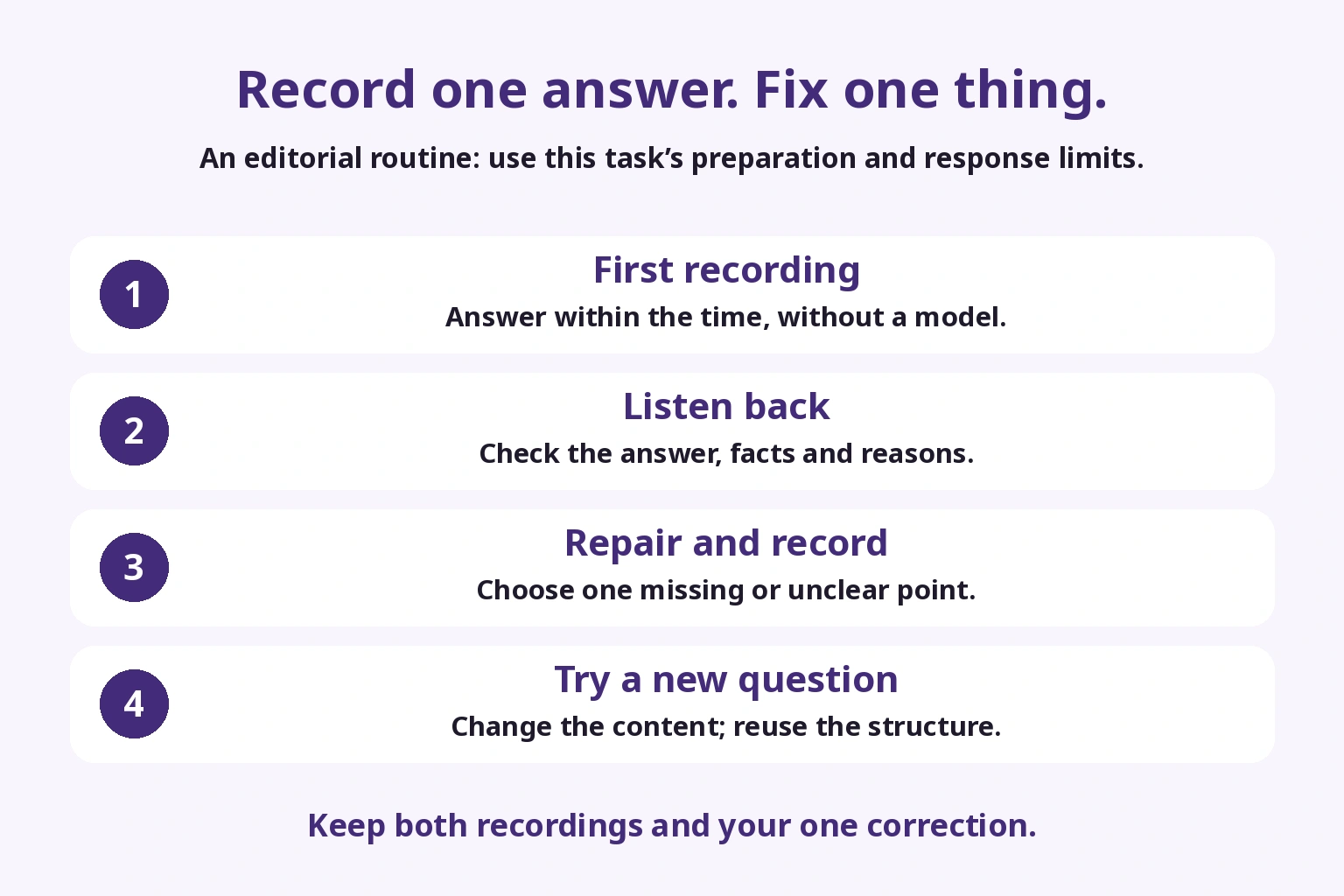
We suggest starting with 15–20 minutes and one or two questions a day. This is a manageable starting allocation, not an established optimum or a score guarantee. Save the date, prompt and one change alongside the audio.
Read aloud: deliver the written message
What you do
Read a short text after 45 seconds’ preparation, with 45 seconds to respond. Pronunciation, intonation and stress are assessed. Concentrate on conveying the words already written, rather than adding an opinion.
Our pattern and example
Use “understand the message → group by meaning → emphasise important information”. The slash indicates a practice grouping, not a compulsory long pause.
The workshop starts at nine. / Please arrive ten minutes early.
The important information is the workshop’s start time and the request to arrive early. This short example is a repair drill, not a full 45-second test text.
Practise alone
Use an official sample for a full timed attempt. During preparation, identify uncertain words and sensible groups. Record, compare with the written text, and check omissions, numbers and sentence endings. Choose one feature—perhaps the end of starts—practise it briefly, then record the whole text again. Transfer to another passage. See English pronunciation practice for repairing a sound without trying to fix everything at once.
Common mistakes
Rushing through endings, restarting the entire passage at one difficult word, or copying melody without understanding the message. Our editors fix missing words before chasing speed; a fast reading is not itself a scoring rule.
Describe a picture: whole scene, action, position
What you do
Prepare for 45 seconds and describe the picture for 30 seconds. Select visible information and make the description coherent. We recommend observable actions and positions rather than inventing feelings or events outside the image.
Our pattern and example
Use “overall scene → main person/action → one location or background detail”. Imagine two people looking at a document at a table, with a laptop beside them.
Two people are working at a table. One person is pointing at a document. There is a laptop next to them.
Change the people, actions and objects to match the actual picture. This is a short structure, not wording to impose on every image.
Practise alone
Choose a photograph you can use. In 45 seconds, select a main subject, verb and position; record for 30 seconds. Listen while looking at the photograph: can you point to each thing described, and have you kept the people consistent? Repair one verb or position, record again and try a different scene. If you keep restating the overall setting, limit that introduction to one sentence and move to an action.
Common mistakes
Listing nouns without actions, mixing up left and right, or asserting invisible motives. “Looking at a clock” is a safer observation exercise than inventing that someone is late for a meeting.
Respond to questions: answer the actual request first
What you do
Listen to a familiar-topic question and respond for 15 seconds on Q5/6 or 30 seconds on Q7. Identify whether it asks for frequency, location, preference or a reason. The three-second gap is not time to compose a long paragraph.
Our pattern and example
Use “direct answer → one useful detail”, or “choice → reason” when a reason is requested. For our practice question about how you usually commute:
I usually take the train to work. The station is close to my home.
If the question instead asks how many days you take the train, give the number of days. Fluently repeating this example would leave that request unanswered.
Practise alone
Use official question audio and reproduce the gap and response limit. For a self-made prompt, record only the question beforehand. Listen to your answer’s first sentence: does it answer the request? If you hesitate, distinguish a listening problem, an undecided idea and difficulty forming English. If the written question is easy, repair listening first; for sentence formation, try instant English composition practice, then return to the audio. Add relevant detail for a longer question without giving every answer a long introduction.
Common mistakes
Giving a preference without the requested reason, omitting frequency or spending the limit on an introduction. Do not assume a recorded test question will be repeated because you ask for clarification.
Use provided information: find the required facts
What you do
Read the information for 45 seconds, then answer each question within its limit. This task calls for facts from the material, not an invented personal schedule or opinion.
Our pattern and example
Use “requested fact → necessary addition”; if the question’s premise is wrong, use “brief correction → correct fact”. Our original practice schedule is:
| Start | Event | Room |
|---|---|---|
| 9:00 a.m. | Welcome session | Room A |
| 10:00 a.m. | Team workshop | Room B |
| 1:00 p.m. | Project discussion | Room A |
For the workshop’s time and location:
The team workshop starts at ten a.m. in Room B.
If a question incorrectly assumes nine:
Actually, it starts at ten a.m., not nine.
Use the correction only when the premise really differs from the schedule.
Practise alone
Read the headings, times and rooms under the 45-second limit. Record questions separately and vary their order. Listen to your 15- or 30-second answers while checking each required field. Repair a number, a.m./p.m. distinction or missing item; then change the schedule and answer again. For a question requiring several items, check all of them, not just the first one explained well.
Common mistakes
Reading the entire document, accepting a wrong premise, or filling in missing facts. Our editors use preparation to learn where information is located, not to memorise the entire schedule.
Express an opinion: connect a position to reasons and examples
What you do
Prepare for 45 seconds and express an opinion with reasons for 60 seconds. Choose a position early and explain it clearly. We do not treat difficult vocabulary or a fixed number of reasons as a score formula.
Our pattern and example
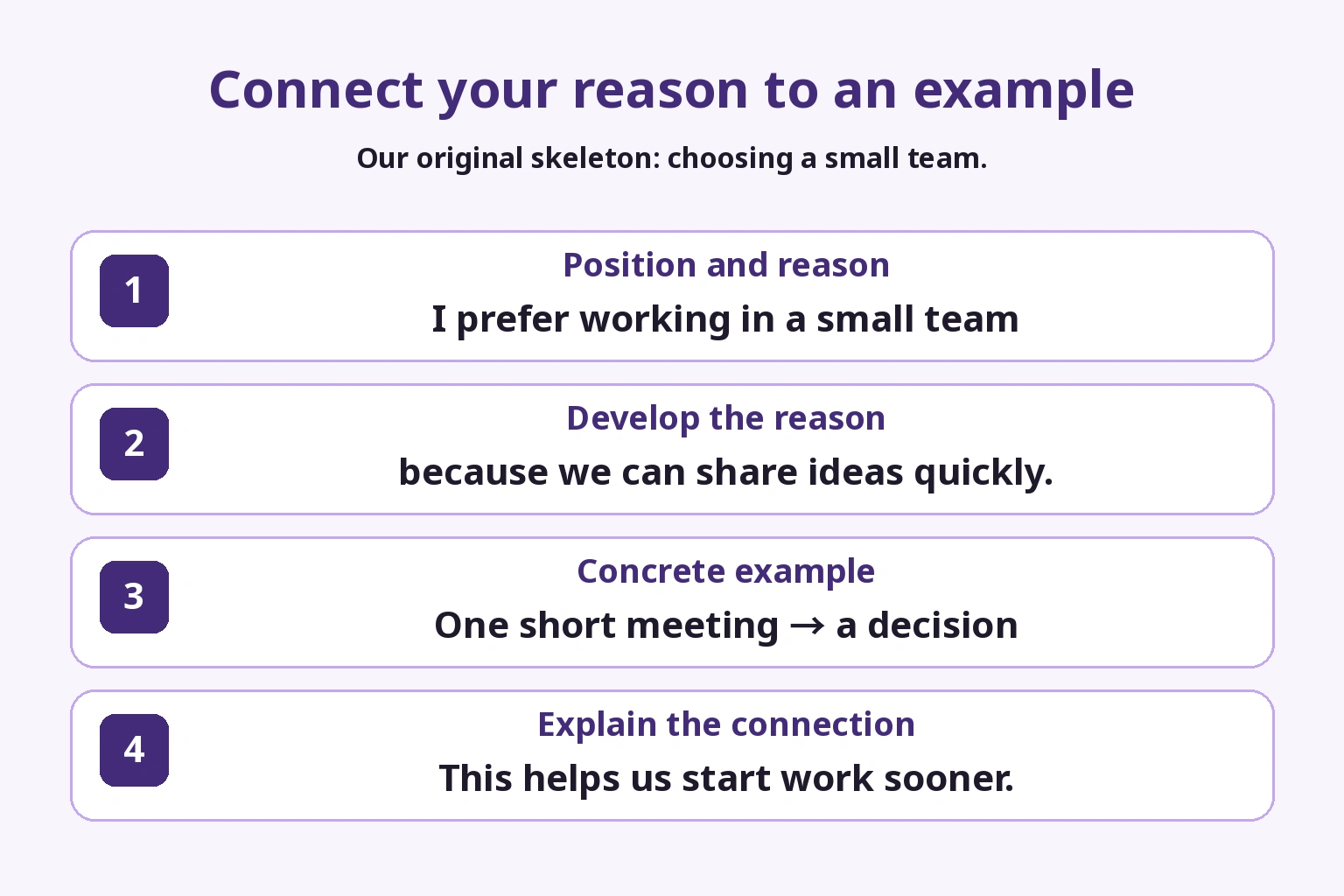
Start with “position → reason → example → how it supports the position”. Add another distinct reason and explanation if useful. For a preference between a large and small team:
I prefer working in a small team because we can share ideas quickly. For example, we can discuss a problem and make a decision in one short meeting. This helps us start work sooner.
This shows a connected argument; it is a short skeleton, not a complete 60-second answer.
Practise alone
In preparation, note the position, reason and example in a few words. Record for 60 seconds without writing a complete script first. Check whether your position changes, whether the example supports the reason and whether a sentence gets cut off. If the example is missing, add a person and action rather than more adjectives. Record again, then change the topic. If time remains, develop a reason or relevant example rather than repeating the conclusion.
Common mistakes
Trying to write a perfect script, listing two reasons without explaining either, or forcing a memorised answer onto a different question. Our editors do not recommend memorising long finished answers: fluent irrelevant content still fails the question’s purpose. For broader speaking practice see how to become able to speak English; for a mid-sentence block see what to do when English words won’t come out.
Save one useful sentence: what we verified in SpeakGain
Use this as short-sentence listening and speaking support, alongside timed whole-task recording. We created one card through normal Add with:
I prefer working in a small team because we can share ideas quickly.
The verified sequence was Library → Knowledge → Learn this card → Listening → Reveal answer → Answer. Listening hid the English while presenting model audio; Answer showed the sentence, explanation, replay, review intervals and Record and check. We tapped the recording action and reached Android’s microphone permission request, but did not verify a recorded pronunciation result. We make no claim about its accuracy or relation to a TOEIC score.
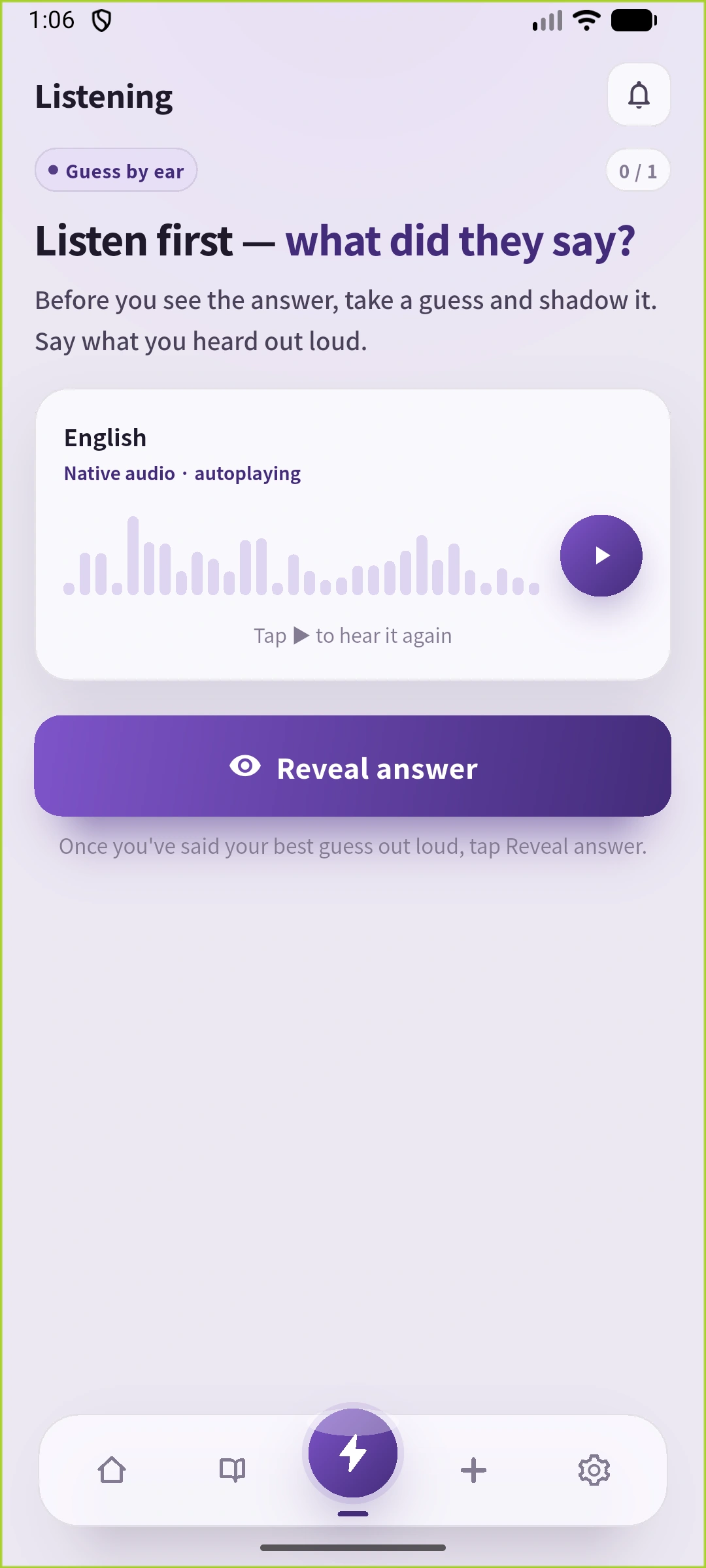
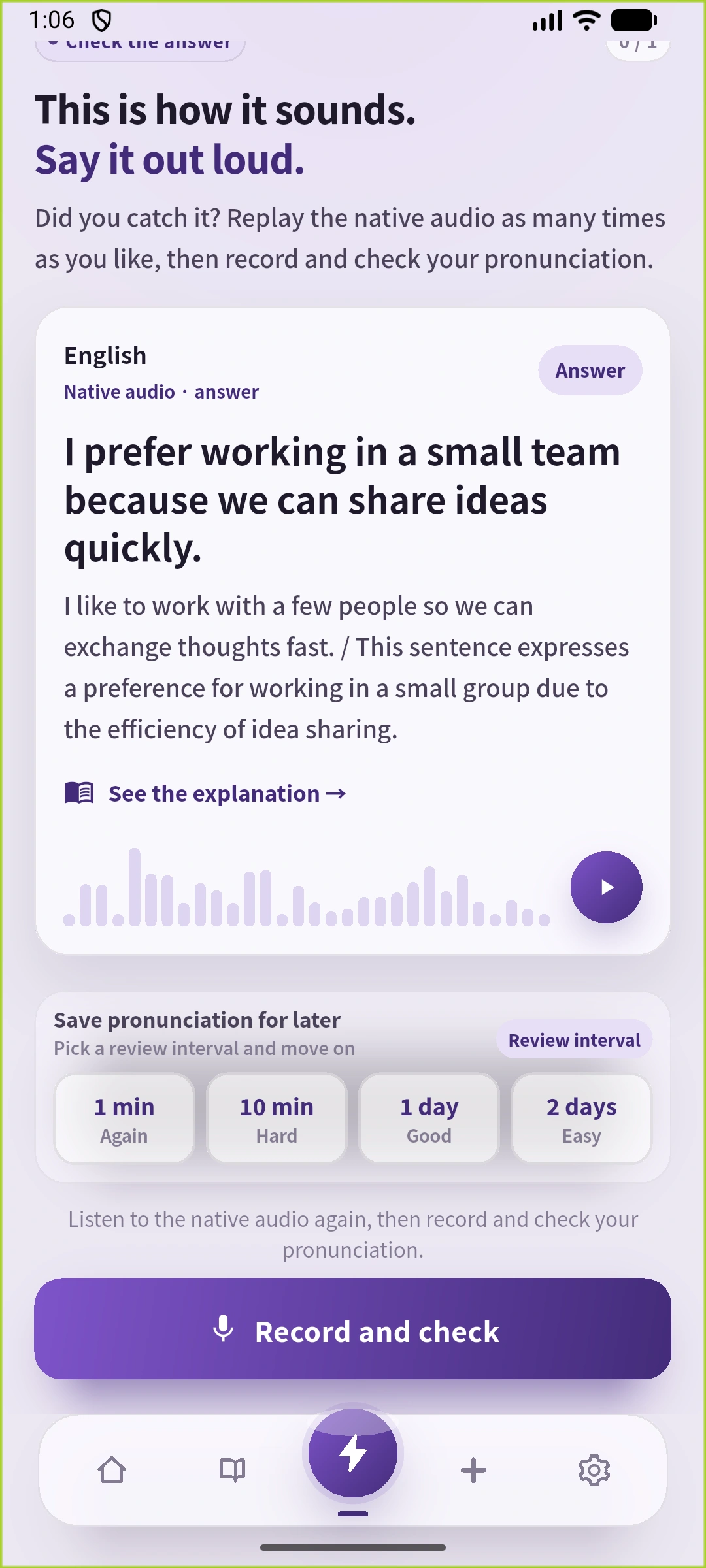
This is the once-generated synthetic model, not official test audio or a test taker's recording.
Listen, reveal and say the sentence, then add your own example and use a separate recorder and timer for the complete task. Saying this one sentence is not the same as completing a 60-second opinion response. See what SpeakGain is for its role.
A practice plan up to test day
Record every task once before allocating your days. Our four-week example divides the work; it does not establish how long you need to reach a score.
| Period | Work | Keep/check |
|---|---|---|
| 4–3 weeks before | Learn the official format; record five task types | Baseline recordings and one issue per task |
| 3–2 weeks before | Repair weak tasks one question at a time; change prompts | First and second recordings |
| 2–1 weeks before | Mix tasks; answer unseen prompts within the limit | Missing facts, connected reasons, cut-off sentences |
| Final week | Check the sequence using official practice material | Recurring errors and current test-day instructions |
| Day before / test day | Confirm documents, venue and check-in; briefly warm up | Avoid adding new long scripts |
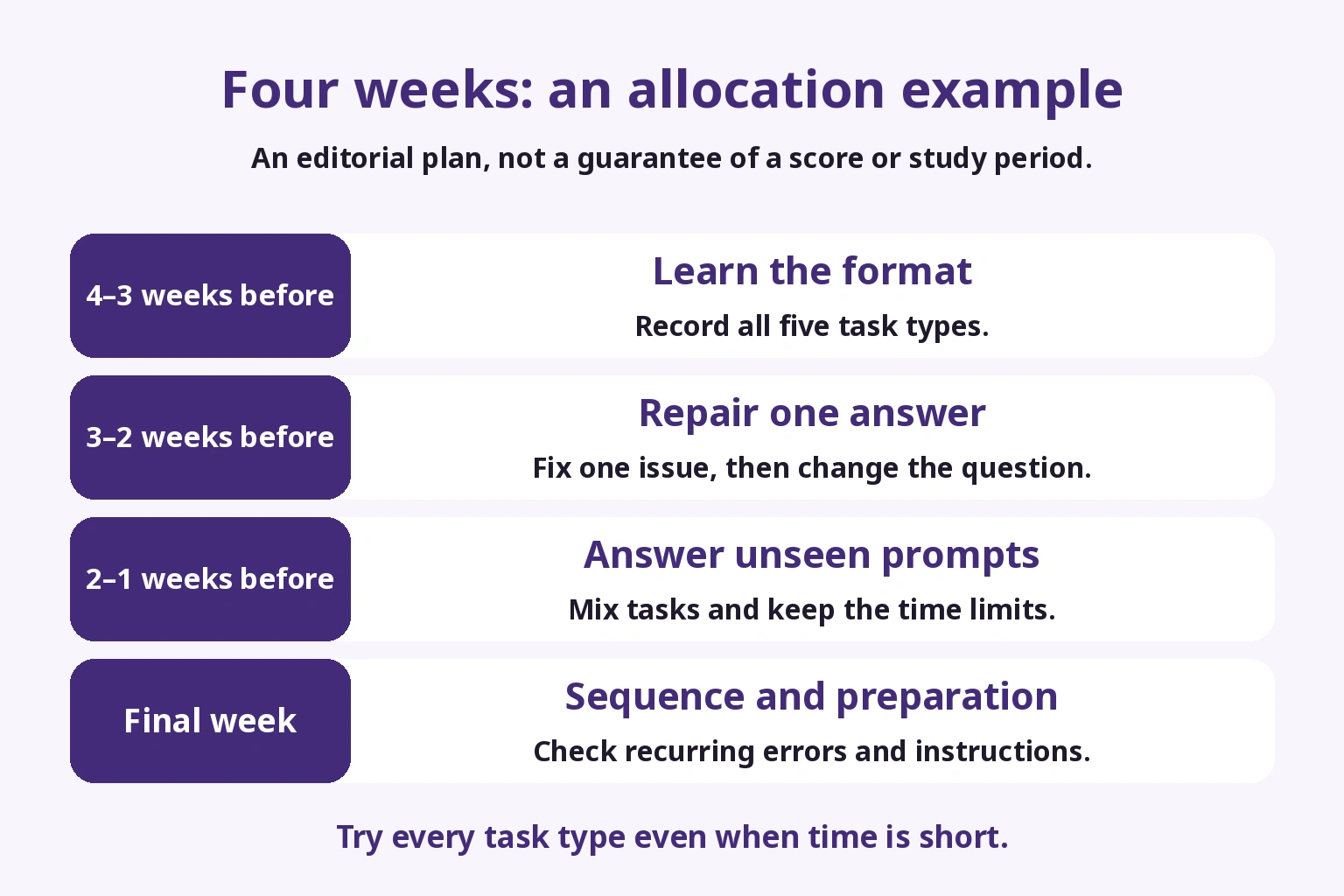
With only one or two weeks, prioritise two observed problems, such as incorrect times and missing examples, but leave time to try all task types. With ten minutes in a day, record, listen and repair one question; transfer to a new prompt the next day if necessary. We favour a small completed recording over merely opening more materials.
Turn common failures into the next drill
If the listener cannot identify your answer, put the requested fact first. If your opinion has no support, add one reason and a concrete example. If a schedule answer is wrong, compare it with the source before repairing delivery. If a key word is unclear, practise it with its surrounding words and return to the full answer. If the sentence is cut off, shorten the introduction before trying to speak faster.
Choose the issue that obstructs this answer, not every possible defect. Ask another listener what they understood when self-listening is inconclusive; checking the message is different from predicting an official score.
Frequently asked questions
Can I prepare on my own?
Yes: format study, timed answers and recording review can be done alone. Start with five baseline recordings. Self-recording does not accurately predict an official score; get another listener’s view when clarity is hard to judge.
What is the passing score?
TOEIC reports scores rather than a universal pass/fail result. Follow the requirement of the organisation requesting it and consult the official range descriptors. IIBC IIBC
Does a high L&R score guarantee a high Speaking score?
No guarantee follows from it. The tests measure different skills; this article offers no score conversion. Practise producing answers under the Speaking limits even when you already understand the vocabulary. IIBC
What equipment and environment should I expect?
Japan’s public test uses a computer and headset, and nearby examinees’ speech may be audible. Follow the equipment and recording checks and notify staff of a fault. Elsewhere, consult the local administrator rather than adopting Japan’s rules. IIBC IIBC
Can I take notes?
Japan’s public-test guide specifies the designated sheet and supplied pen. Do not plan to use your personal notebook or a prepared script. Other administrations may have different arrangements; check their instructions. IIBC
Should I prepare Writing too?
If both results are required, allocate separate typing/writing practice. ETS lists Writing as eight questions, about 60 minutes, scored separately on 0–200. Speaking patterns alone do not prepare every writing task. ETS
How many weeks do I need?
It depends on your current performance, requirement and available time. The four-week plan is an editorial allocation example. Start by trying all five types and use observed weaknesses to adjust it.
Should I memorise answer templates?
Learn short structures and change their content. Our editors advise against forcing long memorised answers onto new questions because the facts, picture or reasons may not match.
Our editorial verdict
Check the official format, record all five types, then repair the issue that most obstructs the answer. Return to the written text for reading, visible facts for a picture, the request for responses, accurate information for schedules and connected reasons for opinions. One long universal script cannot replace those decisions.
Today, complete one timed recording, choose one repair and record again. Then use a different prompt. The useful record is not only how many answers you memorised, but whether you can begin with what this question requires.
If you also take EIKEN in Japan, practise its separate four-scene task and social opinions with our Pre-1 interview guide.
If you also need IELTS, use IELTS Speaking preparation to practise its one-minute notes, long turn and discussion separately.
If you are still choosing a test, use our English test comparison to narrow the options by purpose, speaking format and the recipient’s requirements.
Official sources
Checked 10 October 2026. Recheck current administration instructions before registering or attending: IIBC; ETS; IIBC; IIBC; IIBC; IIBC; IIBC; IIBC.
TOEIC is a registered trademark of ETS. These examples and diagrams are our editors’ original material, not official ETS or IIBC materials.
If a Japanese employer asks you to take PROGOS, our PROGOS preparation guide explains the official format and CEFR result labels, then shows solo practice for workplace answers.