
TOEFL Speaking preparation: 2026 tasks, timing and solo practice
Published
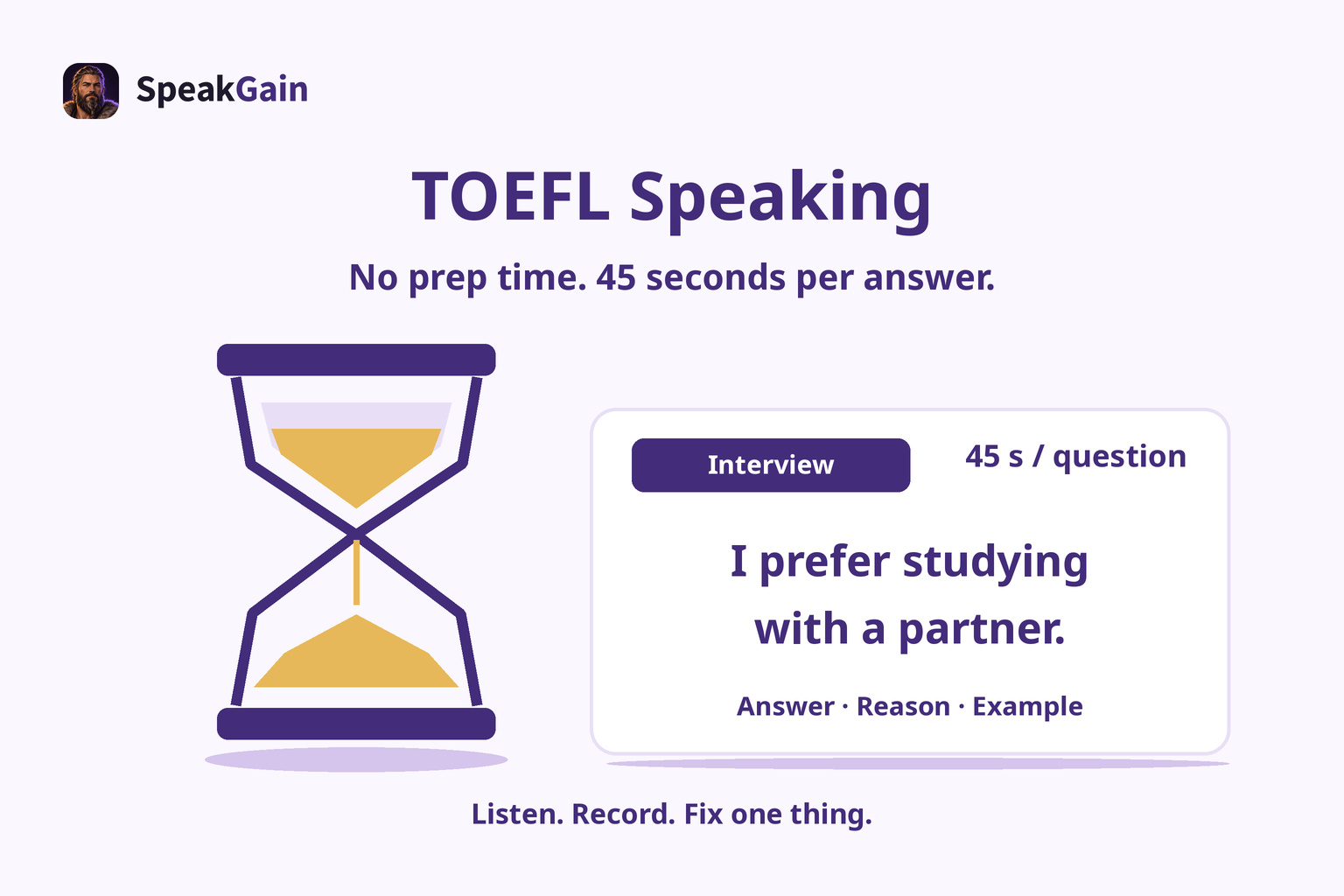
Current TOEFL iBT Speaking has seven Listen and Repeat items and four Take an Interview questions: 11 items in about eight minutes. For independent preparation, record repetitions within the 8–12-second response window and interview answers within 45 seconds, listen back, and fix one thing. Our editorial recommendation is to use your remaining time to identify difficulties in a first recording, practise each task, then check unfamiliar official questions and your testing equipment (ETS Japan’s current format, checked 13 October 2026).
If a Japanese school also assigns GTEC, GTEC speaking preparation distinguishes its format and timing before you practise recorded responses.
This guide covers tests taken on or after 21 January 2026. “One independent task and three integrated tasks” describes the earlier format. Both current tasks have no separate preparation time, as stated in the Speaking instructions in ETS Practice Test 1. Do not add the old 15-second preparation period to an interview drill.
Format, timing, scoring and equipment facts come from ETS and ETS Japan. Answer patterns, examples and study plans are editorial suggestions, not official questions, certified high-scoring answers or score guarantees. This is a practice guide, without school, coaching or app comparisons. Use our English study guide to balance Speaking with the other three skills.
If you need DET for study abroad or admissions, check our Duolingo English Test preparation guide for its current format and speaking practice.
If you are considering a paired exam, our Cambridge English levels and Speaking guide explains A2 to C2 and how to respond to a partner’s ideas.
For whole-test preparation, use our TOEFL study plan to organize all four skills and official materials around your target.
Current tasks, item counts and response time
Repeat the original sentence in the first task; answer the question in your own words in the second. They require different practice.
Sources: ETS Japan, Updated TOEFL iBT Overview and Practice Test 1. Checked 13 October 2026. Response limits apply to each item; eight minutes is the section estimate.
| Task | Items | Preparation | Response window | What ETS measures |
|---|---|---|---|---|
| Listen and Repeat | 7 | None | Maximum 8–12 seconds per sentence | Accurate, intelligible reproduction of spoken input |
| Take an Interview | 4 | None | 45 seconds per question | Relevant, coherent elaboration, natural pace, vocabulary and grammar |
| Speaking section | 11 | As above | About 8 minutes overall | Foundational speaking skills and communication |
Do not assume every repetition allows 12 seconds. Follow the instructions and clock for that item. Eight minutes is not the whole TOEFL appointment: the official guide asks you to allow about two hours including directions and other steps. The ETS blueprint identifies Reading and Listening as adaptive and Speaking as linear; it does not say your next interview question changes because of your repetition performance. ETS’s Speaking page says specialized background knowledge is not required.
Earlier four-task format versus the current format
Check your test date and the actual Speaking contents of a resource. A “2026” title alone is not evidence that it teaches the current tasks.
| Point | Earlier format, through 20 January 2026 | Current format, from 21 January 2026 |
|---|---|---|
| Tasks | 1 Independent + 3 Integrated | 7 Listen and Repeat + 4 Take an Interview |
| Work | Opinion; combine reading/listening information | Reproduce sentences; answer experience/opinion questions |
| Preparation | 15–30 seconds, depending on task | None for either task |
| Response | 45 or 60 seconds | Repetition 8–12 seconds; interview 45 seconds each |
| Section estimate | About 16 minutes | About 8 minutes |
| Reported Speaking score | 0–30 | 1–6 in half-point increments |
Earlier evidence: ETS’s historical four-question practice and the historical panel on its content/structure page; current score evidence: ETS score guidance. Checked 13 October 2026. A historical official page remaining online does not establish today’s format.
Old materials may still help with vocabulary and comprehension. We would use them as supplements, while practising timed responses with current official materials. Lecture summaries and 60-second answers alone do not train exact sentence repetition. Nor should an old opinion template replace answers to personal-experience questions. TOEFL ITP Speaking is a separate test: check the ITP content page if that is the name on your invitation. Our VERSANT preparation guide also explains how to separate versions and task-specific drills.
Listen and Repeat: preserve words, meaning and order
What you do
Listen to seven sentences associated with one academic or campus-life scenario and repeat each exactly. The official overview describes an illustration of the setting, progressively longer and more complex sentences, and a maximum response window of 8–12 seconds. This is repetition, not an opinion or summary (ETS overview).
Editorial pattern and short example
There is no reusable answer template: the sentence itself is the answer. For practice, notice the subject, action and final condition while keeping the original words and sequence.
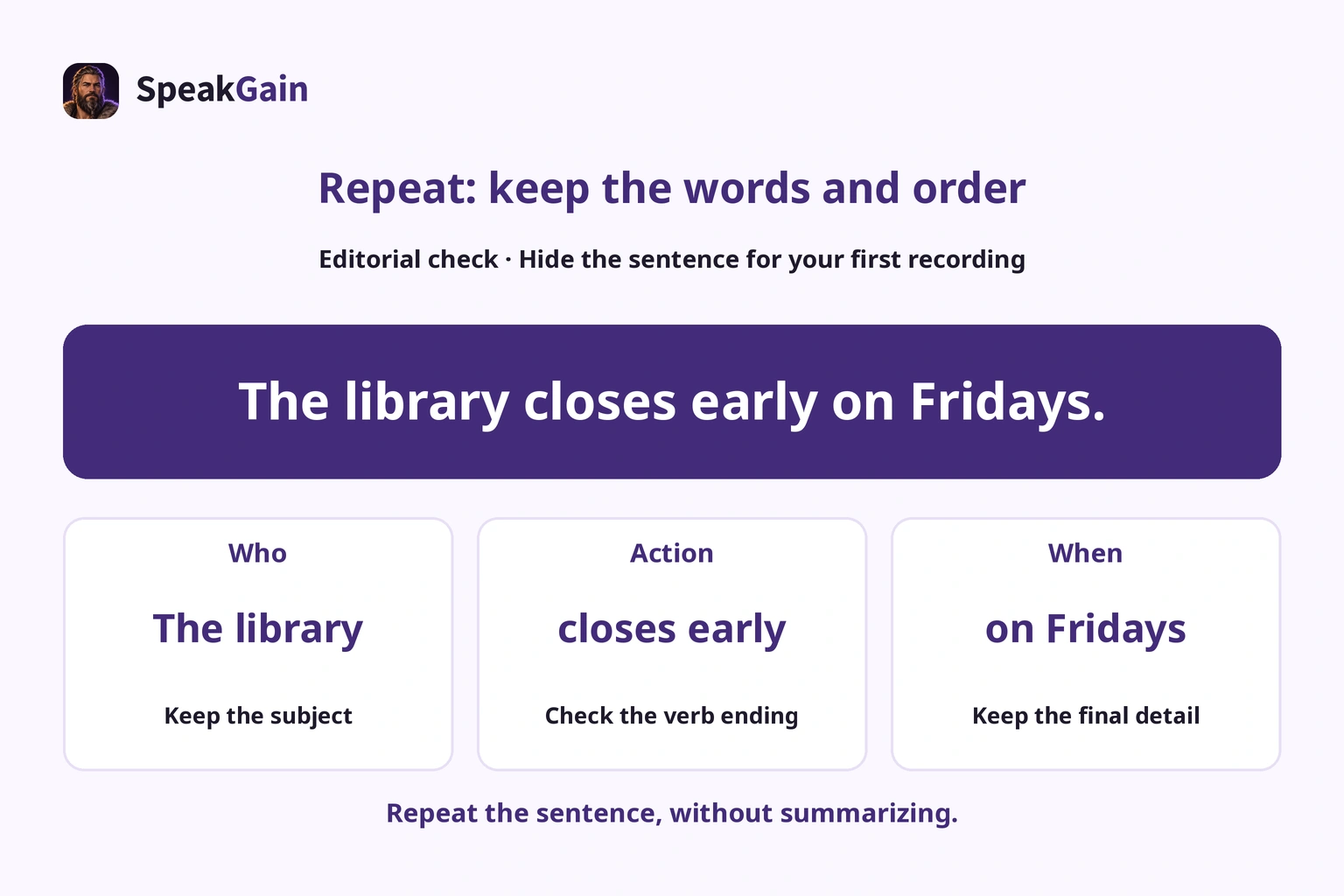
The library closes early on Fridays.
After your first recording, check The library / closes early / on Fridays. The slashes explain groups of meaning; they do not prescribe long pauses. Keep the endings in closes and Fridays. Saying The library is closed on Friday. changes the message, rather than reproducing it. If remembering the beginning makes you miss the ending, shorten your practice sentences first.
Solo routine: timer → record → listen back → fix one thing
- Set the response window. Learn the timing from current official samples. For supplementary audio with an accurate transcript, record which 8–12-second practice window you used.
- Record. Hide the transcript, listen once and repeat. Keep the first attempt, including mistakes.
- Listen back. Compare with the source. Separate missing words, changed words and words that are difficult to understand.
- Fix one thing. For example, repair the ending of closes, record again, then try a different sentence with the same feature.
Repeating a memorized sentence successfully does not prove you can handle new input. Overlapping practice can be a supplementary exercise with audio and text, but return to repetition after the audio with the text hidden.
Common mistakes
Summarizing loses the original wording. Dropping negation, tense or number can change meaning. Rushing may make the final words unintelligible, while exaggerated word-by-word pauses may prevent you from finishing. Repeatedly restarting can consume the response window. Our first-attempt rule is to keep going and review afterwards; it is an editorial strategy, not a claim that ETS bans every self-correction. The current rubric prioritizes accurate repetition and intelligibility.
Take an Interview: answer directly and explain with detail
What you do
Answer four related questions from a prerecorded interviewer, with 45 seconds for each. This is not an open conversation with a live examiner. The official overview describes initial questions about factual information and personal experience, followed by broader opinions that need support (ETS overview).
Editorial pattern and short examples
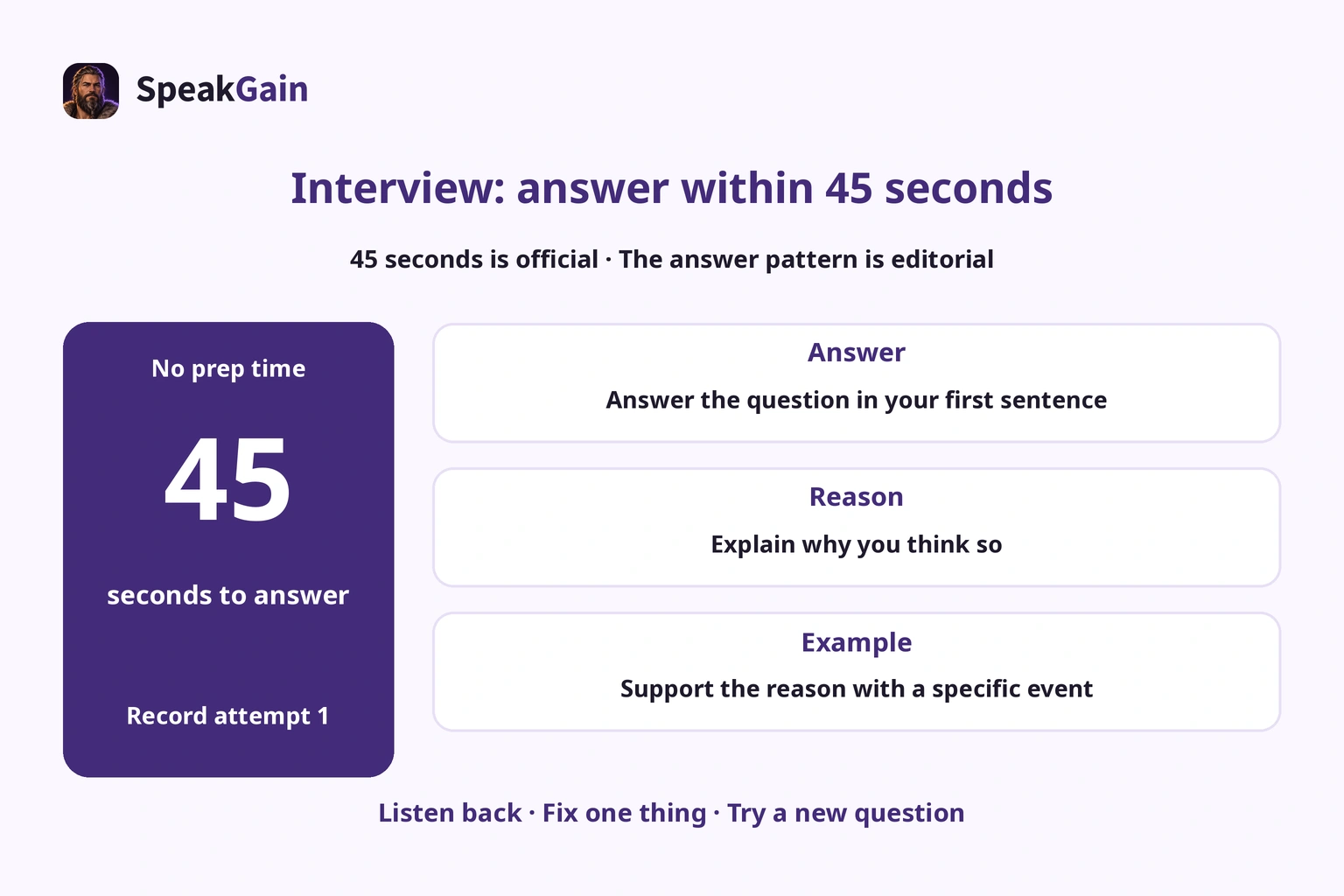
For an opinion, try answer → reason → example. For experience, try event → action → result. These are organizational suggestions, not an official compulsory template.
Editorial question: Do you prefer studying alone or with other people? Why?
I prefer studying with a partner because we can explain difficult ideas to each other. Last week, my classmate helped me understand a graph. Then I explained the next question to her.
The preference, reason and example connect. To develop the answer, describe what was confusing about the graph and how the explanation helped; do not stretch a short answer with empty phrases just to reach 45 seconds.
For Tell me about a time you solved a problem with a classmate., an editorial example is:
Our group could not agree on a topic. I asked everyone to suggest one idea, and we chose the option we could research most easily.
This answers with an event and an action. A generic statement that teamwork matters would leave the requested experience unexplained. If a question asks for two points, check that you addressed both.
Solo routine: record the first 45-second response without preparation
- Time it. Hear an unfamiliar question, then begin the 45-second response window without an added preparation period.
- Record. Answer in the first sentence, then explain. Preserve the recording even if you hesitate.
- Listen back. Check relevance first, supporting detail second, and any unclear speech third. Length alone is not quality.
- Fix one thing. Replace a vague opening, add one concrete detail or repair the tense of a past event. Record again and test the change on another question.
Some days, answer four different questions on one topic in sequence. For example, practise study location, a shared-learning experience, a preference for studying alone or together, and whether universities should add shared study spaces. These are editorial practice prompts, not predicted test questions.
Common mistakes
Long stock introductions waste space that could develop the answer. Listing “convenient and efficient” without showing what happened stays vague. A memorized answer may be fluent but irrelevant. We recommend one explained reason before adding unrelated reasons or impressive vocabulary. IELTS Speaking preparation also discusses detail and examples, but its one-minute preparation and longer speaking task are not TOEFL’s interview timing.
Scoring: a 0–5 response rubric is not the 1–6 section band
Current reported Speaking scores use 1–6 in half-point increments. ETS’s task rubrics use 0–5 for responses; those labels are not interchangeable (score guidance, rubrics, checked 13 October 2026).
Repetition concerns accuracy and intelligibility. Interview criteria cover relevant development, conversational pace, understandable pronunciation/rhythm/intonation, and vocabulary/grammar. It is not a pronunciation-only test or a quota of difficult words. The blueprint classifies the 11 Speaking items as AI-scored. Use current task-specific rubrics rather than importing historical scoring explanations.
The overall 1–6 score is the mean of four section scores, rounded to the nearest half band. During the two-year transition after January 2026, reports also provide a comparable overall 0–120 score. That does not mean every current report promises a separate old-scale 0–30 Speaking score. We provide no unofficial conversion or score prediction from recordings.
Your receiving institution sets requirements; ETS has no universal pass mark. Check the overall and Speaking minimum, submission date, and acceptance of Home Edition and MyBest for your university, graduate programme or scholarship. If requirements still use the old scale, ask the recipient how it handles the current report rather than converting it yourself.
A practice plan before test day
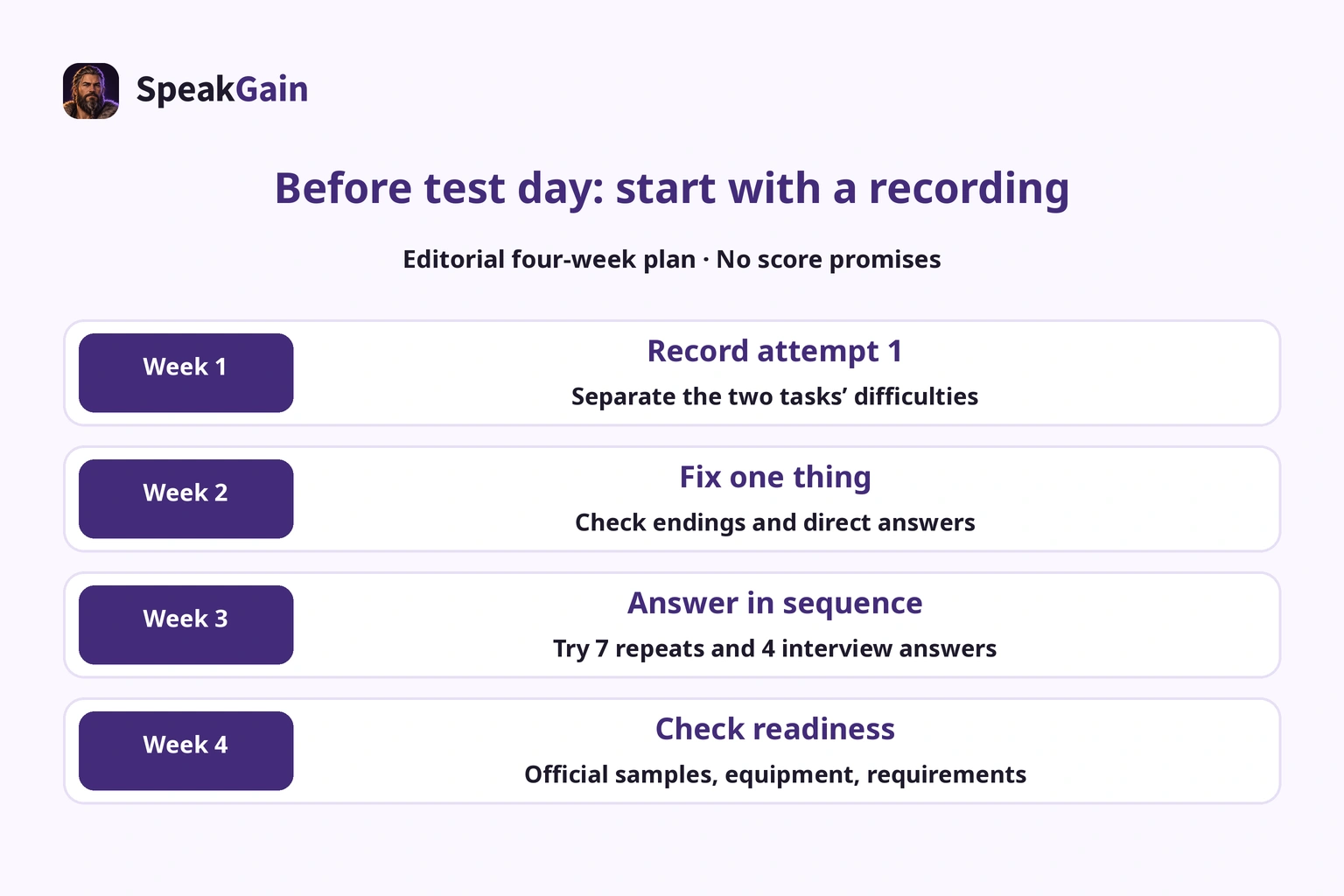
This four-week plan is editorial, not an ETS-required duration or a score promise. Adapt it to the problems in your first recordings.
| Period | Main work | Record |
|---|---|---|
| Week 1 | Confirm current tasks; record both | Missing words, misunderstood question, unclear speech |
| Week 2 | Repair repetition endings and direct interview openings | One correction and its result on a new item |
| Week 3 | Practise seven repetitions and four answers in sequence | First attempts separately from memorized successes |
| Week 4 | Use current official materials; check testing setup | Timing, audio input, booking and submission requirements |
A 20-minute session could use five minutes for new repetitions, five for interview answers and ten for listening back and one correction. Shift the allocation if listening or question relevance is the bigger problem. With only a week, prioritize a baseline recording, the biggest recurring error, official instructions and equipment. With months available, add listening comprehension and basic experience descriptions, while keeping regular unfamiliar timed attempts.
Keep five fields: date, material/window, first-attempt error, one correction, next question to try. “The final phrase was missing; next time listen through the ending” is more actionable than “studied 30 minutes.”
Rehear a short reason with SpeakGain
SpeakGain can support repeated listening to an opening line you want to remember. We saved this new sentence as one card through the normal Add flow. On the device, opening its study flow from the library played audio on a Listening screen with the sentence hidden; Reveal answer opened the Answer screen with the English sentence.
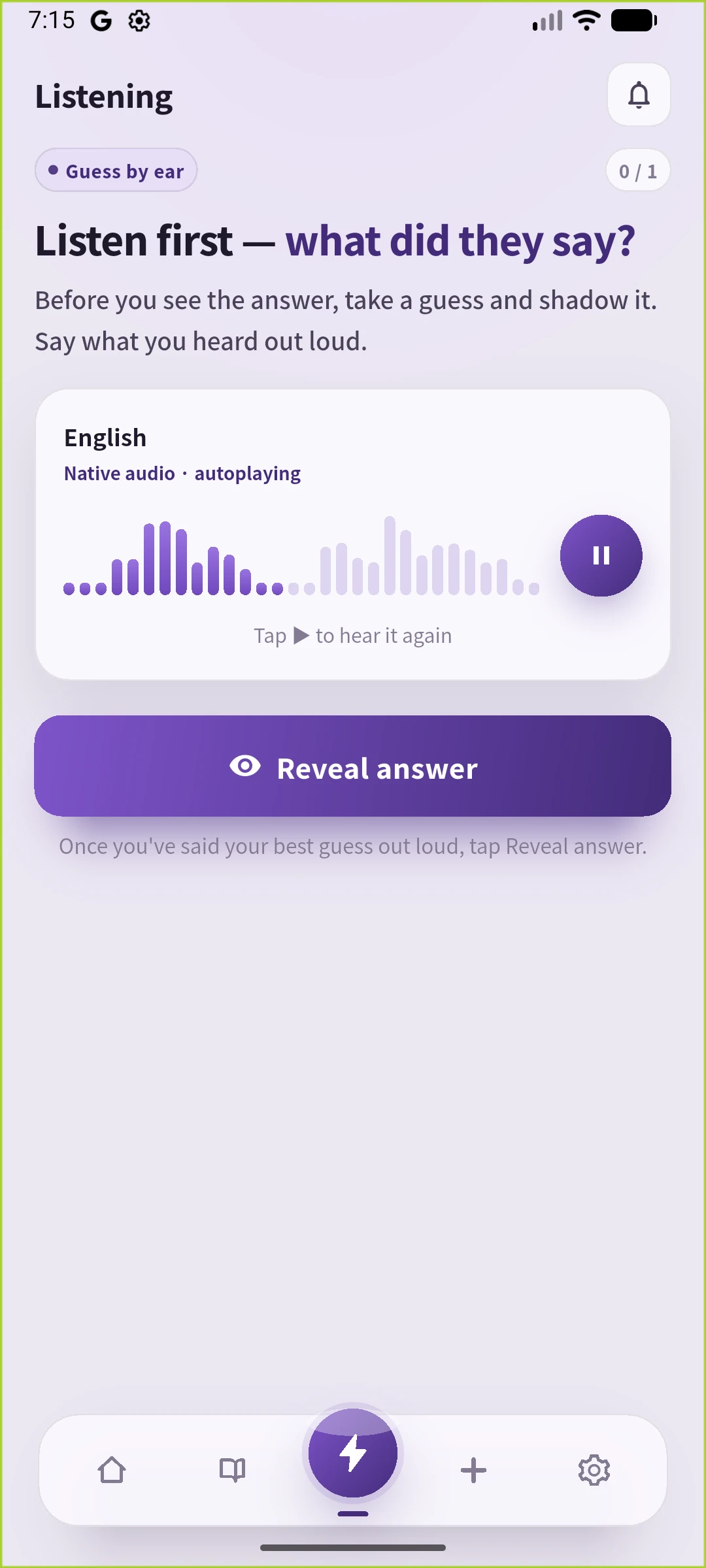
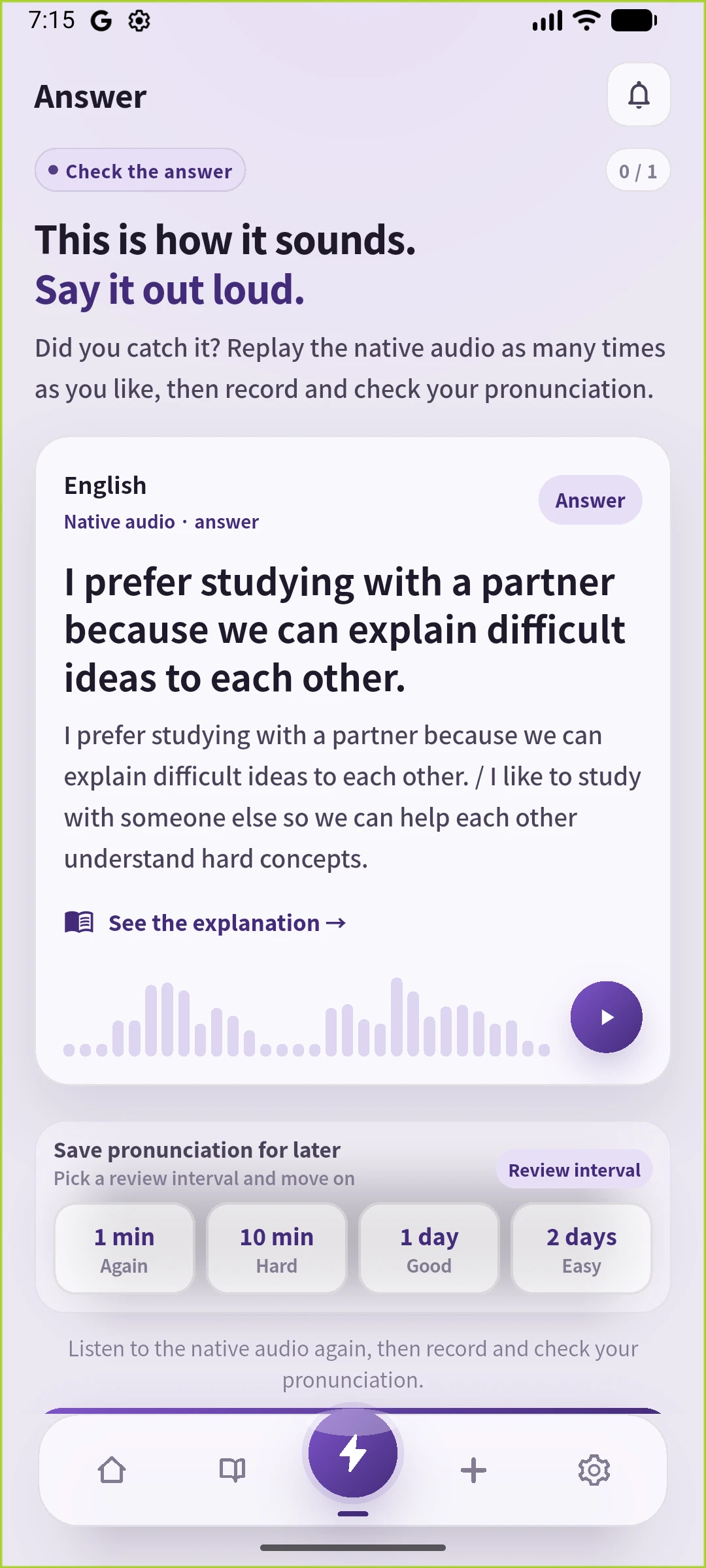
I prefer studying with a partner because we can explain difficult ideas to each other. — The speaker prefers learning with another person so they can help each other understand difficult concepts.
AI-generated Viking voice for one short reason, not a complete 45-second response or an official test item.
After revealing the sentence, compare it with what you said and fix one missing word. Record and replay a full 45-second answer with an ordinary recorder. We verified saving, audio playback, answer reveal and the displayed review choices. SpeakGain is not presented here as a TOEFL mock test, scoring tool or speech assessment.
Home Edition checklist: no headset or earphones
These are selected requirements from ETS’s at-home requirements, checked 13 October 2026. Read the full current page before booking.
- Computer: desktop/laptop, not a mobile/tablet test device; one display and one keyboard. Listed licensed operating systems: Windows 11 or later, or Mac OS X 10.13 or later.
- Audio: internal/external speakers and a microphone that is not part of a headset. Headsets and earphones are prohibited.
- Camera: built-in/separate camera movable to show a 360-degree room view, tabletop and below the desk. Check the conditional second-camera requirements if applicable.
- Connection/check: install TOEFL Test App through My TOEFL Home and run Equipment Check, including bandwidth, at the same weekday/time as your test. Disable screen-sharing and remote-access software.
- Room/notes: alone, clear desk. Use a small erasable whiteboard, or paper inside a transparent sheet protector with an erasable marker; show that notes are erased at the end. Ordinary paper note-taking is not allowed.
Do not transfer a test-centre headset description to Home Edition. Practise and check audio using the permitted home equipment; use the official equipment check to investigate technical failures.
FAQ
Can I prepare on my own?
You can independently practise instructions, timing and recording review. Start with both current official tasks. Self-review is not official scoring, and independent study does not guarantee an admission score. If you cannot judge intelligibility, ask a listener what they understood.
Should I memorize a template?
Use a short structure to organize an interview answer, not a long script regardless of the question. Experience questions need experiences; opinions need support. Repetition needs the original sentence, not an answer template.
Can I still use four-task books?
For supplementary vocabulary/comprehension, yes. For current timed practice, use seven repetitions and four interview answers. Check task contents against official samples.
How much preparation time is provided?
None separately for either current task. Response windows are 8–12 seconds per repetition and 45 seconds per interview question; Practice Test 1 explicitly states no preparation time.
What score should I aim for?
Your recipient’s requirement, including any Speaking minimum. Current bands are 1–6 in half-point increments; ETS sets no universal pass mark. Do not infer a band from your recording duration.
How many weeks or minutes per day?
There is no common requirement for everyone. Use your first attempts to adapt the four-week editorial plan. Check whether the next unfamiliar item shows your chosen correction.
Can I use headphones at home?
No. Home Edition requires permitted speakers and a non-headset microphone. Check the full equipment/environment requirements and run Equipment Check.
Where are current official samples?
ETS Japan’s update page links the official overview, Interactive Sample and full-length practice. Some free samples do not provide review of your response or a score, as the page explains. Completing a sample does not necessarily produce an official score.
Editorial verdict
Confirm the current tasks, then record repetition and interview responses separately. For repetition, inspect words missing from the original. For the interview, first check whether you answered the question. Fix one point and try a new item.
We do not recommend old-task-only preparation, unrelated memorized speeches or converting self-recordings into scores. Before test day, return to official instructions and your booking/submission conditions. If you also take TOEIC Speaking, keep its tasks and times separate with our TOEIC Speaking guide.
Official sources — checked 13 October 2026
- ETS Japan 2026 update — current items, timing, report and sample entry points.
- ETS Updated Overview and Practice Test 1 — task operation, response windows and no preparation time.
- Speaking page, rubrics and blueprint — measured skills and scoring design.
- Score guidance and Home Edition requirements — report scale, recipient requirements and testing setup.
TOEFL and TOEFL iBT are registered trademarks of ETS. This is an independent editorial guide, not official ETS preparation material.
To choose a vocabulary resource and connect remembered words to all four skills, see how to choose and learn from TOEFL vocabulary books for official comparisons and five practical checks.