
Duolingo English Test preparation: format, scores and solo speaking practice
Published
The Duolingo English Test (DET) is an online test of four English skills that you take on a computer in a suitable private space, including at home. Its overall score runs from 10 to 160 in increments of five, with individual Speaking, Writing, Reading and Listening subscores. For speaking, start by recording a concrete photo description and a direct answer followed by a reason or example (official 2026 guide, checked 14 October 2026).
DET is separate from the Duolingo language-learning app. App progress is not an admissions score. Before preparing, check your intended institution’s own website for accepted tests, overall and subscore requirements, and deadlines; this article does not list university thresholds. Format and rules below come from DET; answer structures, original examples and the three-week plan are editorial suggestions. Try the free official practice test, rather than treating our examples as official questions. For a balanced study routine, see how to study English.
Current DET question types and timing
The 2026 guide describes about one uninterrupted hour: roughly five minutes of setup, 45 minutes of adaptive testing and ten minutes for the writing and speaking samples. Some question difficulty changes with performance; question count also changes with the grading engine’s confidence. Not everyone gets an identical set of questions. This table uses the guide and its linked official question pages, checked 14 October 2026. Skills mean individual-subscore labels; preparation is shown separately from response time.
| Official type | Skill | What you do | Time (m:ss) |
|---|---|---|---|
| Read and Select | Reading | Decide whether a word is real English | 0:05 (each) |
| Fill in the Blanks | Reading | Complete one unfinished word in a sentence | 0:20 |
| Read and Complete | Reading | Complete unfinished words in a passage | 3:00 |
| Listen and Type | Listening | Transcribe what you hear | 1:00; 3 plays total |
| Interactive Reading | Reading | Complete words/sentences, highlight an answer, choose idea/title | 7:00 / 8:00 (6 questions, shared) |
| Interactive Listening: Listen and Complete / Listen and Respond | Listening | Complete scenario blanks and select conversation responses | 6:30 (8–10 questions, shared) |
| Interactive Listening: Summarize the Conversation | Listening / Writing | Write a paragraph summarizing the conversation | 1:15 (separate) |
| Write About the Photo | Writing | Describe an image in writing | 1:00 |
| Interactive Writing | Writing | Answer a prompt and a follow-up based on your response | 0:30 preparation → 5:00 → 3:00 |
| Speak About the Photo | Speaking | Describe an image aloud | 0:20 preparation → 1:30 |
| Read, Then Speak | Speaking | Read a prompt and answer aloud | 0:20 preparation → 1:30 |
| Interactive Speaking | Speaking | Answer 6–8 questions in a simulated conversation | 0:35 (each); 3:30–4:40 (response windows total) |
| Writing Sample | Writing | Write an extended response | 0:30 preparation → 5:00 |
| Speaking Sample | Speaking | Speak at length about a prompt | 0:30 preparation → 3:00 (up to) |
Interactive Reading contains Complete the Sentences, Complete the Passage, Highlight the Answer (twice), Identify the Idea and Title the Passage. Its six questions share one seven- or eight-minute clock. Interactive Listening’s first two parts share 6:30; the written summary gets a separate 1:15. Interactive Speaking questions are heard once, with no separate preparation; follow-ups depend on previous answers (official introduction). The 3:30–4:40 duration is the listed sum of response windows, not a promise about elapsed time.
Read Aloud and Listen, Then Speak were removed with the July 2025 update; they are absent from this current inventory. Check old books and videos against current official pages. Reading aloud can still support practice without becoming a current DET task.
Scores: overall, individual and integrated measures
Check the exact measure your institution requests. The following comes from the 2026 guide, pages 22–25, checked 14 October 2026.
| Measure | Official information |
|---|---|
| Overall score | 10–160, steps of 5; mean of four individual subscores rounded to nearest 5 |
| Individual subscores | Speaking, Writing, Reading, Listening |
| Integrated subscores | Production, Literacy, Comprehension, Conversation; each a two-skill mean |
| Results | Normally 2 days; purchased Faster Results 12 hours |
| Validity | Certified scores valid 2 years |
| Sending results | My Tests → SEND RESULTS → select and confirm institutions; unlimited, no added fee |
| Recipient receives | Overall and subscores, Writing Sample and Speaking Sample video |
Production combines Speaking and Writing; Literacy, Reading and Writing; Comprehension, Reading and Listening; Conversation, Listening and Speaking. Each integrated subscore is the mean of its two individual subscores (official explanation). Speaking longer cannot replace weaker reading, listening or writing. The official scores page is the comparison entry point; we do not reproduce numerical IELTS/TOEFL conversions or imply guaranteed individual equivalence. Compare the actual tasks in IELTS speaking preparation, TOEFL speaking preparation and VERSANT preparation, keeping each test’s time limits separate.
Speak About the Photo: start with visible facts
What is required
You have 20 seconds to observe the image, then a 90-second speaking window; the image stays visible and you have one recording opportunity (official task page). Explain it naturally to someone who cannot see it.
Our structure and original example
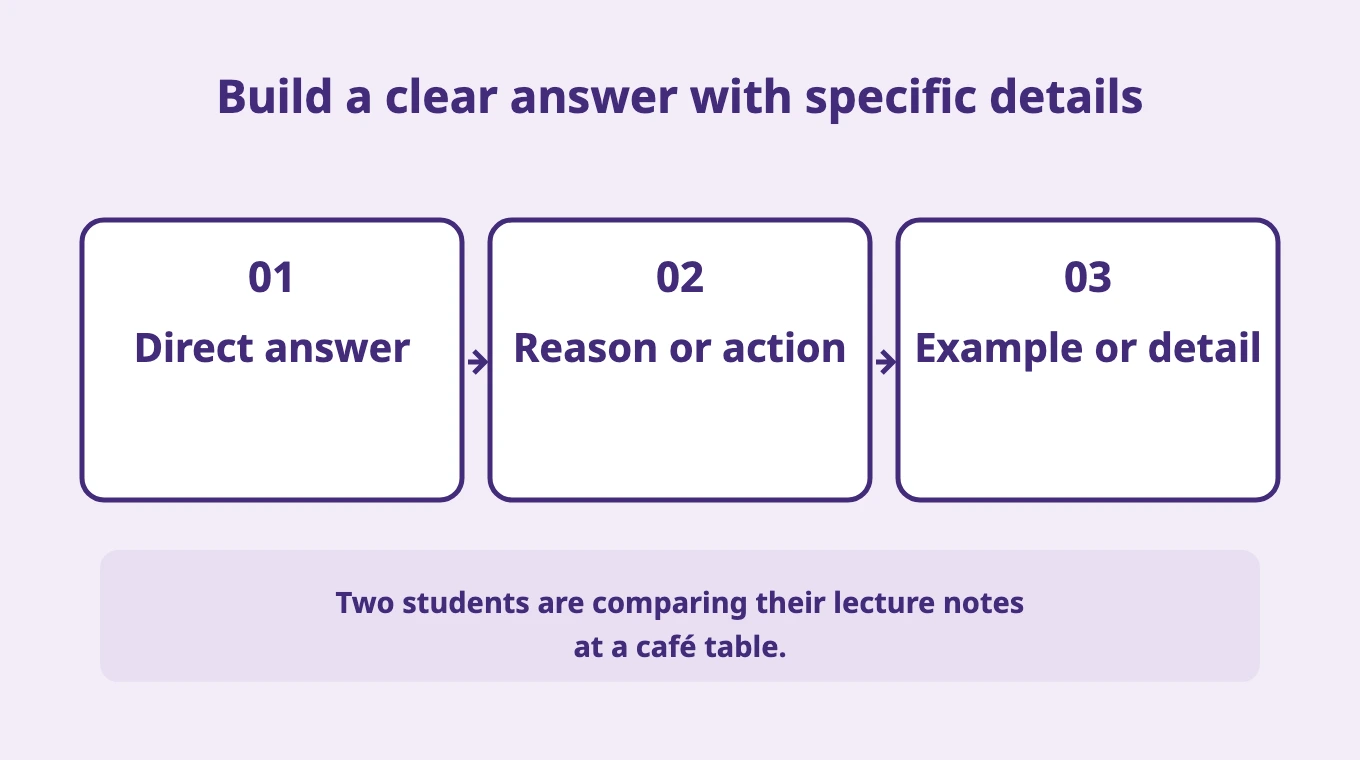
Use overall scene → action → position or objects → cautious inference. Our invented student-life example begins:
Two students are comparing their lecture notes at a café table.
The sentence identifies two students, their action and their location. Only use “comparing” if the image supports it; otherwise describe what is actually visible. Add: An open notebook is between them. One student is pointing to a page. They may be reviewing a difficult topic together. The final sentence is an inference, so it says “may.” This short example is not a complete 90-second answer. Choose details from the actual image.
Solo practice
Choose a photo you can use. Observe it for 20 seconds, then record within a 90-second window without writing a script. Listen for the action, spatial detail and unsupported assumptions; fix one point and record again. Use a different photo tomorrow. If a noun is missing, describe its shape or use instead of abandoning the answer.
Common mistakes
Listing “students, notebook, café” does not explain what happens. Connect subjects and verbs. Do not invent invisible exam dates or study durations; add another visible detail instead of repeating a sentence or speaking faster to fill time.
Read, Then Speak: cover every part of the prompt
What is required
Read the written prompt for 20 seconds, then answer within 90 seconds. The prompt remains visible. Address all of its components (official task page). Distinguish a request for an opinion from one for an experience and a reason.
Our structure and original example
Direct answer → reason → specific event → return to the question. Our original question is: Where do you like to study, and why does that place help you?
I like studying in a quiet corner of the library. I can focus there because there are fewer distractions. Last week, I finished reading an article before my seminar, and I felt ready to join the discussion.
The place, reason and seminar experience connect. Expand by explaining what the article helped you discuss, not by adding unrelated library history. This is an example opening, not an answer to memorize.
Solo practice
Use the 20-second preparation to identify “where” and “why,” then record the first attempt for 90 seconds. Check both parts and whether the example supports the reason. Fix one point, such as a missing example. Next time, change the place or use an experience-focused prompt so you must choose content again.
Common mistakes
A long generic introduction uses time before the answer. A reason without naming the place misses part of the question. Two prompts about university life can still ask different things; a familiar topic is not permission to reuse a whole paragraph.
Interactive Speaking: respond to the question you hear
What is required
Hear six to eight questions once each and answer each within 35 seconds. This is a simulated conversation with follow-ups chosen from earlier answers, rather than an interview with a human examiner (official task page, introduction). Do not add the separate 20-second preparation from the previous task.
Our structure and original example
Answer → reason or small event. Original practice question: How did you prepare for your first group presentation?
I practised my opening with a classmate. She told me which part was unclear, so I made that explanation shorter. That helped me start the presentation with more confidence.
It describes preparation, feedback and a result. A general speech about the benefits of presentations would not answer this experience question.
Solo practice
Listen once to a short question you recorded, then respond for 35 seconds. On some days, continue through six to eight questions. Use follow-ups about a detail you mentioned—what you shortened or what you would change next time. This editorial drill does not reproduce DET’s adaptive system; use the official practice test to experience that format. Check whether your first sentence answers the question, your example makes sense and successive answers remain consistent.
Common mistakes
Recognizing a topic is not the same as hearing the question’s focus. “How did you prepare?” differs from “Why is it important?” Do not hide uncertainty inside an unrelated memorized answer. Natural short sentences with clear subjects and verbs are a better starting point than rushing.
Speaking Sample: develop one coherent account
What is required
Prepare for 30 seconds and speak for up to three minutes. The official page recommends practicing one- to three-minute responses. Your video and topic go to score recipients; the task page lists Speaking, Conversation and Production, so do not treat it as an unscored formality (official task page).
Our structure and original example
Main point → background → action → result → reflection. Original question: Describe a time you learned something from another student.
A classmate helped me plan my weekly reading. I used to leave all the articles until the night before class. She showed me how to divide them into shorter sessions. After trying her method, I arrived with questions instead of unfinished reading.
The example moves from a problem to a change and its result. Develop it with how you divided the reading, what was difficult and what you still do. It is not a complete three-minute script.
Solo practice
Use preparation to organize the background, action and result mentally. Do not use paper notes in a test-condition rehearsal. Record, check the sequence and ending, then expand one concrete point. If you run out of ideas, explain what changed rather than repeating “It was useful.”
Common mistakes
Stretching a short answer with repeated praise adds length without substance. A rehearsed personal introduction can leave the topic unanswered. Build specific details and finish naturally.
Keep reading, listening and writing in the routine
These are editorial practice ideas, not official scoring weights. Read the whole sentence in gap tasks; distinguish real-word recognition from contextual completion. In Interactive Reading, find textual evidence and separate main ideas from details. For Listen and Type, transcribe then distinguish missed words from spelling mistakes. Track who spoke, the issue and the outcome in Interactive Listening, then write a paragraph rather than an oral summary. Practise computer typing for photo writing and answer the new question in Interactive Writing’s second step.
If an idea is clear but speaking stalls, use reading aloud on a short sentence before returning to responses without a script. English speaking practice methods separates reading aloud, self-talk and conversation.
A three-week plan: 20 minutes a day
The goal is to find a problem in the first recording, repair it and test the repair on an unfamiliar prompt. Three weeks is an editorial allocation, not a time-to-score guarantee.
| Week | 20 minutes each day | Record |
|---|---|---|
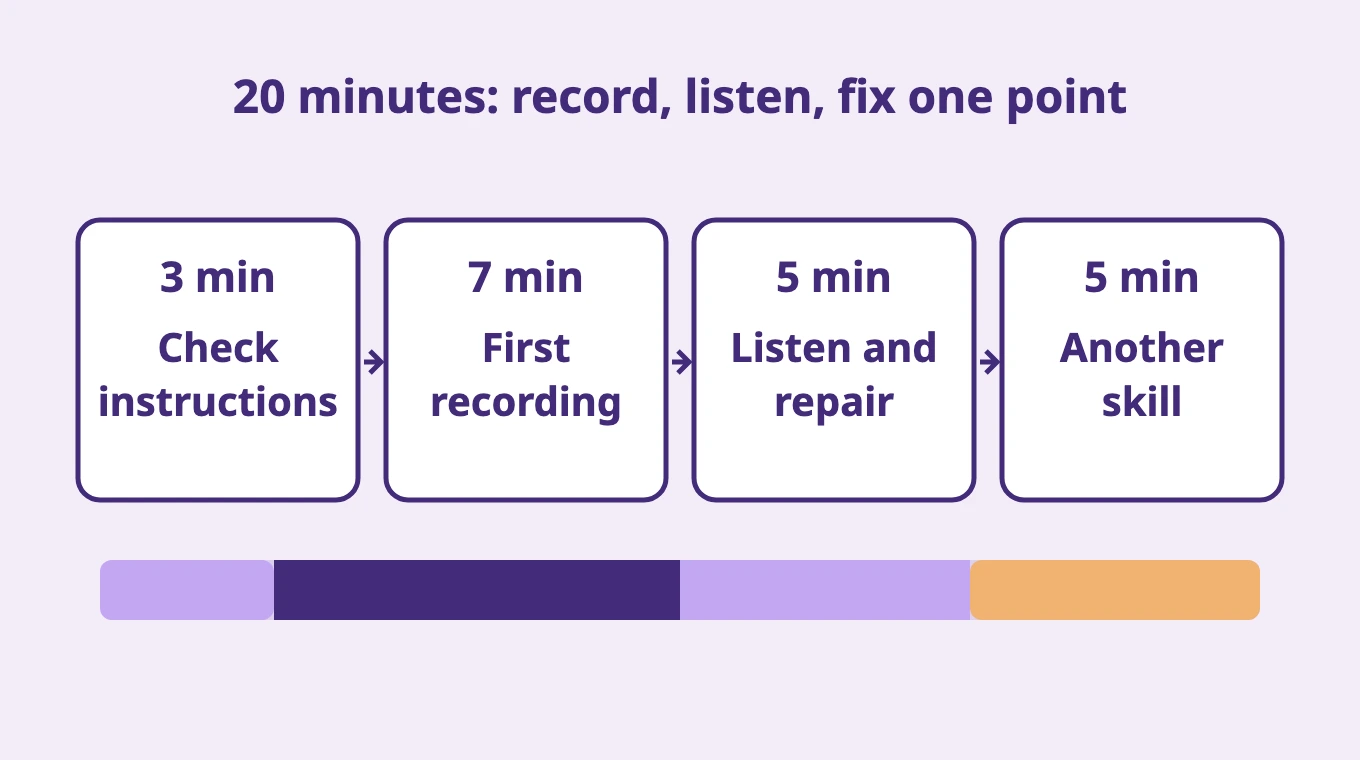
| 1: diagnose | 3 min instructions;7 min photo/read-prompt first recording;5 min listening back;5 min another skill | Missing answer component; one stalled sentence |
| 2: repair | 3 min previous point;7 min 35-second responses;5 min one repair/re-recording;5 min another skill | Direct opening, example, before/after |
| 3: transfer | 3 min instructions/setup;7 min new prompts;5 min assess first attempt;5 min weak other skill | Repair used on unfamiliar task; setup still needed |
Set aside additional time to complete the official practice test. Its shorter, unproctored format reports an estimated range, not a certified score. One high estimate does not prove readiness. Notes belong to study sessions; remove phrase cards and notebooks from the testing area. In the final week, check the room and equipment separately.
Review one photo-description sentence with SpeakGain
Use the example above as a short practice unit. On the device, we saved it through the normal Create flow, opened Knowledge from Library and chose Learn this card. Listening played audio with the sentence hidden. Reveal answer opened Answer with the same sentence and a generated explanation. We also verified the audio replay button and the visible review-interval choices.
The clip below is Viking AI audio generated once from this sentence, rather than a human native-speaker recording or official DET audio. Regardless of the label visible in the app, the audio used here is AI-generated. Listen, say the sentence without reading it, then add another visible detail in your own words.
Two students are comparing their lecture notes at a café table.
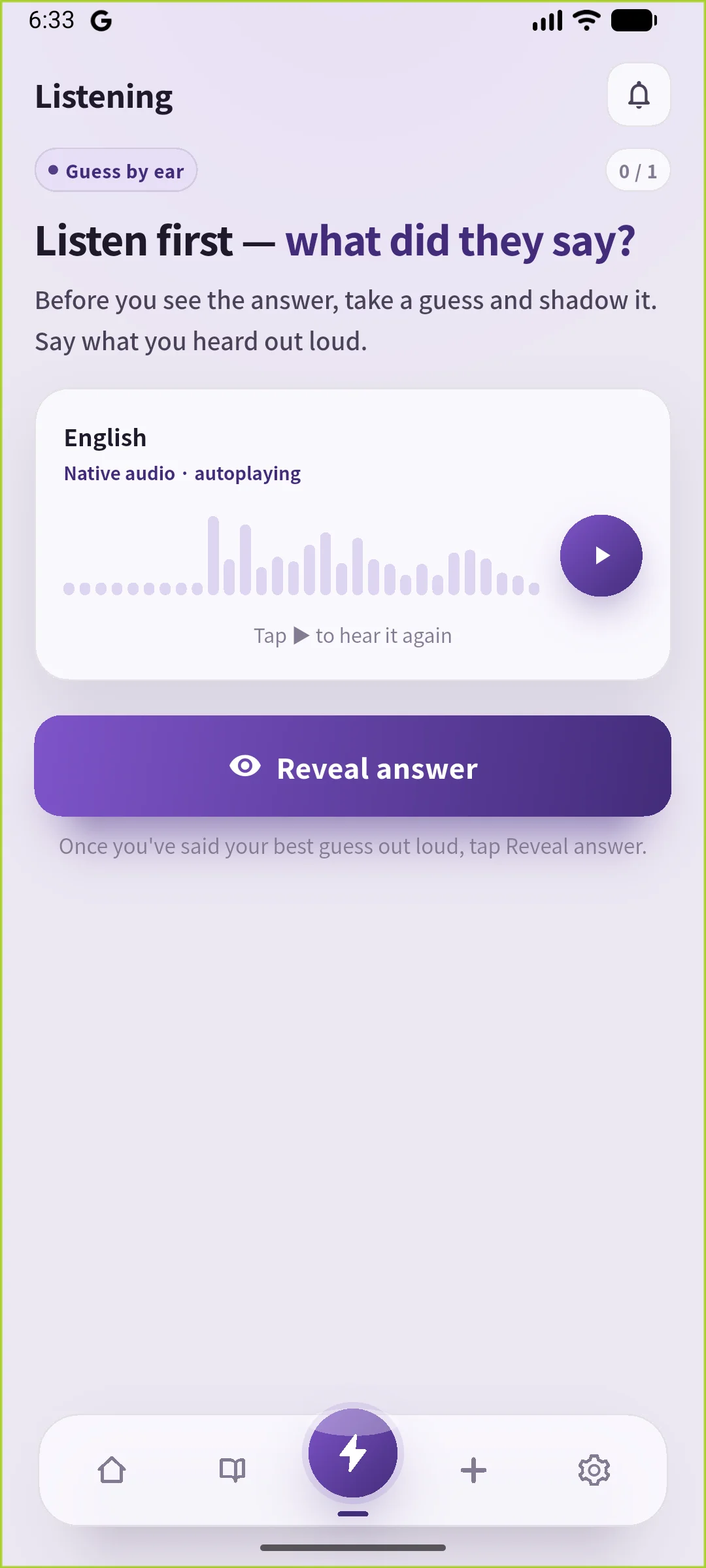
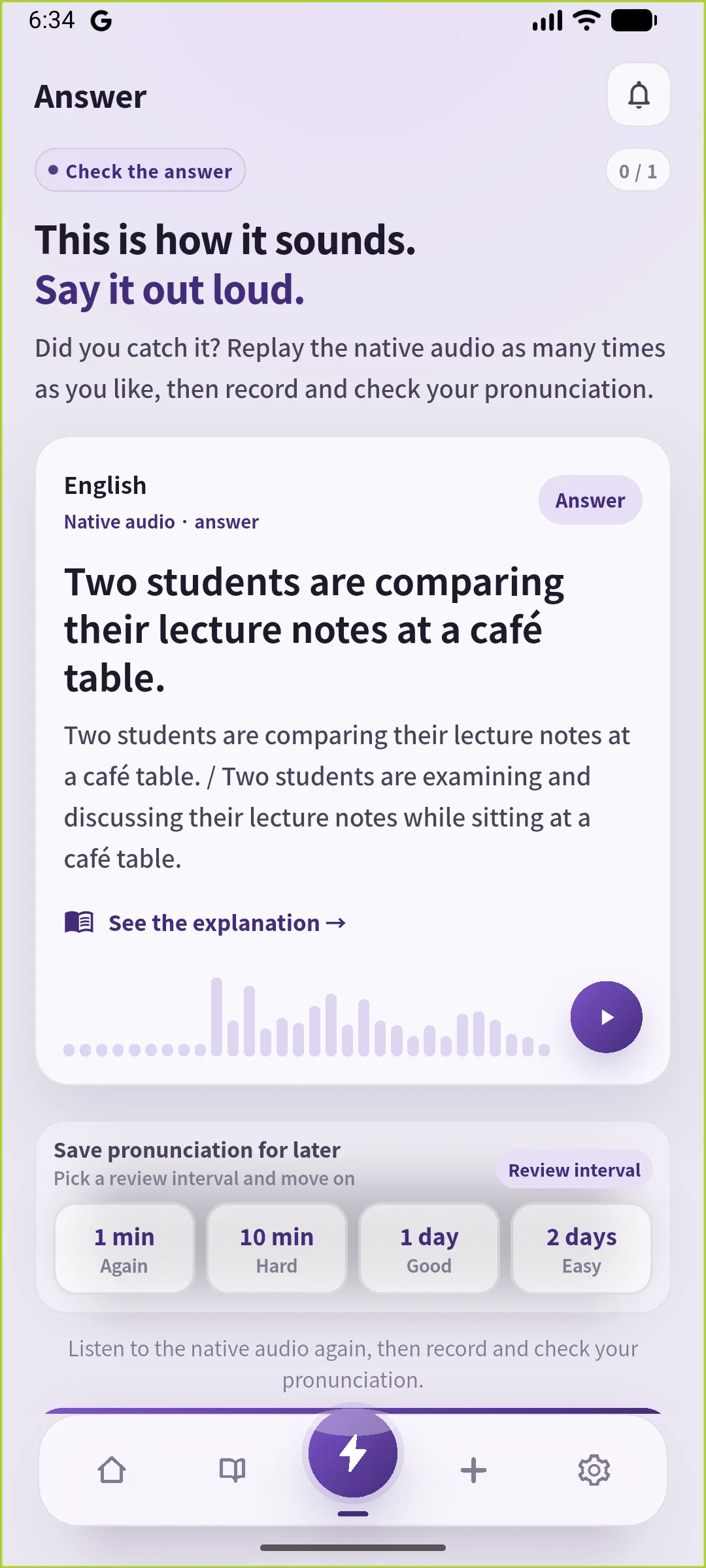
We verified saving a sentence, playing audio and revealing the answer. We do not present SpeakGain as a DET mock test, answer or pronunciation scorer, or DET score predictor. Practise timed responses and review your own recordings separately with the task-specific methods in this article.
Methods we do not recommend
We do not recommend memorizing long model answers: changed prompts can leave you describing invisible details or an irrelevant experience. The official guide also requires natural, topic-specific responses in your own words rather than answers memorized or read from other sources. A universal agree/disagree template fails for photos and experience questions. Keep the organizing principle—answer then develop—but choose the content anew.
We also do not prioritize a fixed quota of difficult words, fast speech to fill the clock or repeated recordings of only one known script. The guide describes relevance/development, vocabulary, grammar, fluency and intelligible pronunciation among the evaluated aspects. First check that you answered; then repair one unclear sentence.
Home testing: prepare more than a computer
The 2026 guide, pages 14–20, checked 14 October 2026, requires a computer with camera, microphone and speakers, a phone and a physical government-issued photo ID. The computer camera should be at the top centre of the screen. DET’s desktop app runs the test; its mobile app supports identification, room/ear scans and continuous recording of the computer screen and keyboard. Keep the phone charged or plugged in. This is separate from the language-learning app.
Internet must provide at least 2 Mbps download and 1 Mbps upload. Do not substitute a saved image or copy for the physical ID; check country-specific official ID guidance. Minimum OS versions are not stated in the guide we inspected; check current equipment requirements before buying.
Use a quiet, well-lit private room. No other people, headphones/earbuds, notes, extra screens or devices; close other programs. Do not record questions or speak before instructed. Stay in frame with the required facial features and ears visible; focus on the screen except when typing. Human proctors review sessions with AI assistance. Wait until upload finishes. Failure to certify because of a rule or setup issue is different from a low English score; plan time for resolving problems before admissions deadlines.
FAQ
What score do I need to study abroad?
Check the institution and program’s own website for accepted tests, overall/subscore requirements and deadlines. There is no single admissions threshold for all universities. Ask the admissions office if unclear.
What room and equipment do I need?
A private, quiet, bright room; the computer camera/microphone/speakers, phone camera, internet and physical ID described above. The phone is a second camera, not an optional study device. Follow the official guide and current setup instructions.
How many times can I take it?
The guide allows purchasing up to three tests in any 30-day period. After a certified result you may buy another test. Purchase limits are not the same as invalid-session retry allowances; individual retry counts/eligibility are not stated in this guide. Check your account result and official support.
How much does it cost?
An exact price is not stated in the inspected 2026 guide. Check the current price, currency and conditions on the official site when buying; we do not borrow a fee from school blogs. Sending certified results has no additional fee.
Should I choose DET, IELTS or TOEFL?
Start with the tests your institution accepts and the testing environment you can provide. Compare official tasks and samples rather than treating different score numbers as interchangeable.
Is the official practice test free?
Yes. The guide says it is free and repeatable. The practice test is shorter and unproctored, and its estimate does not replace a certified result.
Can I prepare if speaking is my weakest skill?
Start with a short direct response: one sentence describing a visible action, or an answer and reason. Record, fix one point, then try a new prompt. Keep the other three skills in the plan; no score increase or deadline is guaranteed.
Editorial verdict
We would first check the current official practice format, then prioritize concrete photo descriptions and direct 35-second responses. For 90-second and longer tasks, add background, actions and results rather than a memorized essay. Today, record one answer, check relevance and detail before pronunciation, and fix one unclear sentence. Tomorrow, change the prompt. Check admissions conditions and home-testing setup alongside English practice.
Official references
All checked 14 October 2026: 2026 test-taker guide, Test Readiness, question-type pages, subscores, scores and free practice test. Question-page links in the speaking sections support their specific preparation and response windows. The official guide links to the DET-owned Help Center.
Duolingo and Duolingo English Test are trademarks of Duolingo, Inc. This independent editorial article and its original examples do not imply official endorsement, a guaranteed score or admission.