
GTEC speaking: test types, answers by part and practice at home
Published
School GTEC speaking in Japan asks you to read aloud, interact using information, tell a four-picture story and express an opinion with reasons. Start at home by confirming your test type, then time one task, record it, listen back and fix one thing. Before planning the remaining weeks, try every part once to find what actually causes difficulty (Benesse samples).
This guide is for teenagers attending schools in Japan, including international and returning students, and their parents or teachers. The English examples and practice routines are our own. They are not official test items, model-score answers or a promise of improvement. A timer and an ordinary voice recorder are enough to begin; no sign-up is needed.
Which GTEC type are you taking?
Core has different response limits and Part B tasks from Basic/Advanced. Basic and Advanced use the same Speaking questions. Check the type and delivery method in your school’s instructions rather than choosing from your age alone (official samples).
The CBT type ended after Japanese fiscal year2025, according to the current official notice, checked13 October2026. “School CBT” on the Assessment Digital page names a school delivery system; it does not mean the discontinued CBT type. Do not use a historical CBT guide as instructions for your current school test.
Official type-by-part format and timing
Checked13 October2026 against Benesse samples and the current rubric, printed pp.7–15. Times below apply per question; preparation and response are separate. The combined Basic/Advanced B row means questions1–2 have10s preparation/15s response, and questions3–4 have20s/20s.
| Type | Part and task | Questions | Preparation (s) | Response (s) | Official assessment focus |
|---|---|---|---|---|---|
| Core | A — Read aloud | 2 | 30 | 30 | Pronunciation and fluency |
| Core | B — Respond and ask questions | 4 (3 responses, 1 question) | 10 | 10 | Goal Achievement: required information |
| Core | C — Tell a four-picture story | 1 | 30 | 40 | Goal Achievement; vocabulary/grammar; pronunciation/fluency |
| Core | D — State an opinion and reasons | 1 | 60 | 40 | Opinion and reason Goal Achievement; vocabulary/grammar; pronunciation/fluency |
| Basic / Advanced | A — Read aloud | 2 | 30 | 40 | Pronunciation and fluency |
| Basic / Advanced | B — Respond and ask questions | 4 (2 responses, 2 questions) | 10 / 20 | 15 / 20 | Goal Achievement: required information |
| Basic / Advanced | C — Tell a four-picture story | 1 | 30 | 60 | Goal Achievement; vocabulary/grammar; pronunciation/fluency |
| Basic / Advanced | D — State an opinion and reasons | 1 | 60 | 60 | Opinion and reason Goal Achievement; vocabulary/grammar; pronunciation/fluency |
| CBT | Testing ended after FY2025 | Not presented as a current format | Not presented as a current format | Not presented as a current format | Not presented as a current format |
Core, Basic and Advanced have8 Speaking questions taking about15 minutes overall. This includes more than your speaking seconds alone. Notes are not allowed during Speaking (official sample directions). You may use notes while learning an answer pattern, but finish your practice without them.
The termination notice does not verify historical CBT part timings. We therefore leave those figures out rather than borrow them from another website. For an existing CBT certificate, check the score-use section below and the official FAQ.
What does the scoring look at?
The rubric distinguishes delivering the required content, using vocabulary and grammar, and speaking with understandable pronunciation and fluency. A focuses on reading delivery; B on Goal Achievement; C and D combine content and language delivery. D assesses an opinion and its supporting reason separately. For Basic/Advanced, the higher reason descriptor includes relevant explanation or examples and a reason extending beyond only the speaker personally; Core has a different reason scale.
Our recording checklist is: Did I answer this task? Did I include what the listener needs? Can the listener follow my voice? An accurate but unrelated sentence misses the task. A short answer can also omit essential content. The public rubric does not provide a fixed “one grammar error costs X points” rule; do not invent one or estimate an official score from your own recording.
A home routine for one question
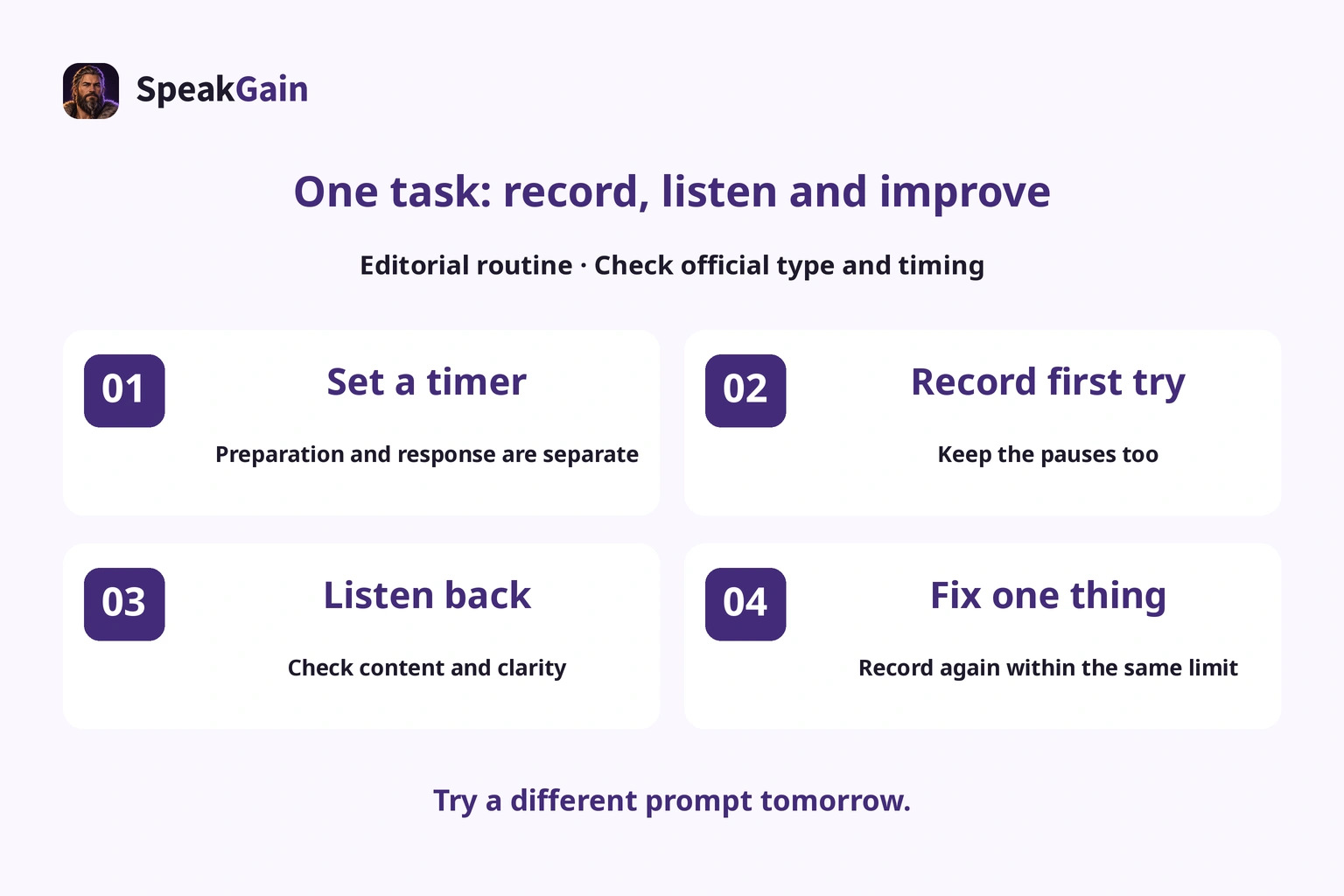
- Set the preparation and response limits for your type. Do not write and rehearse a perfect answer before recording the first attempt.
- Start speaking when the response period begins. Keep pauses and unfinished phrases in the recording so you can find the difficulty.
- Listen once for content, then again for clarity. Check information in B, missing events in C and the opinion–reason connection in D.
- Choose one repair: add the ending of the story, make the tense consistent or make the last words audible. Record again within the same limits.
Tomorrow use a different prompt. That checks whether you can use the pattern, rather than simply recall yesterday’s script. Self-checking is practice, not official assessment. If unsure, give your teacher a short recording and one specific question.
Part A: read the meaning in connected phrases
Task: Read the displayed English aloud. Preparation is30s; response is30s for Core or40s for Basic/Advanced (samples, rubric pp.7–8).
Our pattern: Understand the situation, locate meaningful phrases and finish each phrase before pausing. A short original line is Please bring a bottle of water / for the walk. The slash marks a practice boundary; it is not spoken. Check whether “a bottle of water” reaches the listener as one connected idea.
Home practice: Prepare for30s → record the text within your response limit → listen with the text to find omissions or misplaced pauses → fix one boundary and record again. This short sentence introduces phrasing; use official samples to experience an actual task’s length.
Common mistakes: Racing to finish, repeatedly restarting on a difficult word, or losing volume at the end. Use a pace the listener can follow and keep endings audible. Do not replace the reading with a free opinion. For more practice, see reading aloud.
Part B: switch between answering and asking
Task: Use displayed information to answer or ask a purposeful question. Core has3 responses and1 question, each10s/10s. Basic/Advanced has2 of each, with the two different timing pairs listed above (official B directions).
Our pattern: Answer the requested information in a short sentence; when asking, turn the missing information into a question. On an original note saying “reading club: after school,” a time answer could be It starts after school. To find a meeting place, try Where can we meet? These are patterns, not answers to an official item.
Home practice: Make a simple schedule and have someone ask about time, place or activity → record with the right timer → listen to both the question and answer → correct one mismatch. For asking practice, choose a purpose such as finding the meeting place, then form a question. Alone, record your own prompts and use them later in a changed order.
Common mistakes: Answering with a place when asked for time, inventing information, or explaining when you are supposed to ask. Check the question word and purpose. A long response is not automatically an informative one; B’s public focus is Goal Achievement (rubric p.9).
Part C: cover all four events in order
Task: Tell the story of all four pictures. Prepare for30s, then respond for40s in Core or60s in Basic/Advanced (samples).
Our pattern: Initial situation → next event → change → later outcome. For an original plant sequence: The soil was dry. Then she watered the plant. She put it near the window. A few days later, she saw a new leaf. This is a short starting pattern, not a full official answer.
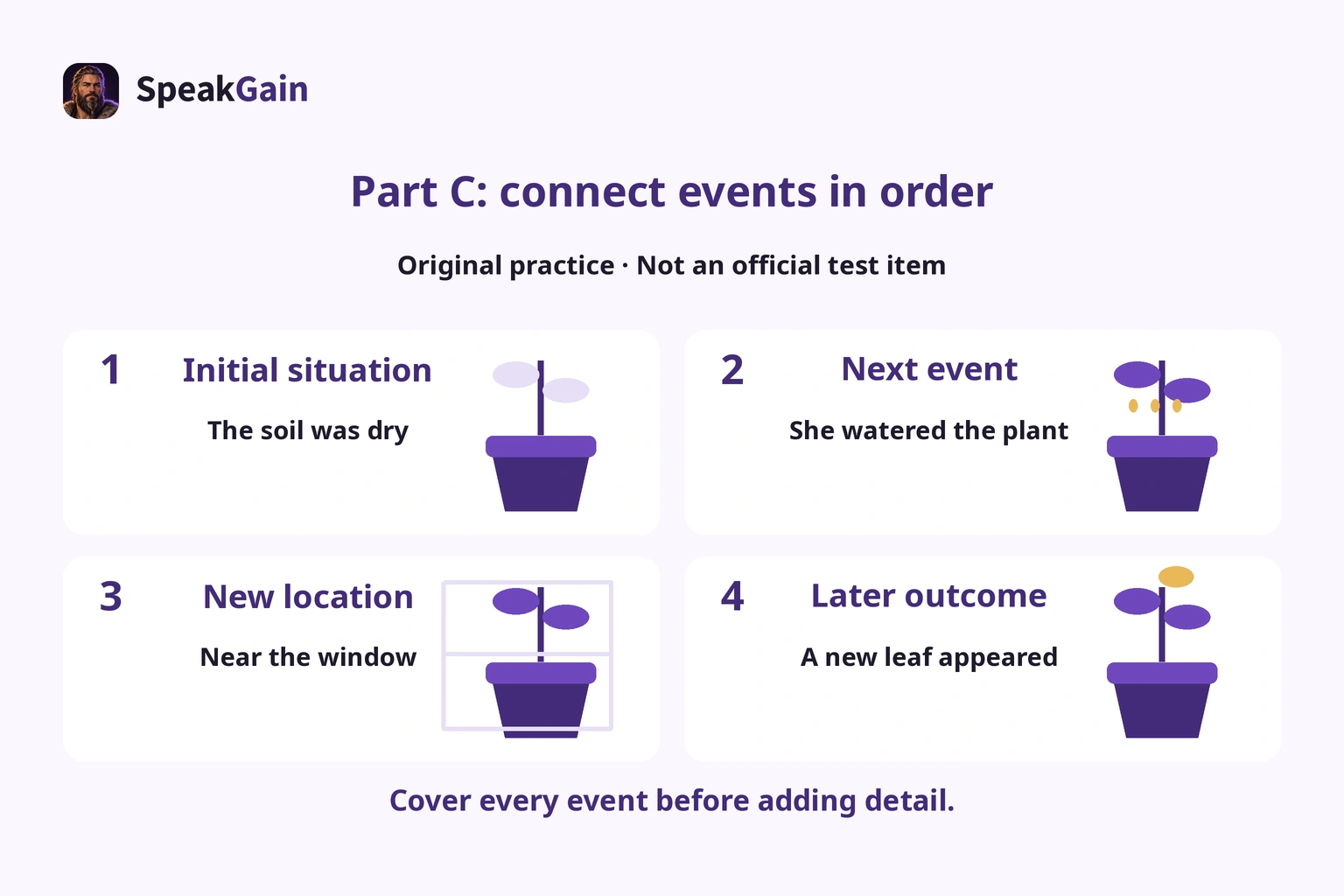
Home practice: Look at four drawings for30s → record within your type’s limit → listen for the main event in every picture → correct one omission or tense. Start with one sentence per picture, then add necessary detail about who did what and how the events connect.
Common mistakes: Spending all your time on picture1, listing nouns without actions, or inventing events. Check the whole sequence during preparation, including the outcome. If a noun will not come, describe the object or action with words you know while preserving the picture’s meaning.
Part D: opinion, reason, then a concrete example
Task: Express your view and why you hold it. Prepare for60s; respond for40s in Core or60s in Basic/Advanced. Basic/Advanced directions ask for detailed, concrete reasons (samples).
Our pattern: State your position, connect a reason and support it with a situation. For our original “a plant for the class” topic: I think a class plant is a good idea because students can take care of it together. Then: For example, they can take turns watering it. Extend these short lines to the actual conditions of the prompt. They do not fill a complete timed answer by themselves.
Home practice: Use60s to decide your view, reason and example → record within the response limit → listen for whether the reason supports the opinion and the example explains the reason → repair one weak connection. Use brief notes only while learning, then practise without notes.
Common mistakes: Saying I agree. without making the position clear, switching to an opposing view, repeating “it is good,” or using the same memorised essay for every topic. We recommend connecting short English sentences you can say instead of drafting everything in your first language and translating it under pressure. Instant sentence practice can support that step.
Save and listen to one line: the SpeakGain flow we checked
This is an optional way to keep one answer-pattern sentence with reference audio. On the dedicated Android setup, we saved the line through normal Add, then checked Library → Knowledge → Learn this card → Listening with the sentence hidden → Reveal answer → Answer. The answer screen showed the sentence, explanation link, playback control and Again/Hard/Good/Easy review choices. We also selected Good.
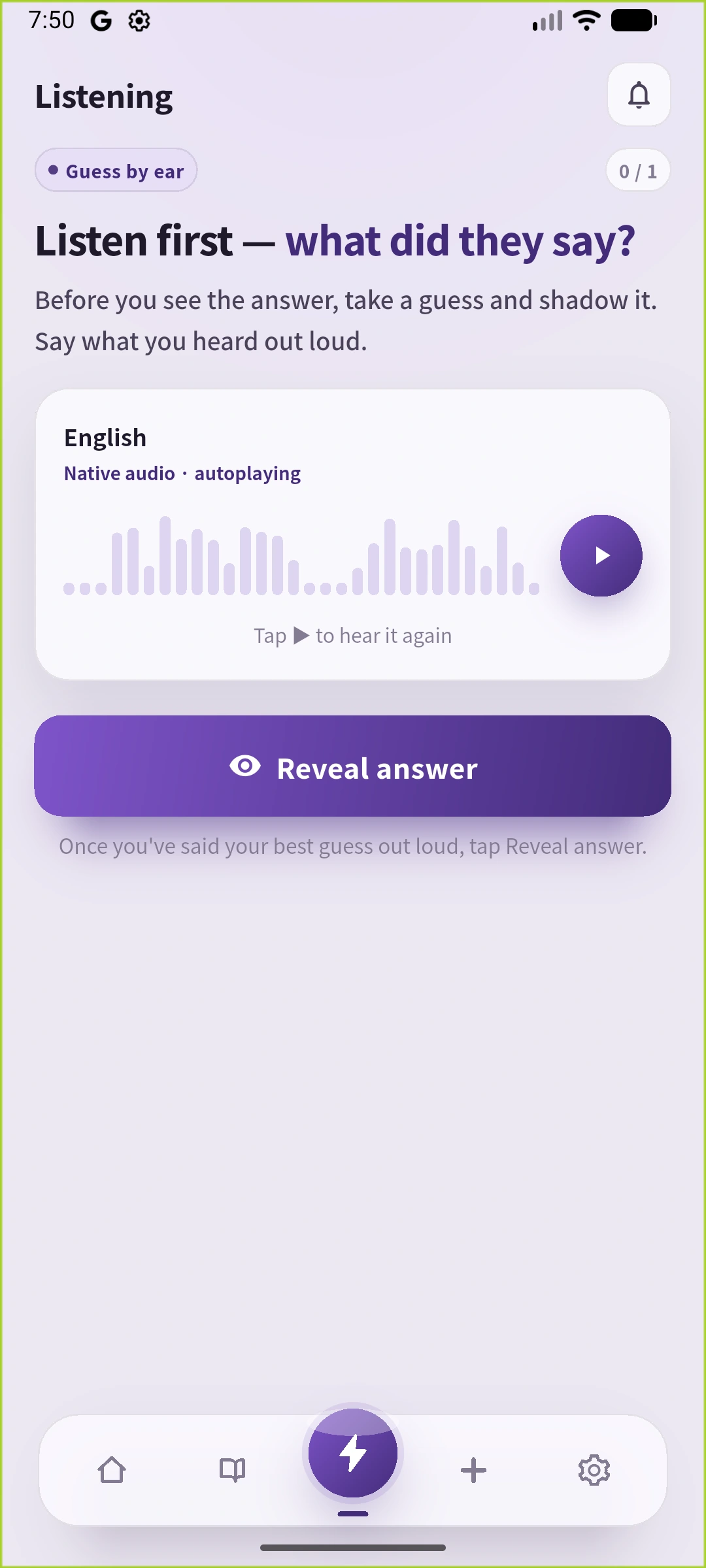
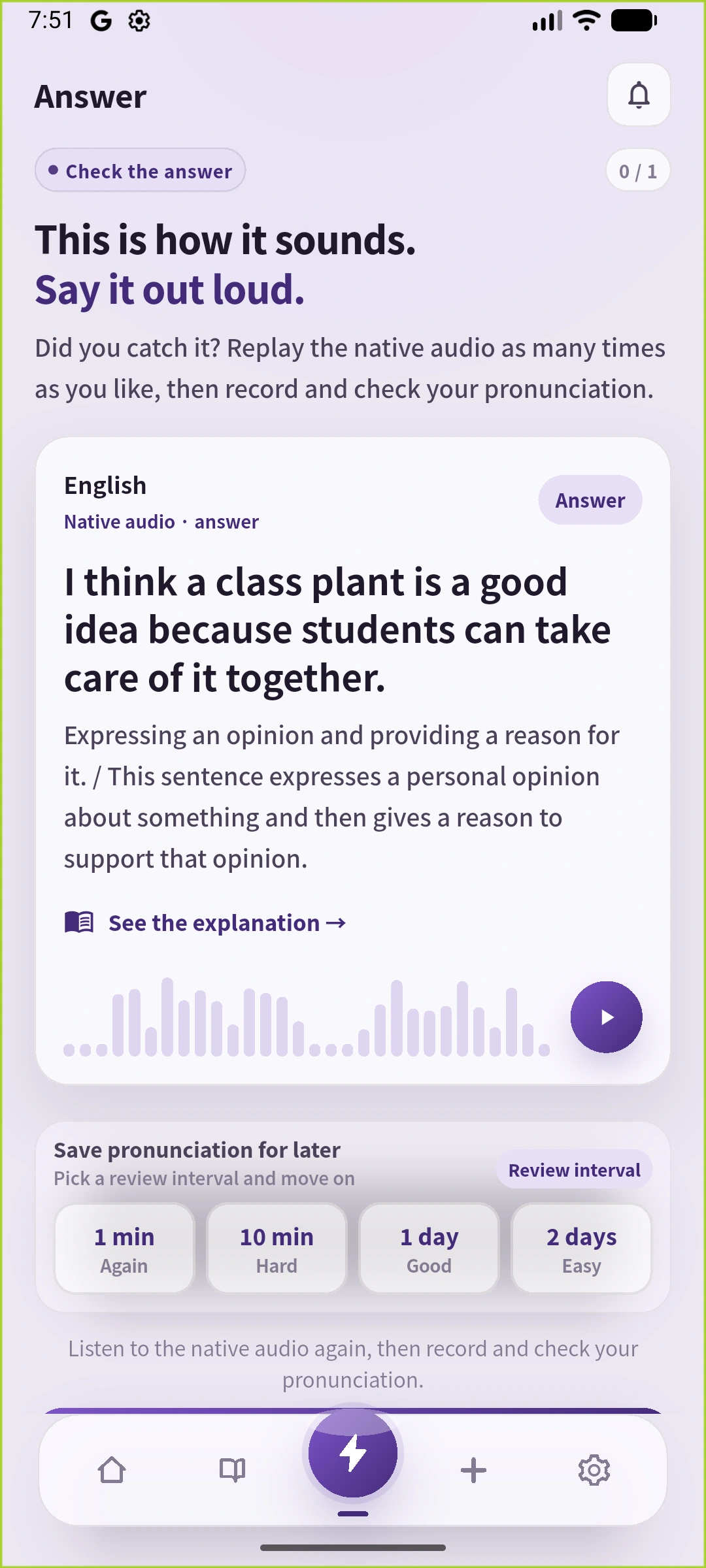
I think a class plant is a good idea because students can take care of it together.
AI-generated Viking audio of our original practice sentence, not an official item, a human recording or a complete timed answer. Native audio on the screen labels the reference audio.
We did not verify a spoken-recording result or speech assessment. Use an ordinary recorder for your timed speak/listen-back routine. SpeakGain is not presented as a GTEC mock test, marking tool or score predictor. Agree app use with a parent or teacher and follow school/family rules.
When your answer will not come, return to the task
The rubric includes silence and completely unrelated responses in zero descriptors. But filler alone does not satisfy a task. Practise these short transitions only when useful:
- Let me think. — choose one position next; do not repeat it until time runs out.
- I mean… — correct just the relevant part, then continue.
- It is something you use to… — explain a real function when a name is missing.
- One reason is… — give a reason connected to the topic.
These expressions do not earn extra preparation time. In A, return to the displayed text; in B, give the requested information; in C, continue the events. Do not expect a recording-based test to replay the prompt because you ask. At home, deliberately practise recovering from a missing word and listen for whether you returned to meaningful content.
Before the test: a practical four-week plan
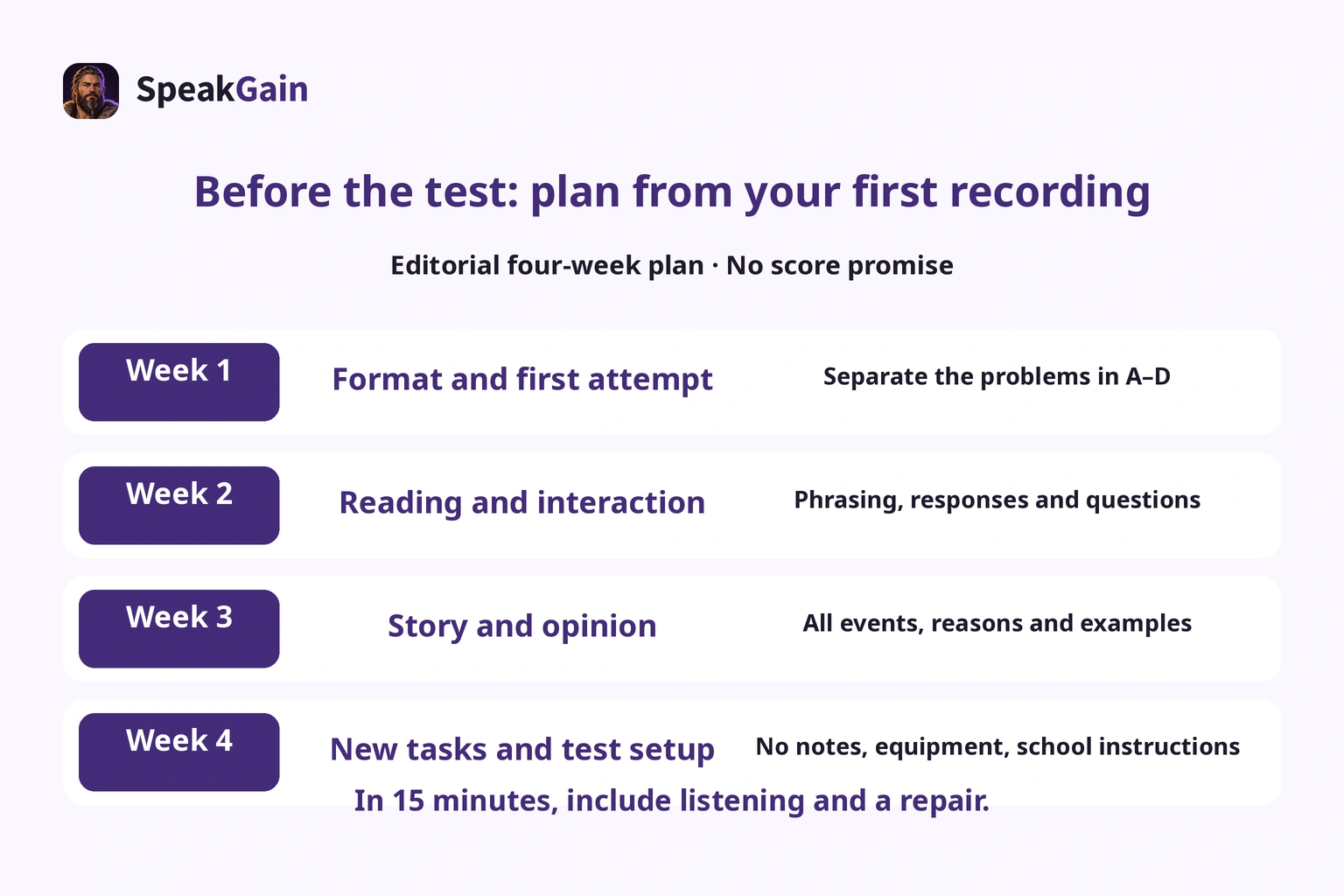
Week1: check the type and record A–D once. Week2: work on reading phrases and answering/asking. Week3: cover the whole story and connect opinions to reasons and examples. Week4: try new prompts without notes and check your school’s test-day instructions. This is our editorial plan, not Benesse’s required study period or a score promise.
For15 minutes a day, allocate3 to choosing/preparing a task,3 to a timed first recording,4 to listening and5 to one repair and another recording. Rotate parts rather than rush all of them daily. With only one week left, try every part first, choose two difficulties and work on those. The day before, review familiar short patterns and practical instructions instead of collecting long new answers.
Parents and teachers can ask “What did you want to communicate?” before correcting everything. Agree with the student before sharing recordings; use fictional material without names or school information. Follow school and family rules for recording and any app use.
Test-day instructions and using the score
Follow your school’s directions for the device, headset, arrival, microphone checks and allowed materials. If Assessment Digital is assigned, use its official environment check and teacher-arranged trial instructions. The trial checks the flow and does not return grading/results.
Benesse’s school page says scores from designated examination dates can be used as official scores for admissions, with details to be checked in each institution’s current requirements. Check your type, test date, required score, certificate and deadline. A learning assessment is not automatically acceptable everywhere. The official validity is through the end of the fiscal year two years after the test; an institution can specify its own eligible testing period. The CBT certificate FAQ remains available despite testing having ended. We provide no universal pass mark, speaking-only admission rule or unofficial score conversion.
Related practice, with formats kept separate
Eiken Grade3 interview practice and Eiken Pre2 interview practice also develop short answers and reasons, but their live interview procedures are different. Versant preparation includes different tasks such as repetition. Use shared sentence practice only after identifying what GTEC asks you to do. For the wider study plan, see how to study English.
Frequently asked questions
What happens in school GTEC speaking?
Core, Basic and Advanced have reading aloud, information-based interaction, a four-picture story and an opinion with reasons:8 questions/about15 minutes. Use the type-specific limits above (samples).
Is silence better than an imperfect answer?
The public rubric includes silence in zero descriptions. Practise saying relevant information with words you know. An unrelated memorised line or filler alone is not a solution (rubric).
How many points does one grammar mistake cost?
We cannot give a fixed deduction from the public descriptors. In C/D, vocabulary/grammar is assessed alongside content and delivery. Pick one error to fix after practice instead of restarting every sentence.
How much home practice is enough?
It depends on your starting point. Our15-minute routine is a manageable starting allocation, not an official recommendation or a formula for points gained.
Are Basic and Advanced Speaking the same?
Yes, the official samples state that their Speaking questions are identical. Do not extend that claim to the other skills; Core also has different timings and a different B task split (samples).
Is CBT still offered?
The CBT type ended after FY2025. School CBT for Assessment Digital is a different name and context; check your school’s instructions (notice, Digital).
Can I use the score for admission?
Official examination-date scores can be used, subject to the destination’s current conditions. Check accepted types, dates, thresholds and proof; no universal Speaking pass score is given here (Benesse).
Where are the official examples?
Choose your type in Benesse samples, and consult the rubric and answer audio. Our English lines and plant illustration are original practice, not official items.
If you also take TEAP, check our TEAP Speaking guide for its interview roles and candidate-led questioning practice.
Our verdict: improve one relevant answer, not a memorised essay
Confirm the type, record all parts once, fix the hardest single problem and test the change on another prompt. Listen for connected phrases in A, required information in B, event order in C and a supporting reason in D. We do not recommend memorising long scripts, translating an entire first-language draft or practising waiting silently: those make it harder to adapt when the topic changes. Aim for one clear, relevant answer and one observable repair.
Official sources and check date
Format, timings, rubric, termination and score-use sources were checked 13 October2026. Recheck before your test and application: samples, scoring/audio, current rubric, CBT notice/FAQ, Assessment Digital, official score guidance. GTEC is a registered trademark of Benesse Corporation. This is an independent editorial practice guide.