
English sentence drills: how to practise, benefits and limits
Published Updated
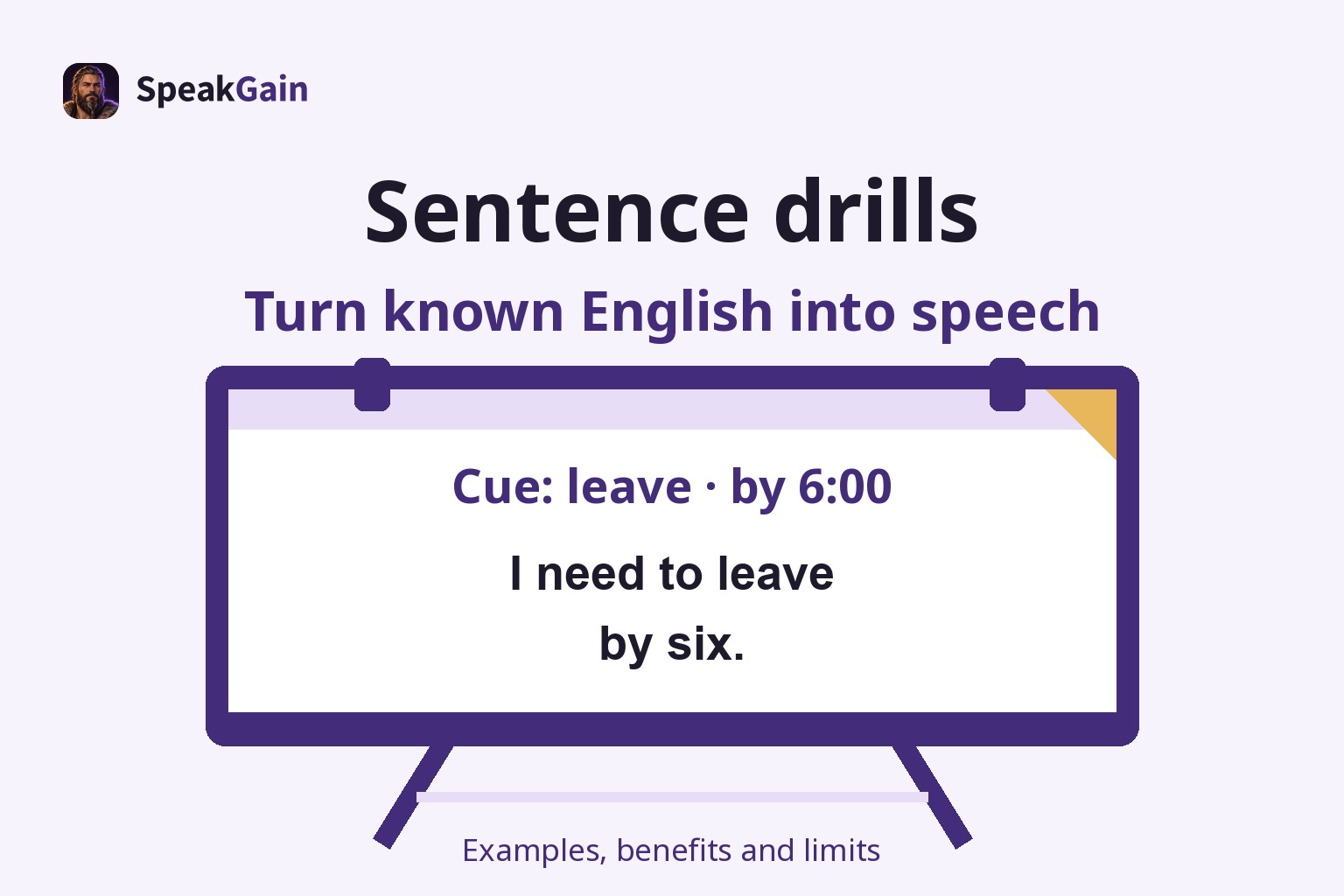
To practise building English sentences aloud, start from a short meaning cue, say an English sentence before looking at the answer, check its meaning and sound, then hide it and say it again. Our editors recommend this for learners who understand a sentence when they see it but cannot produce it aloud. Start with five easy sentences for 10–15 minutes, then change one into something you actually need to say. Those numbers are an editorial starting point, not a research-established optimum.
The aim is to express who does what and when, in English word order. Racing a timer or reproducing a textbook answer quickly does not by itself show that you can hold a conversation. This article explains the method, who it suits, its limits and the bridge to your own replies. For tools, see our sentence-building app guide; for the broader sequence, see how to study English.
For Japan’s newer intermediate grade, our Eiken Pre-2 Plus interview guide explains the three-picture task, short reasons and solo practice.
For an upcoming TOEIC Speaking test, use our task-specific answer patterns and solo practice guide to plan timed recordings around the official limits.
If you are taking Japan’s EIKEN Pre-2 second stage, use our interview flow, answer patterns and solo practice guide to record an answer and repair one point at a time.
For Japan’s EIKEN Grade 3 second stage, our interview flow, five-question answer patterns and solo practice guide helps you record a response and correct one point at a time.
If you keep translating before speaking, try a daily routine for thinking in English to practise one short sentence from a familiar situation.
Beyond building a supplied sentence, speaking paraphrase practice lets you choose the feature you want to communicate.
To choose your solo routine, compare English speaking practice methods by level and goal and select two exercises for your daily menu.
For a paper resource to practise patterns, check editions and audio access in our conversation-book guide.
What does this exercise train?
It trains you to retrieve familiar vocabulary and grammar from meaning, without seeing the English answer first. A cue can be in your first language, or be a situation such as “Departure required no later than six.” English-speaking readers should use meaning cues rather than repeat the answer as its own gloss.
This resembles the Japanese practice known as shunkan eisakubun. The publisher of Yosuke Morisawa’s training book describes quick oral sentence construction from Japanese using basic school grammar; the revised edition includes downloadable audio. That describes the product’s method, rather than independently establishing its effectiveness. Our examples below are original editorial examples, not copied book exercises. Publisher’s description
Reading aloud starts with visible English. Repeating starts with English you have just heard. Sentence building starts with a meaning cue. Conversation also requires understanding another person and choosing what to communicate. These activities overlap, but one cannot verify all the others. If sounds are the obstacle, use reading English aloud; if you cannot find the content or words, see when English words won’t come out.
Who is it useful for—and who needs a different next step?
Our editors recommend it when you can explain the answer but get stuck retrieving its subject, verb or word order. For “Departure required no later than six,” perhaps you cannot say I need to leave by six. Yet, on seeing it, you know that need to takes the base form of a verb and by six gives a deadline. That is a reason to practise using the form, rather than only rereading its explanation.
| Your current difficulty | Our editors’ recommendation |
|---|---|
| You understand the answer but cannot form it aloud | Try five familiar sentences with answers hidden |
| You cannot explain need to | Understand that structure first; use a shorter sentence |
| You are fast only in the usual order | Shuffle the cues and change one detail |
| Textbook answers are easy, but replies are not | Choose your own content and answer a question |
| You can build the sentence but stumble over its sounds | Listen and practise short chunks, then the whole sentence |
Needing a grammar review does not mean you cannot learn to speak. It means this particular exercise needs a comprehension stage before speed. Likewise, endlessly repeating easy material will not verify whether you can understand a question or choose an appropriate reply. Use the speaking roadmap to connect these separate skills.
Does sentence-building practice work? Evidence and limits
We use it as practice in applying known forms; we do not promise that a certain number of textbook laps produces conversational fluency. The following studies are related evidence, not trials of these five sentences or of SpeakGain.
DeKeyser’s 1997 public abstract describes 61 participants learning four rules and 32 words of an artificial language. After reaching a knowledge criterion, they practised computer-based comprehension and production for eight weeks. Production involved typing sentences corresponding to pictures, not oral translation. The reported development was gradual and skill-specific. Our editorial inference is to distinguish knowing a rule from practising its use; the experiment does not establish the effectiveness of this spoken drill. Original abstract
Lambert, Kormos and Minn’s 2017 public abstract describes 32 Japanese learners of English repeating three oral monologue tasks—directions, narration and opinion—six times each. Immediate repetition of the same task was associated with improved fluency. That is different from translating individual short cues, and does not establish transfer to an unfamiliar topic the following week. Original abstract
Accordingly, our editors suggest checking not just same-session speed but next-day recall, shuffled order and one changed detail. This is a practical editorial check, not a validated measurement protocol. We inspected the public abstracts, and do not claim an effect size or guaranteed learning period.
Step 1: Choose five sentences you understand
Use answers whose vocabulary and structure you can explain. Start with the first two if all five are too much. A long business email full of unknown forms makes it hard to identify what needs fixing.
| Meaning or situation cue | Example answer | What to check |
|---|---|---|
| Current state: tired | I am tired now. | be for a state |
| Usual workplace: your home | I usually work from home. | Present simple for a habit |
| Yesterday’s action: sending the file | I sent the file yesterday. | Past tense of send |
| Departure required no later than six | I need to leave by six. | need to + verb; by for a deadline |
| Politely ask for the file today | Could you send me the file today? | A request with Could you |
Put cues and answers on separate sides or cover the answer column. After checking this table on a phone, look away before saying your sentence. Reading the visible answer is a useful checking stage, but record it separately from producing the sentence yourself.
“Usually work from home” describes a habit, not necessarily what is happening right now. “By six” means no later than six, rather than precisely at six. Understand the intended message before substituting individual words from your first language.
Step 2: Say it before you reveal the answer
Give yourself a few seconds to attempt the sentence aloud, then check rather than silently struggle for a minute. Our suggested first-pass pause is about 3–5 seconds, not a pass mark.
You might reach I need to … and lose the verb. Say what you can, reveal the answer and identify the missing leave. On the next attempt, use I need to leave as a chunk, then add by six.
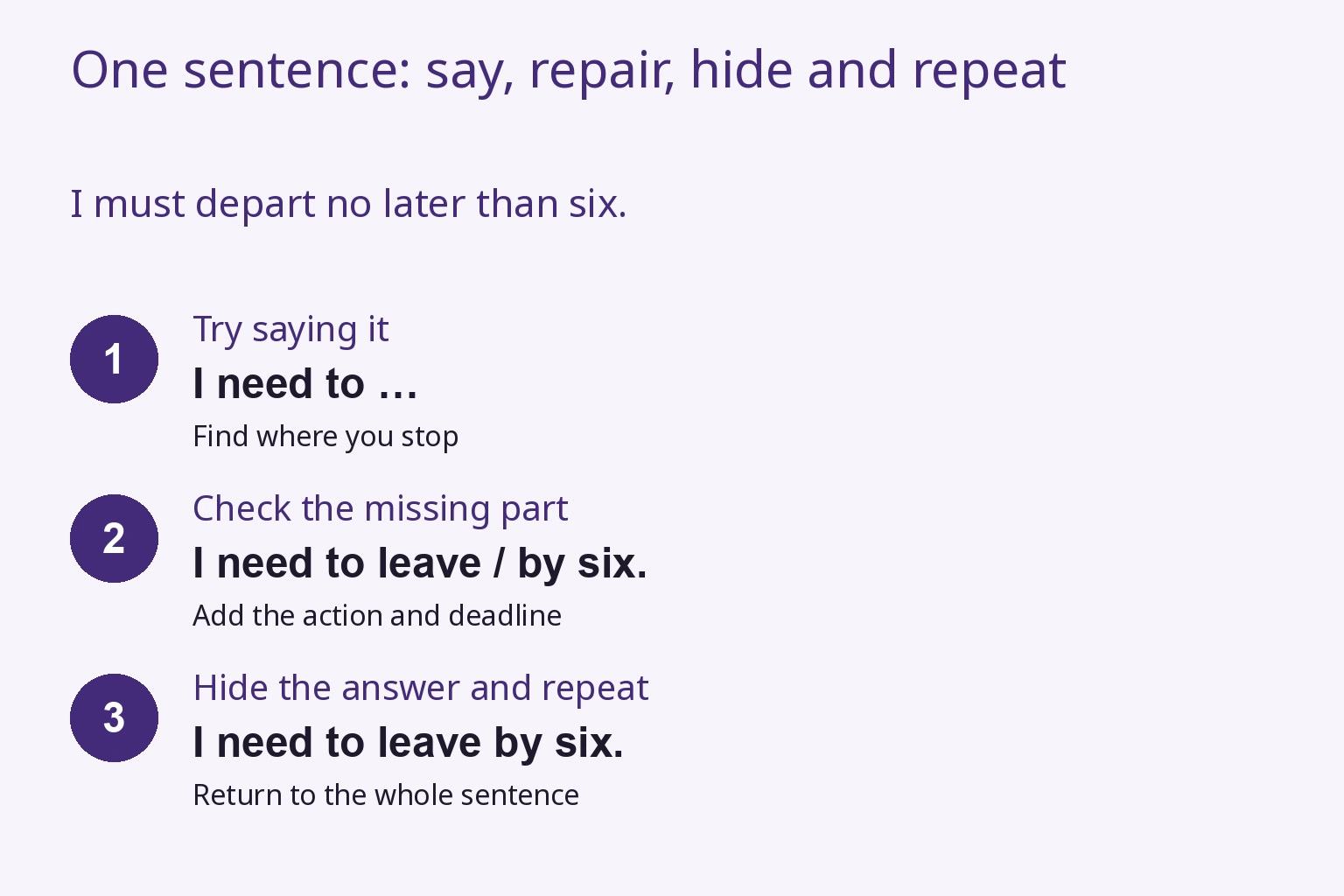
If you say I need leave by six., identify the missing to; if you use send for yesterday, identify the tense. A specific repair tells you what to keep on the next attempt. Thinking the sentence silently does not check whether you can actually pronounce it. If you prepare during a quiet commute, leave a short time later to say the five sentences aloud.
Step 3: Check the answer and sound, then hide and repeat
Checking ends with another attempt from meaning, not merely with looking at correct English.
- Pick one difference between your attempt and the answer.
- Listen to a model and say it once with the text visible.
- Hide the English and produce the whole sentence from the cue.
- Recheck the troublesome part, then return to the whole sentence.
The older edition’s publisher describes audio ordered Japanese → pause → English. With suitable materials, speak during the pause and use the English to check. Repeating after hearing the model is a different attempt from creating a sentence before hearing it. Publisher’s audio description
Do not reject a natural alternative simply because it differs by one word. I’m tired now. expresses the same message here as I am tired now. However, replacing by with at changes the time condition. If you cannot judge an alternative, check an explanation, dictionary or teacher. A pronunciation score cannot establish that your meaning and grammar are correct.
If speed makes you drop to or the, slow down: I need to leave / by six. Then join the chunks into one sentence.
Step 4: Repeat the set with a different purpose each time
Reduce support rather than count laps. First understand the sentences, next retrieve them with English hidden, then shuffle the cues and check again the next day.
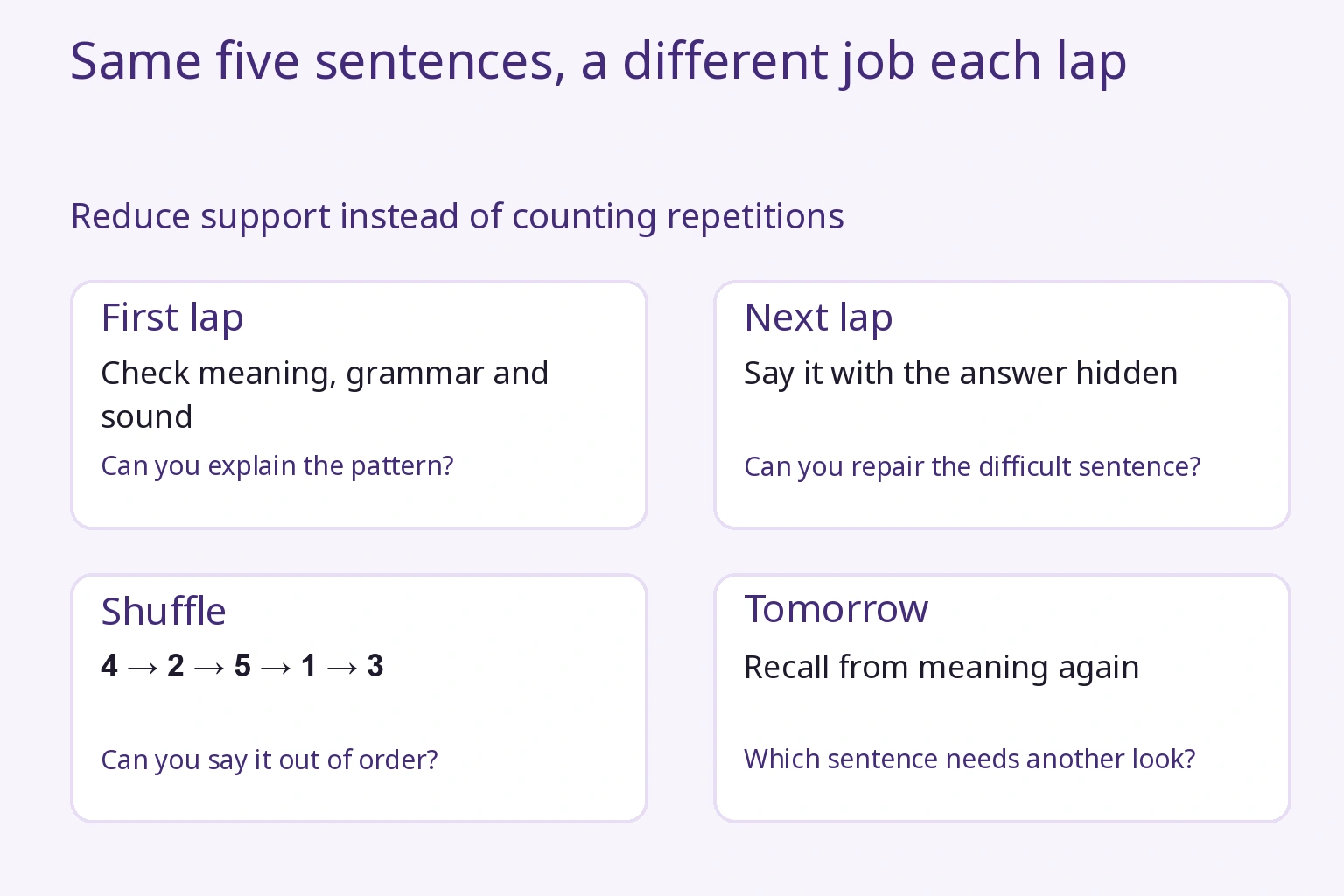
| Stage | Task | Check before moving on |
|---|---|---|
| First pass | Meaning, grammar and sound | Can you explain the structure? |
| Next pass | Answer hidden | Can you repair and finish a difficult sentence? |
| Shuffled pass | Try 4 → 2 → 5 → 1 → 3 | Can you speak without recalling the sequence? |
| Next day | Attempt before looking | Which sentence needs a return visit? |
This is our editors’ sequence, not an official repetition count. If four sentences are ready and one is difficult, spend time on that one. More same-day laps do not replace tomorrow’s check.
For a 10–15-minute session, spend 2–3 minutes recalling the previous set without answers, 5–7 minutes repairing difficult sentences, and the rest shuffling and changing one into your own content. On day one, use the recall time for understanding. Five sentences are not a daily quota: understanding one properly can be enough. If everything comes easily, change a detail rather than add ten more identical laps.
Step 5: Move from textbook sentences to your own replies
Change one detail, then remove the supplied meaning cue and choose what you want to say. First use your real schedule: I need to leave by five. Then respond to What time do you need to leave? Choose the time yourself; By five. can be an appropriate short answer.
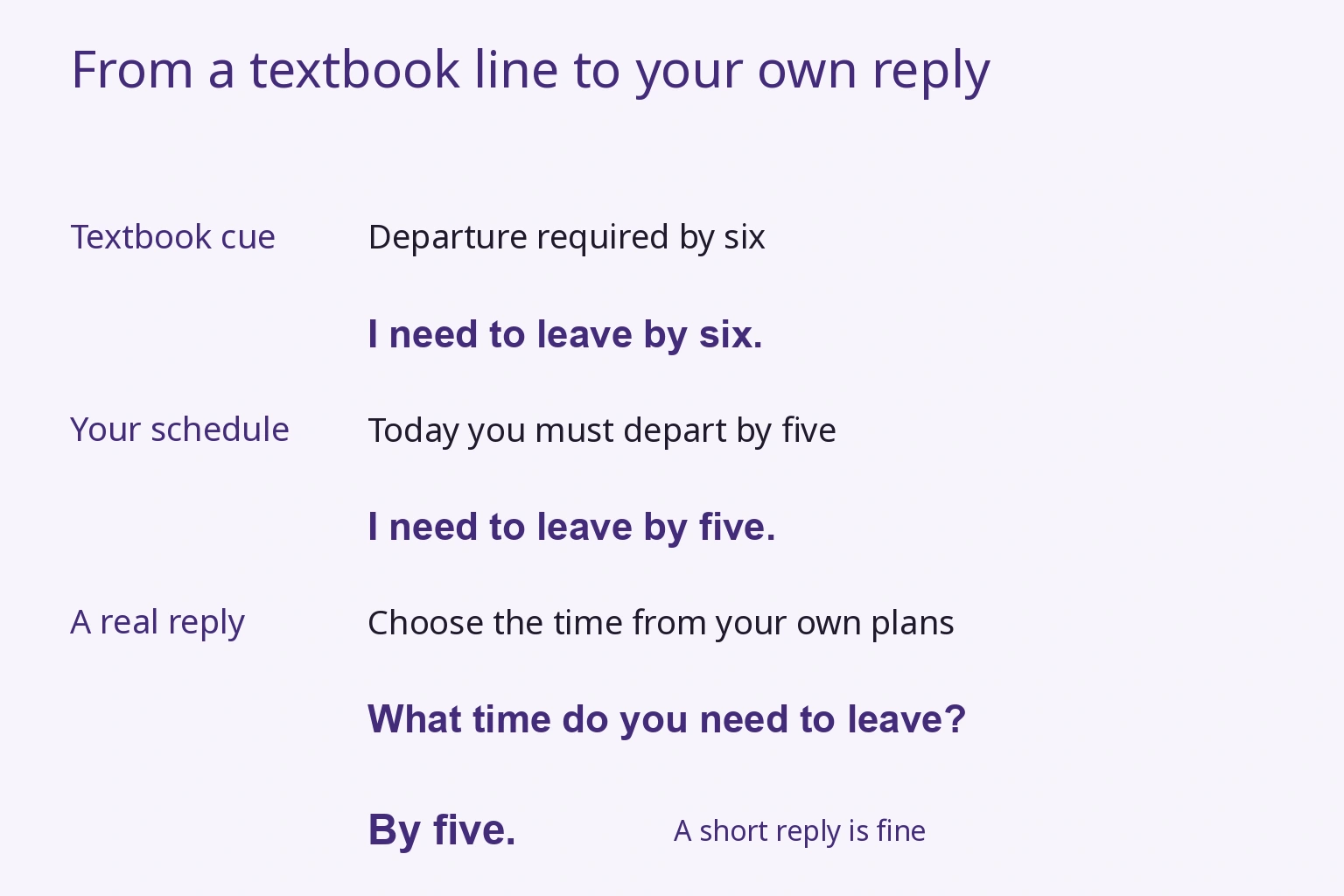
For the past-tense example, change the object: I sent the message yesterday. Then answer What did you do yesterday? with something you actually did. Everyone need not give the same answer. Producing the prepared sending sentence and explaining your own yesterday are separate checks.
Mechanical substitution does not make every combination natural. For example, keep from home only where the verb and meaning suit it. Check unfamiliar combinations instead of treating them as another speed test.
Saving your own sentence with SpeakGain
After choosing a sentence you use, you can save it and practise listening and speaking with SpeakGain, the app we develop. Its standard study flow starts with listening and guessing, then revealing the answer. It is not a dedicated first-language-prompt → English composition mode.
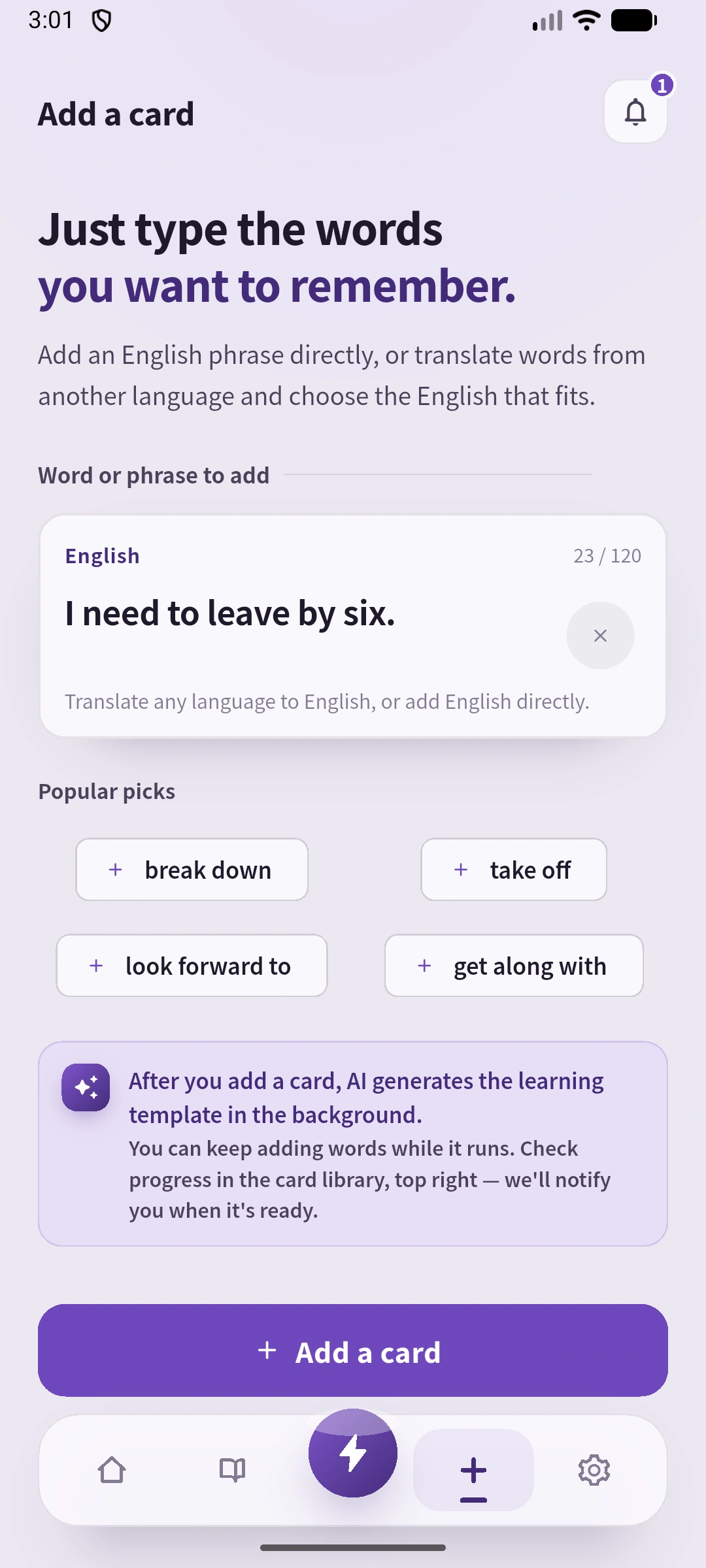
We created one I need to leave by six. card through the normal Add a card flow on Android. These are real screens with English UI: Add a card adds a card; Reveal answer displays the answer. See what SpeakGain does.
Opening study from the created card played audio first and asked us to infer what was said. Revealing the answer showed the sentence and meaning, replay, and a Record and check button for recording and pronunciation checking. Saving an English sentence does not mean every translation you invent is corrected.
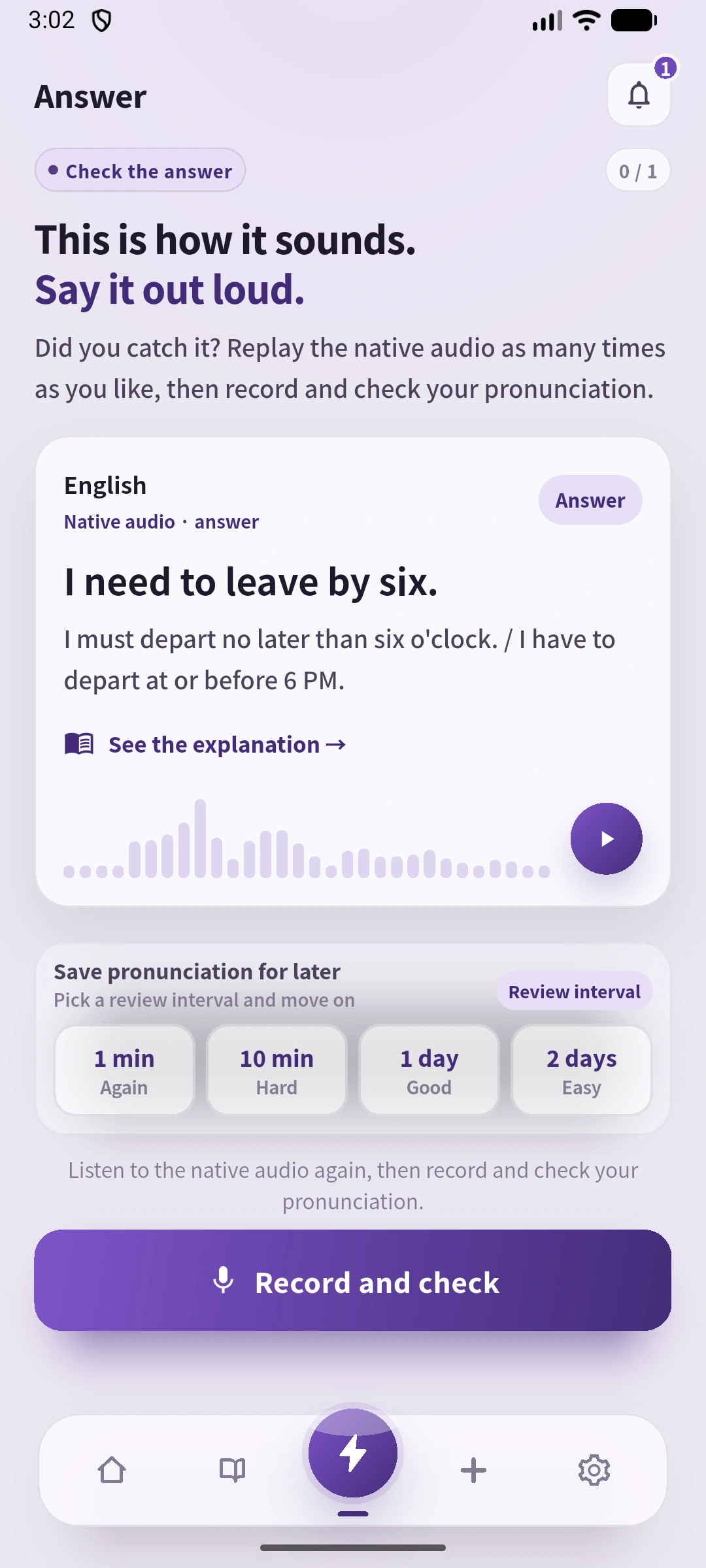
Viking model audio for I need to leave by six.
This Viking model audio was generated once for the shared sentence. You may keep a meaning cue separately on paper, say your answer first and then use this audio to check. That order is an exercise you arrange, rather than an app feature that displays only the native-language cue. Check tomorrow’s recall before collecting more cards.
Six common mistakes and fixes
Before adding repetitions, check what actually prompted your answer. Fix one relevant problem today.
| Mistake | Concrete repair |
|---|---|
| Memorising the order instead of reading the cue | Shuffle, then change six to five and check that the answer changes |
| Only reading the English aloud | Add one attempt with the answer hidden; repair just what disappears |
| Racing and dropping subjects, tense or small words | Slow down; in I sent the file yesterday., check sent and the file |
| Translating an elaborate native-language sentence at once | Start with a short request; add a reason or condition after you can finish it |
| Rejecting every alternative answer | Separate contractions from changes in meaning; ask when unsure |
| Saying textbook lines but failing to reply | Use your own schedule and a question; practise understanding the question separately if necessary |
Record yourself only with a question to check, such as whether the past tense remains. More recordings without listening for anything do not clarify the next repair.
Frequently asked questions
Is sentence building pointless?
No blanket judgment fits everyone. Our editors recommend it for using understood grammar aloud. Its coverage is narrower when you memorise only the sequence, stay silent or never move to your own replies.
How many times should I repeat a book?
Use hidden answers, shuffled order and next-day recall rather than a fixed lap count. Return to the sentences that still stop you, and change content in those you can already say. Ten laps do not certify conversational ability.
How many minutes and sentences per day?
Our starting suggestion is five easy sentences for 10–15 minutes. It is not a proven optimum. Finish checking and saying again, and reserve time for the next review before adding material.
Can I practise alone?
Yes, with checked answers, grammar explanations and audio. Ask a teacher or another qualified person about alternatives or persistent errors you cannot judge yourself.
Is basic grammar enough to start?
Yes. Choose a level where you understand the answer and its structure. Review a form first if even a simple sentence is unclear; difficult vocabulary is not the goal.
Should I use a book or an app?
Choose a tool that lets you see the cue, attempt an answer, check text and sound, and return tomorrow. For specific options, use our sentence-building app guide.
Will first-language cues stop me thinking in English?
The studies inspected do not establish either an inevitable problem or a guarantee of no problem. Our editors use these cues as early support, then move to situations and questions where you choose the content yourself.
When will it improve conversation?
There is no universal deadline. Check fewer pauses and omissions in the set, next-day recall, then replies with changed content. Faster prepared answers alone do not prove transfer to a new conversation.
To bring short sentences into an interview, use our Grade 2 interview guide to check story continuity and opinion reasons through recordings.
Our editors’ verdict
If you understand grammar but cannot form it aloud, make this one part of your practice. If you do not understand it, return to comprehension; if textbook answers are easy, move to choosing your own content. Today, attempt one easy sentence before looking, repair one gap and say it again with the answer hidden. Next time, shuffle and change one detail to match your life before adding material.
Sources
- Beret: revised training book with downloadable audio
- Beret: older edition and audio sequence
- DeKeyser (1997), Beyond Explicit Rule Learning: public abstract
- Lambert, Kormos & Minn (2017), Task Repetition and Second Language Speech Processing: public abstract
Sources and app screens checked on 10 October 2026. Research conditions and editorial suggestions are distinguished throughout; this article does not guarantee the effectiveness of a particular book or app.
When the pattern itself is unclear, our grammar app guide helps you choose focused review before creating your sentence.
To choose a tool for your own entries, compare English diary and writing apps by correction type, consistency support and free limits.