
EIKEN Pre-2 interview preparation: answer patterns and solo practice
Published Updated
Japan’s EIKEN Grade Pre-2 interview takes about six minutes: you read a passage aloud and answer five questions about the passage, illustrations and your own views. The second-stage pass threshold is 406 out of 600 on the EIKEN CSE scale, with responses, pronunciation, language use and willingness to communicate among the assessment considerations. For solo preparation, our editors recommend recording one task, listening back, fixing one point and recording it again. EIKEN EIKEN EIKEN
To use reason-giving practice for a school test, GTEC speaking preparation helps you plan around the assigned type and response limit.
For Japan’s newer intermediate grade, our Eiken Pre-2 Plus interview guide explains the three-picture task, short reasons and solo practice.
This guide covers the conventional, face-to-face second stage in Japan. It is a preparation method, with original examples, rather than a comparison of courses or apps. Test facts were checked against official sources on 10 October 2026; answer patterns, practice timers and the plan are editorial suggestions. For your broader routine, see how to study English.
For Japan’s EIKEN Grade 3 second stage, our interview flow, five-question answer patterns and solo practice guide helps you record a response and correct one point at a time.
For the big picture first, see our all-grade Eiken comparison and common preparation guide before choosing your grade’s practice.
Before attending in Japan, use the Eiken interview-day guide to check clothes, documents, entry and exit, and a short English repeat request.
To turn a written opinion into a short spoken answer, practise connecting a position and reason with our Pre-2 writing guide.
Pre-2 is different from Pre-2 Plus
Grade Pre-2 Plus was introduced in 2025 between Pre-2 and Grade 2. The official FAQ says its introduction does not change existing grades’ question scope or format, or their pass thresholds. We checked this guide against the current Pre-2 page, not the Plus format. The session timetable did change; check your own second-stage admission ticket for arrival details. EIKEN EIKEN
S-CBT speaking records answers through a headset. The instructions below about handing over a card and leaving the interview room refer to the conventional face-to-face interview. EIKEN
Interview flow and question structure
Read silently for 20 seconds, then read the title and passage aloud. You may look at the card for Questions 1–3. After Question 3, turn it over when instructed and answer Questions 4–5 without looking. The official page gives about six minutes for the whole interview, not a fixed answer time for each question. The last column below is our editors’ practice check, not a points rubric. EIKEN
| Order | Task and card use | Official time or amount | Editors’ check |
|---|---|---|---|
| Enter and sit | Hand over the interview card; follow seating instructions; confirm name/grade and greet | No separate time stated | Listen and respond |
| Receive the question card | Passage and Pictures A/B; read silently | 20 seconds | Understand the topic and connections |
| Read aloud | Start with the English title | Passage of about 50 words | Keep words and meaning groups intact |
| Q1 | Answer about the passage; card available | One question; no fixed individual time stated | Select information that answers the question |
| Q2 | Describe people’s actions in an illustration | One question; same timing note | Say who is doing what |
| Q3 | Explain a person’s situation in an illustration | One question; same timing note | Explain the situation using relevant visible information |
| Turn over the card | Follow the examiner’s instruction after Q3 | No separate time stated | Stop relying on the passage |
| Q4 | Give a view on a topic related to the card | One question; no fixed individual time stated | Connect the position and reason |
| Q5 | Answer about everyday matters, possibly unrelated to the card | One question; same timing note | Answer what was actually asked |
| Finish | Return the question card and leave | Whole interview about six minutes | Follow the closing instructions |
There is one examiner and communication is in English. Official assessment considerations include response content, pronunciation, vocabulary, grammar/usage, amount of information and an active willingness to communicate. Start your review with whether the answer fits the question; then address an unclear word or sentence. EIKEN
The pass mark is a CSE threshold, not a self-marking formula
406/600 is the second-stage CSE pass threshold. The historical scoring announcement states that value; the current CSE explanation confirms the skill maximum, and the 2025 Plus FAQ says existing thresholds remain unchanged. We use the historical page only for that second-stage threshold, not its old first-stage description. EIKEN EIKEN EIKEN
The foundation explains that CSE is calculated statistically and candidates cannot calculate it from their own correct-answer counts. Do not turn 406 divided by 600 into a required accuracy percentage, or claim that an unofficial raw total guarantees a pass. Our editors would use recordings to check passage information, actions, situations and reasons—not to predict an official score. EIKEN
A solo routine: record, listen, fix one thing, transfer
Use a recorder and timer at home. Recording, photography and note-taking are prohibited during the actual interview. Start with the official sample materials and official virtual interview. We link to those materials without reproducing the questions or card designs. EIKEN
- Record an attempt without reading an answer. Before reading aloud, use the official 20-second silent-reading period. For question answers, start with a 30-second recording window, including pauses. This is our practice suggestion, not an official time limit.
- Compare the question with what you actually said. Check the answer before judging the accent.
- Choose one obstacle: wrong subject, missing action or absent reason.
- Record the same question again and compare the chosen point.
- Change the person, topic or reason to test whether you can adapt the structure.
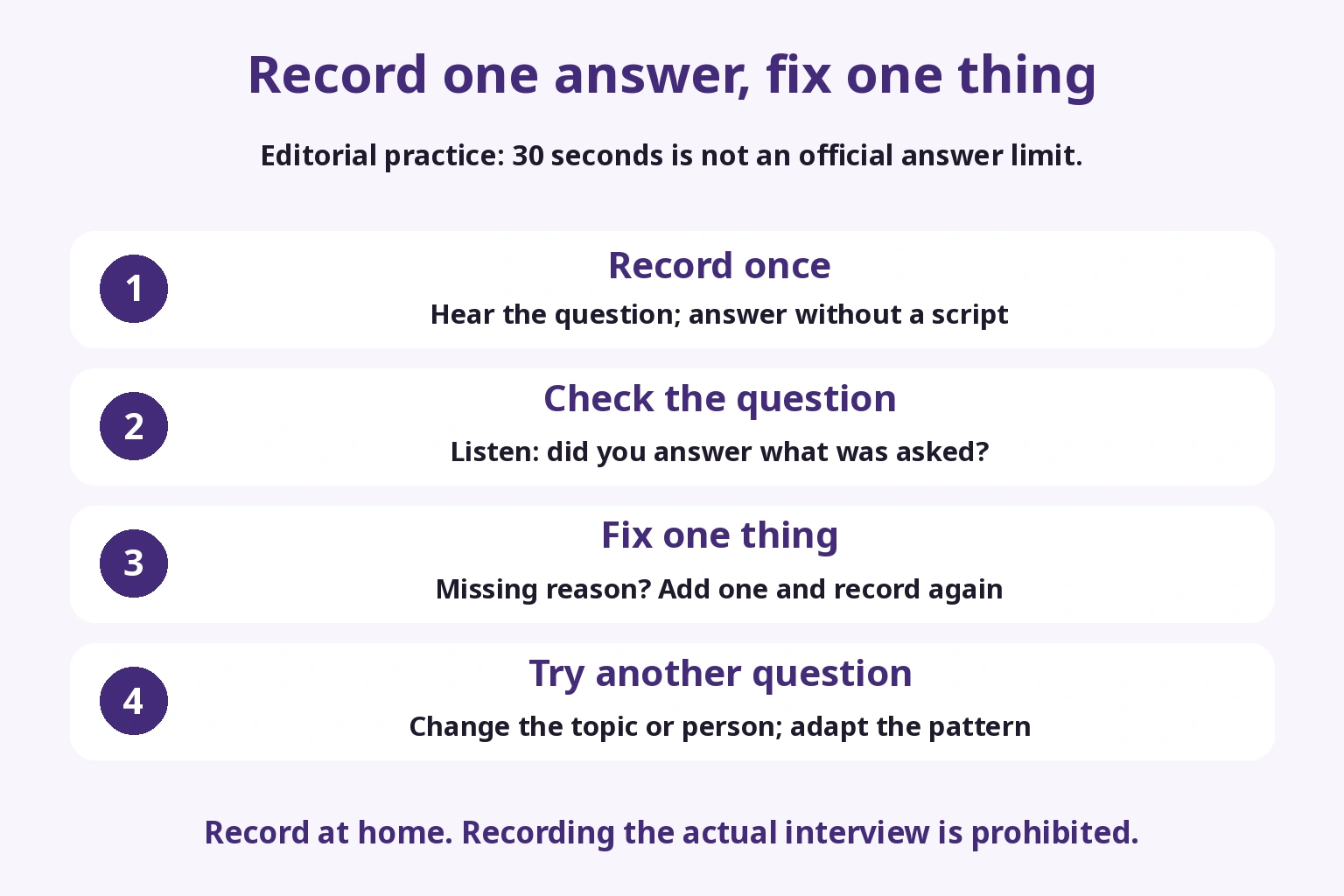
If you record your own practice prompts, play them in a different order. The aim is to respond to what you hear, rather than recall the next answer in a memorized sequence. You do not need to fill every second of the practice window.
Reading aloud: preserve the written message
What is required?
After 20 seconds of silent reading, read the title and passage of about 50 words aloud. Do not rewrite the passage as your own opinion. EIKEN
Editors’ pattern and example
Keep meaning groups together and use punctuation to organize the delivery:
Some students study together after school.
Keep the subject, action and time phrase connected. This is a short original reading drill, not a replacement for a complete passage.
Practise alone
Record a whole passage after the silent-reading period. Compare it with the text for one omission, ending or awkward break. If the ending of students disappears, practise that word with its neighbours and then reread the whole passage. Record another passage to check the same point. See how to practise reading aloud and pronunciation practice.
Common mistakes
Skipping the title, rushing past words and restarting the entire passage after one unfamiliar word. We recommend a short correction and continuing, rather than chasing reading speed.
Q1: select the passage information the question needs
What is asked?
You answer about the passage, with the card available. Find the requested information before adding personal views. EIKEN
Editors’ pattern and example
Identify the question type, locate the relevant information and match the subject. Because can introduce a reason; by can introduce a method when appropriate. Neither is an automatic answer-finding rule. In our invented scenario, students study together because they can ask friends questions:
Because they can ask their friends questions.
They must refer to the people in the actual question. A reason question needs a reason, not just a place or time.
Practise alone
Keep the passage in front of you; hear a prompt and record the search and answer in the suggested 30-second window. Check either relevance, pronouns or unnecessary quoted sentences. Fix one point and repeat. Then mix reason and method prompts so you are not simply recalling because.
Common mistakes
Always reading the last sentence, using a mismatched they, or giving an opinion absent from the passage. Check the question–answer relationship, not just the location of a keyword.
Q2: name visible actions
What is asked?
Describe people’s actions in the illustration. Do not turn it into an imagined story about their future or motives. EIKEN
Editors’ pattern and example
Start with a person, be and an -ing action, plus the object when needed:
A woman is carrying a box.
In another invented part of the scene: A man is cleaning the floor. Separate subjects make it easier to hear whose action you described. Do not invent occupations or purposes.
Practise alone
Use an everyday photograph or your own simple drawing. Record the visible people in turn; start with 30 seconds and adjust the practice window to the material. Review one missed person, is/are mismatch or missing verb. Practise the verb briefly, rerecord, then change the scene.
Common mistakes
Counting people without describing actions, omitting the verb, or spending so long on one person that others disappear. We do not set a guaranteed-points rule based on a minimum number of people.
Q3: explain the situation using its evidence
What is asked?
Explain a person’s situation in the illustration. An action alone may not explain what is happening. EIKEN
Editors’ pattern and example
State the central situation and a relevant reason or obstacle. Wants to … but … and cannot … because … can help when they fit. Our invented situation is a man who wants to lift a heavy box:
He wants to lift the box, but it is too heavy.
This connects the goal and obstacle. He is standing would leave that relationship unexplained; an invented injury would add unsupported history.
Practise alone
Initially identify the intended action and obstacle in your strongest language. Then hide the notes and explain the scene within the suggested recording window. If your first attempt has only an action, add one supported situation detail and record again. Change the scene; finish by practising the instruction to turn the card over.
Common mistakes
Listing actions, inventing a long backstory, or making it unclear what it refers to. Prefer two connected pieces of relevant information.
Q4: connect a position and a reason
What is asked?
Give your own view on something related to the card’s topic, without looking at it. This is different from finding the passage’s answer in Q1. EIKEN
Editors’ pattern and example
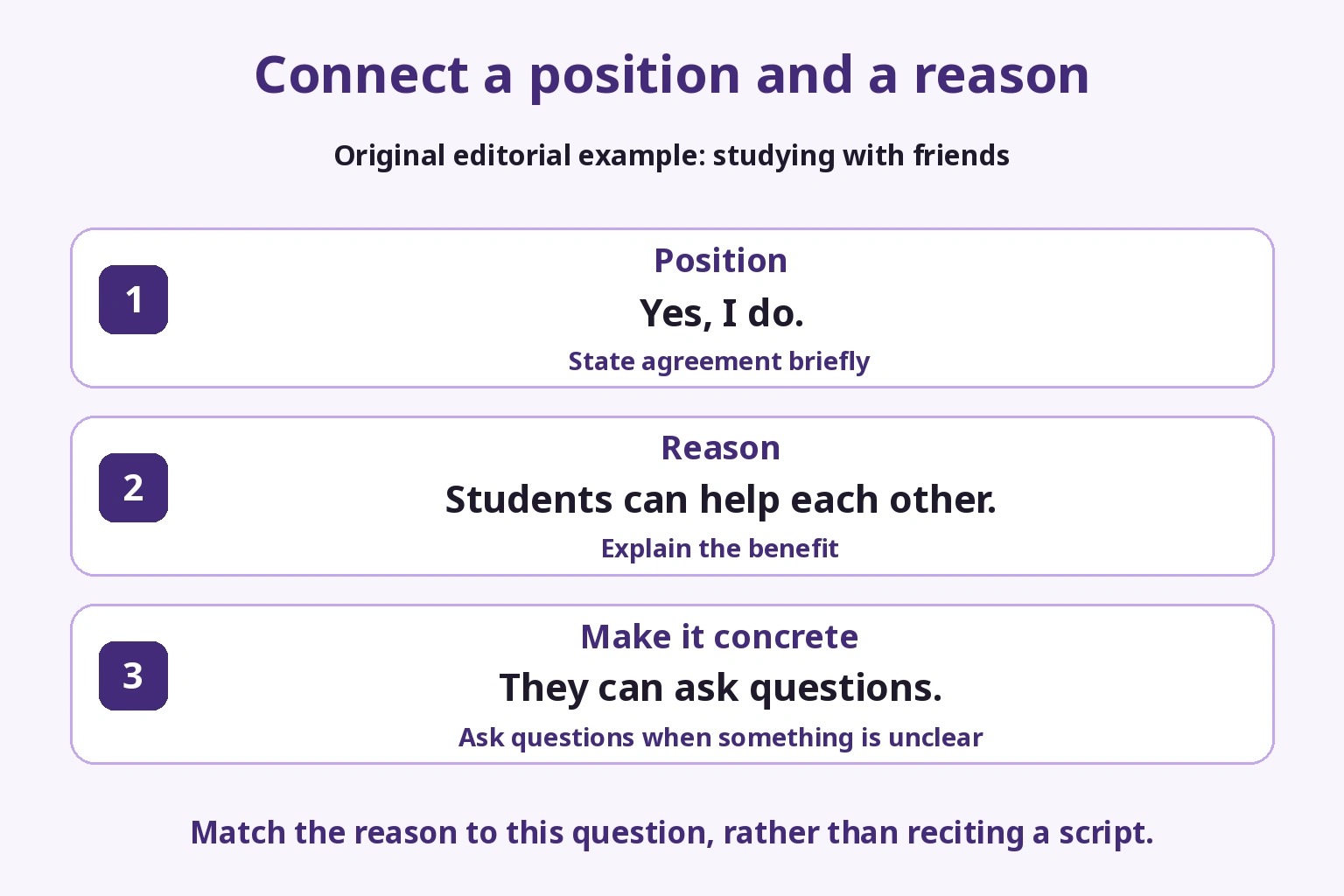
Position, reason, then a short explanation when useful. Match a yes/no response to the question; answer a follow-up request for a reason. For our original topic of studying with friends:
Yes, I do. Students can help each other. They can ask questions when they do not understand something.
The final sentence makes helping concrete. We do not prescribe a fixed number of reasons as a scoring formula.
Practise alone
Record without a card or complete script. If the reason is missing, add one; if it is only “good,” explain what students can do. Rerecord, then try the opposite position on the same topic, such as concentrating alone. This is flexibility practice, not an instruction to misrepresent your views.
Common mistakes
Stopping at yes, using an unrelated reason, or waiting for a long memorized answer to come back. Explain what “convenient” means rather than applying it to every topic.
Q5: answer the everyday question first
What is asked?
Answer about everyday matters, including topics not directly related to the card. Focus on the final question rather than forcing the previous passage into your answer. EIKEN
Editors’ pattern and example
Requested answer first, then a reason or concrete action:
I like studying with a friend because we can help each other.
You can make it concrete with: We can ask each other questions. If the prompt asks how often, give frequency first; if it asks what you want to do, name the action. The sentence is a flexible example, not an answer to every prompt.
Practise alone
Shuffle a few everyday prompts and record answers. Check one missing detail—who, when or what—then repeat. Change a preference question into a frequency question and make sure the first sentence changes. For short-sentence production, see oral sentence-building practice, then return to interview prompts.
Common mistakes
Reacting only to the introduction, delivering an unrelated prepared sentence, or inventing an impressive experience and becoming stuck. Use an ordinary example you can explain.
Repetition requests and attitude
A natural request to repeat a question is not penalized; unnatural or repeated requests can be. A stalled answer may lead the examiner to move on. This is the official qualification, not permission to ask indefinitely. EIKEN
Our example is Could you say that again, please? Practise the request followed by answering the repeated question. It is an editorial example, not a compulsory official phrase. Use it to hear the question, not as repeated time-buying.
Official attitude considerations concern active willingness to communicate. Our editors practise greetings, acknowledging instructions and giving audible responses, without promising points for smiling or volume alone. When ideas are slow, return to the subject and choose a short answer you can express.
A short pattern line in SpeakGain
We used SpeakGain to save, hear and say this line, created through its normal Add flow:
I like studying with a friend because we can help each other.
The verified path was Library → Knowledge → Learn this card → Listening → Reveal answer → Answer. Listening presented audio before showing the sentence. Answer showed the same sentence, explanation, model replay, review intervals and Record and check. Pressing that action reached Android’s microphone-permission request; we did not complete a recording or verify a resulting assessment.
This is not an EIKEN mock interview or EIKEN scoring feature. We make no claim about recording-result accuracy or exam-score improvement. Use a separate home recorder/timer for a complete interview answer and its content check.
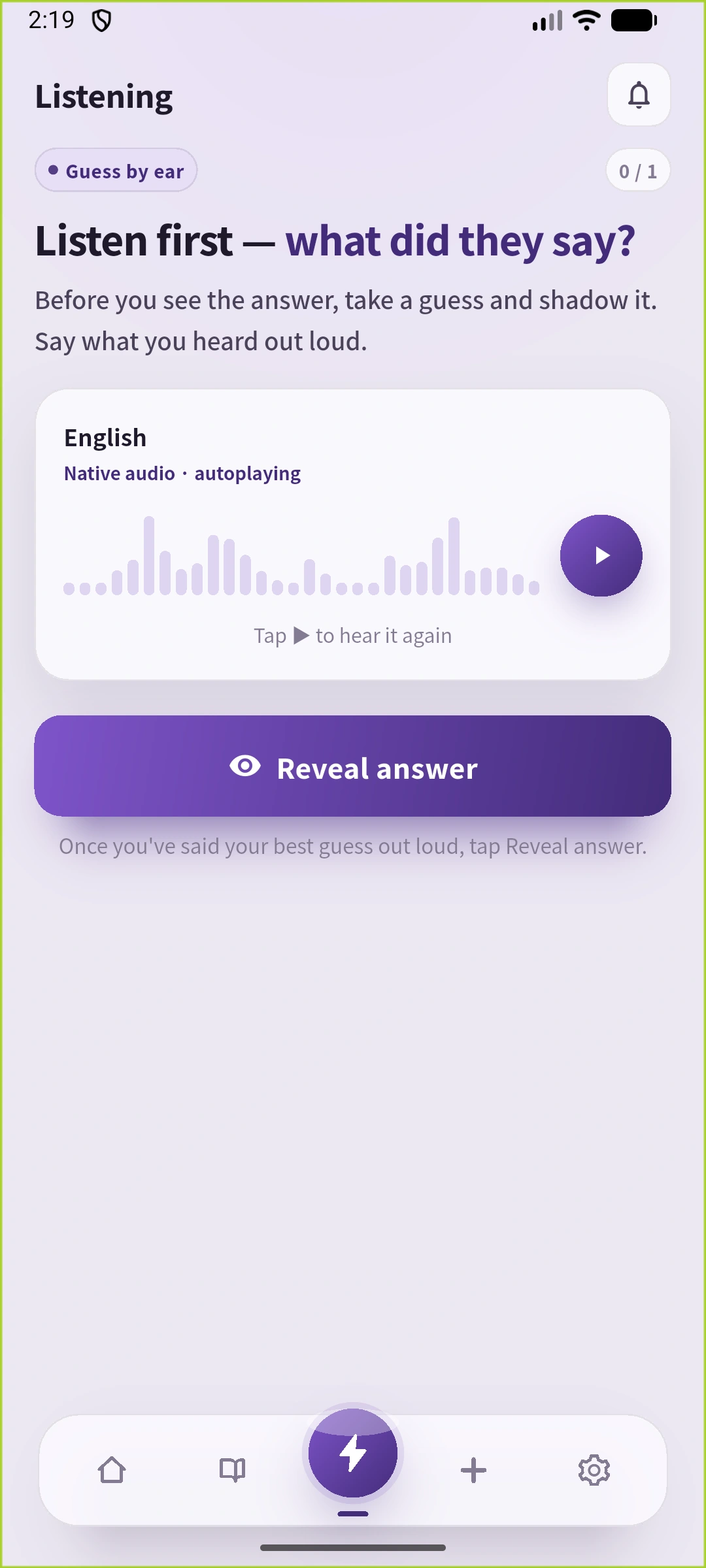
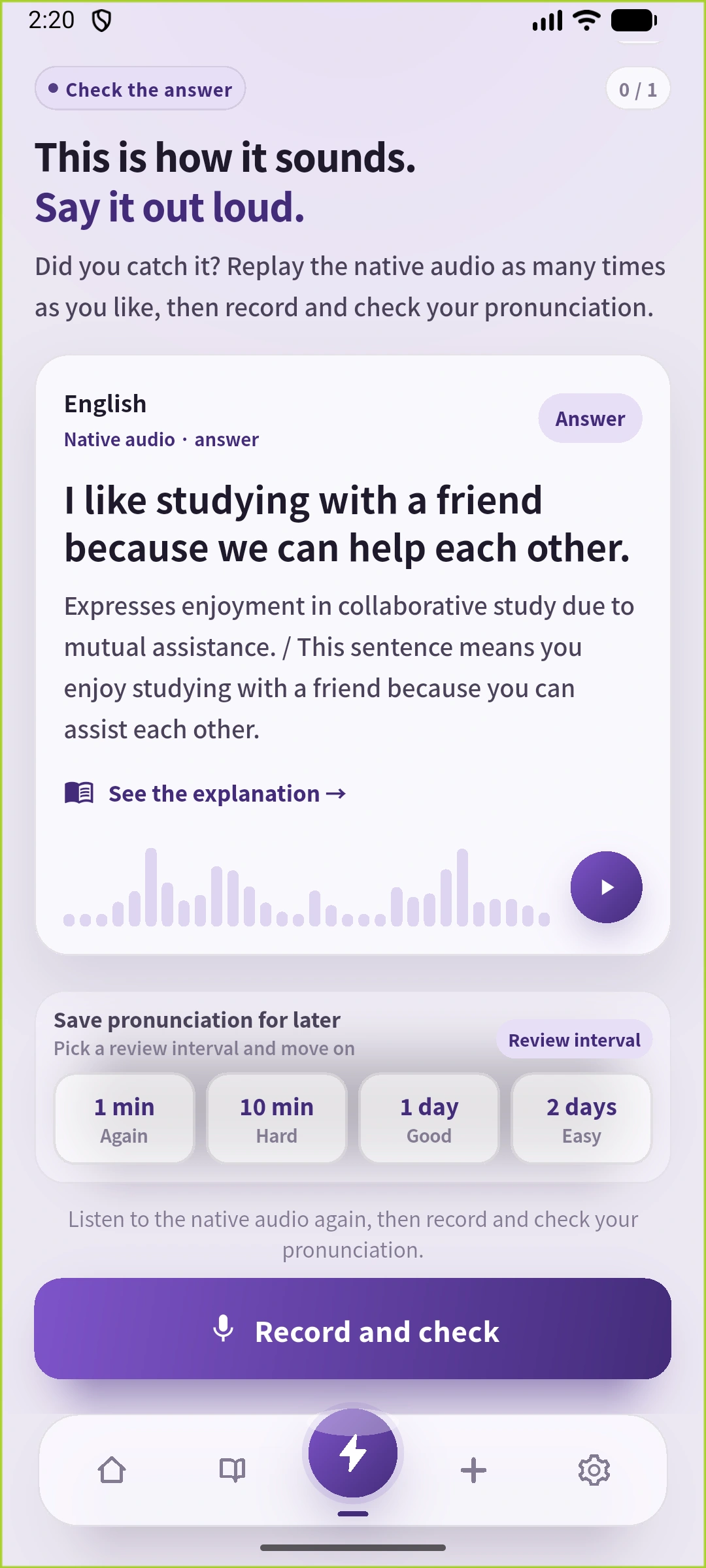
Deep-voiced Viking synthetic audio generated once for this sentence, not official EIKEN audio or a candidate’s interview recording.
Listen, reveal, say the line, then add your own relevant detail and return to the question. See what SpeakGain is.
A flexible two-week plan
Try reading and all five question types before allocating the remaining days. This is an editors’ example, not a promise to pass in two weeks.
| When | Work | Keep |
|---|---|---|
| 14–10 days before | Official format and first recordings of reading plus five questions | One obstacle per task |
| 9–5 days before | Correct weak tasks; transfer to different material | First/revised recordings and one correction |
| 4–2 days before | Run the sequence; turn over the card after Q3 | Recurring errors and answers without a script |
| Previous day | Check ticket, venue, arrival instructions and materials; short speaking warm-up | Official instructions and familiar short lines |
| Interview day | Attend the specified place/time; follow staff and examiner instructions | Ticket and required materials |
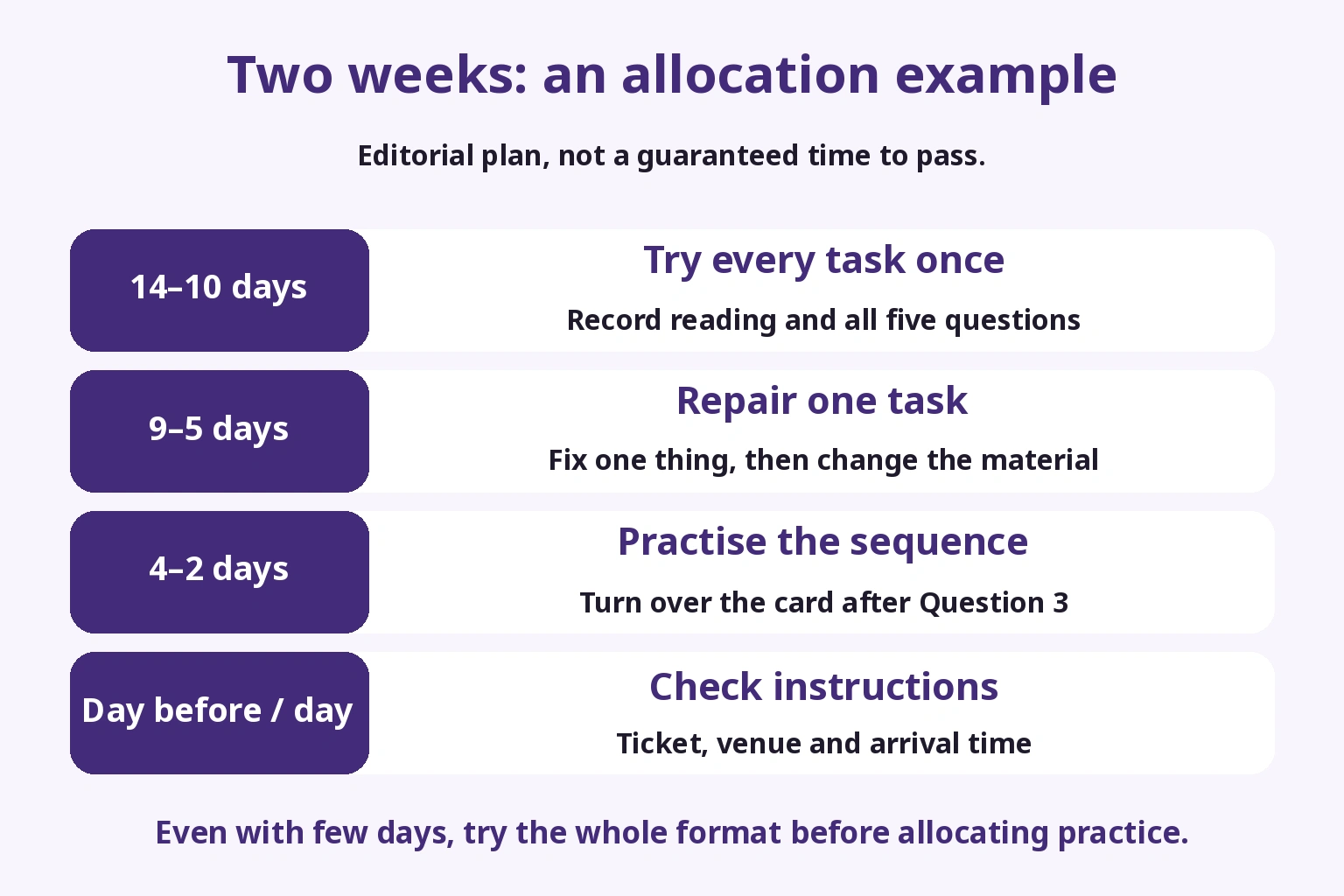
With ten minutes, record one task, listen, fix and repeat; transfer tomorrow if necessary. With only a few days, first try every task, choose two obstacles, and leave time for the full flow. If you cannot judge clarity, ask someone what they heard; that feedback is not an official score. For another test, see TOEIC Speaking preparation without transferring its timings to EIKEN.
Interview-day reminders
Check your own admission ticket and current instructions, rather than calculating arrival from the six-minute interview. Hand over the interview card, sit when instructed, read the title, turn over the question card after Q3 and return it at the end. After leaving, promptly exit the venue; do not return to the waiting room or talk with waiting candidates. Do not record the actual test. EIKEN EIKEN
FAQ
What is the pass threshold?
CSE406 out of 600 for the second stage. You cannot calculate CSE from a self-marked percentage. EIKEN EIKEN
How many questions and how long?
Reading aloud plus five questions, about six minutes overall; silent reading is 20 seconds. The official page does not give a fixed answer time for each question. EIKEN
Did the 2025 introduction change Pre-2?
The Plus introduction does not change existing question scope or format. Plus is a separate grade; timetable changes still require checking your ticket. EIKEN EIKEN
Can I ask the examiner to repeat?
A natural request is not penalized; unnatural/repeated requests can be. Practise responding after the repetition. EIKEN
What if I cannot think of an answer?
Return to what was asked and choose a short, expressible position or action. Do not wait for a universal script or keep asking for repetition to delay answering.
Is smiling enough for attitude?
No official smile-only scoring rule is supplied. Active communication is an assessment consideration; practise responses and check their content separately. EIKEN
Can I practise alone?
Yes: format review, reading, recording and listening back. Our editors do not treat self-recordings as accurate CSE or pass predictions.
How many days do I need?
There is no single duration for everyone. Try all tasks first; the two-week plan is an editorial allocation, not a guaranteed preparation period.
Should I memorize answer patterns?
Learn short structures and change their content. Our editors advise against forcing a long memorized answer onto a different question.
When moving to Grade 2, use our Grade 2 interview guide to practise three-scene narration and reasons for an opinion.
Editors’ verdict
Check the official flow, record reading and all five tasks, repair one point, then try another question and the whole sequence. Return to the passage for Q1, actions for Q2, the situation for Q3, a relevant view for Q4 and the everyday question for Q5. Today, keep one recording and one specific correction—not just another memorized paragraph.
For a later Pre-1 attempt, our Pre-1 interview guide explains four-scene narration and social opinions with concrete examples.
If you are taking Tokyo’s speaking test, our ESAT-J preparation guide explains the current tasks and practice for each part at home.
If you plan to take the recorded format, see our Eiken S-CBT comparison and speaking practice guide to prepare for screen instructions alongside these interview answers.
For a plan covering the first stage through the interview, see our Eiken Pre-2 study plan and priorities by time left.
Official sources
Checked 10 October 2026. Recheck current instructions and your own admission ticket: EIKEN; official samples; virtual interview; EIKEN; EIKEN; EIKEN; EIKEN; EIKEN.
EIKEN is a registered trademark of the Eiken Foundation of Japan. Our examples, graphics and practice plan are editorial material, not official questions, question cards or answer keys.