
Eiken interview day: clothes, what to bring, entry and repeat requests
Published
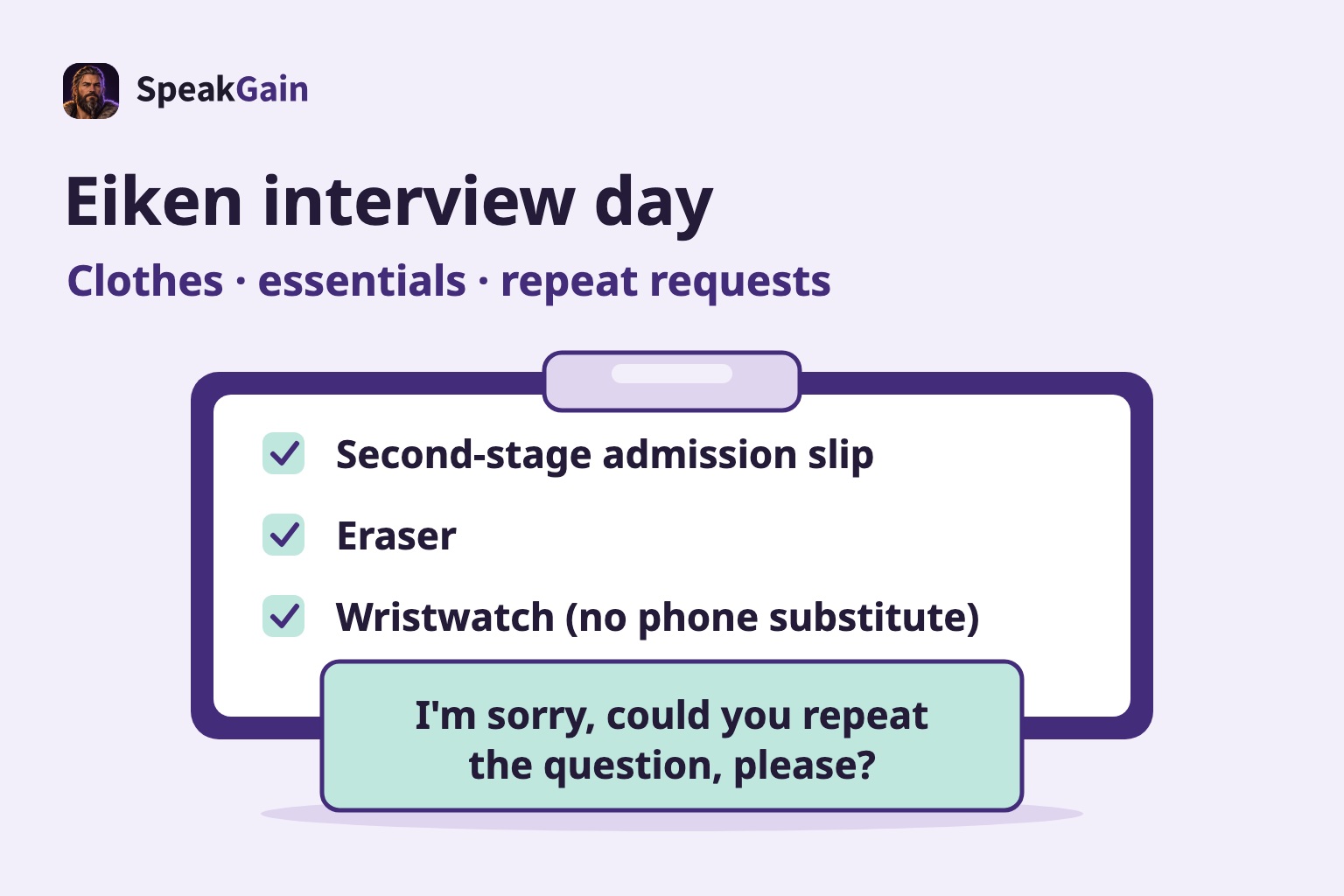
For Eiken’s in-person second-stage interview in Japan, bring your second-stage admission slip, the photograph-bearing identity paperwork, an accepted original photo ID, and the required stationery and other items. The domestic official pages checked do not prescribe a school uniform, casual clothes or a suit; they do advise clothing that lets you adjust to the room temperature. Follow reception, the waiting room, interview-card completion, the holding seats, entry and seating, your grade’s tasks, card return and departure, and use a short, natural English request if you miss a question (day instructions, 2026 identification rules, regulations, repeat requests).
This guide is for students, adults and parents preparing for Japan’s conventional, face-to-face Eiken interview, Grades 3 through 1. It is not an S-CBT operating guide. Official information was checked on 15 October 2026. All English examples and preparation routines are our editorial suggestions, not prescribed scripts or scoring rules. For the tasks themselves, use the interview preparation guide.
What to bring: check the paperwork first
The photo attached to the examination paperwork does not replace your original photo ID. From the first administration of the 2026 academic year, an accepted, unexpired original photo ID is required for the covered Grades 1–3. A photocopy, a phone image or a digital student ID is not a substitute (official identification notice).
| Item | Required? | Official wording or category, translated and summarised | Note |
|---|---|---|---|
| Second-stage admission slip and identity paperwork | Yes | Required examination documents | Main-site first-stage candidates bring the photo-bearing identity form and second-stage slip. School/local-site candidates and first-stage exemption candidates follow the photo-bearing second-stage-slip instructions |
| Original photo ID | Yes | Accepted photo identification | Must be valid and original. A student card must have a photograph. Keep it with you, not with a parent |
| Black HB pencil or mechanical pencil, and eraser | Required items | Stationery under regulation 8.1 | Used to complete and mark the interview card. Eiken does not lend forgotten stationery |
| Silent wristwatch | Required item | Wristwatch under regulation 8.1 | No smartwatch. A phone or tablet cannot serve as a clock |
| Indoor shoes and a shoe bag | When specified | Required at venues whose admission slip requests indoor shoes | Check your own slip; do not assume every venue needs them. Forgotten indoor shoes are not lent |
| Interview card | Not prepared at home | Distributed in the waiting room | Complete the candidate fields and carry it to the interview room |
Table checked 15 October 2026: regulations 8.1–8.2, second-stage instructions, identification, waiting-room procedure. The opening illustration depicts only three listed items, not a complete packing list.
Our advice is to put the documents together, test the pencil and check the venue, assembly time and indoor-shoe instruction on the second-stage slip. Even if you took the first stage at school, read the second-stage destination rather than assuming it is the same building.
If you forget the photo ID, the official notice describes procedures at the venue and a subsequent submission. The conventional test requires the venue procedure before the examination begins; missing the deadline or providing inadequate identification can invalidate the result. Do not plan to bring it later. Tell staff immediately and consult the current notice.
Reception to departure: actions and short English lines
Follow the staff’s directions and sit when instructed by the examiner. Communication with the examiner is in English. The lines below are examples we wrote, not a requirement to use English at reception or a mandatory interview script.
| Stage | What to do | Our English example | Note |
|---|---|---|---|
| Reception | Register at the general information desk; read the notices | No fixed line specified officially | Check the venue and assembly time on your slip |
| Phone storage | Switch it off and place it in the supplied case | No fixed line specified officially | Wear the case; do not use the phone before leaving the venue |
| Waiting room | Take the assigned seat and complete the interview card | No fixed line specified officially | Check the grade on the card and candidate instructions |
| Holding seats | Carry all belongings and check the interview room’s grade | No fixed line specified officially | After the document check, put away everything except the interview card. You cannot return to the waiting room |
| Entry and submission | Enter on instruction and hand over the interview card | Hello. / Here you are. | Grades 3–Pre-1: examiner; Grade 1: staff member |
| Seating and checks | Sit on instruction and answer the identity questions | Thank you. / My name is Yuki Tanaka. | Substitute your own name; answer what is asked |
| Interview | Complete the tasks for your grade and answer questions | I’m sorry, could you repeat the question, please? | A request to hear the question again, not to slow it down or explain its meaning |
| Finish and exit | Return the task card, stand and leave | Thank you. Goodbye. | Leave promptly; do not return to the waiting room or discuss the test with waiting candidates |
Table checked 15 October 2026: reception and transfer, holding-seat checks, Grade 3, Grade 1, repeat requests and departure.
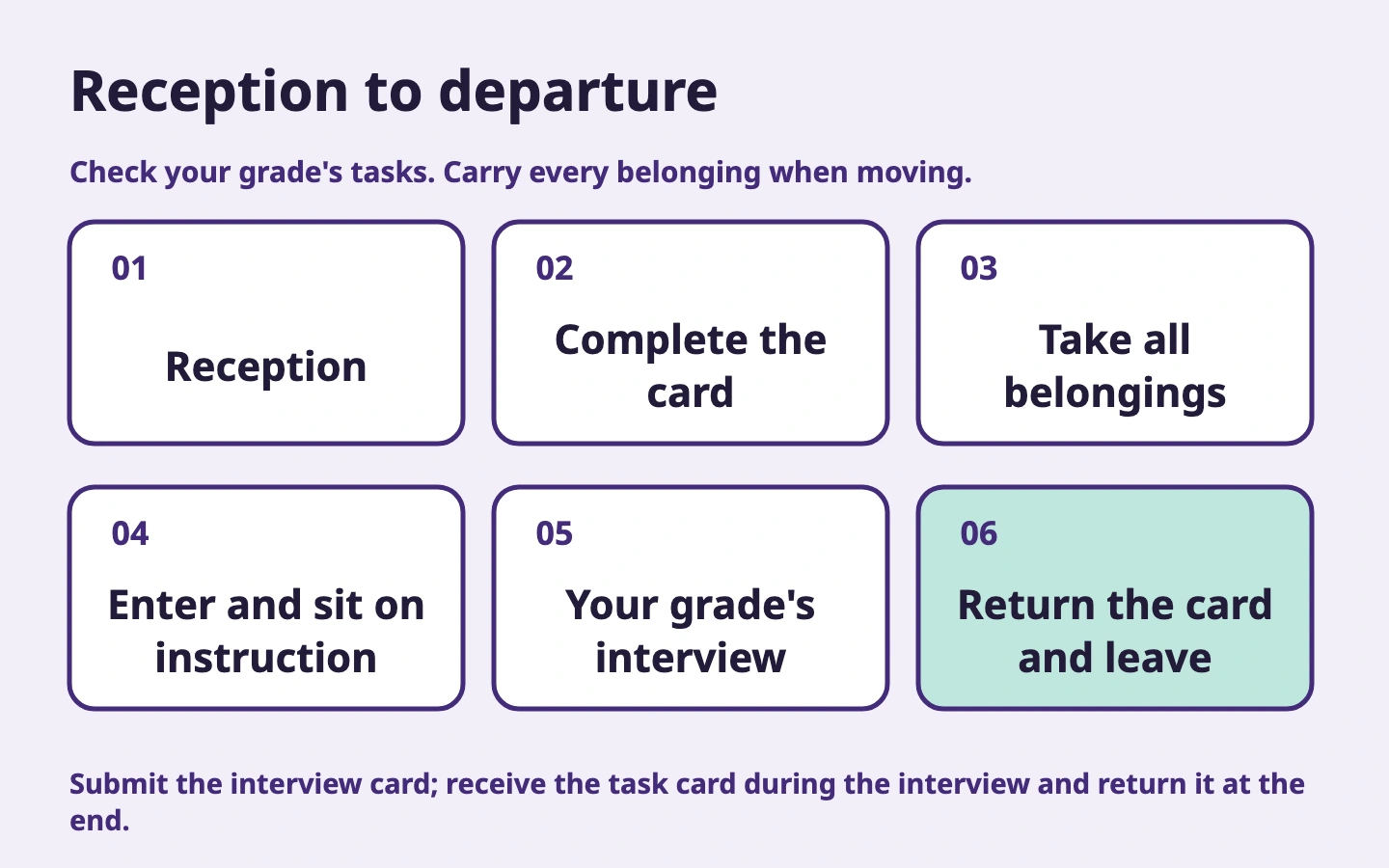
The official schedule gives approximately one hour from reception to completion as a guide. Our advice is not to calculate a parent’s meeting time from the interview’s speaking time alone (schedule).
The interview card is not the question card
The interview card records candidate information such as name and personal number. It is not a sheet for writing your answers to the speaking questions. Check the official completion guide beforehand, then follow the supplied card and instructions. Ask staff about an unclear field instead of inventing a value.
Keep the completed interview card until entry. Take all belongings when moving: you cannot return to the waiting room. At the holding seats, staff check the admission slip and photo ID; after that, put away everything except the interview card (official procedure).
Parents may help a young child complete the required fields, but leave after completion and wait outside the venue. This does not allow help during the interview. Agree on a meeting place beforehand and tell the child to ask staff if lost (parent instructions).
Keep greetings short
We suggest Hello. on entry, Here you are. when handing over the card, and Thank you. when invited to sit. Follow the instruction before performing a rehearsed gesture. For a name question, replace the name in My name is Yuki Tanaka.; for a grade check, Grade 3. is a practice example for that grade.
The opening differs by grade. Grade 1 officially includes a name check and brief everyday conversation; do not assume one script fits every grade (Grade 3, Pre-1, Grade 1). At the end, return the task card and practise Thank you. Goodbye. No mandatory wording or specific greeting-related points were found in the checked official pages.
Uniform, casual clothes or a suit?
A domestic uniform or suit requirement, or a ban on casual clothes, was not stated in the official pages checked. Regulation 12.2 and the main-site guidance do request clothing that accommodates temperature changes. Therefore, saying that the official site says nothing about clothes would also be inaccurate (regulations, venue guidance).
Our editorial advice: choose clean, familiar clothes you can sit comfortably in. A familiar school uniform is reasonable; so are comfortable casual clothes. Adults need not buy a new suit solely because this is called an interview. If a suit is comfortable and familiar, it is an option. Read any individual school or venue instructions too.
Sit in the outfit the night before and check your neck, shoulders and ability to add or remove a layer. We do not invent rules about colours, brands or shoe styles. Claims that uniforms improve the chance of passing or suits increase attitude marks were not found in the checked official guidance.
Asking for a repeat: official rule, example, practice
What the official guidance says
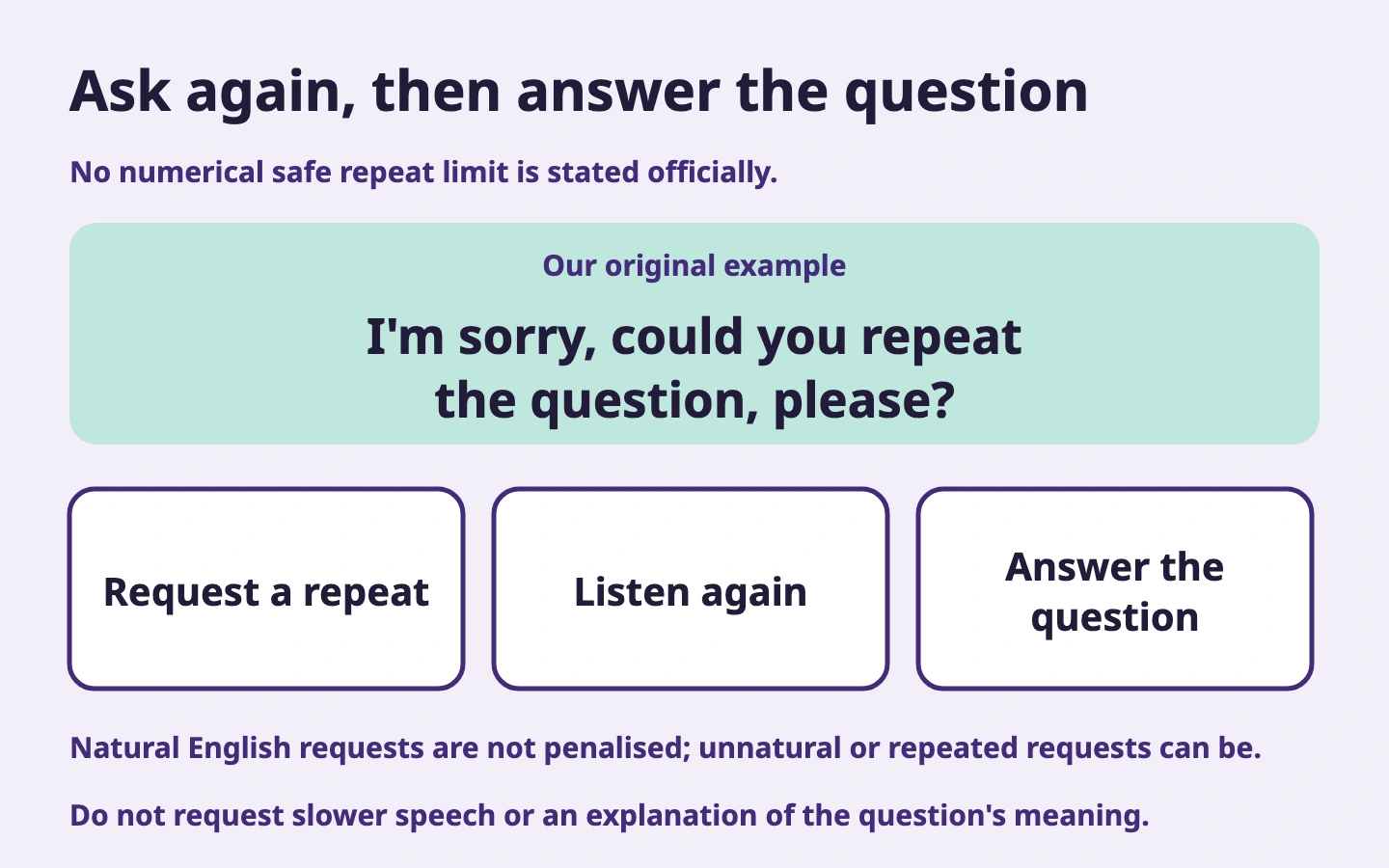
An English request to repeat a question, made naturally in the interaction when it was not heard, is not subject to a deduction. Unnatural or repeated requests can be penalised. You cannot ask for the question to be spoken more slowly, or ask for an explanation of its content or sentence meaning (official cautions).
A numerical safe limit and the number of points deducted are not officially stated in the checked guidance. Neither “every repeat loses points” nor “unlimited repeats are free” accurately conveys the conditions. We suggest practising the return to answering rather than assigning a safe count.
A short line we wrote
I’m sorry, could you repeat the question, please? asks to hear the question again. It is our original worked example, not an Eiken password or prescribed line. Could you repeat that, please? is another short option. Choose one you can produce easily instead of spending time selecting an impressive formulation. Do not turn the request into a demand for a definition.
Practise through to the answer
Use a question you can answer briefly, such as our example What do you like to do after school? This exercise connects a repeat request to an answer; it does not reproduce an official task.
- Have someone read the question, or use your own practice recording.
- Say the repeat-request sentence while looking at it.
- Hear the question again and give your own relevant answer.
- Hide the sentence and produce it from the situation “I missed the question”.
I like playing tennis. is a simple practice answer. Graded answer construction belongs in the grade guides, not in this exercise.
Mistakes we would avoid
Do not ask again after every question merely to buy thinking time, or repeat the request without returning to an answer. This conflicts with the cautions about unnatural and repeated requests. General-conversation requests for slower speech or a word’s meaning should not be transferred to this examination. Missing the sound and hearing the question but not knowing what to say are different problems.
The night before and the morning: our routine
These times are editorial suggestions for limiting preparation, not an official schedule or a proven optimal dose.
| When | Our suggestion | Finish when |
|---|---|---|
| Night before: about 10 minutes | Check documents, photograph, original photo ID, stationery, watch and any required indoor shoes; read the route and assembly time | Everything is in one bag |
| Night before: about 5 minutes | View your grade’s official virtual test and practise greetings, card handover and a repeat request | You respond to instructions as well as reciting words |
| Before leaving | Check clothing, documents, official notices and transport | You have a route for your assigned assembly time |
| Morning voice practice: about 2 minutes | Say your name and the repeat request, then answer yesterday’s short question | You leave without adding a new script |
Use the official virtual second-stage test. The day schedule instructs candidates to use public transport and prohibits coming by car, including drop-offs. Check the official FAQ and notices on the morning of the test. Stop phone practice before entering the venue: switch it off and store it as instructed until you leave (electronic-device cautions).
What we do not recommend
Long memorised greetings make finishing a script the goal, even when the examiner asks something unexpected. We prefer a short greeting and a response to the actual instruction. We also reject repeat-request tricks, invented eye-contact durations and “smile to cover silence” scoring formulas. The official Grades 3–Pre-1 descriptions include willingness and attitude towards communication, but do not turn one gesture or outfit into a private points table (Grade 3, Pre-1).
Our view is to practise listening, responding briefly and moving on instruction even while nervous. Remaining anxiety does not erase the documents and route you have already checked.
A single sentence for SpeakGain practice
Our worked sentence is I’m sorry, could you repeat the question, please? Keep preparation with SpeakGain separate from Eiken’s tasks: practise hearing and saying this sentence, then still practise answering the repeated question.
On 15 October 2026 we saved this sentence through SpeakGain’s normal Add screen in its English interface, then followed Library → Knowledge → Learn this card. Listening hid the written sentence and prompted us to listen to the generated audio and say the words aloud. Reveal answer displayed the saved sentence, an English explanation and replay control.
We replayed the same audio and selected 1 day / Good once. This is the learner’s choice of review interval, not an Eiken answer grade. The screen’s Native audio label refers here to AI-generated reference audio, not a recording by a human native speaker.
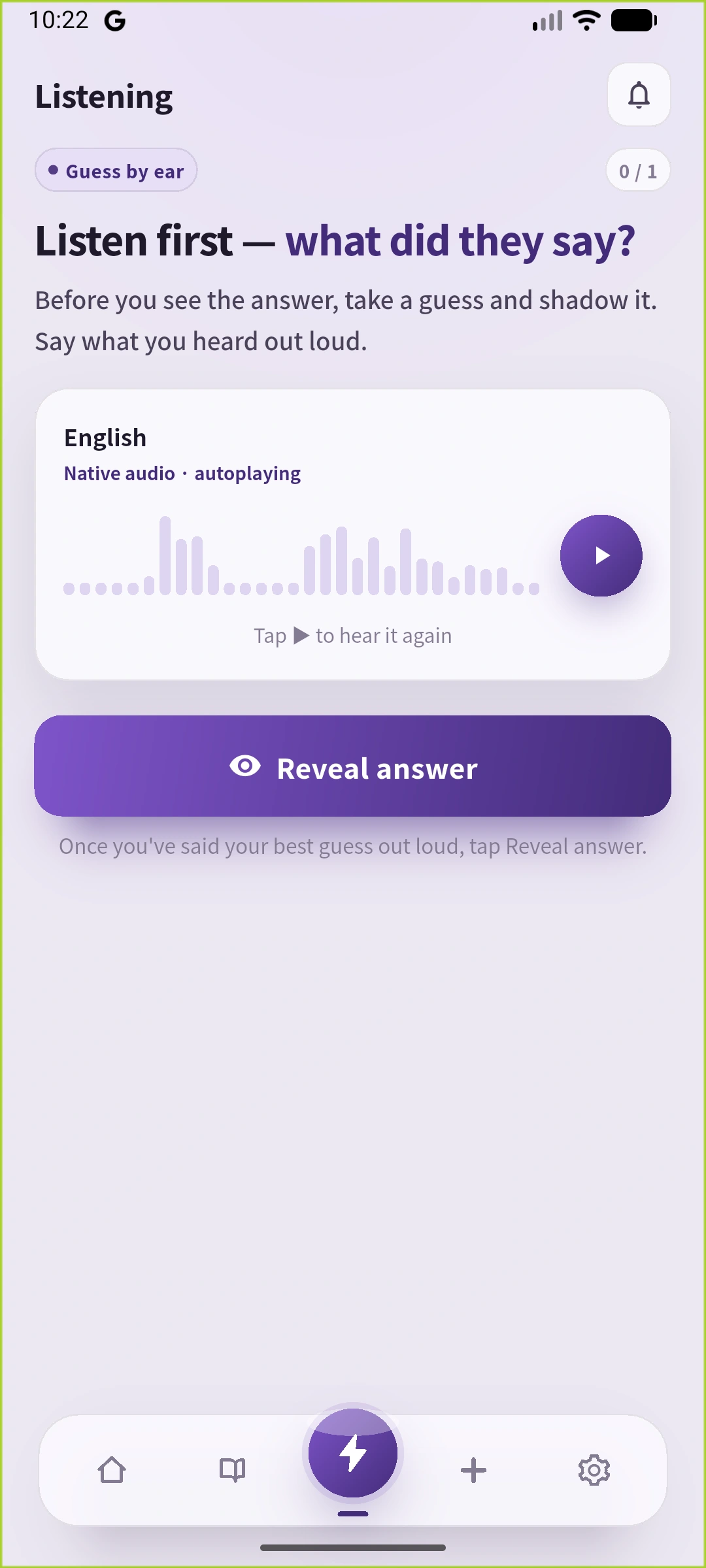
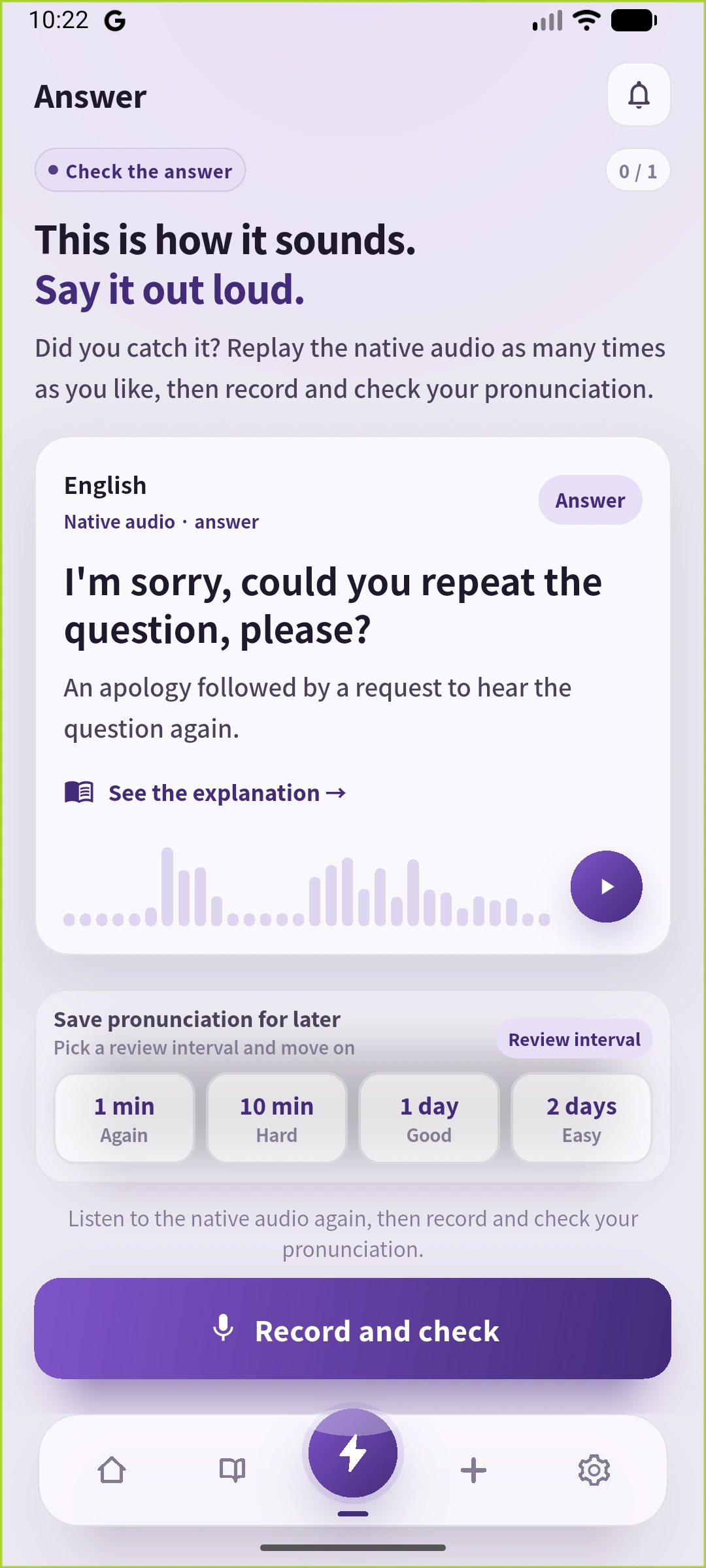
Viking reference audio for our repeat-request example — I'm sorry, could you repeat the question, please?
AI-generated reference audio. Pause after listening, say the line, then practise hearing your own question again and answering it.
This article does not present SpeakGain as an Eiken mock interview, an answer or pronunciation scorer, or a guarantee of passing. Use the official format and grade-specific exercises. See what SpeakGain does.
Use your grade guide for the questions
After checking the day arrangements, use the overall interview guide and the relevant detailed article: Grade 3, Pre-2, Pre-2 Plus, Grade 2, Pre-1 or Grade 1. The official grade pages specify the tasks. Do not borrow card-turning or preparation timings from another grade. Our diagrams do not reproduce Eiken cards or official artwork.
Frequently asked questions
Uniform or casual clothes?
Neither is prescribed in the domestic pages checked. Temperature-adjustable clothing is advised. We suggest the familiar, comfortable choice, while also checking any school-specific instructions (regulation 12.2).
Do adults need a suit?
No suit requirement was found in the checked official pages. Our advice is not to buy one solely for the interview. Specific clothes-related bonuses or deductions were not officially stated either (regulations).
What if I arrive late?
The regulations set a limit of 30 minutes after the assembly time; later candidates cannot take the test. The FAQ also says late candidates may be refused. Explain the situation at reception and follow the venue manager’s instructions; the FAQ asks you not to contact the venue directly. Do not interpret the limit as a guarantee of admission (regulation 11, FAQ).
Does a repeat request lose points? How many are allowed?
A natural English request is not penalised; unnatural or repeated requests can be. A numerical limit and deduction size are not stated in the checked guidance. Practise hearing again and answering (official cautions).
What goes on the interview card?
Candidate details such as name and personal number, entered and marked in the required fields, not prepared speaking answers. Follow the actual form and staff directions (completion guide).
What if nerves make me freeze?
Our advice is to ask again if you missed the sound, or return to what the question asks if you heard it. Official guidance says the examiner may move on if your response stalls. No universal safe silence duration is specified (cautions).
Will forgetting a greeting make me fail?
No such rule for a particular greeting was found in the checked official guidance. We suggest listening to the next instruction rather than restarting a long script (Grade 3 procedure and assessment).
Our editorial verdict
Prioritise the documents, transport for your assigned assembly time and short entry, exit and repeat-request lines. Choose familiar clothes that accommodate temperature changes and try sitting in them the night before. We prefer one run-through of responding to instructions to hunting for tricks or inventing safe repeat counts. This preparation does not guarantee a pass; it gives you concrete day arrangements while the grade guides handle the questions.
Official sources and check date
Checked 15 October 2026: day instructions, photo ID, regulations, schedule, cautions, card completion, FAQ, virtual test, and the official Grade 3, Pre-2, Pre-2 Plus, Grade 2, Pre-1, Grade 1 pages. Recheck your latest slip and notices before attending.
Eiken is a registered trademark of the Eiken Foundation of Japan. This is an independent editorial guide.