
Eiken interview preparation: all grades, the flow and solo practice
Published Updated
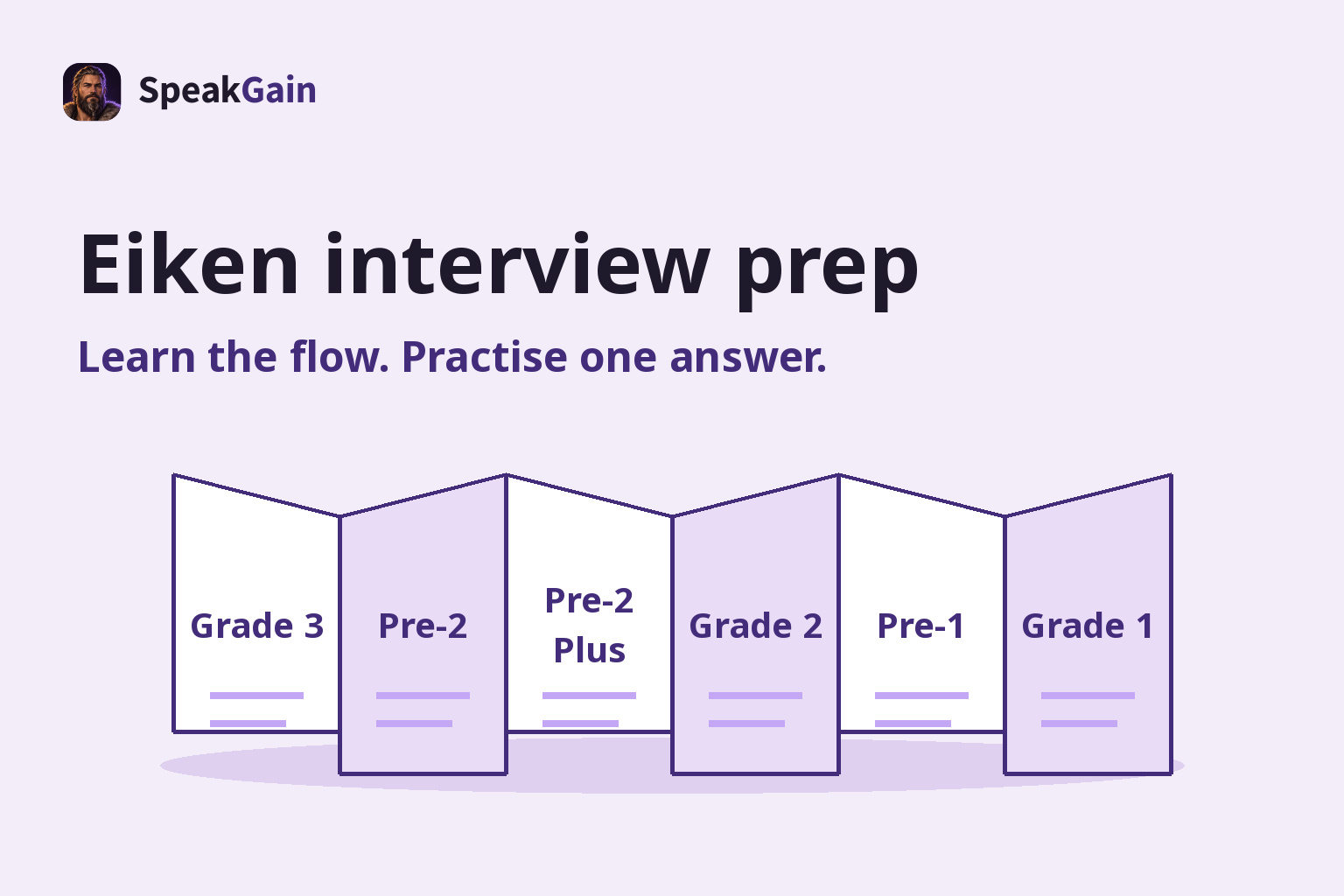
Japan’s Eiken interview is the face-to-face second-stage speaking test for Grades 3 through 1: candidates respond to material and explain ideas through tasks suited to their grade. Official evaluation covers content, pronunciation and language use; Grades 3 through Pre-1 also name willingness and attitude toward communication. Start by checking your grade’s official format, recording one short answer and listening for whether it actually answers the question (official formats, Grade 1 evaluation).
This guide is for students, adults and parents preparing for Eiken in Japan. It provides the overview; the seven linked grade guides handle detailed task practice. Official pages were checked 14 October 2026. Examples, practice checks and the two-week plan are our editorial suggestions, not official questions or promises of a pass.
If you are considering a paired exam, our Cambridge English levels and Speaking guide explains A2 to C2 and how to respond to a partner’s ideas.
Before attending in Japan, use the Eiken interview-day guide to check clothes, documents, entry and exit, and a short English repeat request.
For the whole exam, including the first stage, see our Eiken Pre-1 study plan and summary practice.
For the full preparation sequence, including summary writing, see our Eiken Grade 2 study plan by time remaining.
Before choosing preparation materials, use our guide to choosing your first Eiken grade to compare official levels, test tasks and your purpose.
Compare all grades before choosing practice
| Grade / detailed guide | Time / mode | Tasks | Card turn | Passing Speaking CSE | First focus / source |
|---|---|---|---|---|---|
| Grade 3 | About 5 min · face-to-face | ~30-word reading; passage 1, pictures 2, personal questions 2 | After No.3; follow instructions | 353 | Name the target and action · Official |
| Pre-2 | About 6 min · face-to-face | ~50-word reading; passage 1, action 1, situation 1, opinions etc. 2 | After No.3; follow instructions | 406 | Separate action from situation · Official |
| Pre-2 Plus | About 7 min · face-to-face | ~55-word reading; passage 1, 3-picture story 1, opinions 2 | After No.2; follow instructions | 427 | Connect the story in order · Official |
| Grade 2 | About 7 min · face-to-face | ~60-word reading; passage 1, 3-picture story 1, opinions 2 | After No.2; follow instructions | 460 | Connect opinion and reason · Official |
| Pre-1 | About 8 min · face-to-face | Conversation, 2-minute 4-picture narration, 4 opinion questions | After No.1; follow instructions | 512 | Track events and the person’s thoughts · Official |
| Grade 1 | About 10 min · face-to-face | Conversation; choose 1 of 5 topics; speech 2 min, Q&A 4 min; preparation 1 min | Not stated in official guidance | 602 | Explain your claim and handle follow-ups · Official |
| Grades 4/5 | About 4 min / About 3 min · recorded | Grade 4: ~25-word reading; passage 2, picture 1, personal 1. Grade 5: ~20-word reading; passage 2, personal 1 | Physical card turn does not apply | 324 / 266 (separate qualification) | Follow screen and audio instructions · Official 4 / Official 5 |
The thresholds come from the official CSE table. Grade 4/5 speaking earns a separate qualification; those grades are awarded from the first-stage result alone (official results). Although grade pages use “recorded interview,” these tests are not face-to-face second-stage interviews (official delivery). Physical card-turn instructions do not apply to them.
CSE is statistically calculated. You cannot convert your own raw correct-answer count into CSE (official calculation). Detailed question weights, a raw-score conversion table and a universal required sentence count are not stated in the official guidance inspected. S-CBT speaking uses a headset to record answers; it is distinct from the entry, exit and physical-card procedure here (S-CBT).
Entry to exit: learn the shared flow
The common thread is to follow instructions, perform your grade’s tasks and return the task card before leaving. The individual official pages linked in the comparison specify the differences.
- Enter when directed by staff and hand over the interview card. Grades 3–Pre-1 hand it to the examiner; Grade 1 hands it to staff.
- Sit when instructed, confirm your identity and respond to greetings or brief conversation/questions.
- Receive the task card, or Grade 1 topic card. This is different from the interview card handed over at entry.
- Follow your grade’s preparation and tasks. Grades 3–2 have 20 seconds of silent reading before reading aloud from the English title. Pre-1 has one minute to prepare a two-minute narration; Grade 1 has one minute including topic selection before a two-minute speech.
- Answer the questions and turn the card at your grade’s designated point. Do not turn it early on your own.
- Return the task card and leave. Exit the venue promptly; do not return to the waiting room or talk to waiting candidates.
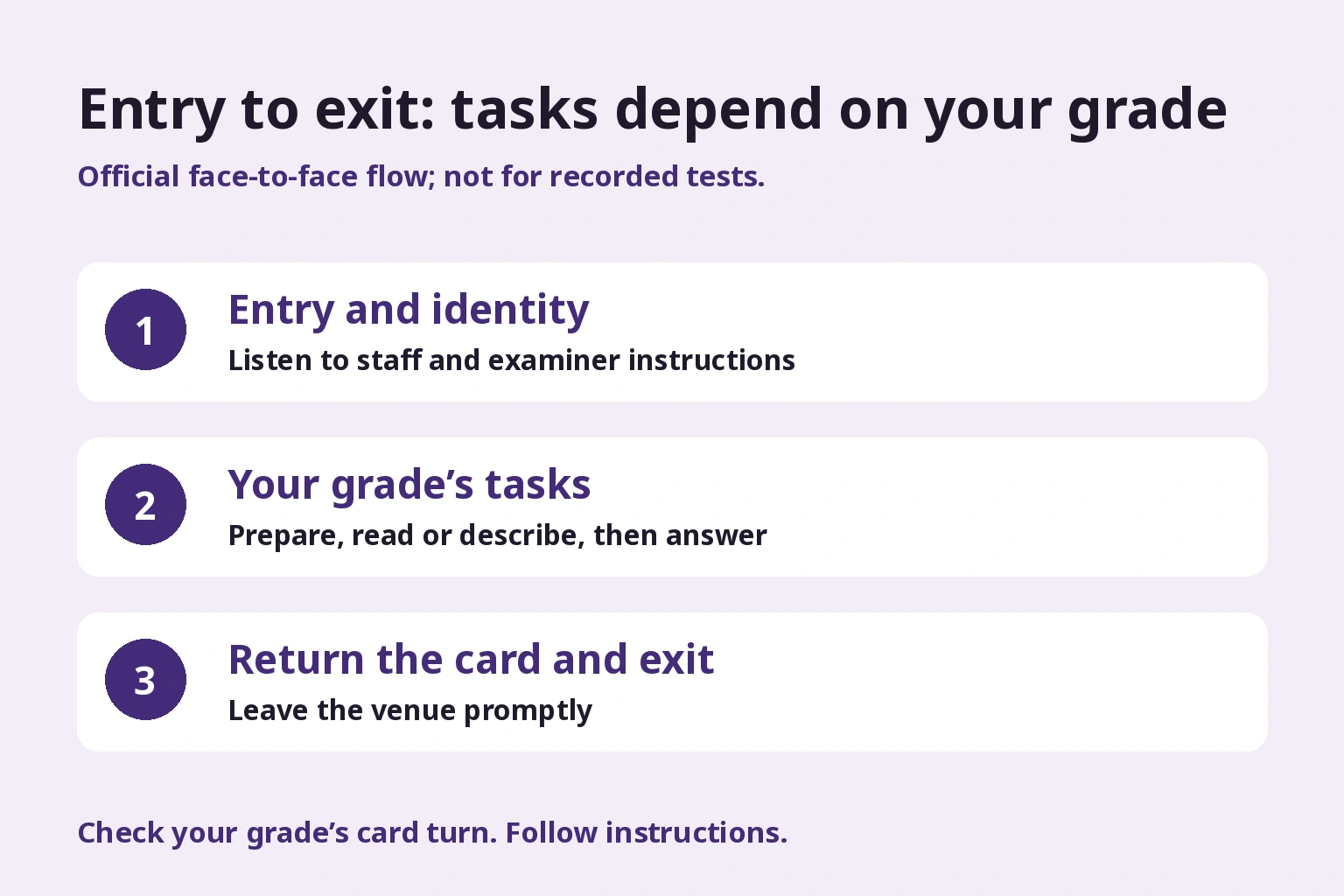
We would first view the official virtual test, then practise the movements with plain paper at home. Connect “listen → respond → act” to the tasks instead of writing a long greeting script. Official cards and questions are linked, not reproduced. Continue with the Grade 3 guide or Pre-1 guide for a full grade-specific run.
Evaluation and attitude: what to check
Grades 3–2 list response content, pronunciation, vocabulary, grammar, usage, information and willingness/attitude toward communication. Pre-1 also includes narration. Grade 1 lists Short Speech, Interaction, Grammar and Vocabulary, Pronunciation; its official English page does not list a separate Attitude category. Do not transfer another grade’s rubric.
We do not recommend treating attitude as “just smile.” In practice, check whether you respond to instructions, address the question and return to answering after asking for repetition. These are editorial checks, not official point allocations.
- Content: did your opening answer address the person, action or opinion asked about?
- Information: does the reason explain the answer, or is a necessary action missing?
- Language: are the subject, verb, tense and references appropriate?
- Sound and response: is the end audible, and did you answer after the repeat request?
Choose one issue per recording. A listener’s feedback helps identify what was understood; it is not a CSE prediction. Use the Grade 2 guide for task checks and the Grade 1 guide for speech and follow-up questions.
Shared answer patterns: adapt the content
Use a short structure—answer, then the reason or information needed—not one memorised answer for every task. These original examples use accessible English. They are starting points even for higher grades, not replacements for a complete narration or speech.
For an opinion about walking to school: I think so, because walking to school helps me stay active. The position comes first, and the reason explains the benefit of walking. Change the reason or take the opposite position next time; the exercise is matching the question, not finding the “correct” opinion.
Another pattern is I think it is useful. It saves time. Check what “it” refers to and whose time is saved. A vague “it is convenient” does not automatically suit every topic.
For a personal habit: I usually walk after dinner. I enjoy the fresh air. Answer the information requested instead of forcing “I think” into every response. For description: A woman is carrying a bag. Start with the person and action; do not invent background that the material does not support. Longer narratives also need sequence and change.
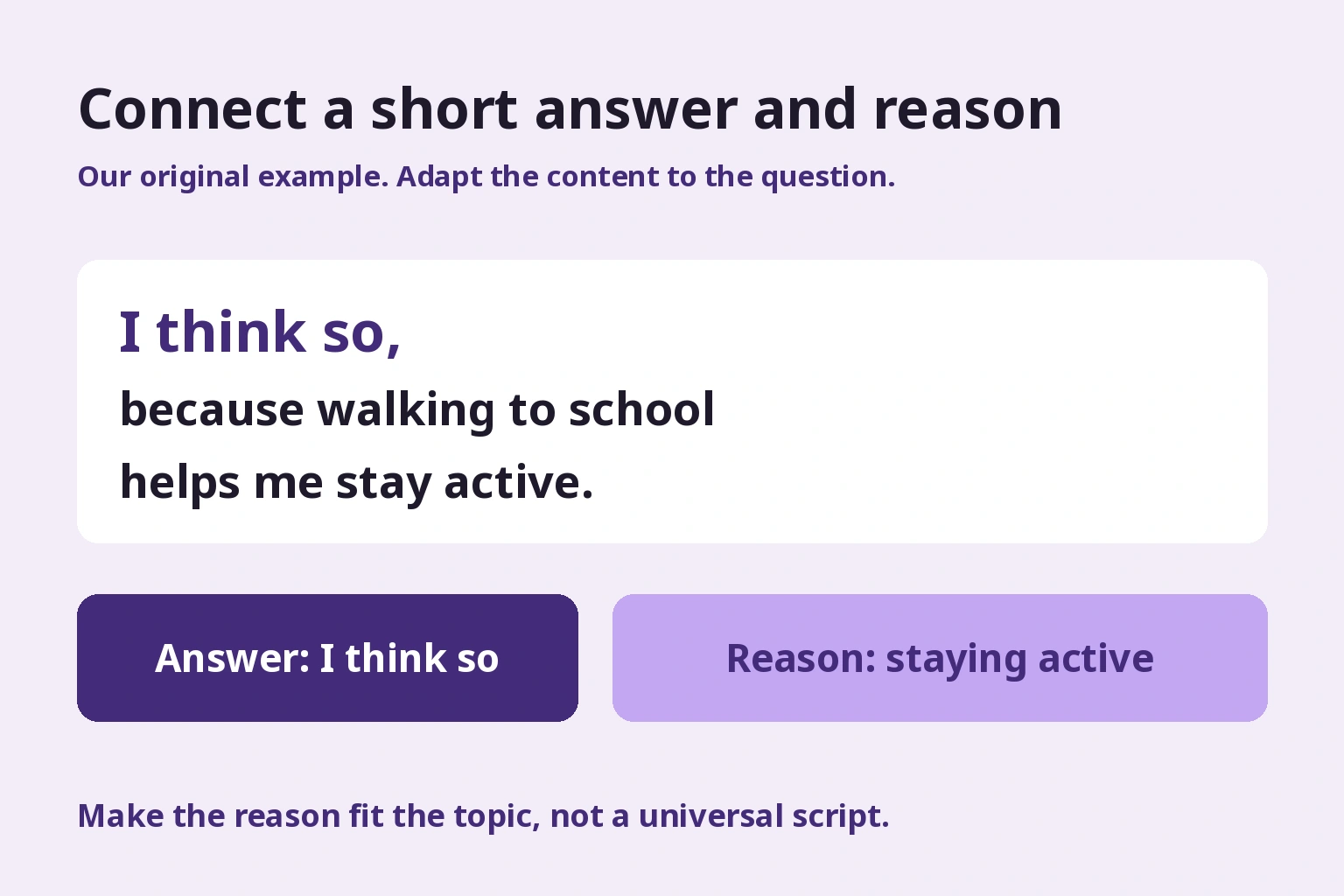
Practise once while reading, then hide the English and respond to the situation. If you can read it but cannot produce it, choose a usable verb and start with the subject before adding more vocabulary. See Pre-2, Pre-2 Plus and Pre-1 for applying these structures to the actual tasks.
Solo practice: record, correct one thing, change the prompt
You can check the format, record a response and practise a revised answer on your own. Recording here means home practice: recording during the interview is prohibited (official instructions).
- Choose your grade’s official sample through the official practice entrance; identify the task before studying an answer.
- Record an initial answer, including where you stop. Do not try to make the first recording perfect.
- Listen with the question in view: correct target, connected reason, audible ending?
- Correct one issue and record again. Note whether you used a script, then try without it.
- Change the topic or position the next day. Check whether you can build a new answer, not only recite yesterday’s sentence.
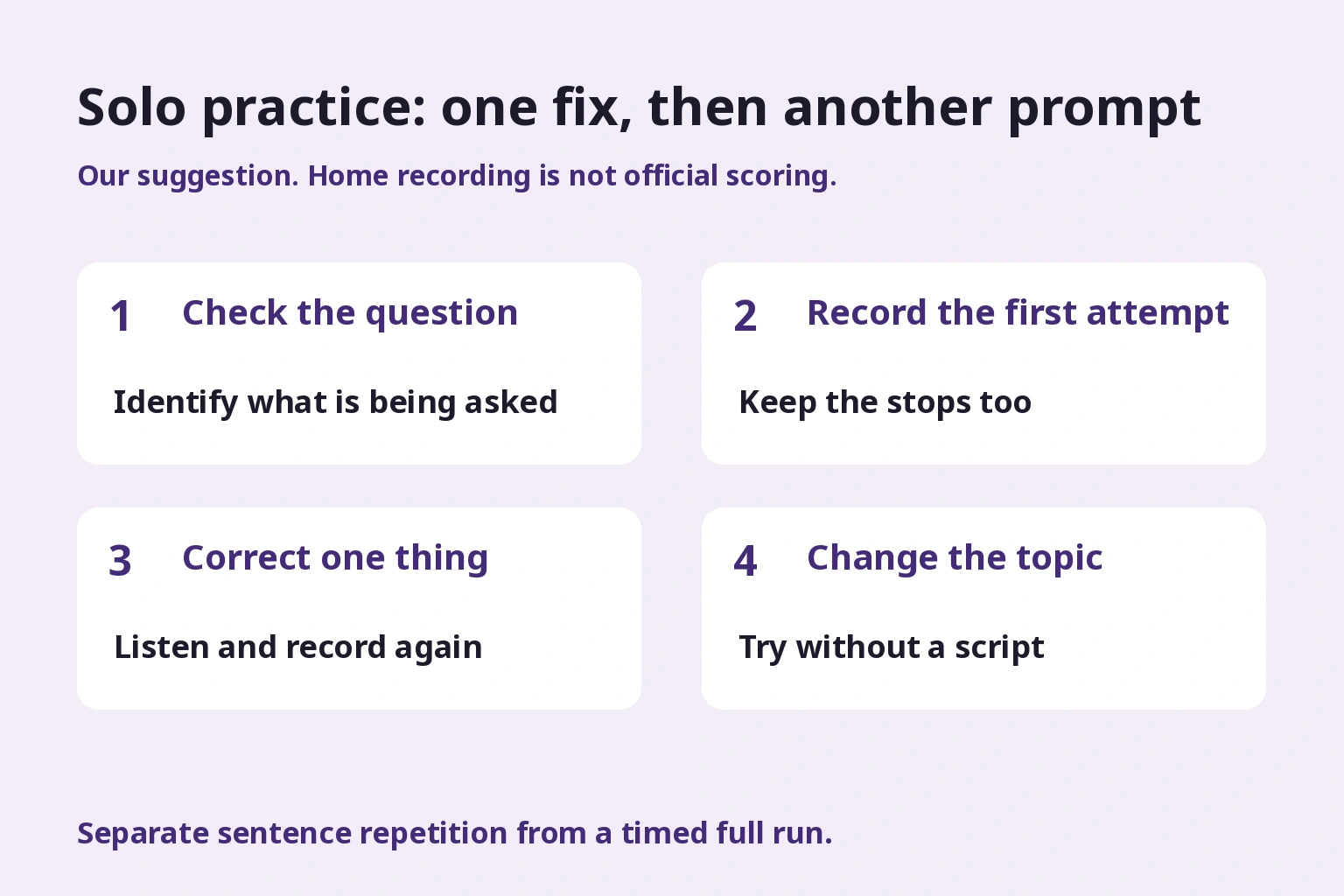
Our ten-minute starting plan is one minute to check the prompt, four to record/listen, four to correct/re-record and one to note tomorrow’s task. This is not an official response limit. Keep separate full runs at your grade’s timing. An unexpected question is harder to reproduce alone; ask a family member to read a prompt and tell you what they understood rather than supply the answer. Their opinion is not official scoring.
Use Grade 3, Grade 2 or Grade 1 for full runs. Families preparing for the recorded tests should use Grade 4/5 instead of rehearsing face-to-face card movements.
Separate sentence repetition from interview practice
We used SpeakGain to save one short answer sentence with audio as a practice aid. We created this example once through the normal Add flow and verified its generated explanation and Viking audio. See What is SpeakGain? for the app’s basic role.
This is AI-generated Viking audio, not a recording by a human native speaker. The screen’s “Native audio” label refers to this generated clip here.
I think so, because walking to school helps me stay active.
On the device we opened the Library card, then Knowledge → Learn this card. Listening hid the English and played the audio; Reveal answer opened Answer with the saved sentence and generated explanation. Playback and review-interval choices were visible, and selecting Good was recorded in the learning history. Both real screens below show the same newly created card in English UI with an English explanation.
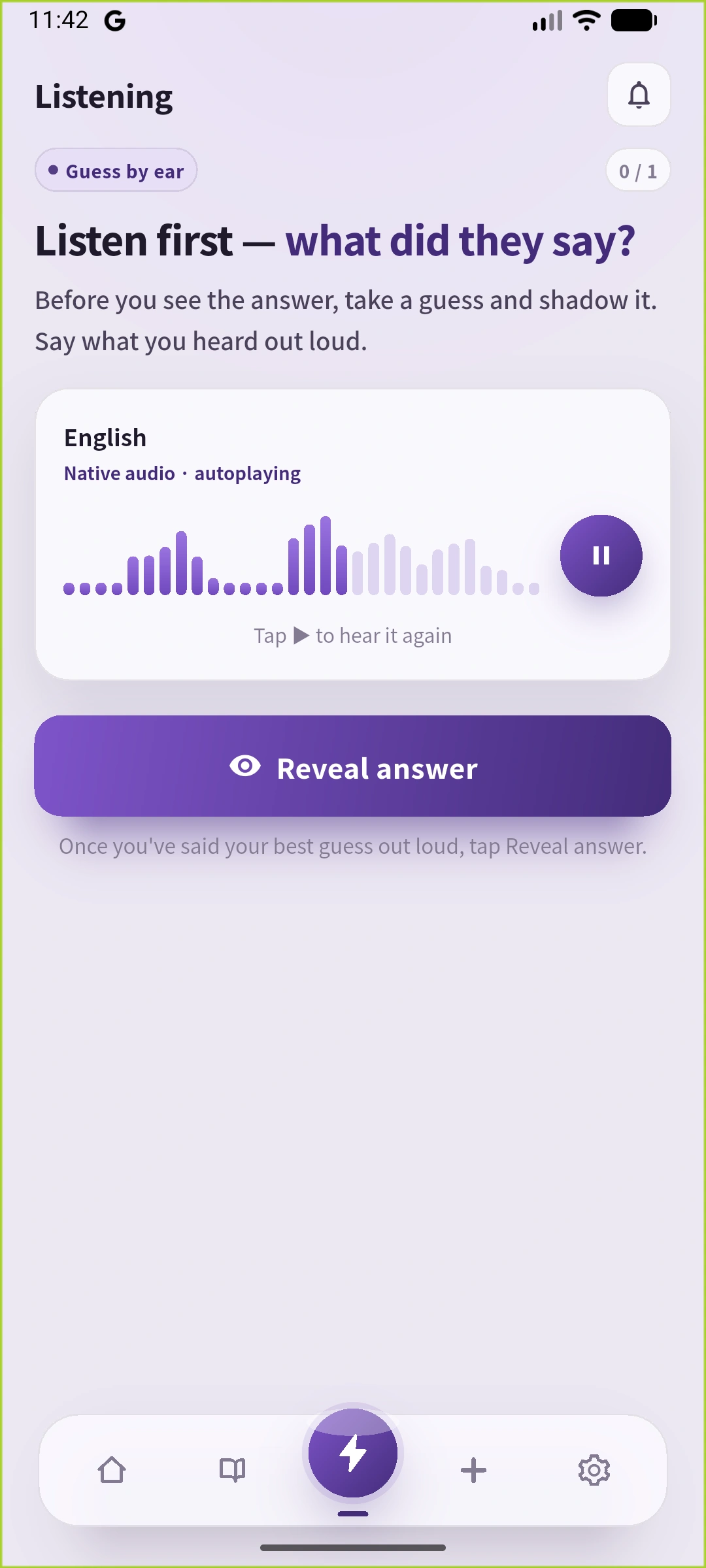
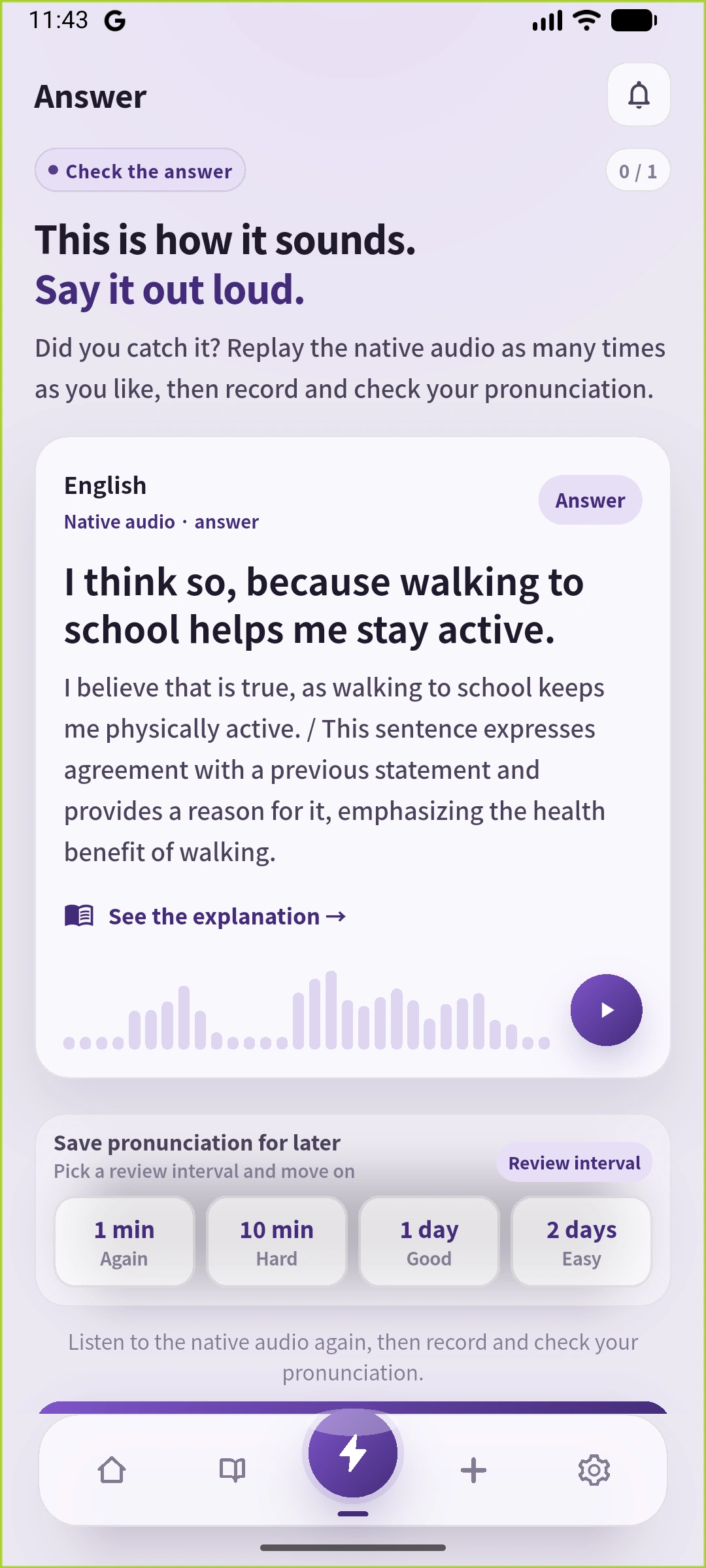
We verified saving a sentence, listening, revealing it and selecting review. We did not verify recording or assessment-result screens. This is not presented as an Eiken mock interview, answer/pronunciation scoring or a pass guarantee. We would listen, speak aloud, then return to an actual prompt and change the reason. Check content with official samples and separate home recording.
An editorial two-week preparation plan
Try the entire format once, then give more time to the tasks that stop you. This is a planning example, not a claim that two weeks guarantees a pass.
| When | What we would practise | What to keep |
|---|---|---|
| 14–11 days before | Check the format, samples and card handling; attempt all tasks | One difficulty per task |
| 10–7 days | Record one answer, fix a subject/verb/reason issue and re-record | First and revised recordings |
| 6–4 days | Change topic or position; answer without a script | Whether transfer worked |
| 3–2 days | Run the grade’s order and timings, including instructions and repeats | Forgotten actions |
| The day before | Check your ticket, venue, reporting time and belongings; lightly practise familiar sentences | Current candidate instructions |
With only a few days, still try everything once before selecting two weak tasks. Do not practise opinion answers exclusively if your grade also includes reading aloud. Parents can schedule a small independent task and a separate family listening session. The study-method hub and Pre-2 Plus plan help with allocating practice.
Methods we do not recommend
Do not make long model-answer memorisation the centre of preparation. Replaying a complete script can distract from a changed subject or position. Remember a short structure, then swap the reason, person or action.
We also reject “just smile,” universal reasons and tricks based on inserting difficult words. Official evaluation has several dimensions; a gesture or phrase alone does not establish a score. Keep the first recording instead of deleting everything except a polished final take: it shows what actually needed repair. Smooth delivery is not a CSE conversion. Higher grades still need full Pre-1 and Grade 1 tasks, not only sentence practice.
Test-day tips
Use your own ticket and current official instructions for venue, reporting time and belongings. Five to ten minutes of interview time is not your total time at the venue. Check the official schedule for your session and application method.
Communication is in English; notes, photos and recording are prohibited during the interview. Return the card and leave promptly. Natural requests for repetition are not penalised; unnatural or repeated requests may be. Requests for slower delivery or explanations of meaning are not allowed (official precautions). A universally safe repeat count is not stated.
Our practice phrase is Could you say that again, please? Rehearse listening and answering after it. If ideas stop, return to the person, action or position asked about and begin with content you can express. We do not invent an allowed silence duration. Recheck your Pre-2 or Grade 2 flow, and use official results rather than a home recording to establish the outcome.
Frequently asked questions
Which grades have an interview?
Traditional face-to-face interviews run from Grade 3 to Grade 1. Grade 4/5 speaking is separately recorded; see the official format links in the table.
What is attitude?
Willingness and attitude toward communication. Grades 3–Pre-1 list it; Grade 1 does not list a separate category with that name. Smiling alone is not a scoring formula.
May I ask for repetition?
A natural request is allowed without a deduction. Unnatural or repeated requests may be penalised; no safe count is published in the inspected instructions (precautions).
Does one silence mean failure?
That automatic-failure rule is not stated in the inspected official pages. A stalled answer may lead to the next question. We suggest practising a short relevant opening (official example of instructions).
When do I turn the card?
After No.3 for Grade 3/Pre-2, No.2 for Pre-2 Plus/Grade 2, No.1 for Pre-1. Grade 1’s turn instruction is not stated. Follow the actual instructions and grade-specific source in the table.
What are the pass thresholds?
Speaking CSE: 353, 406, 427, 460, 512 and 602 from Grade 3 through Grade 1. These are not raw scores (official CSE).
Can I practise alone?
Yes: check the format, record, fix one issue and try a changed topic. Add another listener when possible; home practice is not official scoring.
How early should I start?
There is no universal number of days. Try all tasks and allocate time to your current difficulties; the two-week plan is an editorial example.
Does Grade 4/5 speaking failure prevent grade certification?
No: grade certification depends only on the first-stage result. Speaking is a separate qualification (official explanation, our guide).
Is S-CBT face-to-face?
Speaking answers are recorded through a headset. Use its own official procedure, not the entry/exit flow here (S-CBT).
Our editorial verdict
Check the grade and delivery mode, try the official flow, record one answer, correct one issue and change the topic. Use the comparison to choose a starting point and the grade guides for actual task requirements. Today, keep one answer in your own voice and choose one observable correction for tomorrow. Continue full runs using your grade’s order and timing.
If you are still choosing a test, use our English test comparison to narrow the options by purpose, speaking format and the recipient’s requirements.
For a plan covering the first stage through the interview, see our Eiken Pre-2 study plan and priorities by time left.
Official sources checked on 14 October 2026
The comparison links the current official format for every grade. Also consulted:
- Virtual interview and speaking practice
- CSE pass thresholds
- CSE calculation
- Recorded Grade 4/5 delivery
- Grade 4/5 certification and results
- Grade 1 evaluation
- Interview precautions
- S-CBT
- Schedule
- Results
Eiken is a registered trademark of the Eiken Foundation of Japan. This article’s examples, diagrams and plans are our own editorial work, not official questions, cards or answers.
For an app alongside interview materials, our Eiken study-app comparison distinguishes interview courses from practising one answer sentence aloud.