
Which Eiken grade should you take first? All 8 grades, CEFR and test formats
Published
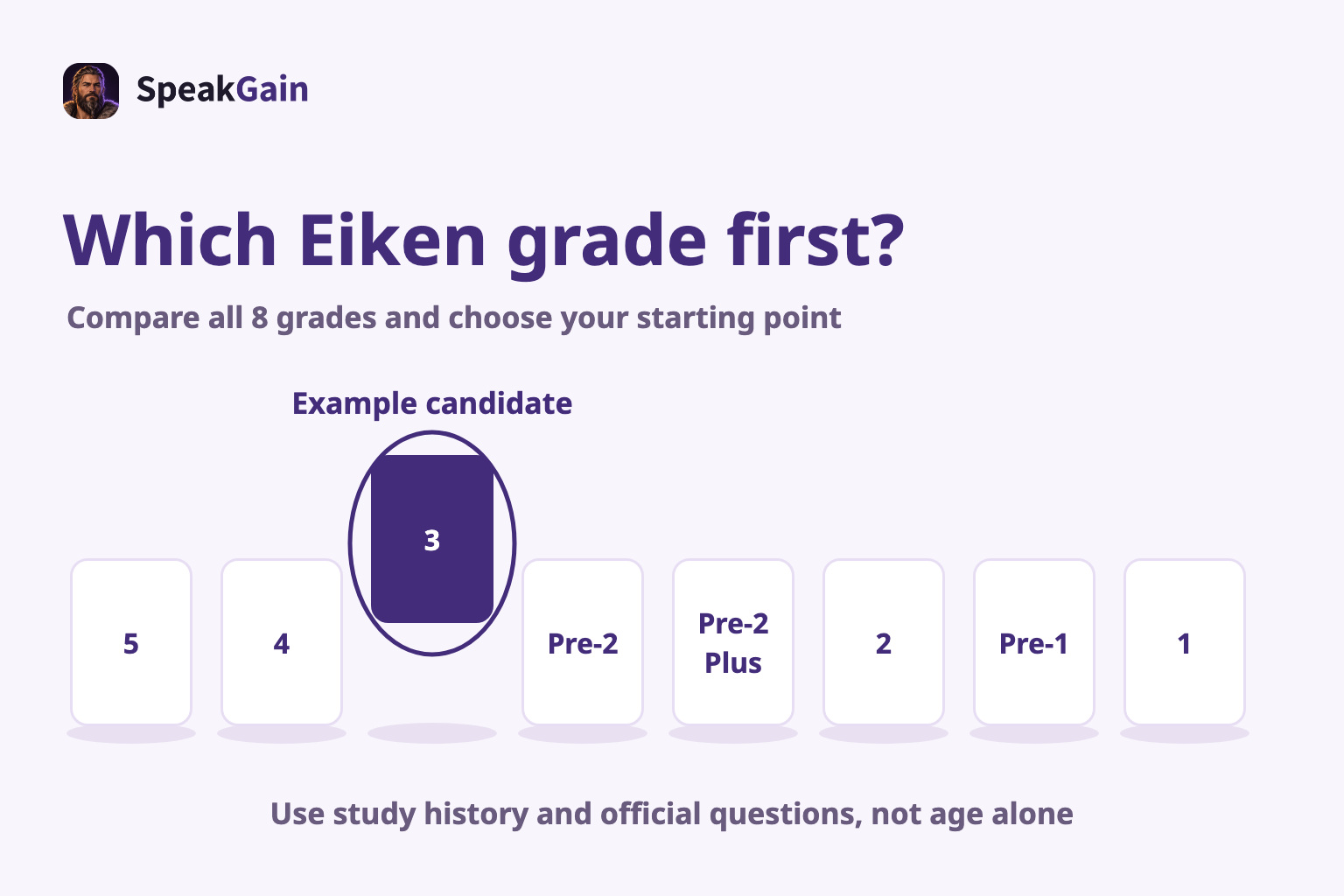
For your first Eiken test, shortlist two nearby grades using the official proficiency guide, then try official questions in every assessed skill—not just reading and listening. Grades 5 and 4 are useful starting comparisons for learners building foundations, Grade 3 for those who have covered junior-high English, and Pre-2 or higher for learners working on high-school material. If you need the result for admission or study abroad, check the institution’s required grade, CSE score, CEFR and submission deadline first.
This guide concerns Japan’s Eiken, for first-time candidates and parents, including families living in Japan. Official information was checked on 16 October 2026. Age-based candidate suggestions and the selection method are editorial advice, not a diagnosis or a prediction of passing. The stage descriptions below concern conventional Eiken.
If you are choosing between Pre-2 and Grade 2, our Pre-2 Plus guide compares the official requirements and gives a step-by-step decision process.
All eight grades: official level, CEFR and test structure
| Grade | Official proficiency guide | Overall CEFR display range | Stage 1 / writing | Stage 2 / speaking | Official source |
|---|---|---|---|---|---|
| 5 | Early junior high | Not calculated or displayed | Reading + listening; no writing task | No second stage; separate recorded speaking test | Test content |
| 4 | Mid junior high | Not calculated or displayed | Reading + listening; no writing task | No second stage; separate recorded speaking test | Test content |
| 3 | Junior-high graduation | A1 | Reading + writing + listening; one email and one opinion task | Interview speaking test | Test content |
| Pre-2 | Mid high school | A1–A2 | Reading + writing + listening; one email and one opinion task | Interview speaking test | Test content |
| Pre-2 Plus | Advanced high school | A1–A2 | Reading + writing + listening; one summary and one opinion task | Interview speaking test | Test content |
| 2 | High-school graduation | A2–B1 | Reading + writing + listening; one summary and one opinion task | Interview speaking test | Test content |
| Pre-1 | Mid university | B1–B2 | Reading + writing + listening; one summary and one opinion task | Interview speaking test | Test content |
| 1 | Advanced university | B2–C1 | Reading + writing + listening; one summary and one opinion task | Interview, including a two-minute speech and Q&A | Test content |
The proficiency descriptions refer to the Japanese school system; they are learning guides, not age requirements. The common sources for the level and CEFR columns are the official grade guide and official CSE explanation; each row’s link gives its current test content. All were checked on 16 October 2026.
CEFR is a score-dependent display range, not an automatic label attached to a grade. Results below the grade’s calculation range do not display CEFR; results above it show that grade’s ceiling. Grades 4 and 5 are explicitly outside the calculation range: do not invent an A1 or “pre-A1” label for them. A fixed required grade by age or a guaranteed number of study hours is not stated officially in the inspected guidance.
The planned introduction of Grades 6 and 7 was postponed in the official announcement dated 31 July 2026. Do not treat an old launch plan as a current registration option; consult the latest notices. This table covers the eight grades currently in the official level guide.
First-grade candidates by situation — editorial suggestions
| Situation | Candidates to compare | How to check — editorial suggestions |
|---|---|---|
| Elementary pupil, beginning written English | 5, then compare 4 | Can the child read the instructions and text and follow the audio independently? |
| Elementary pupil studying junior-high material | 4 / 3; Pre-2 if ready | For 3 and above, try writing and speaking too. |
| Junior-high pupil learning the basics | 5 / 4 | Separate unlearned material from gaps in material already studied. |
| Junior-high pupil who has covered the course | 3 / Pre-2 | Write both tasks and answer the speaking samples aloud. |
| High-school student | 3 / Pre-2; then Pre-2 Plus / 2 as appropriate | Compare the actual content, summary task and time demands. |
| Adult returning to English | 5 / 4 for foundations; 3 / Pre-2 if those return | Judge current performance, not the school you graduated from. |
| Admissions, study abroad or course credit | The institution’s specified grade or score | Read the current requirements, accepted format, result period and deadline. |
These are grades to compare with official tasks, not prescriptions for a particular age. Study history matters more than a school-year label.
A practical sequence: guide, candidates, tasks, purpose
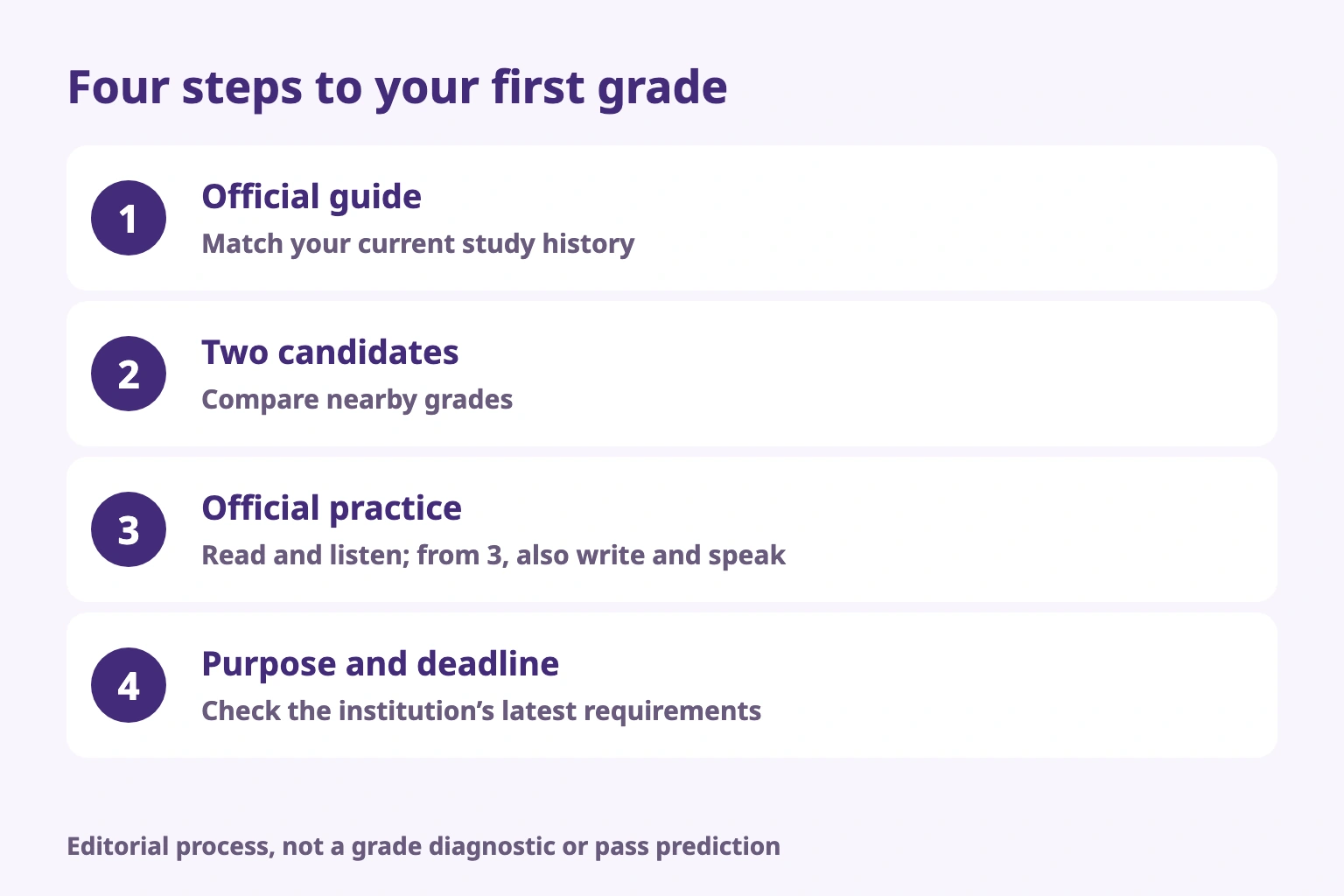
1. Match the official guide to what you have actually studied
Start with the content you know now. An adult who graduated from high school years ago may reasonably check junior-high foundations. Conversely, a younger learner may have studied much further. Time spent in an English class is not a single measure of readiness: conversational experience may coexist with slow reading, and strong reading may coexist with difficulty answering aloud.
2. Compare two nearby grades
For example, compare 4 with 3 or 3 with Pre-2. You do not need to work through all eight tests. If the lower candidate contains many unfamiliar tasks, move down; if you can handle it independently, inspect the next candidate.
You may start at 3 or Pre-2. Regulation 3.2 allows any grade regardless of previously attempted grades. Checking a lower grade’s material does not mean you must register for that grade.
3. Try every assessed skill with current official material
Open the candidate grade from the official past-paper and content index. Match the question booklet, answers and listening audio to the same sitting. First inspect a few tasks to understand the format; before registering, try a complete paper under its stated time conditions.
From Grade 3 upward, actually write both tasks and answer the speaking samples aloud. Understanding a published answer is different from producing your own. Parents should note any vocabulary help or explanations they supplied rather than treating assisted work as independent performance.
Record actionable obstacles: unfamiliar words, running out of time, leaving a writing task blank, or understanding a question but being unable to speak. We do not invent a universal practice percentage that determines your grade. CSE is not a simple raw-correct-answer total; use practice results to compare tasks and plan learning, not to guarantee a pass.
4. Decide in light of purpose and time
Without an external deadline, our preference is a manageable grade that reveals useful next learning steps. A harder grade is not automatically a better first choice, and a well-prepared learner need not collect every lower certificate. With an institutional requirement, distinguish an intermediate learning target from the result you must actually submit. Allow time for results and documents, not just the test date.
What changes at the important boundaries?
Grades 5 and 4: Stage 1 assesses reading and listening, with no writing task. Grade 4 adds longer reading work. Their separate recorded speaking test is not a second-stage interview, and grade certification depends on first-stage reading/listening results, independently of that speaking outcome. See the Grade 4 and 5 speaking-test guide for procedures.
Grade 3 and Pre-2: Stage 1 includes one email and one opinion-writing task, followed by interview speaking at Stage 2. Do not choose solely from multiple-choice performance. Once you have selected a grade, use the dedicated study, writing or interview articles below rather than treating this guide as a preparation course.
Pre-2 Plus and above: Pre-2 Plus sits between Pre-2 and 2, with an advanced-high-school official guide. Its writing includes a summary and an opinion task. Although Pre-2 and Pre-2 Plus can both display A1–A2, they have different content and level guides. Grades 2, Pre-1 and 1 also include summary and opinion writing; Grade 1’s interview includes a two-minute speech. Try the actual tasks rather than inferring readiness from a CEFR band, academic title or overseas experience.
Elementary pupils: separate listening experience from independent reading
The official guides are early junior high for 5, mid junior high for 4, and junior-high graduation for 3—not fixed elementary-school age targets. Our starting comparison for a child learning written English is 5 and 4. A child who has covered junior-high content may compare 3 or Pre-2 too.
Try the child’s candidate from the official index without supplying answers. For Grade 3, include writing and speaking. If the child can converse but cannot read the tasks, check reading foundations first. “Is 3 too early?” cannot be answered by age alone. For children under 11, regulation 3.3 asks the guardian to read the guidance and judge whether the child can take the test. We would not rush a child because classmates have a certificate.
Junior-high students: compare with the material already covered
Use the official early/mid/graduation guides to shortlist 5/4 while building foundations, or 3/Pre-2 after covering junior-high English. Try the official tasks and separate material not yet taught from gaps in what you have studied. Write both Grade 3 tasks and answer its speaking sample before assuming that a school-test mark shows readiness. Skipping 4 is permitted; whether it is a sensible choice depends on those tasks, your goal and the time available.
High-school students: include Pre-2 Plus in the comparison
The official guides are mid high school for Pre-2, advanced high school for Pre-2 Plus, and graduation for 2. Grade 3 remains a reasonable candidate when revisiting foundations. If Pre-2’s complete task set is manageable, compare Pre-2 Plus and 2, including summary writing, not just vocabulary. If Grade 2 is already within reach, inspect Pre-1’s current paper. Do not choose a grade merely because it seems appropriate to your school year, or assume that all university admissions demand the same certificate.
Adults returning to English: assess today’s skills
Regulation 3.1 sets no age, occupation or education requirement. Grades 5/4 can check foundations; 3/Pre-2 can be compared when familiar material returns. Try listening as well as reading, then actual writing and speaking for 3 upward. Even if most study fits into a commute, make separate time to try these tasks before registration. There is no reason to be embarrassed by a foundation grade, and no need to start there if you are already comfortable with higher tasks. If your goal calls for another examination, see the English-test comparison.
Admissions, study abroad and course credit: read the institution’s requirements
The official admissions notes explain grade-specific CEFR calculation. Grade passes, CSE and CEFR are different requirements. Do not assume “Grade 3 always gives extra points” or “Grade 2 works at every university.” First confirm whether that institution accepts Eiken at all.
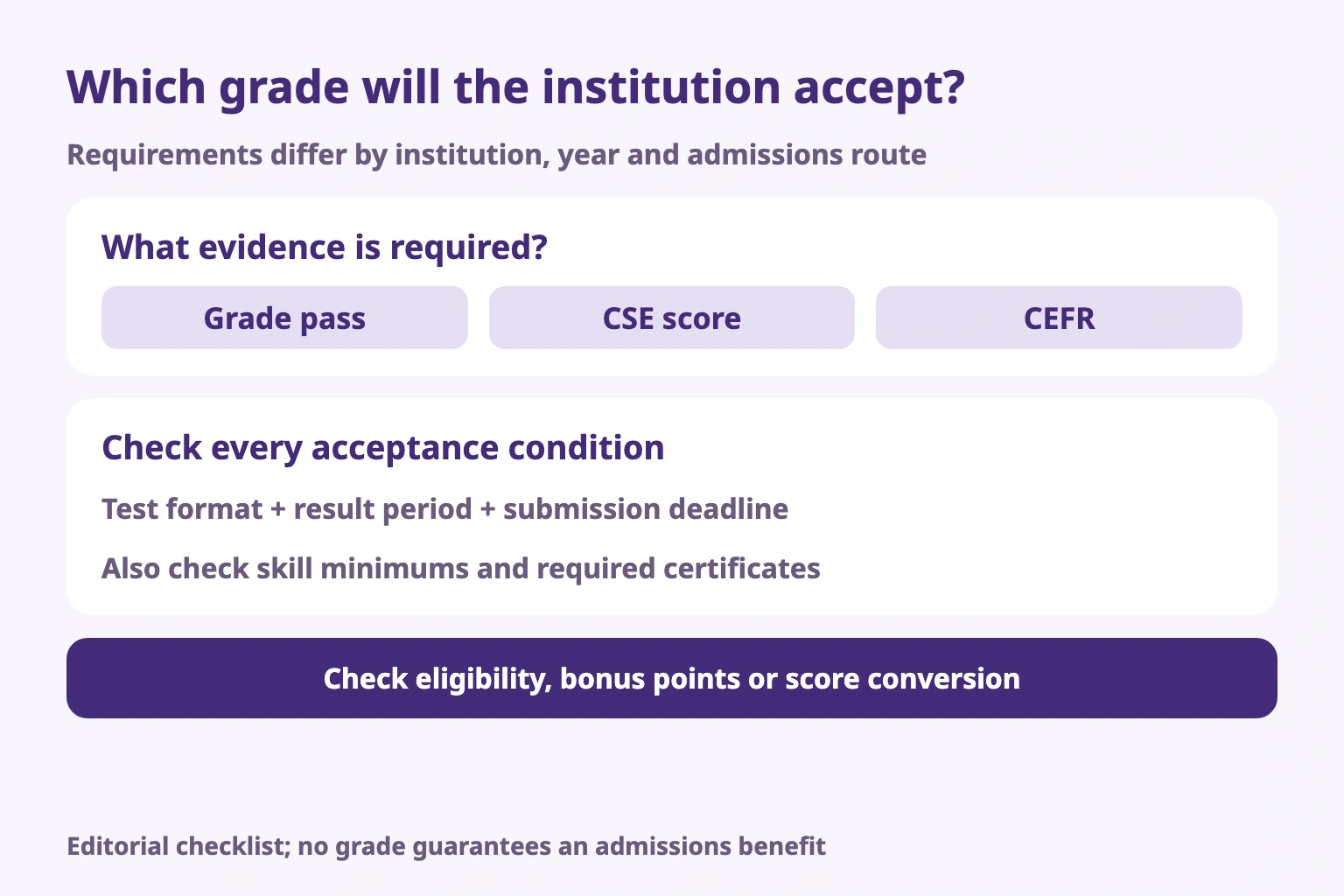
Write down the academic year, department and admissions route; whether the requirement is a grade pass, overall CSE, CEFR or skill minimums; whether it provides eligibility, bonus points, score conversion, exemption or credit; accepted test formats; eligible result dates; and certificate and submission rules. Check the current official institutional document, not only a search snippet or last year’s page. Ask the admissions office about unclear conditions.
Then try the official tasks for the required grade and compare them with your present candidate. If a school requires B1, Grades 2 and Pre-1 can display B1, but only with the necessary score and grade-specific calculation rules. Confirm whether a grade pass is required as well. A higher Eiken certificate cannot automatically replace a different examination named by a study-abroad provider.
After choosing: make one short opinion-and-reason sentence
Here is our original practice sentence, not an official question or complete exam answer:
I like walking because it helps me relax.
It states a preference and gives a reason. If it is true for you, check the meaning and say it aloud; for a different question, create a relevant answer of your own. We prefer this to memorizing a long answer and using it regardless of the question. Actual interviews also include other task types; consult the interview guide and Eiken study-app comparison for their separate roles.
Listen to your own sentence in SpeakGain
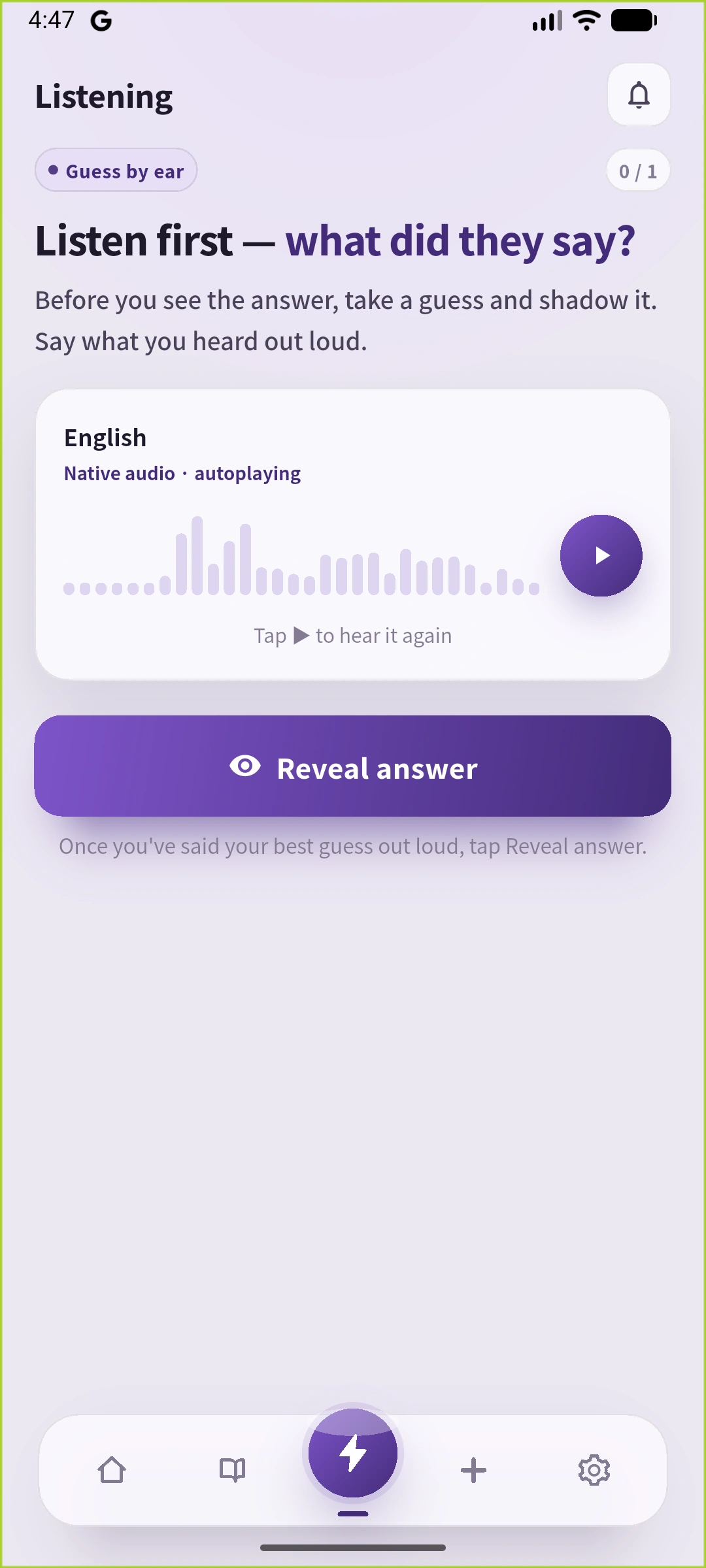
On the device, we saved the sentence above through SpeakGain’s normal Create flow, opened that card’s Knowledge view from Library, and selected “Learn this card”. Listening hid the English and invited us to listen and say what we heard. “Reveal answer” then opened Answer with the exact saved sentence.
Here the purpose is to keep an original short sentence, listen, speak it aloud and compare with the text. We did not test learner-recording submission, scoring or review-interval selection in this check. Choose your exam grade using the official tasks and your purpose, as described above.
Further reading for your chosen grade
- Eiken Grade 4 and 5 Speaking Tests: how to take them and practise at home
- Eiken Grade 3 study plan: current format, time left and family support
- Eiken Grade 3 writing: emails, opinions and reviewing at home
- EIKEN Grade 3 interview: flow, answer patterns and solo practice
- Eiken Pre-2 study plan: current format, four skills and time left
- Eiken Pre-2 writing: emails, opinion essays and clear reasons
- EIKEN Pre-2 interview preparation: answer patterns and solo practice
- Eiken Pre-2 Plus interview: format, differences and solo practice
- How to study for Eiken Grade 2: summaries, skills and a realistic study plan
- Eiken Grade 2 Writing: summaries, opinion essays and the limits of templates
- EIKEN Grade 2 interview preparation: four questions, narration and solo practice
- How to study for Eiken Grade Pre-1: summaries, four skills and a realistic plan
- Eiken Grade Pre-1 Writing: summaries, essays and scoring
- EIKEN Grade Pre-1 interview preparation: narration, opinions and solo practice
- Eiken Grade 1 interview preparation: choose, speak and handle follow-ups
- Eiken interview day: clothes, what to bring, entry and repeat requests
- Eiken S-CBT preparation: test formats and recorded speaking
Frequently asked questions
Which grade should an elementary pupil take first?
Compare 5/4 when building foundations. A learner who has covered junior-high content and can attempt writing and speaking can consider 3 or above. Check independent performance, not age alone.
Can I start directly at Grade 3 or Pre-2, or skip grades?
Yes. Previous lower-grade passes are not an entry requirement under regulation 3.2. Try both writing tasks and the speaking sample before making the choice; using lower papers for revision does not oblige you to take those tests.
Where does Pre-2 Plus fit?
Between Pre-2 and 2. Introduced in 2025, it has an advanced-high-school guide, summary/opinion writing and a score-dependent overall CEFR display of A1–A2. It is not automatically B1.
Which grade corresponds to CEFR B1?
The official display table permits B1 for Grade 2 and Pre-1. Your score and grade-specific calculation range determine the actual display; registering for Grade 2 does not itself establish B1.
Which grade helps with admissions?
There is no universal threshold. Check the institution, academic year, route, grade/CSE/CEFR, skill requirements, eligible dates and submission deadline. Benefits are not guaranteed merely by a grade name.
Should I choose by pass rates?
Current grade-by-grade pass rates were not stated officially on the inspected participation, level and test-content pages. We could not verify a current official figure, so we do not reuse old percentages to recommend a grade.
Does S-CBT change my grade choice?
Choose grade and test format separately. Official S-CBT guidance describes assessing four skills in one day. Check its offered grades, procedures and schedule, plus whether your institution accepts that format; the stage table here describes conventional Eiken.
Editorial verdict: compare adjacent grades before registering
We would shortlist two nearby grades from the official guide, try every required skill with current official material, then choose using the purpose and deadline. Parents can help observe what the child does independently rather than chase a prestigious-looking grade. Today’s useful first step is to open one official paper; after choosing, move to the specific grade’s preparation guide.
If you are deciding whether to aim for Pre-1, our guide to its official level, CEFR, adjacent grades and self-check steps helps you compare the evidence.
Official references
- Grade guide and practice papers
- CSE and CEFR
- Pre-2 Plus
- Eligibility and skipping grades
- Admissions requirements
- S-CBT
- Latest Grade 6/7 notices
Checked 16 October 2026. Eiken is a registered trademark of the Eiken Foundation of Japan. This is an independent SpeakGain editorial guide.
For the official benchmark, CEFR and limits of pass-rate evidence, use our Eiken Grade 2 level guide and its steps for checking your readiness.
Before choosing your test, use our Eiken Grade 3 level and pass-score guide to check the official reference, CSE thresholds and tasks across all four skills.
To compare the official benchmark, CEFR and the gap to Grade 2, read our Eiken Pre-2 level guide.