
Eiken Pre-2 study plan: current format, four skills and time left
Published
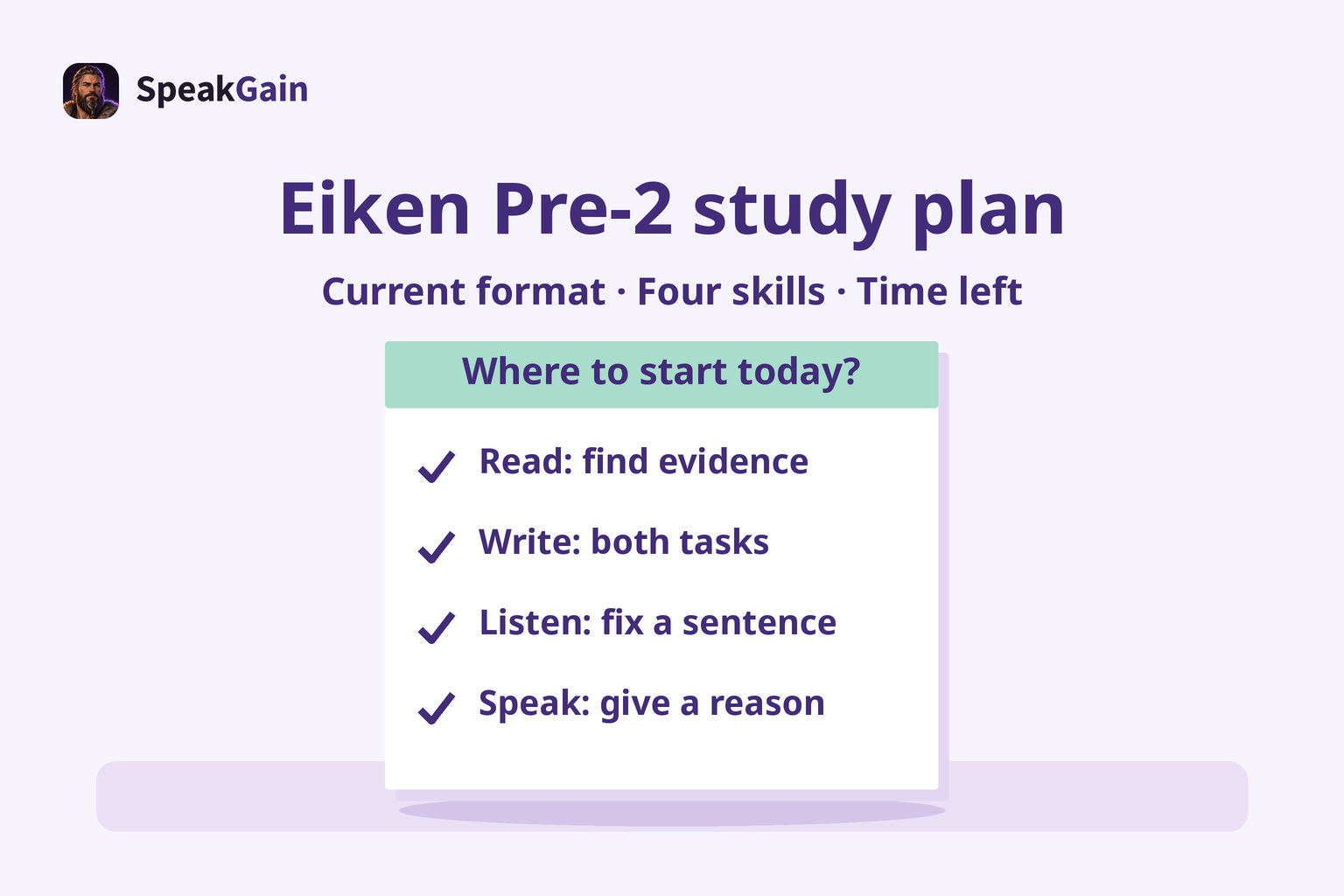
Start Eiken Grade Pre-2 preparation with one current official paper, then separate the reasons you struggle with reading, writing and listening. Since the 2024 renewal, writing includes both an email reply and an opinion task, so our recommendation is to practise writing and short listening activities while building vocabulary. With three months left, repair the foundations; with one month, prioritise weaknesses and timing; with two weeks, cover untried tasks and review recurring mistakes.
Eiken is a Japanese English qualification. This guide covers Grade Pre-2 in the conventional two-stage test, for junior-high and high-school students, their families, and adults returning to English, including English-speaking residents of Japan. Official information was checked on 16 October 2026. Study methods, schedules and allocations of study time below are editorial suggestions, not official requirements or promises of passing.
If you are choosing between Pre-2 and Grade 2, our Pre-2 Plus guide compares the official requirements and gives a step-by-step decision process.
For a purpose-based choice of resources and a routine that turns words into your own sentences, see our Eiken Pre-2 vocabulary guide.
Current format and passing criteria
The 2024 renewal added email writing alongside the opinion task and changed the reading question count and written-test duration. Do not plan around an older guide that describes only one writing task.
| Skill | Task | Questions | Time | Official source |
|---|---|---|---|---|
| Reading | Section 1: complete words or phrases in short texts | 15 | 80 minutes shared with writing | Format |
| Reading | Section 2: complete dialogues | 5 | Same shared time | Format |
| Reading | Section 3: gaps in passages | 2 | Same shared time | Format |
| Reading | Section 4: passage comprehension | 7 | Same shared time | Format |
| Writing | Section 5: email reply, target 40–50 words | 1 | Within the same 80 minutes | Current booklet, p10 |
| Writing | Section 6: opinion and two reasons, target 50–60 words | 1 | Within the same 80 minutes | Current booklet, p11 |
| Listening | Response selection; dialogue comprehension; short-passage comprehension | 10 each, 30 total | About 25 minutes overall | Format |
| Speaking | Read a passage of about 50 words aloud and answer questions on text, pictures and opinions | 1 reading task + 5 questions | About 6 minutes overall | Format |
Reading totals 29 questions. There is no official fixed allocation stated for individual reading or writing sections. The interview duration is not the total time you will spend at the venue. This article uses the current Japanese official pages for listening time; the English overview has a conflicting duration.
| Decision | Maximum CSE score | Passing threshold | Source |
|---|---|---|---|
| First stage | 600 each for reading, writing and listening; 1800 total | 1322 across the three skills | Criteria and score explanation |
| Second stage | 600 for speaking | 406 | Criteria and score explanation |
Question counts do not determine each skill’s share of the score. You cannot convert your own number of correct answers into a CSE score: the official explanation describes statistical calculation after all answers have been marked. Record correct answers and the causes of mistakes, rather than inventing a guaranteed passing raw score. First- and second-stage thresholds are assessed separately; adding them to make 1728 does not allow one stage to compensate for failure in the other.
What to prioritise with the time left
Try every skill once before choosing your priorities. These are editorial plans, not claims that a particular deadline is enough to pass.
| Time left | Priorities | What to do today | Keep in the plan |
|---|---|---|---|
| 3 months | Repair vocabulary and grammar while starting both writing tasks and listening/speaking | Use one official sitting to diagnose weaknesses | Weekly rewriting and listening review |
| 1 month | Choose two major weaknesses; finish reading and both writing tasks within 80 minutes | Find blank writing answers and reading answers without evidence | An unfamiliar paper and correction time |
| 2 weeks | Avoid adding materials; cover untried tasks and recurring errors | Write both tasks and try all three listening formats | A timed run, an introduction to the interview and checking test instructions |
“How should I study until test day?” depends on your starting point as well as the deadline. If reading is manageable but you have never written an email, write one today instead of spending another whole session only on vocabulary. If everything feels difficult, reduce the amount and repair specific sentences rather than rushing through more papers.
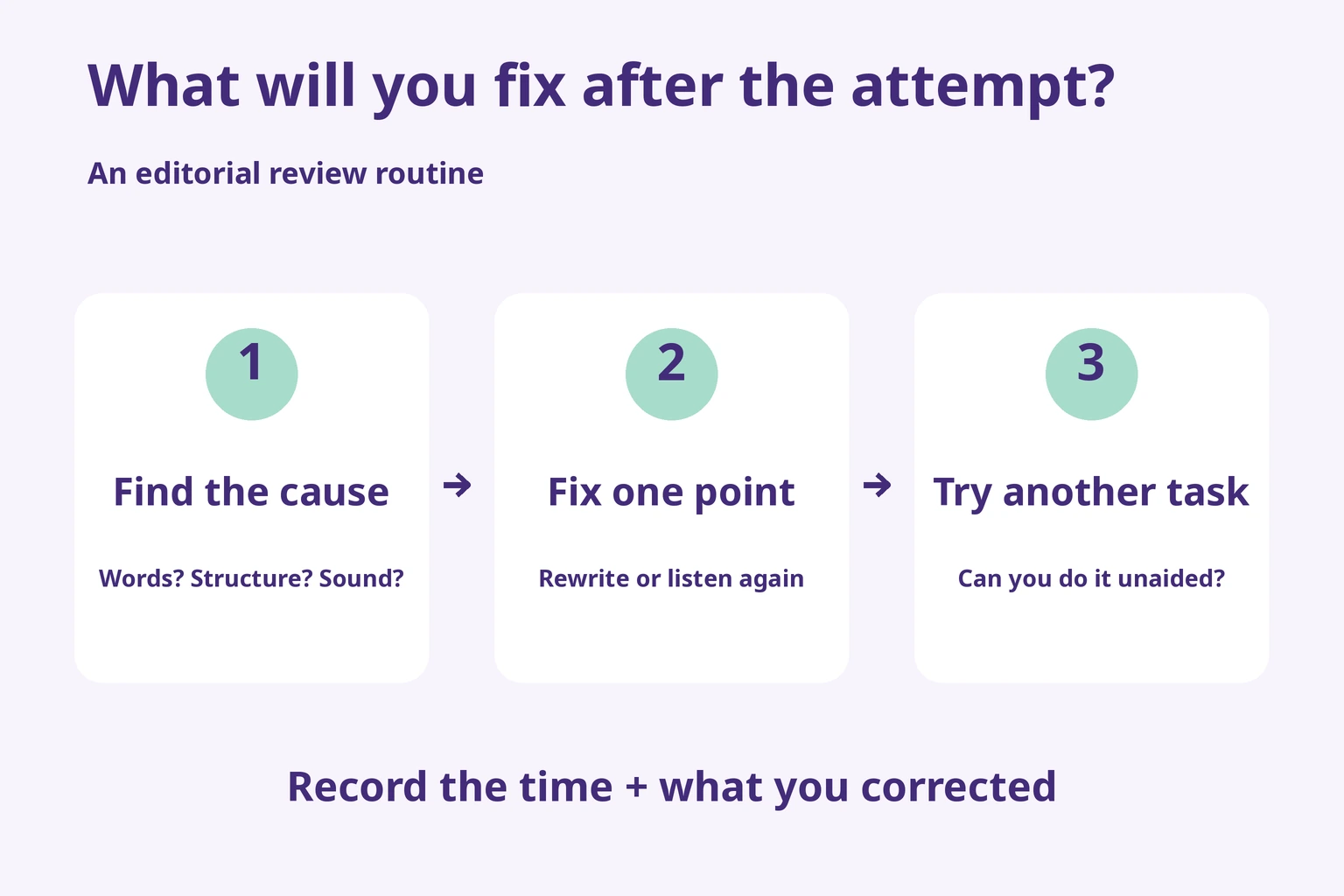
On the first attempt, record the time used, unfinished writing and where you lost the listening thread. Classify reading errors as unknown vocabulary, sentence relationships or missing evidence; writing errors as missed instructions, weak reasons or sentences you cannot construct; listening errors as meaning you do not know even in print or familiar words you failed to recognise. Choose two actionable repairs for the first week. Leave an unused sitting for a later check.
Reading: move from word meanings to evidence
Official format: short-text, dialogue and passage gaps plus passage comprehension, as shown in the official structure.
Common difficulties: choosing a familiar option without checking the whole sentence, looking only at the final line of a dialogue, or assuming that repeated words mean matching content.
Practice: after checking an answer, explain the completed sentence in your own words. Save a word with its surrounding phrase. In dialogues, identify who wants what and how the other person responds. For passages, find the evidence and compare subjects, negatives and times with the option. Revisit the paragraph relevant to your mistake before translating the entire text. If basic sentence structure is the obstacle, review the relevant grammar from your Grade 3 or school materials, then return to the Pre-2 sentence.
Official materials: use the question booklet and answers. An answer number alone does not explain why the choice fits. If you need help, show a teacher the sentence and your interpretation.
Writing: practise email and opinion separately
Official format: the current booklet asks for a reply to the sender’s question and two specific questions about the features of the underlined item, in approximately 40–50 words. The opinion task asks for your opinion and two reasons, in approximately 50–60 words.
Common difficulties: replying only with personal news, asking just one question, asking about the wrong item, or giving two reasons that say the same thing. The official opinion-writing criteria cover content, organisation, vocabulary and grammar; an answer unrelated to the question can receive zero across the criteria.
Practice: before the email, identify what to answer, what to ask about and how many questions are needed. Match each requirement to a sentence after writing. For opinion writing, decide your position and two distinct reasons before choosing English expressions. Here is our original practice sentence:
I think students should grow vegetables because they can learn about nature.
It links an opinion to one reason. It is not a complete test answer: the actual task also needs a second relevant reason and suitable explanation. For this practice topic, learning to value food could be another angle; merely rephrasing “learn about nature” would not add a distinct reason.
Check the content and order first, then subjects, verbs, tense, number and spelling. Rewrite one correction from memory the next day. If someone can review your work, ask a focused question such as whether both email questions address the specified item or whether the two reasons overlap.
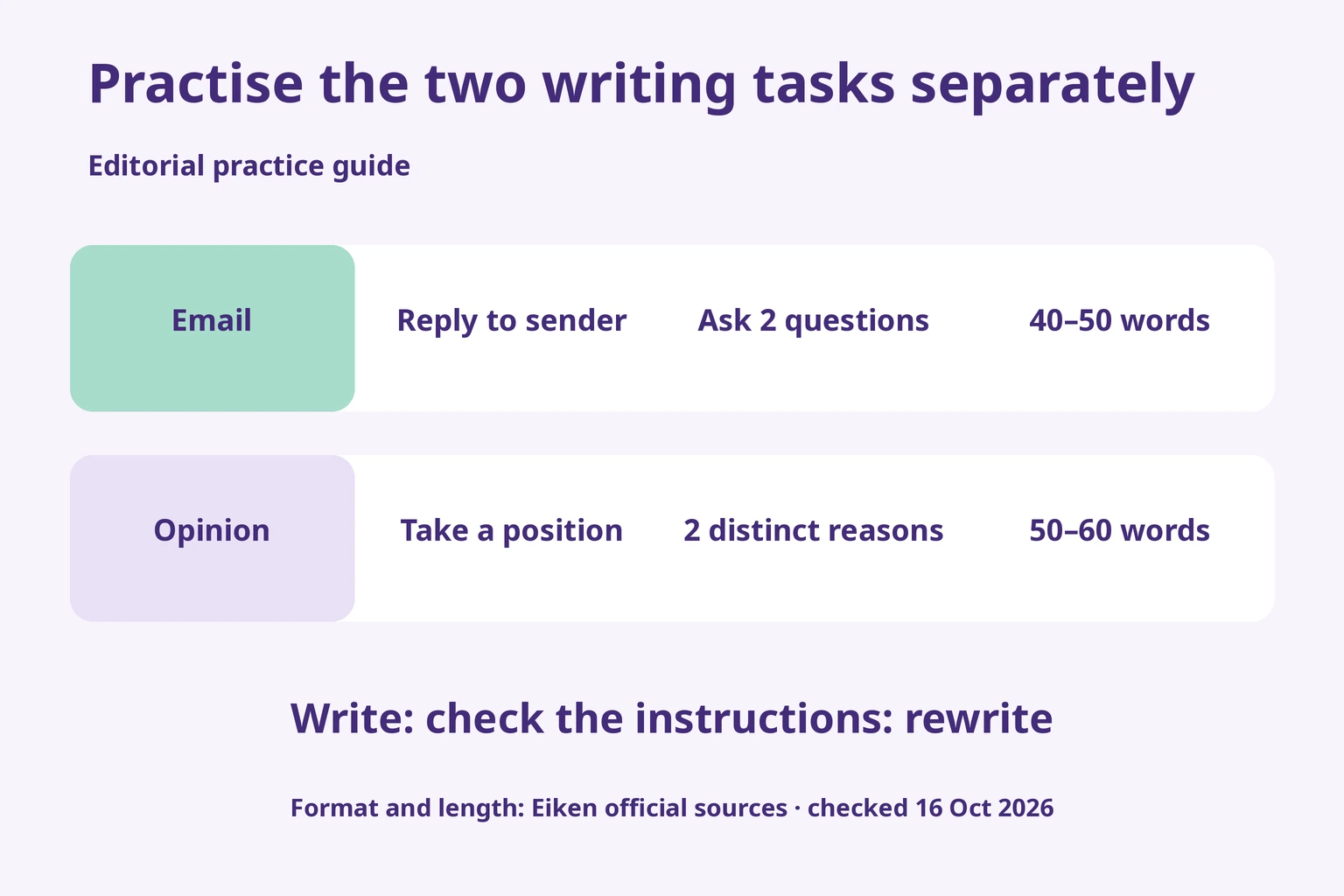
Official materials: use sections 5 and 6 and the answers from the same sitting. Treat the sample answer as a reference, not a script to paste into another question. Do not interpret the raw-mark description on the opinion-writing guidance page as the total for the entire two-task writing skill.
Listening: diagnose what you could not hear
Official format: three task types, with each recording played once, according to the official format. Try the initial check without pausing; repeated listening belongs in review.
Common difficulties: losing the rest of the recording after one unknown word, confusing speakers or changed plans, and selecting an option because it contains a word you heard.
Practice: listen once and answer. Before opening the script, recall who did what and why. Then compare with the official script. If the sentence is unclear in print, repair its vocabulary or grammar. If it is clear in print, match the missed phrase with the recording. Close the script, listen again, understand the meaning and say the sentence aloud. Work in smaller chunks if speed obscures meaning, then return to the original recording. Record what became understandable, not just the number of replays.
Official materials: the past-paper page provides audio by part and the listening script. Keep the year and sitting consistent across the audio, booklet and script; use the official links rather than redistributing the recordings.
Interview: begin saying short answers during first-stage preparation
Official format: reading aloud and five questions covering the passage, people’s actions, a person’s situation, a related opinion and an everyday topic, as listed in the official interview structure.
Common difficulties: being able to write a sentence but not say it, stopping at “Yes”, or reusing a memorised reason when the question has changed.
Practice and official materials: view the sample and virtual interview from the official page. At home, record one answer and check whether it addresses the question and includes the necessary explanation. A short opinion sentence does not cover all interview tasks. Detailed practice belongs in our Pre-2 interview guide; use the Grade 3 interview guide to revisit the earlier level and the Eiken interview overview to compare grades.
How many study hours do you need?
No universal required number of hours is stated in the official sources checked. Your starting grammar, listening experience and ability to write both tasks determine what needs work. Test duration and preparation time are different things.
As an editorial scheduling example, 45 minutes on each of five weekdays plus 75 minutes on each weekend day gives 6 hours 15 minutes a week, or 50 scheduled hours over eight weeks. This is available time, not a measured requirement or passing threshold. Recalculate for days off. A 45-minute session might contain 10 minutes of vocabulary review, 20 of reading or writing, and 15 of listening review and speaking. Alternate reading and writing days; check what you actually corrected at the end of the week.
Our two-month plan for a junior-high student
Keep schoolwork and other commitments in view, and try both writing tasks in the first week. This eight-week sequence is an editorial opinion, adjustable around school exams or work.
| Weeks | Practice | Evidence to keep |
|---|---|---|
| 1–2 | Diagnose the current format, repair grammar, attempt email and opinion | Timing, blanks and error types |
| 3–4 | Find reading evidence, rewrite writing and review one missed listening sentence | Can you correct the same error yourself? |
| 5–6 | Check weaknesses on different material; say short written answers aloud | Can you respond when the question changes? |
| 7–8 | Use an unused timed paper, repair what remains, check test instructions and interview flow | Did both writing tasks and final review fit? |
Parents can ask “What did you fix today?” instead of comparing daily scores. Help prepare a focused question for a teacher where needed. Adults returning to English should reserve writing time at home as well as listening during travel.
An initial editorial division of the written test is 40 minutes reading, 15 email, 20 opinion and 5 review. It is not an official allocation. Adjust it using your attempt: if reading takes all 80 minutes, decide when to move to writing; if the email is slow, practise shorter questions. Preserve time to check that both answers address their tasks.
Use official past papers without exhausting them
The official Pre-2 page publishes one year’s papers, three sittings, with first-stage question and answer PDFs, listening scripts and part-by-part audio. Downloads cover the main venue and secondary-venue F schedule. Second-stage sample PDFs and the virtual interview are also linked. On the check date, the displayed sittings were 2026 session 2, 2026 session 1 and 2025 session 3; check the page as its contents change.
Our suggestion is one sitting for diagnosis and review, another to check repairs and an unused one for a final timed run. Three published sittings are not a compulsory practice dose. Before adding materials, decide whether you need grammar explanation or unfamiliar practice. If buying a book, verify its target grade and coverage of both current writing tasks on the publisher’s page. We do not rank books or provide shopping links here.
Three methods we do not recommend
Memorising a complete essay as a universal answer: the topic or email target may change. Learn short expressions, then change their content to fit the question.
Using only a vocabulary book: knowing meanings does not practise asking two questions, finding passage evidence, understanding one-play audio or explaining a reason aloud.
Doing past papers without review: the same cause can recur. A higher score on a familiar paper may reflect remembered answers; explain the correction and try unfamiliar material.
Say the opinion-and-reason sentence aloud
I think students should grow vegetables because they can learn about nature.
Understand it, say it, then recall your opinion and reason without looking. Change the topic and try a new short answer. Return to the actual question rather than giving this sentence as a universal response. About SpeakGain explains its role as a place for short phrases with audio; app selection belongs in our Eiken study-app comparison. Keep official format practice, content review and speaking practice as complementary activities.
We entered this sentence through the normal Add flow and verified Library → Knowledge → Learn this card → Listening → Reveal answer → Answer on the device. Listening hid the sentence and invited us to listen and say what we heard; Answer showed the same English. We did not submit a learner recording or test assessment. SpeakGain is a short-sentence listening and speaking aid here, not an Eiken mock test, writing or pronunciation scorer, or CSE predictor.
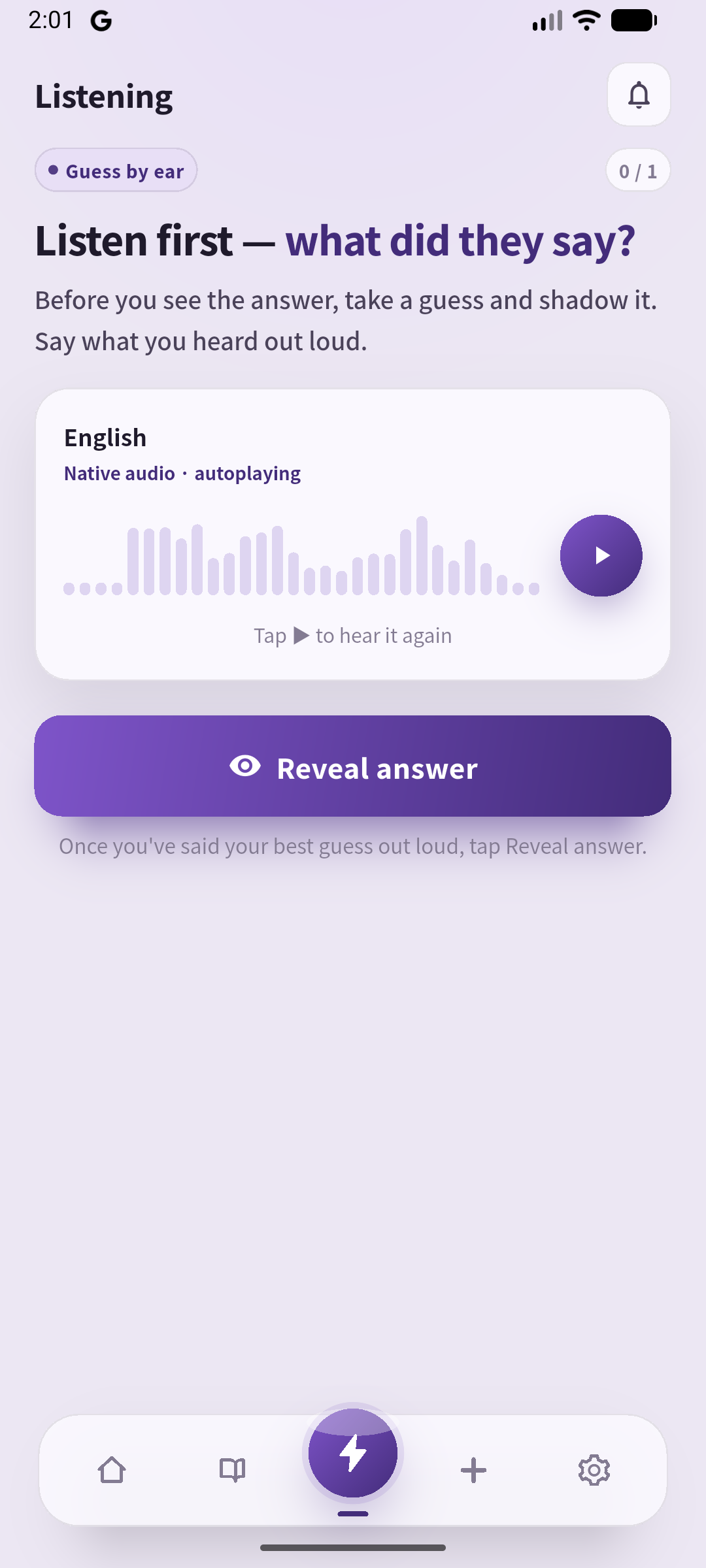
AI-generated Deep-voiced Viking audio, generated once for this original sentence. It is not official Eiken audio or a complete answer.
Pre-2 and Pre-2 Plus are different grades
Pre-2 Plus is not a new name for Pre-2. The official new-grade page explains its introduction between Pre-2 and Grade 2 in 2025. Pre-2 focuses on everyday topics and basic expressions; Plus asks for understanding key points and details on familiar social topics and expressing ideas in greater detail with varied language. The introduction did not change existing grades’ scope or format.
Prepare for the grade you entered. For a later goal, compare our Pre-2 Plus interview guide and Grade 2 study plan; do not mix their task formats into Pre-2 practice.
Frequently asked questions
Where should I start?
With a current official paper and a record of why you made mistakes. Start both writing tasks alongside vocabulary, and include a little spoken practice.
How many hours are required?
The official sources checked state no universal requirement. Our 50 hours over eight weeks is a scheduling example, adjustable to your starting point and commitments.
Can a junior-high student aim for Pre-2?
Separate the official level guideline—mid-level high-school English—from your own preparation. Diagnose gaps and adapt the two-month editorial plan to school commitments; the level guideline does not guarantee a result.
Is one month enough?
The deadline alone cannot answer that. Diagnose today, select two major weaknesses, and combine timed attempts with correction instead of starting many new books.
What should I do with two weeks left?
Try both writing tasks and all listening formats, repair recurring errors, and keep an unused timed attempt and test-instruction check. We do not promise a pass in two weeks.
How should I practise writing?
Separate email reply from opinion writing. Check the reply and two targeted questions; for opinion, check your position and two distinct reasons. Change the content for another prompt.
What are the passing CSE scores?
First stage: 1322/1800. Second stage: 406/600, from the official criteria and maximum scores. Correct-answer percentages cannot be directly converted to CSE.
How do I move up from Grade 3?
Check whether you can use its grammar and vocabulary in sentences. Repair the basics while attempting Pre-2 reading, both writing tasks, listening and short spoken answers.
Can I check Pre-2 format with Plus materials?
Use Pre-2’s official materials for format checks. Plus is a separate grade, so match the material to the grade you entered.
Editorial verdict
Check the current official format, diagnose once, classify mistakes, practise both writing tasks alongside audio, and test repairs on different material. With less time, prioritise untouched tasks and repeated errors over additional books. End a session with one thing you corrected as well as the minutes you studied, then use that record to adjust next week’s plan.
Official information checked on 16 October 2026. Examples, diagrams and plans are editorial work, not official questions, answers or predictions of passing. Eiken is a registered trademark of the Eiken Foundation of Japan.
To compare the official benchmark, CEFR and the gap to Grade 2, read our Eiken Pre-2 level guide.