
Eiken Pre-2 vocabulary: choose a wordbook or app and use words in your own sentences
Published
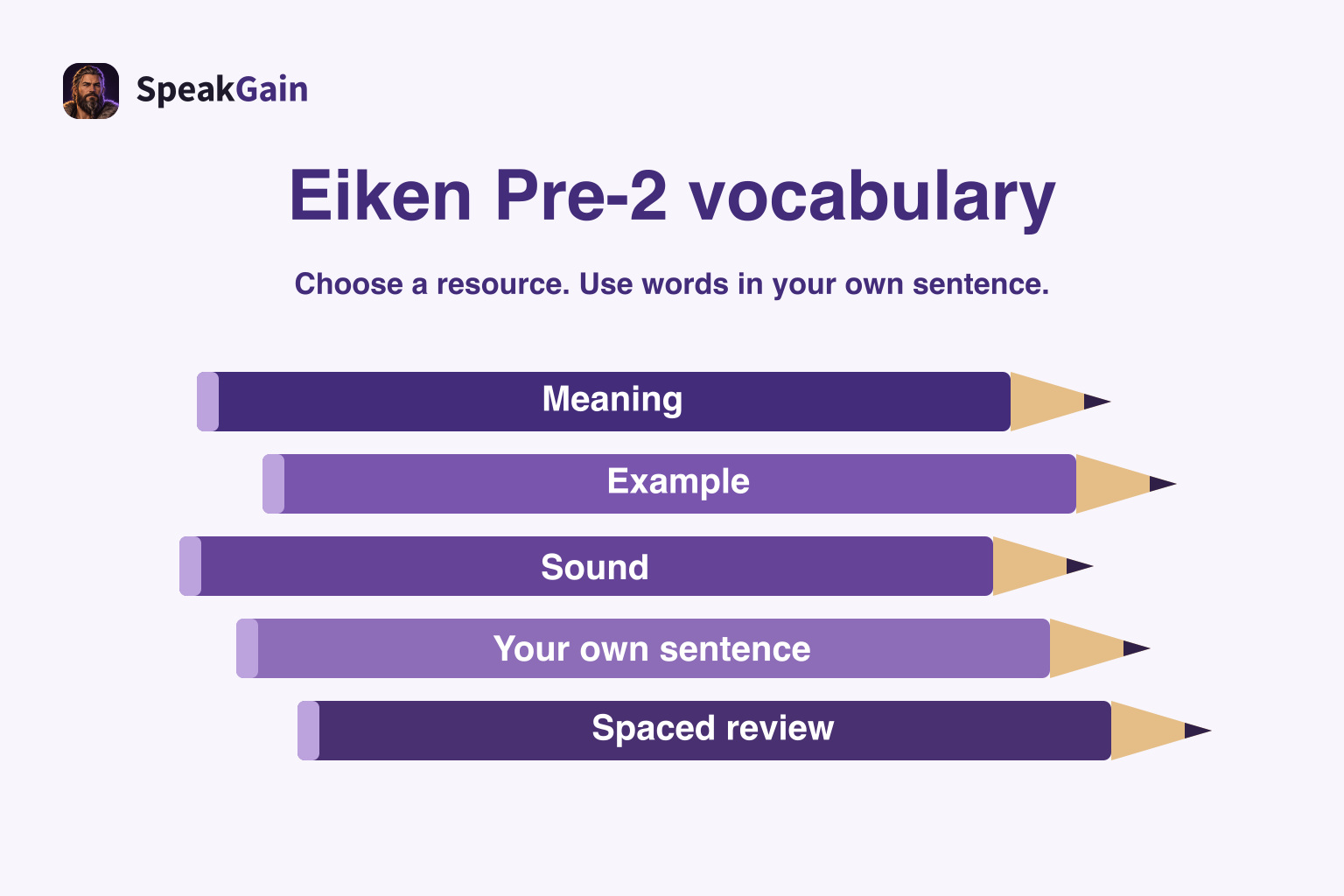
For Japan’s Eiken Grade Pre-2, our editorial recommendation is to choose one main wordbook or app and practise meaning → example → sound → your own sentence → review after a gap. The official grade guide, test format and grade benchmarks checked for this article do not state a fixed required word count or an exhaustive vocabulary list; a resource’s entry count is not a passing requirement. Practise understanding words in passages and expressing your ideas in writing and an interview, as well as choosing answers to vocabulary questions.
Choose a wordbook or app by its purpose
This is a purpose-based comparison, not a ranking. Information comes only from the publishers’ and providers’ official pages, checked on 16 October 2026. We have not read, used or tested these third-party resources to compare their effectiveness. “Who it suits” is our editorial interpretation of the stated features. These are Japanese materials, with Japanese explanations, for an examination chiefly taken in Japan.
| Name | Provider | Entries stated officially | Audio | Features | Who it suits: editorial view | Checked |
|---|---|---|---|---|---|---|
| Eiken Pre-2 Derujun Pass Tan, new-cover 5th revised edition, book | Obunsha | Contents: 1,100 words, 400 idioms; separately 100 conversation expressions and 32 composition items | Free download; Eigo no Tomo support | Frequency-based order; tests in the word and idiom sections | Learners who want to mark progress on paper and use accompanying audio | 2026-10-16 |
| Rankjun Eiken Pre-2 English Vocabulary 1550, new-cover edition, book | Gakken | 1,550 in the title; no breakdown on the page checked | Free word and idiom audio files | Idioms grouped by pattern/category; web quizzes for included words and idioms | Learners who want to organise idioms and check book content through quizzes | 2026-10-16 |
| Derujun Pass Tan Pre-2, 5th revised edition, content in English Words by Monokakido | Monokakido; source book: Obunsha | Total not stated on the provider page checked | All headwords, meanings and examples; automatic playback and speed controls | iOS; weak-word filtering, multiple-choice and written questions | Learners with a supported device who want to return to weak words | 2026-10-16 |
All three target Pre-2. Obunsha says its new-cover fifth edition has the same content as the previous fifth edition, with a changed cover. Check that explanation before replacing an existing copy. The Monokakido content is labelled fifth edition. Counting units differ: do not add words, idioms and expressions and rank resources by the total. A free host app does not necessarily mean free learning content. Check edition, OS, audio access and usage conditions with the provider. No covers, affiliate links or purchase links are included here.
Our choice: one main resource plus support for a specific gap
If marking a page keeps you going, use a book with its audio. If short checks during travel suit your routine, consider an app that returns you to weak words on a supported device. If school already specifies a Pre-2 resource, check whether it provides meanings, examples and sound before buying another.
Decide where tomorrow’s review will begin: marked pages or incorrect items. Include listening time and connectivity in your decision. We prefer a resource you can return to with the answers hidden; this is not evidence that one medium produces better memory. See our broader vocabulary app comparison and Eiken app guide for other purposes.
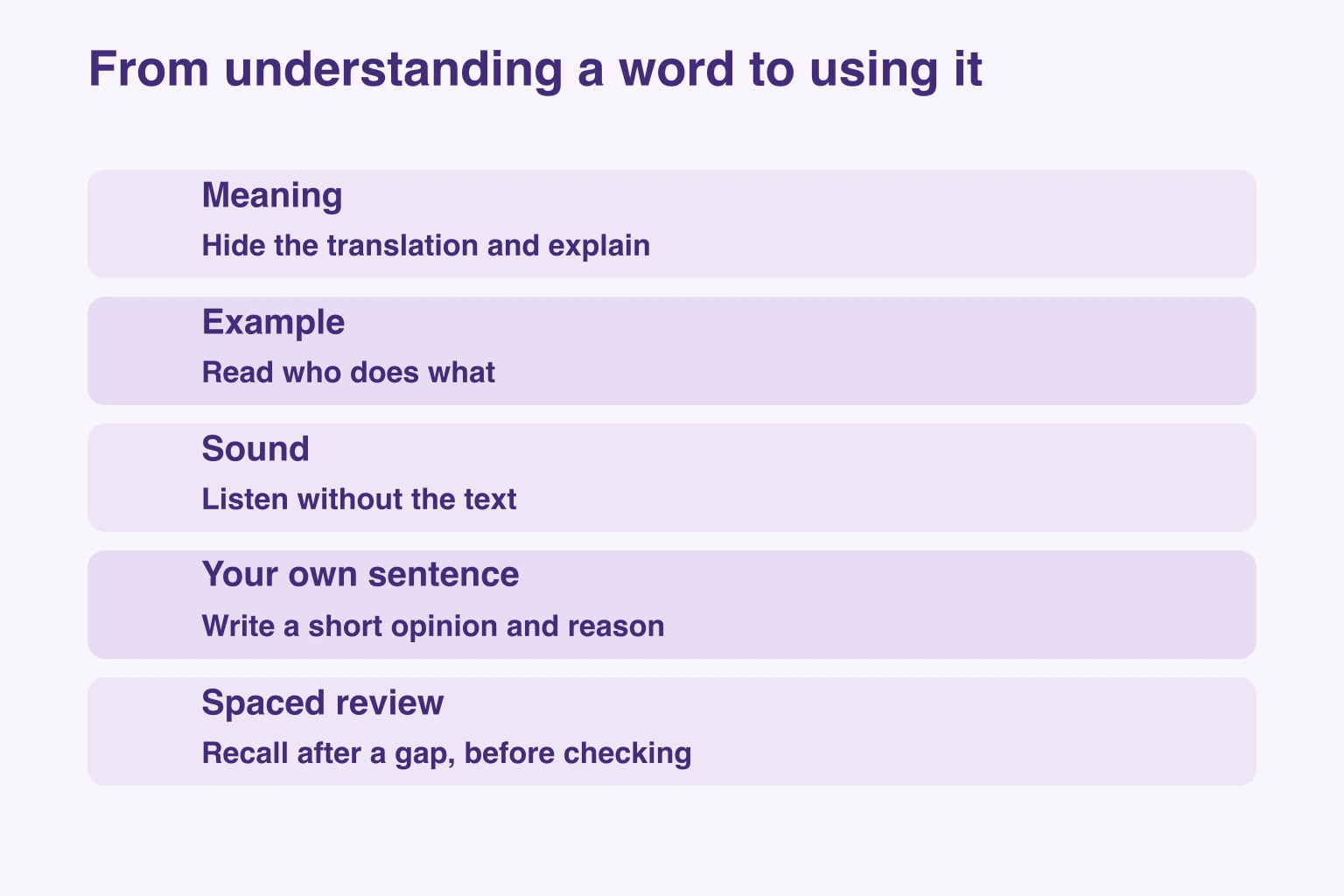
Five stages, each with a check
This is an editorial practice proposal, not a method prescribed by Eiken or an optimal schedule for everyone.
| Stage | What to do | How to check |
|---|---|---|
| Meaning | Check the part of speech and this sentence’s meaning | Hide the translation and explain the word |
| Example | Read who does what, including accompanying words | Explain the whole sentence |
| Sound | Listen, check the text and say a short stretch aloud | Hide the text and connect sound to meaning |
| Your sentence | Write a short opinion and reason about a familiar topic | Check usage and whether the reason supports the opinion |
| Spaced review | Return after a gap and recall before checking | Identify whether meaning, sound or usage caused the difficulty |
You do not need to write a composition for every new word. Work through the main resource and choose one word that could fit your life. Leave time to encounter the other words in examples and audio too. “It felt familiar today” and “I recalled it tomorrow” are different checks. Mark the type of difficulty rather than restarting every page. Our general vocabulary learning guide covers broader review methods.
How many words does Pre-2 require?
The official grade benchmarks describe Pre-2 as intermediate high-school level, covering everyday topics and expressing information and ideas with basic vocabulary. This is a grade benchmark, not a rule excluding younger students or saying high-school students need no preparation.
A fixed required word count and exhaustive vocabulary list are not officially stated in the materials checked: the benchmarks, Pre-2 guide and test format. Do not turn numbers found elsewhere into Eiken’s passing conditions. A publisher’s entry count is its selection, not your total vocabulary or the total number of possible test words. After a first pass, use official questions to find what to repair.
Pre-2 and Pre-2 Plus are different grades
The official benchmark for Pre-2 is intermediate high-school level; Pre-2 Plus is upper high-school level and involves more detailed understanding and expression on familiar social topics. Check whether a search result or resource says “Plus” and return to the official guide for the grade you will take.
When moving up from Grade 3, briefly check familiar words in a Pre-2 resource too: another sense or an idiom may be unfamiliar. You need not copy every known word again. Check meaning, sentence and sound, then spend time where you stop.
When you move on to Grade 2, use our separate Grade 2 vocabulary guide for its resources and practice.
Use vocabulary differently across the test
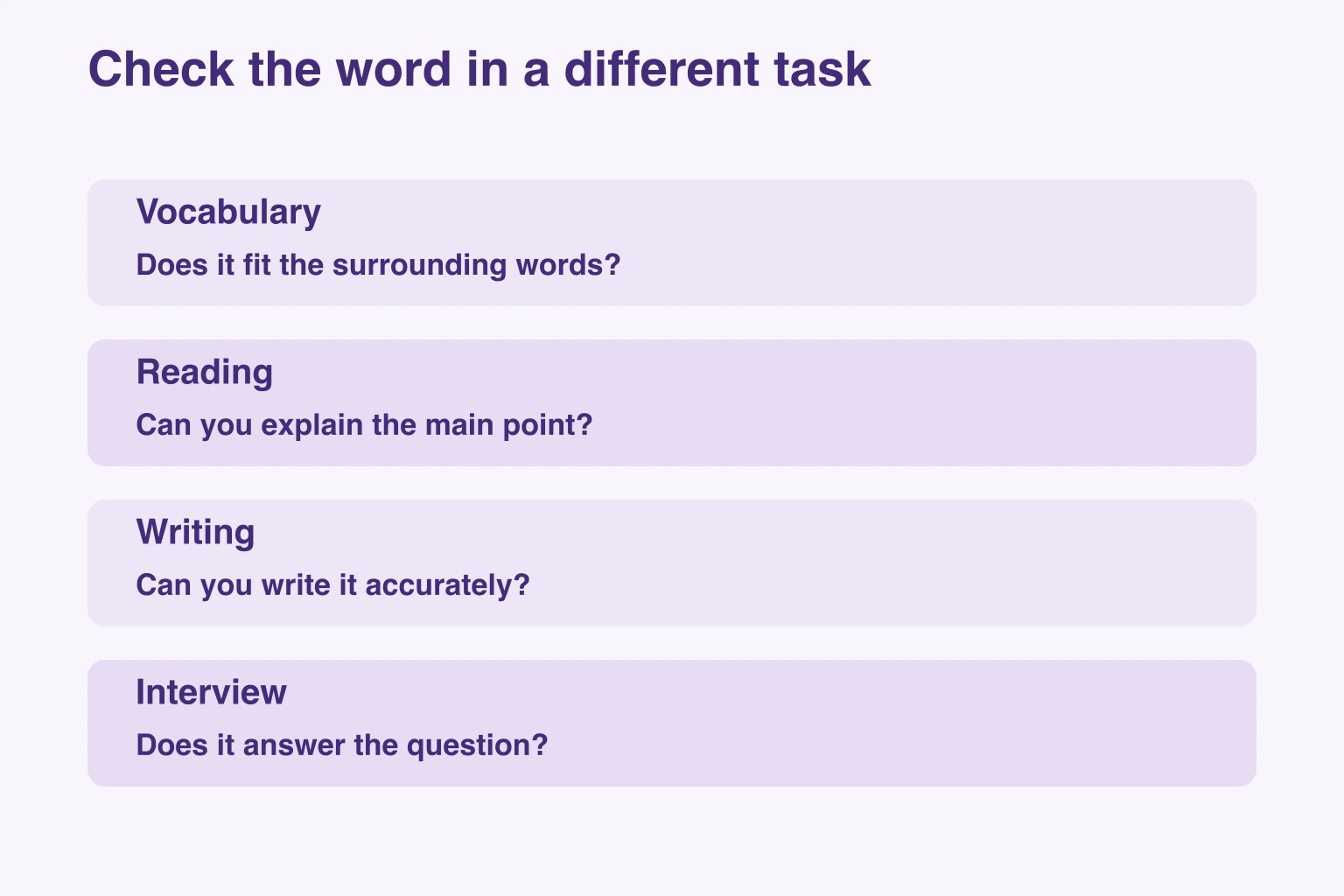
The official Pre-2 format includes short-text and dialogue gap filling, passage gap filling and comprehension, an email reply and opinion writing, listening and an interview. The distinctions below are our practice advice.
Vocabulary questions: check whether the word fits
After a mistake, do more than record the correct translation. Check who did what and the words around the gap. Was the problem the direction of meaning or an unfamiliar phrase? Our practice word is reduce. Understand what is being reduced, rather than only recalling its translation. This is an example of using a word, not a prediction of the next test.
Reading: connect the meaning to the passage
If knowing the words did not lead to the right answer, reread that sentence and its neighbours. Explain whose story it is or what the reason explains. We would separate timed answering from looking things up, check unknown words affecting the answer first, and reread. Collecting translations alone does not check whether the passage now makes sense.
Writing: answer the task with accurate short expressions
Pre-2 writing includes an email reply and an opinion task. Prioritise relevant content in words you can use over inserting difficult vocabulary. Check subject and verb, what follows the verb, spelling and whether the reason supports the opinion. Our Pre-2 writing guide handles complete answers and task requirements.
Listening and interview: understand without seeing the text
A familiar written word may go unrecognised in sound. Listen, check text and meaning if necessary, then hide the text and listen again. Find one point you missed rather than only leaving audio running. For interview practice, answer a familiar question briefly. If the target word will not come, continue with an expression you can use and check it afterwards. Check that you answered the question too. Record at home, not during the actual interview: the official instructions prohibit recording and photography there.
Make an opinion-and-reason sentence with reduce
We wrote this example ourselves. It is not an official question or a publisher’s sentence, and reduce is not designated here as an exclusively Pre-2 word from an official vocabulary list. We chose a familiar food-and-environment topic for practice.
We should reduce food waste because food is important.
Check reduce as a verb meaning to make something smaller in amount. Read reduce food waste as a combination; the because-clause gives the reason. Read the whole sentence so that the opinion and reason connect.
Use resource or dictionary audio to check the word’s sound. Say your sentence without racing, keeping what you want to reduce and why clear. Hide the text and recall those two ideas rather than translating the entire sentence word by word.
To make it personal, think of a situation at home, a school lunch or a school event. Rewrite the reason yourself. Check new combinations in dictionary examples or with a teacher. This is a small usage exercise, not a complete writing or interview answer; the actual question may require more content.
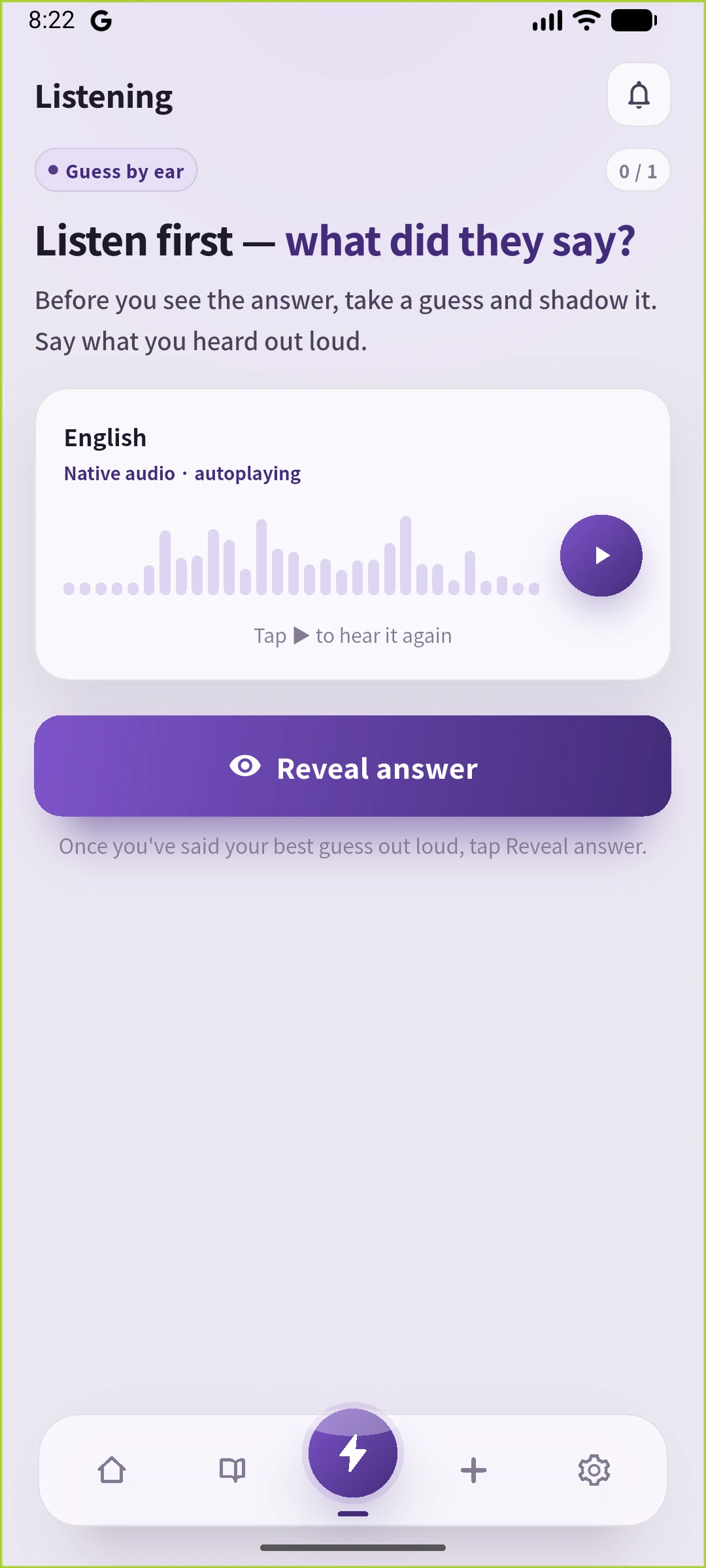
For practising your own sentence with sound after checking its meaning, see what SpeakGain is. We saved the example above once through the normal Add flow. In Library, we opened the card’s Knowledge and selected Learn this card. Listening hid the sentence and automatically played the generated audio, with instructions to guess what was heard and say it aloud. Reveal answer then displayed the same saved sentence on Answer. This is the single-sentence listening and speaking flow we verified. Returning after a gap to recall the sentence is our editorial practice suggestion.
Listen to the original sentence above: Viking AI-generated audio
Generated once for this sentence. After listening, hide the words and try saying the opinion and reason aloud.
How we would use three months: editorial opinion
This roughly 12-week outline is not a required duration or a promise of learning a fixed number of words or passing. Allow for school tests, activities, work and home commitments. Adjust to what you actually managed in the first two weeks. Our whole-test Pre-2 plan covers time across skills.
Month 1: choose one resource and diagnose the difficulty. Try some official questions and separate unknown words from familiar words you misunderstood in context. Choose a daily amount that leaves time for yesterday’s work. One possible 15-minute starting allocation is five minutes of recall, seven on new meanings, examples and sound, and three on your sentence. These are not measured optimal allocations. Reduce new material if examples take longer. Parents could ask what the learner can say with yesterday’s word, then help locate a meaning, sound or usage gap without blaming them.
Month 2: connect reading and listening to the resource. Return to the main resource when a missed word is already there. Rather than copying long lists, check both the original passage and the resource’s example. At the weekend, briefly try meaning recall, understanding sound without text and saying your sentence. Select useful words; not every word you recognise must immediately become active vocabulary.
Month 3: target weak points and connect to test tasks. Revisit repeated errors with context, idioms or sound. If vocabulary questions go well but writing stalls, work on sentences and spelling. If you can write a word but read slowly, spend more time rereading passages. Do not plan an overnight catch-up of everything unfinished. Keep test-format practice and decide when to move beyond Pre-2 from your learning situation and official tasks, not a word count alone.
Methods we would not recommend
Large meaning-only drills as the entire method: they can help with a first meaning check, but do not check combinations, sound or independent use. Hide answers to ensure you are not only remembering their position.
Starting several wordbooks from page one at once: repeated “new” words and separate marks make it harder to decide what to review. Add support when you can name the missing role.
Only rereading or leaving audio running: neither checks unaided understanding. End with even one item hidden; after listening while travelling, do a brief check at home.
Do not postpone all idioms until every word is finished. Check whole-expression meaning and usage when an idiom appears in the main resource, instead of adding the translations of its individual words. We leave the lists in your resource rather than reproducing them here.
Frequently asked questions
How many words should I learn?
The official materials checked do not state a fixed required number. Separate a resource’s count from exam requirements and identify gaps with official questions.
Can I start with one book?
We would start with one main book or app. This keeps review organised, not guaranteed passing. Add support when a specific gap becomes clear.
App or paper?
We would choose whichever lets you return tomorrow and hide the answers. Compare marked pages with weak-item filtering, then check OS, edition, audio and usage conditions.
Should I leave idioms until later?
Our suggestion is to check their meaning as a whole and their examples as they appear, alongside individual words.
What if I keep forgetting?
Reduce new material and recall old items before checking. Tomorrow, a few days later and a later week are starting points to adjust, not universally optimal intervals.
Will three months be enough?
Starting knowledge and time differ. Our plan is an allocation example. Review what you managed and where official tasks still cause trouble every two weeks.
Should a younger learner restart Grade 3 vocabulary?
Do not decide by age alone. If basic verbs or sentence connections repeatedly cause trouble, repair those specific gaps with an existing foundation resource before buying everything again.
Our editorial verdict
Choose one Pre-2 resource, check meaning, example and sound, and put one useful word into a short opinion-and-reason sentence. Return after a gap and recall it. Before buying more, check whether you can explain the meaning, understand it in a sentence and in sound, and use it yourself. Connect vocabulary questions to reading, writing and interview practice through those small daily checks.
Information checked: 16 October 2026. Resource choices, practice stages and timing are editorial opinions. Eiken is a registered trademark of the Eiken Foundation of Japan. Official references are linked beside the claims and in the comparison table.