
Eiken Pre-2 writing: emails, opinion essays and clear reasons
Published
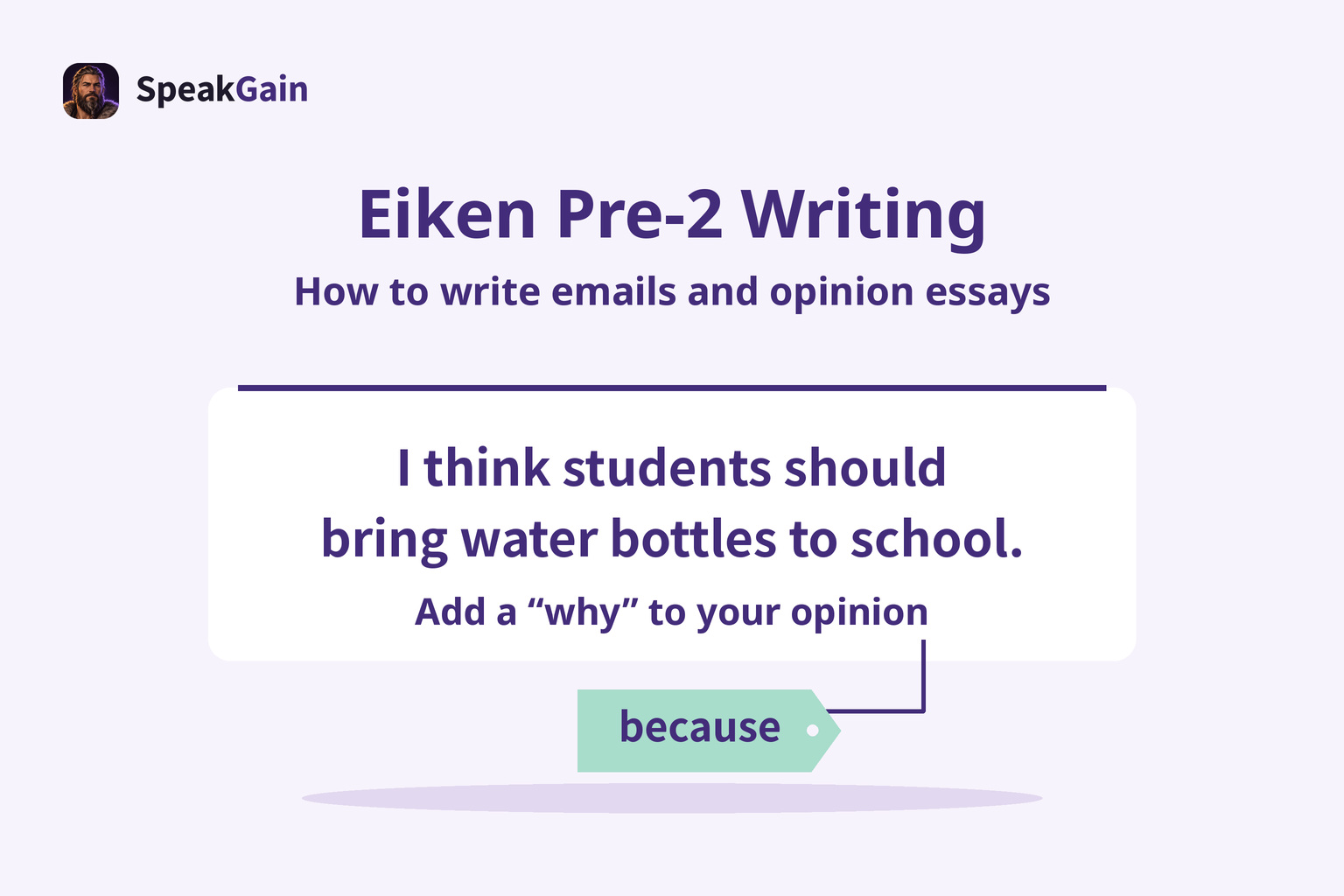
Japan’s Eiken Grade Pre-2 Writing has two tasks: an email reply of about 40–50 words and an opinion essay of about 50–60 words with two reasons. Before writing, note your answer and two questions for the email, or your position and two different supporting reasons for the essay. If you cannot think of a reason, ask who benefits and what improves, then add a short result or example. Current official materials
Test facts were checked on 16 October 2026. The routines and two-week plan below are editorial suggestions for students, parents and adults preparing for this Japanese test. All prompts, emails and responses here are newly written editorial examples, not official questions or model answers; we assign them no score.
For Grade 2’s summary and opinion tasks, use the separate Grade 2 writing guide; this article stays with Pre-2 emails and opinions.
For the four-skill sequence and a plan based on time remaining, see the Pre-2 study plan; this guide focuses on Writing practice.
Start with the two different writing jobs
| Task | What you write | Suggested length | Official source |
|---|---|---|---|
| Email reply | Answer the sender’s question and ask two specific questions about the designated underlined item to learn about its features | 40–50 words | Current booklet, p.10 |
| Opinion essay | State your view on the question and give two supporting reasons | 50–60 words | Booklet, p.11 |
The official format notice confirms the two-task format. Practise replying and explaining an opinion separately; do not prepare only one essay or confuse Pre-2 with another grade’s summary task.
The booklet describes these word counts as guidelines. A fixed penalty per missing word, an automatic zero below a particular count, or a universal allowance for extra words is not stated in the official materials checked. Aim to include the necessary content within the guideline rather than inventing a safe range.
Turn the assessment viewpoints into review questions
The official Pre-2 scoring explanation describes an opinion with two reasons through four viewpoints. The mistake and check columns are our editors’ practice interpretation.
| Viewpoint | Official explanation, summarized | Common mistake | How to check |
|---|---|---|---|
| Content | Include the required opinion and two relevant reasons | Only one reason, or the same reason twice | Circle the opinion; label reasons 1 and 2 |
| Organization | Present ideas in a clear, logical flow | A contradiction or unrelated information | Connect each sentence to the reason it supports |
| Vocabulary | Use suitable words correctly | A difficult word with the wrong meaning or spelling | Explain what each word means in your sentence |
| Grammar | Use a range of sentence structures correctly | Missing subject or verb; repeated forms used mechanically | Check subject, verb, tense and singular/plural forms |
That page explains the opinion task. Detailed email-specific deductions and task-by-task scoring rules are not stated in the official materials checked. For email practice, follow its own instructions first and also review flow, vocabulary and grammar. Do not present the essay’s two reasons as the same assessment requirement as the email’s two questions.
The current booklet warns that a reply that does not respond to the email, or an essay that does not address the question, may receive zero. Memorized, accurate English cannot rescue a response to a different question. Review relevance before spelling.
Email: prepare an answer and two questions about the item
What the official task requires
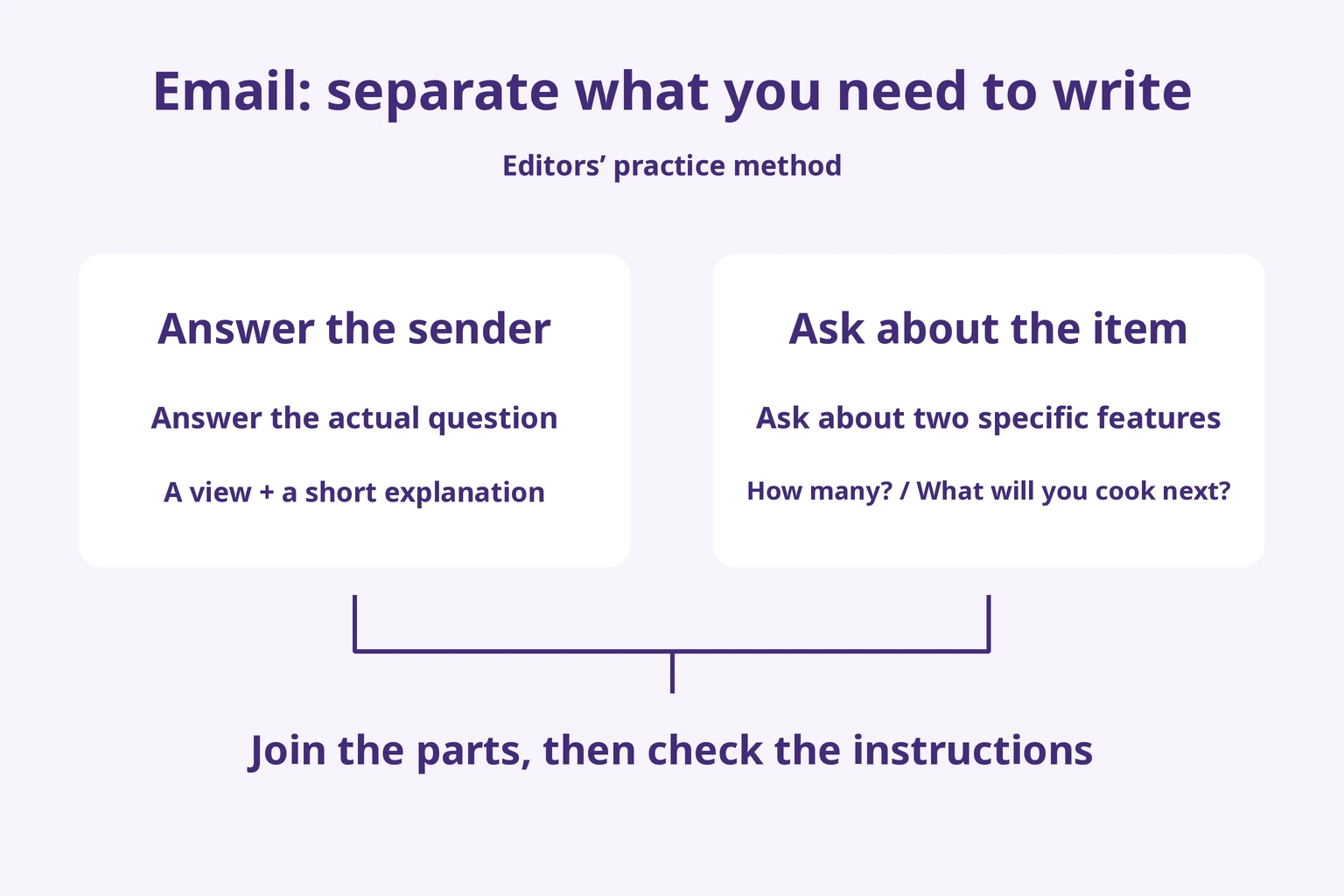
The email instructions require a reply to the sender’s question plus two specific questions about the features of the designated underlined item. The part you write should be about 40–50 words. Our practice method separates answering, asking and joining those parts into a reply.
Writing steps
- Find what the sender asks. Read the surrounding story too: who did what, and when?
- Identify the item you must ask about. Choose two features not already explained. For an activity, its frequency or content may be useful; for an object, size or use may fit.
- Make brief notes in your strongest language: answer, explanation, question 1, question 2.
- Write complete sentences. Choose What, How many or How often according to what you actually want to know.
- Read the received message and your reply alternately. Check relevance, avoid asking for information already supplied, then count the words.
Original example: a school cooking club
Practice message, newly written by our editors
I joined a new cooking club at school this month. We made vegetable soup yesterday. I want to cook breakfast for my family on Sunday. Do you think students should learn to make breakfast?
For this exercise, ask about a new cooking club. Answer whether students should learn to make breakfast and ask two questions about the club. This is a teaching example, not a reproduction of official test artwork.
Example reply section: 42 words by our space-separated count
Yes, I think students should learn to make breakfast. They can prepare a meal when their parents are busy. I have two questions about your cooking club. How many students are in the club? What food will you learn to cook next?
The reply gives a view and explains that students can prepare food when their parents are busy. It then asks about the number of members and what they will learn to cook next. The two questions concern different features of the club.
The order is not a universal formula. When the received message changes, change your answer and questions too.
Common mistakes and solo checks
“I like cooking” alone does not answer whether students should learn to make breakfast. Asking a family member’s age does not ask about the designated club. Two sentences that both ask about membership numbers still repeat the same content.
- Did you answer the sender’s question with a useful explanation?
- Did you ask two specific, different questions about the required item?
- Are the answers to your questions already in the received message?
- Are question word order, question marks, subjects and verbs correct?
- Did you count only the part you write and aim for the guideline?
These checks find missing instructions; they do not calculate deductions. Parents can first ask, “What will this question tell you about the club?” If the learner cannot explain, choose the question’s purpose before correcting individual words.
Opinion essay: how do you write the reasons?
Start from the official purpose
The current task asks for an opinion and two reasons in about 50–60 words. The scoring explanation advises adding explanation or examples, avoiding reasons that contradict the position, and avoiding reliance only on personal experiences when answering a general question.
Write what becomes better, and for whom, if your opinion is followed. Then answer “Why does that happen?” or “What can people do as a result?” You do not need a complicated social argument.
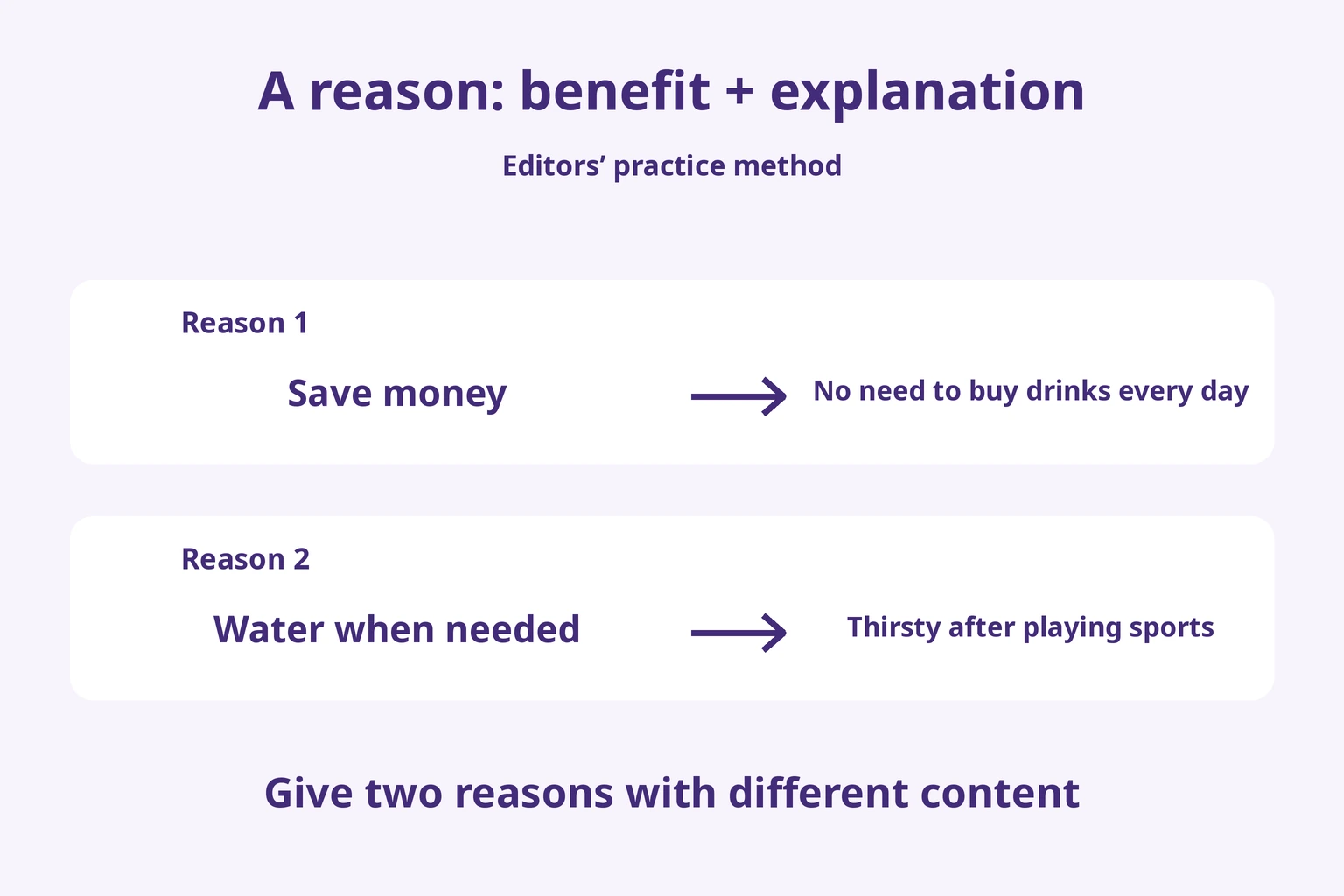
For water bottles, “save money” can develop into “do not need to buy drinks every day.” Another reason is having water when needed, illustrated by feeling thirsty after sports. These support the same position from two different directions.
Writing steps
- Identify the people and judgment in the question. Is it about students generally or your own preference?
- Choose one position before drafting.
- Note two distinct reasons. Money, time, health, learning and relationships are brainstorming prompts from our editors, not official required categories.
- Add a result or example to each reason.
- Write position → reason 1 with support → reason 2 with support. Include required content before adding a long closing sentence.
- Compare every sentence with the question, then check the English and length. Make sure reason 2 is not merely a rewording of reason 1.
Original example: taking a water bottle to school
Our newly written practice question
Do you think students should bring water bottles to school?
Example response: 57 words by our space-separated count
I think students should bring water bottles to school because they can save money. They do not need to buy drinks every day. Also, students can drink water when they need it. For example, they may feel thirsty after playing sports. Having a water bottle in their bag helps them get a drink quickly during a break.
The first reason is saving money; not buying drinks daily explains it. The second is access to water when needed, with a sports situation as support. Both support bringing a bottle to school.
For spoken practice, start with this original sentence:
I think students should bring water bottles to school because they can save money.
It states an opinion and one reason. It can help you practise explaining your idea aloud, but it is not a complete two-reason essay.
Common mistakes and self-review
“Save money” and “it is cheaper” may express the same reason. “I have a blue bottle” does not by itself justify a general recommendation for students. Give a general reason first; a personal experience can then support it.
A standalone because-clause may be an incomplete sentence. Initially, join because to a main clause as in our example. Do not make every sentence mechanically identical: the official grammar viewpoint also considers appropriate structural variety.
- Restate the question and your position in your own language.
- Explain reasons 1 and 2 separately. Are they genuinely different?
- Ask “Why?” or “For example?” after each reason.
- Remove contradictions and irrelevant sentences.
- Check subjects, verbs, tense, number and spelling; count words last.
Use a template as a structure
Our editors recommend a plan for the content, not a memorized paragraph: answer → explanation → two questions for email; position → reason 1 and support → reason 2 and support for an opinion. Neither order is an officially approved formula or a score guarantee.
I think, because, Also and For example can show relationships. Check that because introduces a real reason and that an example actually illustrates the preceding point. A connector cannot make unrelated ideas logical.
We do not recommend reusing a ready-made health, money or friendship paragraph for every topic. It can leave irrelevant content, unexplained reasons and unsuitable words, all at odds with the official viewpoints. Reread the question before recalling a phrase.
Use simpler wording when you can explain it more accurately. Replace a vague claim about health with a specific relevant benefit, rather than a difficult synonym. See English paraphrasing for changing expression while preserving meaning.
Review alone: content first, English second
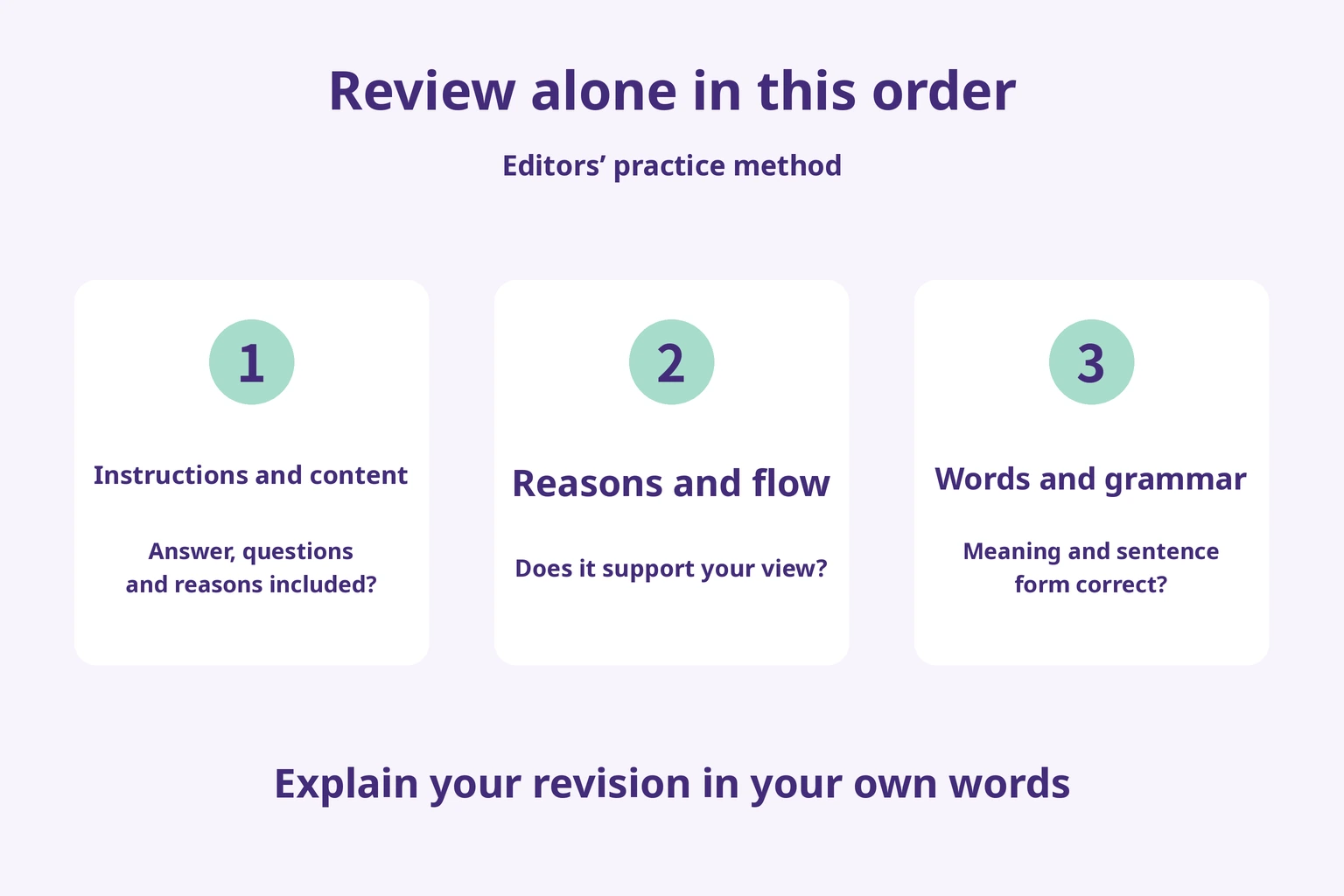
Our editors read in three passes: instructions and content, reasons and flow, then vocabulary and grammar. This is a way to find a repair for the next attempt, not predict an official score.
Reread the question, then explain your English in your strongest language. If you cannot explain how a sentence supports the view, choose a better reason or add the missing explanation; replacing a word will not fix the logic.
Check meaning-changing errors first: who is involved, present or past, the verb after can, singular/plural forms and question order. Consult a dictionary or grammar reference when unsure and confirm that its example fits your intended meaning.
If you use an AI correction tool, compare the original and suggestion and ask why a change was made. Do not assume its judgment equals Eiken scoring. We do not rank or recommend scoring services here; the useful question is whether you can verify the correction and retain your meaning.
Keeping an English diary can build a short-writing habit; our diary and writing app guide explains tool roles. A personal diary entry does not automatically answer a test email or a question about people generally.
Our editors’ two-week writing routine
This is an editorial practice plan, not a promise of passing in two weeks. On a short day, improve one previous reason instead of collecting new questions.
| Days | Practice | Keep a record of |
|---|---|---|
| 1–2 | Read the current instructions; try both tasks once | Time and missing requirements |
| 3–4 | Separate the email answer from the item you must ask about | Two relevant questions and a reply |
| 5–6 | Choose two reasons and add support to each | An essay with distinct reasons |
| 7 | Rewrite the previous two responses | One sentence explaining your revision |
| 8–10 | Use another topic and the same checks | One recurring mistake |
| 11–12 | Time planning, writing and review together | Where you use the time |
| 13–14 | Recheck official tasks; revise the weaker task | Three reminders for next time |
The official page gives 80 minutes for Reading and Writing together. A recommended number of minutes for each writing task is not stated in the official materials checked. If you can reserve 30 minutes for writing, our starting experiment is 12 for email, 15 for the essay and 3 for final review. Adjust using a whole-test practice attempt, including reading.
For tools in a broader routine, see Eiken study apps. This plan covers Writing only.
Three methods we do not recommend
Memorizing whole reusable paragraphs: a changed topic can make the paragraph irrelevant. Learn a connector together with the conditions in which it makes sense.
Padding the word count: repetition and unrelated sentences do not explain a reason. If short, add a relevant result or situation. If long, remove duplicated meaning first.
Memorizing predicted-question answers: even a similar topic may ask about a different person or judgment. Test whether you can select fresh reasons for a new question. These are editorial choices based on the official content and organization viewpoints.
Say your written reason aloud
Try saying the water-bottle sentence without reading. Check what you support and why. Start with a meaningful opinion-and-reason sentence before attempting to recite a long essay. Our Pre-2 interview guide covers interview-specific tasks separately.
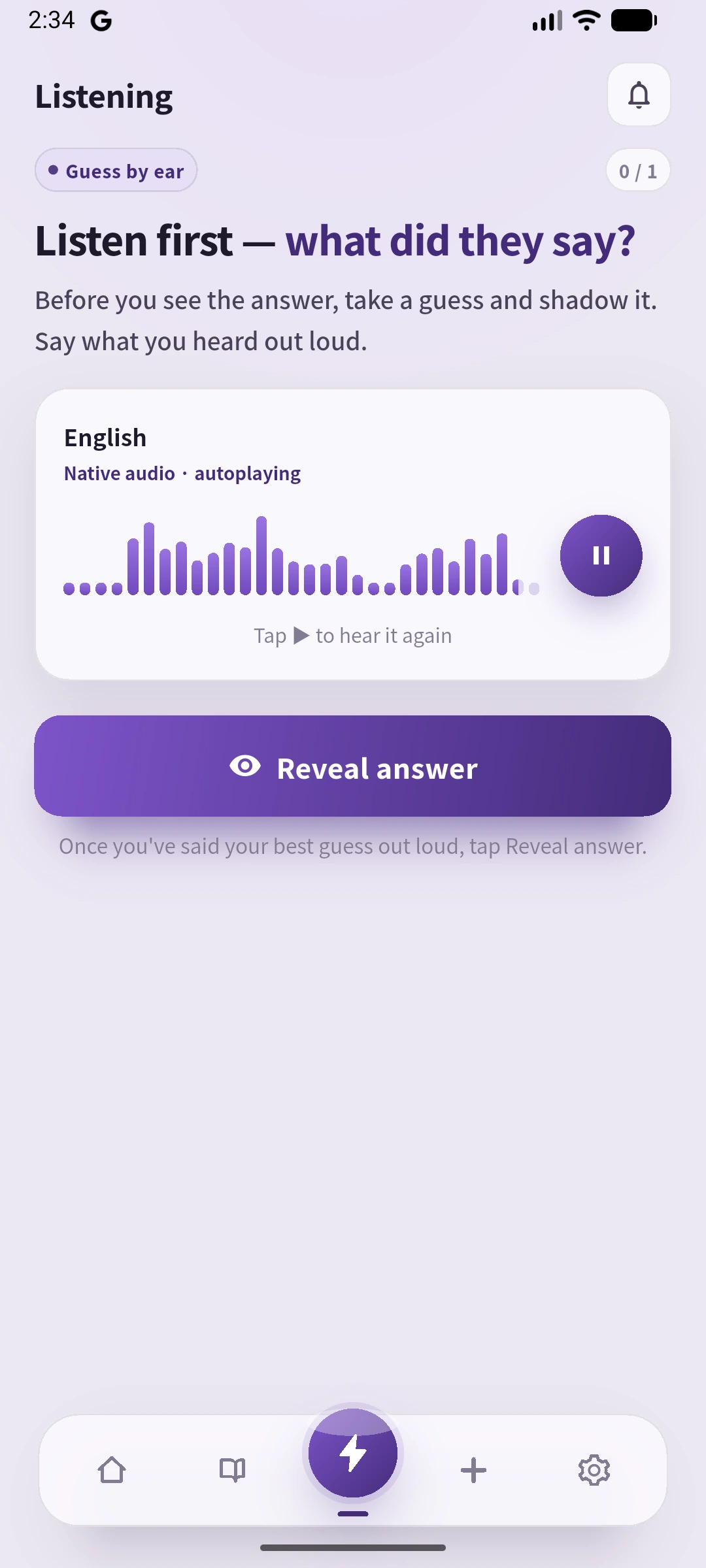
On the device, we saved the original sentence as one SpeakGain card through the normal Add flow, then followed Add → Library → Knowledge → Learn this card → Listening → Reveal answer → Answer.
Listening hid the English and automatically played the reference audio, with instructions to say what we heard before tapping Reveal answer. Answer displayed the original sentence for comparison.
We verified short-sentence listening and speaking practice. We did not submit a recording or test assessment. Review the whole written response against the sender’s email or question and the official viewpoints.
Original editorial sentence · Viking AI audio
I think students should bring water bottles to school because they can save money.
Generated once for this sentence; not official test audio or a complete written response.
Frequently asked questions
Can I use a template?
Use it as a content plan, our editors suggest. It is not an officially recognized universal answer. Choose the opinion, reasons and email questions for the actual prompt.
What if I can think of only one reason?
Summarize it briefly, then look for a different relevant benefit. Saving money and being cheap overlap. Try time or a practical situation; in practice, testing the opposite position may also reveal an easier argument.
Can I use my own experience?
The official explanation warns that personal experience alone can be unconvincing for a general question. State a general reason first and use experience as support.
What happens below or above the word guideline?
A universal deduction is not stated in the official materials checked. Follow the current instructions, add useful explanation when short and remove repetition when long. Do not invent an acceptable overflow range.
Which task should I practise first?
Try both, then begin with the one where you missed more instructions. Keep practising both tasks.
How should I divide the time?
Official task-specific recommendations were not found in the checked sources. Time a combined reading-and-writing attempt, keeping a review period. Our 30-minute split is only a starting experiment.
How can I correct my work alone?
Check relevance, then the connection between reasons, then words and grammar. If possible, ask someone which reason was unclear rather than requesting only a general judgment.
Can a junior-high student start?
Start with simple English about school, family and shopping, as in our examples. We make no age-based score or pass promise. Check whether you can explain your reason yourself.
Does this help with the interview?
It can provide material for speaking an opinion and reason. Writing and responding immediately to a spoken question still need separate practice; see the interview guide.
Editorial verdict
Prioritize answering the actual message or question and including the requested content. For email, check an answer and two questions; for the essay, a position, two reasons and their support. A structure should help you inspect the response rather than force the question into memorized English.
Today, write one of each task and repair one missing element. Repeat the process on another topic to discover what you can adapt independently.
Official references
- Current Pre-2 tasks, past papers and answers
- 2026 session 2 booklet, instructions on pp.10–11
- Pre-2 opinion-writing assessment viewpoints
- Format renewal notice
Checked 16 October 2026. Follow the latest official instructions.