
Eiken Pre-2 level: official benchmarks, CEFR and the gap to Grade 2
Published
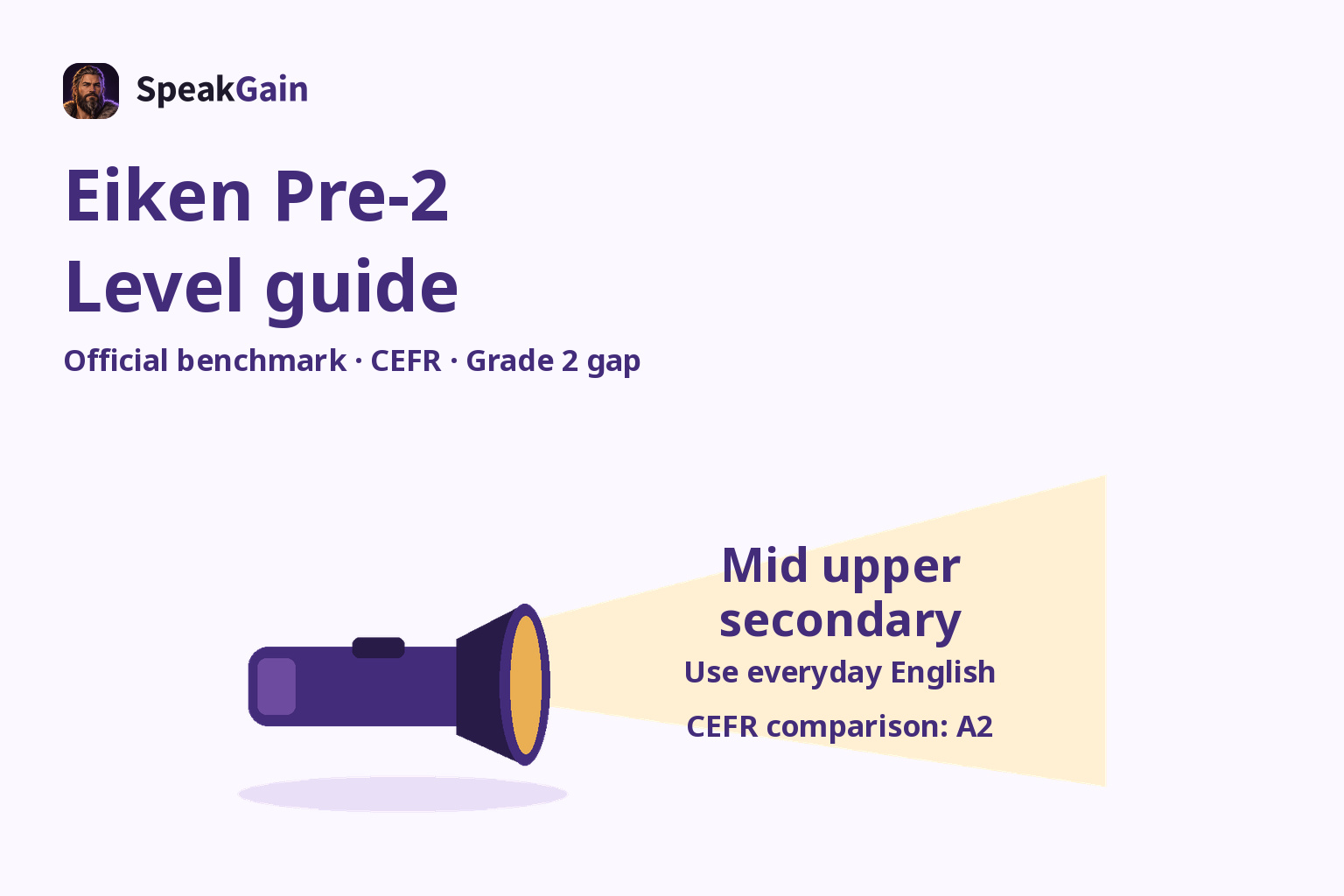
Japan’s Eiken Pre-2 has an official benchmark of mid upper-secondary school and an A2 comparison in the official CEFR grade table. Its current pass rate is not officially published. To check whether you are approaching Pre-2 or Grade 2, try the official papers and interview samples across reading, listening, writing and speaking. Official benchmarks, CEFR comparison, participation information.
This guide is for students, parents and adults returning to English, including families living in Japan. It describes the traditional two-stage test. Official sources were checked on 16 October 2026; examples and self-check steps are our own editorial work.
Compare Grade 3, Pre-2, Pre-2 Plus and Grade 2
R means reading, W writing, L listening and S speaking. The CEFR column compares successful grade levels; it is not the full range that may appear on an individual result. Each first stage tests R/W/L and each second stage is a speaking interview.
| Grade | Official benchmark | CEFR comparison | Traditional test | CSE: first / second stage | Official source |
|---|---|---|---|---|---|
| Grade 3 | End of lower secondary | A1 | R/W 65 min; L ≈25; S ≈5; email + opinion | 1103 / 353 | Official source |
| Pre-2 | Mid upper secondary | A2 | R/W 80 min; L ≈25; S ≈6; email + opinion | 1322 / 406 | Official source |
| Pre-2 Plus | Advanced upper secondary | A2 | R/W 85 min; L ≈25; S ≈7; summary + opinion | 1402 / 427 | Official source |
| Grade 2 | End of upper secondary | B1 | R/W 85 min; L ≈25; S ≈7; summary + opinion | 1520 / 460 | Official source |
School-level labels come from the official benchmarks; CEFR comes from the official comparison; thresholds come from the CSE guidance. All checked on 16 October 2026. Follow the instructions for your selected paper too. For the broader choice of a first test, see which Eiken grade to take.
What can and cannot be confirmed officially
| Item | Official status | Our treatment |
|---|---|---|
| Level, format, CEFR and CSE | Published | Use current official evidence |
| Current Pre-2 pass rate | Not currently officially published | No old rates or estimates |
| TOEIC or deviation-score conversion | No direct official table found | Compare CEFR; no point equivalence |
| Junior-high pass rate, universal study hours, difficulty multiplier | Not stated in checked current official guidance | Do not invent numbers |
| Admissions or hiring benefits | Recipient-specific conditions | Check the school or employer |
We checked the current grade pages, CSE guidance, participation information and admissions guidance. “Not stated” describes the current sources inspected; it does not claim that no historical document exists.
Can a junior-high student pass?
A junior-high student may take Pre-2. The official rules impose no age, occupation or educational-background restriction and do not require earlier grades. “Mid upper secondary” is a proficiency benchmark, not an age requirement.
It does not establish any individual student’s chance of passing. A current junior-high Pre-2 pass rate was not stated in the official guidance checked. We recommend discussing tasks the learner can actually complete rather than comparing classmates’ certificates. Adults can use the same approach: remembering grammar and completing every task within the time limit are different checks.
A2 as a comparison versus CEFR on your result
The official grade comparison places Pre-2 at A2. The CSE explanation separately sets a reporting range for each test grade. For Pre-2, a four-skill total of 1400–1699 yields A1 and 1700–1949 yields A2. Below 1400 no overall CEFR is reported; at 1950 or above the reported upper limit remains A2. All four skills must be taken for an overall four-skill CEFR. Official chart.

Taking Pre-2 therefore does not automatically mean A2, and a higher total cannot make this grade report B1. Check the grade passed, total and skill CSE scores, displayed CEFR and the recipient’s requirements separately. We found no current official table directly converting Pre-2 into an individual TOEIC score or Japanese deviation score. CEFR is a common reference, not a guarantee of points on another test.
What the two stages ask you to do
The first stage has 80 minutes for R/W and about 25 for L. Reading includes vocabulary, dialogue and longer passages; writing requires an email reply and an opinion. Listening covers responses, conversations and short passages, each played once. The interview lasts about six minutes: read a passage of about 50 words, then answer five questions covering the passage, people’s actions, a situation and personal opinions. Recording, photography and notes are prohibited in the real interview. Official format.
For readiness, do not stop after multiple-choice questions. Write both tasks and answer the interview aloud. Detailed practice belongs in our Pre-2 writing guide and interview guide.
CSE thresholds are not a pass rate
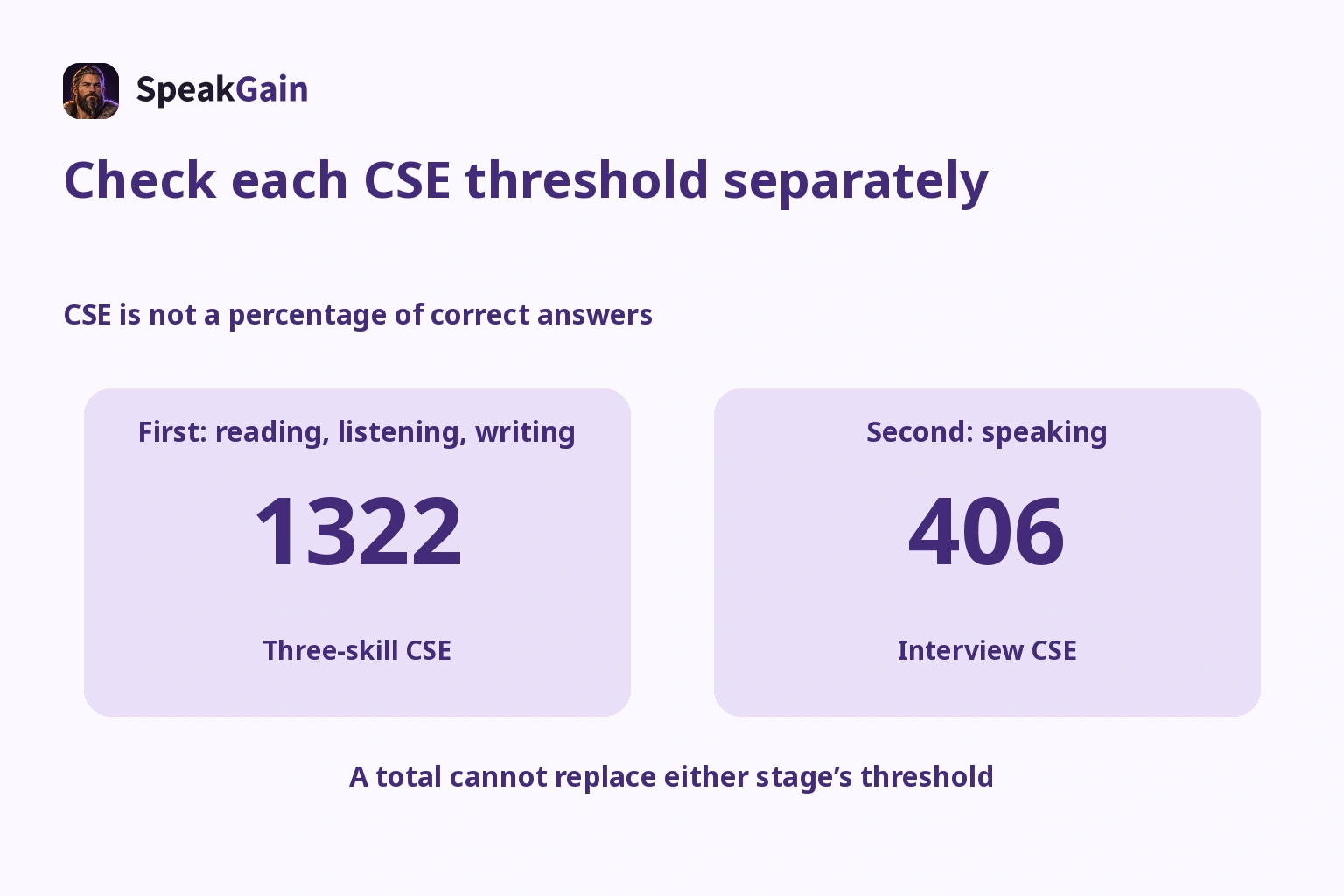
Pre-2 requires 1322 in the first stage and 406 in the second. Each skill has a maximum of 600: the first-stage maximum is 1800 and the four-skill maximum 2400. Although the two thresholds add to 1728, the stages are judged separately; the total does not cancel a shortfall in one stage. Candidates cannot calculate CSE themselves from their correct-answer count. Dividing 1322 by 1800 does not give the required percentage of correct answers. Official CSE rules.
The current Pre-2 pass rate is not officially published, including a current first- or second-stage rate in the materials checked. Applicant totals on the participation page do not supply it. We do not fill that gap with old percentages or estimates. Another person’s score report is not your probability of success or a fixed future cut-off.
Four skills in the official Can-do list
The official Can-do list describes goals for working toward a pass. These are paraphrases, followed by sentences we wrote; none is an official test question.
| Skill | Goal, summarised | Our short example |
|---|---|---|
| Reading | Get the outline of everyday texts using basic language | The school library closes at four on Fridays. Identify the place, day and time. |
| Listening | Get the outline of everyday speech delivered slowly and clearly | Please bring your lunch for the trip tomorrow. Identify what to bring and when. |
| Speaking | Convey everyday information and feelings using basic language | I think students should cook at home because it is a useful skill. Connect an opinion and a reason. |
| Writing | Put everyday information and feelings into basic written language | I enjoyed the school trip because I learned about nature. Write a feeling and its reason. |
Understanding one sentence does not establish Pre-2 proficiency. Use longer official texts, audio and productive tasks too. Knowing a word differs from using information to act. If vocabulary blocks you, move to the Pre-2 vocabulary guide.
How big is the gap from Pre-2 to Grade 2?
The direct answer is a move from the mid upper-secondary benchmark and everyday topics to the end-of-upper-secondary benchmark and social topics, with understanding of development and detail and more developed explanations. The CEFR comparison changes from A2 to B1. No universal difficulty multiplier is stated. Official benchmarks.
The difference is visible in tasks: Pre-2 has an email reply, while Grade 2 has a summary; the Grade 2 interview also asks for an explanation of a three-panel sequence. Pre-2 Plus provides an advanced upper-secondary benchmark and topics more abstract than Pre-2, with lower vocabulary and structural processing demands than Grade 2. Sharing A2 does not make Pre-2 and Plus identical. Grade 3 also shares everyday topics, but official guidance says length, content and questions differ by grade. Pre-2 format, Grade 2 format, Plus design.
Compare tasks before deciding whether to use Plus as an intermediate goal. See the Pre-2 Plus guide and Grade 2 level guide. Taking every grade in sequence is not required.
Six steps to check readiness, including Grade 2
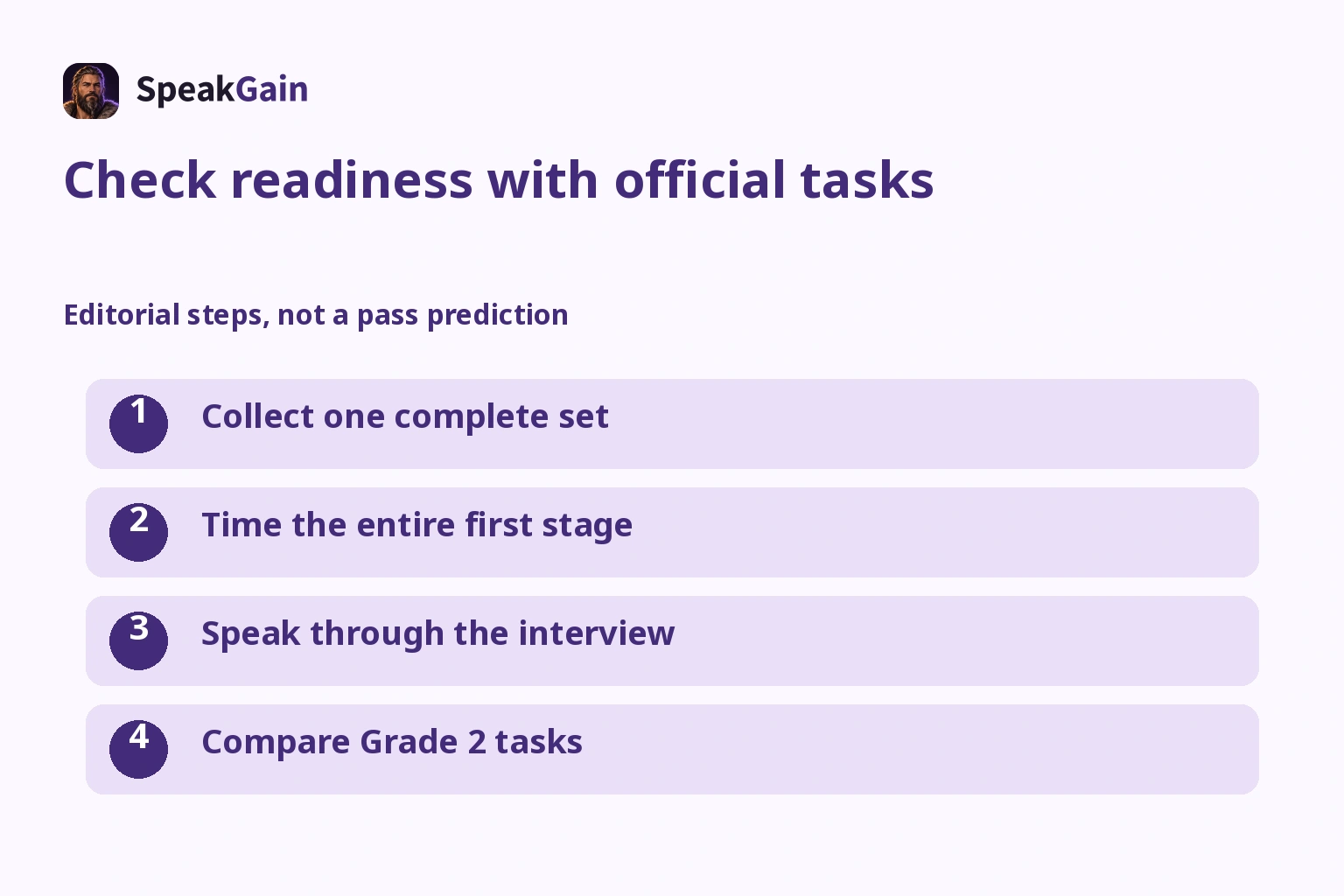
These are editorial steps, not official diagnosis or score prediction.
- Collect a complete set. Use the official Pre-2 page for a paper, answer key and audio from the same session. Three sessions from the past year were available when checked. Open the interview sample and virtual interview too.
- Time the entire first stage. Use 80 minutes for R/W, actually write both tasks, and play L without pauses according to its instructions. Record unfinished items before reading answers.
- Separate marking from writing review. Check R/L against the key; compare W with the official sample for relevance and connections between ideas. Ask a teacher about writing you cannot assess. Do not convert your own marks into CSE.
- Speak through stage two. Try the official interview sample, including description and opinions. Recording yourself at home can help review the attempt; recording is prohibited in the real interview.
- Try Grade 2 as well. From the official Grade 2 page, attempt the entire first stage, including summary and opinion within 85 minutes, plus listening and the interview sample. Note whether selecting key information or explaining a sequence causes difficulty. Separate vocabulary, understanding, expressing reasons and running out of time. Another available session can reveal whether a familiar topic affected the result.
- Choose a goal from the evidence. If Pre-2 tasks remain unattempted, identify them first. If Grade 2’s summary or sequence explanation is the obstacle, also try official Plus tasks. For study allocation, use the Pre-2 study plan; this article does not prescribe universal hours to pass.
Using it for school or work
Pre-2 does not guarantee a benefit at every school or company. Use official admissions guidance as a starting point, then check the recipient’s latest rules. Identify the school, department, admission route and year, or the company and role. Check accepted test formats; grade, total or skill CSE and CEFR conditions; the purpose of the requirement; eligible test dates; deadlines; and certificates. Ask the relevant office if unclear. This checklist is editorial advice, not evidence that a particular recipient accepts Pre-2.
Start with one opinion and one reason
I think students should cook at home because it is a useful skill.
Our sentence links cooking at home to a useful skill. It is practice material, not a complete exam response. Check the actual question and its requirements before developing it. We do not recommend memorising a long answer regardless of the question: the learner still has to decide whether the content fits.
Check your sentence by listening in SpeakGain
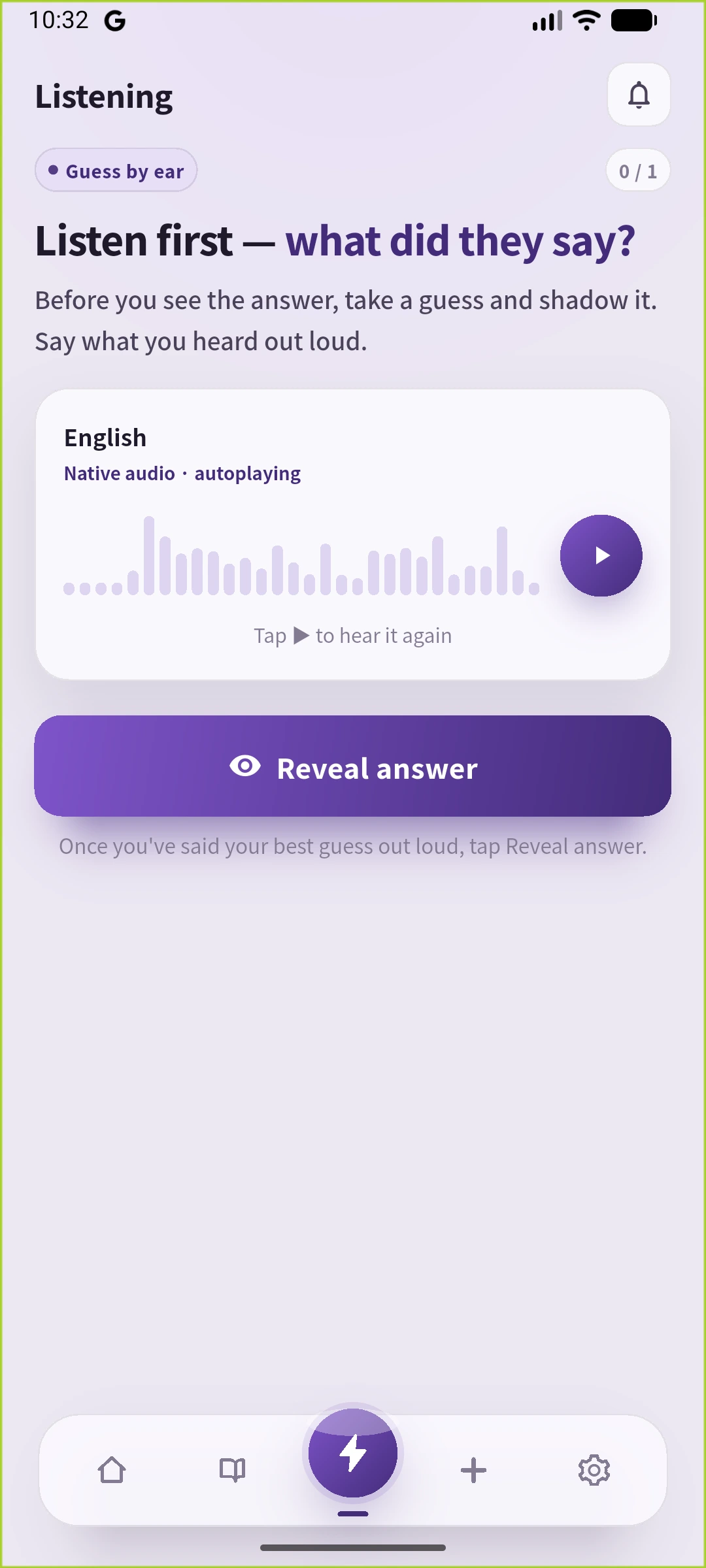
We added the original cooking sentence as one card through Add in SpeakGain. From Library → View, we opened Knowledge and selected Learn this card. Listening hid the sentence and played its generated audio. The screen asked us to guess what we heard and say it aloud; Reveal answer then displayed the same saved sentence.
We verified saving a sentence, listening and revealing it as material for speaking aloud. We did not use this as an Eiken mock exam, answer or pronunciation grading, or score prediction. Keep working on official tasks and use a sentence whose meaning you understand.
Original sentence audio · AI-generated with Viking
Generated once for the original sentence about cooking at home. This is not official exam audio or a complete answer.
Frequently asked questions
Is Pre-2 restricted to high-school students?
No. The rules do not impose an age or educational restriction. They do not predict whether any individual will pass.
What is the pass rate? What about just the interview?
It is not currently officially published in the current materials checked. We use neither historical rates nor estimates. Participation information.
What TOEIC score or deviation score is equivalent?
No current official direct conversion table was found. Use CEFR as a shared reference and inspect each test’s tasks rather than equating points.
Is Plus compulsory before Grade 2?
No. Previous grades do not restrict eligibility. Plus is a possible intermediate goal, not a required step. Rules.
Can I pass by self-study or with 60% correct?
No universal self-study time or guarantee is stated. Official guidance says you cannot calculate CSE from your correct-answer count. Try all skills and seek feedback where needed. CSE.
Will it help with admissions or employment?
Check the specific school or employer, year, route, scores and certificates. A grade label alone does not establish eligibility. Admissions guidance.
Editorial verdict
Use the official mid upper-secondary benchmark as a starting point, then check what you can do in all four skills. To judge the gap to Grade 2, actually attempt its summary and sequence explanation. Record the obstacle, compare Plus if useful, and choose the next goal from those observations rather than unofficial percentages or conversions.
Official sources checked: 16 October 2026. Examples, figures and self-check steps are editorial, not official questions, official answers or pass predictions. Eiken is a registered trademark of the Eiken Foundation of Japan.