
Eiken Grade Pre-1 level: CEFR, Grade 2 differences and official pass-rate information
Published
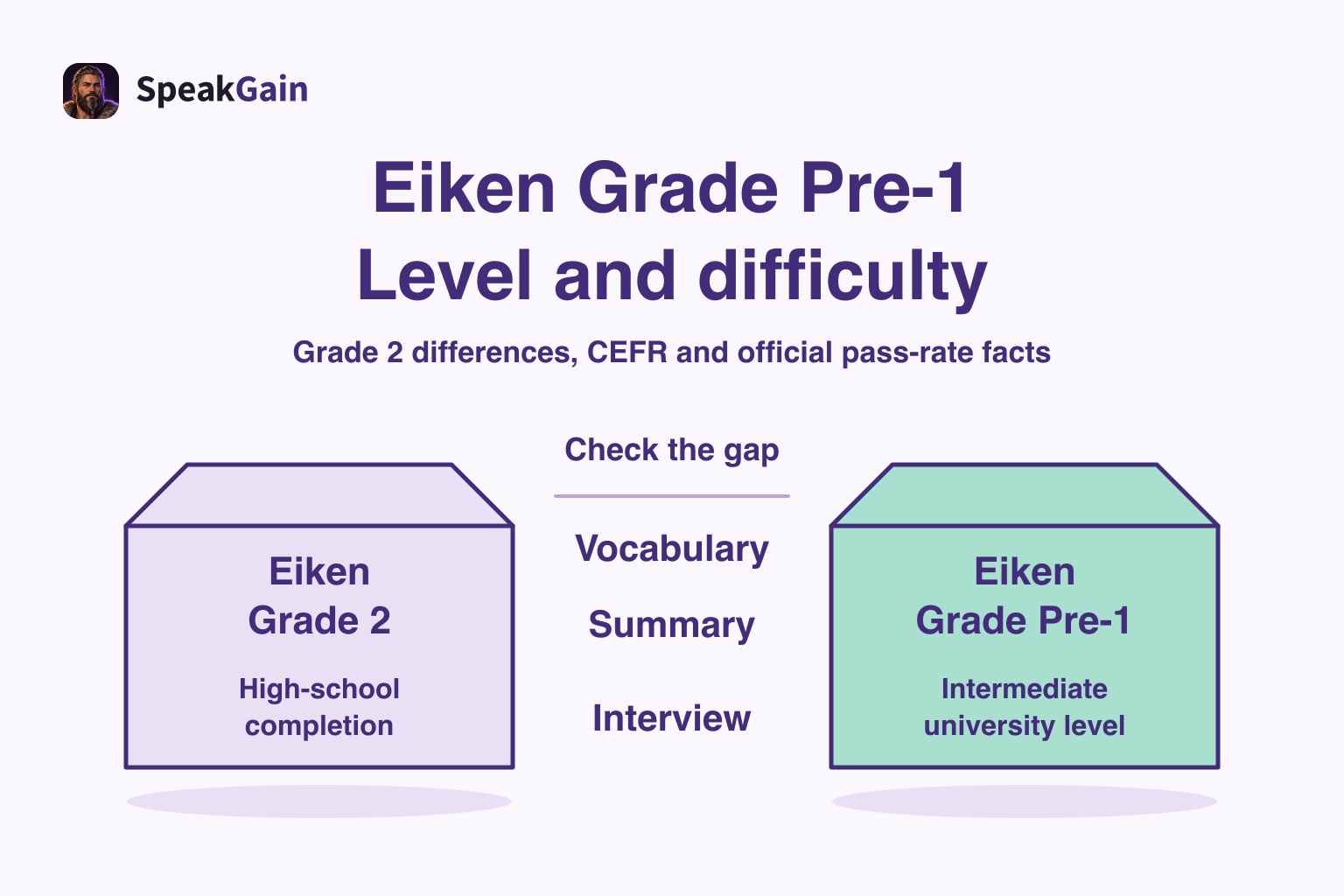
Japan’s Eiken Grade Pre-1 has an official guide level of intermediate university English: understanding complex social topics and expressing a position with clear supporting reasons. Depending on the actual score, its four-skill CEFR result can be B1 or B2; a current official Pre-1 pass rate is not published. To decide whether to aim for it, start with official Grade 2 papers, then compare Pre-1 first-stage tasks and second-stage samples. Official levels, CSE/CEFR, participation data; checked 16 October 2026.
Grade 2, Pre-1 and Grade 1: the official comparison
CEFR below means the levels that can be reported for that exam grade, depending on the score. It is not a claim that passing gives every skill the same CEFR level. This table describes the conventional exam; R/W means reading and writing, L listening.
| Grade | Official guide level | Reportable CEFR | Conventional format | CSE pass threshold: first / second stage | Sources |
|---|---|---|---|---|---|
| Grade 2 | High-school completion | A2, B1 | R/W 85 min + L about 25 min; interview about 7 min | 1520 / 460 | Levels, format, CSE |
| Pre-1 | Intermediate university | B1, B2 | R/W 90 min + L about 30 min; interview about 8 min | 1792 / 512 | Levels, format, CSE |
| Grade 1 | Advanced university | B2, C1 | R/W 100 min + L about 35 min; interview about 10 min | 2028 / 602 | Levels, format, CSE |
Checked 16 October 2026. First-stage reading, listening and writing are combined; second-stage speaking is assessed separately. CEFR has score boundaries and grade-specific reporting limits. Official CSE explanation.
What can and cannot be confirmed officially?
| Question | Official status in the sources checked | Our treatment |
|---|---|---|
| Level and skill targets | Published in grade guides and Can-do lists | Summarize them; label our examples separately |
| Format and CSE pass criteria | Published | Keep the two stages separate |
| CEFR | Grade- and score-dependent mapping exists | Explain Pre-1’s B1/B2 reporting range |
| Current Pre-1 pass rate | No current official publication found | No historical or estimated percentage |
| Direct conversion into a TOEIC score | Not found in the official material checked | No “Pre-1 equals X points” claim |
| Conversion into a Japanese deviation score | Not officially specified | No invented value |
| Required vocabulary, study hours or independent-study success rate | No fixed official figures found | No numerical pass promise |
| Universal admissions or employment benefit | No universal condition stated | Check the receiving institution’s current rules |
Sources: levels, Can-do, CSE, statistics, official notice. “Not specified” describes the official material inspected on the check date.
What does intermediate university level mean in practice?
It is an official guide, not a university-enrolment requirement or a claim about the average student. We recommend comparing tasks with what you can currently do rather than judging readiness by age or school year. Eiken’s Can-do list describes target skills for passing, not a guarantee about every situation a certificate holder encounters. Grade guide; Pre-1 Can-do.
The following are short, original editorial examples, not official questions or complete answers.
Reading: connect the claim and its evidence
The official target includes understanding complex writing on social topics, organizing its development, main points and details for a purpose.
The report supports remote work because it can reduce commuting time.
This illustrates stating the claim and supporting reason after reading. Understanding one short sentence cannot establish your grade: check a full official passage.
Listening: distinguish the main point from supporting detail
The target includes organizing arguments and evidence in complex spoken material. Official task examples include lectures and reports.
The speaker says the project failed because local residents were not consulted.
After listening, identify the reported cause. Record separately what you understood on the first hearing and what became clear only after reading the script.
Speaking: express a position and a reason
The target is detailed communication on social issues using varied language and a clear structure, position and evidence.
Cities should plant more trees because they provide shade on hot days.
This is the shared practice sentence for this article. It gives one recommendation and one reason; it does not satisfy every interview task by itself.
Writing: organize information and reasoning
The official target includes organized written communication; task examples include summaries and essays expressing a reasoned position.
Schools should offer cooking classes because students need practical skills for daily life.
This illustrates only the relationship between a position and a reason. An actual response must follow all instructions and develop a complete piece of writing. All four skill summaries above come from the official Can-do list.
CEFR B2? Read the score and the pass result separately
For Pre-1, four-skill CEFR is reported as B1 or B2 depending on the score. The official four-skill B2 boundary is 2300, but Pre-1’s reporting floor is 1980: below that no four-skill CEFR appears. Even with a higher score, Pre-1’s reporting ceiling is B2. All four skills must be taken; a first-stage result alone does not show four-skill CEFR. Mapping and notes.
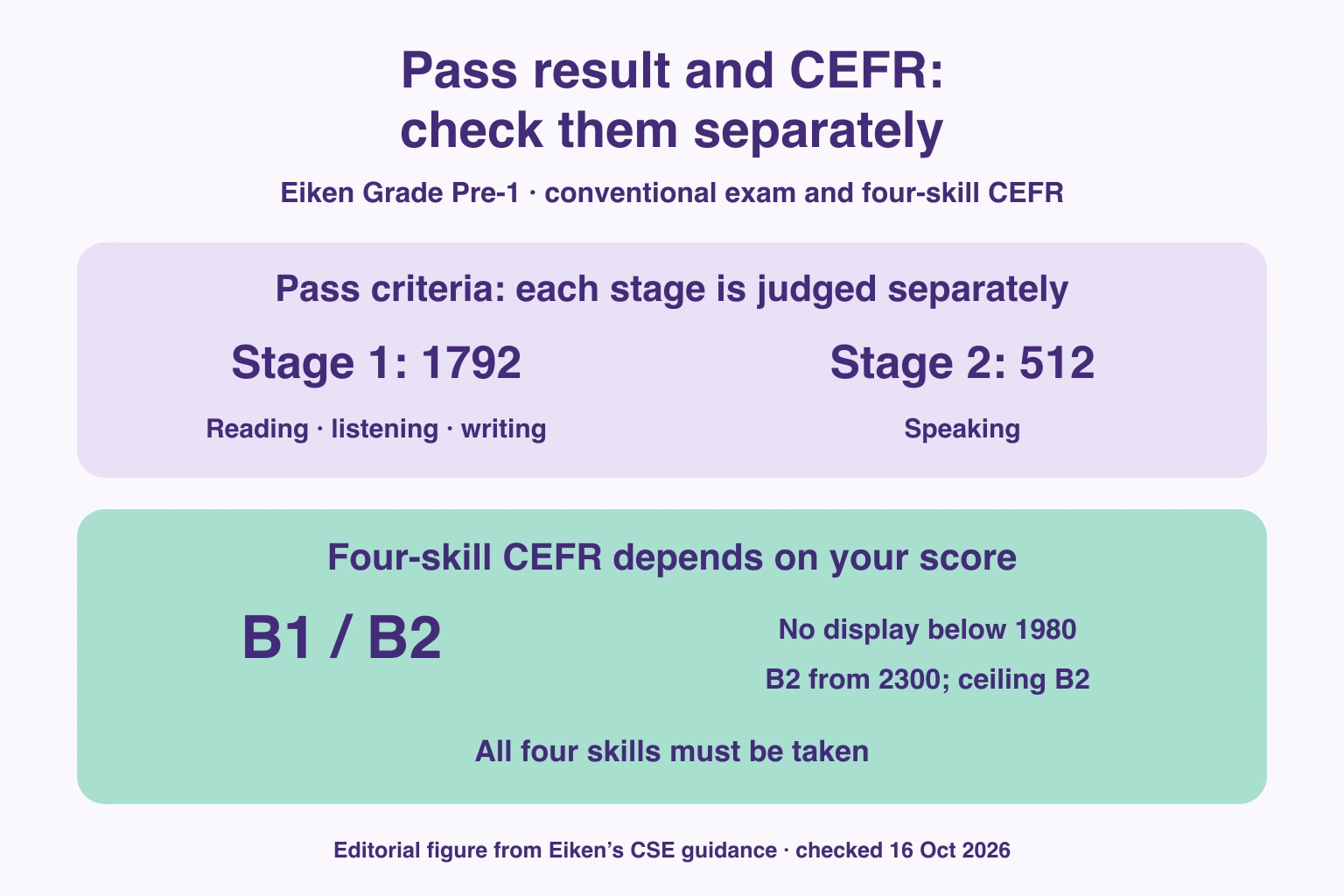
1792 plus 512 equals 2304. However, a combined 2304 does not itself establish a Pre-1 pass: each stage must meet its own threshold. Extra speaking points cannot compensate for a failed first stage, or vice versa. When reading a result, separate the grade passed, each stage’s CSE, four-skill CEFR and individual skill results. That is our reading checklist, not an additional official criterion. Pass rules.
What happens in the first and second stages?
In the conventional exam, reading and writing share 90 minutes, followed by approximately 30 minutes of listening. Reading has 18 short gaps, six passage gaps and seven comprehension questions. Writing has one summary and one opinion task. Listening has 12 conversation, 12 passage and five Real-Life questions; each recording is played once. Current format.
The second stage is an approximately eight-minute interview with one examiner. It includes free conversation, a four-picture narration and opinion questions. Narration preparation lasts one minute, and narration two minutes. There is one picture-related opinion question, two related to the card’s topic and one on a somewhat related social topic. Official interview procedure.
S-CBT is a different delivery format completed in one day, awarding equivalent grades, qualifications and CSE scores. Do not use conventional stage scheduling or face-to-face instructions as S-CBT test-day instructions. Official overview.
Each Pre-1 skill has a maximum of 750 CSE points, regardless of its question count. CSE is calculated statistically after all responses have been marked; you cannot accurately calculate it from your raw correct-answer count. The current sources specify no universally safe self-marked percentage. Historical raw-score examples are not a current guaranteed threshold. Scoring explanation.
How is it different from Grade 2 and Grade 1?
The official goals move from following and explaining social topics at Grade 2 to handling more complex content with explicit claims and evidence at Pre-1. Grade 1 adds specialist topics, inference and logical communication. This is a comparison of the published goals, not a numerical multiplier of difficulty.
Grade 2’s interview includes reading aloud, a question on that passage and describing three pictures. Pre-1 uses four-picture narration and social-topic opinions. Grade 1 asks you to choose one of five topics for a two-minute speech, followed by questions; it has two examiners. Grade 2, Pre-1, Grade 1.
A fixed vocabulary difference or number of hours from Grade 2 is not officially specified in the sources checked. We would compare actual tasks: can you follow the reasoning, summarize to the instructions and explain your own view? Detailed methods belong in our Pre-1 study plan and vocabulary guide.
For the earlier benchmark and its CEFR conditions, see our Eiken Grade 2 level guide.
Is there an official Pre-1 pass rate?
No current official pass rate is published in the material checked on 16 October 2026. Eiken’s participation page reports combined applicant totals across its test brands; those are not Pre-1 candidate counts or a grade-specific pass rate. The answer-notice page also states that pass-rate and scoring enquiries cannot be answered. Participation; notice.
We do not substitute old annual figures, unsupported estimates or a claimed date when publication stopped. Numbers with an unclear year, population or stage cannot tell you where your own preparation needs attention. Our recommendation is to return to the official goals and your work on current tasks.
What TOEIC score or deviation score is Pre-1 equivalent to?
We found no direct official conversion that assigns a particular TOEIC score to a Pre-1 pass. A Japanese statistical deviation score is not officially specified either.
Eiken does publish material placing multiple tests alongside CEFR bands. That does not mean no comparison material exists. But sharing a CEFR band is not a way to predict an individual’s other-test score. Use the current CSE/CEFR mapping as a common reference, then check the required skills and delivery format of each test.
If a university or employer accepts alternative qualifications, its requirements determine what you may submit. Check whether it asks for a grade pass, a total score or separate skills. Our English-test comparison discusses choosing a test; it does not supply a Pre-1-to-TOEIC point conversion.
Am I near Grade 2? Then compare Pre-1
This is an editorial self-check, not an official diagnostic or pass prediction. It also helps people who passed Grade 2 earlier record their present difficulties.
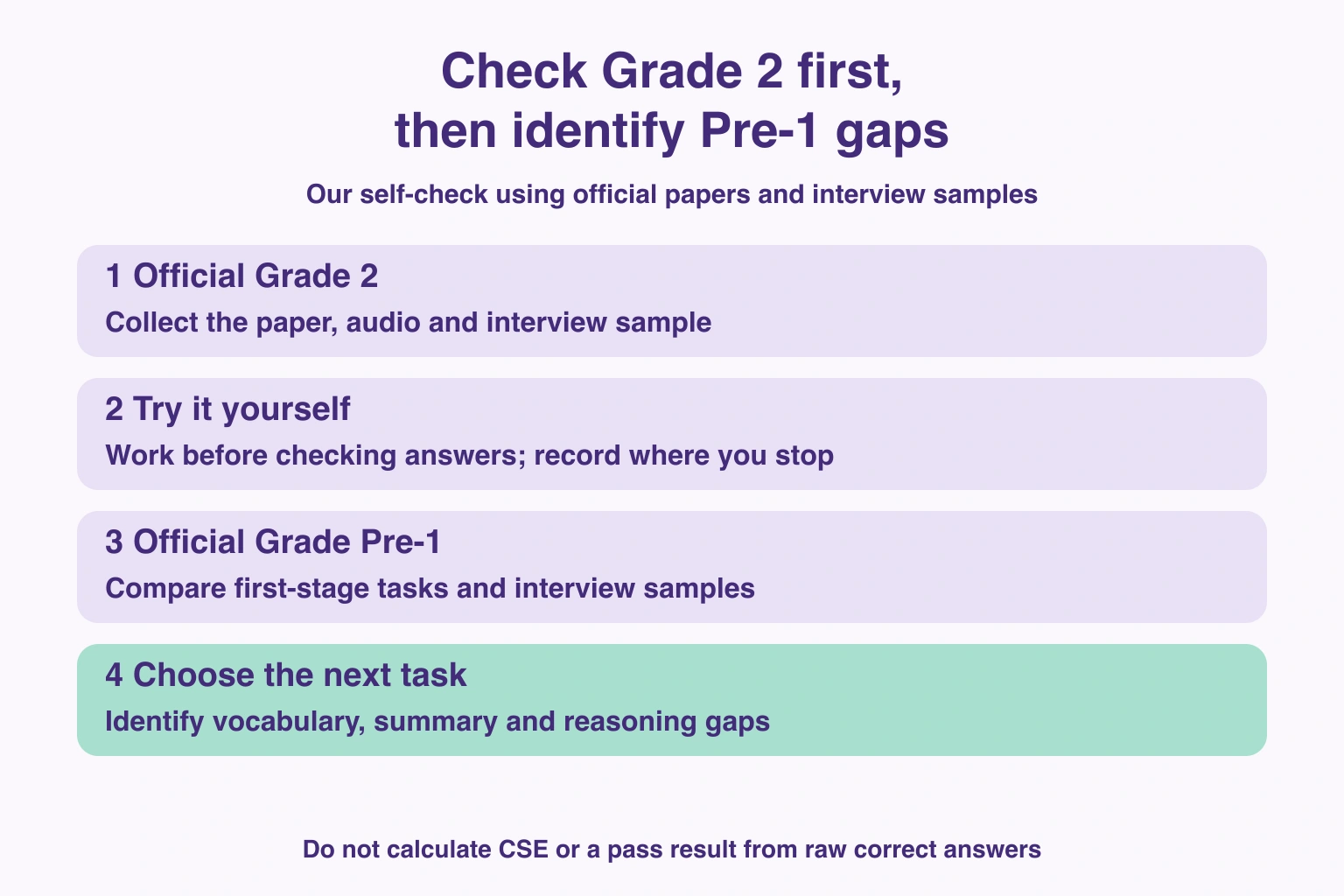
- Collect one official Grade 2 set. From the Grade 2 page, select the booklet, audio and key for the same session. Open the interview sample too. Record the session and your attempt date.
- Attempt before reading the answers or script. Official Grade 2 timing is R/W 85 minutes and L about 25. Our suggestion is to work without a dictionary or mid-test answer checks, retaining both writing tasks. Separate unfinished work from misunderstood content. Format.
- Mark only what you can judge. Check selected answers against the official key and find their evidence. Review whether your summary and opinion follow the instructions. Ask a teacher about content you cannot assess; do not invent CSE or a pass result.
- Try the interview sample aloud. Record where reading aloud, explaining content or giving an opinion stops. Knowing what a sample means and producing an answer yourself are separate observations. The official page links to samples and the virtual interview.
- Repeat with Pre-1 materials. Use its first-stage papers and interview sample, checking R/W 90 minutes, L about 30, four-picture narration and opinions. Compare vocabulary, reasoning, summary and supporting explanations.
- Choose the next target from the difficulties. If Grade 2 instructions or timely completion remain difficult, we would address those first. If you can attempt the whole Grade 2 task set and name specific Pre-1 gaps, move to a Pre-1 plan. We set no invented raw-percentage boundary for that decision.
Write actionable notes: an unfamiliar word, a misread claim, an unfinished writing task or a question you could not support with a reason. “It was hard” alone does not identify the next task. See which Eiken grade to take if the target itself remains unclear.
Admissions, study abroad, teacher recruitment and jobs
The official Pre-1 overview describes uses in admissions, credit recognition, teacher recruitment and overseas study. It does not establish a universal rule for every school, employer or local authority.
Before registering, we recommend identifying the exact institution, department, application route and year. Check the purpose—eligibility, additional points, exemption or credit—the grade or CSE required, skill-specific conditions, accepted test formats and dates, deadline and certificate submission method. Ask the receiving office when wording is unclear. These are editorial checking steps, not universal institutional requirements.
Parents should discuss the learner’s actual task record alongside the intended use, rather than rejecting the goal simply because “university level” sounds too early for a high-school student.
Start with one short opinion and reason
Cities should plant more trees because they provide shade on hot days.
We would say the recommendation first, then see whether we can supply the reason without reading. Check that shade on hot days supports planting trees. A short, relevant explanation is our starting point before adding unfamiliar vocabulary.
We do not recommend memorizing long complete answers and using them without checking the question: the reason may not fit. Whole-response development belongs in our Pre-1 writing guide; responding to questions belongs in interview preparation.
In SpeakGain, we saved this original sentence as one card through the normal Add flow. From Library, View opened Knowledge; Learn this card then opened Listening. The English was hidden, the generated audio played automatically, and the instructions asked us to guess and say what we heard. Reveal answer displayed the same saved sentence.
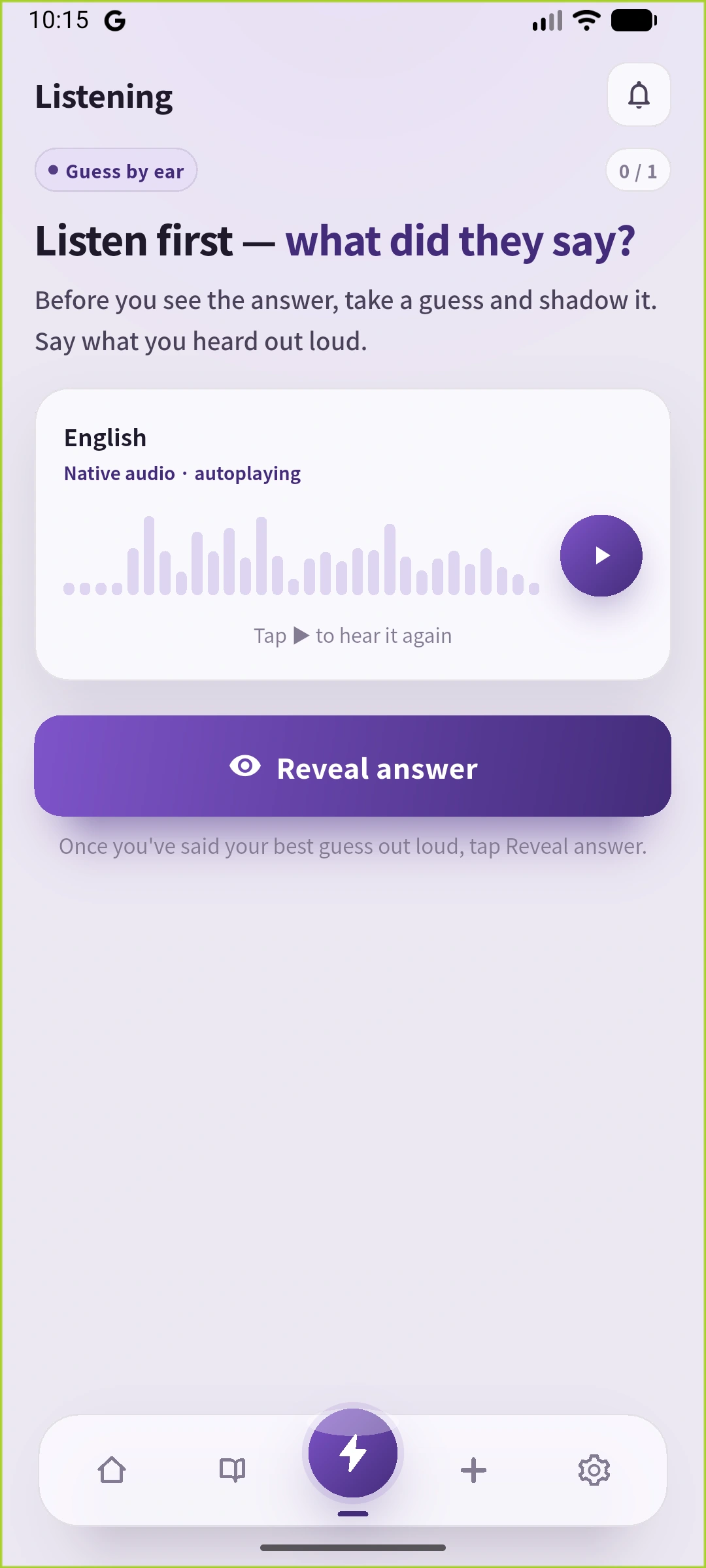
Original practice sentence · Viking AI audio
Frequently asked questions
What level is Pre-1?
The official guide is intermediate university level. Pre-1 can report B1 or B2 depending on the actual score, with grade-specific limits. Levels; CEFR.
Is it an impressive qualification?
We do not give subjective status rankings. Compare the official tasks, what you can do and your intended use; check the receiving institution’s rules.
What is the pass rate?
No current official publication was found as of 16 October 2026. We do not replace it with historical or estimated percentages. Official participation data.
Is it equivalent to a specific TOEIC or deviation score?
No direct TOEIC score conversion was found in the official sources checked; no deviation-score conversion was specified. CEFR comparison is not an individual score prediction. CSE/CEFR.
How far is it from Grade 2?
The official guide changes from high-school completion to intermediate university, with complex content and explicit reasoning. Compare both grades’ official tasks rather than inventing hours or word totals. Goals.
Can I use it for university, study abroad, teaching or employment?
Use differs by institution and application route. Check the relevant year, grade/score, test format, dates and certificate requirements. Broad official usage guidance is not universal acceptance. Overview.
Can a working adult prepare independently, and how long will it take?
There is no fixed official duration or independent-study success rate in the material checked. We would diagnose first, calculate available time and use the study plan.
Is a combined CSE 2304 enough?
Not by itself. First-stage 1792 and second-stage 512 must each be reached. Pass rules.
Editorial verdict
Decide using the official target, the qualification’s intended use and your work on official tasks. Comparing Grade 2 and Pre-1 directly gives you a concrete next action: record what you understand and where explanations stop, rather than searching for a pass-rate estimate or a one-number conversion.
Open the receiving institution’s requirements, the official past papers and the interview sample. Then move to the study plan, writing, interview or vocabulary guide for the specific difficulty you found.
Official information checked 16 October 2026. Eiken is a registered trademark of the Eiken Foundation of Japan. This independent editorial guide is not official test material. The English examples, checking steps and final judgment are our own.
Before choosing the next target, use our Eiken Grade 1 level guide to compare Pre-1, check official pass thresholds and try the official tasks yourself.