
Eiken Grade 1 level: CEFR, passing scores and the gap from Pre-1
Published
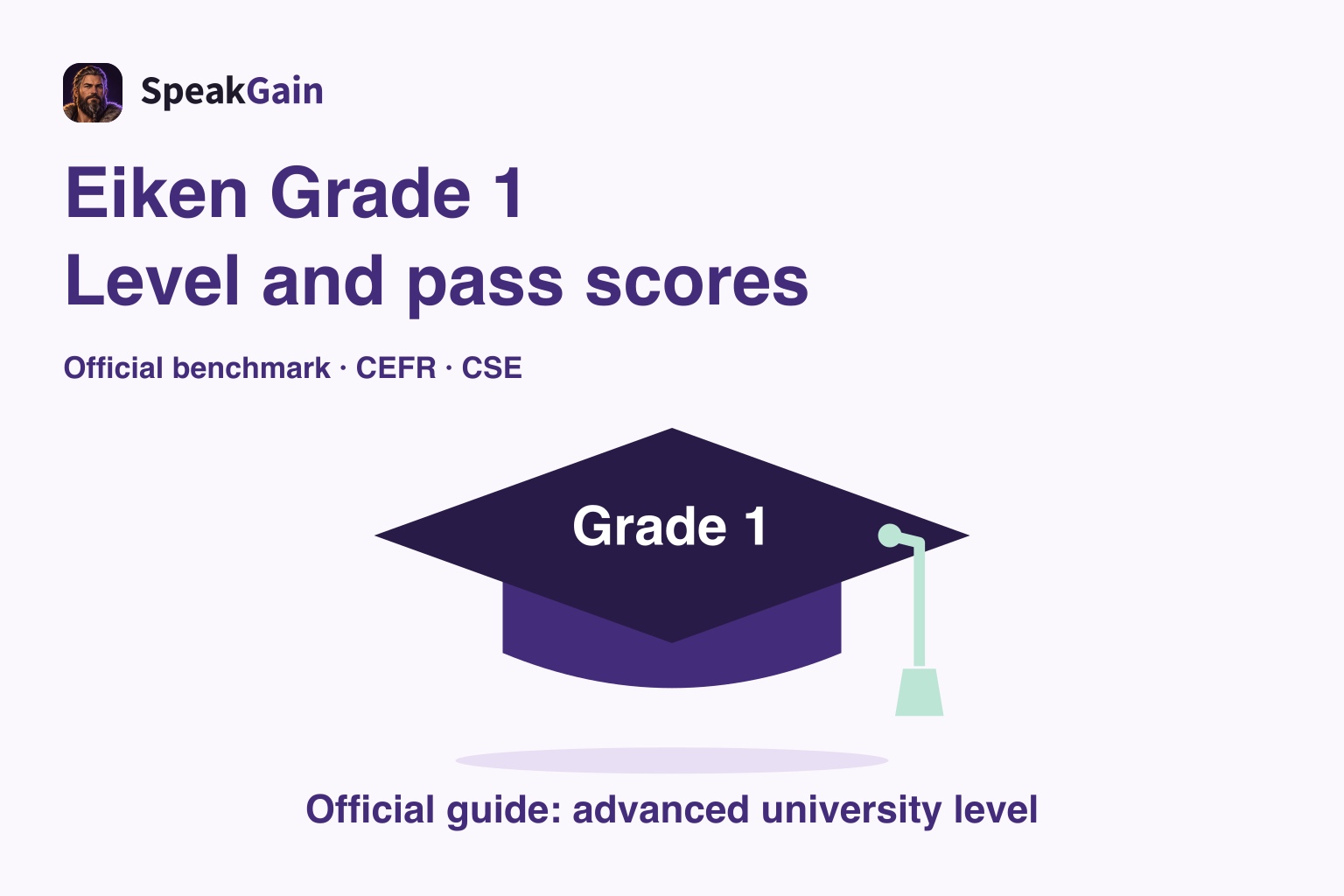
Eiken Grade 1, a Japanese English qualification, has an official benchmark of advanced university level and is aligned with CEFR C1 in the grade comparison; its CSE pass thresholds are 2028 for stage one and 602 for stage two. No current official Grade 1 pass rate is published, and we found no direct official conversion from this qualification to an individual’s TOEIC score in the Eiken materials inspected. To check your readiness, try the official past papers and interview sample across all four skills rather than predicting a result from a conversion table. Benchmarks · CSE · Published participation data.
Official information checked on 16 October 2026. This guide is for students, working adults and parents considering Japan’s Eiken. The official facts and our suggested checking steps are identified separately.
Grade Pre-1 and Grade 1: the official comparison
The CEFR column distinguishes the grade’s broad alignment from the levels that can be reported for an individual result. These are traditional-format test structures. Reading and writing share one time allowance; the two stages have separate pass decisions.
| Grade | Official benchmark | CEFR | Test structure | CSE pass threshold | Official sources |
|---|---|---|---|---|---|
| Pre-1 | Intermediate university level | Grade alignment B2; result reporting B1/B2 | Reading/writing 90 min, listening about 30; interview about 8 min, one examiner, picture narration and opinion questions | Stage one 1792; stage two 512 | Level, Format, CSE, Alignment |
| 1 | Advanced university level | Grade alignment C1; result reporting B2/C1 | Reading/writing 100 min, listening about 35; interview about 10 min, two examiners, selected-topic speech and Q&A | Stage one 2028; stage two 602 | Level, Format, CSE, Alignment |
“Advanced university level” is an ability benchmark. The official pages do not define it as the average of a particular university or as proof that a particular year of university study is sufficient. Use the tasks to assess your starting point. See the Pre-1 level guide or which Eiken grade to take if you are choosing between levels.
What can be confirmed officially?
| Item | Official status in the materials checked | Treatment here |
|---|---|---|
| Level, tasks and skill objectives | Published | Explain separately, with sources |
| CSE 2028/602 and CEFR conditions | Published | Separate pass decisions from CEFR reporting |
| Current pass rate, including age/stage breakdowns | No current official publication found | State that it is not currently published; no old estimates |
| Direct Grade 1-to-TOEIC conversion | No applicable official table found | No equivalent point score |
| Japanese deviation-score conversion, fixed vocabulary or study-hour requirement | Not stated officially in the materials checked | Do not add a number |
| A benefit guaranteed at every school or employer | No common condition published | Check each receiving institution |
Pass-rate checks used participation data and the answer notice. Score interpretation uses the official explanation; cross-test discussion uses the CEFR comparison. “Not found” describes this review, not permission to substitute an unsourced number.
What should a Grade 1 learner be able to do?
The official Can-do list gives skill objectives for passing, not a guarantee that every certificate holder can perform every professional task. The following summarizes the Grade 1 list. All example sentences are our own, not official questions or complete Grade 1 answers.
Reading: organize a complex argument and its evidence
The goal includes understanding specialized texts, inferring meaning and identifying development, main points and relevant details for a purpose.
The study links habitat loss to declining insect populations. This practice sentence illustrates identifying a claim. Ask whether the text establishes a causal relationship or only reports an association; understanding one sentence alone does not establish your level.
Listening: identify the position and its support
The target includes complex specialized information, lectures and discussions, with their main points and supporting reasons.
The speaker questions whether the policy will reduce waste. This is a model of a short note about a speaker’s position. Keep what you understood on the first listen separate from what you discovered from the transcript.
Speaking: develop a position with clear reasons
The target is detailed, logical communication about specialized topics using suitable language. Our shared practice sentence is:
Governments should protect wetlands because they reduce flood risks.
This is an opinion-and-reason practice example, not a sourced scientific claim or a full interview answer. Our suggested follow-up is to explain what alternatives you would compare and how you would discuss costs.
Writing: structure an explanation and select important information
The official objectives include coherent argument and structured summaries of specialized or academic texts.
The report weighs the benefits of automation against its social costs. This describes an imaginary report. When summarizing an actual passage, only include information supported by that passage. Can-do source.
What the two stages actually require
The official Grade 1 format specifies reading/writing in 100 minutes and listening in about 35. Reading has 22 short-text vocabulary items, 6 passage gap-fill items and 7 comprehension items. Writing has one summary and one opinion essay. Listening has 10 conversation items, 10 passage items, 5 real-life items and 2 interview items; each recording is played once.
Our advice is to try both writing tasks as part of the timed first stage. Testing vocabulary alone leaves a large part of the workload unexamined. Detailed methods belong in our writing guide and vocabulary guide.
The second stage lasts about 10 minutes with two examiners. After introductory conversation, choose one of five topics, prepare for one minute without notes, give a two-minute speech and answer related questions; Q&A is listed as four minutes. We recommend testing your ability to respond to a new point, as well as delivering a prepared position. See interview preparation.
What is the Grade 1 passing score?
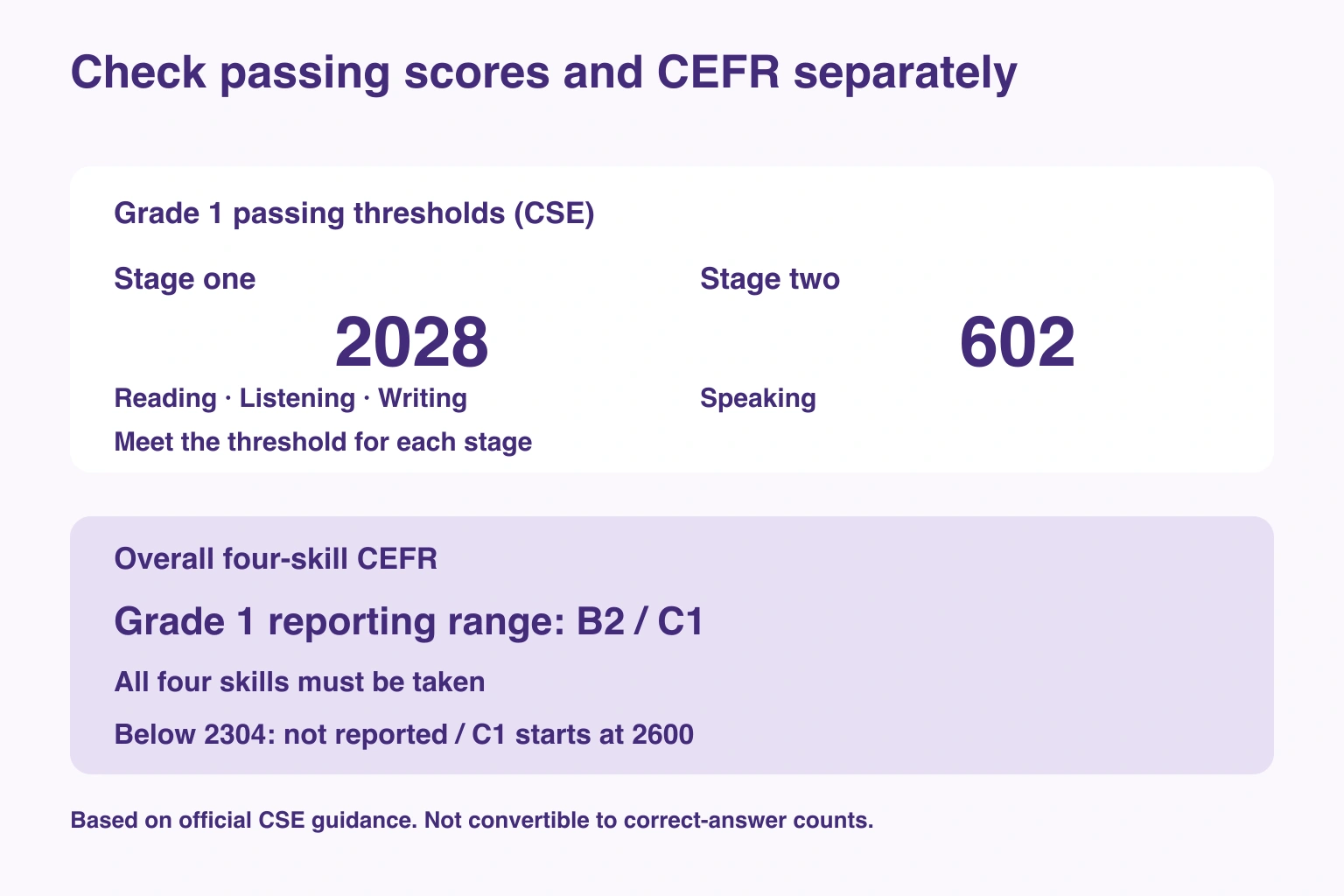
The answer is CSE 2028 across reading, listening and writing for stage one, and CSE 602 in speaking for stage two. Each skill has a maximum of 850, so stage one is out of 2550 and stage two out of 850. Each stage must meet its own threshold. CSE · Scoring.
Why you cannot convert this into a number of correct answers
Eiken explains that scores are calculated statistically after all scripts are marked. The same raw number of correct answers can yield different scores in different administrations; candidates cannot calculate CSE from their own raw marks. Skills receive equal score allocations despite different question counts. Dividing 2028 by the maximum does not produce a guaranteed passing accuracy rate. Historical examples on the official page are not current guarantees. Official explanation.
C1 alignment is different from a reported result
The grade comparison aligns Grade 1 with C1. The CSE page specifies B2/C1 reporting for Grade 1 results: an overall four-skill score below 2304 does not receive an overall CEFR level, and the C1 overall boundary is 2600. All four skills must be taken. Scores above a grade’s CEFR reporting range receive that grade’s reporting ceiling. Registration or a first-stage result alone does not establish an overall C1 result.
Pass rates, TOEIC and Japanese deviation scores
No current official Grade 1 pass rate is published as of 16 October 2026. The participation page does not provide the Grade 1 figures needed to derive one, and the answer notice says inquiries about pass rates and marking cannot be answered. We do not fill the gap with old or age-specific estimates.
We found no direct official table in the Eiken sources inspected that determines a TOEIC score from an individual’s Grade 1 qualification. A Japanese deviation-score conversion is also not stated officially. An official CEFR comparison exists, but a shared framework is not a prediction of someone’s score on another test. Check the skills and proof required by your destination. See English tests compared.
How Grade 1 differs from Pre-1
The official benchmark moves from socially relevant topics at Pre-1 to specialized topics at Grade 1, with inference and logical argument. The sources do not specify a fixed vocabulary total or a “times harder” multiplier. In the interview, Pre-1 includes four-picture narration; Grade 1 requires a selected-topic speech. Both include speaking, but the tasks are different. Pre-1 format · Grade 1 format.
Our advice is to try a fresh Grade 1 paper and speaking sample even if you already hold Pre-1. Your prior certificate gives context; it does not show how you currently handle the new tasks.
Five steps to check your own starting point
These are our editorial checking steps, not an official diagnosis or pass prediction. No official self-marked “safe zone” was found.
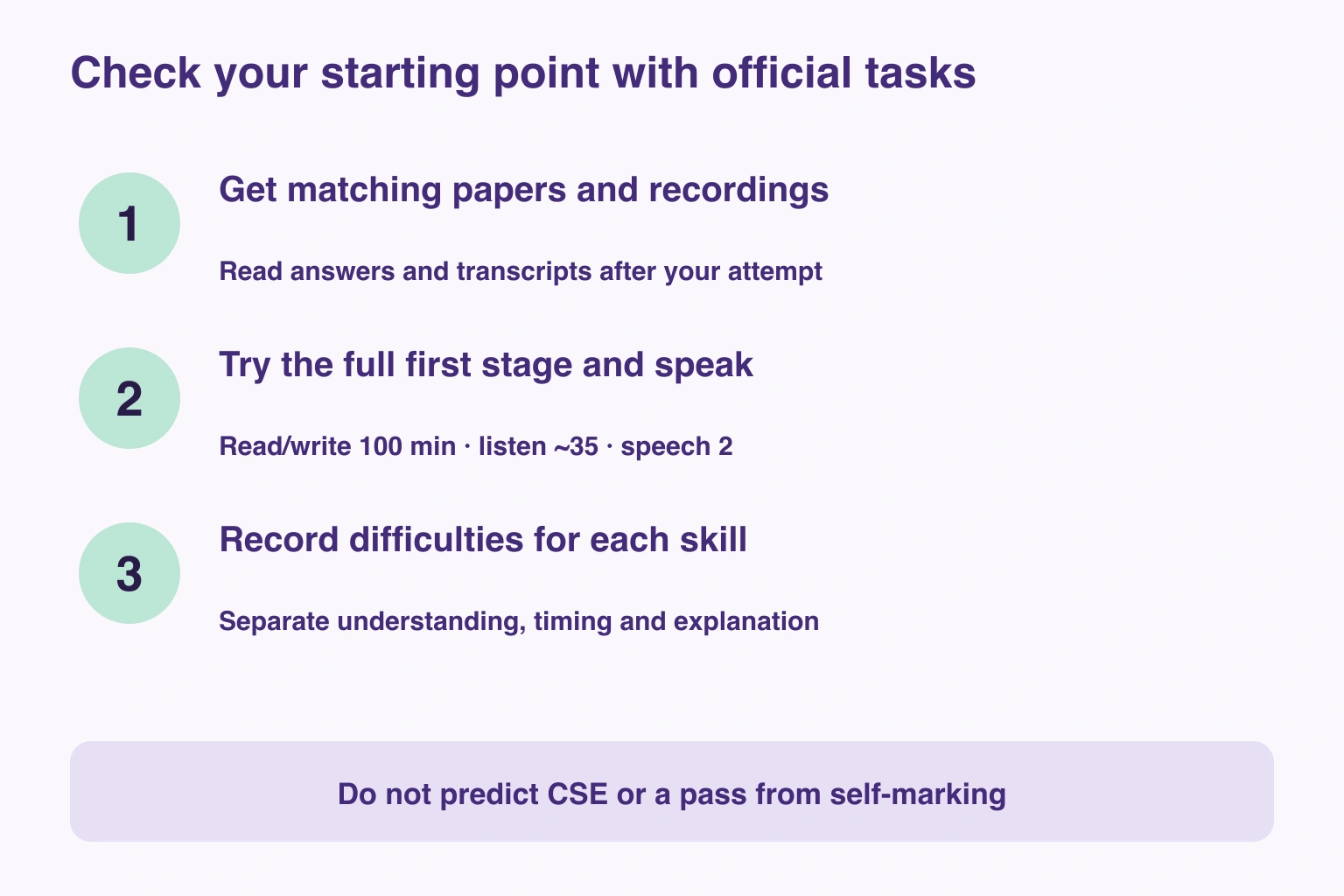
- Get matching official materials. The Grade 1 page provides papers, audio, transcripts, answers and a second-stage sample. At the check date, it listed 2026 sessions 2 and 1 and 2025 session 3. Keep answers and transcripts closed initially.
- Try reading and both writing tasks within 100 minutes. Record your timed attempt before extending time or using a dictionary; note any help separately.
- Complete listening with the official recordings. Try the once-only listening condition first. Distinguish missed words from a misunderstood argument when reviewing the transcript afterward.
- Speak using the official interview sample. Check the virtual interview guidance, then try one minute of preparation and two minutes of speech at home. Thinking that you could answer is different from actually speaking.
- Record a separate difficulty for each skill. Note evidence misread, points missed, unfinished writing and explanations that stopped. Do not calculate a predicted CSE. If necessary, compare with the official Pre-1 materials.
We would distinguish unfamiliar format from difficulty that remains with extra time, rather than judge suitability from one attempt. Move to the Grade 1 study plan for practice methods.
University, study abroad, teaching and employment
The Grade 1 page gives examples of qualification use, but there is no universal admissions bonus, hiring advantage or job guarantee. The admissions guidance explains that schools may use grades, CSE or CEFR differently.
Our checklist is: find the current requirements for the exact course, admissions route, program or job; identify whether it requires a pass, total/skill CSE or CEFR; check accepted test formats, test dates, documents and deadlines; ask the receiving institution about unclear conditions. For teaching, interpreting and translation, a language certificate and the requirements of a particular role must be checked separately.
Practise one opinion and reason, then return to the full task
Our example is Governments should protect wetlands because they reduce flood risks. Explain the position and its reason in your own words, say it aloud and then try addressing an alternative or cost. We do not recommend memorizing one long answer as your entire preparation: the official tasks include summarizing, writing an opinion, giving a speech and answering related questions, which need separate checks.
Save one sentence in SpeakGain, listen, then reveal it
We saved this original sentence as one card through SpeakGain’s normal Add flow and checked its study screens. From the new card in Library, View opened Knowledge; Learn this card led to Listening. Listening hid the English sentence, played the reference audio and displayed an instruction to guess what was said and say it aloud. Reveal answer then showed the saved original on Answer.
Here we use it to keep one sentence, listen and practise saying it. We do not present it as an Eiken mock test, answer or pronunciation grading, or a CSE/pass prediction.
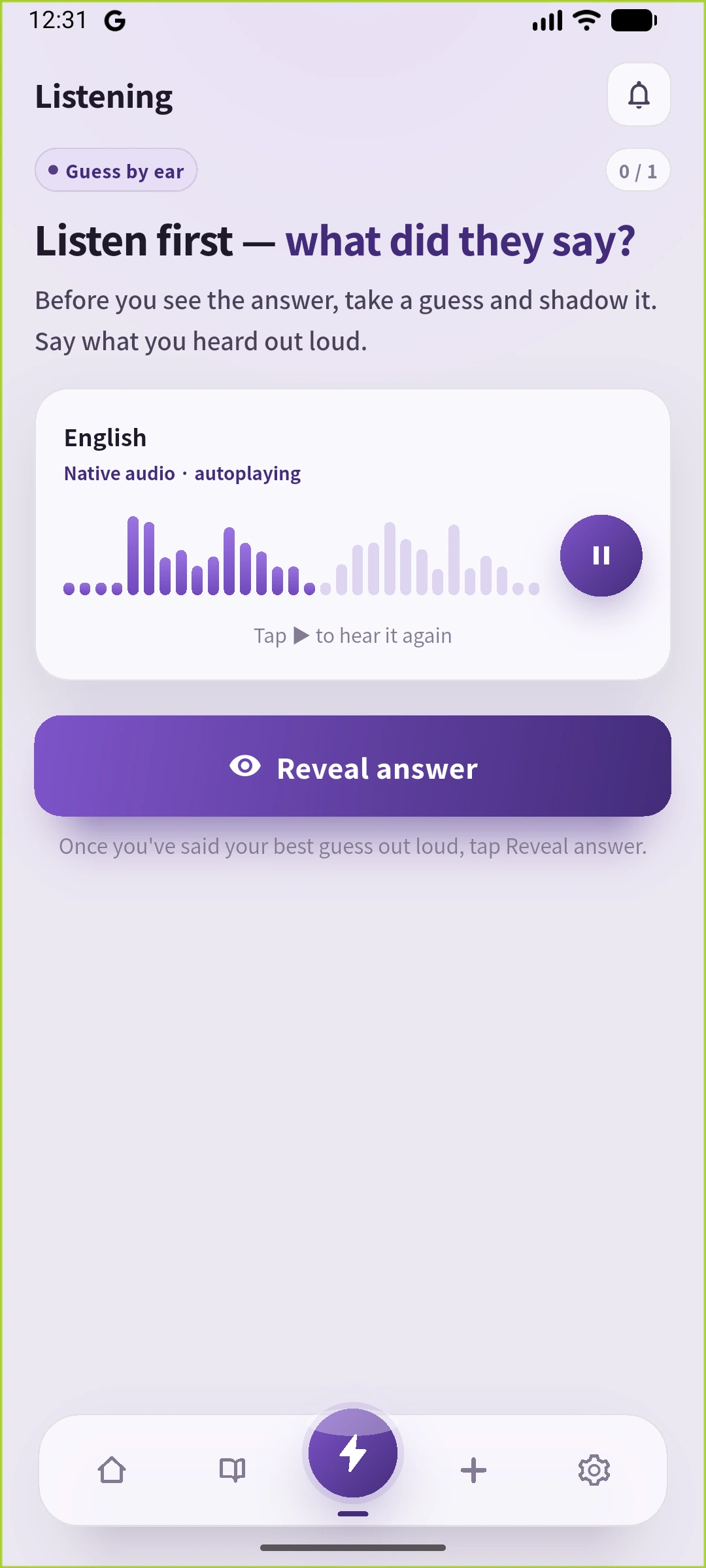
This is an AI-generated Viking reference voice, not a human native-speaker recording or official Eiken audio. We generated the sentence’s audio once and reuse it in every language.
FAQ
Is Grade 1 an “impressive” level?
That is a subjective judgment. The verifiable description is advanced university level, with specialized comprehension and logically supported communication. Benchmark.
What is the pass rate?
No current official rate is published at the check date. We do not present historical figures as current. Data · Notice.
What passing score, or how many correct answers, do I need?
CSE 2028 for stage one and 602 for stage two. You cannot calculate the required number of correct answers from these thresholds. CSE · Scoring.
What TOEIC score or deviation score is equivalent?
We found no direct official TOEIC conversion in the materials checked; an official deviation-score value is not stated. Use CEFR as a comparison framework, not a personal score prediction. Comparison.
How different is Pre-1?
The benchmarks are intermediate versus advanced university level, and the interview tasks differ. Try both official samples rather than assign a numerical difficulty ratio. Pre-1 · Grade 1.
Can it be used for translating, interpreting or teaching jobs?
Check the current requirements of the specific role or scheme. No common hiring guarantee is stated officially. Use examples.
Can a working adult pass through independent study, and how long will it take?
The sources checked give no individual study duration or independent-study success probability. Our recommendation is to identify your four-skill starting point and then build a plan. Study plan.
Does taking Grade 1 automatically give C1?
No. Overall CEFR reporting depends on all four skills, the score and the grade’s reporting range. CSE conditions.
Editorial verdict
Choose using the official benchmark, the tasks you actually attempted and the qualification your destination accepts. We recommend recording where your comprehension, timing or explanations break down rather than seeking an estimated pass rate or TOEIC conversion. Once Grade 1 fits your purpose, use those observations to plan study.
Official sources linked throughout were checked on 16 October 2026. Eiken is a registered trademark of the Eiken Foundation of Japan. This independent guide is not official test material; examples, checking steps and editorial judgments are our own.