
Eiken Grade 1 vocabulary: choose a book or app and use words in your own sentence
Published
For Japan’s Eiken Grade 1, choose one main vocabulary resource with examples and audio, then work through meaning → example → sound → your own sentence → review after a gap. Our editorial recommendation is to practise recognising words in vocabulary questions and passages separately from using reliable words in writing and the interview. The official Eiken sources we checked state no fixed required vocabulary total or exhaustive word list.
This guide is for university students, working adults and English teachers whose main obstacle is vocabulary. The resources below are Japanese study materials for Japan’s Eiken test. For the rest of your preparation, see the Grade 1 study plan.
Choose by purpose, not a ranking
Checked 16 October 2026 on publishers’ and providers’ official pages. We have not used, read or tested the third-party books or app. Suitability is our editorial judgement; entry counts describe the resource, not an official passing requirement.
| Name | Provider | Entries stated officially | Audio | Features | Suits someone who… | Checked |
|---|---|---|---|---|---|---|
| Grade 1 Derujun Pass Tan, 6th revision | Obunsha | 2,100 words + 300 idioms; separately 200 field-specific and 125 writing/speaking expressions | Free download; Eigo no Tomo support | Frequency order, checks, expression sections | Wants a paper resource with a clear order | 2026-10-16 |
| Grade 1 Tan-jukugo EX, 2nd edition | The Japan Times Publishing | About 2,950 words/phrases | Free headword/phrase and example audio download | Examples, word origins, synonyms, antonyms and derivatives | Wants to examine combinations and related words | 2026-10-16 |
| Grade 1 Pass Tan, 5th revision, in English Words by Monokakido | Monokakido; original material: Obunsha | Total not stated on this page | Headwords, meanings and examples; adjustable speed and intervals | iOS; weak-word/random order, meaning selection and word-entry tasks | Wants questions and audio together on iOS | 2026-10-16 |
The paper book is the sixth revision; the app’s official page describes the fifth. Do not assume identical content. The counts use different categories, so we do not add the separate expression sections into a supposedly comparable total.
Choose according to where you study and what stops you. For commuting, check whether you can access the audio on your device. At a desk, consider how you will return to examples. Confirm OS, edition and access conditions with the provider. If a resource you already own has examples and audio, we would begin there. See the broader vocabulary app comparison and Eiken app guide for other purposes.
A five-stage routine with a check at each stage
| Stage | Action | Check |
|---|---|---|
| Meaning | Identify the meaning and part of speech in this context | Hide the translation and explain the intended meaning |
| Example | Read with subjects, objects and prepositions | Explain what acts on what, and how |
| Sound | Listen to the word and example, then say manageable chunks | Understand the meaning without looking |
| Your sentence | Write a short opinion and reason | Check context, usage and whether the reason supports the opinion |
| Spaced review | Return on another day, recalling before looking | Identify whether meaning, usage or sound caused the pause |
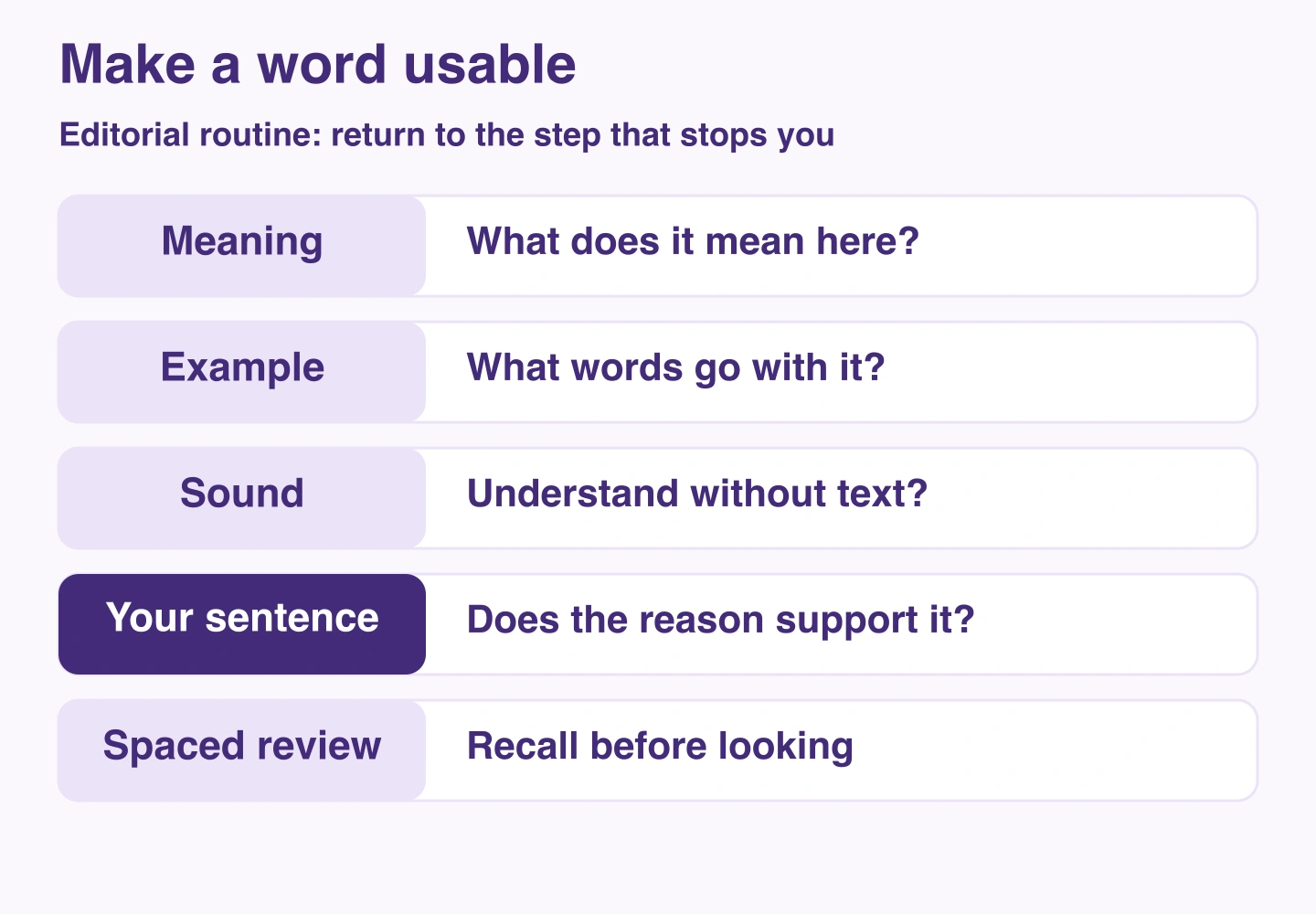
You do not need to produce an original sentence for every difficult word. Learn a broad range for understanding, then select words you want to use. Before memorising several examples, explain one example’s structure. Familiarity with the translation may hide uncertainty about its object or preposition. For general review organisation, see how to memorise English words.
How many words are required?
The official level guide describes Grade 1 as advanced university level, including complex specialist texts and clearly developed arguments. The level, format and past-paper pages checked give no fixed required total or exhaustive vocabulary list. A publisher’s resource size or marketing description is not an Eiken rule.
Compare what remains uncertain in your main resource with what actually blocks comprehension in official papers. Sometimes the problem is a new meaning, derivative or combination of a familiar word. Repair Pre-1 foundations when they repeatedly stop you, rather than assuming every unfamiliar advanced word requires a complete restart.
If the foundations need attention, use the Pre-1 vocabulary guide for that level’s resource choices and review.
Use vocabulary differently across the test
The official format has 22 short vocabulary-gap questions, six passage gaps and seven reading-comprehension questions. Writing includes a summary and an opinion essay; the interview includes a two-minute chosen-topic speech and Q&A.
Short gaps: read the situation, negation, contrast and cause before matching an option. In review, distinguish unknown meaning, misread context and incorrect usage. Explain the correct choice, then investigate the options that confused you. Remembering an old question is different from judging a new one.
Passages: ask whether an unknown word changes the argument or whether sentence structure is the real obstacle. After checking the word, return to its paragraph and explain the relationship it clarifies. Guess during an initial reading; verify the evidence during review.
Writing: the official vocabulary criterion concerns appropriate, correct use, including variety that fits the context. Do not insert difficult words just to display them. A synonym can change strength or meaning, particularly in a summary. See the Grade 1 writing guide for building complete answers.
Interview: vocabulary is among the official evaluation perspectives. We would practise explaining a chosen word or reason in simpler language when asked a follow-up. Add “why?” or “what example?” after your sentence. Recognition vocabulary does not all need to become speech vocabulary.
Worked example: use exacerbate in an opinion and reason
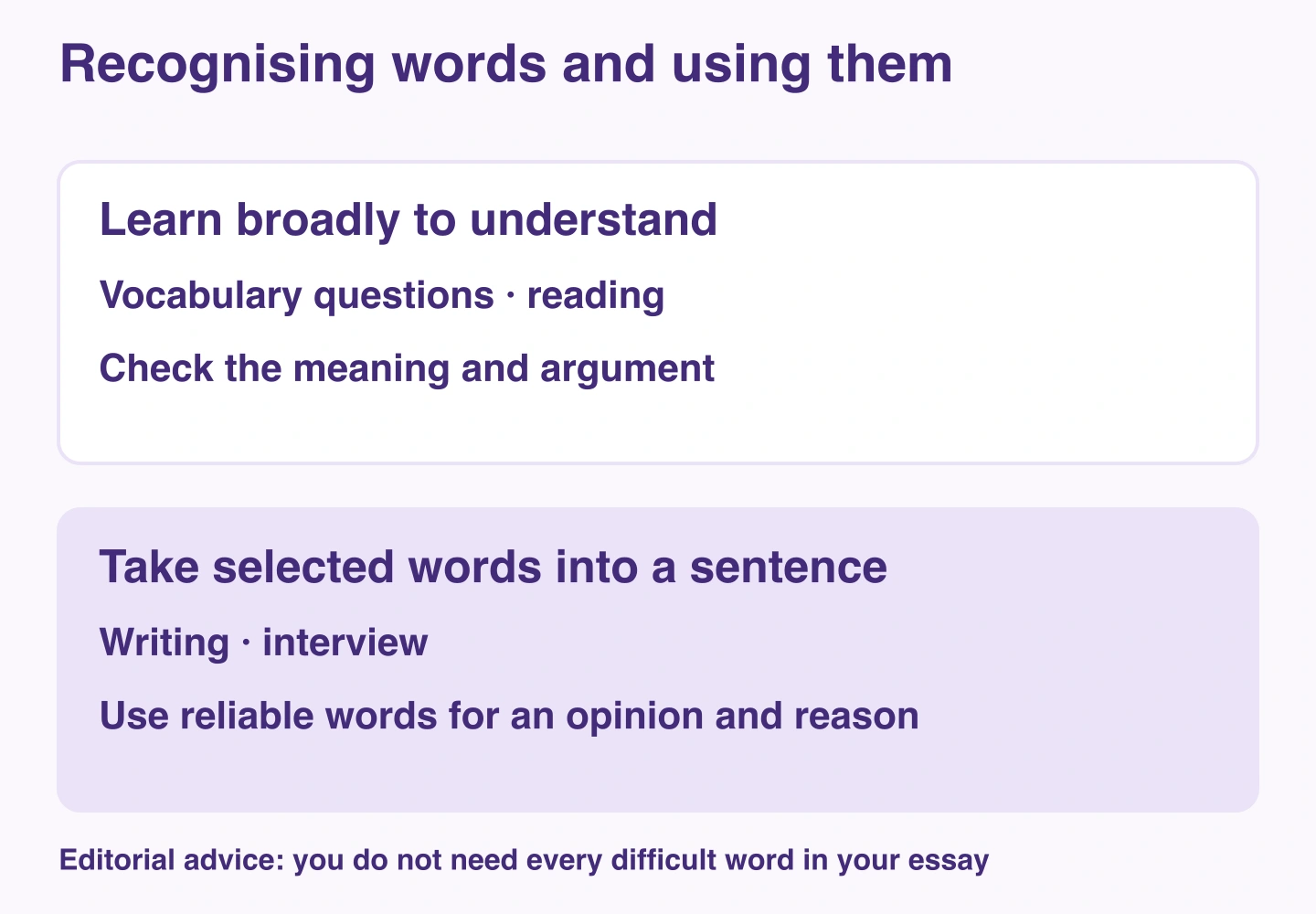
We chose exacerbate, meaning to make a problem worse, as an advanced vocabulary example, not an officially prescribed Grade 1 word. We wrote this sentence ourselves:
I oppose these cuts because they could exacerbate inequality.
Imagine a discussion about cuts to support for low-income households. “These cuts” needs that preceding context; this is not a universal answer for any question. Identify what could worsen: inequality. Check the verb–object combination and how the reason supports the opinion.
Listen for the word’s sound and the sentence’s chunks, hide the English, then explain your position and the possible consequence. If the word comes back but the reason does not, clarify the idea first. This is a short practice sentence, not a complete Grade 1 essay or speech. Add explanations and examples relevant to the actual task.
Listen to your sentence and say it with SpeakGain
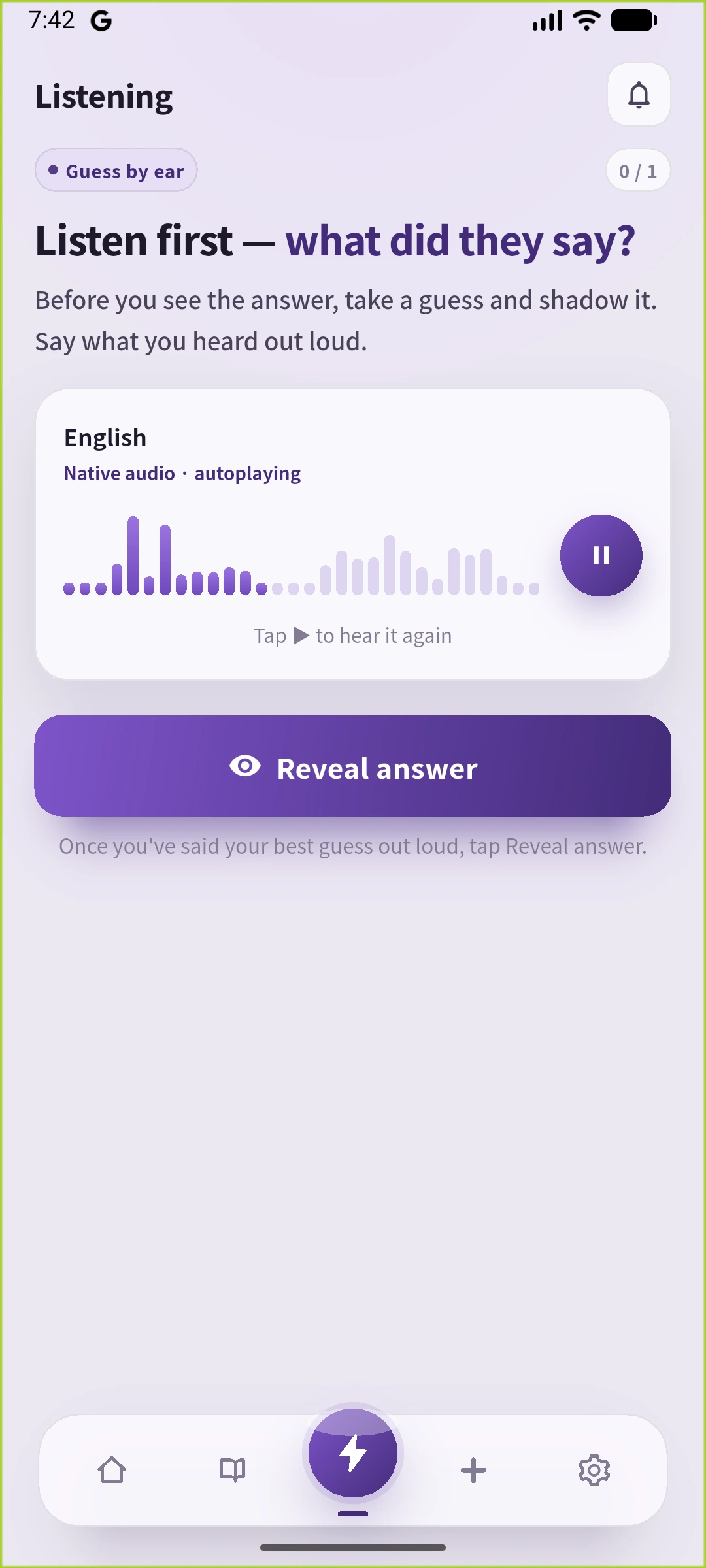
We used SpeakGain at the stage of listening to and restating a sentence whose meaning and usage we had checked. We saved this original sentence through the normal Add flow, opened Knowledge in Library and selected Learn this card. Listening hid the English and automatically played the generated audio, with instructions to say what was heard. Reveal answer displayed the same saved sentence. Recalling it again the next day without looking is this article’s editorial practice proposal.
Our original sentence · Viking AI audio
I oppose these cuts because they could exacerbate inequality.
Generated once for this sentence and shared across all languages. Check the meaning, listen, hide the English and say the idea aloud as a short practice.
How we would organise three months — editorial opinion
This is a review framework for someone already able to read around Pre-1 level, not a prediction that vocabulary can be mastered in three months.
| Period | Focus | Adjustment |
|---|---|---|
| Month 1 | Diagnose with official material; choose one resource; connect meaning, examples and sound | Reduce new material when next-day review overruns |
| Month 2 | Revisit old words; write selected original sentences; return to passages | Repair the specific usage or sound that stops you |
| Month 3 | Check unseen official questions and vocabulary needed in writing/speech | Track recurring errors rather than completed rounds |
A 25-minute editorial example is ten minutes of recall, ten on new words and examples, and five on one sentence. It is not an official or optimal ratio. Set new-word volume after seeing how much you can actually review. Students can use gaps around classes; workers can separate commuting review from spoken practice; teachers should distinguish personal study from lesson preparation.
Keep a small restart point for busy days: recall yesterday’s material and say one sentence. Each week, check some material beyond the vocabulary resource. Return to the whole-test plan for balancing other skills.
Methods we do not recommend
Mass meaning-only drills as the finish line: these can check initial meanings but do not check combinations, sound or expression. Use their results to select the next practice. Starting several books at once: extra sources can consume the time needed to revisit yesterday’s work. Give a second resource a specific supporting role. Forcing advanced vocabulary into writing: retain the intended meaning before replacing a word. Restarting the entire book after forgetting: identify the missing meaning, usage or sound instead.
The next day, a few days later and the following week are example review intervals to try, not universal optimal timings. Extend gaps when recall is reliable and revisit uncertainty sooner.
Frequently asked questions
How many words are enough?
No fixed total is stated in the official sources checked. Resource entry counts are not passing thresholds. Use official material to identify actual gaps.
Is one book enough?
We would choose one main resource, then supplement a demonstrated gap. Finishing one book does not guarantee a pass.
Book or app?
Choose for study location, device and how you review examples. A paper book with audio on a phone is also a possible combination. Check the edition and access conditions.
What about idioms?
Include them: the official short-gap task concerns words and phrases. Check their prepositions and combinations in context, rather than adding isolated lists.
What if I keep forgetting?
Recall before revealing the answer. Separate uncertainty about meaning, sound and use; reduce new material if review keeps accumulating.
Can I finish in three months?
The official sources checked give no universal learning period. The plan above is a review cycle, not a completion or passing promise.
Must I use every difficult word in the interview?
No. We recommend a broad recognition vocabulary and a growing set of words whose meaning and usage you can trust for expression.
Should vocabulary come before all reading and writing?
We recommend parallel practice. Actual texts and original sentences show which meanings and combinations you need.
Editorial verdict
Choose one main resource, connect meaning, examples and sound, then use selected words in an original sentence. Review what you can explain and reproduce, not just how many entries you saw. Today, take one uncertain word, verify its usage, write an opinion and reason, and try recalling it tomorrow.
Official sources
Eiken levels · Grade 1 format · Official papers and audio · Writing criteria · Obunsha · The Japan Times Publishing · Monokakido. Checked 16 October 2026. Eiken is a registered trademark of the Eiken Foundation of Japan. This article is not an official Eiken resource.