
How to study for Eiken Grade 1: summaries, four skills and a six-month plan
Published
Start with one current official Eiken Grade 1 past paper, then identify whether vocabulary, passages, summarising, essay development or listening stops you. Our editorial recommendation is to practise reading, both writing tasks and listening together, while keeping short spoken answers in your week from the start. Six months may or may not be enough: your starting point and the work you can actually revise matter more than the calendar.
This guide concerns Japan’s Eiken Grade 1, for university students, working adults and English teachers, including readers living in Japan whose first language is not Japanese. Official information was checked on 16 October 2026. Practice methods and schedules are editorial proposals; the sentence and diagrams are our own, not reproduced test questions.
Current format: two writing tasks inside the 100 minutes
| Skill | Task | Questions | Time / length | Official source |
|---|---|---|---|---|
| Reading | Short vocabulary gaps | 22 | Reading + Writing: 100 min | Official |
| Reading | Passage gaps | 6 | Reading + Writing: 100 min | Official |
| Reading | Reading comprehension | 7 | Reading + Writing: 100 min | Official |
| Writing | Summary | 1 | 90–110 words within the shared 100 min | Official |
| Writing | Opinion essay | 1 | Suggested 200–240 words within the shared 100 min | Official |
| Listening | Dialogues | 10 | Listening total: about 35 min; each once | Official |
| Listening | Passages | 10 | Listening total: about 35 min; each once | Official |
| Listening | Real-Life | 5 | Listening total: about 35 min; each once | Official |
| Listening | Interview | 2 | Listening total: about 35 min; each once | Official |
| Speaking | Conversation, speech and Q&A | 1 speech; other counts not specified | About 10 min; prepare 1, speech 2, Q&A 4 min | Official |
Reading and Writing share 100 minutes; the official pages do not prescribe separate limits for each section or task. Since the 2024 renewal, Reading has 35 questions rather than 41, and Writing includes both a summary and an opinion essay. The combined 100 minutes, Listening and Speaking were unchanged. Papers from the first 2024 administration onward reflect the renewal (official announcement).
CSE pass scores are not a fixed percentage of correct answers
| Stage | Maximum CSE | Pass criterion | Source |
|---|---|---|---|
| First | 850 each for reading, listening, writing; 2,550 total | 2,028 across the three skills | Official |
| Second | 850 for speaking | 602 | Official |
The four-skill maximum is 3,400, but the first and second stages have separate pass criteria. A strong interview does not compensate for failing the first stage. Skills receive equal maximum scores despite different question counts. The official explanation says CSE is calculated statistically after all answers are marked, so you cannot calculate it from your own number of correct answers (official scoring explanation). Use home marking to diagnose errors, not to promise a pass at a fixed percentage.
Is six months enough? Plan from the diagnosis
| Time left | Priorities — editorial proposal | Check before adjusting |
|---|---|---|
| 1 year | Diagnose; build contextual vocabulary, paragraph reading and close listening. Write both tasks throughout, then increase timed work. | Can you explain the material after review? |
| 6 months | Diagnose in week one; review weaknesses and write both tasks weekly. Later add full timed work and interview responses. | Can you finish revisions, not just drafts? |
| 3 months | Start all skills together; focus on recurring errors and time-outs rather than a vocabulary-only phase. | Is the obstacle knowledge or time? |
| 1 month | Avoid adding resources; review recurring errors and check timing on unseen material. | Does the next answer improve? |
| 2 weeks | Recheck omitted summary points, overlapping reasons and listening conditions; keep short speaking. | Can you do it with the answer hidden? |
These are editorial plans, not official preparation periods or pass guarantees. If a passage remains unclear even with a dictionary, allow time for sentence structure and basic vocabulary. If you understand it after review but cannot finish both writing tasks, work on allocation and selecting ideas. Passing Pre-1 alone does not settle which problem you have.
The step up from Pre-1
| Item | Pre-1, current | Grade 1, current |
|---|---|---|
| Reading | 18 + 6 + 7 questions | 22 + 6 + 7 questions |
| Summary | 60–70 words | 90–110 words |
| Opinion essay | Suggested 120–150 words; use two provided POINTS | Suggested 200–240 words; three supporting reasons |
| Reading + Writing | 90 min | 100 min |
| Interview | About 8 min, one examiner; four-picture narration and questions | About 10 min, two examiners; choose one of five topics for a speech and Q&A |
Official · Official · Official · Official
The official benchmarks are university intermediate level for Pre-1 and university advanced level for Grade 1. The official pages note differences in passage length, content and question difficulty, but do not state a universal passage word count or a fixed vocabulary total required to pass (Pre-1 format; Grade 1 format). Our view: add vocabulary in context, but also practise tracking arguments across paragraphs, retaining relationships in a longer summary and explaining three genuinely different reasons. Simply lengthening a Pre-1 answer can produce repetition. See the Pre-1 study plan if that stage needs attention.
Reading: separate unfamiliar words from misunderstood logic
Official format: 22 short vocabulary gaps, six passage gaps and seven comprehension questions (format). Common difficulties: losing the paragraph while decoding one word, mixing the author’s explanation with someone else’s view, or choosing an option just because it repeats a word from the passage.
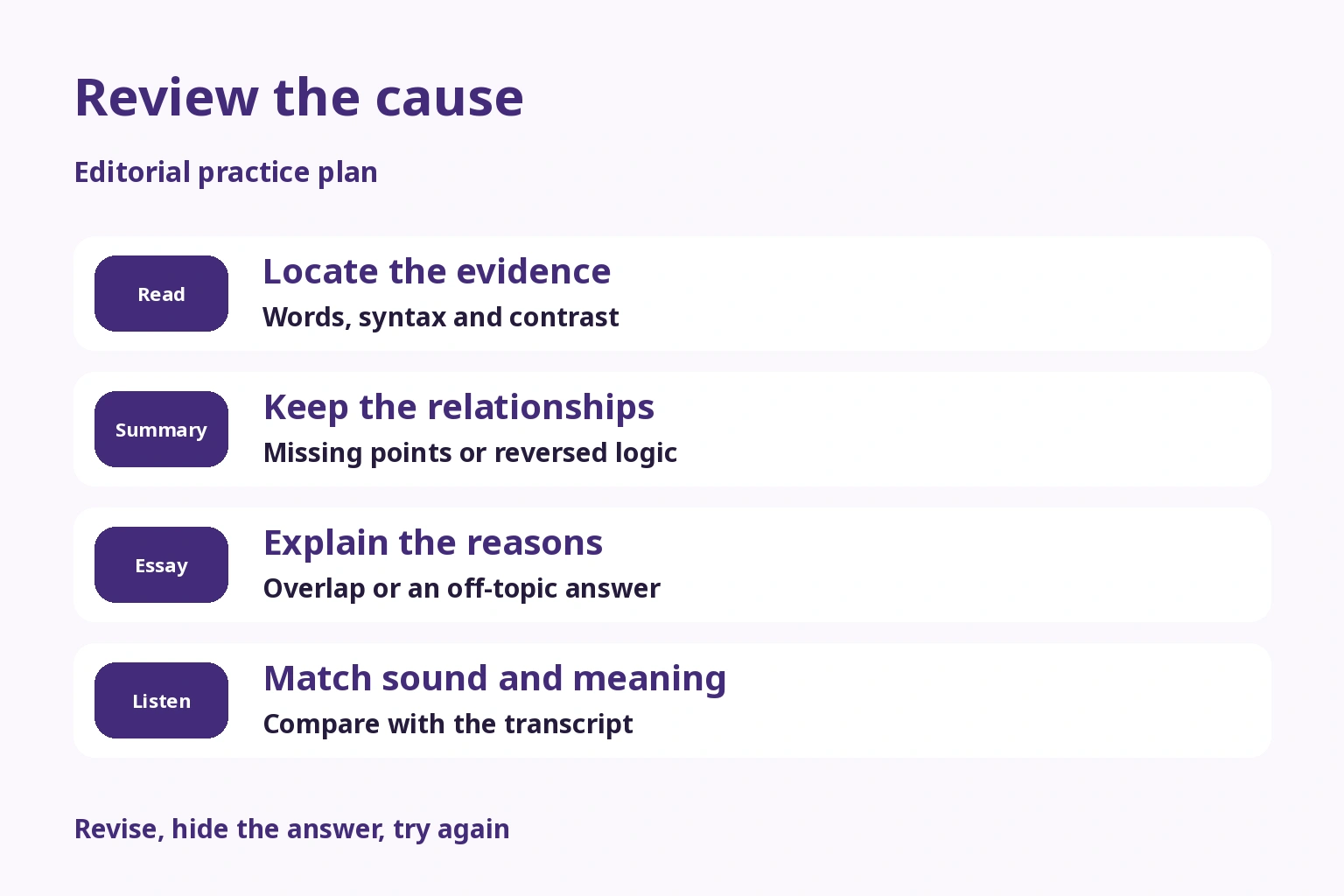
Editorial practice: first answer without a dictionary and mark uncertainty. During review, classify errors as vocabulary, syntax, cause/contrast or interpretation of an option. Give each paragraph a short heading, locate evidence for the answer and explain why the alternatives go beyond or contradict it. Check a word’s meaning, grammatical role and combinations in its original sentence. Next day, hide the translation and read again. Treat speed on a memorised paper separately from speed on an unseen passage. Official materials: the Reading sections and keys on the past-paper page.
Summary: preserve relationships before cutting words
Official format: one summary, 90–110 words, using your own words as far as possible (current paper, page 12). Common difficulties: overexplaining the opening, losing the final point, retaining examples instead of the claim, changing possibility into certainty, or adding your opinion.
Editorial practice: read each paragraph’s role; identify causes, effects, contrasts and responses without forcing every text into a benefits/problems template. Choose the essential claims and note who holds them. Rebuild the meaning in your own sentences rather than replacing isolated words with difficult synonyms. Compare with the original for agents, negatives, logic and strength of claims; only then adjust to 90–110 words. Rewrite with the model answer closed and check whether previously missing information survives.
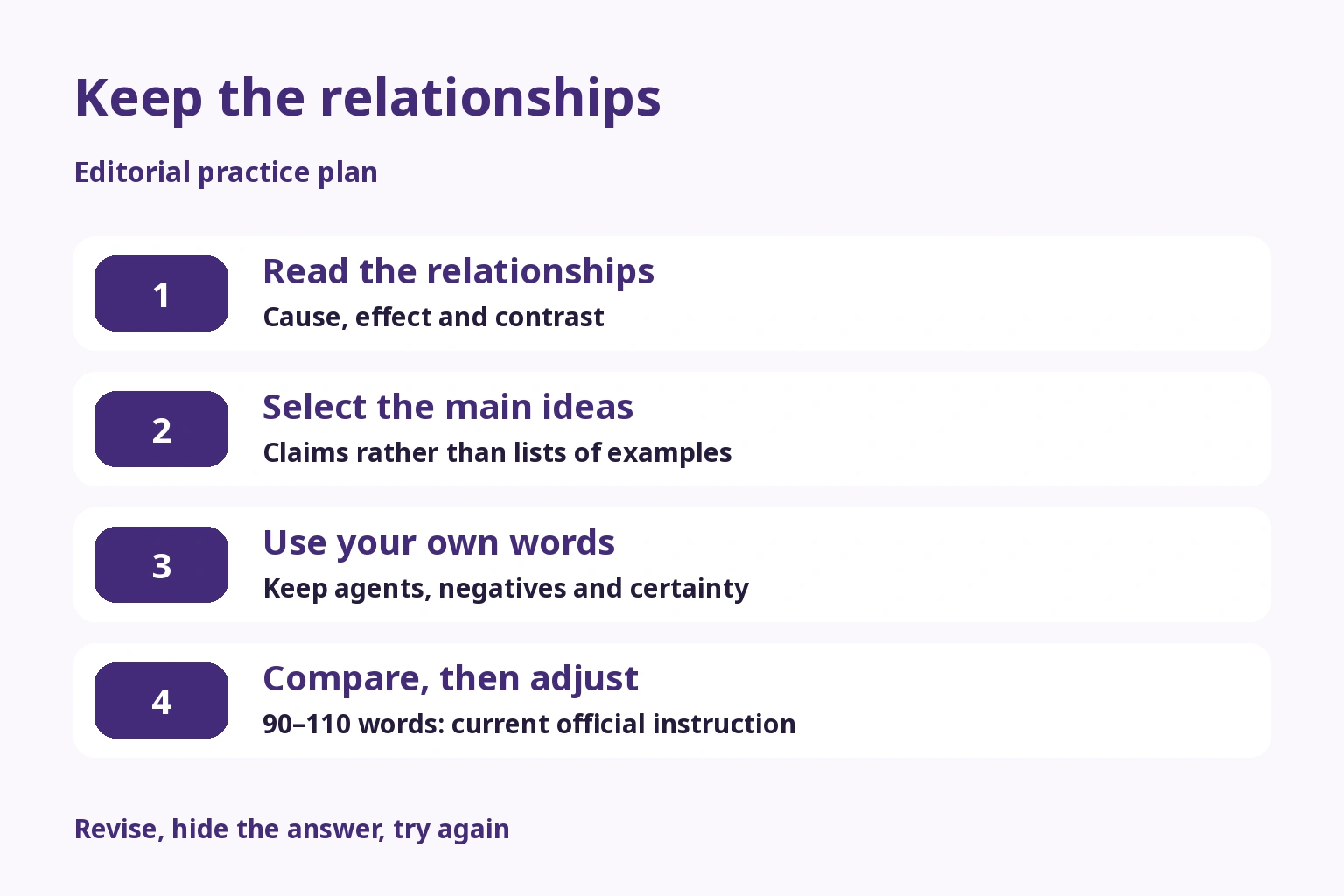
For a simple original planning example, consider “more night-time public transport / easier travel for night workers / funding and staffing difficulties”. This illustrates relationships, not an official question or completed summary. In actual practice, retain only information present in the source. Official materials: current summaries and sample answers on the official page. Ask a teacher a precise question such as whether your sentence reverses the causal relationship, showing the source passage alongside it.
Opinion essay: check the position and three reasons first
Official format: one essay with three reasons supporting your answer; introduction, main body and conclusion; suggested length 200–240 words (current paper, page 14). Common difficulties: three reasons that repeat one effect, drifting away from the question and spending too long on the introduction.
Editorial practice: outline your position and three distinct reasons, then explain who is affected, what happens and why. First check relevance, then revise overlap and missing explanations, then language and word count. Reserve time for both a first draft and a rewrite. Official materials: essays and sample answers on the past-paper page.
Our original practice sentence is:
Cities should plant more trees because shade makes public spaces safer during heat waves.
The opinion is to increase tree planting; the reason concerns shade during extreme heat. This is one reason, not a complete Grade 1 answer, and it is an argument-building example rather than a cited scientific finding. Test its relevance to the actual question and develop other distinct reasons instead of inserting it into every topic.
For detailed drafting and revision of both tasks, see our Grade 1 summary and essay writing guide.
Listening: distinguish sound problems from meaning problems
Official format: 10 dialogue, 10 passage, five Real-Life and two interview questions, about 35 minutes in total, each recording played once (format). Common difficulties: following one missed word and losing the next point, substituting your own inference for a speaker’s decision, and overlooking a condition.
Editorial practice: answer once without stopping, then revisit the short section responsible for the error. Before opening the transcript, record what you understood. Compare for unknown words, known words not recognised in sound, sentence meaning and relationships across the talk. Check meaning, match sound to text, then listen with the transcript closed. Track intention in dialogues, main claim and support in passages, conditions in Real-Life tasks, and the connection between questions and responses in interviews. Official materials: audio, transcripts and keys on the official page. Do not reproduce the official questions or audio in an article or app.
Interview: start short spoken opinions before the first stage
Official format: an approximately ten-minute interview with two examiners; choose one of five topics, prepare for one minute, speak for two minutes and answer questions for four minutes (official procedure). Common difficulties: having reasons on paper but not aloud, or memorising a speech without being able to respond.
Editorial practice: speak a position and reason at home, then answer “why?” and one opposing view. Record yourself at home and check whether you answer the question early. Notes, photographs and recording are prohibited during the actual interview. Official materials: the second-stage sample and virtual interview linked from the official page. Use our Grade 1 interview guide for detailed speech and follow-up practice.
Study hours: build a week you can revise within
The official materials checked do not state a universal number of study hours, including extra hours after Pre-1 or separate requirements for workers and teachers. All durations below are editorial examples.
Five weekdays at 60 minutes and two weekend days at 120 minutes give nine hours a week. Treating six months as 26 weeks gives 234 scheduled hours. That is arithmetic, not a researched passing threshold. Deduct busy weeks and adjust after two weeks of actual work. Put short vocabulary checks or replaying audio into travel time; keep desk time for summaries, essays and full practice. Record what changed, not just minutes spent playing audio. Teachers should also distinguish explaining English in class from producing a timed summary or spoken argument.
How we would use six months — editorial opinion
In week one, attempt one official paper under the Reading/Writing 100-minute conditions and complete Listening. Preserve blanks and time-outs, then see what you can do without a time limit. During roughly the first three months, alternate reading and listening review, and aim initially for one summary and one essay each week, each paired with a rewrite. If revision is not getting done, reduce new tasks instead of building a backlog. Keep short speaking practice throughout.
During the second half, try unseen material and increase full timed practice. One editorial starting allocation is Reading 45 minutes, summary 20, essay 30 and checking five. It is not an official allocation. Record where you stall and adjust so both writing tasks are reached. After the first stage, focus more on the official interview procedure and detailed responses. If a week goes badly, finish an unrevised answer before adding another resource.
Official papers: separate diagnosis from an unseen check
The official page provides one year, three administrations of first-stage papers: question and answer PDFs, listening scripts and audio. It also links a second-stage sample and virtual interview; this does not mean three administrations of interview questions. At checking, the listings were 2026-2, 2026-1 and 2025-3. They change as the page is updated. Grade 1 is held at main test venues.
We would use one paper diagnostically, another for skill work and retain unseen material for a timed check. Three papers are not an official sufficiency rule. Reuse a paper for different purposes: initial answers, evidence review, then a check without the key or transcript. A score increase on remembered questions is not automatically a gain in transferable skill.
We do not recommend individual commercial books here. If using one you own, check the publisher’s current edition information for both writing tasks and 35 Reading questions. Use the current format for full timing checks, even if older material remains useful for isolated practice.
Three approaches we do not recommend
Memorised essay templates alone: rehearsed reasons can miss a new question. Useful connectors still need to fit the actual logic. Vocabulary books alone before everything else: knowing words does not practise selecting summary content or explaining three reasons. Past papers without review: question counts rise without revealing what needs to change. Keep the cause, a correction and a fresh attempt without the answer.
Turn one opinion and reason into speaking practice
Understand the original tree-planting sentence, hide it, say the idea again and think of another reason. See the Eiken app comparison for choosing tools. In SpeakGain, we saved this sentence through the normal Add flow, opened Knowledge from Library and selected Learn this card. Listening hid the English and automatically played the generated audio, with instructions to guess what was heard and say it aloud. Reveal answer displayed the same saved sentence.
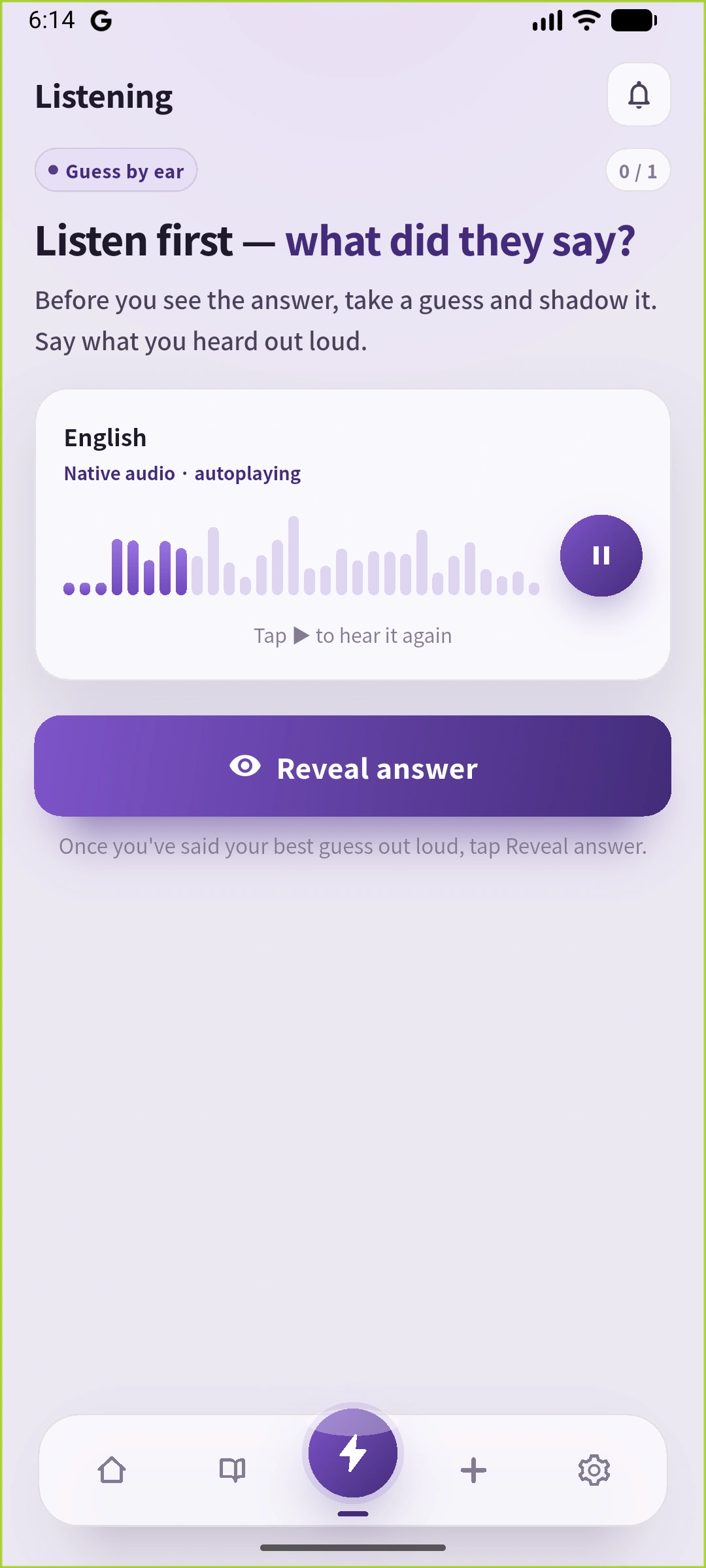
Our original sentence · Viking AI audio
Cities should plant more trees because shade makes public spaces safer during heat waves.
Generated once for this sentence and shared across all languages. Use it to listen and say one opinion and reason. A complete Grade 1 answer still needs three relevant reasons and their explanations for the actual question.
Frequently asked questions
What should I do first?
Try a current official paper and classify the obstacles. Start writing and short speaking practice in the same week as reading and listening review.
How many hours do I need?
The official sources checked give no universal figure. The 234 hours above are a scheduling example, not a passing requirement.
Can I pass in six months?
Time alone cannot answer that. Diagnose what becomes clear with review and what needs foundational work, then revise the plan. Our six-month schedule guarantees no result.
What changes from Pre-1?
The summary moves from 60–70 to 90–110 words, the suggested essay length from 120–150 to 200–240, and the interview changes from picture narration to a chosen-topic speech and questions (current Grade 1 paper; Pre-1 paper; formats).
How much vocabulary is enough?
No fixed required total appears in the official pages checked. Revisit words that block actual comprehension, then return to the passage or audio.
What CSE scores pass?
2,028 for the first stage and 602 for Speaking in the second; each skill has a maximum of 850. You cannot self-convert correct answers into CSE (official explanation).
Can a working adult study independently?
You can organise practice around official materials. Separate commuting review from desk work, and seek specific feedback when you cannot judge a summary’s fidelity or an argument’s relevance yourself.
How many past papers should I do?
The website offers a year’s three administrations, but publishes no guaranteed passing practice count. Track correction and transfer, not just papers completed.
When should I start interview preparation?
Keep short opinions and reasons in the week before the first stage; use the official sample for procedural and timed practice afterward.
What is the pass rate?
The current official participation page reports applicant numbers; a current Grade 1 pass rate is not stated there. We do not substitute old or unsourced percentages.
If vocabulary is your main obstacle in Japan’s Eiken Grade 1, see how to choose vocabulary resources and practise your own sentence for a comparison based on official provider information.
Our verdict: increase revised answers, not your resource pile
Diagnose with current official material, practise the actual cause of mistakes, revise writing and speaking, and check on unseen material. With six months left, write a summary this week instead of waiting to finish vocabulary. If choosing the level itself, consult the Eiken grade selection guide; for a wider purpose, see English tests compared.
Official sources and references
- Grade 1 format and interview procedure
- Official past papers, audio and interview sample
- 2024 renewal
- Current Grade 1 paper
- Pre-1 format
- Current Pre-1 paper
- CSE scoring and pass criteria
- Current participation statistics
Checked 16 October 2026. Eiken is a registered trademark of the Eiken Foundation of Japan. This is not an official Eiken resource.
Before choosing the next target, use our Eiken Grade 1 level guide to compare Pre-1, check official pass thresholds and try the official tasks yourself.