
Eiken Pre-1 vocabulary: choose a wordbook or app and use words in your own sentences
Published
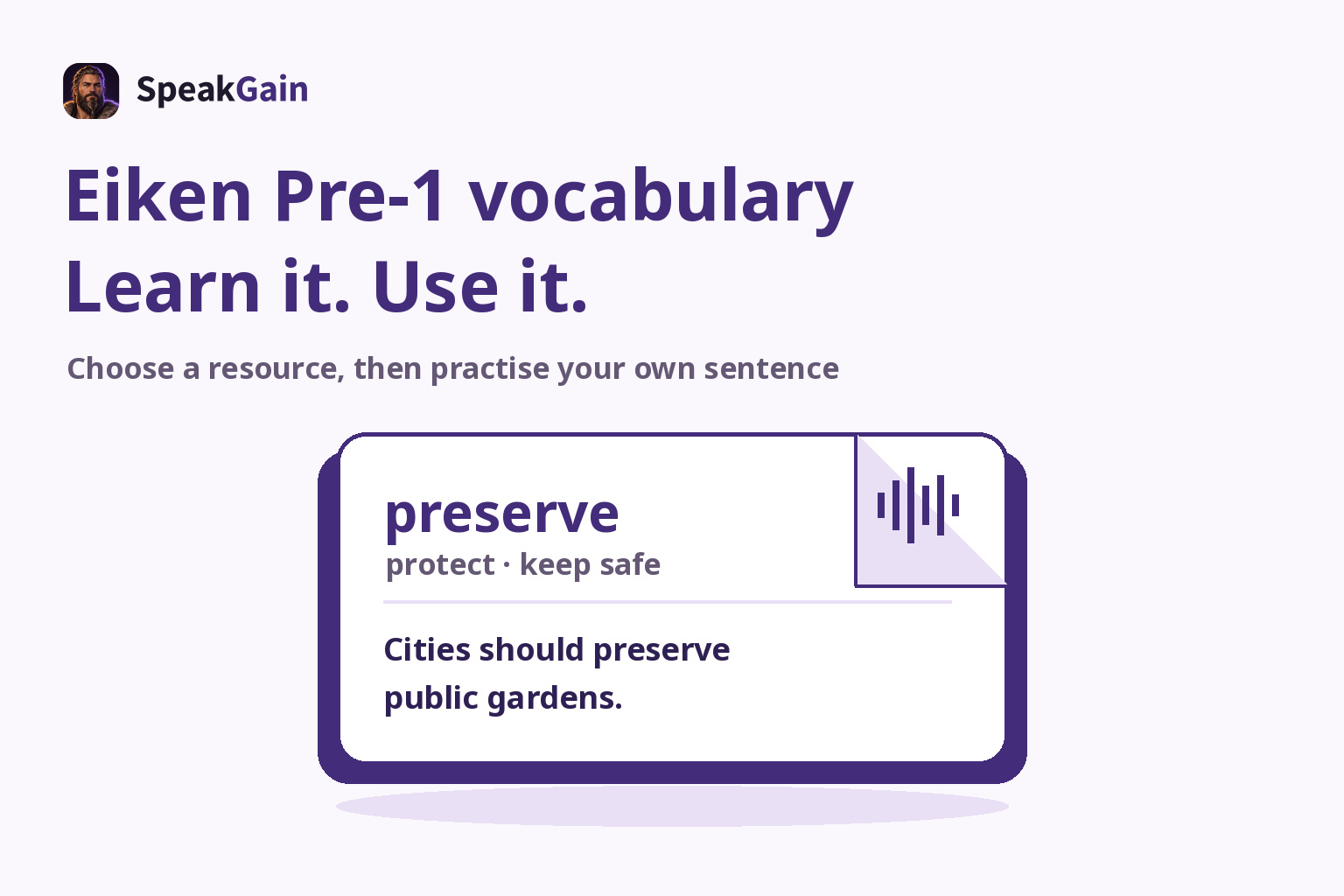
For Japan’s Eiken Grade Pre-1, our editorial recommendation is to choose one main wordbook or app, then practise meaning → example → sound → your own sentence → review after a gap. The Eiken pages checked for this article do not officially specify a fixed number of words required or an exhaustive vocabulary range; a publisher’s entry count is not a passing requirement. Check both whether you understand a word in a passage and whether you can use it accurately in writing or an interview.
Choose a resource by the job you want it to do
This is a purpose-based comparison, not a ranking. Facts come from publishers’ or providers’ official pages, checked on 16 October 2026. We have not used, tested or read these third-party resources to compare their effectiveness; the suitability column is our editorial interpretation. These are Japanese resources, primarily with Japanese explanations, for a test chiefly taken in Japan.
| Name | Provider | Entries stated officially | Audio | Features | Who it suits: editorial view | Checked |
|---|---|---|---|---|---|---|
| Eiken Pre-1 Derujun Pass Tan, 6th revised edition, book | Obunsha | Contents: 1,600 words, 300 idioms; separately, 200 topic expressions and 70 writing/speaking expressions | Free audio; download and Eigo no Tomo support | Frequency-based order, word-section tests, expression sections | Learners who want to track progress on paper and move into expressions | 2026-10-16 |
| Eiken Pre-1 Tanjukugo EX, 2nd edition, book | The Japan Times Publishing | About 2,400 words and phrases | Free downloadable audio for all headwords/phrases and examples | Examples with collocations; etymology, synonyms, antonyms and derivatives | Learners who want usage and related information alongside meaning | 2026-10-16 |
| Derujun Pass Tan Pre-1, 5th revised edition, content in English Words by Monokakido | Monokakido; source book: Obunsha | Total not stated on the provider page checked | Headwords, meanings and examples; automatic playback and speed controls | iOS; weak-word filtering, multiple-choice and written questions | Learners with a supported device who want to revisit selected weak words | 2026-10-16 |
The resources target Pre-1, but their counting units differ. Do not add sections together and treat the result as a unique-headword total. The paper Pass Tan is edition 6; the Monokakido page describes edition 5. The app page’s wording about its latest edition does not make it the latest paper edition. A free host app also does not mean its learning content is free. Check edition, OS and access conditions with the provider. We include no covers, affiliate links or purchase links.
Our choice would be one main resource plus a tool that fills a specific gap. Choose paper if opening a book and checking examples fits your routine; consider an app with weak-word filtering if short reviews on a supported phone fit better. This is a practical choice, not evidence that one medium improves memory more. If you combine a book and app, decide which tracks progress so the same word does not end up both “learned” and “not started.” See the broader vocabulary app comparison and Eiken app guide for other purposes.
Five stages, with a check at each stage
This is our suggested routine, not an Eiken-prescribed method or a universally optimal review schedule.
| Stage | What to do | How to check |
|---|---|---|
| Meaning | Identify the part of speech and meaning in this sentence | Hide the translation and explain that meaning |
| Example | Read who does what, including accompanying words | Explain the whole sentence, not just the target word |
| Sound | Listen to the resource audio, check stress and say a short stretch | Close the text and connect the sound to meaning |
| Your sentence | Write a short opinion and reason | Check usage and whether the reason supports your opinion |
| Review after a gap | Recall before looking at the answer | Separate problems with meaning, sound and use |
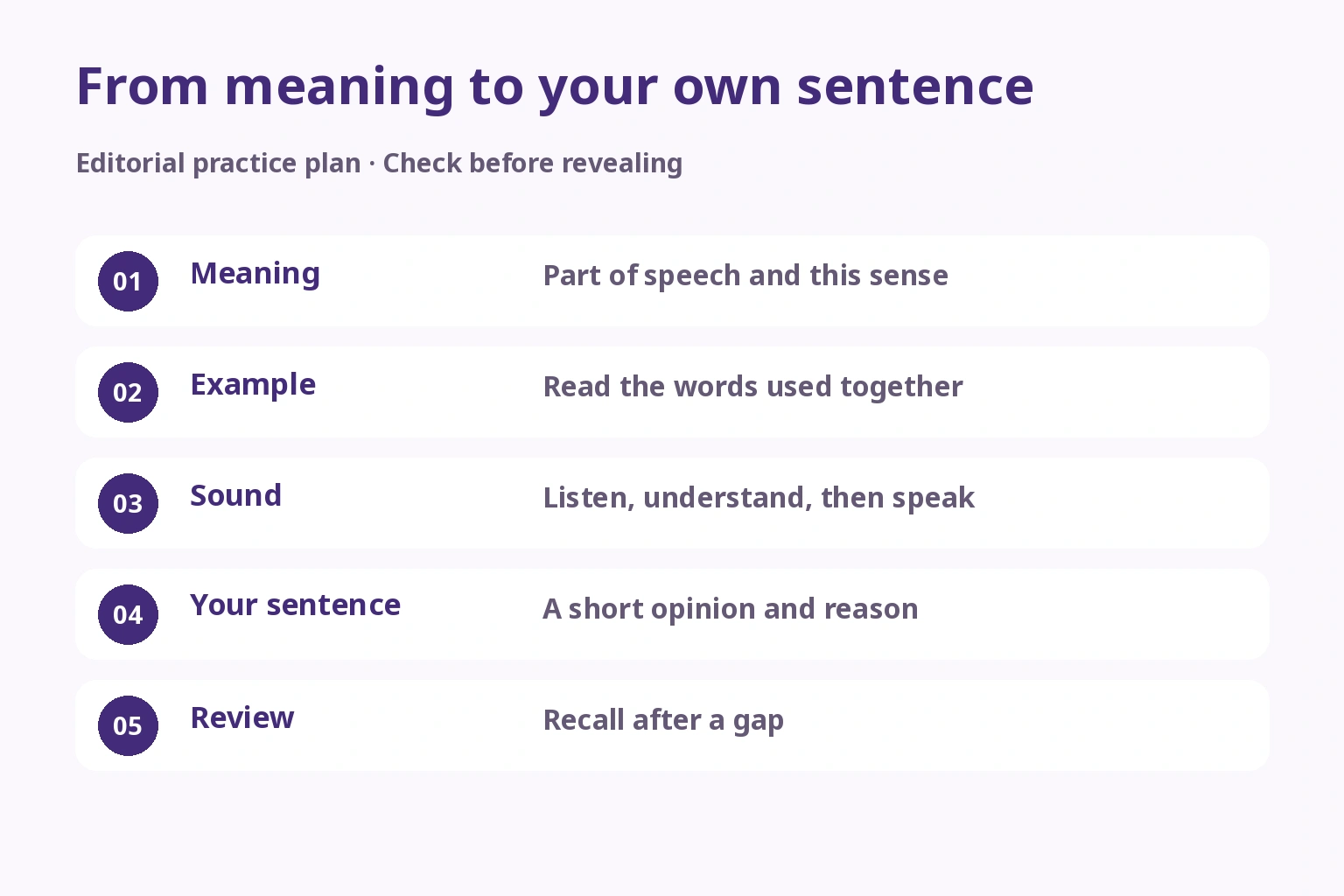
You do not need a long composition for every new word. Work through your main resource, then choose one word you want to use and put it into a short sentence. Leave time for old words as well as new ones. Our general vocabulary learning guide covers broader memorisation and review methods.
How many words does Pre-1 require?
The official Pre-1 introduction describes roughly intermediate university level and understanding and using English needed in social life. A fixed required word count and exhaustive vocabulary list are not officially stated in the materials checked. A book’s approximate 2,400 entries is its publisher’s selection, not the learner’s total vocabulary or Eiken’s passing condition. Derivatives, phrases and multiple meanings can also be counted differently.
Use official past papers and audio to diagnose where understanding stops. Did you not know the word, choose the wrong sense, or fail to recognise it in sound? If basic verbs or connectors repeatedly cause trouble, repair those specific gaps with your existing foundation resource. You do not automatically need to restart from the earliest grade. Nor should you chase only difficult headwords while ignoring basic usage. Open official materials separately; do not copy their questions or word lists into your own public materials.
Vocabulary does different work across the test
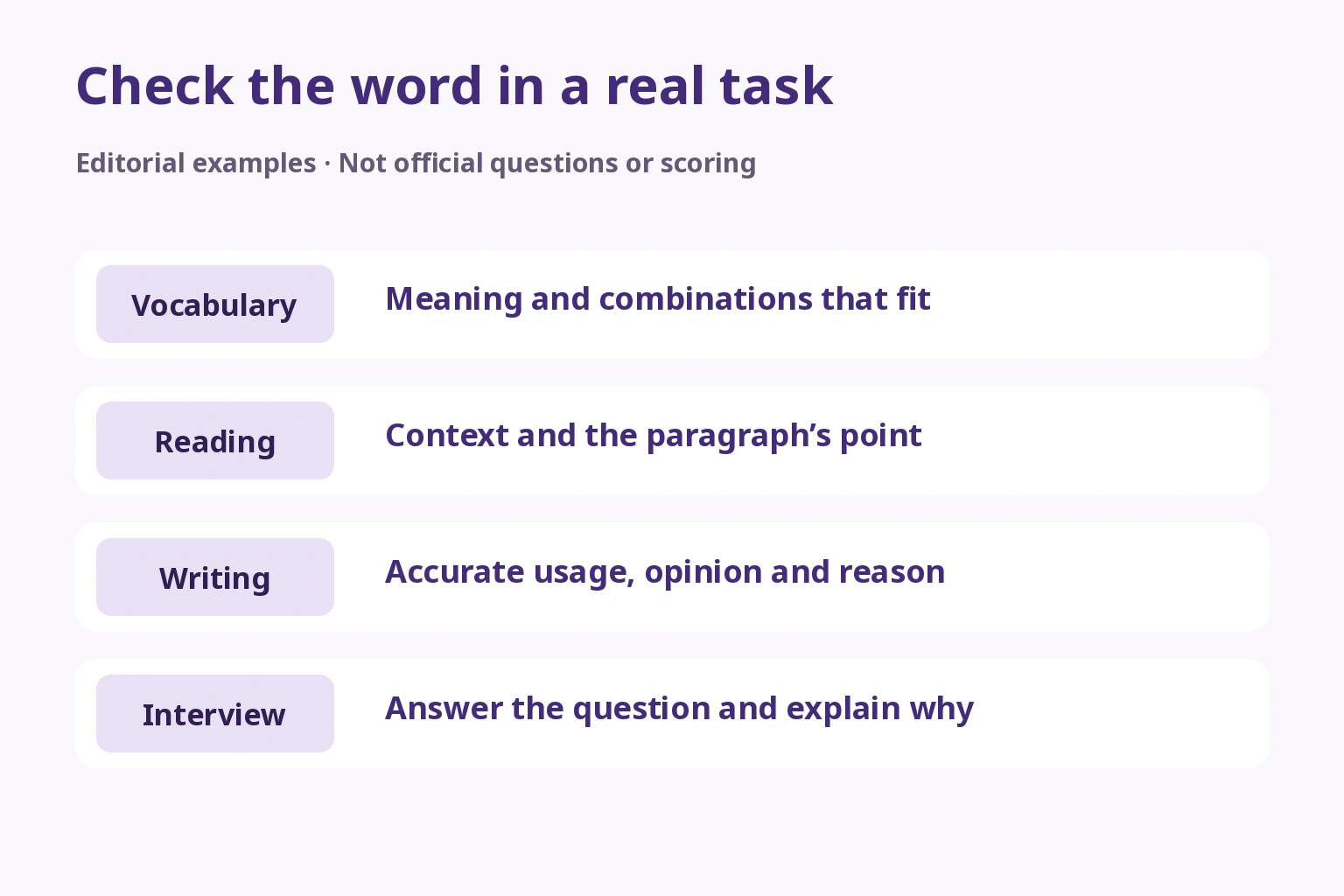
The official format includes short-text gap filling, passage gap filling and comprehension, summary and opinion writing, listening and an interview. The following practice distinctions are ours.
In vocabulary questions, return to the full sentence after a wrong answer. Look at the subject, object and surrounding logic: was the problem meaning or a word combination? Our practice word is preserve. Learn what is being preserved, rather than reciting a translation alone. This is not a prediction of a test item or an official grade-specific word designation.
In reading, first mark unknown words that affect the answer or the main point. After checking them, explain the paragraph’s point. If you understand the vocabulary but cannot say what the paragraph illustrates, work on paragraph relationships rather than simply adding more words.
In writing, prioritise accurate usage and answering the task over inserting difficult vocabulary. Check objects and word combinations. In a summary, replacing a word with a synonym must not change the original information, scope or strength. Our Pre-1 writing guide covers summary and opinion tasks in detail.
In listening, separate an unknown meaning from a familiar word you failed to recognise. Listen, check the text and listen again without it. For interview practice, express a short opinion and reason; if a difficult word will not come, continue with an expression you can use, then check the difficult word afterwards. Practise recordings at home: the official interview instructions prohibit recording during the test.
Work through one original sentence
We wrote this example ourselves. It is neither a publisher’s example nor an Eiken question. We selected preserve for a social-topic opinion, not from an official grade vocabulary list.
Cities should preserve public gardens because they give residents a quiet place to relax.
Identify preserve as a verb, then read “preserve public gardens” as a combination. Check that the because-clause gives a reason for the proposal. Listen for stress and the word within the sentence, then say it without rushing. Hide the text and recall the opinion and reason.
To make the practice your own, decide what you would protect and why. Try another reason rather than only reproducing a memorised sentence. Check any new combination in a dictionary or with a teacher: words that share a translation do not always take the same objects. This sentence is a small usage exercise, not a complete essay or interview answer. Developing the required reasons and selecting summary information remain separate tasks.
For a tool to practise an original sentence with audio after checking its meaning, see what SpeakGain is. We saved the example above through the normal Add flow. In Library, we opened the card’s Knowledge and chose Learn this card. Listening hid the English text and automatically played the generated audio, with instructions to guess what was heard and say it aloud. Reveal answer then showed the same saved sentence on Answer. We verified this single-sentence listening and speaking flow; we did not run an Eiken vocabulary test or mock exam, score an answer or pronunciation, or predict a score.
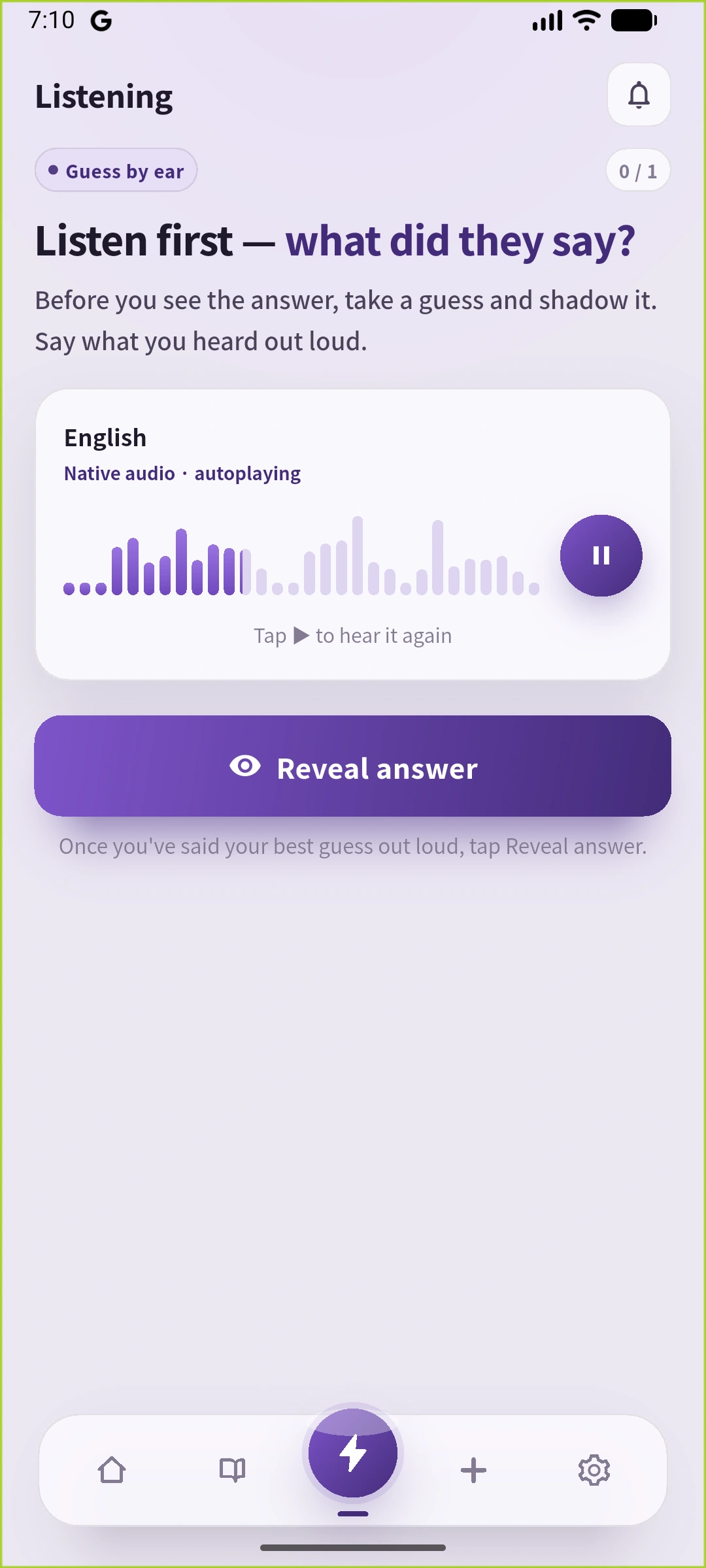
Listen to the original example above: Viking AI-generated audio
Generated once for this sentence. After listening, hide the words and practise saying the opinion and reason aloud.
How we would use three months: editorial opinion
This roughly 12-week example is not an official required duration or a promise of passing. Allow for school examinations, university work or busy work periods; adjust after the first two weeks. The whole-test Pre-1 plan covers time across skills.
Weeks 1–4: diagnose gaps with official questions and choose one resource. Keep new material small enough to revisit tomorrow. A possible 15-minute allocation is five minutes of recall, seven on new words and examples, and three on one original sentence. These are starting allocations, not required targets. Reduce new material when old items pile up; give less time to words you already know.
Weeks 5–8: connect the resource to mistakes in reading and listening. Record a location and the type of gap rather than copying everything into another wordbook. At the end of the week, check meaning recall and sentence production separately. Return to combinations if the object will not come; shorten and speak the sentence if writing is easy but speech stalls.
Weeks 9–12: prioritise unresolved words and test-format practice before opening another large resource. Revisit repeated errors, sound–meaning gaps and misused words. Keep practising how to find evidence despite an unknown word and how to continue a reason with vocabulary you can use. Count successful use in a new context, not just completed rounds.
Review what failed, before looking at the answer
A starting schedule might be tomorrow, a few days later and a week later. These are editorial examples, not optimal intervals for everyone. Try recall first, then check meaning, example and sound, and try again. Mark whether the difficulty was meaning, sound or use. Getting an item right repeatedly in one sitting is different from recalling it later. On a review-heavy day, reduce new words rather than allowing the backlog to keep growing. We make no numerical retention guarantee.
Methods we would not recommend
- Large meaning-only drills as the entire method. They can check recognition, but leave combinations, sound and task-specific use unchecked. Add an example and a short original sentence for selected words.
- Starting several wordbooks from page one at once. Overlap can create multiple unfinished review queues. Add a resource when you can name the missing role, not to increase the number of books.
- Forcing difficult words into an essay. An uncertain combination may distort your meaning. Answer the question and check usage first.
- Predicting a pass from a word count. No fixed official vocabulary total was found; summary and reason-giving require other operations too. Return to official tasks to check progress.
Frequently asked questions
How many words should I learn?
The official materials checked do not state a fixed required number. Separate resource entry counts from exam requirements and diagnose your gaps in context.
Is one wordbook enough?
We would start with one main resource to keep review manageable. That is not a guarantee that one book secures a pass. Add support for a gap you have identified.
Book or app?
Choose according to your review routine, supported device, audio and edition. A paper resource suits checking examples on a page; an app with filtering suits revisiting selected items.
Can I leave idioms until later?
We would include the resource’s idiom section in the plan. Check the whole expression, including prepositions and objects, rather than inferring its meaning from the verb alone.
What if I keep forgetting?
Reduce new material and recall after a gap before revealing the answer. Diagnose meaning, sound and use separately. No fixed number of encounters guarantees learning.
Can I finish in three months?
It depends on your starting knowledge and available time. Our three-month outline is an allocation example, not Eiken’s requirement or a passing guarantee.
What if I can write a word but cannot say it in an interview?
Shorten the sentence and practise an opinion and reason without the text. Check sound and usage where you stop. Translation recall and answering a spoken question need separate practice.
Must I replace an older edition?
There is no universal answer. Obunsha describes revised content and new expression sections in paper edition 6, while the Monokakido page checked describes edition 5. Compare the role you need with your existing edition.
Our editorial verdict
Choose one main resource, check meaning and examples, listen, write a short opinion and reason, and recall after a gap. Then return to vocabulary questions, a passage, writing or interview practice during the week. Decide what to do next by whether you understand a new sentence and can express your meaning accurately, rather than by difficult words collected or books completed.
Official references
- Eiken Pre-1 overview and past papers
- Official format and interview instructions
- Obunsha: Pass Tan edition 6
- The Japan Times Publishing: Tanjukugo EX edition 2
- Monokakido: Pass Tan Pre-1 edition 5
Information checked: 16 October 2026. Eiken is a registered trademark of the Eiken Foundation of Japan. This article is not an official Eiken teaching resource. Resource choices, practice stages and timing are editorial opinions.