
Eiken Grade 3 level, pass scores and official guidance
Published
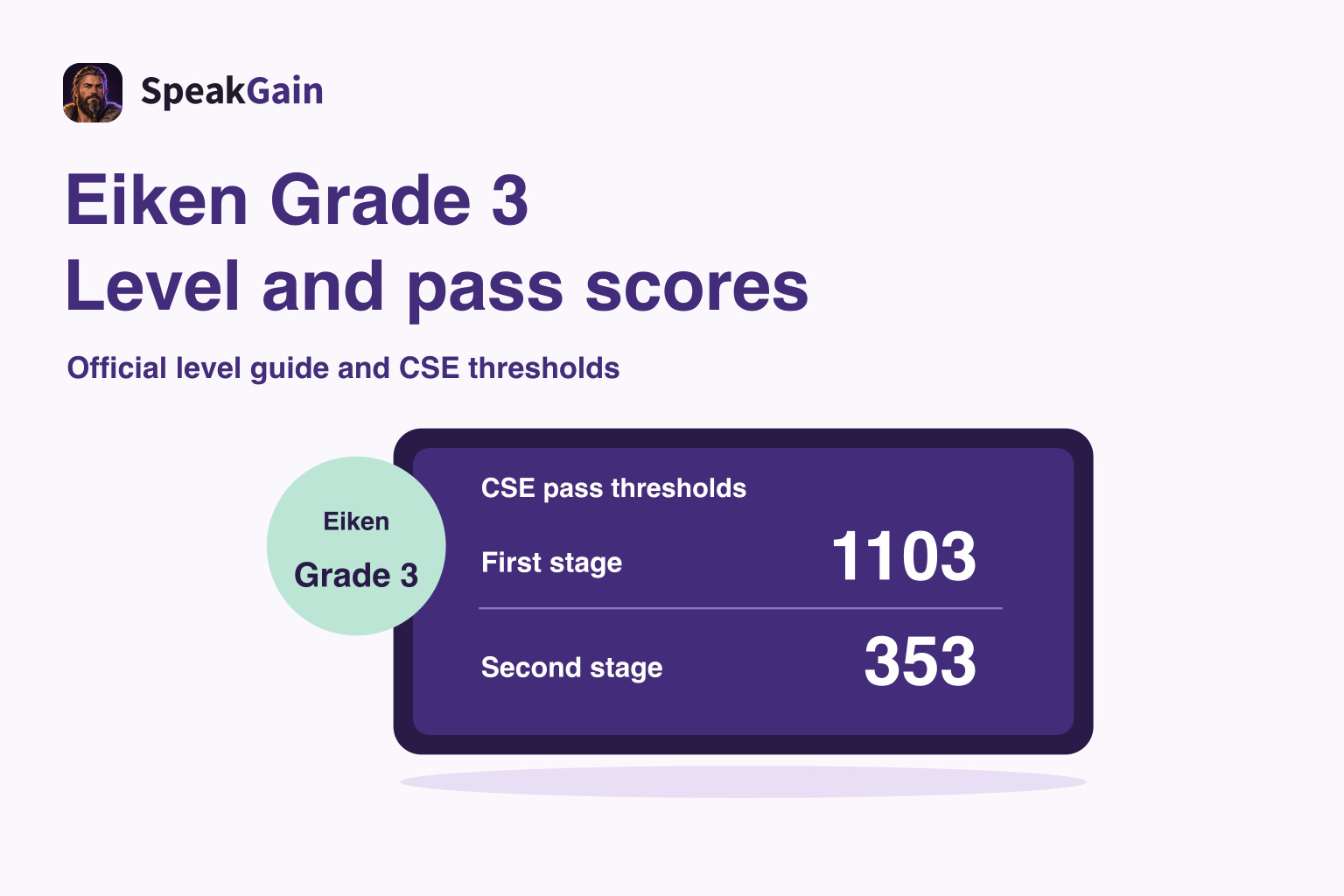
Eiken Grade 3 is officially pitched at the end of Japanese junior high school, with A1 as its CEFR comparison level. Its CSE pass thresholds are 1103 for the first stage and 353 for the second; these cannot be converted into a fixed number of correct answers, and a current official Grade 3 pass rate is not published. To check your starting point, try the official papers across reading, listening and writing, then answer the interview sample aloud.
This guide concerns Japan’s Eiken, in its traditional two-stage format. It is for upper-elementary and junior-high students, parents and adults returning to English, including English-speaking families living in Japan. Official information was checked on 16 October 2026. For a practice schedule, use the Grade 3 study plan.
Grade 4, Grade 3 and Pre-2 at a glance
| Grade | Official school-level guide in Japan | CEFR | Traditional test structure | CSE pass threshold | Official source |
|---|---|---|---|---|---|
| Grade 4 | Mid junior high | Outside the CEFR reporting range | Reading 35 min; listening about 30 min; separate recorded speaking test | First stage 622; separate speaking 324 | Format, scores |
| Grade 3 | End of junior high | Comparison A1; reported overall CEFR capped at A1 | Reading/writing 65 min; listening about 25 min; interview about 5 min | First stage 1103/1650; second 353/550 | Format, scores |
| Pre-2 | Mid senior high | Comparison A2; reporting range A1–A2 | Reading/writing 80 min; listening about 25 min; interview about 6 min | First stage 1322/1800; second 406/600 | Format, scores |
Checked 16 October 2026. School-level guides come from the official overview, CEFR comparisons from the English overview, and reporting conditions from the CSE guide. Stage maxima above are editorial sums of the official per-skill maxima: 550 for Grade 3 and 600 for Pre-2. Grade 4 certification depends only on the reading/listening first stage; its recorded speaking result is separate. See the Grade 4/5 speaking guide before treating it as equivalent to a Grade 3 interview.
What can be established officially?
| Item | Status in current official material checked | Treatment here |
|---|---|---|
| Level and CSE thresholds | Published | Give the level guide and separate stage thresholds |
| Required correct-answer count | Candidates cannot calculate CSE from raw answers | Do not supply a fixed question count or percentage |
| Current Grade 3 pass rate, including by school age | Not stated in current official sources checked | Say that no current official rate is published; do not recycle old figures |
| A direct Grade 3-to-TOEIC score or deviation-score conversion | No official direct conversion found | Explain CEFR without predicting another test score |
| Universal study hours, vocabulary total or admissions/employment advantage | Not stated as universal requirements | Check individual tasks and the receiving institution’s conditions |
Sources: CSE scoring, candidate statistics, level guide and admissions checks, checked on the date above. “Not stated” describes the current material reviewed; it does not claim that no historical document ever mentioned a number.
Can an elementary or junior-high student pass?
The official “end of junior high school” guide describes the target English ability. It is not an age requirement. The examination rules do not restrict entry by age, occupation or educational background, and a previous lower-grade attempt is not required. For children under 11, the rules ask parents to review the guidance and judge whether the child can take the test.
Children may therefore enter, but their age does not establish that they can pass now. Current school-age-specific Grade 3 pass rates were not found in the official material checked. The editorial recommendation is to let the learner read the instructions, attempt the writing and answer aloud. Parents can note where help was needed without doing the work for them. Adults can use the same process instead of assuming their school history establishes their current level.
Pass scores: first stage 1103, second stage 353
The first stage combines reading, listening and writing CSE scores and requires 1103 out of 1650. The speaking stage requires 353 out of 550. Both thresholds are checked separately (official scoring explanation and threshold table). Adding the two thresholds gives 1456, but that editorial arithmetic does not mean a high result in one stage can compensate for falling below the other stage’s threshold.

CSE is not a count of correct questions. Eiken explains that scores are calculated statistically after all scripts in a session have been marked, so the same raw number can produce different scores across sessions. Each skill has the same CSE maximum even though question counts differ. Candidates cannot calculate their own CSE from correct answers.
Dividing 1103 by 1650 gives a fraction of the CSE scale, not a required percentage of questions. Historical examples of raw performance are not a current fixed pass rule. Use self-marking to identify misunderstood vocabulary, texts or audio; do not build a CSE conversion table. Writing length and speaking time alone do not establish the quality of an answer. Our editorial advice is to ask a teacher or another suitable reviewer about answers you cannot assess reliably.
CEFR A1 and passing Grade 3 are different checks
CEFR describes what a language user can do across levels A1–C2. Eiken’s CEFR explanation includes conditions such as a conversation partner speaking slowly and clearly at A1. It does not promise understanding of every conversation at any speed.
For Grade 3, overall four-skill CSE 1400 or higher reports A1, and A1 remains the reporting ceiling even at higher scores. Below 1400, overall CEFR is outside the reporting range. All four skills must be taken for an overall four-skill CEFR result. Do not infer it from a first-stage-only result (official range diagram).

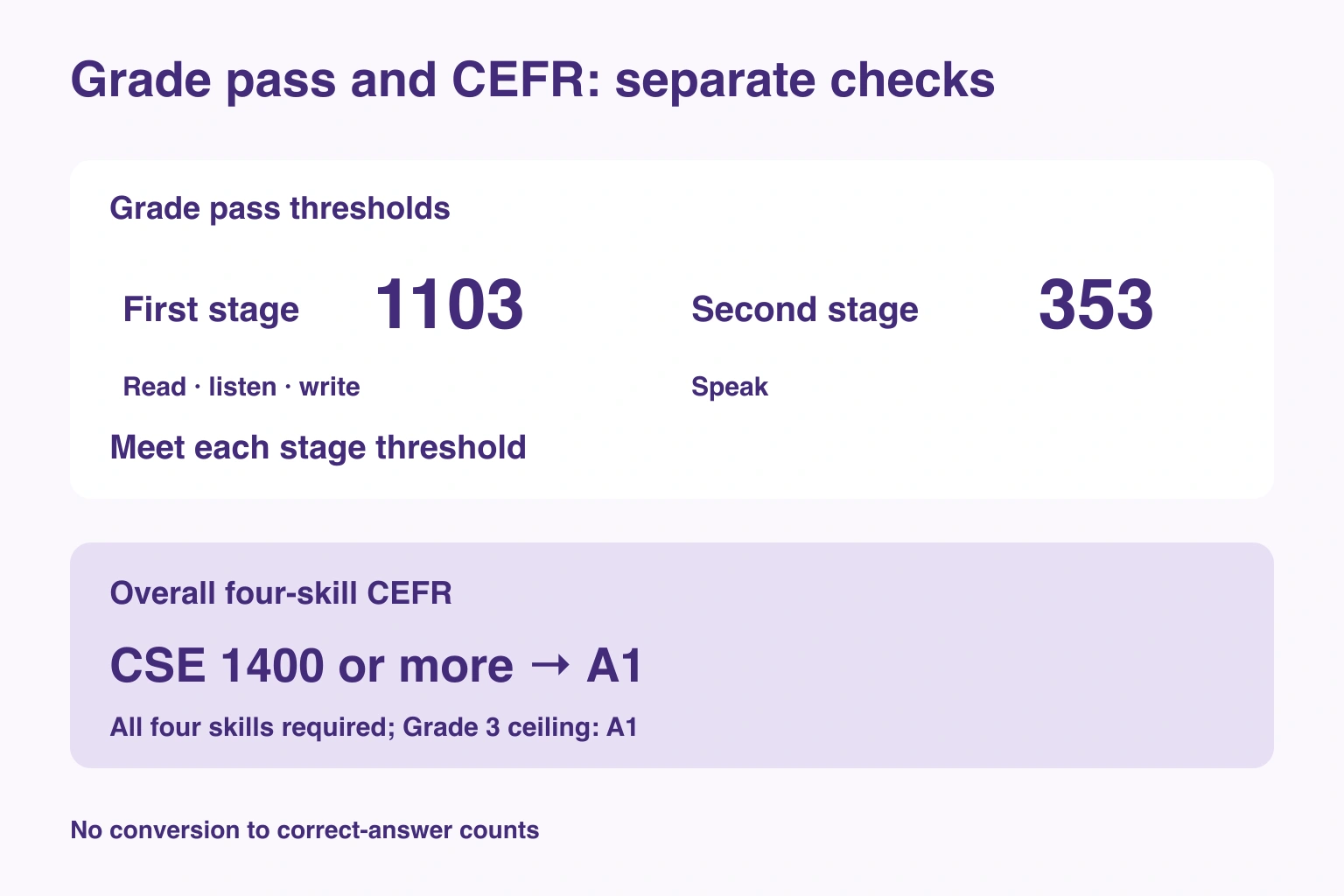
We found no current official table directly converting an individual Grade 3 pass into a TOEIC score or a deviation score. Shared CEFR bands can help compare broad ability descriptions, but cannot predict your personal score on a different test. This does not mean no official cross-test comparison information exists at all. Check the actual test and score requested by the institution receiving your results.
What the official Can-do list means in practice
The Grade 3 Can-do list describes understanding the gist and main points of short everyday texts and speech, and expressing thoughts with reasons using basic language. The following are editorial summaries with original examples, not official questions or complete answers. One short sentence cannot certify a learner’s level.
- Reading: identify the main message in a short everyday text, such as an email. “Please bring your lunch because the shop is closed today.” Here, identify what to bring and why.
- Listening: understand main points in short speech when delivered slowly and clearly. “Our class will meet at the station at nine tomorrow.” Separate the time, place and day; understanding the written sentence is not the same as catching it from sound.
- Speaking: express a view or feeling with a reason. “I like drawing because I can make pictures for my friends.” This article’s new 11-word practice sentence means the speaker enjoys drawing pictures for friends.
- Writing: organize thoughts and reasons for a reader. “I walk to school because I enjoy talking with my sister.” Check how the reason connects to the action, rather than copying a model regardless of the prompt.
The drawing sentence supplies one opinion and one reason. It is a practice component, not a complete writing submission or a universal interview answer. Keep the same sentence when listening and speaking, then change the content to match the question you actually receive.
What happens in each stage?
In the current first stage, reading has 15 short-text gap questions, 5 dialogue gaps and 10 comprehension questions. Writing has one email reply and one opinion task, within the same 65 minutes as reading. Listening has three groups of 10: response selection is played once, while dialogue and short-passage comprehension are played twice. Follow the chosen paper and recording rather than assuming everything repeats.
The second stage is an approximately five-minute interview with one examiner. Read a passage of about 30 words, answer one passage question, two illustration questions and two questions about yourself or familiar matters. The official procedure gives 20 seconds for silent reading before reading aloud. Merely looking over a sample does not test your spoken response. Details belong in the interview guide; email and opinion practice are in the writing guide, and vocabulary in the Grade 3 vocabulary guide.
The differences from Grade 4 and Pre-2
Grade 3 adds writing and an interview to the skills used for grade certification. Confidence with Grade 4 reading and listening does not establish that you can compose a reply or answer a spoken question. Pre-2 still includes email, opinion writing and an interview, but reading/writing lasts 80 minutes, the interview passage is about 50 words, and all listening sections are played once (Pre-2 format). Shared topic areas do not imply identical text length or question demands. No official difficulty multiplier was found. For a broader decision, see which Eiken grade to take.
For the next level’s official guide and CEFR conditions, see the Pre-2 level guide.
Current pass rate: no official rate published
The current candidate statistics combine applicants for Eiken, Eiken IBA and Eiken Jr. They do not provide a current Grade 3 pass-rate table. We also checked current Grade 3 information and official-site search without finding a current rate. We therefore state no current official Grade 3 pass rate is published and do not reuse old or estimated numbers.
An elementary-school applicant total is not the number passing Grade 3. Do not calculate an age-specific pass rate from it. A first-stage rate, an interview rate and an overall grade rate also describe different groups. Our editorial choice is to focus on the learner’s actual tasks, rather than fill this missing information with impressions.
Six steps to check your starting point
This is an editorial self-check, not a pass prediction. The official paper page provides the previous year’s three sessions, answer keys, listening recordings/transcripts and a second-stage sample; its download notes limit which venue schedules are covered.
- Choose one current session and collect its paper, audio and answers. Read the instructions yourself before looking at solutions.
- Attempt reading and both writing tasks within 65 minutes. Record unfinished tasks and whether you used a dictionary or other help.
- Play the official listening recording as instructed. Keep your first attempt separate from later replay or transcript-supported work.
- Check selection answers, then record causes by skill. Check whether writing addresses the prompt and retain uncertainties for review. Do not convert raw marks into CSE.
- Use the official interview sample and virtual interview to read and answer aloud, including questions about yourself. Note where you could not produce an answer.
- Practise the identified tasks, then use another session or topic. Remembering answers from one paper is not the same as responding to new material. Use the study plan to organize the next work.
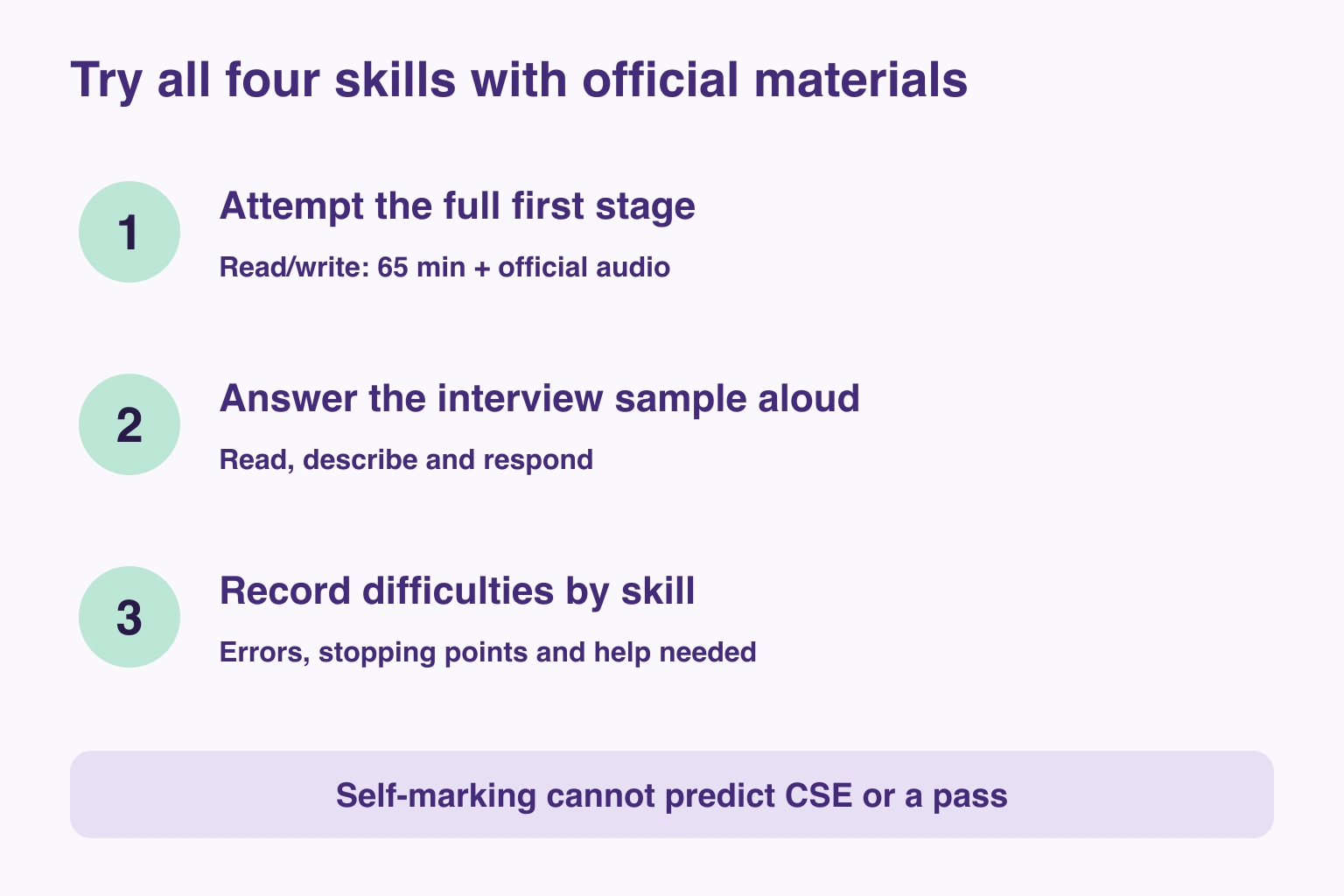
If you also want to check readiness for Grade 2, do not extrapolate from Grade 3. Open the Grade 2 official materials, check its current format, attempt reading/writing in 85 minutes and the listening recording (about 25 minutes), including summary and opinion writing. Then try its interview sample aloud, including description and responses. Record difficulties by skill without predicting CSE or a pass. The Grade 2 level guide explains its scope.
Admissions and employment: check the actual requirement
Do not assume that Grade 3 always brings an advantage. Eiken’s admissions checklist distinguishes grade certification, CSE and CEFR conditions. Our suggested process is to find the exact school year, department and selection route; check the accepted test, qualification or score, eligible test dates and evidence required; then confirm the submission deadline and method. Ask admissions staff about ambiguity. Students and parents can read the same document together.
The official material checked does not state a company-wide rule that Grade 3 earns hiring credit. Read the employer’s current vacancy requirements and ask its recruitment contact if needed. Recording a qualification on a CV does not establish how it will be evaluated.
Listen to your sentence and say it with SpeakGain
We use SpeakGain to keep a short original sentence with audio and practise listening and speaking. On the device, we created the drawing sentence once through Add, then followed Library → View → Knowledge → Learn this card → Listening → Reveal answer → Answer.
Listening played audio with the sentence hidden and prompted us to guess what we heard and say it aloud. Reveal answer then displayed the same saved English sentence on Answer. The screenshot below shows the English interface we checked.
I like drawing because I can make pictures for my friends.
This demonstrates saving and practising a sentence. It is not an Eiken mock test, answer or pronunciation scoring, or a CSE/pass prediction.
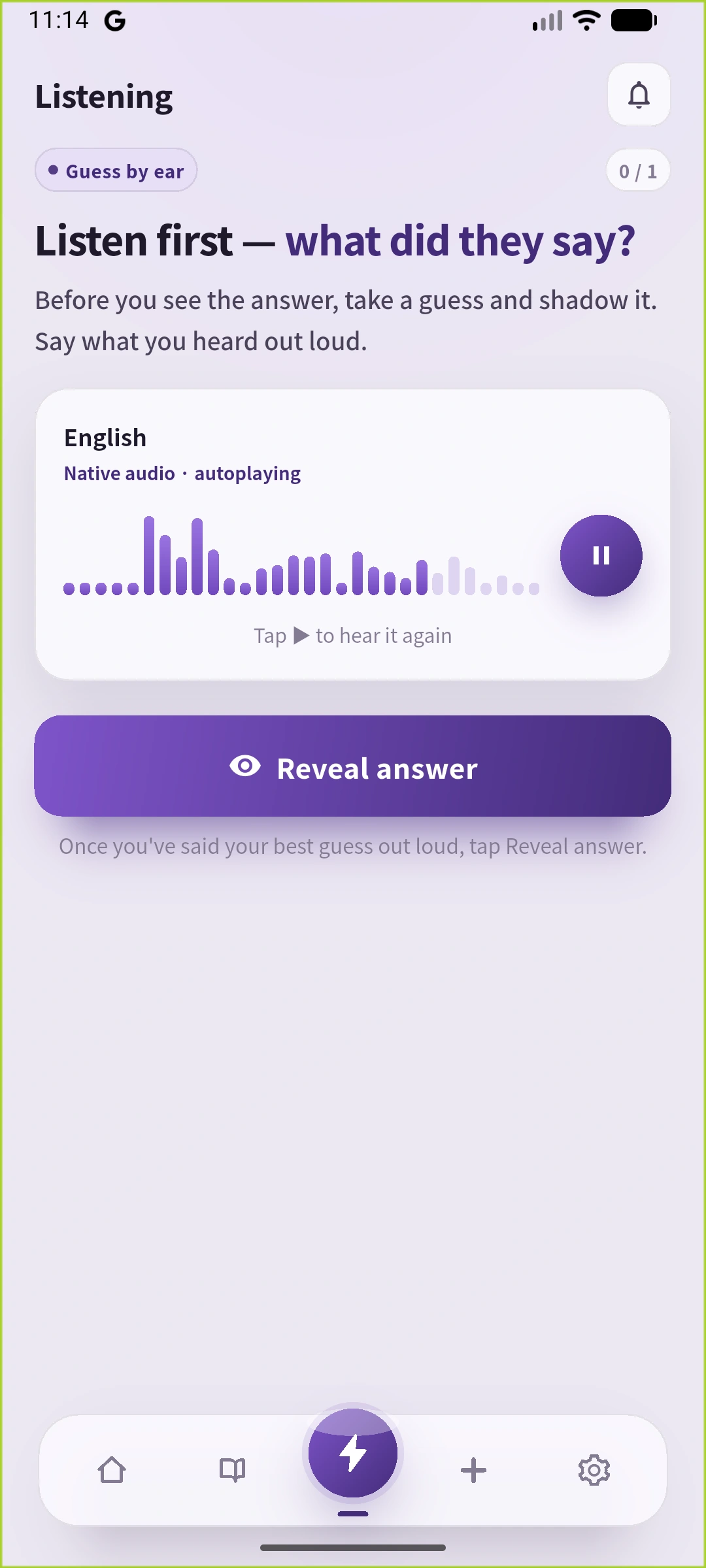
This is Viking AI-generated audio of our original sentence, not a human native-speaker recording or official Eiken audio. The same single generation is reused in every language.
Frequently asked questions
What score passes Grade 3?
First-stage CSE 1103/1650 and second-stage 353/550, assessed separately (official thresholds).
How many correct answers do I need?
There is no fixed conversion. Eiken says candidates cannot calculate CSE from their raw answer count (scoring explanation).
What percentage of candidates pass?
No current official Grade 3 rate was found; current published applicant totals are not pass rates (statistics).
Can an elementary or junior-high student pass?
There is no age or schooling entry restriction, but age alone cannot establish readiness. Try the full official tasks; no current age-specific Grade 3 rate was found (rules).
How different are Grade 4 and Pre-2?
Their guides are mid junior high and mid senior high respectively. Grade 3 adds writing/interview certification tasks; Pre-2 changes time, passage length and listening repetitions. No official numerical difficulty ratio is stated (overview, Pre-2).
Is Grade 3 CEFR A1?
A1 is the grade comparison. An individual overall A1 result requires all four skills and CSE at least 1400; Grade 3’s reporting ceiling is A1 (CSE guide).
Will it help with school admission or work?
Check each institution’s current requirements and evidence rules. Do not generalize from the grade name (admissions guidance).
Can adults study independently?
Entry rules do not exclude adults. Trying official materials across all skills is our suggested starting point. No universal independent-study time or success rate is stated in the sources checked (rules).
Editorial verdict
We would use the official level guide, then attempt reading, listening, writing and the interview sample before choosing what to practise. This replaces age-based assumptions with evidence of the learner’s current work. We do not recommend reassurance from estimated pass rates, fixed correct-answer targets or memorized answers unrelated to the question. Leave one concrete note about where you stopped, then turn it into the next task in the Grade 3 study plan.
Official sources were checked on 16 October 2026 and are linked beside the relevant claims. Recheck the current guidance before entering or submitting results. Eiken is a registered trademark of the Eiken Foundation of Japan. Examples, diagrams and self-check steps are original editorial material, not official test questions or a pass guarantee.