
Eiken Grade 3 vocabulary: choose a book or app and practise your own sentence
Published
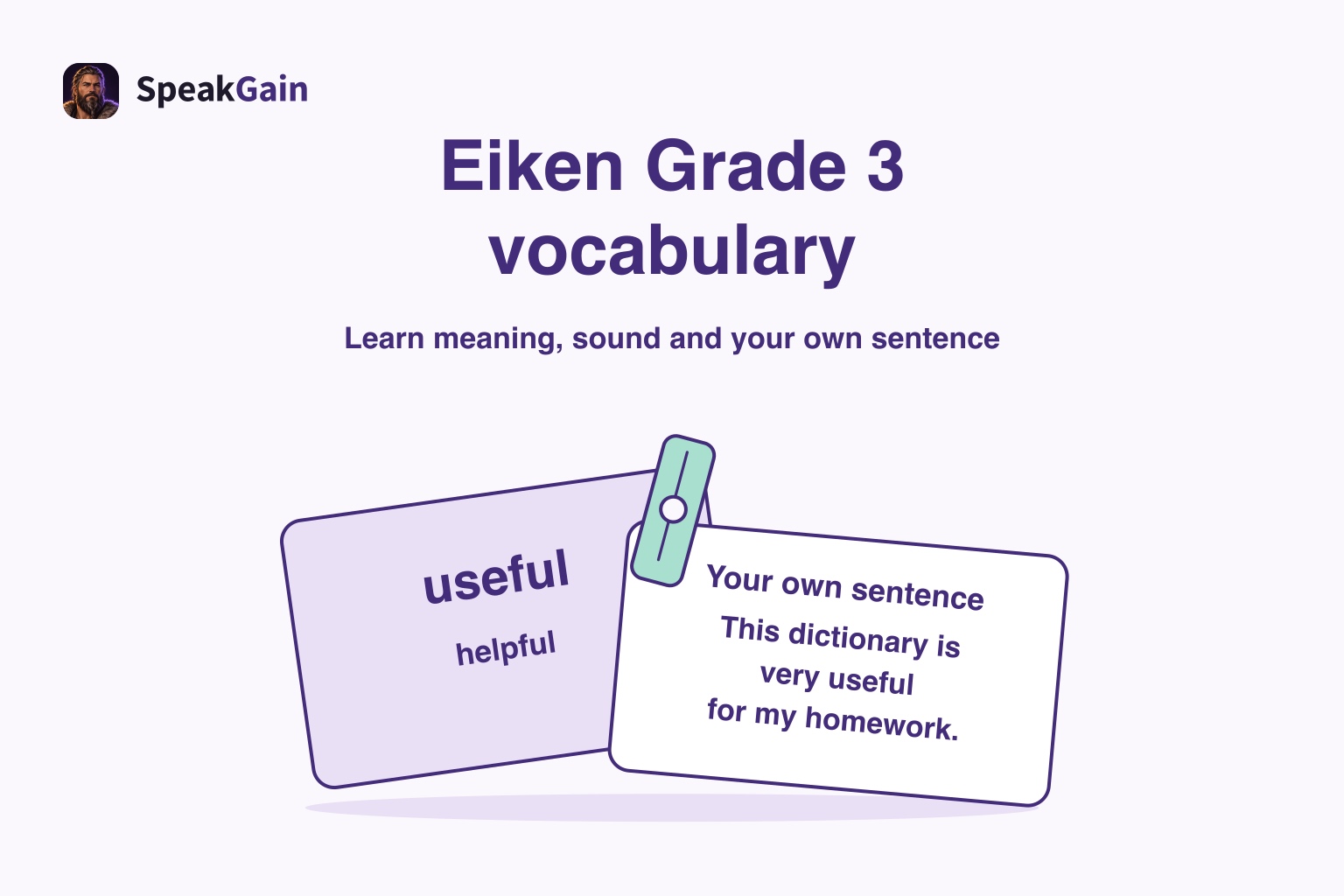
For Japan’s Eiken Grade 3, our editorial recommendation is to choose one main wordbook or app and practise meaning → example → sound → your own sentence → review after a gap. The official grade guide, format and benchmarks checked here do not state a fixed required word count or exhaustive vocabulary list; a book’s entry count is not a passing requirement. Go beyond choosing a translation: understand words in passages and use familiar words to express ideas in writing and an interview.
Choose by what will help you continue
This comparison uses only publishers’ and providers’ official pages, checked on 16 October 2026. It is not a ranking or a comparison based on reading, using or testing third-party resources. “Who it suits” is our editorial judgement from the stated features. These are Japanese resources, with Japanese explanations, for a test mainly taken in Japan; this article is for older primary and junior-high pupils, parents and adults returning to English.
| Name | Provider | Official entry count | Audio | Features | Who it suits: editorial view | Checked |
|---|---|---|---|---|---|---|
| Eiken 3 Derujun Pass Tan, new-cover fifth revised edition, book | Obunsha | Contents: 900 words, 300 idioms; separately 100 conversation expressions | Free download; Eigo no Tomo support | Frequency-based order; checks in word and idiom sections | Learners who want to mark paper pages and use accompanying audio | 2026-10-16 |
| Rankjun Eiken 3 English Vocabulary 1350, new-cover edition, book | Gakken | 1,350 words, idioms and conversation expressions | Free files for words, idioms and expressions | Related-word explanations; companion quiz app announced | Learners who want a book with an additional quiz check | 2026-10-16 |
| Derujun Pass Tan 3, fifth revised edition, content in English Words by Monokakido | Monokakido; source book: Obunsha | Total not stated on the provider page checked | All headwords, meanings and examples; automatic playback and controls | iOS; weak-word filtering, choice and written questions | Supported-device users who want to return to mistakes | 2026-10-16 |
All three target Grade 3. Counts cover different kinds of entries, so do not rank by adding up the numbers. Obunsha says the new-cover fifth edition has the same content as the previous fifth edition; check before replacing a copy. The Monokakido content is labelled fifth edition. We do not copy the paper edition’s count into an app row whose provider page gives no total.
Gakken announces a quiz app and free audio; we have not checked its operation on current devices. Check OS, edition, audio access and content conditions with each provider. A free host app does not necessarily mean free content. We include no covers, affiliate or purchase links.
Our three selection questions: Can you find tomorrow’s review point? Can you actually play the audio? Can you understand the example’s explanation? Use marked pages or weak-item lists to return to mistakes. For a child, help set up audio once. If school already specifies a Grade 3 resource, check these points before buying another. Broader choices belong in our vocabulary app guide and Eiken app comparison.
Five stages, with a check at each stage
This is our practice proposal, not an Eiken-prescribed method or a guaranteed number of repetitions.
| Stage | What to do | How to check |
|---|---|---|
| Meaning | Check the meaning in this sentence and the part of speech | Hide the translation and explain the word |
| Example | Read who does what and the accompanying words | Explain the whole sentence |
| Sound | Listen, check the text and say it aloud | Hide the text and connect sound to meaning |
| Your sentence | Write about something familiar; consider a reason or purpose | Check usage, spelling and the connection of ideas |
| Spaced review | Return after a gap and recall before checking | Identify whether meaning, sound or sentence use caused trouble |
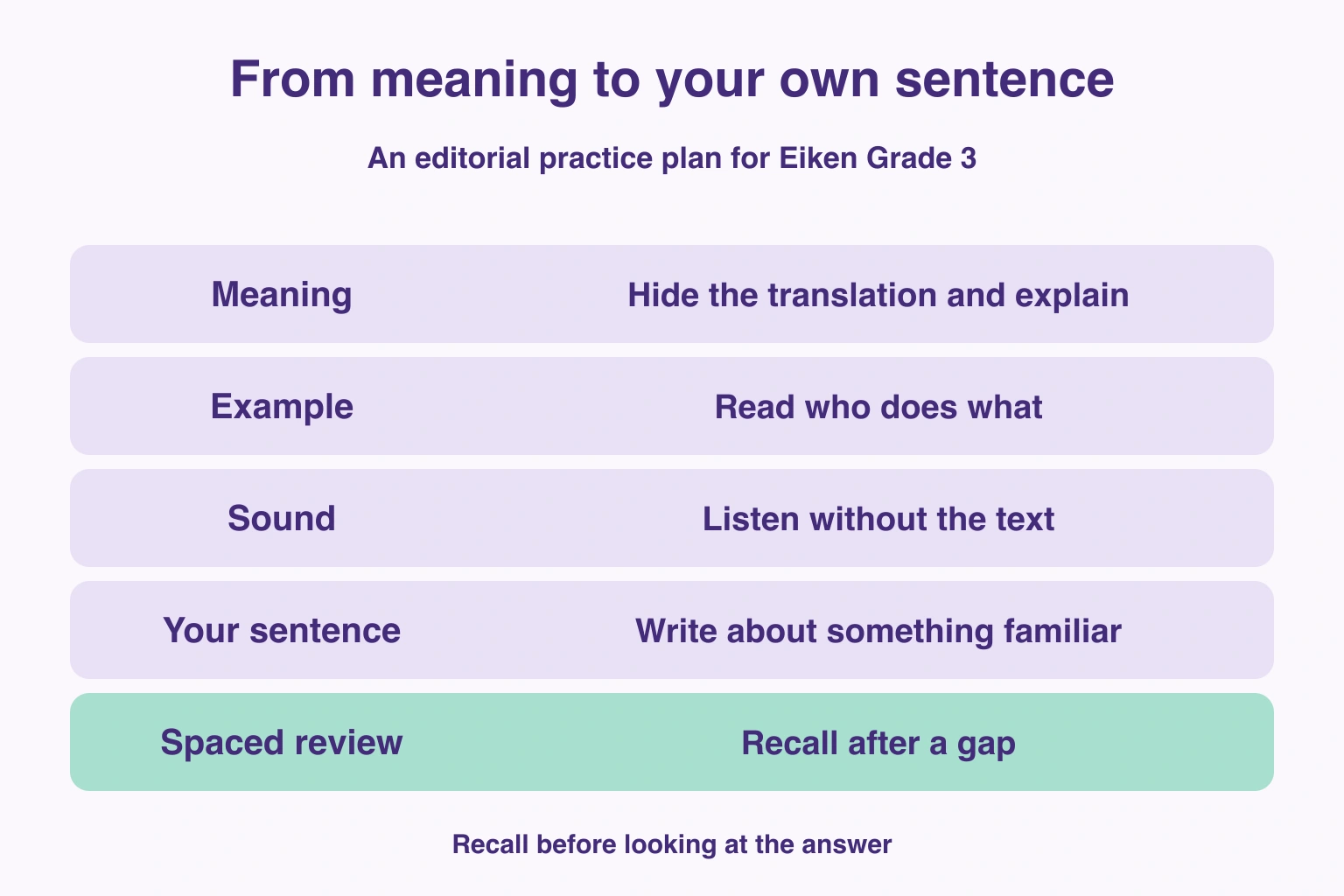
Do not write a long composition for every word. Check meaning, example and sound in your main resource, then choose one useful word from the day for your own sentence. Seeing an answer and recognising it is a different check from recalling it tomorrow. Start with the book closed, check only where you stop, then hide the answer again. A mark shows where to return; it is not a reason to blame yourself. Our general vocabulary guide covers broader review methods.
How many words does Grade 3 require?
The official benchmarks describe Grade 3 as Japanese junior-high graduation level: understanding main points on everyday topics and communicating thoughts or feelings with reasons. This is a grade benchmark, not an age restriction.
A fixed required count and exhaustive vocabulary list are not officially stated in the sources checked: the benchmarks, Grade 3 guide and format. A publisher’s selection is neither your total vocabulary nor all possible test words. After working through a resource, use official questions to identify missing meanings or sounds.
Moving up from Grade 4
The official guide describes Grade 3 as bringing together Grade 5 and 4 foundations; the traditional examination adds an interview, and Grade 3 also includes writing. Familiar words still deserve a quick sound-and-sentence check. If a child knows a translation but cannot understand the example, ask a teacher about the sentence’s subject and verb before simply adding more words. Adults returning to English can make the same distinction: vocabulary, sentence structure and sound are separate possible difficulties.
Use the whole-test Grade 3 plan for time across skills, the Grade 3 writing guide for complete answers, and the Pre-2 vocabulary guide when moving to the next grade.
What changes across test tasks?
The official format includes short-text vocabulary and dialogue gap filling, reading comprehension, an email reply and opinion writing, listening and an interview. These are our suggestions for revising words within those tasks.
Vocabulary questions: after checking an answer, explain why it fits the sentence. Read who did what and the words around the gap. Distinguish an unknown meaning from an unfamiliar combination. If you remember an answer’s position, hide the choices and explain the sentence instead.
Reading: after looking up a word, reread its sentence and the neighbouring sentences. Whose plan or reason is it? We would begin with words affecting the answer rather than copy every unknown word into a separate list. Checking a translation alone does not check understanding of the passage.
Writing: answer what was asked using words you can check, rather than forcing in a difficult word. Check subject, verb, spelling and whether your reason supports your idea. A one-sentence vocabulary exercise is not a complete email reply or opinion answer; the writing guide handles those requirements.
Listening and interview: listen without text, check what you missed, then hide the words and listen again. Do not decide pronunciation from a transliteration alone. Answer a familiar question briefly. If the word will not come, express what you can with known words and check afterwards. Ask both “Did I use the word?” and “Did I answer the question?”
Use useful in a sentence about your life
Our single practice word is useful. Check its meaning, then think about what helps you and what it helps you do. We are not predicting a test word or selecting from an official exhaustive list.
This dictionary is very useful for my homework.
This sentence makes an evaluation of the dictionary and names its purpose: homework. Read useful for with what follows it, rather than stopping at the isolated word. If the situation is not true for you, consider your own familiar situation instead of memorising someone else’s life.
Check the usage in your resource or a dictionary, hide the English and recall the idea. Look back only where you stop, then try again. “I can explain useful” and “I can use useful in a sentence” are different checks.
Listen to your sentence and say it in SpeakGain
After checking meaning and usage, we saved the sentence above once through the normal Add flow in SpeakGain. From Library, we opened the card’s View, then chose Learn this card in Knowledge. Listening hid the English and automatically played the generated audio, with instructions to guess what was heard and say it aloud. Reveal answer displayed the same saved sentence on Answer. This is the flow we verified on the device. Returning after a gap to recall it is our editorial practice suggestion.
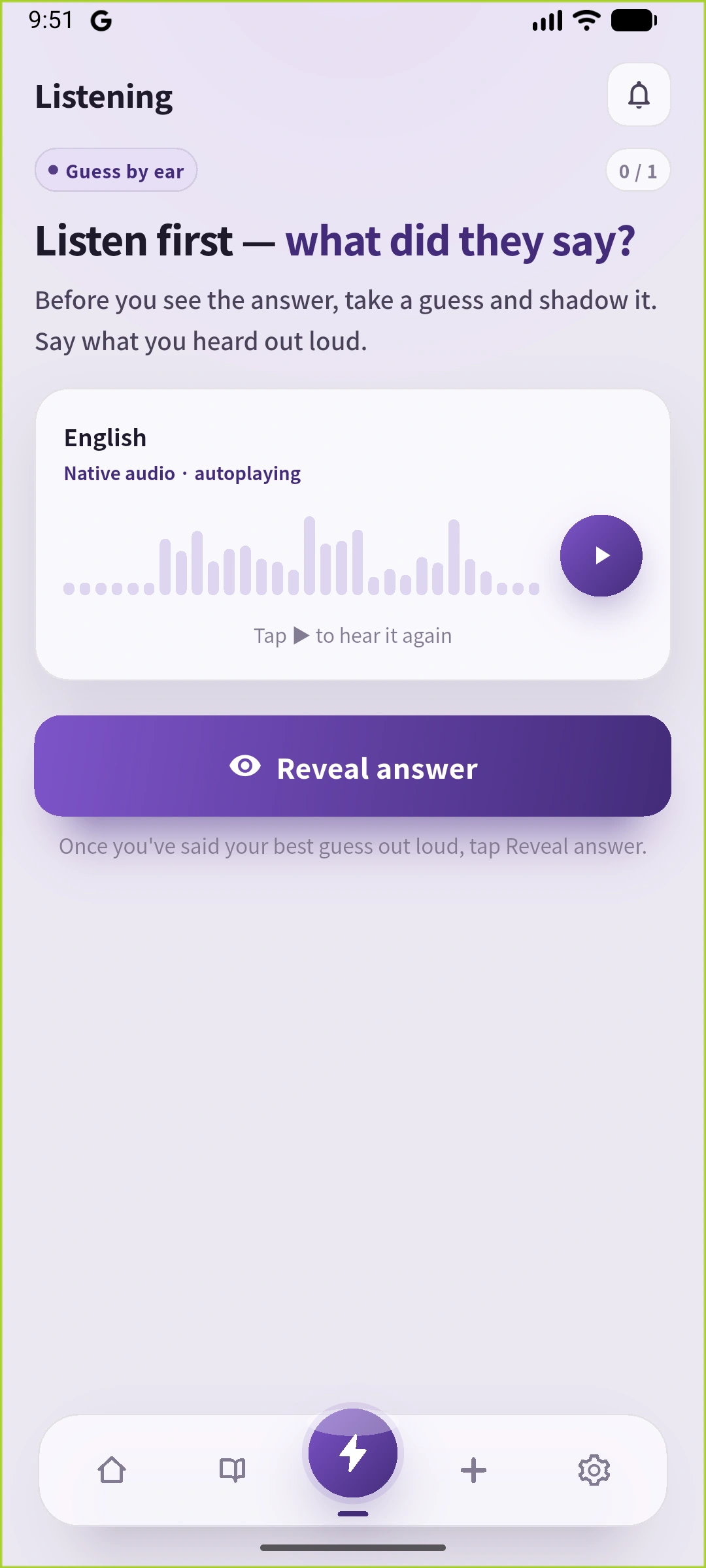
Listen to the sentence above: Viking AI-generated audio
After listening, hide the words and say what is useful and what it helps with.
Parents: ask where the learner stopped before giving an answer
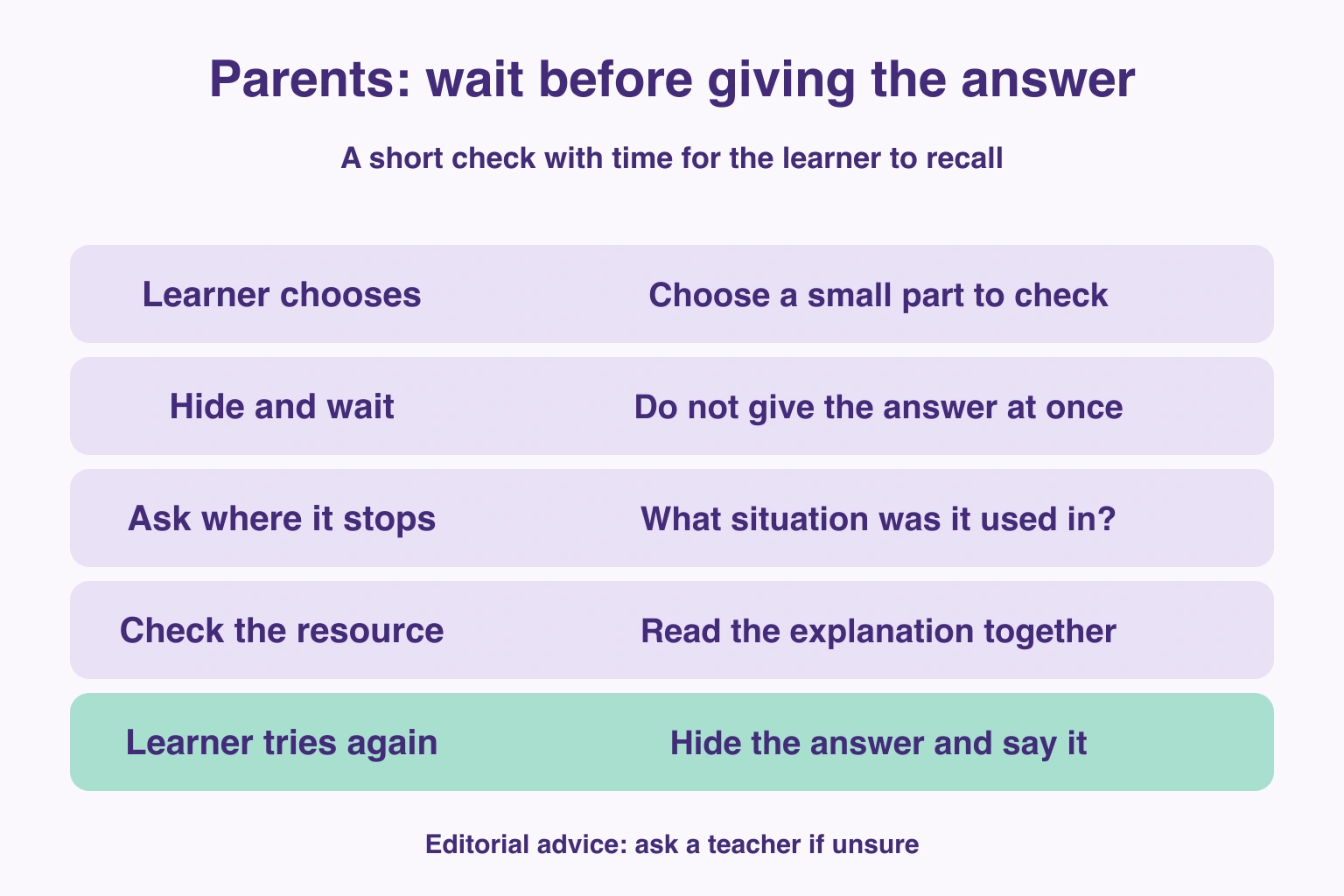
This is our suggestion for a short home check. Let the child choose a small part of the main resource. A parent can hide the translation or play audio, then wait. Do not turn it into a long test or supply the answer immediately.
If meaning is missing, ask “What situation was it used in?” If the example is difficult, ask “Who is this about?” If that does not help, read the explanation together. After checking, hide it again and let the child say it independently. Giving a chain of hints until the child reaches your answer does not show what they can recall alone.
For a personal sentence, ask whether the idea fits the child. Do not rewrite it into impressive English they cannot say. If you are unsure about correctness, mark it for a dictionary, resource or teacher to check. Even parents who do not feel confident in English can prepare time and audio, hide an answer and wait.
Finish with a specific observation: the child recalled a meaning today that was missing yesterday. Avoid comparisons with siblings or friends. Agree on the next review point together and stop there.
How we would use three months: editorial opinion
This is a planning example, not Eiken’s required duration or a promise of passing. Adjust it for starting knowledge, school, work and home life.
| Period | Main work | Check before moving on |
|---|---|---|
| Month 1 | Choose one resource; check meaning, examples and sound; repair Grade 4 gaps | Can you mark what you cannot recall with the answer hidden? |
| Month 2 | Return to marks and write personal sentences | Can you understand the audio and briefly write and say your idea? |
| Month 3 | Return from missed official questions to the resource; connect to writing and interview | Can you separate meaning, structure, sound and content difficulties? |
Choose a daily amount you can review tomorrow. On busy days, start with yesterday’s marks and reduce new material. Track recall as well as pages completed. Do not fill every day with meaning drills; keep time for audio and speaking. Near the test, schedule official questions, writing and interview practice before using every available minute to finish a book.
Tomorrow, a few days later and a week later are possible starting review dates, not universally optimal intervals. Return sooner to repeated difficulties and adjust after seeing what you can do.
Methods we would not recommend
Large meaning-only drills as the whole method: checking a meaning is useful, but it does not check sound, combinations or independent writing. Even on a day of many correct answers, take one word through an example, audio and your sentence. Repeatedly copying a visible spelling also differs from recalling it after a gap; hide it and check later.
Starting several wordbooks at once: overlapping material and scattered marks make it harder to know where to return. Begin with one main resource and add support only when you can name the missing role. A book plus an app need not be two separate purchases if you already have suitable audio or companion functions.
Frequently asked questions
How many words do I need?
No fixed required count is officially stated in the sources checked. Resource entry counts are not passing conditions. Use official questions to identify gaps.
Is one wordbook enough?
We would start with one main book or app to organise review. That does not guarantee all possible test words. Add support for an identified gap.
App or paper?
Choose what lets you return to mistakes, read explanations and use audio. Consider supported devices, shared-device time and where you can listen.
How should I learn idioms?
Check their whole meaning and the words that follow in examples. Hide the example and recall the situation. We do not reproduce resource lists here.
What if I forget the next day?
Recall before checking, identify meaning, sound or spelling trouble and choose a return date. Reduce new material if review no longer fits.
How many months will it take?
There is no duration we can promise everyone. Our three-month plan is an editorial example; adjust from your foundations, available time and official tasks.
Can parents with weak English help?
Yes: play audio, hide answers and wait. Mark uncertain language for checking rather than composing the answer for the child.
Our editorial verdict
Choose one resource, check meaning, example and sound, and put a useful word into a familiar sentence. Judge progress by what you can recall and use after a gap as well as by entry counts. Parents can preserve the learner’s thinking time and help locate the next review point.
Information checked: 16 October 2026. Choices, practice stages and schedules are editorial opinions. Eiken is a registered trademark of the Eiken Foundation of Japan; this independently prepared article does not imply its approval or recommendation. Official sources are linked beside the relevant claims.