
Eiken Grade 3 study plan: current format, time left and family support
Published
Start Eiken Grade 3 with one current official paper and identify where you stop: reading, writing, listening or answering aloud. Writing now includes an email reply and an opinion task, so begin short writing and speaking practice in the first week alongside vocabulary. Our editorial approach is to repair foundations with three months left, and prioritise diagnosed weaknesses and review with one month or two weeks left.
Eiken is Japan’s English qualification. This guide covers Grade 3 in the conventional two-stage test, for upper-elementary and junior-high students, parents helping them, and adults returning to English, including residents of Japan whose first language is English. Official information was checked on 16 October 2026. Methods, minutes and schedules below are editorial suggestions, not official prescriptions or promises of passing.
Current format and CSE passing criteria
The 2024 renewal added an email reply and extended shared reading/writing time to 65 minutes. Do not plan around an older description of one writing task and 50 minutes.
| Skill | Tasks | Questions | Time | Official source |
|---|---|---|---|---|
| Reading | Short-text gaps / dialogue gaps / passage comprehension | 15 / 5 / 10; 30 total | 65 minutes shared with writing | Format |
| Writing | Email reply / opinion with two reasons | 1 each | Within the same 65 minutes | Format |
| Writing length | Reply to the sender’s two questions / state an opinion and two reasons | Email: about 15–25 words in the blank; opinion: about 25–35 words | No fixed task allocation stated in the sources checked | Current booklet, pp10–11 |
| Listening | Response selection / dialogue comprehension / short-passage comprehension | 10 each; 30 total | Overview: about 25 minutes; latest posted booklet: about 27 | Format, booklet cover |
| Speaking | Read about 30 words aloud; questions on the text, illustration and yourself | 1 reading task + 1 / 2 / 2 questions | About 5 minutes | Format |
Use the instructions and audio for the sitting you practise. The listening overview and the 2026 session 2 booklet give different approximate durations; do not cut that sitting’s recording short to fit the overview. Reading and writing share a time limit, rather than each receiving 65 minutes.
| Decision | Maximum CSE | Passing threshold | Source |
|---|---|---|---|
| First stage | 550 each for reading, writing and listening; 1,650 total | 1,103 across the three skills | Current explanation and table |
| Second stage | 550 for speaking | 353 | Current official table |

The official explanation gives skills equal score weight regardless of question counts. You cannot calculate CSE from your own correct-answer count; scores can differ between sittings for the same number correct. The four maximum scores add to 2,200, but first and second stages have separate passing criteria. Use raw results to diagnose what to practise, not to invent a guaranteed passing percentage.
Three months, one month or two weeks: priorities
Try all skills before deciding what needs time. These are editorial plans, not official preparation periods.
| Time left | Priority | Keep for later |
|---|---|---|
| 3 months | Diagnose with one official sitting; repair vocabulary and sentence structure while attempting both writing tasks and short spoken answers each week | An unfamiliar paper to check timing and repairs |
| 2 months | Check all four skills in week one; alternate targeted corrections, writing and audio practice | The eight-week family plan below and a reserved timed session |
| 1 month | Classify errors before adding materials; address blank writing, weak grammar and missed listening information | A final timed run and correction time |
| 2 weeks | Try the whole format now; choose a few recurring problems, rather than finishing a new book | Review, a complete run and checking admission instructions |
“I’m starting now; what should I do?” Get the official booklet and matching audio, attempt it and write both answers yourself. If you split it across days, treat that as a task check, not proof that you can finish under test conditions. Arrange a full run later. With a short deadline, do not wait to finish a vocabulary book before discovering what stops you writing.
Reading: find the evidence, not just familiar words
Official format: 15 short-text gaps, 5 dialogue gaps and 10 passage-comprehension questions, including notices, emails and explanatory texts (official structure).
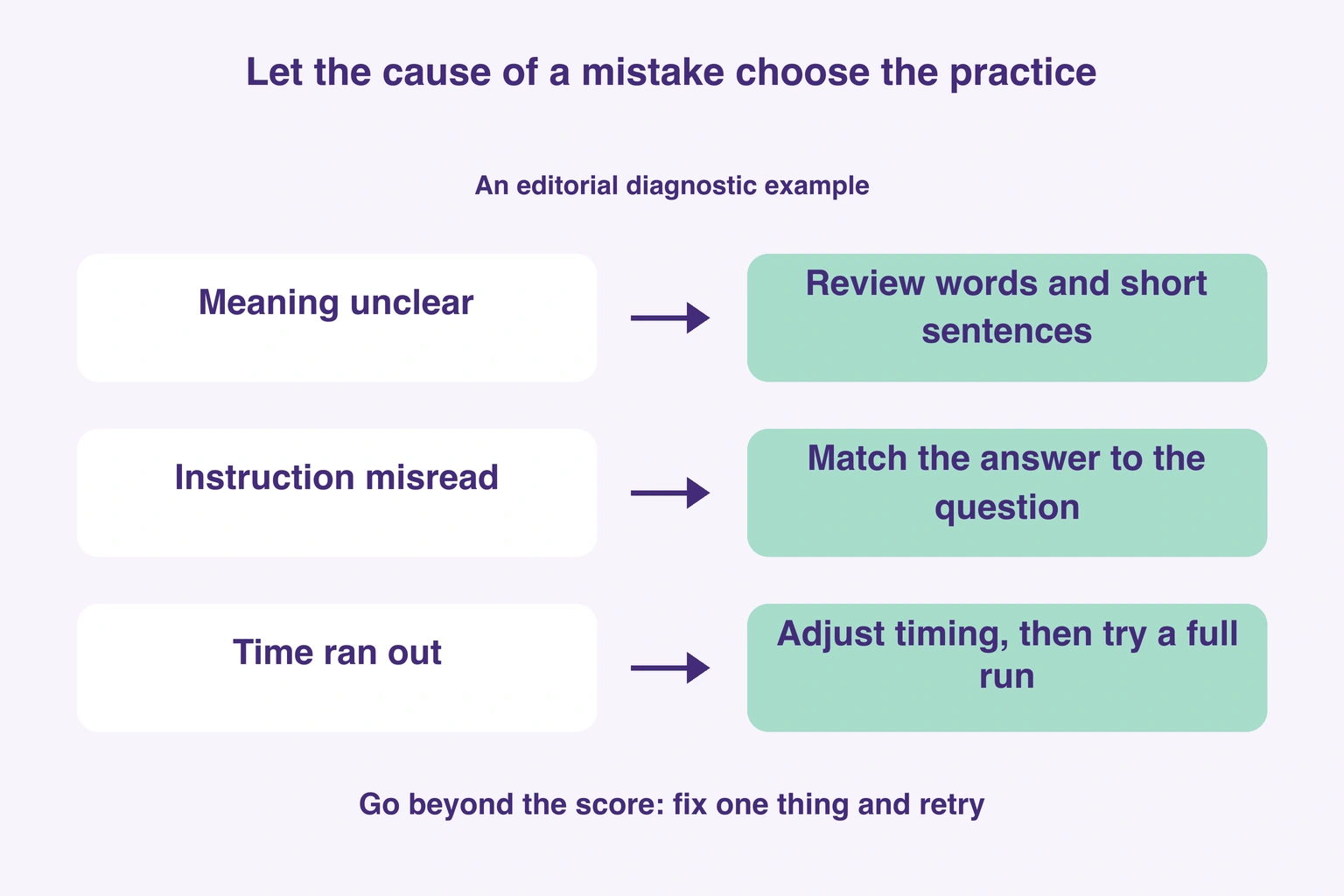
Common difficulties: recognising individual words without connecting the subject and verb; ignoring the turns around a dialogue gap; choosing an option because it repeats a word in the passage. Younger learners may also need help organising who did what, when and where.
Practice: before memorising the correct option, explain which part of the text supports it. Note the people, time and place, then compare them with your choice. If vocabulary caused the error, review it in its short sentence and check the meaning again the next day with the translation hidden. If sentence structure was the problem, repair the relevant subject, verb, negative or time reference and return to that sentence. Adults should check what they can actually use rather than assuming previously learned grammar is secure.
Official materials: the question booklet and answers. Write down your reason before checking the answer number. For explanations you cannot resolve, take the specific sentence and your interpretation to a teacher or another suitable reviewer.
Writing: reply and opinion are different jobs
Official format: an email answering two underlined questions, about 15–25 words in the supplied blank; an opinion with two reasons, about 25–35 words (current instructions, pp10–11).
Common difficulties: writing personal news instead of replying, missing one question, giving just one reason, or inserting a memorised essay regardless of the topic. The booklet warns that an answer that does not address the question can receive zero.
Practice: for email, make two short notes about what was asked, write your own replies, and point to where each question was answered. For an opinion, decide on one position and two supporting reasons before searching for English expressions. Use words you understand and can correct yourself.
Our original practice sentence is:
I like cooking because I can make lunch for my family.
It joins a preference to one reason. It is a sentence-building exercise, not a complete answer with two reasons and the requested length. Find a different relevant reason for a cooking topic; do not reuse the sentence unchanged when asked where you want to go. Check relevance before spelling and grammar. A parent can ask which question a sentence answers instead of rewriting it for the child.
Official materials: booklets and answer examples, plus the opinion-writing criteria for content, organisation, vocabulary and grammar. Do not transfer that opinion-task marking description to the email. Write first; after studying an example, close it and answer again in your own words.
For short worked examples, the limits of templates and checks after writing, see our Grade 3 writing guide.
Listening: record the cause before replaying
Official format: part 1 has 10 response-selection questions, one play and supporting illustrations. Parts 2 and 3 have 10 dialogue and 10 short-passage questions, each played twice (official format). Keep those play counts for the first attempt.
Common difficulties: choosing after one familiar word, confusing negatives or days, or treating a paused attempt as a timed result.
Practice: answer without stopping and mark uncertain places. Listen again before opening the script, then compare. If the sentence is unclear even in print, repair its meaning; if clear in print, match the missed phrase to the recording and say it aloud. Close the script, listen again, and explain what happened. Keep one concrete correction, such as a missed negative, and check it the next day. Imitating sounds is not a substitute for understanding them.
Official materials: matching part-by-part audio, script and answers. Keep the year and sitting consistent; use official links rather than reproducing questions or recordings here.
Interview: begin speaking during first-stage preparation
Official format: about five minutes, reading a passage of about 30 words aloud, then one text question, two illustration questions and two questions about yourself or familiar matters (format). The official junior-high graduation level is a guideline, not a required school year or a promise about preparation time.
Common difficulties: being able to write but not say a sentence, answering a different question, or adding the same memorised reason to everything.
Practice: check the official flow and record one attempt at the reading and tasks. Listen for whether you supplied the requested information, then fix one point and record again. Change the topic next time. A question about frequency needs frequency, not the cooking preference above.
Official materials: start with the sample and virtual-interview links. Task-by-task detail belongs in our Grade 3 interview guide; use the Eiken interview overview for a broader view of test-day preparation.
Study hours: distinguish available time from required work
The official sources checked state no universal number of hours required to pass Grade 3. A recent Grade 4 learner, an adult reviewing forgotten grammar and a confident speaker struggling with spelling need different work.
An editorial scheduling example is 25 minutes on five weekdays and 45 on each weekend day: 215 minutes weekly, or 1,720 minutes—28 hours 40 minutes—over eight weeks. That is scheduled availability, not a measured passing requirement. Extend or rearrange a weekend slot for a full paper; 45 minutes does not fit the entire first stage.
Allocate more writing if your answers were blank; use focused audio review if you understand the script but miss it by ear. Record what you corrected alongside minutes studied. If necessary work will not fit, reconsider the timetable without taking time from sleep or schoolwork.
Our two-month plan for a child and parent
This eight-week sequence is editorial opinion. Attempt writing and speaking in the first week rather than postponing them until vocabulary feels complete.
| Weeks | Learner’s work | Parent’s support |
|---|---|---|
| 1 | Try the first stage and check the interview sample; separate errors, blanks and time-outs | Prepare audio; wait until the attempt ends before asking what was hard |
| 2–3 | Repair basic phrases and sentence structure; write the two tasks on different days; review short audio and read aloud | Help locate explanations of unfamiliar grammar; do not write the answers |
| 4–5 | Retry mistakes and check task relevance, audio meaning and spoken answers | Ask the learner to explain which question each answer addresses |
| 6–7 | Use another sitting for a full timed attempt and practise the interview flow | Arrange a quiet, sufficiently long session and ask what changed |
| 8 | Review corrections and familiar short sentences; read test instructions | Check the admission notice, venue, arrival time and belongings together |
One 25-minute weekday session could contain five minutes reviewing phrases, fifteen on the day’s main task and five recording corrections. Rotate reading, email, audio review, opinion writing and short responses across the week. Adjust around school exams, clubs or work. Upper-elementary learners may need help understanding instructions as well as English grammar; adults need time actually writing at home, alongside listening during travel.
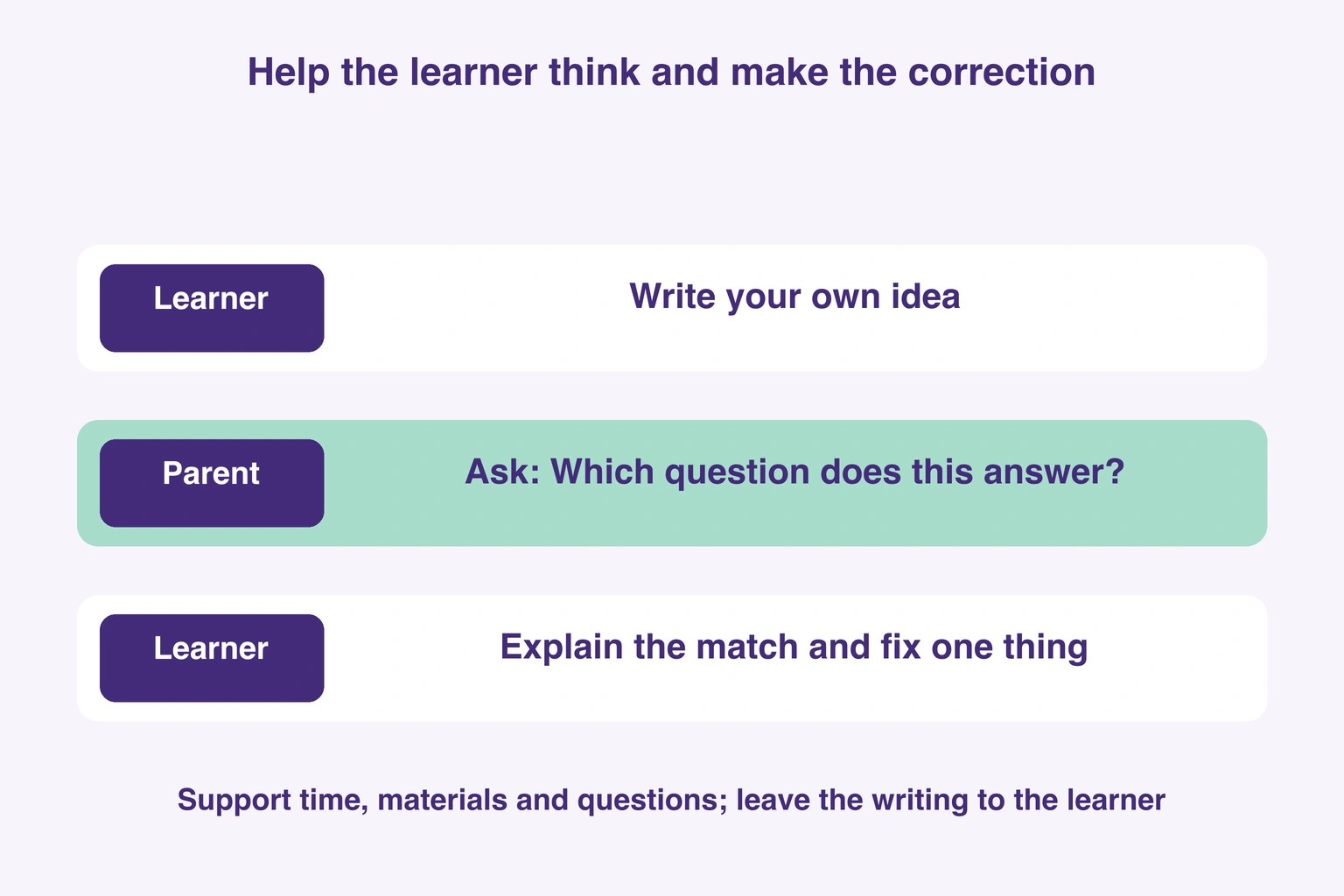
Parents do not need to become examiners. Set up materials and time, ask the child to point to the answer, and find a teacher or reliable explanation for unresolved English. Avoid imposing an impressive reason the child cannot explain. Comment on observed work—answering both questions or repairing a sentence—rather than comparing daily scores.
Use official papers beyond the first attempt
The Grade 3 page publishes one year, three sittings, with first-stage question/answer PDFs, audio and listening scripts; it specifies main venues and the secondary-venue F schedule. It also links a second-stage sample PDF and virtual interview. Not every secondary-venue schedule is available.
Our sequence is one sitting for diagnosis, correction and a later retry with answers hidden, then another unfamiliar sitting to test the repairs and timing. Do not rush through all published material. Explaining evidence or meaning matters more than a high score from remembered answers. The renewal page states that papers from 2024 session 1 onward reflect the renewal; check the current booklet if using older supplementary materials.
Choose extra materials for a missing role—grammar explanation, phrase review or someone to check an answer. App comparisons belong in our Eiken study-app guide, rather than a new ranking here. We reproduce no official questions or answer sheets.
Three methods we do not recommend
Memorising a complete essay as a universal answer: it can miss a changed topic. Learn short structures, change the content and explain their meaning yourself.
Only studying a vocabulary book: it does not make you practise replying, writing two reasons or responding aloud. Connect learned words to your own sentences.
Doing papers without review: repeated errors remain while unused papers disappear. Correct at least one cause before trying a different sitting, and see whether the repair transfers.
Moving up from Grade 4
The official Grade 3 guide describes the culmination of Grade 4/5 foundations and the addition of writing and an interview. Revisit shaky basics while checking the new tasks now. The Grades 4/5 speaking-test guide explains the earlier recorded format; do not confuse it with Grade 3’s second stage. For a later goal, use the Pre-2 study plan without importing its timings or tasks into Grade 3.
Listen to the opinion-and-reason sentence, then say it
Our suggestion is to understand and say the cooking sentence above, then return to the actual question and change the content. SpeakGain helps keep that short sentence with audio for listening and speaking practice.
We created one card with the same English through the normal Add flow and verified Library → Knowledge → Learn this card → Listening → Reveal answer → Answer on the device. Listening hid the English and invited us to listen and say what we heard. After Reveal answer, Answer displayed the exact input sentence.
This is the short-sentence practice we observed, not an Eiken mock test, an answer or pronunciation scorer, or a CSE/pass predictor. About SpeakGain explains its role.
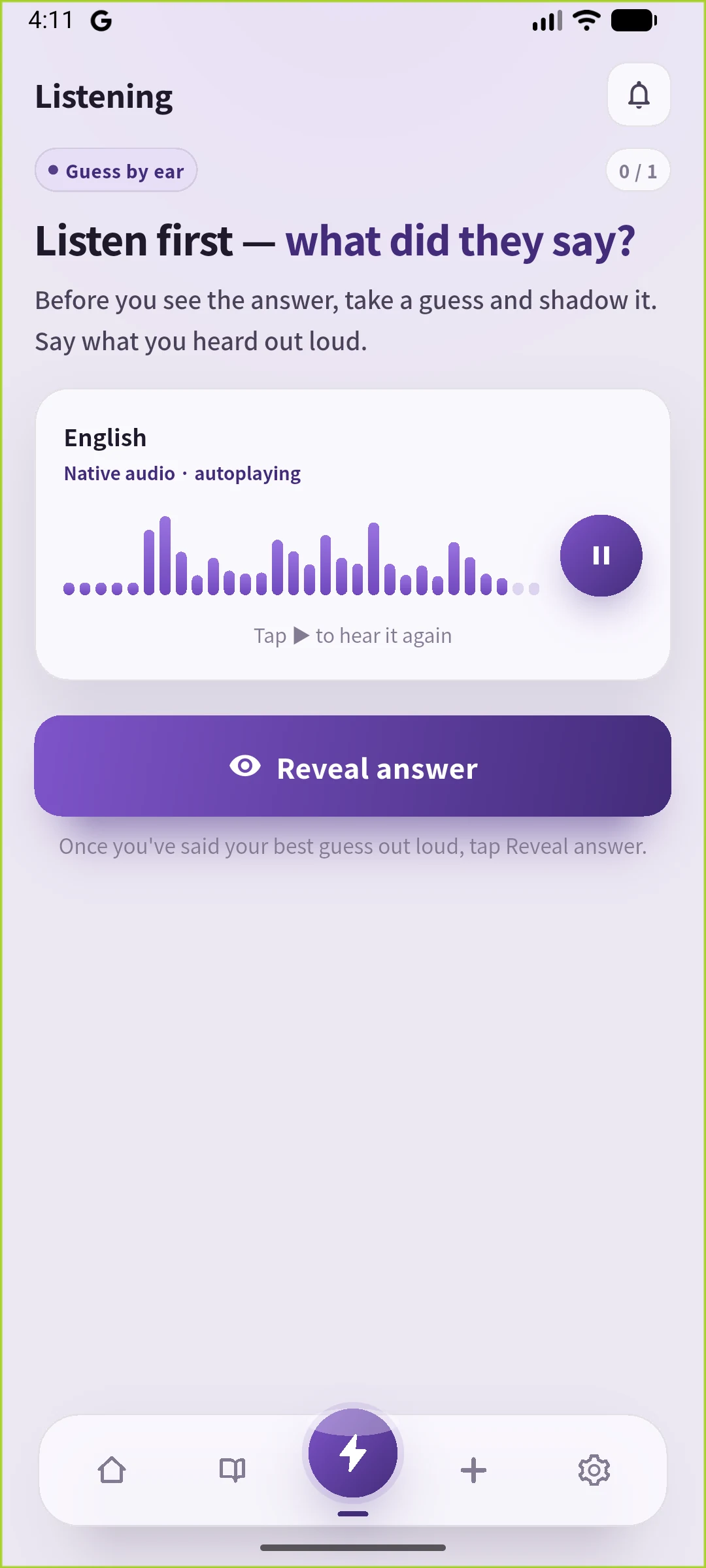
Viking AI-generated reference audio for the original sentence above, not a human native-speaker recording or official Eiken audio. The single generation is shared across all locales.
Frequently asked questions
Where do I start today?
Attempt current official material, including both writing tasks, and check the interview sample. Classify what stopped you before choosing more exercises.
How many hours do I need?
No universal requirement is stated in the official sources checked. Our 28 hours 40 minutes is an eight-week availability example, not a passing threshold.
How should an elementary or first-year junior-high student prepare?
Check whether the learner understands instructions and can form short answers independently. Review untaught structures and use personally meaningful, simple content; the official school-level guideline is not a guarantee.
Is one month enough? What if only two weeks remain?
The deadline alone cannot answer that. Diagnose immediately, prioritise blanks and recurring errors, and preserve correction time, a full attempt and instruction checks. We promise no two-week pass.
Is writing just an essay now?
No: one email reply and one opinion task. The current booklet gives approximately 15–25 and 25–35 words respectively; the opinion needs two reasons.
What are the CSE passing scores?
First stage 1,103/1,650; second stage 353/550 (official table and explanation). You cannot convert a raw percentage yourself.
Can I study independently, and how can a parent help?
Build an attempt–review–retry routine with official materials. Get help with unresolved answers. Parents can provide time, materials and questions without doing the writing.
Editorial verdict
Check the format, try all skills, fix one cause and test it on different material. Keep writing and short spoken answers in the first week’s plan even when returning to Grade 4 foundations. Record where you stopped and what you corrected alongside the minutes. Use the plan to choose your next action, not to promise a result.
Official information checked on 16 October 2026. Examples, figures and plans are SpeakGain editorial work, not official questions, answers or predictions. Eiken is a registered trademark of the Eiken Foundation of Japan.
For focused practice at Japan’s Grade 3, our Eiken Grade 3 vocabulary guide compares official resource features and explains personal sentences and support at home.
Before choosing your test, use our Eiken Grade 3 level and pass-score guide to check the official reference, CSE thresholds and tasks across all four skills.