
Eiken Grade 3 writing: emails, opinions and reviewing at home
Published
Japan’s Eiken Grade 3 Writing has two tasks: an email reply of about 15–25 words and an opinion response of about 25–35 words with two reasons. Email is assessed through content, vocabulary and grammar; opinion writing also includes organization. Our editors suggest starting with answering the actual question, using a structure to organize your response rather than memorizing an answer. Official tasks, current booklet, opinion viewpoints, official email material, p.25; checked 16 October 2026.
This guide is for upper-elementary and junior-high learners, parents helping at home, and adults returning to English in Japan. It covers the first-stage Writing test. Use the separate Grade 3 interview guide for the second stage, and the Pre-2 writing guide when moving to that grade.
Know the two different jobs
| Task | Content | Word guideline | Official source |
|---|---|---|---|
| Email, one task | Reply to both questions in the message | 15–25 words in the part you write | Booklet p.10 |
| Opinion, one task | Give your view and two supporting reasons | 25–35 words | Booklet p.11 |
Reading and Writing share 65 minutes. Fixed minutes for each writing task are not stated in the official materials checked. Use current official papers and answers, not the pre-2024 one-task format. The renewal notice explains the change. Two email answers are not the same as two essay reasons.
Use the viewpoints as review questions
The opinion explanations below summarize the official page. Email’s three named viewpoints appear in the currently available 2024 official seminar material, p.25. The mistakes and checks are editorial practice suggestions, not a scoring calculator.
| Viewpoint | Official summary and scope | Common mistake | How to check at home |
|---|---|---|---|
| Content | Opinion: your view and two relevant reasons. Email lists content as a viewpoint | One answer or reason missing | Point to each required answer |
| Organization | Opinion: clear, logical flow. Not listed as an independent email viewpoint in the cited material | Changing topic or contradicting your view | Explain how the reasons support your answer |
| Vocabulary | Opinion: appropriate words used correctly. Also named for email | Difficult words with wrong meanings or spelling | Explain each word in your sentence |
| Grammar | Opinion: grammatically correct sentences. Also named for email | Missing subject/verb or inconsistent tense | Check who does what and when |
Detailed email-specific explanations for the three viewpoints are not stated in the official materials checked. We do not present the opinion rubric as an email rubric. At home, check meaning and sentence form in both tasks.
Email: answer each question in order
Official task and viewpoints
The current instructions, p.10 require replies to the two underlined questions, with content you choose yourself. The guideline is 15–25 words in the blank section. A response that does not address the message may receive zero; writing outside the answer area is not assessed. You do not need to add your name after the closing. The three viewpoints are in official material p.25.
Our writing steps
- Read the whole message: whose situation is it, and when?
- Restate both questions simply, such as “what food?” and “with whom?”
- Choose one piece of information for each answer.
- Write short sentences in the same order, including subjects and verbs.
- Count the words, add relevant detail if needed, then check spelling and verb forms.
Do not decide that every answer must use the past tense or because. Let the message decide what you need to say.
A newly written example
All emails, questions and responses here were written for this article. They are not copied official questions, past questions or predictions. See official examples separately. Imagine this message from Mia:
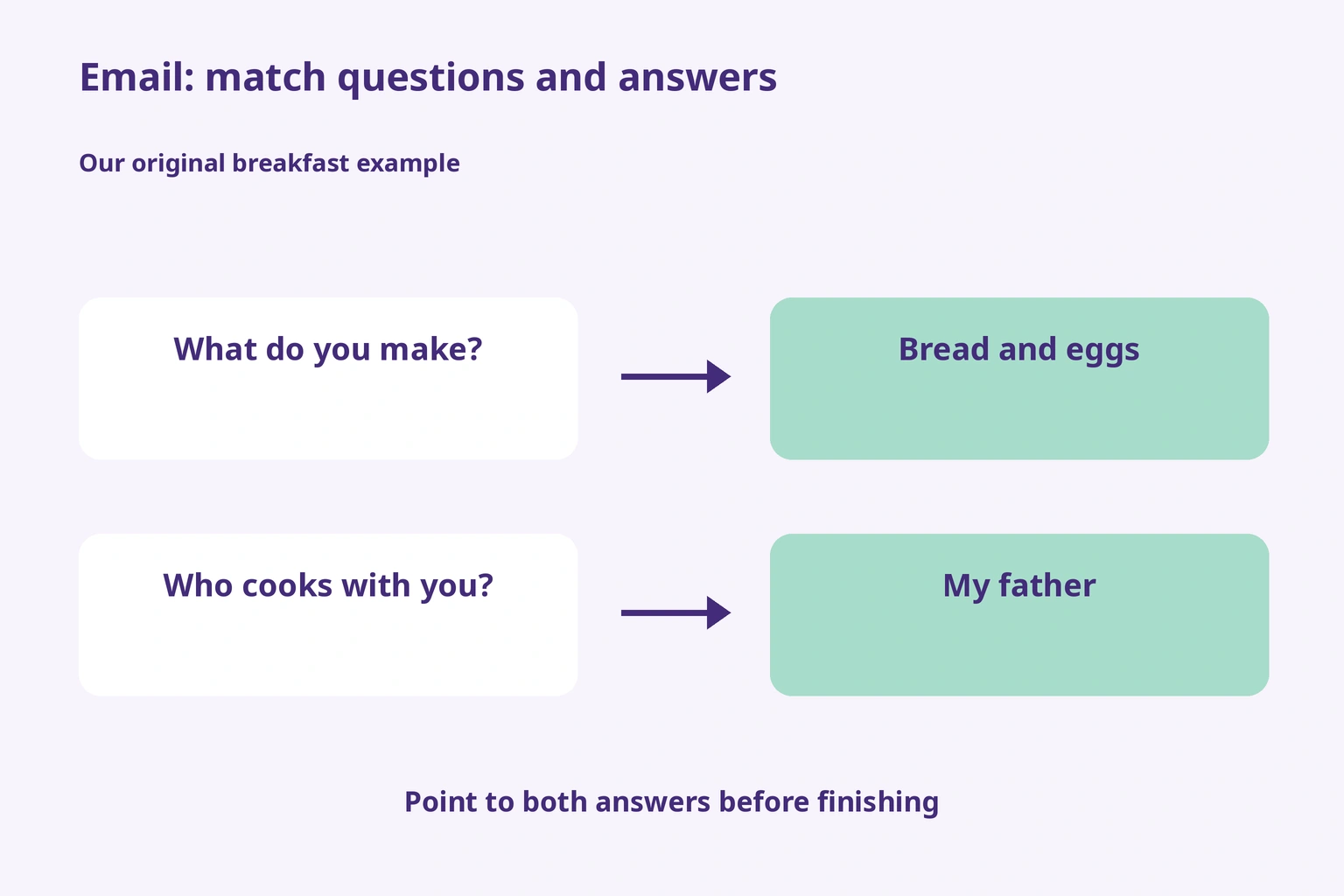
Hello! You told me that you make breakfast at home. What do you usually make? Who do you cook with? Please tell me about it. Mia
It asks what you make and whom you cook with. Example reply section:
I usually make bread and eggs. I cook with my father, and we have a good time together.
That is 18 words by our space-separated count. The first sentence names the food; the second names the person and adds a relevant detail. We assign this example no score.
Common mistakes
“Cooking is fun” does not tell Mia the food or the person. Misreading Who as How can lead to a description of the method instead. Adding a sentence about a favorite sport just to reach the word count changes the topic. First repair the missing information.
Solo checklist
- Can you restate both questions and point to both answers?
- Do the people, situation and time fit the message?
- Does each sentence have a subject and verb?
- Have you checked the word guideline and, in test-format practice, the answer area?
These checks find gaps; they do not predict deductions.
Opinion: one view, two reasons with explanations
Official task and viewpoints
The booklet, p.11 asks for a view and two reasons in about 25–35 words. The four viewpoints include explaining reasons and avoiding contradictions or unrelated information.
Our writing steps
- Identify exactly what the question asks about.
- Choose one answer.
- Think of two reasons, using your strongest language first if helpful.
- Select reasons you can explain in simple English, with a concrete situation.
- Connect the ideas with suitable words, then review meaning, grammar and length.
“Fun” and “interesting” may leave you repeating the same idea. Try different angles: what you can do with friends, or what is convenient in your daily life. This is an editorial idea-finding method, not a list of reasons that guarantee points.
Our original question and response
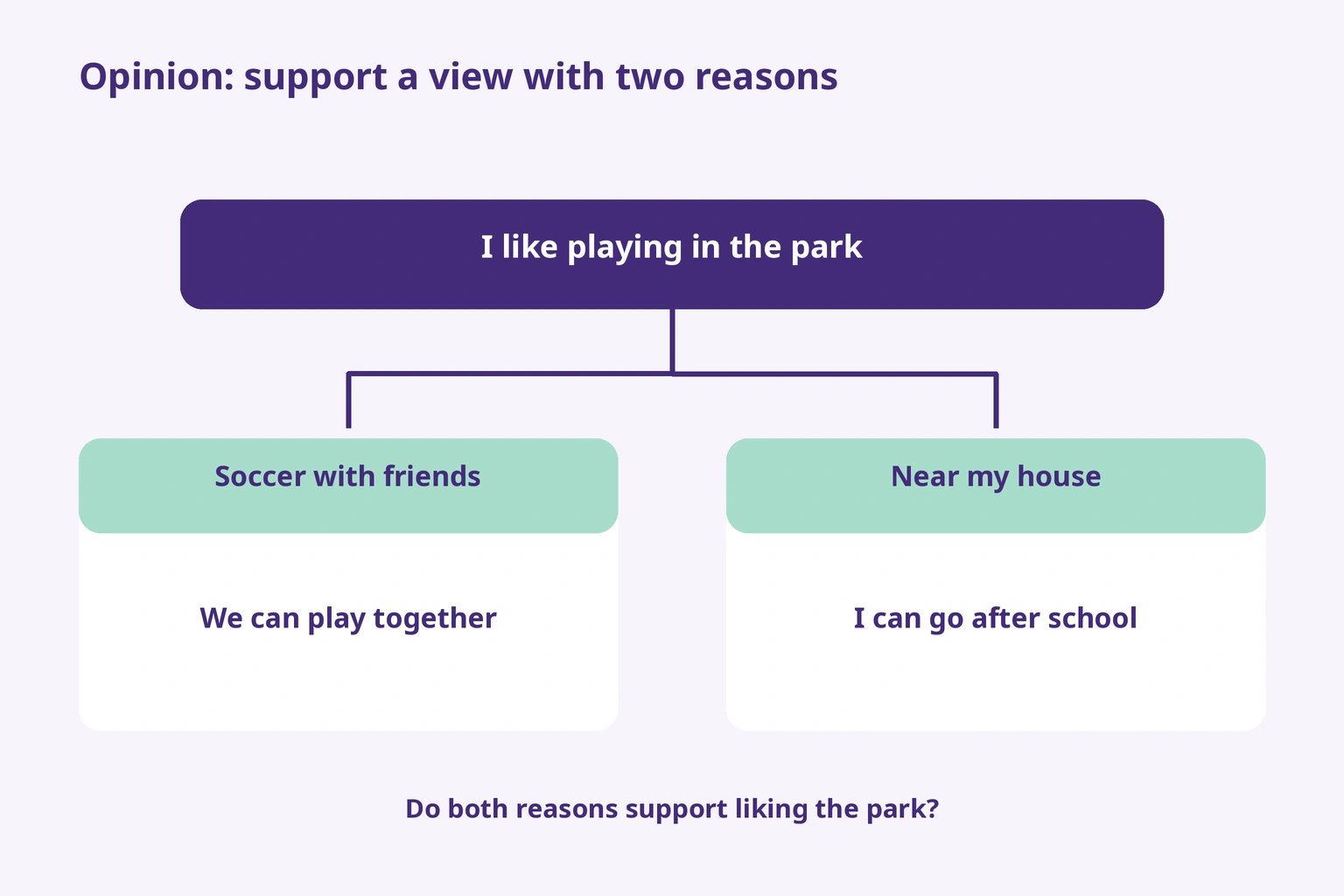
Do you like playing in the park?
I like playing in the park because I can play soccer with my friends. Also, the park is near my house, so I can go there after school.
Our count is 28 words. The view is liking the park; the reasons are playing soccer with friends and being close to home, which makes an after-school visit possible. This is not an officially scored answer.
Common mistakes and solo checklist
Saying you like the park and then giving a reason for not going makes the position unclear. After because, check that you have expressed who can do what, rather than adding an isolated noun.
- Is your answer about the same thing as the question?
- Is your view explicit?
- Are there two reasons, both supporting that view?
- Have you explained “why?” or “in what way?”
- Have you checked meanings, spelling, subjects, verbs and length?
A template organizes content; it does not supply it
Our email structure is answer 1 → answer 2 → useful detail. Our opinion structure is view → reason 1 with explanation → reason 2 with explanation. These are planning tools. Change the content whenever the question changes.
Memorizing I like or I want to still leaves you choosing the correct words and forms that follow. Because cannot create a logical reason when the ideas do not connect. Fluent-looking sentences about another topic cannot satisfy the content requirement. Check the structure and the actual answer separately.
Permission rules for a particular template and guaranteed template bonuses are not stated in the official materials checked. Our advice is to change the topic after learning a structure and build a fresh response. If you cannot express an idea, use simpler English paraphrasing while preserving its meaning.
Review at home without someone rewriting your answer
Our order is question and answer → required information or reasons → meaning and grammar → word count. Read aloud quietly to notice a missing word, but remember that speaking a sentence does not prove it answers the question. Reading aloud is our practice suggestion, not a Writing scoring item.
Keep your first version. Beside the revision, write one reason for the change, such as “I forgot whom I cook with.” Rewrite without looking the next day, then try another topic. An English diary can provide familiar material, but choose only details relevant to the actual prompt. The diary and writing app guide discusses tool roles.
Parents: ask before correcting
Ask “What does the sender want to know?” and “Which sentence answers that?” Wait while the learner points. If the person is missing, ask “Who was the second question about?” before supplying with my father. Let the child choose the information and look up one uncertain word or form.
Say “We found answer 1; let’s add answer 2,” rather than replacing the whole reply. If you cannot judge a grammar point, keep the intended meaning and ask a teacher about that specific sentence. Parents can help match question and answer without being English experts.
If using AI correction, compare the versions: did the meaning change, and can the learner explain the revision? Treat generated judgments as suggestions, not official Eiken scores. Return to a shorter sentence if the correction is beyond the learner’s understanding.
Our editors’ two-week plan
This is an opinion about practice, not an official schedule or a promise of passing in two weeks.
| Days | Practice | Keep |
|---|---|---|
| 1–2 | Read current instructions; match questions and answers in our email | Meanings of both questions |
| 3–4 | Write a reply, then change what is being asked | A note about missing information |
| 5–6 | Plan a view and two reasons before writing | Reasons you can explain |
| 7 | Reread earlier work | One repair for next week |
| 8–10 | Write either task daily; change topics | First and revised versions |
| 11–12 | Try both tasks from official papers, recording time | Time for each task |
| 13 | Practise Reading and Writing together in 65 minutes | Whether review fitted |
| 14 | Recheck recurring gaps, verbs and spelling | A short personal checklist |
Our starting experiment is 5 minutes for email, 10 for opinion and 3 for review, leaving 47 for reading. These are editorial timings, not official allocations. Adjust using a complete practice attempt. If writing stops completely, return to one subject-and-verb sentence and build from there.
Methods we do not recommend
Memorizing whole paragraphs: it skips selecting content for the actual question. Padding the word count: repeated intensifiers do not explain an answer; add relevant information instead. Memorizing predicted answers: a similar topic can still ask about a different person or judgment. Use practice questions to make fresh answers, not to hope for an exact match.
Listen to and say one sentence you wrote
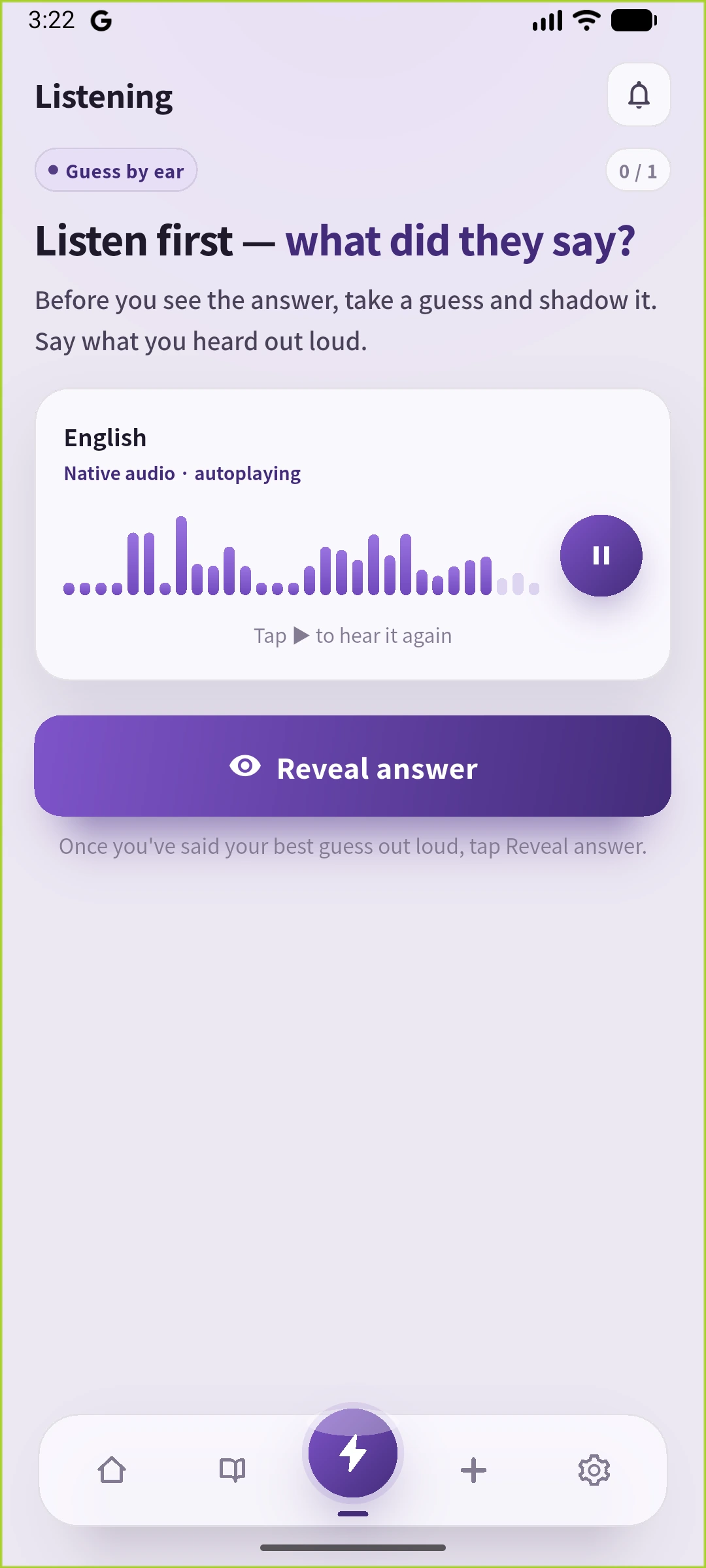
We saved the first sentence of our opinion example as one SpeakGain card through the normal Add flow. On the device we followed Add → Library → Knowledge → Learn this card → Listening → Reveal answer → Answer.
I like playing in the park because I can play soccer with my friends.
Listening hid the English and automatically played the reference audio. The screen asked us to say what we heard before revealing the answer; Answer then displayed the original sentence for comparison.
This is practice in listening to and saying a short sentence. Review the full written response against its question and official viewpoints. Practise responding to interview questions separately too.
Original editorial sentence · Viking AI audio
I like playing in the park because I can play soccer with my friends.
Generated once for this sentence and shared across locales; not official test audio or a complete written answer.
FAQ
Does being under or over the guideline automatically mean zero?
The opinion guidance says extremely short answers and missing reasons can be penalized. A fixed penalty for one word outside the guideline, an automatic zero for exceeding it, and detailed email shortfall deductions are not stated in the official materials checked. Practise within the guideline and review content first.
What if I write about another topic?
The current booklet says a reply or essay that does not address its task may receive zero. “May” is not “always.” Accurate English alone does not make an irrelevant answer appropriate.
Can I use a template? What if I cannot find reasons?
Use a structure as an editorial planning aid, without a score guarantee. Look for simple situations: what you can do with someone, or what becomes convenient. Keep both reasons connected to one view.
Which task first, and how much time?
Official prescribed practice order and fixed task timings were not found in the checked materials. We suggest starting with email because its question–answer pairs are easy to inspect, then trying opinion writing in the same week. Measure both within the shared 65 minutes.
Can an elementary-school child practise? How should parents help?
Use familiar subjects and short English, without an age-based score promise. Parents can ask the learner to explain the question and locate the answer, then help check one uncertainty. Grade 4–5 speaking preparation offers a separate starting point for speaking.
Can I use the sentences for the interview?
They can be material for home speaking practice, but an interview requires answering the question you hear. Use the Grade 3 interview guide separately rather than only reciting a written response.
Editorial verdict
Start with a sentence you can explain yourself and check against the question. For email, find both answers; for opinion, find the view, two reasons and their explanations. Then repair the English and count the words. Parents should return questions before supplying an answer. Choose tools by the job you need through our Eiken study app guide.
Official references
- Current Grade 3 content
- Papers and official answers
- 2026 session 2 booklet, pp.10–11
- Opinion assessment viewpoints and cautions
- Official seminar, email viewpoints p.25; published 2024
- 2024 format renewal
Checked 16 October 2026. Eiken is a registered trademark of the Eiken Foundation of Japan. This article is not an official Eiken teaching resource.