
Eiken S-CBT preparation: test formats and recorded speaking
Published
Eiken S-CBT is a computer-based way to take all four Eiken skills in one day at a test centre in Japan. Unlike the conventional test, which separates the first stage and face-to-face interview into different days, S-CBT starts with speaking and records your answers through a headset microphone. Start by checking the official demo, then record one short answer yourself and listen for whether it answers the question. (Official overview, test sequence)
This guide is for students, adults and parents choosing a format, or preparing after registration. Worry about speaking without an examiner’s reaction is different from difficulty forming an English answer; practise each separately. This is Japan’s Eiken, not a general description of computer-based language tests or a promise of availability abroad. Official information was checked on 14 October 2026. Our examples, format recommendations and study plan are editorial suggestions, not official questions or model answers.
Conventional Eiken or S-CBT: compare the practical differences
The official explanation says the question content, difficulty and marking standards are unchanged. The grade and score are treated in the same way. Choose around dates, controls and how you prefer to deliver your spoken answers (overview).
| Point | Conventional Eiken | Eiken S-CBT |
|---|---|---|
| Dates | Three administrations yearly; first and second stages on separate days | Normally Saturdays and Sundays each week; availability varies by grade and region |
| Location and equipment | A different format; a detailed conventional venue list is not stated in the S-CBT sources checked | Test-centre PC, headset and mouse; not a home test |
| Grades | The overview directs candidates for Grades 1, 4 and 5 to the conventional test | Pre-1, 2, Pre-2 Plus, Pre-2 and 3 |
| Skill order | First stage, then the second stage for successful candidates; the detailed first-stage order is not stated in the S-CBT sources checked | Speaking → listening → reading → writing |
| Speaking | Face-to-face interview | Recorded answers following screen and audio instructions |
| Reading/listening | Paper format; detailed answer-sheet procedures are not stated in the S-CBT sources checked | Click options with a mouse |
| Writing | Paper answers | Choose handwriting or typing when applying; handwriting still uses questions on the screen |
| Results | Exact publication dates are not stated in the S-CBT sources checked | Online results and a paper score report; check the schedule for your test date |
Sources, checked 14 October 2026: overview, FAQ, test information, results. “Not stated” identifies a limit of these S-CBT sources, not a claim that no information exists elsewhere.
S-CBT does not require typing every answer. Reading and listening use clicks, speaking uses your voice, and writing uses your selected method. Basic computer operation is necessary. For children under 11, the official overview asks parents to read the rules and guidance and decide whether the child can take the test (overview, FAQ).
Speaking structure by grade: what is actually confirmed?
The official S-CBT explanation says its content and format follow conventional Eiken. This does not make interview-room movements, paper-card handling or on-screen timing identical (overview, test-centre information).
| Grade | Confirmed in the S-CBT sources checked | Detailed answer preparation |
|---|---|---|
| 3 | Official demo has reading aloud and Questions 1–5; its guide lists six tasks | Grade 3 |
| Pre-2 | Same-content/format statement confirmed; a grade-specific breakdown is not stated in the official S-CBT pages checked | Pre-2 |
| Pre-2 Plus | An eligible grade; its detailed breakdown is not stated in those S-CBT pages | Pre-2 Plus |
| 2 | Same-content/format statement confirmed; its detailed breakdown is not stated in those S-CBT pages | Grade 2 |
| Pre-1 | Same-content/format statement confirmed; its detailed breakdown is not stated in those S-CBT pages | Pre-1 |
Checked 14 October 2026: overview, demo guide, speaking demo. The grade articles mainly explain conventional interview tasks and answers. Use them for English preparation, and S-CBT guidance for controls. Do not transplant entering a room or turning over a paper card into a recorded-test procedure. Candidates considering lower grades should read our separate Grade 4/5 speaking-test guide; it is not the S-CBT registration system.
What changed in FY2025?
Two confirmed changes matter when comparing older guidance:
- From April 2025, the same grade could be booked up to three times instead of two within one administration period, counting domestic and overseas venues together. The periods are April–July, August–November and December–March (official change notice).
- Pre-2 Plus began at domestic S-CBT venues with the June 2025 tests (notice confirming the launch).
Those notices do not state that the recorded format or skill order changed in FY2025. Use the current test page and FAQ for today’s sequence. Also check current document requirements: the FAQ states that from April 2026 candidates need a printed admission ticket and an accepted, valid original photo ID; writing instruments are provided by the venue (FAQ). Parents can help check these before test day.
Recorded speaking: from the screen to your answer
At the centre, wear the headset and record your speech according to the PC instructions (official sequence and controls). Our preparation approach separates learning the controls from learning to answer.
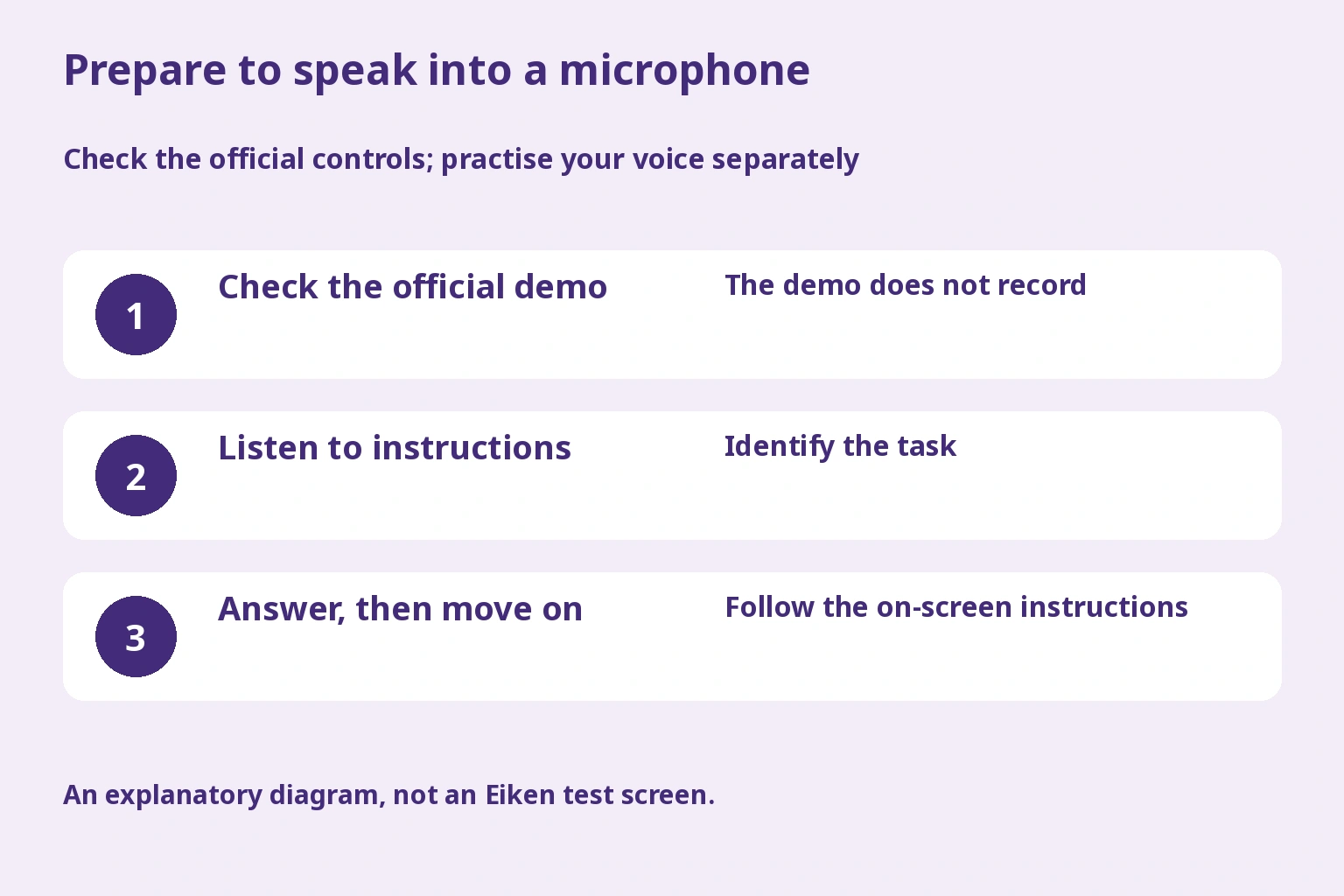
1. Start with the official demo
The official speaking demo is Grade 3. Higher-grade candidates can use it to understand operation, but should not assume its language difficulty matches their grade. It displays greetings, warm-up, silent reading, reading aloud and Questions 1–5, with guidance about moving on after answering.
The demo does not record your voice, and some functions differ from the real test. Reaching its final screen is not evidence that your own voice was recorded successfully. Practise recording separately; do not treat a demo time display as a universal limit for every grade (demo limitations).
2. Listen for what the task asks
Our suggestion is to identify the required action before starting: read a passage, answer about its content, describe a situation, or give an opinion. An opinion rehearsed in advance will not answer a question asking for a fact. Practise waiting for the prompt and then beginning without someone encouraging you. Confirm buttons, displays and timing in the official controls guidance.
3. Finish your answer and follow the next instruction
In home practice, keep recording even if you pause. Learn to decide when your answer is complete without waiting for an examiner’s nod. Repeating the same sentence because you feel unsure can distract you from the next instruction. A right to freely re-record answers in the real test is not stated in the official sources checked. Do not infer one from your phone’s recording app. If equipment appears faulty, be prepared to tell the venue staff rather than changing settings yourself.
Match your answer pattern to the task
The following is our practice framework, not a universal marking template. Choose a pattern after checking the tasks for your grade.
| Practice task | Focus first | Our original short example |
|---|---|---|
| Reading aloud | Read the given words without adding an opinion | “Students need a quiet place to study.” |
| Passage response | Locate the fact or reason requested | “Because they need a quiet place.” |
| Describing a person | Say who is doing what | “A student is looking for a seat.” |
| Explaining events | Connect what happened in sequence | “The library was full, so she went home.” |
| Giving an opinion | State your position and a relevant reason | “I think public libraries should stay open later, because students need a quiet place to study.” |
These sentences are not copied from official questions or presented as answers to them. Grade-specific detail stays in our guides for 3, Pre-2, Pre-2 Plus, 2 and Pre-1.
Begin an opinion with an answer and a reason
Our practice topic is whether public libraries should stay open later. The sentence below is a starting point around Pre-2–Grade 2, not a complete answer guaranteed to satisfy every grade:
I think public libraries should stay open later, because students need a quiet place to study.
The first part states the position; the second explains it. Practise the first part alone, then connect the reason. Prefer a reason you understand and can say to adding difficult vocabulary for its own sake.
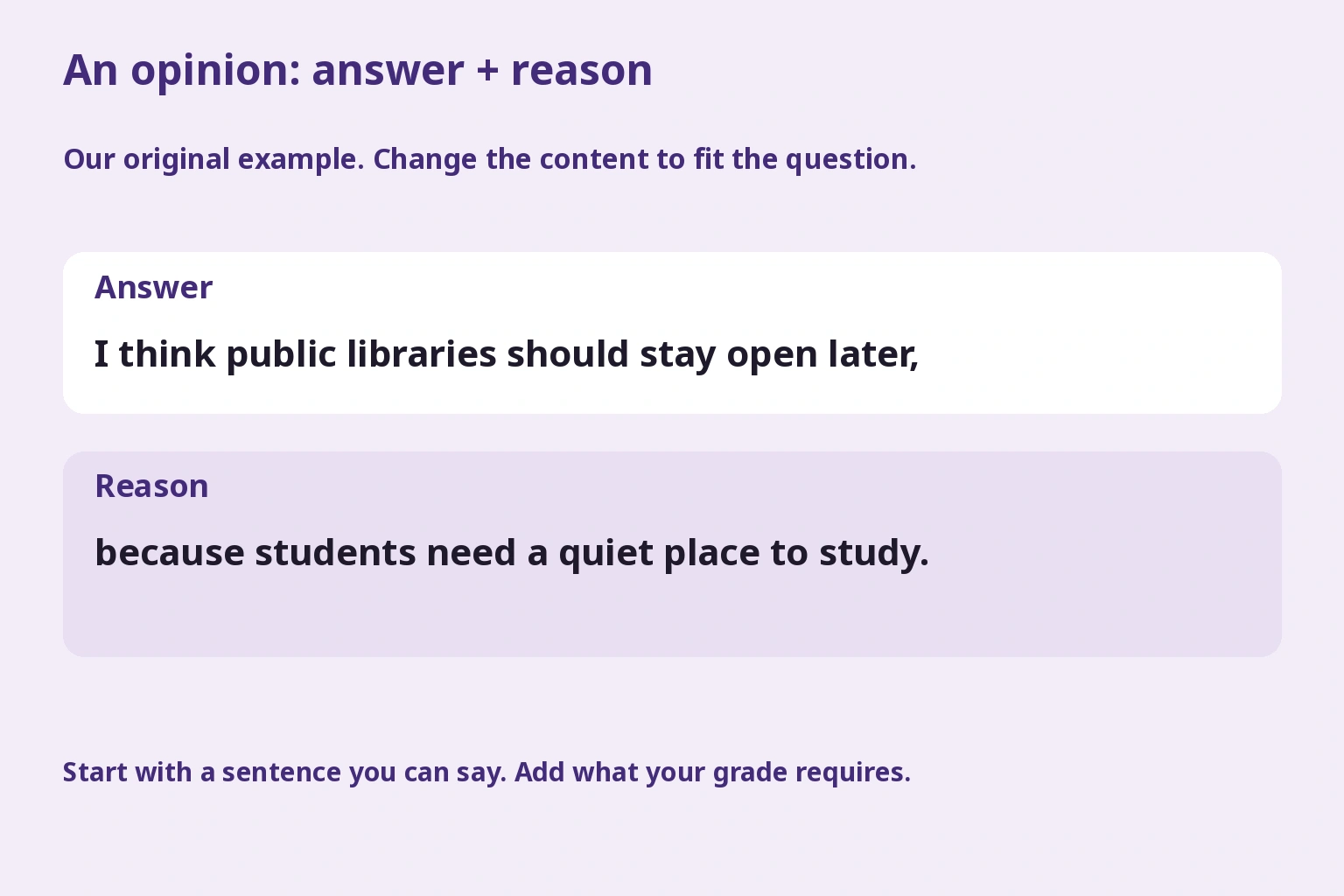
This is not an all-purpose answer. Change the topic and build a new reason. If the task requires more detail or multiple pieces of information, add them. A recorded word count does not establish whether an answer passes; listen for whether it addresses the question.
Solo recording: keep the first attempt, fix one thing
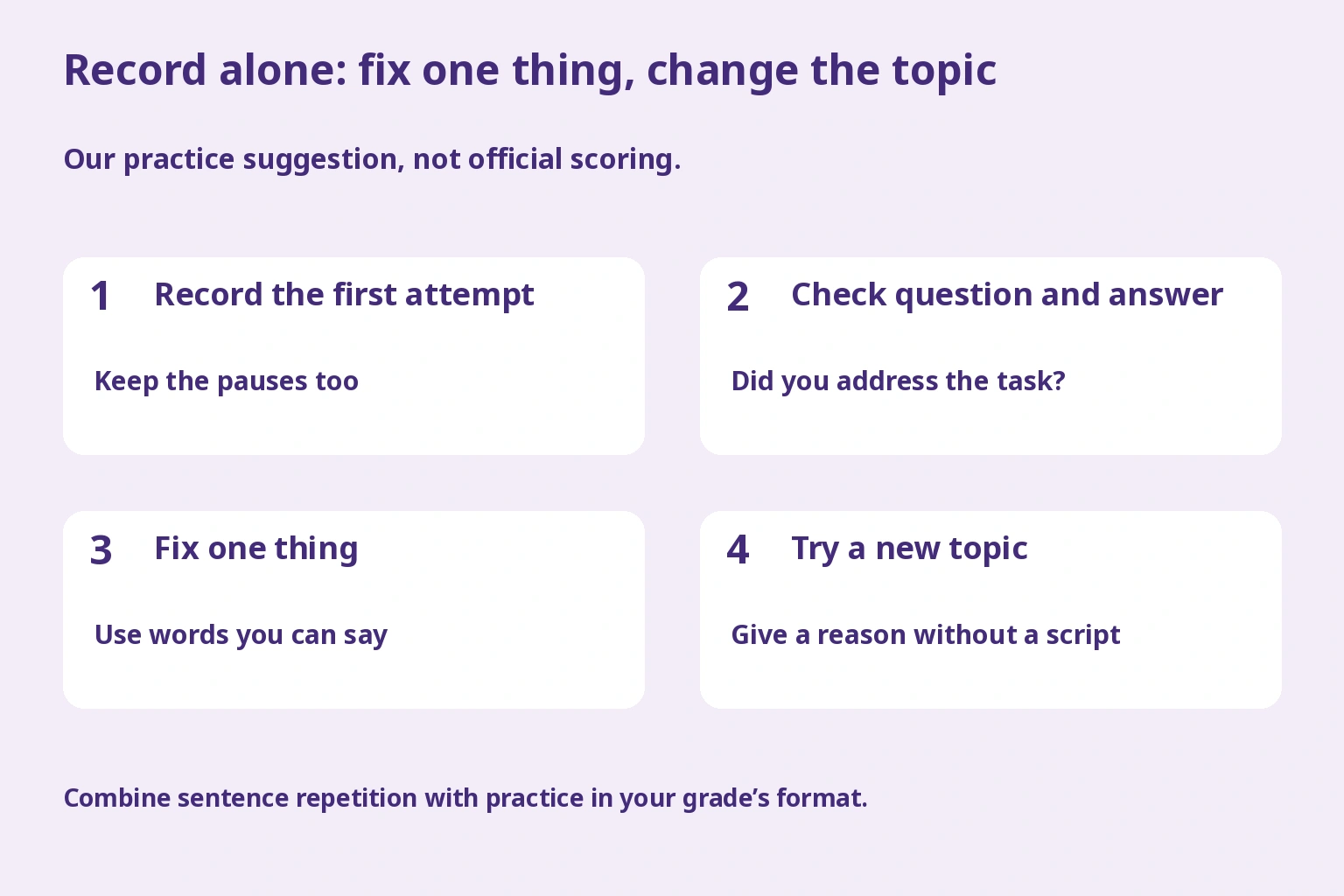
We would start with a recording of one answer rather than a long daily session. A familiar phone recorder is enough for home practice. It is neither official assessment nor a replica of the exam.
- Choose a topic. Keep checking official samples separate from answering our original practice prompt. Link to official material instead of reproducing it.
- Record once without a script. Keep hesitation: it helps identify what needs work.
- Compare question and answer. Did you give an opinion when asked for one, or a reason when asked why?
- Listen through the ending. Note an inaudible final phrase or an unfinished reason. Do not convert a self-assessed pronunciation score into an official score.
- Change one thing and record again: shorten the reason or use words you can say. Keep the original attempt too.
- Change the topic tomorrow so you are choosing an answer, not merely recalling one sentence.
Parents need not correct every grammatical error. Ask the learner what was asked, which words answer it, and whether the whole recording is audible. Give the learner a final independent attempt before listening together. Sentence repetition and practising several tasks in your grade’s order are different exercises; schedule both.
Use SpeakGain to listen to a short answer and say it aloud
SpeakGain can help you keep an original sentence as a short practice card. We entered the library sentence above through the normal Create flow and verified that its Viking audio was generated. The player below uses that AI-generated audio; it is not an official exam question or model-answer recording.
I think public libraries should stay open later, because students need a quiet place to study.
On the device, the study screen first hid the English sentence and played the audio. We said what we heard, then used Reveal answer to check the sentence. The next screen let us replay the audio and select a review interval. For opinion practice, separate the round in which you imitate the sentence from the round in which you give your own reason without reading it.
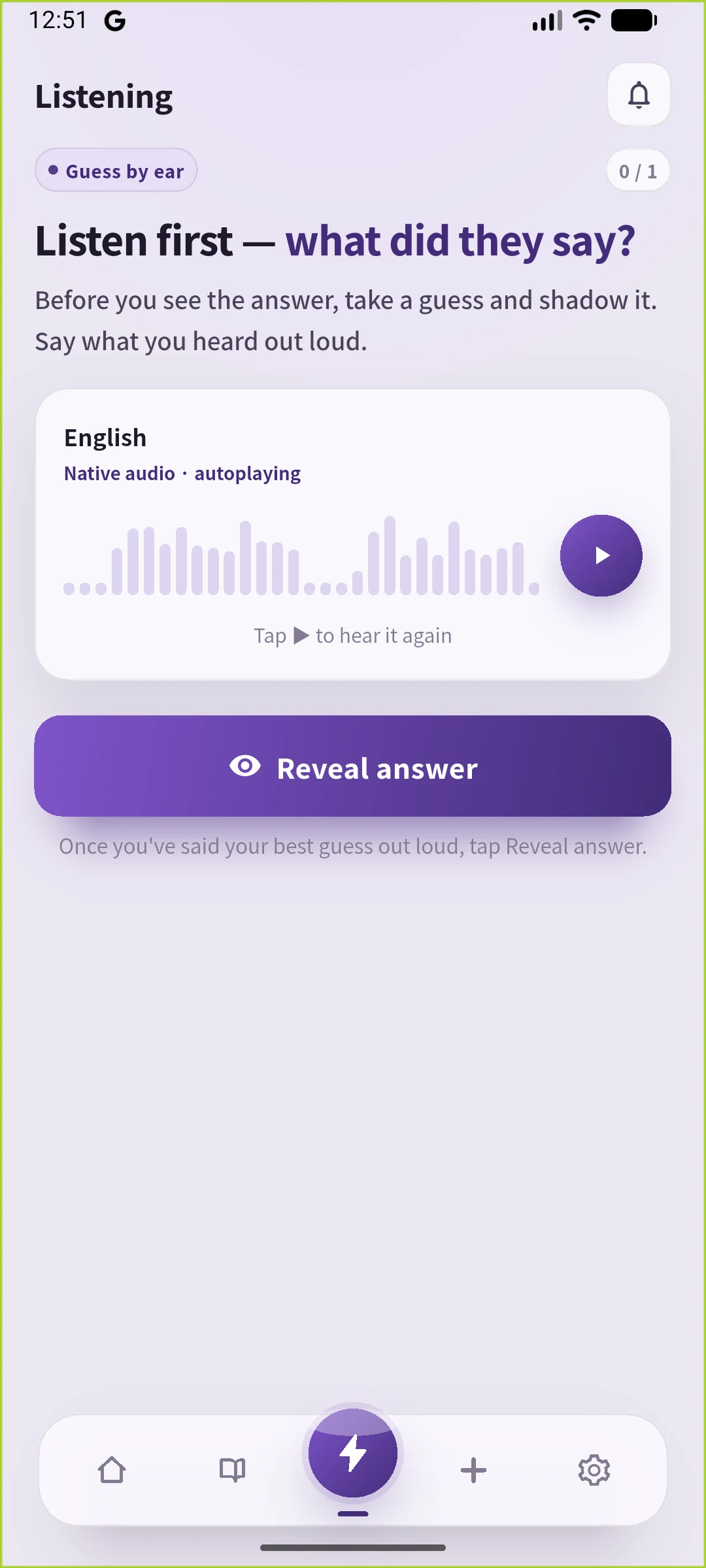
Here, SpeakGain supports listening to and saying short sentences. We do not present it as an Eiken S-CBT mock test, a scorer of Eiken answers or pronunciation, or a guarantee of passing. Return to the official demo and your own recordings to check whether your answer fits the question and the available time.
Common mistakes and the next useful adjustment
These are editorial practice observations, not an official penalty list.
| What happens | Change on the next attempt |
|---|---|
| Reading the screen distracts you from the question | Learn the official controls separately from answering in English |
| You wait for a person to react | Practise starting after an audio prompt by yourself |
| A long introduction crowds out the reason | State the position briefly, then give a relevant reason |
| Your final words disappear | Listen to the whole recording and keep the ending audible |
| You reuse the library sentence for unrelated questions | Change the topic and construct a matching reason |
| You think finishing the demo checked your recording | Record separately; the demo does not record |
For concerns about other voices, inspect the official centre images. A guarantee of complete silence or quantified sound isolation is not stated in the sources checked. Our suggestion is occasional practice with ordinary background sounds, not loud-noise endurance or a belief that volume alone determines the score.
A two-week plan based on actions, not a pass promise
This is our suggested allocation, roughly 10–15 minutes of speaking a day, with the other three skills studied separately. It does not promise a pass in two weeks. Return to grade-specific material if your first recording reveals substantial content gaps.
| Days | Work | Keep a note of |
|---|---|---|
| 1–2 | Check current dates, venue, results, controls and demo | Confusing operations and required preparation |
| 3–4 | Review your grade’s tasks and record a short answer | Whether answer and reason match |
| 5–6 | Practise reading or describing, not only opinions | Words or content that stopped you |
| 7 | Review the first recordings | One priority for next week |
| 8–9 | Fix that priority and change the topic | What you could say without a script |
| 10–11 | Practise in your grade’s sequence and official timing | Difficult transitions |
| 12 | Complete a practice sequence alone | Whether you waited for help |
| 13 | Briefly revisit the weakest task | One revised answer |
| 14 | Check documents, travel and meeting time; practise briefly | Readiness for the day |
On a busy day, one recorded question and one check are enough to keep the plan useful. Use the recording to choose the next step rather than filling every box or adding long new answers the night before.
Which format would we choose?
Our editorial choice starts with available dates and the deadline for using results, then considers controls and recorded speaking. The official sources do not offer an easier standard for S-CBT (overview).
- Consider S-CBT if you want to avoid returning for a separate interview, a suitable date is available, you can operate the PC, and you can practise answering into a microphone. Finishing in one day does not mean results arrive by your deadline.
- Consider the conventional format if your face-to-face preparation is established and you have little time to resolve strong computer-operation anxiety.
- Parents should check access to the venue, meeting time, ID and result deadlines, and let the learner try recorded speaking before choosing for them.
Check what the school or employer accepts, not just the test date. Use the official results schedule to confirm online publication, paper-report timing and the evidence you must submit.
Methods we do not recommend
Long answer memorisation as the main method: it may produce a fluent rehearsed paragraph without teaching you to answer a different question. Practise a short pattern, then change the content.
Listening without speaking: understanding a recording and producing an answer are separate practice checks. Record your own response at least once.
Memorising interview-room gestures as S-CBT controls: grade articles help with English, but paper-card movements are not a substitute for the official S-CBT controls.
Volume or word-count “tricks”: the checked official sources give no universal guarantee. Do not convert home recordings or app practice into official CSE scores or pass predictions.
Frequently asked questions
Is S-CBT harder?
The official content, difficulty and marking standards are unchanged. The burden of controls or recording can feel different. We suggest trying the demo and one home recording before choosing (overview).
How are answers assessed without a face-to-face examiner?
Speech is recorded and the same marking standards apply. First-stage three-skill and second-stage speaking CSE decisions are separate; only first-stage passes receive a second-stage pass/fail decision. The human/AI division and number of raters are not stated in the checked S-CBT pages (overview, FAQ).
Are the two stages separate?
Normally you take four skills in one day, but the two pass/fail decisions remain separate. First-stage-exempt candidates take speaking only (overview, FAQ).
How often can I take the same grade?
Up to three bookings within one administration period, counting domestic and overseas venues together. The writing method does not change that limit; absence or withdrawal counts, and each application requires payment (change notice, FAQ).
Can I prepare alone?
Start by recording a short answer and checking it against the question. Our suggestion is official-demo practice plus a separate recording, because the demo itself does not record (demo guide).
Will other people’s voices distract me?
There is no single answer for everyone or every test day. Centre images are available; a guarantee about how clearly neighbouring voices can be heard is not stated in the checked sources (centre information).
When do results arrive?
Check the official list for your test date. Do not assume a fixed number of days; verify the online publication and paper-report dates before applying if you have a deadline (results).
Which format is better?
We would choose the format we can prepare for among those meeting our timetable and result deadline. Recorded and face-to-face formats do not provide a guarantee of easier passing.
Our verdict: start with one recording of your own voice
Check the official operation, record one answer, check that it answers the question, and fix one thing. That is our starting sequence. Practise beginning and ending an answer independently instead of trying to cover anxiety with longer memorised paragraphs. Then combine sentence repetition with the tasks for your grade. If you have already registered, today’s recording should identify tomorrow’s next change.
Official references
Checked 14 October 2026. Recheck current test conditions before attending: overview, FAQ, controls and sequence, demo limitations, speaking demo, dates, centre images, results, FY2025 booking change, Pre-2 Plus launch.
Eiken is a registered trademark of the Eiken Foundation of Japan. Our examples, diagrams and plan are editorial materials, not official Eiken teaching or marking materials.