
ESAT-J preparation: Tokyo’s 2026 format, assessment and home practice
Published
ESAT-J is Tokyo’s test of the English speaking skills taught in junior high school; the version for third-year students is ESAT-J YEAR 3. Its results are reported as grades A–F and converted to a maximum of 20 points in the applicable Tokyo metropolitan high-school entrance selection. Start home preparation by checking the current official sample, then recording a short response or a passage and checking whether it answers the task clearly (official overview, 2027 entrance rules).
This guide is for students and families preparing for Tokyo’s test, including English-speaking households. It covers the 2026 test and 2027 high-school entry, checked on 14 October 2026. English examples, diagrams and practice schedules are our own, not official questions or model answers.
Current format at a glance
| Item | Official YEAR 3 information |
|---|---|
| Students | Third-year students at Tokyo public junior-high schools and equivalent institutions. Public special-school junior-high divisions/special classes participate by choice. National/private or out-of-Tokyo students may take it when using the result for metropolitan high-school admission |
| Dates | Main test: 22 November 2026; supplementary/retest: 13 December 2026 |
| Method | Provided tablet and headset; spoken answers recorded |
| Parts | A oral reading: 2; B conversation: 5; C narration: 1; D short speech: 1; 9 tasks altogether |
| Procedure | Each of two groups has about 65 minutes including preparation. Assembly 12:30, start 13:00, dismissal planned for 15:40 |
| Assessment | A: speech/audio. B–D: communicative achievement, language use, speech/audio |
Sources: 2026 guidelines, 2026 notice. Time at the venue is different from speaking time. Follow your own admission ticket and instructions.
| Part | Task | Preparation in the current sample | Response/recording |
|---|---|---|---|
| A | Read aloud so meaning is clear | 30 seconds each | 30 seconds each |
| B | Answer four questions and ask one | None for the four responses; 10 seconds for asking | Up to 15 seconds each |
| C | Explain all four illustrations in sequence | 30 seconds | Up to 40 seconds |
| D | Give an opinion with reasons/examples | 60 seconds | Up to 40 seconds |
These are current official sample timings, not an invented total duration. Open the sample PDF and the videos linked on the official page. Older four-question descriptions of Part B do not describe this sample. Do not reproduce the official material in your own public worksheets.
Assessment, grades and entrance use
The test is criterion-based, not a ranking against classmates. Qualified assessors trained for the test use Tokyo’s criteria, with multiple assessment, review and checks. The guidelines say the marked results undergo IRT statistical processing (Q&A, Q12–15, guidelines). At home, check three separate things: did you answer the requested task, does the language make sense, and can a listener understand the recording? This checklist is our practice method, not official scoring.
| Grade | A | B | C | D | E | F |
|---|---|---|---|---|---|---|
| Entrance points | 20 | 16 | 12 | 8 | 4 | 0 |
Under 2027 rules, section 2−10−1, the applicable academic-test selection generally uses the result at schools conducting an English academic test. Up to 20 points are added to the 1,000-point academic-test/school-record total, giving 1,020. Additional interviews or other selection categories must be checked separately. A home answer does not predict these points: a formula converting our sentence or a count of responses into a grade is not stated officially in the inspected current documents.
For the main test, portal results are scheduled for 6 January 2027, with school reports sent on 18 January. Supplementary/retest dates are 22 January and 28 January respectively (Q11). Use the report’s advice for further learning and consult the school about applications.
Part A: read in meaningful groups
What is required
Read the given English so its meaning reaches the listener. Pronunciation, stress, pace and pauses are assessed (sample, criteria). Do not add an opinion to the passage.
Our pattern and example
Understand the meaning → identify groups → make important words audible.
Our class has a small garden. We grow flowers there.
The garden is the setting; flowers say what is grown. Pause between the sentences rather than stressing every word equally. This short example introduces the method; it does not recreate the official passage length.
Home practice
Record a readable textbook passage. Listen with the text and choose one unclear word or awkward pause. Practise it with surrounding words, then record again. Return to the official sample to practise preparation and recording separately. Our reading-aloud guide explains the basic routine.
Common mistakes
Racing without understanding, copying sounds without meaning, or repeatedly restarting one word. Build a comprehensible pace first; then check the limit and practise continuing after a stumble.
Part B: answer the question type and practise asking
What is required
Four responses plus one question, using the information and the communicative purpose given (sample, criteria). Asking is a separate skill from answering.
Our pattern and examples
Identify what is wanted → give that information first. Original after-school examples:
| Purpose | Example |
|---|---|
| Give a time | It starts at four. |
| Describe an experience | I played basketball yesterday. |
| Ask for a start time | What time does the club start? |
These are not answers to an official question. Do not reply with your preference when you have been asked to ask about a time.
Home practice
Make a simple schedule. Have someone read different questions, or prerecord and shuffle them yourself. Answer without a written script in a 15-second practice window. Separately, look at a piece of information you want to know and form a question. If necessary, write to check grammar, then speak without the completed answer.
Common mistakes
Using the same memorized sentence for every prompt, giving a time when asked for a reason, or explaining when asked to question. Before editing pronunciation, identify what the question was trying to find out.
Part C: keep the person and the sequence
What is required
Explain all four illustrations as a sequence. Follow the designated opening in the task; the current sample has 30 seconds’ preparation and up to 40 seconds to answer (sample, criteria).
Our pattern and example
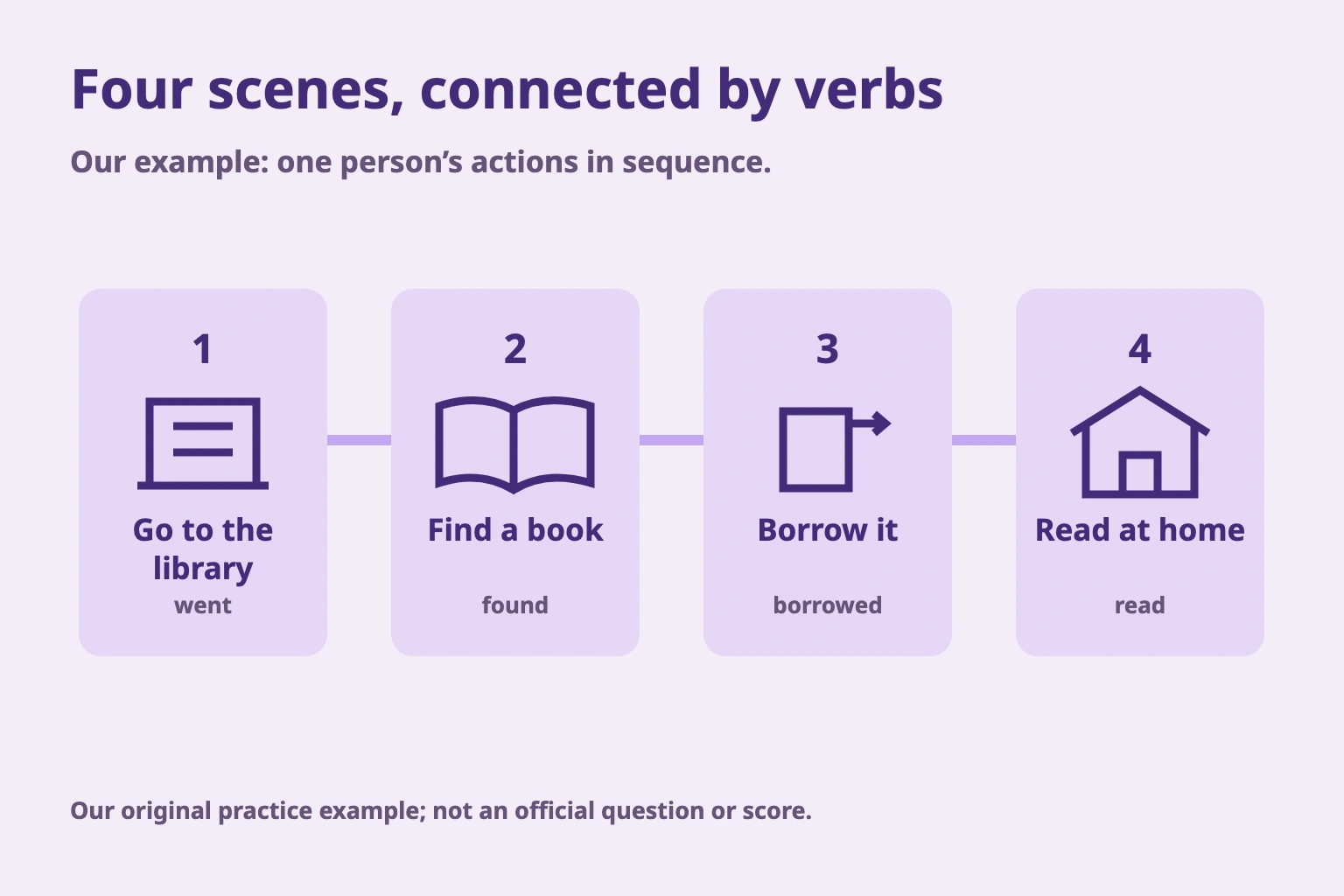
Situation → next action → change → outcome. This library story is independently written:
After school, I went to the library. I found a book about space. Then I borrowed it. I read it at home.
It keeps the same person and uses verbs to move the story forward. Use the task’s opening in the actual test, not this one automatically.
Home practice
Draw or note four original events. Identify who acts, what happens and what changes. Say one sentence per event, then connect them in the sample’s time window. Listen for skipped events or changed characters. Add a missing action before decorating the first scene. Finally try a different story.
Common mistakes
Spending all the time on picture one, listing objects, or inventing details unsupported by the pictures. First cover the whole sequence briefly.
Part D: connect opinion, reason and example
What is required
Give an opinion on a familiar theme with reasons/examples. In the sample you may select one of three hints or your own idea, with 60 seconds’ preparation and up to 40 seconds’ response (sample, criteria).
Our pattern and example
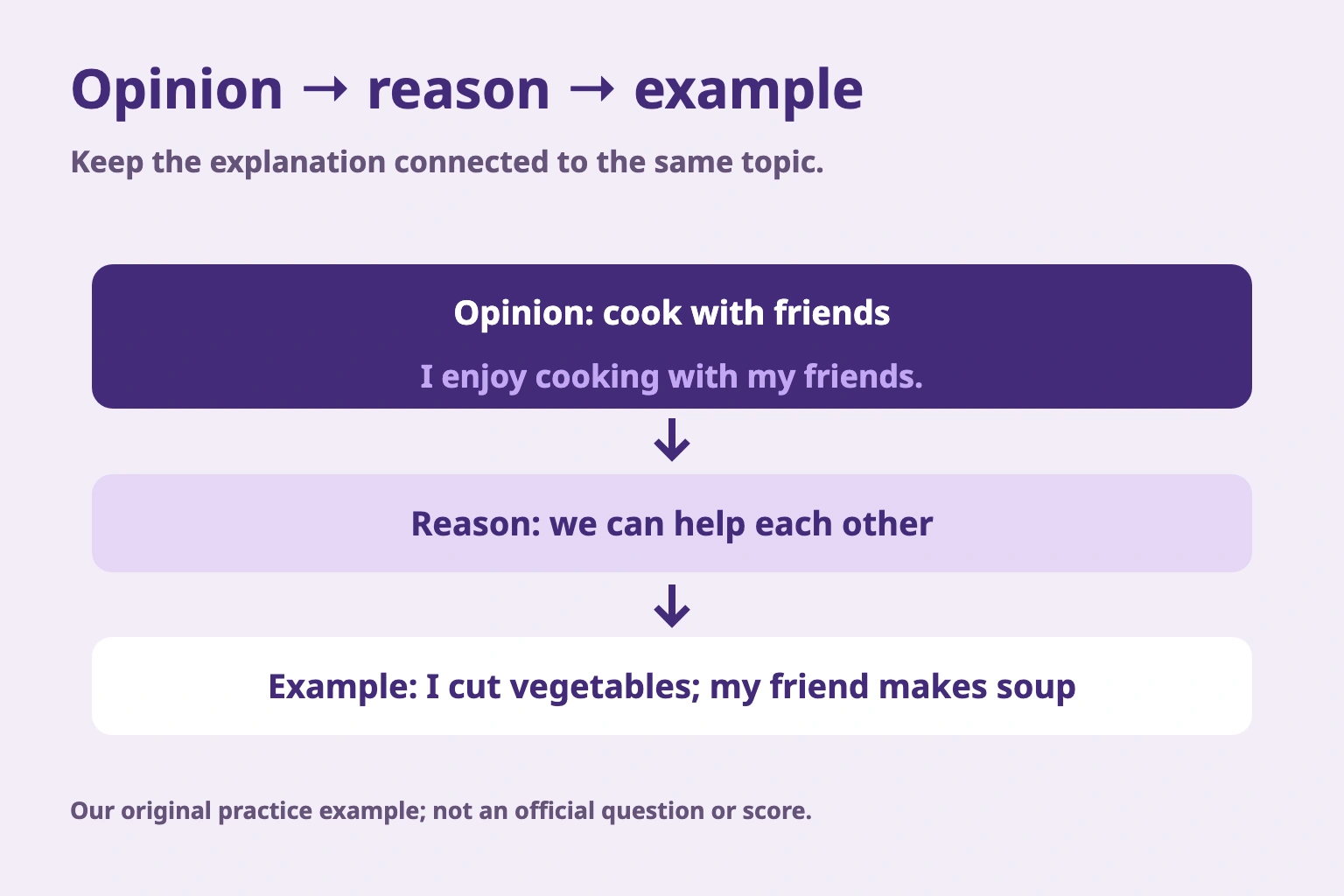
Opinion → relevant reason → concrete example. For an original practice theme about activities with friends:
I enjoy cooking with my friends because we can help each other.
Add detail that shows the help:
For example, I cut vegetables and my friend makes soup.
The example explains the reason. It is a starting point, not a sufficient answer to every theme or a promise of a particular grade.
Home practice
Choose a familiar topic, prepare an opinion and a reason, then record. If the reason is only “good”, say what someone can do or how it helps. Add one relevant example and rerecord. Change the topic to test whether you can change the content. Use instant composition practice for short-sentence foundations, then return to the English prompt.
Common mistakes
Listing all hints without a reason, adding an unrelated experience, or waiting to recall a long model answer. More connectors alone do not make the explanation clearer.
A home routine and parents’ role
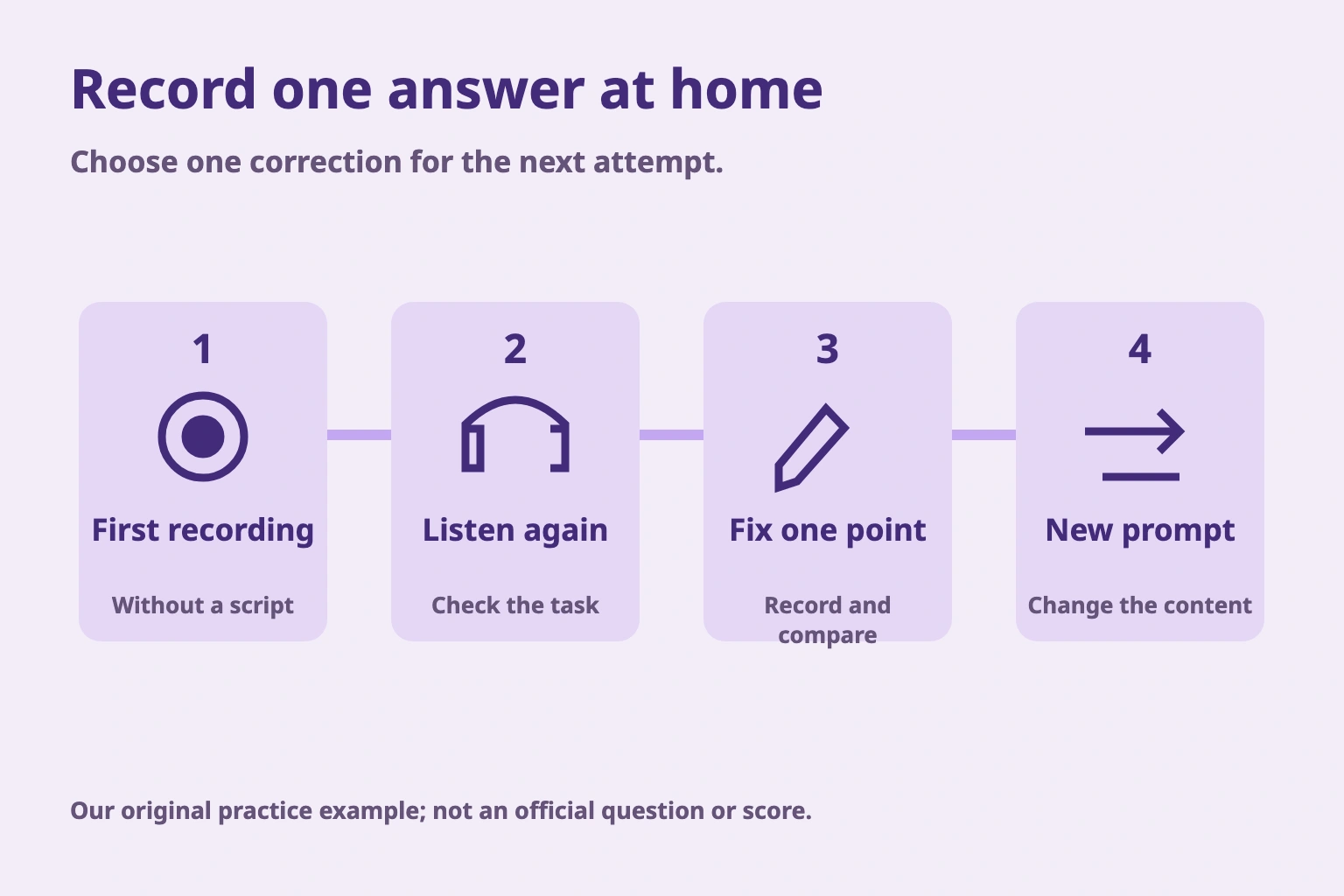
Record once → compare with the task → correct one point → record again → try another prompt. In a 10–15-minute session, one task is enough; that allocation is editorial advice, not an official dosage. Keep the date, prompt, one correction and next action. Our speaking-practice guide helps choose exercises; return to ESAT-J’s tasks afterwards.
Parents can provide quiet time, a timer and a listener. Ask “What did the question want?” and “What will you change?” Let the student finish before commenting. Check the meaning together in your home language, then let the student express it in English. Avoid comparisons with siblings or awarding predicted grades. Ask a teacher or consult textbook audio when language is uncertain. The official Q3–4 recommends school activities and home oral-reading review.
Use SpeakGain to save and listen to a short answer
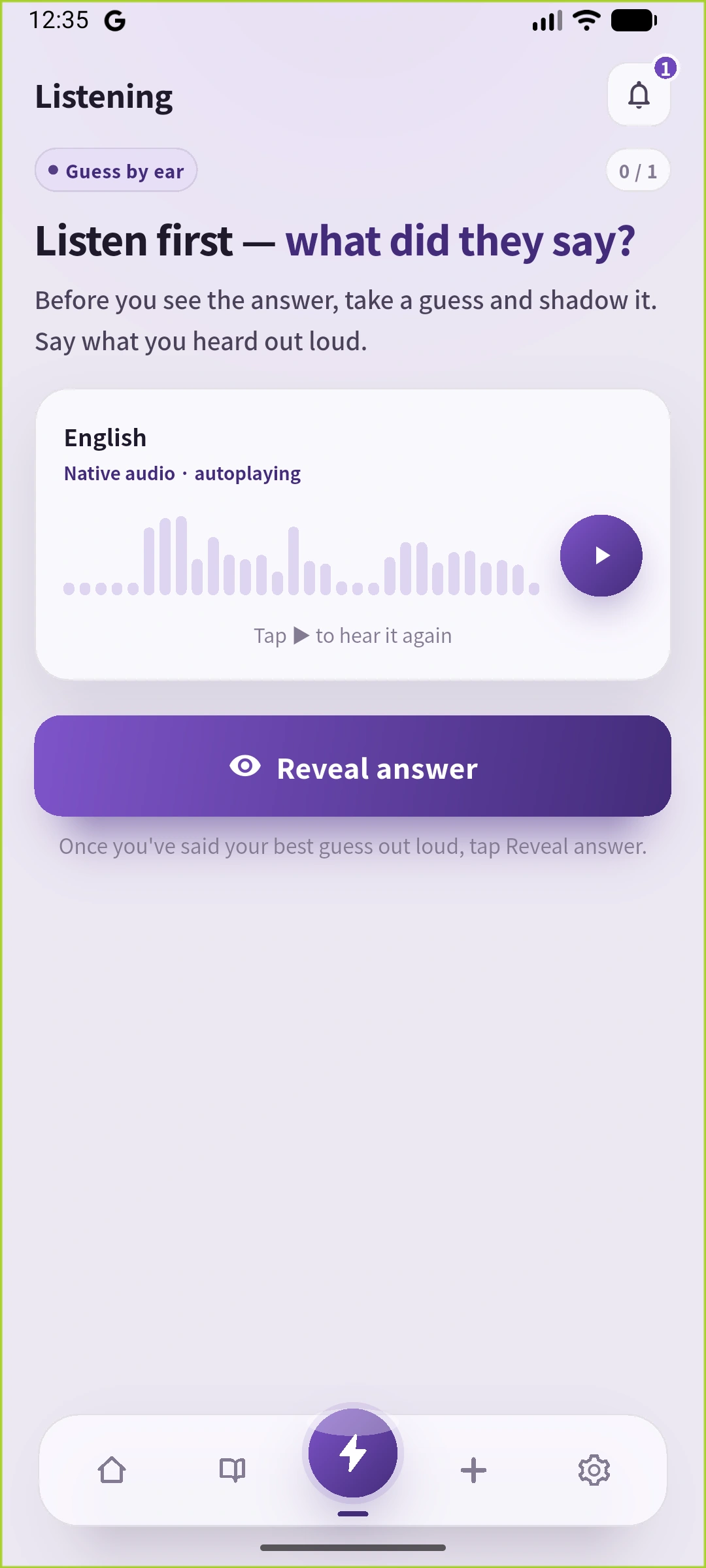
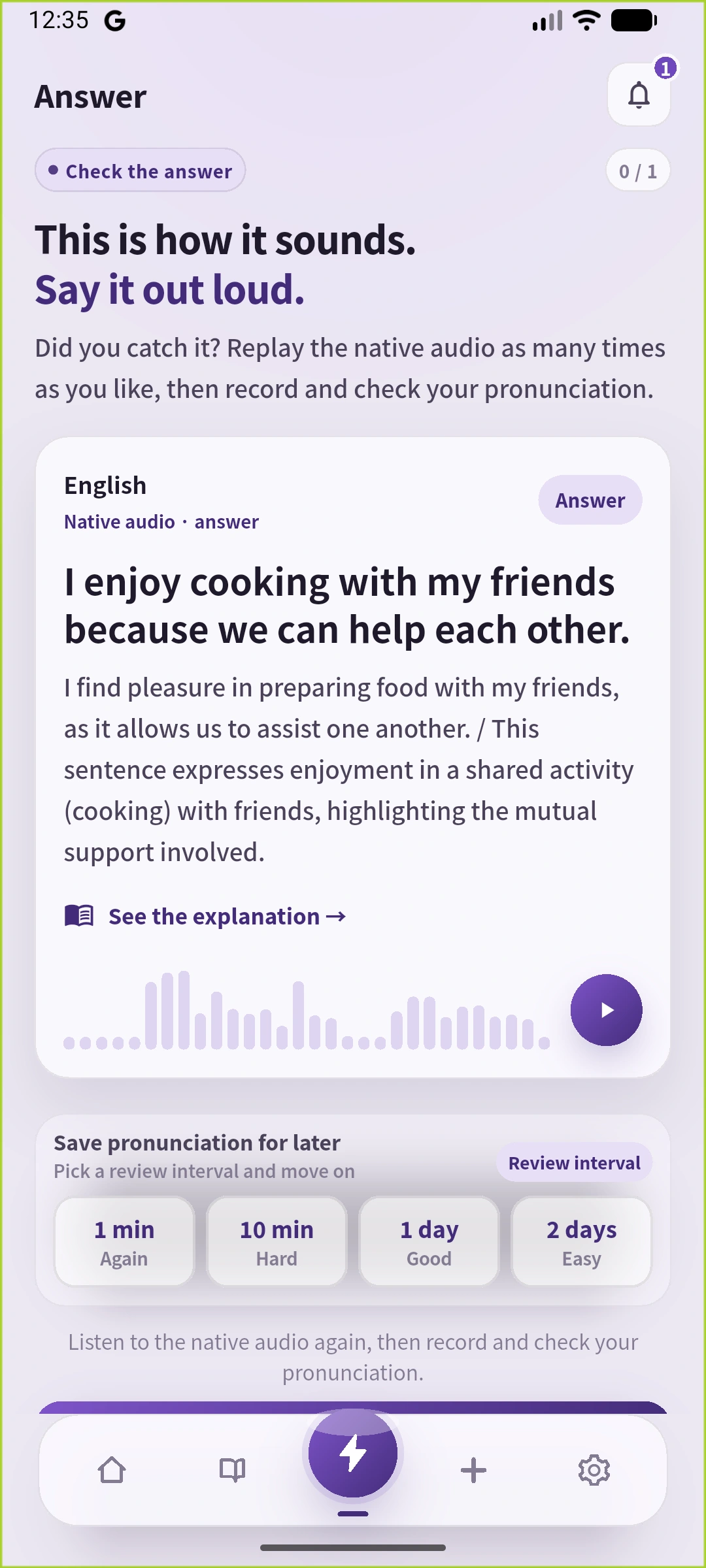
On the device, we entered the original sentence below in the add screen, created a card and opened its study flow from the card library. Listening played reference audio while hiding the English. Reveal answer opened Answer, showing the sentence with an English paraphrase and explanation. We also verified that the audio could be replayed on Answer.
At home, listen first, reveal the answer to check its meaning, then say it aloud yourself. To check whether a whole answer addresses a task, use the official samples and the recording-and-review routine above. Review-interval choices and a Record and check entry were visible, but we did not submit a recording of our voice or verify answer or pronunciation assessment.
I enjoy cooking with my friends because we can help each other.
AI-generated Viking reference audio, generated once through normal card creation. This is neither a human recording nor official test audio.
Our last-four-week plan
| When | Focus | Record |
|---|---|---|
| Four weeks before | Check current samples and attempt A–D once | One difficulty per part |
| Three weeks before | Reading groups; short responses and questions | First/revised recordings |
| Two weeks before | All C scenes; D reasons and examples | Missing event or weak reason |
| Final week | Separate preparation/response; try different material | Instruction/timing uncertainty |
| Day before | Ticket, instructions, belongings, travel; light reading | Practical checklist |
This is a flexible editorial plan, not “A in four weeks”. With only a week, attempt every part once, choose two weaknesses and retain a run-through. Avoid spending all remaining time memorizing one long speech.
Methods we do not recommend
Long complete-answer memorization can drift away from a changed question. Universal reasons such as “fun”, listing every hint or speaking faster do not check whether the purpose is met. Reading silently without attempting a response hides the point where you actually stop. Listen-back should lead to a correction, not repeated guesses at your grade.
Do not skip the test as a points strategy. Q16–17 says absence merely to obtain higher points does not qualify for the protective measure and is treated as zero. Illness and other unavoidable circumstances require the proper school/official procedures.
Test-day preparation
Check your ticket and current instructions. The guidelines, section 1−14 lists the ticket, candidate instructions, identity document, writing tools, indoor shoes/bag if specified, and non-electronic self-study materials. Writing notes during the test is prohibited. School tablet experiences and the operation video linked in Q8 help with orientation. Follow staff instructions if equipment seems wrong; home recording is different from recording the test on your phone.
FAQ
Is it only for third-year students?
No. YEAR 1 and YEAR 2 are for the first two junior-high years; this guide covers YEAR 3. Their evaluation uses three levels, unlike YEAR 3’s six (official, Q12).
Is it harder than EIKEN Grade 3 or Pre-2?
A uniform difficulty conversion is not stated officially in the inspected materials. Q5 says taking a particular certification does not confer an advantage. Our Grade 3 and Pre-2 interview guides cover related practice, but their interview procedures are not this recorded test.
What if I cannot attend?
Contact the school and check the supplementary/retest procedure, section 1−16. The 13 December date is not an automatic rescheduling for every absence.
Must I record at home? Do I need native-like pronunciation?
Home recording is our recommendation, not an officially stated eligibility requirement. A family listener is an alternative. Q18 emphasizes intelligibility rather than necessarily sounding native; pronunciation, stress and pace still need attention.
Can SpeakGain predict my ESAT-J grade?
We use SpeakGain here as an aid for saving short sentences, listening to reference audio and revealing answers. We do not present it as an ESAT-J mock test, answer or pronunciation scorer, or grade predictor.
Our verdict
Start with the current sample and one attempt at every part. Separate A’s meaningful reading, B’s responses/questions, C’s sequence and D’s opinion/reason. Today, record one short answer, find one correction and try another prompt. Keep evidence of what you changed, rather than a count of long answers memorized.
Official information checked 14 October 2026. Consult the new annual materials before reusing this guide. All practice examples and figures are SpeakGain editorial work; official questions, audio and artwork are linked, not reproduced.