
How to think in English: a daily routine for less mental translation
Published
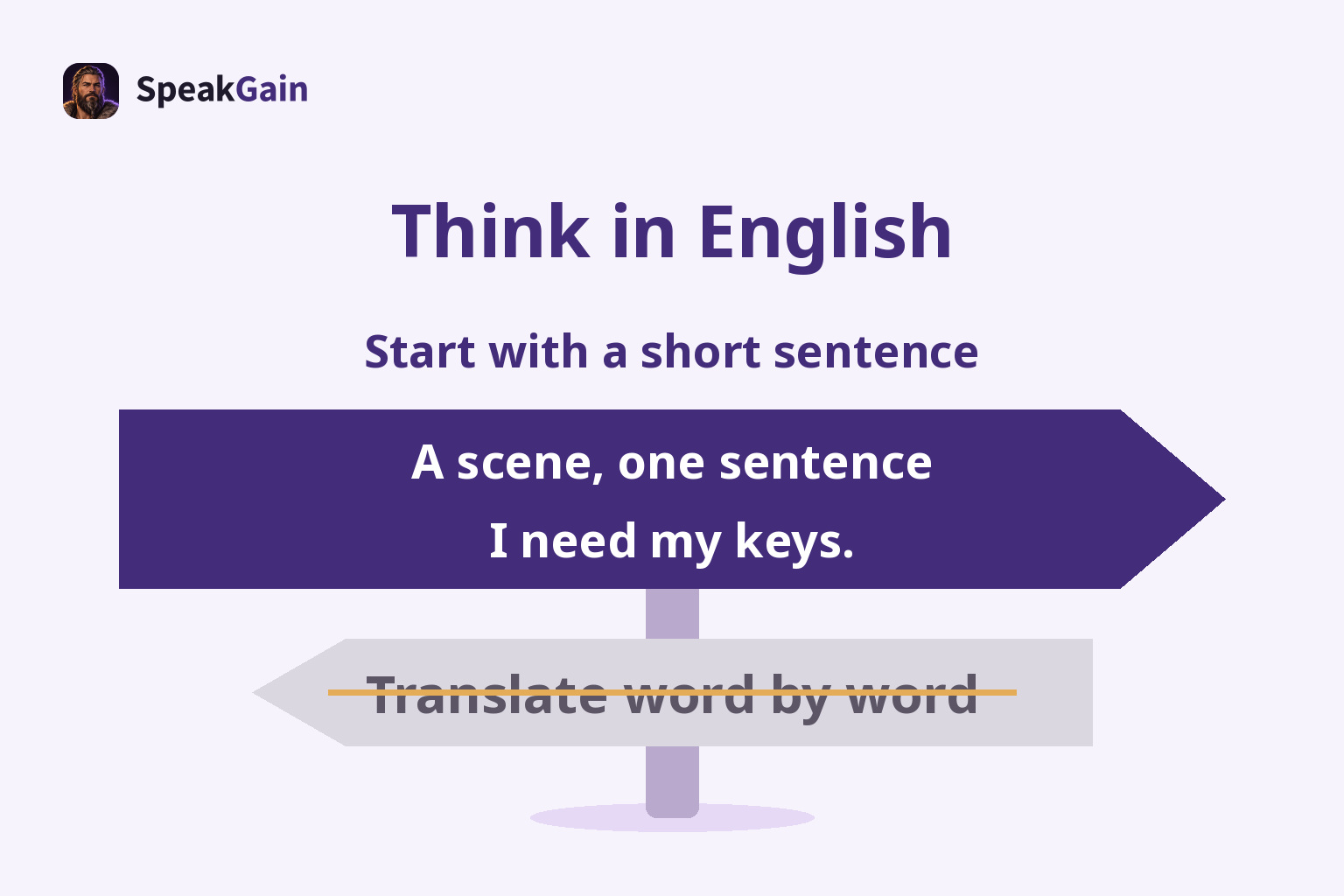
To think in English with less mental translation, build a small set of short sentences you can say directly from familiar situations. We use “thinking in English” to mean expressing simple ideas in English and connecting useful phrases with scenes and sound, not acquiring a different kind of brain. Our suggested starting routine is about ten minutes a day: choose one everyday sentence, check its meaning and sound, hide the words, say it from the situation, and record a short attempt.
Your first language does not need to disappear. If you want a drink, being able to say I want some water. is already a useful target. If you regularly pause to compose a long sentence in your first language and then translate every word, start with smaller messages. This is a study-method guide, not a comparison of schools, courses or apps. For the wider sequence, see how to study English.
Add paraphrase practice: describe an object’s purpose without using its name.
Four exercises for less translation
Our order is objects and actions → a sentence with sound → a scene without writing → a short recording. The times below are editorial suggestions, not experimentally established optimal doses.
| Method | What to do | Daily time | When to use it | Caution |
|---|---|---|---|---|
| Describe an object or action | Say what you do with one familiar object | 2 minutes | Home, errands, getting ready | Do not stop at naming it |
| Check a sentence with sound | Check meaning and form, listen, stop and speak | 3 minutes | A frequent request or explanation | Hearing it is not saying it |
| Speak from a scene | Hide both the translation and the sentence | 2 minutes | You keep composing in your first language | A picture can suggest several meanings |
| Record a short monologue | Say two or three sentences and correct one point | 3 minutes | Linking sentences and finding pauses | Do not judge speed alone |
If yesterday’s sentence will not come out, revisit it before adding five new ones. The useful question is whether you can say something you need with less support.
What does “thinking in English” realistically mean?
Here it describes a practical learning target, not a medical diagnosis or a measurement of brain structure. We do not base these exercises on claims about the right hemisphere, age cutoffs or a switch that changes your brain.
There are three observable targets: more familiar sentences you can say without reconstructing a translation; simple ideas expressed as short English sentences; and phrases practised with a situation and their sound. For a longer message, try I’m busy now. and I’ll reply after lunch. rather than translating an elaborate explanation all at once. If the second sentence is missing, practise that part.
Instead of monitoring whether a word in your first language entered your mind, record what you did: “I described where the keys go.” Saying a rehearsed sentence does not show that you can discuss every new topic without translation.
Method 1: put everyday objects and actions into sentences
Why: an editorial way to make the content easier to choose
An object in front of you gives you something definite to talk about. This is our practice design, not an experimental finding that English labels remove translation. Start with a key, water or a bag so that choosing a topic does not compete with forming the sentence.
How
- Pick one object you handle today.
- Check an unfamiliar word’s meaning and pronunciation in a dictionary.
- Make a short sentence about your usual action.
- Say it when you use the object. If you cannot speak there, do the speaking later.
Example
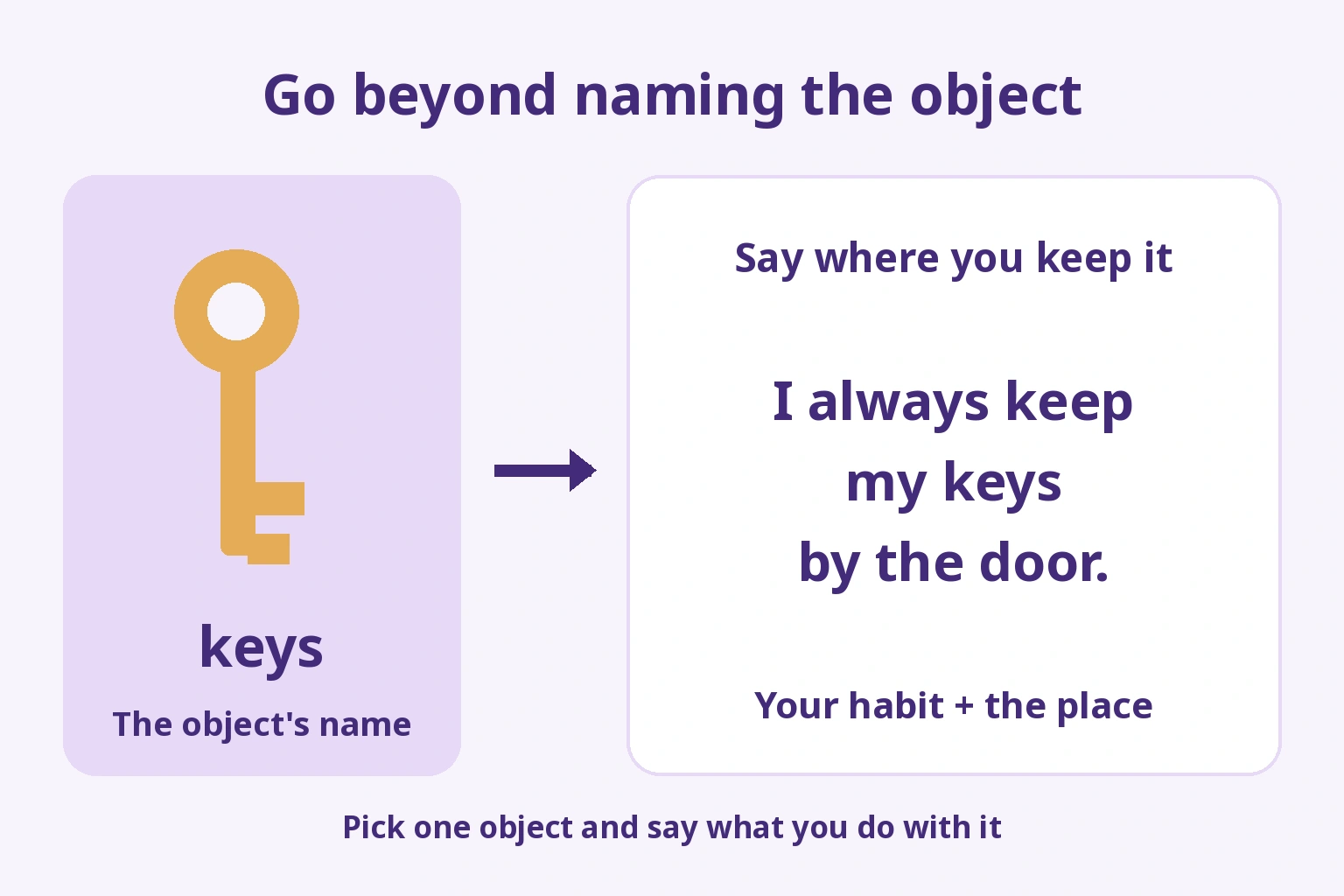
I always keep my keys by the door.
This describes your usual storage place, near the door.
The sentence says more than keys. It includes a habit and a location. For an action happening now, I’m putting my keys here. describes something different. You do not need to learn both on the first day.
Common mistake: collecting labels without using a sentence
Recognising the name of an object is different from describing what you do with it. Before labelling the whole house, use one object in one sentence. Check a verb’s example usage, not just a one-word translation. Choose one practice cue, such as putting your keys away, rather than requiring English commentary all day.
Method 2: connect a useful sentence with meaning and sound
Why: separate understanding from producing
If you understand a sentence on the page, add a turn in which you retrieve it yourself. DeKeyser’s 1997 study involved 61 people learning an artificial language, followed by eight weeks of comprehension and production practice. Production involved typing a sentence for a picture. The reported learning was skill-specific and gradual. Original abstract
We use that distinction to inform our editorial choice to separate checking from retrieving. It is not a direct test of this spoken routine, English conversation or a “brain” effect.
How
- Choose one sentence you actually want to use.
- Check who does what, its form, and whether it describes a habit or a current action.
- Listen, stop the audio and say it. Check a smaller chunk if needed.
- Hide the writing and say it while imagining the situation.
- Tomorrow, try before opening the writing or playing the model.
If you have no model audio, use a reliable dictionary or suitable material with audio to check uncertain sounds.
Example
Break the key sentence into I always keep my keys / by the door. for checking. If you can say the first part but omit the place, look at the actual location and practise the ending. Then join the sentence again. How to memorise English sentences expands the check-and-retrieve process.
Common mistake: counting replays as successful speaking
Ten plays do not equal ten independent attempts. Stop the model and say the message yourself. If the meaning is unclear, return to the text and a translation. You can still enjoy background listening, but it does not establish that you can retrieve a sentence. See passive listening: conditions and limits.
Use SpeakGain to save and listen to one useful sentence
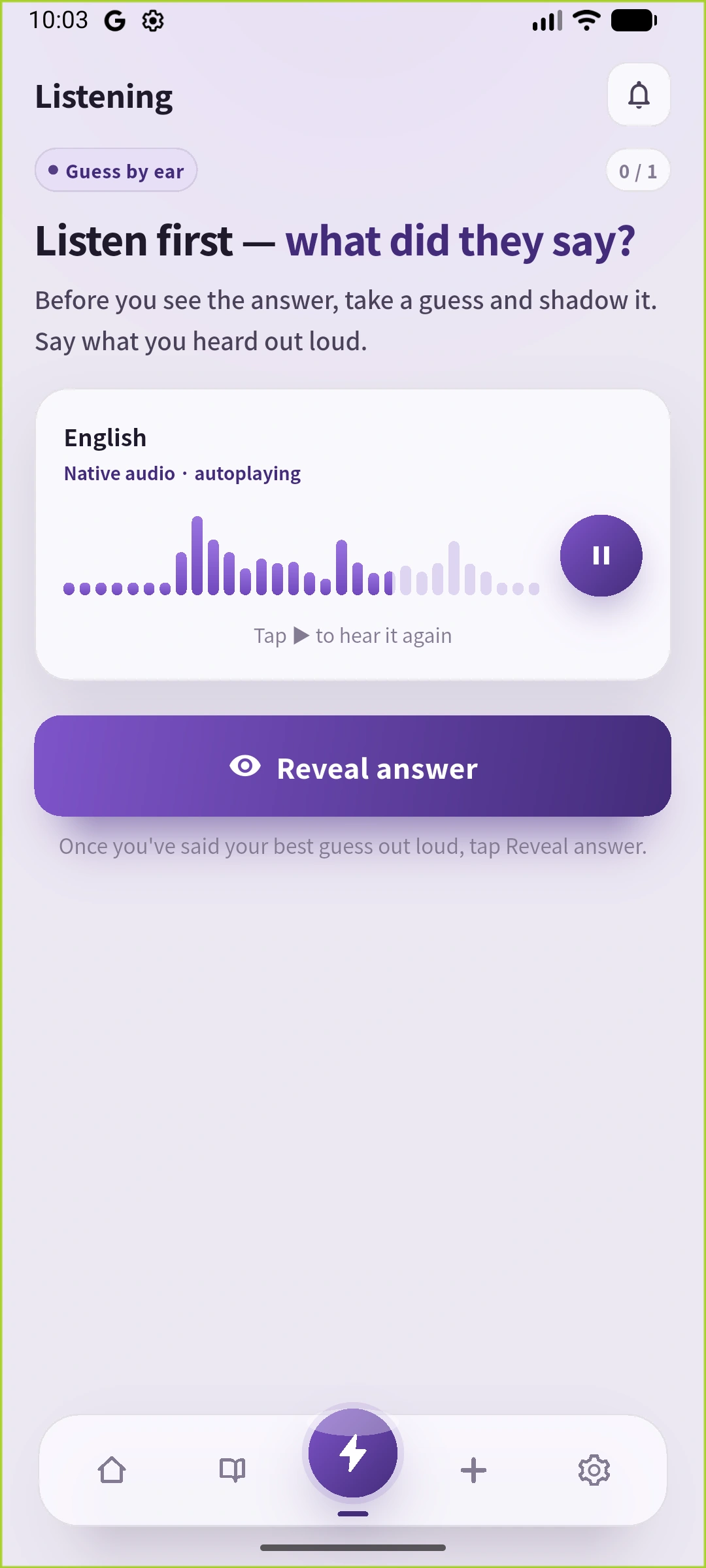
We saved the keys sentence once through the normal Add flow and checked the study screens on the device. From Knowledge in Card library, Learn this card opened Listening / Guess by ear with the sentence hidden. Reveal answer then showed the saved sentence in Answer.
Answer displayed playback and the Record and check entry. We verified that entry, not a submitted recording or a pronunciation result. You can use an ordinary recorder for the monologue in method 4. See what SpeakGain is for its role. These screens do not demonstrate an English brain, brain change or a learning outcome.
Method 3: remove the translation prompt and use a scene
Why: our editorial suggestion to practise with the intended cue
A conversation does not always give you a written translation prompt. We therefore suggest a final turn using a situation instead. This is not proof that picture practice eliminates internal translation.
Instant English composition can help you practise known sentence forms from a meaning prompt. Keep that useful step; then hide the first-language prompt too and choose a message from the scene.
How
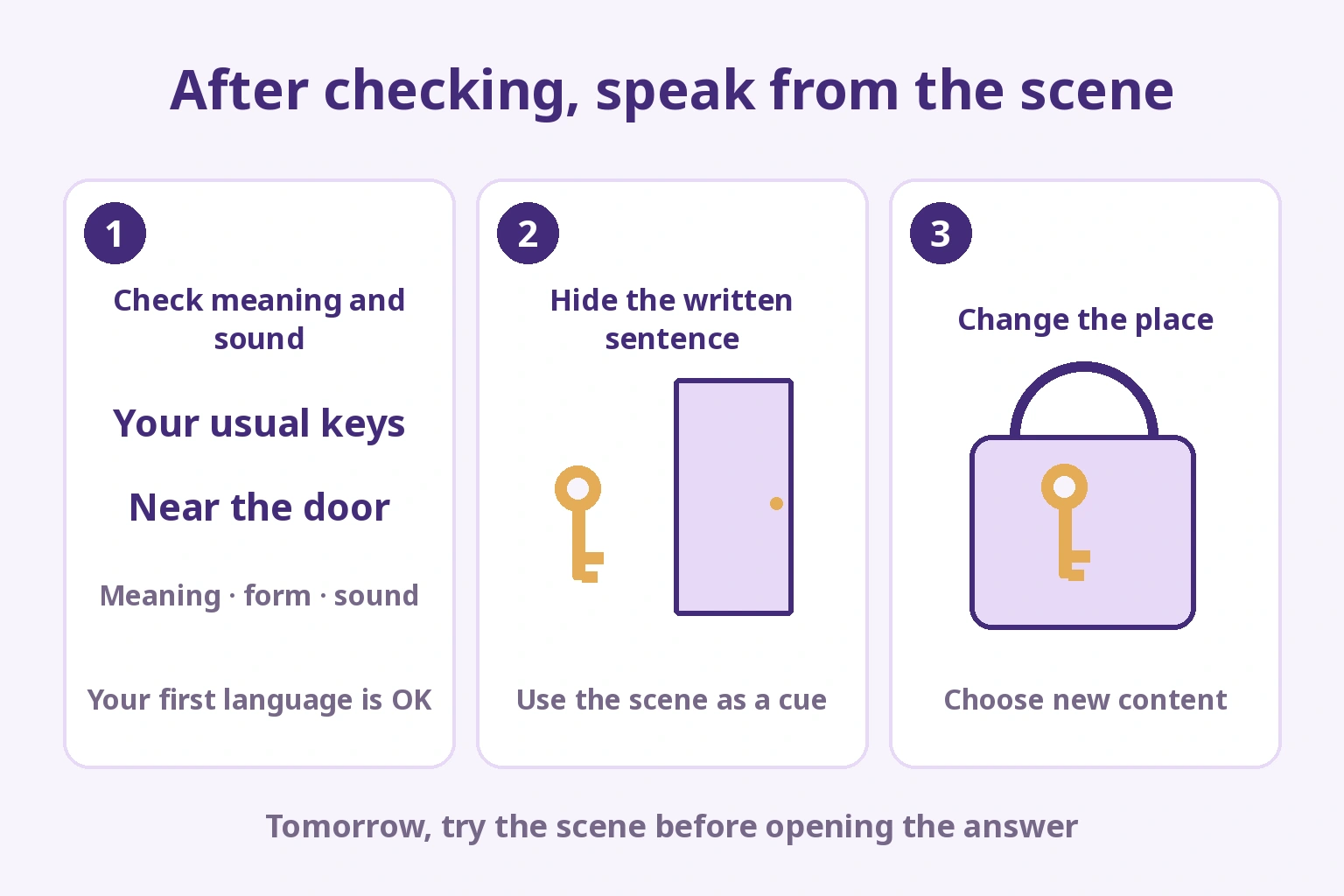
- Use your actual keys near the door, or your own photo.
- Decide that the message is the usual storage place. You may clarify this in your first language initially.
- Hide all writing and say it from the situation.
- Change one location and choose the appropriate content again.
Example
I always keep my keys in my bag.
Now the usual storage place is inside your bag.
Changing the place also changes by the door to in my bag. If your real storage place is a drawer, check how to express that. Reciting an untrue habit is not evidence that you can explain your own routine.
Common mistake: treating a picture as a single-answer question
One picture can support a name, a current action or a habit. Clarify what you are trying to communicate. A different sentence is not automatically a memory failure. Keep the objects few and the language familiar rather than spending the whole session looking up vocabulary.
Method 4: record a short monologue and correct one point
Why: repetition evidence and our reason for recording are different
There is relevant research on repeating spoken tasks, but recording alone does not guarantee improvement. Lambert, Kormos and Minn’s study, published in 2017, had 32 Japanese learners of English perform instruction, narrative and opinion tasks six times each. Immediate repetition of the same task was associated with fluency gains. Original abstract
That does not establish that a daily 30-second monologue improves every unfamiliar conversation. Our editorial use of a recording is to hear a pause or omission and select one correction. Trying changed content tomorrow is also our suggestion.
How
- Pick your current state or next action.
- Record two or three familiar sentences; 20–30 seconds is a starting guide.
- Listen and find one incomplete part or meaning error.
- Check it and say the same message again.
Example
I’m getting ready to leave. I need my keys.
You are preparing to go out and need your keys.
If the first sentence stops at I’m getting…, check getting ready to leave. Tomorrow, explain a situation involving your bag instead.
Common mistake: deleting an attempt without keeping the correction
Before recording again, note what you will change. “I stopped before leave” is useful. Faster speech that drops information is not the goal. Solo practice does not test how you hear and respond to another person; also create opportunities to use the content in conversation. The speaking roadmap helps connect those stages.
A daily ten-minute plan
Finish one useful sentence rather than continually expanding the list. These are editorial timings.
| Time | Task | Check |
|---|---|---|
| First 2 minutes | Try yesterday’s scene; on day one choose a sentence | What came out before checking? |
| Next 3 minutes | Check meaning, form and sound; stop and speak | Does the message match your action or habit? |
| Next 2 minutes | Hide the writing; change one place if ready | Did you choose content rather than read? |
| Last 3 minutes | Record a short monologue and correct one point | What will you check tomorrow? |
On a busy day, reduce this to checking and one hidden-answer attempt. If speaking is impractical during your commute, prepare there and speak later. A weekly review is a schedule suggestion, not a deadline for progress. Separately note rehearsed sentences, next-day retrieval, changed content and actual conversational use. If in my bag is where you stop, check that phrase. When English words will not come out helps distinguish missing vocabulary, sentence form and speaking difficulty.
Methods we do not recommend as your only approach
- Translation-only vocabulary memorisation: useful for meaning, but add a sentence you can retrieve.
- Uncomprehended audio for hours: listening duration does not establish understanding or independent speaking. Stop and check a short part.
- A complete ban on your first language: use it to resolve meaning and grammar, then remove the prompt for one attempt.
- All-day, difficult self-talk: start with one familiar routine rather than making every thought a dictionary task.
- A fixed “English brain in X days” deadline: these studies give no universal completion date. Preserve meaning instead of racing.
FAQ
Can adults learn to think in English?
Adults can use more directly available short sentences as a practice target. We do not diagnose an “English brain” by age. Start with a known form and a useful situation.
How long does it take to translate less?
There is no single timetable. Existing vocabulary, grammar and use differ. Track what you can say from a scene and with changed content.
Is thinking in my first language bad?
No. It can help with meaning and complex content. If long mental translation slows replies, remove the prompt only for the final short-sentence attempt.
Should I use an English-only dictionary?
Use one if you understand its explanation and examples. A bilingual dictionary is fine when needed. Using the word in your sentence matters more than the dictionary category.
Does talking to myself help?
It gives you a way to form, check and repeat short sentences. Add a recording and one correction; separately practise interaction with another person.
What if I lack vocabulary?
Look up one word needed for today’s sentence and use it. If the words are known but word order is missing, check the sentence form instead.
Why do I stop aloud when I can say it mentally?
Include an actual speaking turn. Stop the audio, check a difficult chunk, then join the full sentence.
Should grammar come first?
Check the grammar if the sentence is unclear even when you see it. If you understand it but cannot retrieve it, add speaking practice. You do not need to choose between studying all grammar first and ignoring it.
Editorial verdict: expand useful sentences, not a brain label
Choose a sentence from your life, check meaning and sound, say it from the scene, and record one correction. That changes the question from whether your first language vanished to whether you could communicate today’s message with less help. Try the keys sentence today, try it before checking tomorrow, then change the location. Treat the missing part as the next practice target, not a failure to acquire a special brain.
Sources
- DeKeyser (1997): Beyond Explicit Rule Learning — Original abstract inspected. Artificial-language comprehension and typed production, not this ten-minute speaking routine.
- Lambert, Kormos & Minn (2017): Task Repetition and Second Language Speech Processing — Original abstract inspected. Immediate same-task repetition, not proof of transfer to every new topic or brain change.