
Does passive listening help your English? Conditions, beginner material and one sentence a day
Published
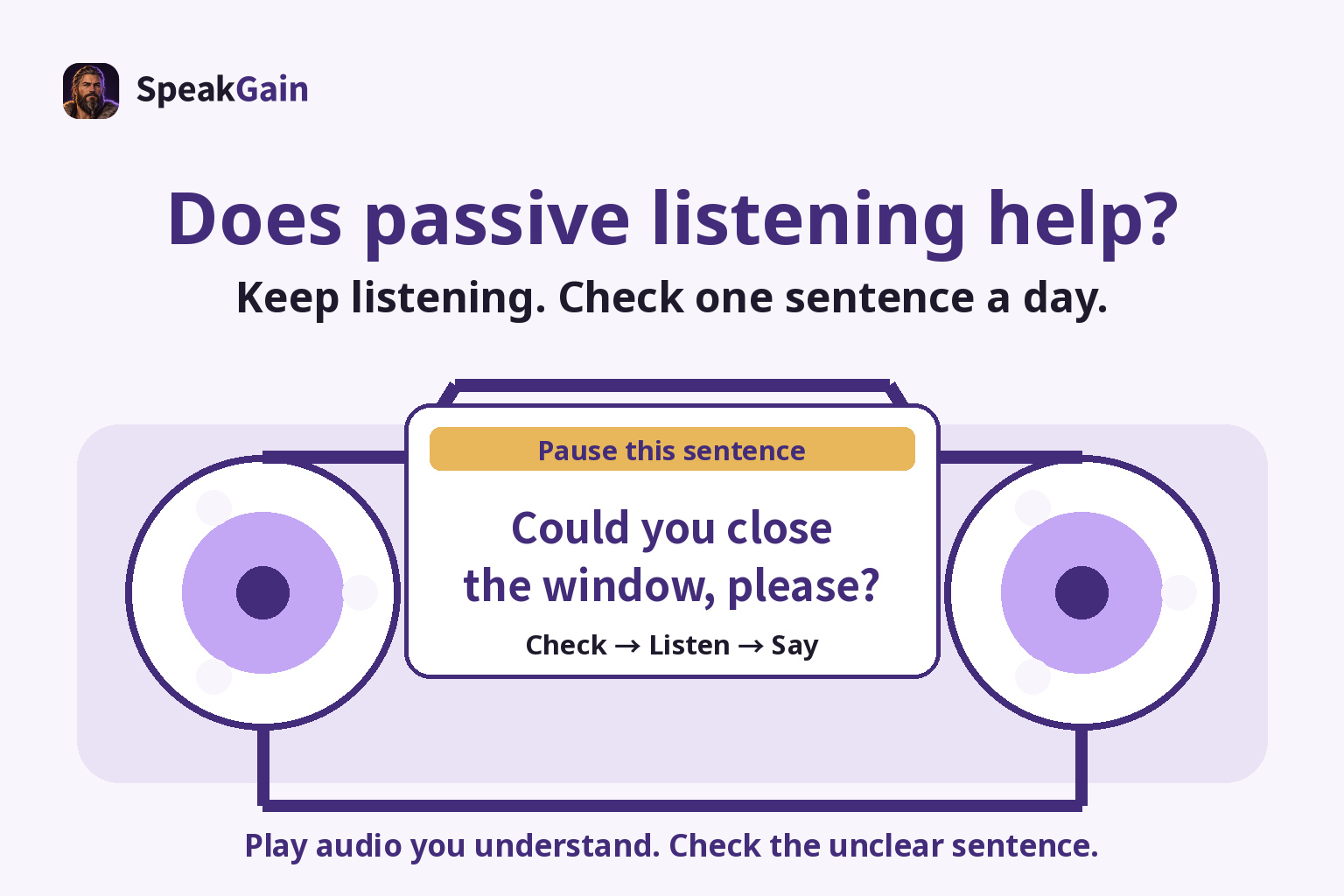
Passive listening can be useful as extra contact with English when much of the material is understandable and you sometimes follow its meaning. That does not mean playing mostly incomprehensible audio will, by itself, teach you to understand conversations or speak. Our editorial recommendation is to keep enjoyable listening and add one sentence a day: check the transcript, replay the same audio, then stop and say it.
You do not need to abandon the podcast you enjoy while commuting or doing housework. Enjoying a programme and investigating a missed phrase serve different purposes. Record listening time if it helps your routine, but also ask what you understood and which uncertain word you checked.
This article concerns adults learning English. Research findings and our practical suggestions are identified separately. For tools, see our listening-app guide; for a broader practice plan, see how to improve English listening.
Does passive listening work? Separate the activities first
The label “passive listening” does not tell us what the listener actually does. One person follows a story while folding laundry; another barely notices that speech is playing. Those are different learning situations, even with the same recording.
| Activity | What happens | Our editorial use |
|---|---|---|
| Background playback | You cannot say what the recording was about | Keep it for enjoyment, but do not make it your only practice |
| Listening while doing another task | You sometimes follow the topic and meaning | Use easy material as additional contact with English |
| Replaying checked material | You hear phrases whose meaning you already confirmed | Return to familiar expressions |
| Checking one sentence | You compare words and audio and investigate a gap | Add a short focused practice session |
Do not turn an experience of following meaning into evidence that completely unattended sound teaches language. In research, incidental learning can mean learning without an intention to memorise vocabulary; participants may still be paying attention to a story. “No memorisation task” and “no attention” are not interchangeable.
Our editors would retain listening for enjoyment and repeated contact, then set aside a small check. Trying to turn every minute into an exercise may be impractical. Choose the sentence you will investigate rather than demanding perfect attention throughout a programme.
When it may help—and when expectations should be lower
Choose material you can understand, sometimes attend to, and revisit with a transcript. This is our interpretation for practical use, not a proven combination that guarantees improvement.
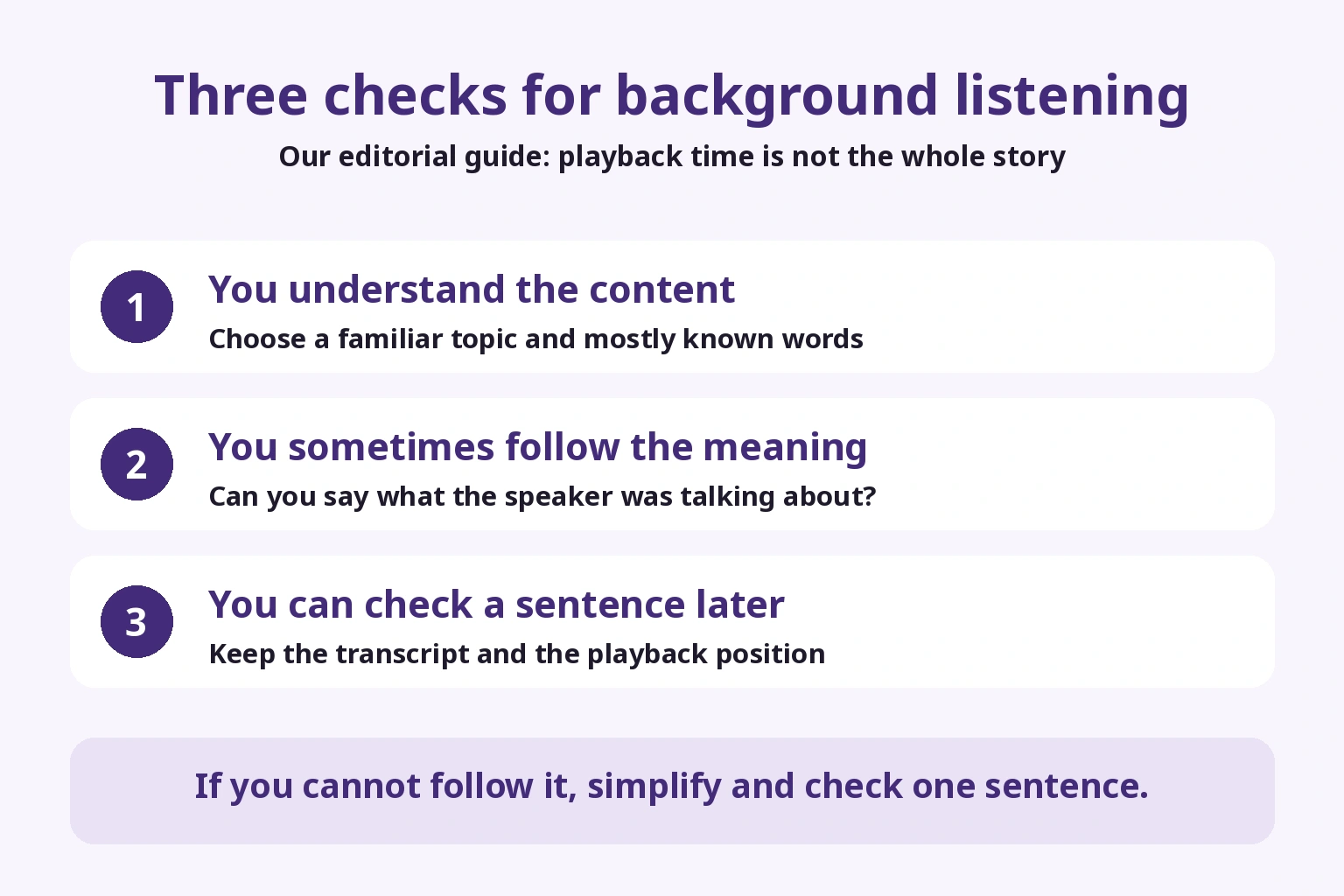
Understandable material gives you something to follow
Check whether a short section makes sense before adding hours of playback. Familiar vocabulary and a recognisable topic give you a way to connect sound with meaning.
Van Zeeland and Schmitt tested 36 native and 40 non-native listeners using four informal narratives with some words replaced by nonwords. Many non-native participants understood factual information at 90% lexical coverage, but results varied substantially; variation was lower at 95%.The original study
This was a study of known-word coverage and immediate comprehension, not an intervention showing that playing 95%-understood audio during housework improves listening. Its short narratives do not automatically represent fast discussion or specialist news. Vocabulary coverage is also not the same as the percentage of a message you understand: grammar, topic knowledge and recognising spoken words matter.
Recognising a sound is different from recalling its meaning
A word sounding familiar does not establish that you know what it means. In a separate study, the same authors measured word-form recognition, grammatical recognition and meaning recall after listening. Form recognition developed ahead of meaning recall.The vocabulary study
Participants were listening to English stories, not simply leaving audio unattended during work. We therefore reject both sweeping claims: that listening contributes nothing, and that repetition inevitably makes unfamiliar meanings clear. Check what a familiar-sounding word means in a short sentence.
The research inspected here also does not directly prove long-term maintenance from background playback. We use replay as a way to meet familiar expressions again, and test retention separately by listening without the text.
If meaning disappears, add a check rather than more hours
When you cannot describe the topic and never investigate unknown words, our editors would lower expectations and simplify the material. Schmidt’s paper discusses noticing, attention and incidental learning, including cases where the task directs attention despite no deliberate intention to learn vocabulary.Schmidt’s paper
This is a theoretical paper, not a trial establishing a daily listening dose or a percentage loss from divided attention. We do not turn the debate into “unattended audio can never teach a single word.” Our practical response is to make an uncertain part observable with one sentence.
If answering emails leaves you unable to follow the recording, change the combination. Even an apparently simple physical task may occupy your attention. Pause occasionally and ask whether you can give the gist; the name of the task alone does not settle it.
Beginner material: four checks before you choose
Start with short audio, an accurate transcript and language you mostly understand in writing. A “beginner” label, a slow voice or a long playlist is not enough.
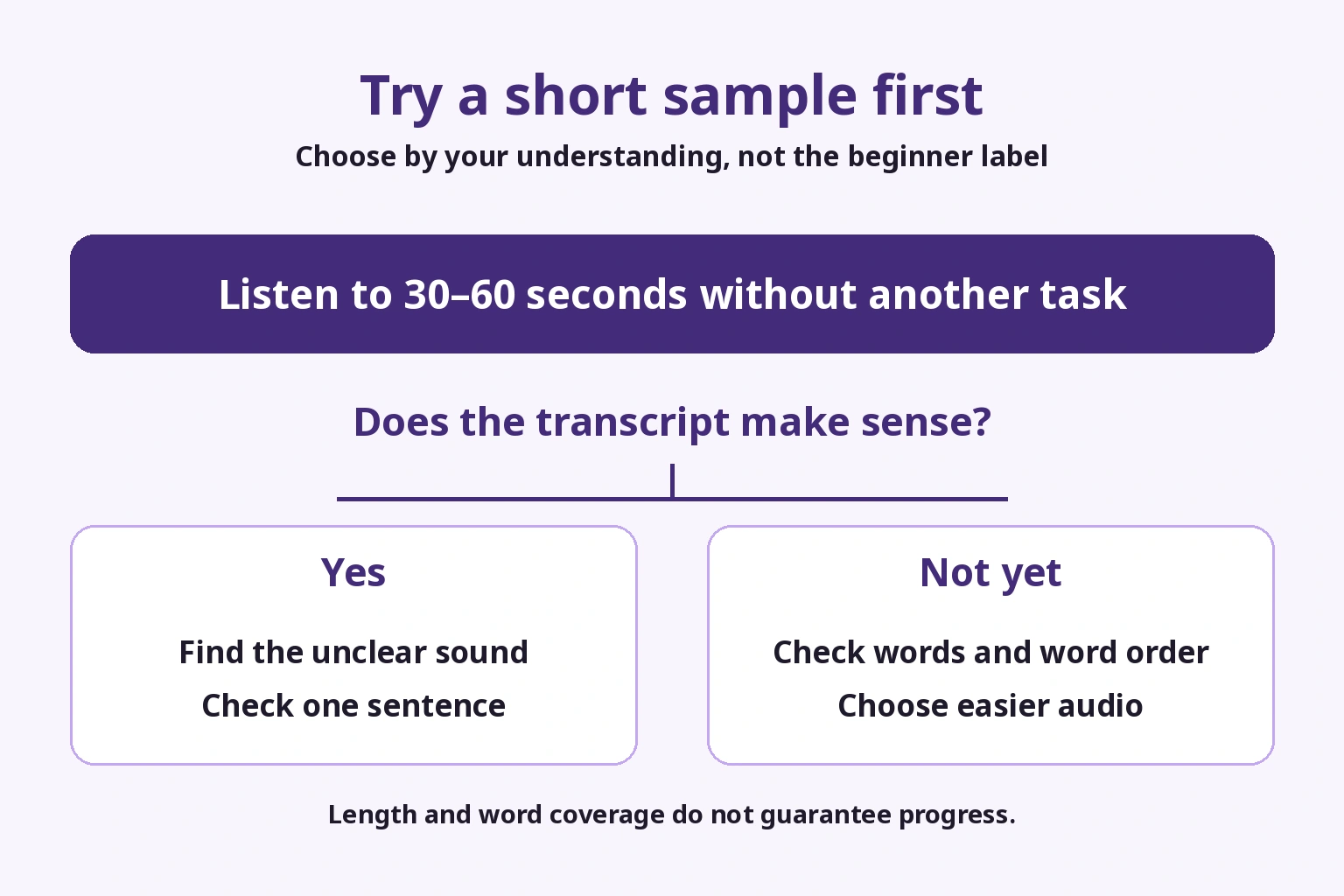
1. Try 30–60 seconds without another task
Can you say who is doing what? This sample length is our starting suggestion, not an effective-dose threshold. A familiar situation—shopping, making plans or eating—may be easier to follow.
If you catch isolated words but cannot tell whether the speaker is requesting or explaining something, read the transcript. If it still makes no sense, choose easier material. If the text is clear but the audio is not, select a sentence to investigate.
2. Look for where meaning stops
Aim for mostly familiar language with a small number of checkable gaps. As a practical first filter, our editors might choose a sample with roughly one unknown word in twenty. This draws on vocabulary research; it is not a validated beginner pass mark.
One unknown central verb can block meaning even when every other word is familiar. An unknown person’s name may not. Prioritise whether you understand the event over mechanically counting words. If you know all the words but miss the message, inspect word order and spoken recognition.
3. Keep a reliable transcript and a way back
Check that you can return to one sentence later. A short learner dialogue, easy story or audio textbook can work. You need not analyse the entire episode, but you do need the selected sentence and its position.
Automatic captions can disagree with speech. Our editors prefer a publisher-provided transcript for a beginner’s first check, rather than material requiring the learner to correct captions too. Overlapping voices, music or mismatched text add unnecessary uncertainty.
4. Choose a topic you want to hear again
Interest helps you choose; difficulty still needs checking. If news on your favourite subject is too hard, try a learner explanation of that subject. Keep films and songs for enjoyment while choosing a separate, easy sentence for investigation.
| Material | A possible beginner entry | Check first |
|---|---|---|
| Audio textbook | A short dialogue you have studied | Does the written sentence make sense? |
| Podcast | A short learner episode | Are transcript and playback position available? |
| Video | Clear, brief conversation or explanation | Caption accuracy, background sound and overlapping speakers |
| App audio or phrase card | A sentence you want to revisit | Is it for continuous listening or sentence practice? |
See our listening-app guide for tool comparisons. Here, choose by whether you can finish checking today’s sentence.
Add one sentence a day: four steps
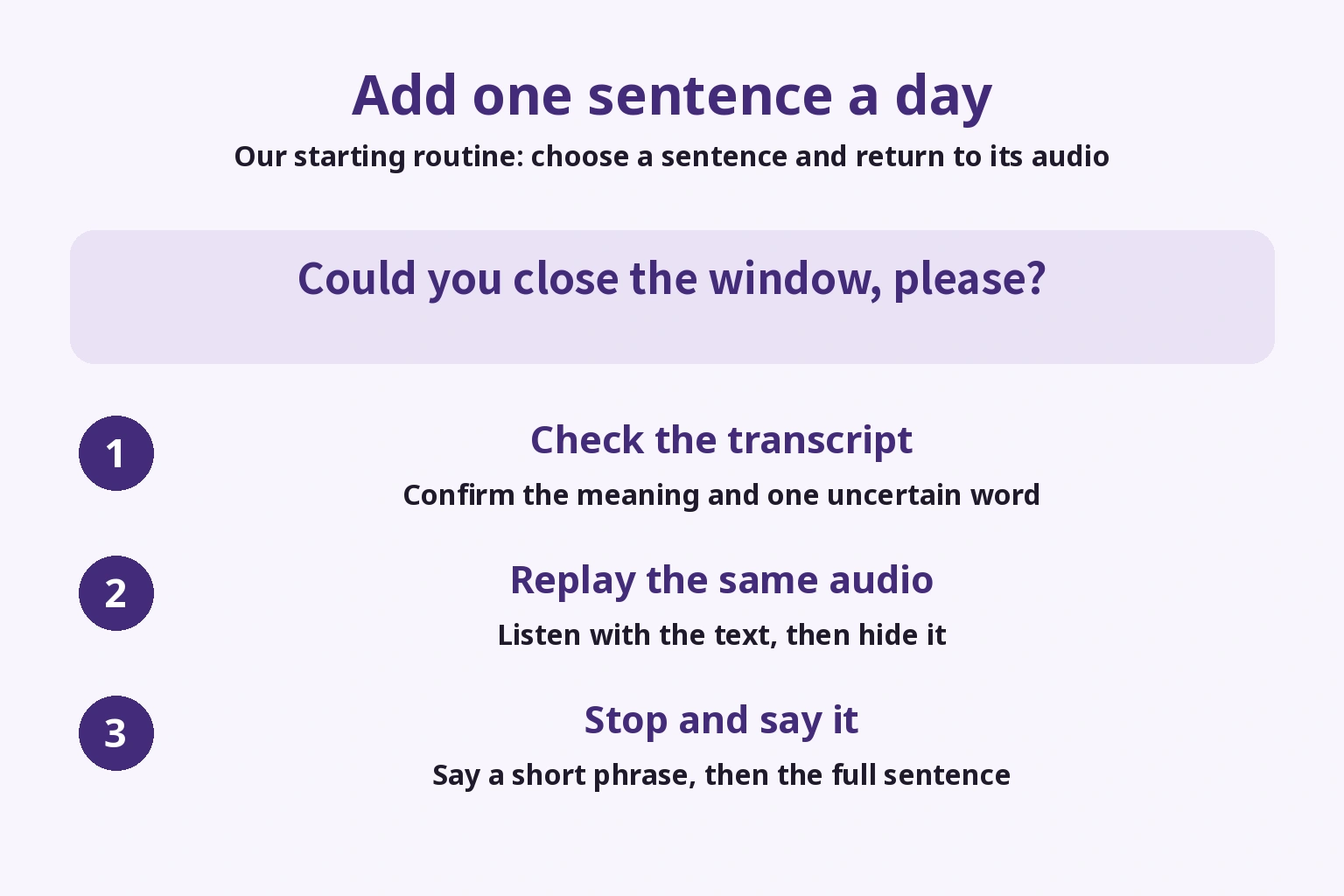
Check the link between meaning and sound in one short sentence. One sentence a day is our manageable starting routine, not an optimum established by research. The aim is to preserve one specific uncertainty rather than turn a whole programme into homework.
Step 1: Select a short sentence and its position
Choose something slightly unclear in sound but understandable in writing. Note the playback position and the situation, so you can return to the original speaker. Follow the material’s terms when saving or sharing it.
Our practice example is a request to close a window. It was written for this article, not taken from a programme:
Could you close the window, please?
First listen without reading. Can you identify the request? If you catch only close and window, note those words and the unclear part; a full transcription is optional. For more detailed investigation, see the dictation method.
Step 2: Check the transcript and one uncertain part
Read for meaning, then choose one gap. Could you introduces a request; close is the action; the window is the object; please accompanies the request. Here close is a verb meaning to shut, not the adjective meaning nearby.
If you heard “close window,” check the article the. If the action was unclear, confirm close the window first. Do not attribute every difficulty to connected speech: vocabulary, grammar or sound may be involved. Leave a note such as “listen for the between close and window,” rather than merely copying the answer.
Step 3: Replay the same audio, then hide the text
Listen once with the transcript and once without it. Find the uncertain word within close the window, not only in isolated dictionary audio. Match the actual speaker’s sound to the words instead of inventing a fixed phonetic spelling.
If the sentence remains unclear, shorten the section. Slowing it briefly can help inspection, but also return to the original speed. Note what you could confirm, rather than requiring an immediate perfect answer.
With your own material, return to its original recording first. Recognising the same words in AI speech does not prove you understood the original speaker. This article’s model is for trying the routine with our example.
Step 4: Stop, say it, and listen again tomorrow
Pause the audio and say the sentence on your own. Beginners can repeat after a pause before trying to follow simultaneously. If close the window is difficult, practise that phrase and return to the sentence.
Our starting suggestion is 3–5 minutes for the whole check and two or three spoken attempts. Neither time nor repetition count guarantees progress. If checking vocabulary takes all the time, shorten the sentence or choose easier material.
Tomorrow, listen without the text first. After roughly a week, distinguish practised sentences from new, easy requests. Understanding the familiar example is worth recording, but may partly reflect remembering the answer; it is not evidence that unfamiliar conversations are now clear.
Where SpeakGain fits: save the sentence after listening
Use SpeakGain to save a selected phrase, guess from audio, reveal the answer and move toward speaking. We entered this sentence through the normal Add → Add a card flow and verified it on the dedicated article device.
From Knowledge, Learn this card opened Listening / Guess by ear with the English hidden. Reveal answer opened Answer, where we confirmed the sentence, meaning, model playback and the Record and check control.
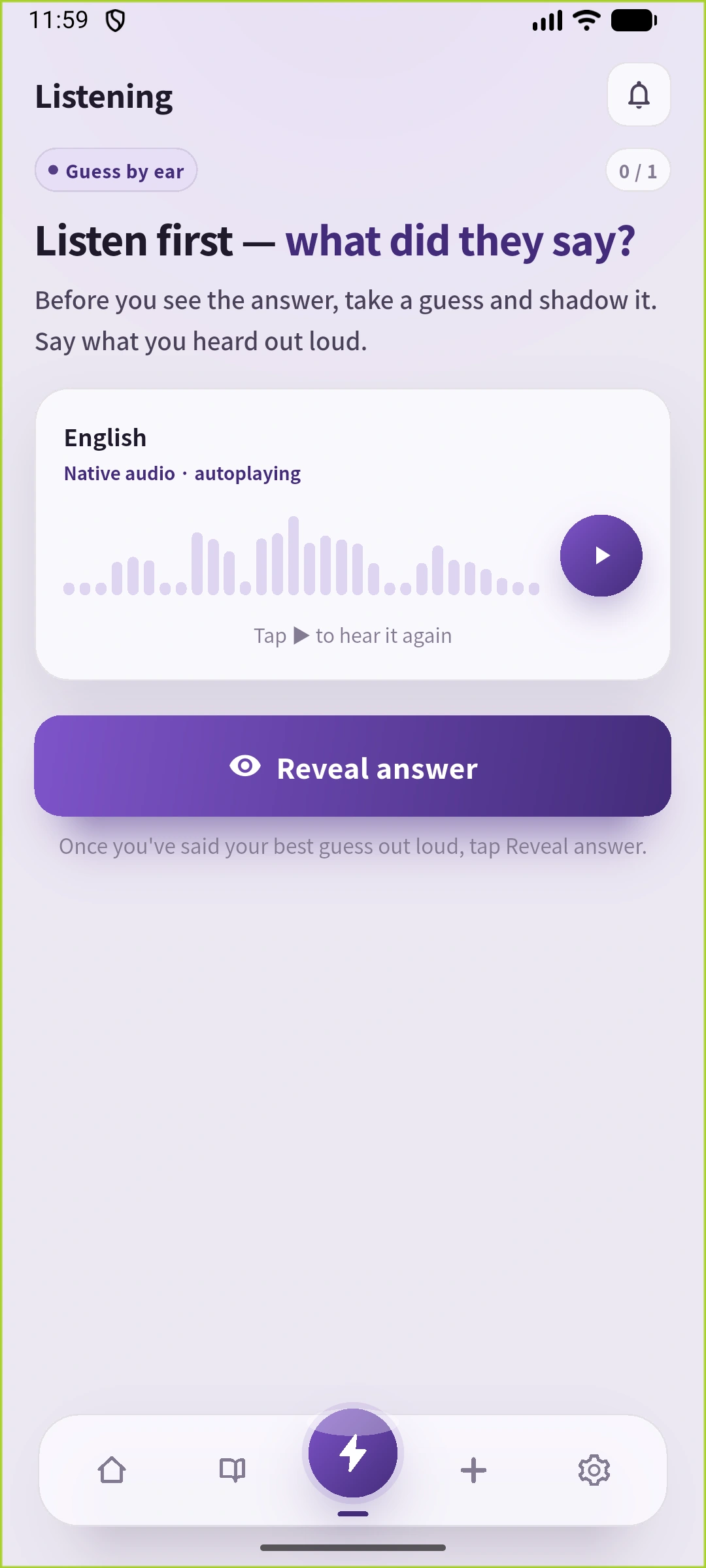
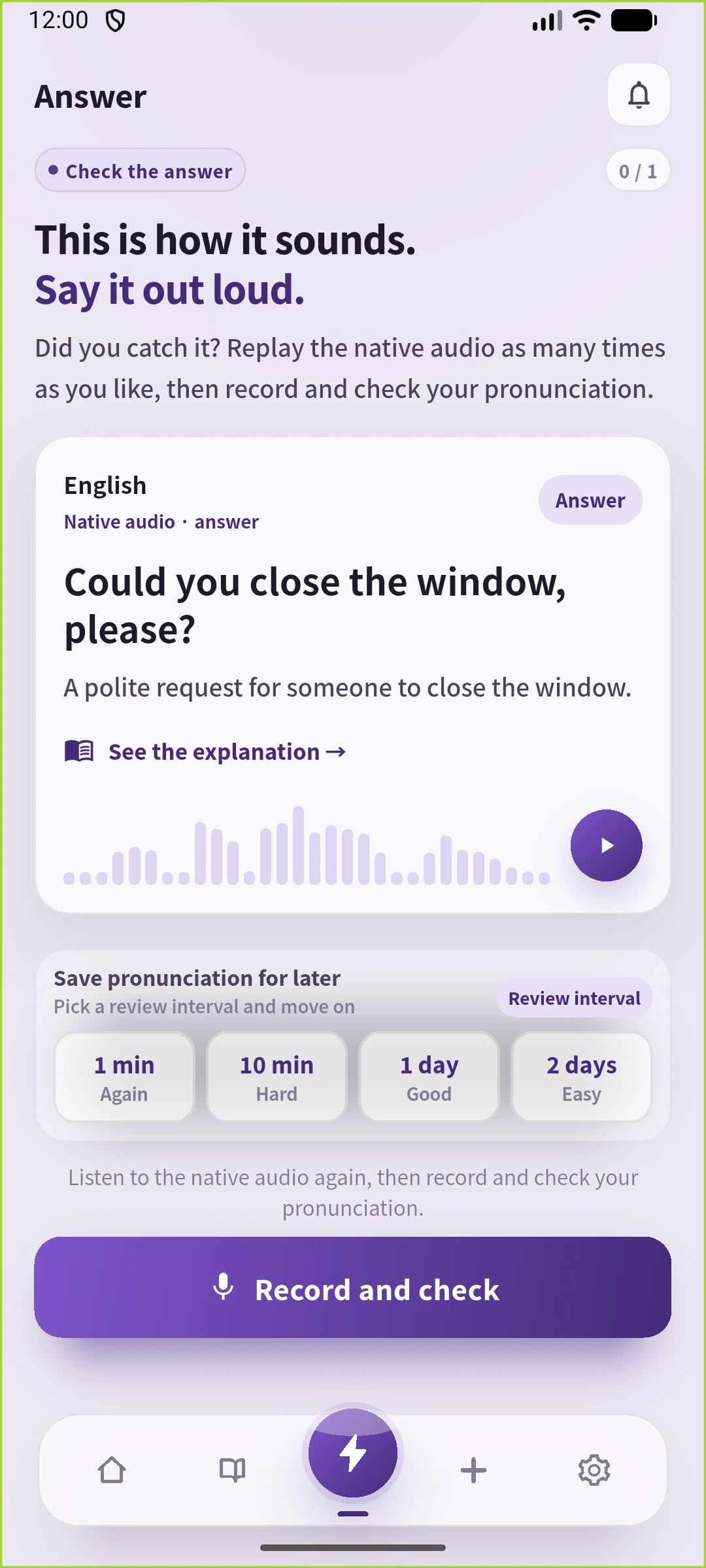
This is the sentence-by-sentence flow we verified. We are not presenting SpeakGain as a passive-listening or continuous-playback mode. Play a programme in its own player, then use a card to check a phrase. See what SpeakGain is for the scope of the product.
Common mistakes and fixes
Review material and the missing step before increasing playback hours. Our priority is finishing one check.
- Choosing difficulty as a badge of good practice: if even the topic is unclear, choose an easier sample. You can still enjoy harder content separately; a test score alone does not determine the right clip.
- Recording time but not understanding: add one line about the request you understood or the word you located. Playback history measures playback, not successful comprehension.
- Listening only to the translation: use it to clarify the situation, then connect the English words to the meaning and replay English alone.
- Saving every uncertain sentence: complete today’s sentence before building a large unchecked collection.
- Treating imitation as conversation ability: imagine the situation and say the request with its meaning in mind. Being able to repeat a model does not show you can select the phrase in conversation.
- Replacing practice with sleep playback: our editors prefer a short check while awake. Limited sleep experiments do not establish conversational gains from overnight programmes.
Once meaning is clear and you can repeat after a pause, the shadowing method explains how to prepare for following a recording aloud.
Frequently asked questions
Is passive listening pointless?
Not categorically. Following understandable content or replaying a checked sentence are reasonable uses. Our editors do not recommend making unexplained, unattended playback your only route to listening and speaking.
Can I learn English while asleep?
Overnight programme playback is not an established route to English proficiency. Züst and colleagues presented pseudoword–German word pairs during a nap. Presentation at particular slow-wave peaks influenced implicit choices after waking.The authors’ abstract
The study measured sleep stage and presentation timing; it did not demonstrate better English conversation from consumer recordings. We avoid both “sleep learns nothing” and “sleep playback teaches English,” and prioritise an awake check.
What should a beginner listen to?
Short, easy dialogues with a reliable transcript. Pick something you mostly understand when written, with a few gaps you can resolve. Slow but unfamiliar language may still be too difficult.
How many hours a day do I need?
The inspected studies do not establish a universal number. Our suggestion is enjoyable playback within your day plus a 3–5-minute sentence check. Look at completed checking and replay, not hours alone.
Should the audio include a translation?
A translation can help clarify meaning. Then return to the English words and the original sound; test understanding with English alone.
Should I repeat the same recording?
Yes, for checking a selected sentence in the same voice. Also try new short material so remembered answers do not become your only measure of progress.
Which app is best for passive listening?
Start with easy material, accurate text and accessible replay positions. For specific tools, see the listening-app guide. This article focuses on method rather than comparing apps.
What if I cannot speak aloud on the commute?
Check and replay first; speak later. Save the sentence and position, then pause and say it at home. Keep track of the unfinished step.
Our editorial verdict: keep listening, pause one sentence
Keep enjoyable listening, but stop to check one sentence each day. We would use comprehensible material for repeated contact without expecting hours of unknown audio alone to fix listening and speaking.
Choose an easy sample, save one sentence and its position, check the meaning and uncertain word, replay the same sound, then stop and say it. Tomorrow, listen without the text. For vocabulary, grammar and a wider routine, see how to study English.
Sources and limits
- Van Zeeland & Schmitt: lexical coverage and listening comprehension — Immediate comprehension of informal narratives; not a background-listening intervention.
- Van Zeeland & Schmitt: vocabulary dimensions through listening — Distinguishes recognition from recalling meaning; does not measure unattended playback.
- Schmidt: consciousness in second-language learning — A theoretical discussion, not a daily-dose trial.
- Züst et al.: vocabulary associations during sleep — Controlled presentation timing and implicit testing; not conversational-English outcomes.
- SpeakGain editorial device check — Product flow and AI audio, not evidence of learning gains.
For shows to use on your commute or during chores, our English-learning podcast guide compares levels, purposes and transcript access, then adds one spoken sentence.