
English dictation practice: who it helps and how to fix missed words
Published
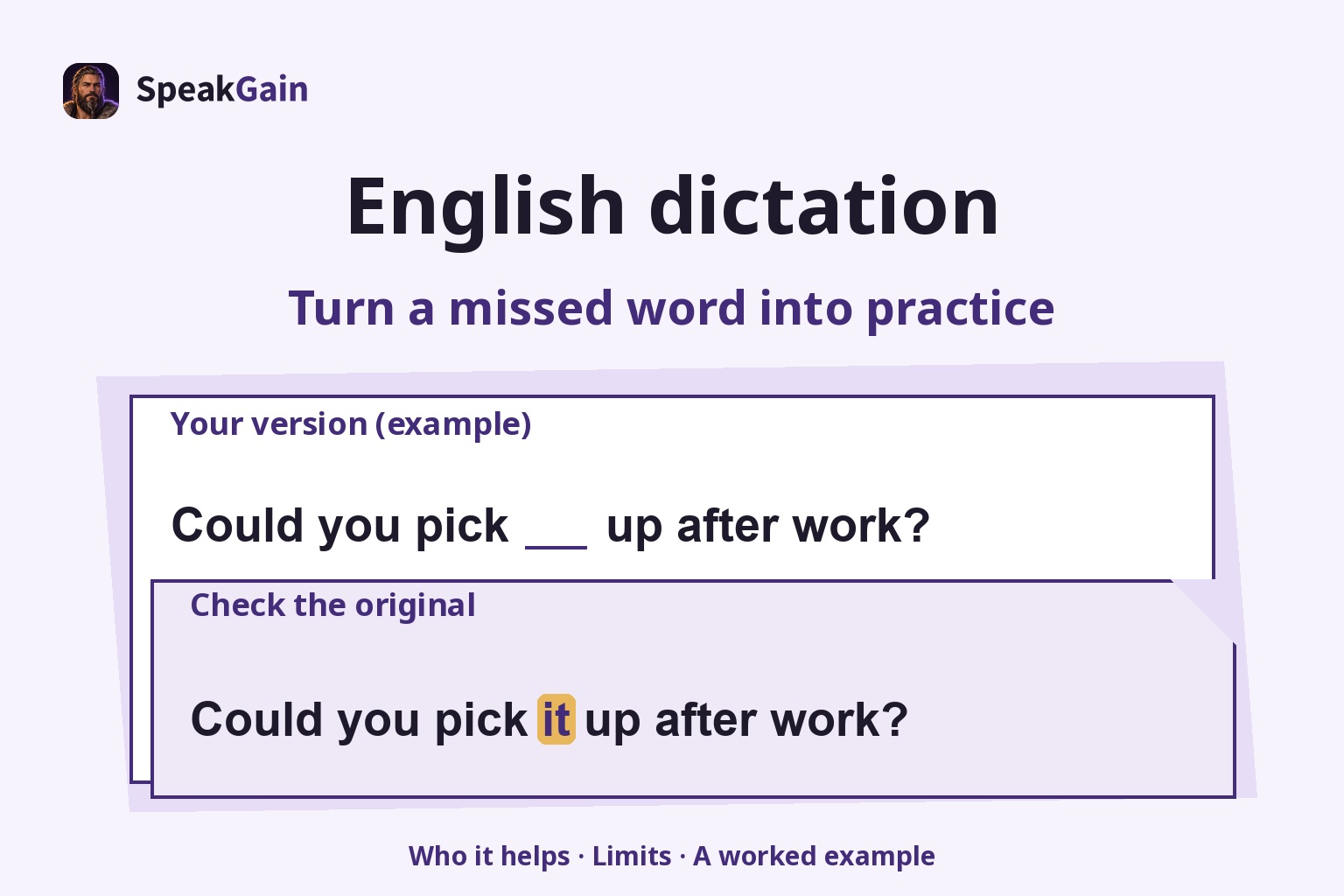
Dictation means writing the English you hear, comparing it with the transcript, and checking the parts you missed. Our editors recommend it when a sentence makes sense in writing but its words disappear in audio. We do not recommend transcribing a long recording full of unknown vocabulary. Start with one to three short sentences in about ten minutes: listen, write, compare, identify the cause, then replay and say the same phrase. That amount is our starting suggestion, not a scientifically established optimum.
The useful result is a specific next action, rather than a page of perfect handwriting. Missing a familiar pronoun calls for a different response from not knowing a phrasal verb. This guide demonstrates the process with one short recording. For tools, see listening apps; for the wider plan, see how to study English.
What does dictation practise?
It makes your interpretation of the sound visible. Keep the answer hidden on the first attempt. Separate words you heard from guesses and gaps, then compare them with a reliable transcript.
| Practice | What you do | What it helps you check |
|---|---|---|
| Listening for meaning | Listen through and identify the message | Who wants what, and why |
| Dictation | Write what you hear and compare | Omissions and substitutions |
| Repeating | Pause, then say a short phrase | Whether you can reproduce it |
| Shadowing | Speak just behind continuous audio | Following the flow of speech |
Our editors combine detail work with uninterrupted listening. In conversation, the speaker continues while you are still writing the previous word. Dictation therefore belongs alongside, rather than replacing, listening for meaning.
Who benefits, and who should change the task?
Ask whether you understand this particular sentence when you read the answer. Years of study are less useful than that test for choosing today’s material.
| Your situation | Our editorial recommendation |
|---|---|
| You understand the text but miss short words | Try a short dictation and replay the surrounding phrase |
| The transcript contains unfamiliar vocabulary | Check meaning and pronunciation first; choose an easier sentence |
| You know the words but cannot explain the structure | Review the grammar before returning to the sound |
| You can repeat the message but forget it while writing | Pause before writing or use a gap-fill |
| You transcribe long clips and never review | Reduce the task to one sentence |
| You write accurately but miss the speaker’s intention | Also summarise the message and think of a response |
A beginner who understands “I am tired.” can start at that level. An advanced learner may only need the one uncertain sentence from a longer recording. Neither needs to transcribe everything. As familiar material becomes easy, our editors increase checks with new audio rather than accumulating copies of the same text.
What is the evidence—and what are the limits?
We use dictation to locate and investigate gaps; we do not promise fluency after a fixed number of days. Teaching guidance, research on listening processes, and evidence for a particular daily routine are different things.
British Council guidance describes comparing a transcription with the original to draw attention to weak forms, linking and elision. It also suggests partial dictation for learners who find a full transcription difficult. This is teaching guidance, not a controlled trial of ten minutes a day.
Field (2008) presented progressively longer ambiguous utterances and examined how listeners revised word-boundary interpretations. Second-language listeners were less ready than first-language listeners to revise an initially mistaken segmentation. The study did not test daily dictation, these five steps, or SpeakGain. Our editorial application is to revisit the surrounding audio after checking the text, rather than keep searching for the word we initially guessed.
Correctly writing a sentence does not establish that you understood its message. A perfect score immediately after repeated listening may also reflect memory of the answer. Record improvement on the practised sentence separately from the first replay tomorrow and performance on a new short clip.
Step 1: choose one short recording with a transcript
You need audio, a trustworthy answer and a way to pause. Paper or a device note is enough. Choose something you broadly understand in writing and can replay as a single sentence.
Our example is a request to collect an item after work. The editors created the sentence and generated it once with SpeakGain’s Deep-voiced Viking. The approximately two-second clip is AI practice audio, not a recording of spontaneous conversation. Listen before opening the answer.
Open after listening: sentence and meaning
Could you pick it up after work?
Could you collect the item after you finish work?
Check that text and audio match. If you read the answer first to judge difficulty, use that attempt as practice rather than an unseen test. Test a fresh sentence later. For a podcast, select one sentence; overlapping movie dialogue, unfamiliar names in news and lyrics make the initial diagnosis harder. See why movie English is difficult to hear.
Step 2: keep the answer hidden and preserve gaps
Listen once for the whole message, then pause to write what you caught. You do not have to write while the audio plays.
Suppose you wrote “Could you pick ___ up after work?” This is an illustrative attempt, not a real learner’s score. A gap already gives you something to investigate. If grammar suggests “it” but you are unsure you heard it, write “it?” instead of treating the guess as certain.
Our editors start with two or three replays: message, missing part, then surrounding sound. This is a practical stopping guide, not an experimentally proven limit. If the gap remains, move to the answer. Beginners can use “Could you ___ it ___ after work?” to focus on only part of the sentence. A temporary note of how it sounded is an observation, not a pronunciation model to memorise.
Step 3: distinguish omissions, substitutions and spelling
Keep the original attempt before copying a correction. Mark missing words, underline replacements and separately note spelling errors.
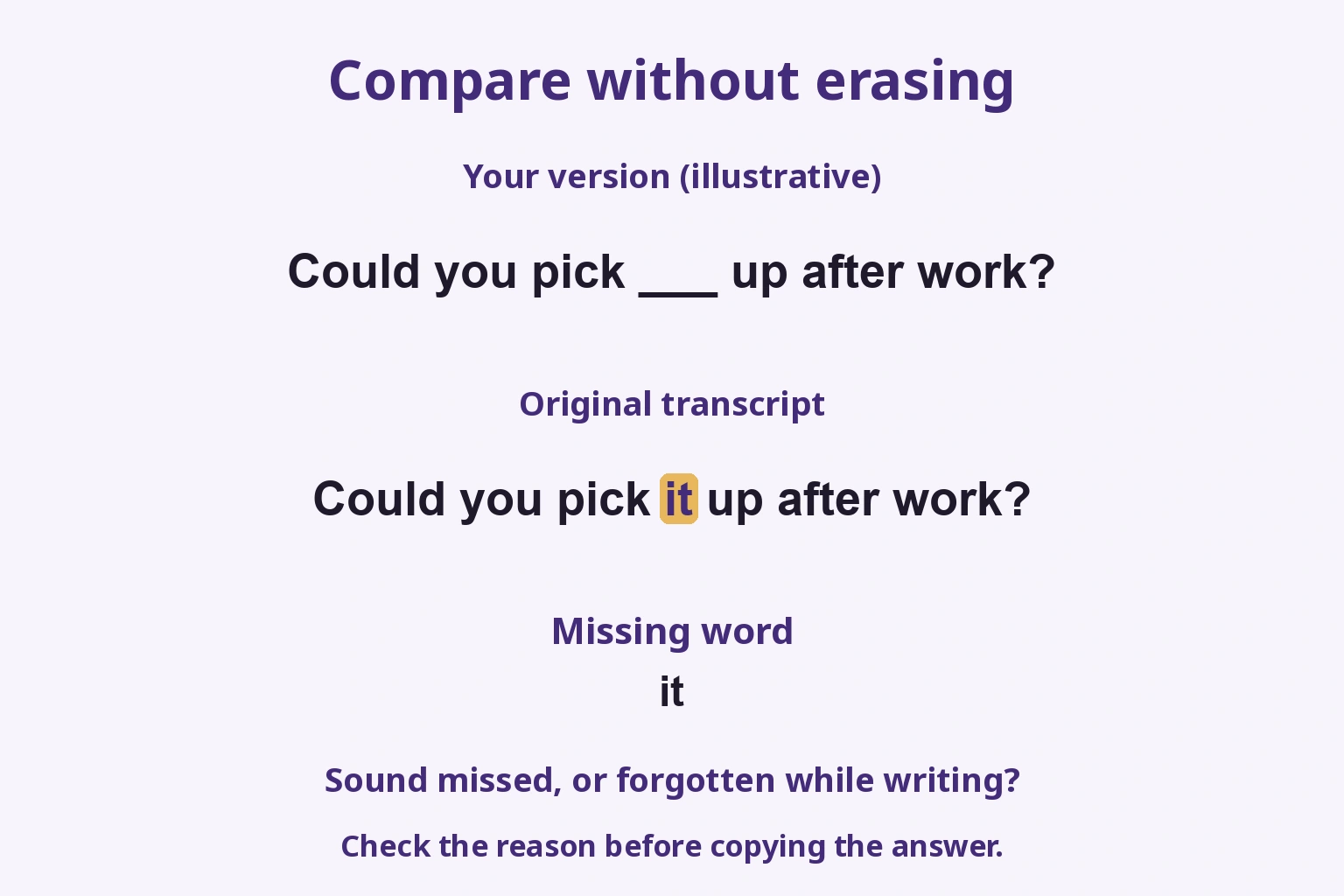
| Your note | Difference | What to investigate |
|---|---|---|
| Could you pick ___ up after work? | Missing “it” | Did you hear it within the surrounding phrase? |
| Could you pick it up after walk? | “walk” instead of “work” | Sound confusion or a contextual guess? |
| Could you pick it up after werk? | Spelling of “work” | Did you recognise the sound and meaning but not the spelling? |
Do not count all three as the same listening failure. If you understood and could say “work” but could not spell it, check spelling. If you guessed the right word without recognising its sound, leave a question mark. For listening repair, a missing full stop and a missed pronoun need different priorities; exam spelling rules can be checked separately.
Step 4: classify why the part was missed
If the text is unclear, check knowledge. If the text is clear but the audio is not, investigate sound and task load. More than one cause may apply. Treat each category as a hypothesis that guides a check.
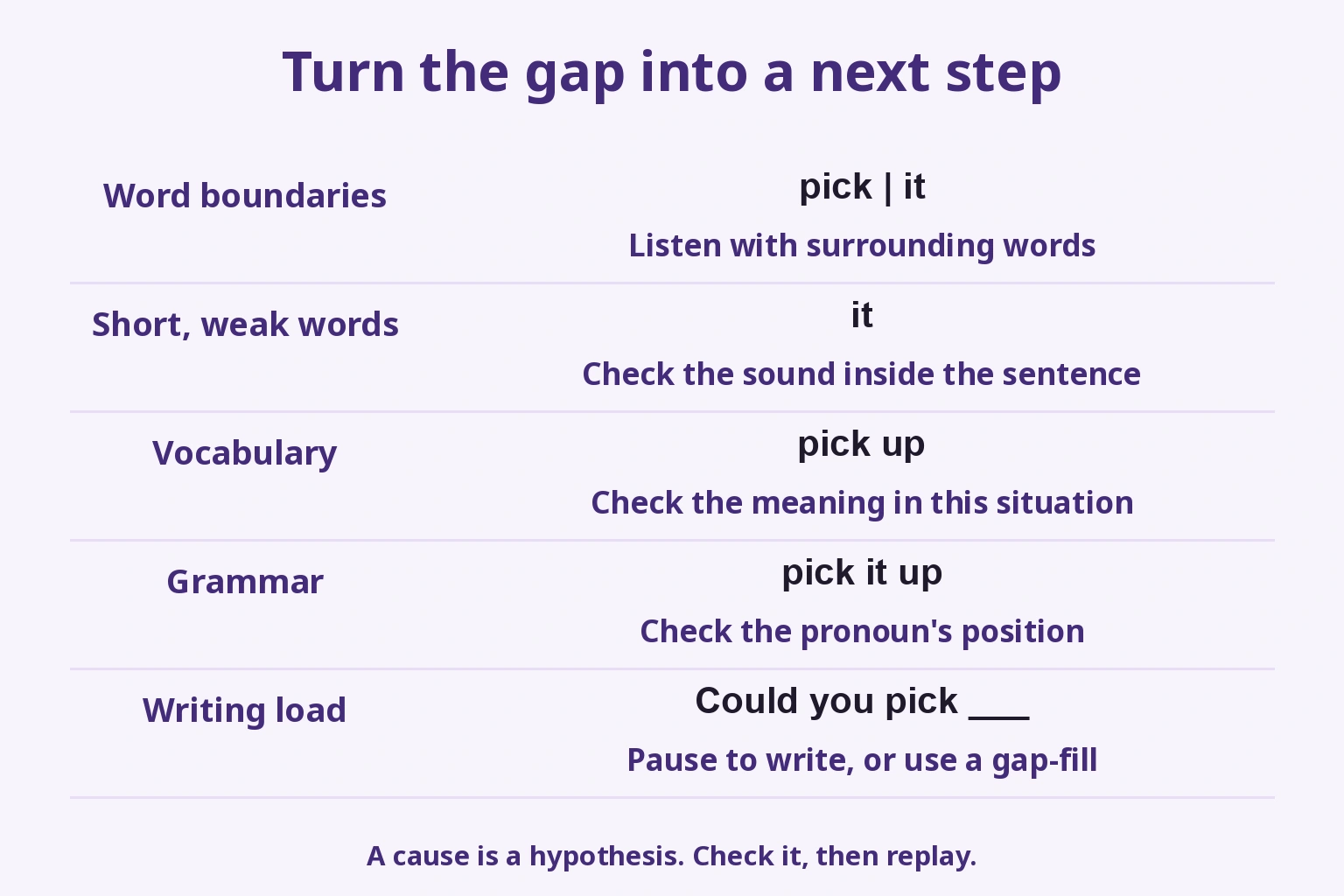
1. Word boundaries and connected speech
Known words may not arrive as separate units. There need not be a printed-space-sized pause between “pick” and “it”. Listen to “pick it up” together and align it with the text. Do not impose a fixed spelling of its sound or claim a particular sound must disappear: speakers and speeds differ.
2. Short, weak words
You may have retained stronger content words but missed a short pronoun. Replay around “it” and “you”. Hearing a dictionary word alone is different from recognising it in a sentence. A boundary problem and a weak word can overlap; your note can name both. Inferring a necessary word from grammar is still different from hearing it.
3. Vocabulary or phrase meaning
If “pick up” is unfamiliar in this context, repeated playback alone does not supply its meaning. Here it means collecting an item. Check that relevant sense and its sound, without memorising every dictionary meaning first. If several phrases are unknown, easier material will make sound problems easier to isolate.
4. Grammar and word order
“Could you” makes a request, “it” identifies the item and “after work” gives the time. With a separable phrasal verb such as “pick up”, a pronoun object goes between verb and particle: “pick it up”, rather than “pick up it”. Check the Cambridge explanation if that order is the difficulty, then return to audio.
5. Writing load or spelling
Failure to write does not always mean failure to hear. If you can repeat the sentence immediately but lose its ending while writing the beginning, pause first, shorten it or use a gap-fill. If you know what is being collected and when but cannot spell “work”, address spelling. Avoid reducing every problem to “bad ears”.
Step 5: replay the original and say a short phrase
The practice is complete when you return to the sound after diagnosis. Reduce transcription volume to leave time for this stage.
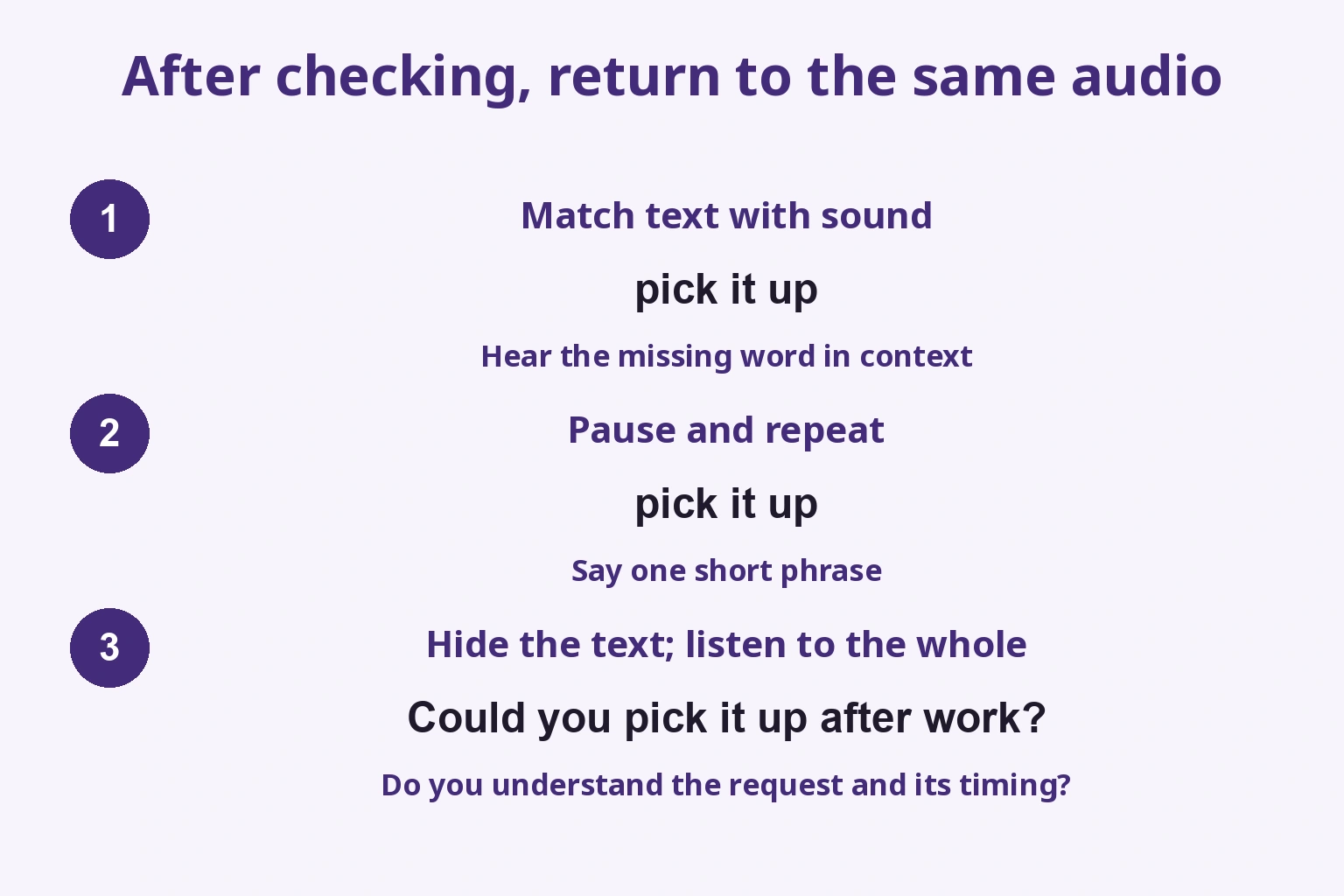
Listen to “pick it up” while reading. Pause and say it once. Hide the text and listen to the whole sentence: can you recognise the request to collect something after work? Repeating with pauses is sufficient initially. Move to shadowing when meaning and sound are clear; see shadowing apps for tools.
Our editors recommend returning to the recording in which the gap occurred. A different AI voice can help practise the sentence, but success with that voice does not prove you understood the original speaker.
Use SpeakGain for listening and speaking after the written attempt
SpeakGain supports the later listen, guess, reveal and speak stages. Save a sentence through the normal Create flow after dictating on paper or in notes. That input saves a phrase; it is not an assessed dictation answer.
On the verified device, the card’s Knowledge screen led through “Learn this card” to “Listening / Guess by ear”, with the sentence hidden. “Reveal answer” opened the sentence and meaning, audio replay and “Record and check”. This listening stage has no typing-based dictation submission mode.
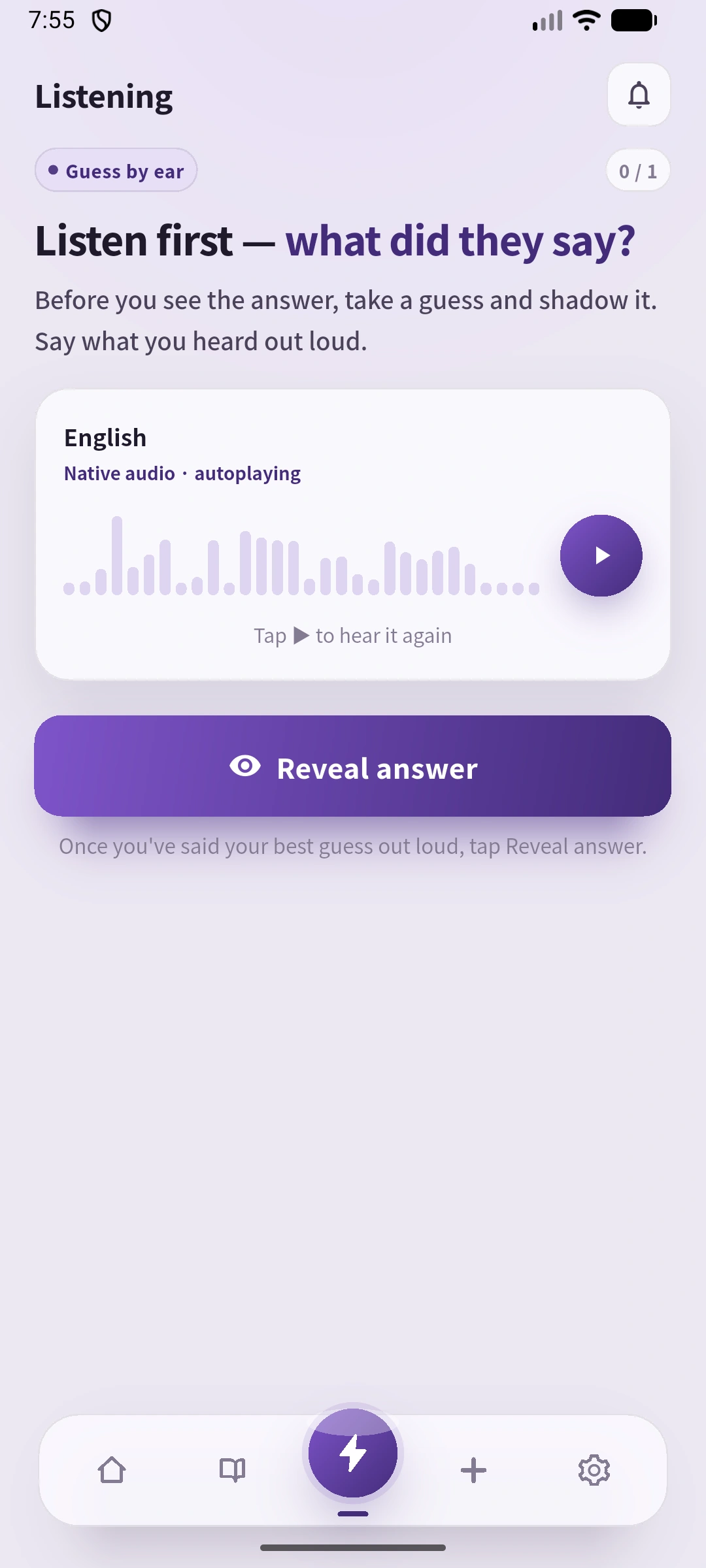
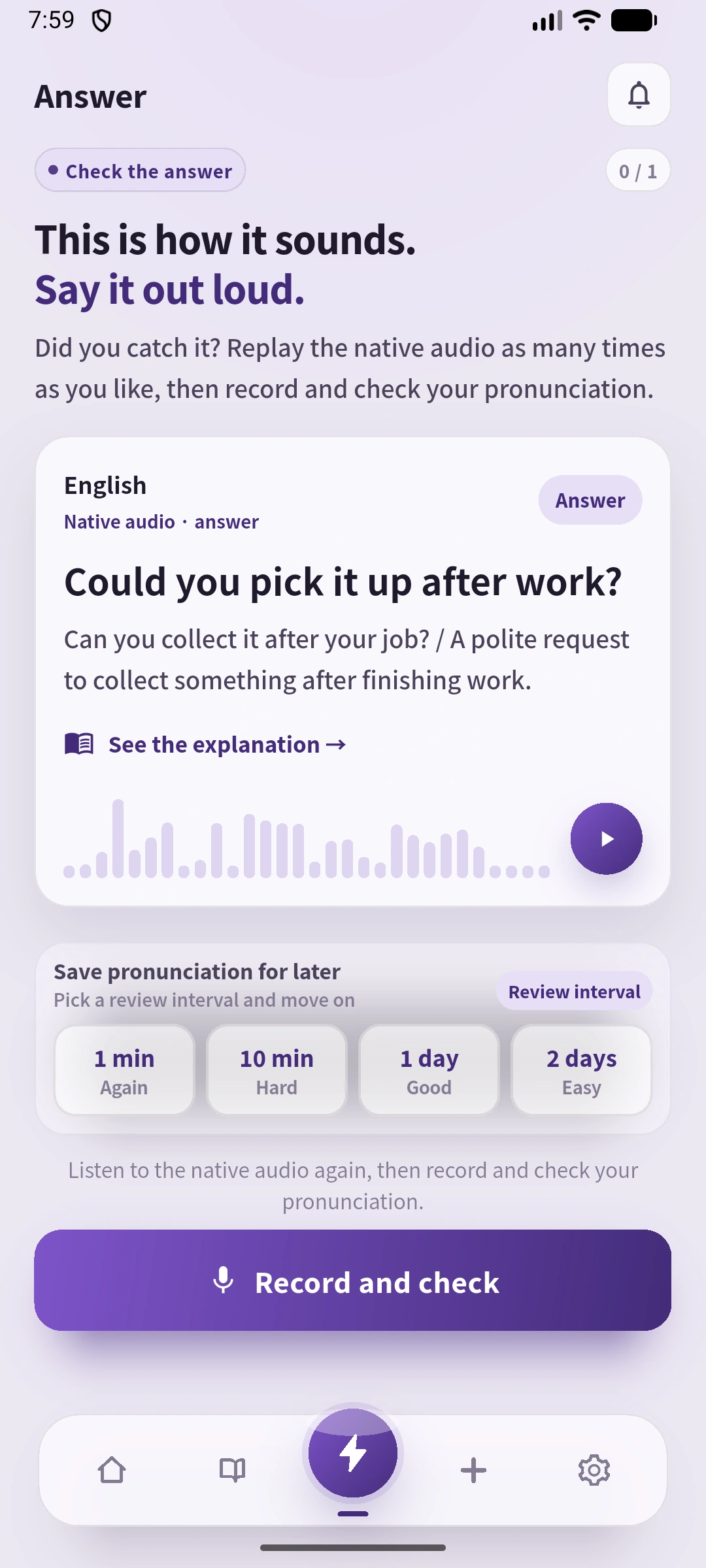
The screenshots show the English interface. This article does not report pronunciation scores or learning outcomes. Keep the original material’s audio if adapting to its speaker matters. Check uncertain grammar against a dictionary or teaching material, rather than treating an app explanation as research evidence. See what SpeakGain does.
How much should you do each day?
Our starting routine is one to three sentences in about ten minutes. It is editorial advice, not a universal optimum.
| Time | Task | Keep a record of |
|---|---|---|
| 1 minute | Choose and listen through | Situation and broad meaning |
| 2 minutes | Pause and write | Words, gaps and question marks |
| 3 minutes | Compare and investigate | One plausible cause |
| 4 minutes | Replay and repeat | Whether you understand without text |
One carefully checked sentence is enough for a session. If nearly everything is blank, simplify the next sentence. Tomorrow, hide the text and listen once before reviewing; also try a new short request. Separate recognition of a memorised example from transfer to unfamiliar speech.
Common mistakes and fixes
Transcribing an entire long clip
Pausing, writing and investigating make even a minute of audio a lengthy task. Select one sentence and finish the review instead.
Finishing by copying the answer
A tidy correction is not an audio check. Pair every correction with replay of the word in context and then the full sentence.
Blaming pronunciation for everything
Read the transcript first. Unknown meaning needs vocabulary or grammar work; familiar meaning calls for sound or load checks.
Counting inferred words as heard words
Keep a question mark when grammar supplied the answer. Recheck the actual sound instead of polishing your score.
Giving up because of spelling
Record sound recognition and written accuracy separately. Our editors suggest avoiding autocomplete on the attempt used to check spelling.
Calling a memorised perfect score progress in conversation
Check the next day’s first replay and new material. Improvement on this sentence is worth recording, but it does not establish general conversation comprehension.
How should you choose material?
Prefer reliable transcripts, sentence-level replay and language you understand on the page. Beginner or intermediate course audio is a good starting candidate. Gap-fill exercises can reduce writing load; a short scripted dialogue can provide an interesting situation. Phrase cards suit revisiting a personally useful sentence. Automatically generated subtitles need checking against audio, and beginners should not have to diagnose subtitle errors as well.
This is a method guide, not an app ranking. Compare tools in listening apps and shadowing apps. First ask whether a tool lets you complete the replay stage.
Frequently asked questions
Is dictation ineffective?
It depends on the target and routine. We recommend investigating familiar written language that you miss in sound, not endless transcription of unknown language or stopping at correction.
How many minutes a day?
Start with about ten minutes and one to three short sentences. Reduce quantity or difficulty before extending a session that never reaches replay.
What material is best?
Short audio with an accurate transcript that you understand in writing. Being able to replay one sentence matters more initially than finishing a whole video.
Dictation or shadowing first?
If you cannot locate the gap, try a short dictation and comparison first. Clarify meaning and sound, repeat with pauses, then shadow. Already-understood sentences do not all require dictation.
Can beginners do it?
Yes, with understood short sentences or partial dictation. If the written answer is unclear, review words and grammar first.
Paper or an app?
Use whichever preserves gaps and makes replay easy. Separate autocomplete-assisted answers from independent listening attempts.
Must I write every word?
No. A gap-fill can target a specific missed word. Our editors prefer reviewing part of one sentence to increasing writing until review disappears.
Does SpeakGain have a dictation mode?
We are not presenting it as a typing-based dictation assessment. Here it is used after an external written attempt to save, listen, guess, reveal and speak.
Our editorial verdict
Use dictation to repair a sentence you understand in print but miss in sound. Judge a session by whether you located the gap, checked a plausible cause and returned to the same audio. Today, leave a gap honestly, compare, then listen without the text and say the short phrase. Increase volume only after that process fits your session.
Sources
- British Council / Amy Lightfoot: Using dictation — Teaching guidance on comparison, sound features and partial dictation; not a daily-duration trial.
- Field (2008): Revising segmentation hypotheses in first and second language listening — Study of revising word segmentation; not a daily dictation intervention.
- Cambridge Dictionary / Liz Walter: An introduction to phrasal verbs — Grammar guidance on pronoun position in separable phrasal verbs.
- Editorial device verification of normal Create and the listening, reveal and recording entry points. App explanations and AI audio are not evidence of learning effectiveness.
If you play English while commuting or doing housework, our passive-listening guide explains how to choose understandable material and add one sentence of checking each day.