
English shadowing: six steps, benefits and fixes
Published Updated
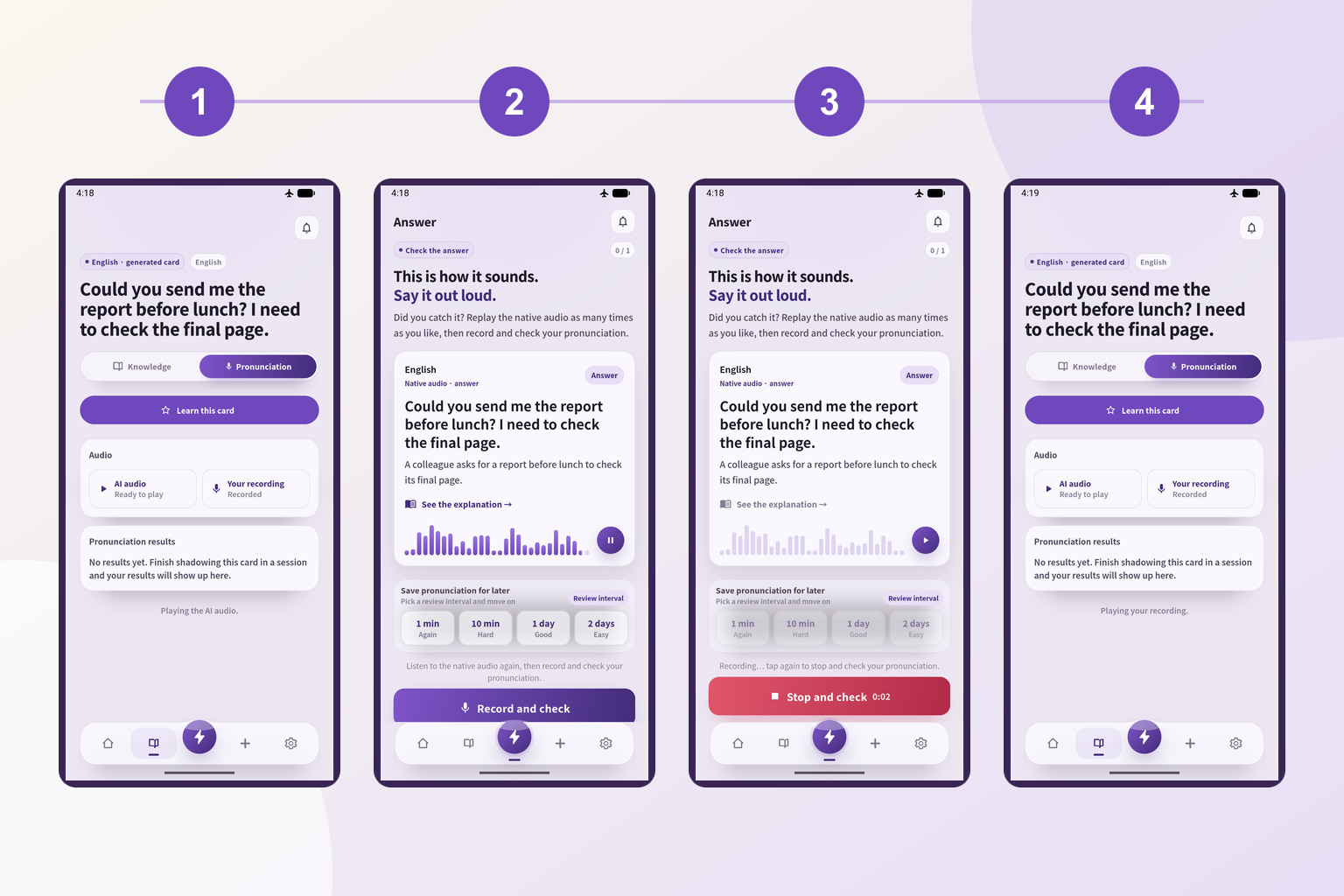
Start with a short recording you understand. Check the meaning, listen without speaking, speak with the transcript, hide it and follow slightly behind the audio, then record yourself and fix one difference. Work through the two sentences below before looking for more material.
Shadowing is a good choice when familiar written words disappear in connected speech, or when you hear the words but cannot keep their rhythm when speaking. If you cannot understand the transcript, study its vocabulary and meaning first. If you understand speech but cannot invent a reply, practise answering questions instead of adding more shadowing.
How to study English: choose by your goal and what stops you
If following the audio obscures emphasis, try one-sentence intonation and stress practice first, marking the text and stopping the model before imitation.
After practising the sounds, try retelling in English to hide the text and reconstruct its meaning from five cues.
Before following audio, choose an understandable short text with a matching recording from our read-aloud material guide.
To choose your solo routine, compare English speaking practice methods by level and goal and select two exercises for your daily menu.
For TOEIC Parts 1–4, use our listening practice guide to identify why a sentence was missed and choose the next drill.
What counts as shadowing?
The model keeps speaking while you repeat what you have just heard. You are listening to the next words while saying the previous ones. Keep a small delay; do not spend the exercise counting exactly half a second or two words.
| Exercise | When you speak | Use it for |
|---|---|---|
| Reading aloud | At your own pace, looking at text | Understanding the sentence and its chunks |
| Listen and repeat | After pausing the model | Repairing a difficult phrase |
| Speaking along | At the same time as the model, with text | Matching pace and phrase boundaries |
| Shadowing | Slightly behind an uninterrupted model | Following and reproducing incoming speech |
Reading along is preparation. The final check is following the audio with the transcript hidden. Pausing to fix a phrase is useful; call that repetition rather than treating it as failed shadowing.
Before following the audio continuously, locate uncertain words with the short example in our dictation method guide.
If following without text is too hard, use synchronized English reading to fix the first drift before returning to shadowing.
Your practice material: a request before lunch
Could you send me the report before lunch? I need to check the final page.
A colleague needs the report before lunch because they must check its last page. We wrote these sentences for this article and generated the model with SpeakGain’s AI voice, Deep-voiced Viking. In the steps below, listen to this voice’s phrasing, stress and rhythm, then compare your recording. You can play or save the audio here.
For your next recording, choose one or two sentences with an accurate transcript, familiar vocabulary, a clear voice and easy replay controls. You should be able to explain who wants what. Avoid overlapping speakers, loud music, unfamiliar names and long monologues at the beginning. For film material, use our guide to learning English with movies to select a manageable scene.
Six steps using the same two sentences
1. Set one target
Listen once. If two sentences are too much, use only the question. Set today’s target to “keep send me the report together,” rather than “sound perfect.” Write down the date, recording, difficult phrase and what changes in the next take. Ten repetitions that drop the same word are different from one repetition that fixes it.
2. Understand the message and its chunks
Could you send me / the report / before lunch?
I need to check / the final page.
The slashes mark meaning groups, not instructions to insert long pauses. Identify the request, the object and the deadline. Then answer: What must the other person send? The report. By when? Before lunch. Why? To check the final page.
If you confuse before with after, stop and clarify it. Here, could makes a polite request; it does not describe a past event. Explain the scene without looking at a translation before you move on.
During the sound practice, you do not need to translate each word in your head. Understanding beforehand and attending to sounds during the exercise are separate jobs. This division follows Hamada’s teaching guidance. Hamada, 2018, pp.20–23
3. Listen without speaking
Hide the words and listen for the report, the deadline and the final page. Then listen with the transcript. If the report is clear but the words before it blur together, mark Could you send me. This turns “I cannot hear English” into a small, testable problem.
Do not overlay your voice yet: it makes it harder to tell whether you missed the model or struggled to produce the sound. Copy what this recording actually does, not a pronunciation rule you assume every speaker must follow.
4. Speak along, then repair the difficult phrase
Read with the model at the same time. Check that you reach before lunch before the next sentence begins. If send me the report breaks down, pause. Listen to that chunk, repeat after it two or three times, then put it back into the question.
A phrase is not repaired until it works in context. If your player offers speed controls, slow it a little while working, then return to the original speed. If you need extreme slowing just to survive the clip, choose shorter, easier material.
5. Hide the transcript and follow behind
Start speaking just after hearing the opening Could you. While you say Could you send me, keep listening to the report before lunch. This is an example of how to get started, not a rule about exactly how many words to lag behind.
Continue into the second sentence. If you start predicting from memory and get ahead of the voice, reset. If you miss a word, rejoin at the next chunk and fix the missed phrase after playback. If almost nothing comes out, return to step 4 with one sentence.
6. Record, compare and change one thing
Listen through headphones while recording your voice. A loud speaker can fill the gaps in your recording with the model’s voice, hiding omissions. Make a short test recording to check that your voice is distinguishable.
Compare the same section in this order: model → your voice → model. Check missing words first, then unintended pauses, then stress and the ending.
| Check | What to listen for | Next attempt |
|---|---|---|
| me and the remain audible | You jump from send to report | Repeat send me the report, then restore the sentence |
| before lunch stays together | A long gap after before | Practise the deadline as one chunk |
| final page is complete | The ending fades or becomes rushed | Practise sentence two alone, then both sentences |
An example note might say: “Take one: dropped me. Take two after repair: me is present, but I pause after before.” This is an illustration, not a learner testimonial. Keep one improvement and one next target.
What the research actually measured
Hamada’s 2016 study involved 43 Japanese university learners and nine lessons. Tests included a 20-item dictation cloze and 22 listening questions. Both proficiency groups improved on the phoneme-perception measure; only the lower group improved on the high-school-level listening questions. Sound perception and comprehension did not move identically. Original abstract
In Hamada’s 2014 classroom study, 56 students took eight lessons over a month. The 24 students practising after content study improved from 6.33 to 7.17 on a 13-question listening test. That was a significant within-group change, not proof of a difference between groups; allocation was not random. Understanding first is our practical recommendation, informed by these results and the teaching guidance. Full paper, methods and Tables 3–5
Foote and McDonough followed 16 university-level English learners for eight weeks, with at least four ten-minute practices a week. Twenty-two English speakers rated imitation and picture-based speech. Imitation, comprehensibility and fluency improved; accentedness did not improve significantly. There was no control group to separate shadowing from other English exposure. Full paper, 2017, pp.39–45 and 50–51
Our application is to target missing words and disruptive pauses, rather than a “native” voice. These studies did not test this recording or SpeakGain. The ten-minute routine below is an editorial starting point, not a scientifically established minimum dose.
Seven reasons shadowing feels useless—and a repair for each
You cannot understand the text. Stop shadowing. Learn the relevant words and sentence structure, then answer the three meaning questions. Use an easier clip if that still takes most of the session.
You keep dropping the same fast phrase. Stop running the whole recording. Repeat send me the report after pausing, then put it back into the sentence. More uninterrupted attempts are not a substitute for this repair.
You imitate without checking the message. Ask what the speaker requested after the audio ends. If you cannot answer, revisit meaning. You need not translate every word while speaking.
You never listen to yourself. Record an opening and closing attempt. Compare just me first. If you cannot hear the difference, ask a teacher to identify one concrete target in that short section.
You increase minutes but memorise one clip. Try a new, equally easy sentence tomorrow. Log performance on familiar material separately from understanding an unfamiliar recording.
You can follow but cannot reply. Practise producing a response without a model: Yes, I’ll send it now. Shadowing gives you words to follow; answering requires choosing what to say. Use our guide for when English words will not come out.
You chase a score or a perfect accent. Check whether key words are missing and whether pauses obscure the message. If you do not know how to form a particular sound, get articulatory instruction or focused feedback instead of endlessly repeating the full passage.
Compare the model and your recording in SpeakGain
A player and a voice recorder are enough for the method. SpeakGain, the app we make, is one way to keep the sentence, model audio and recording practice together.
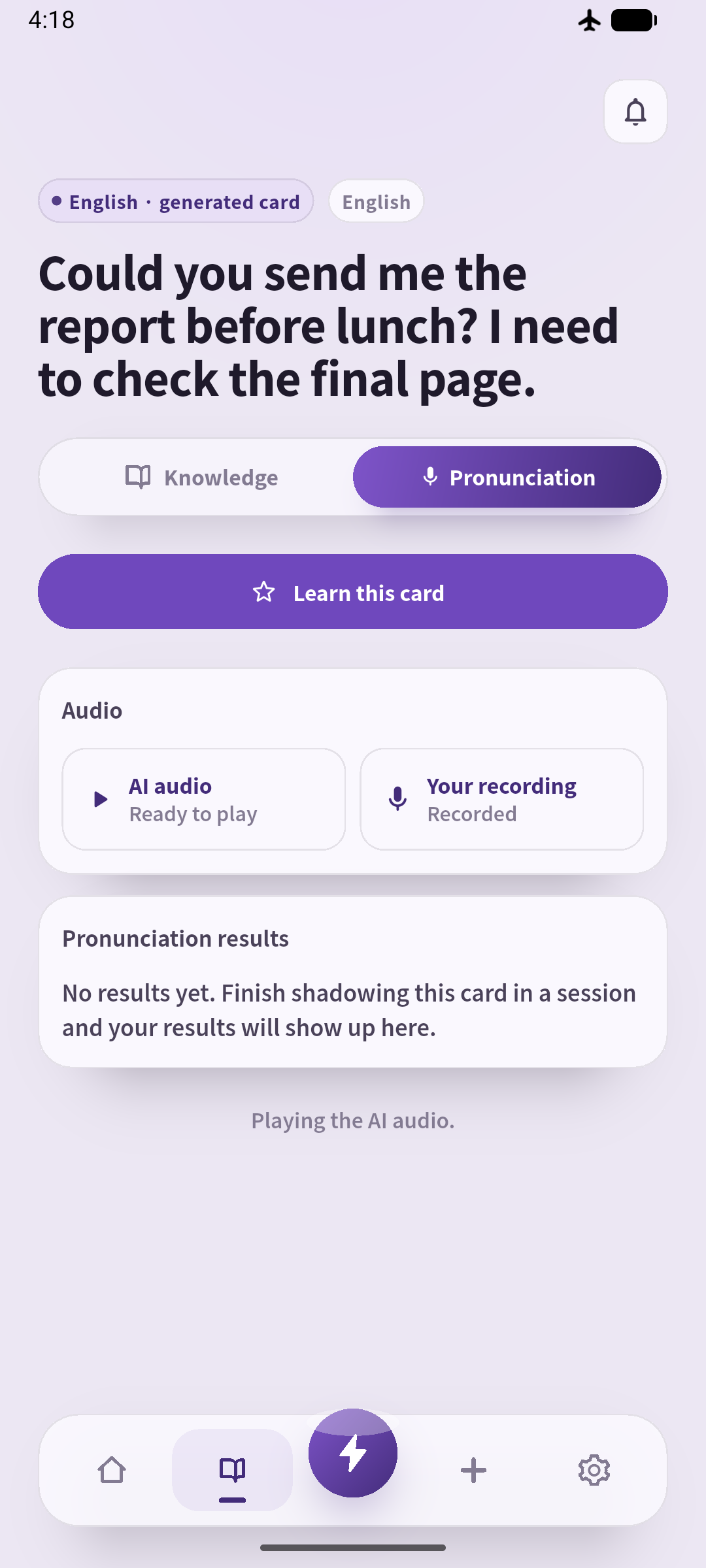
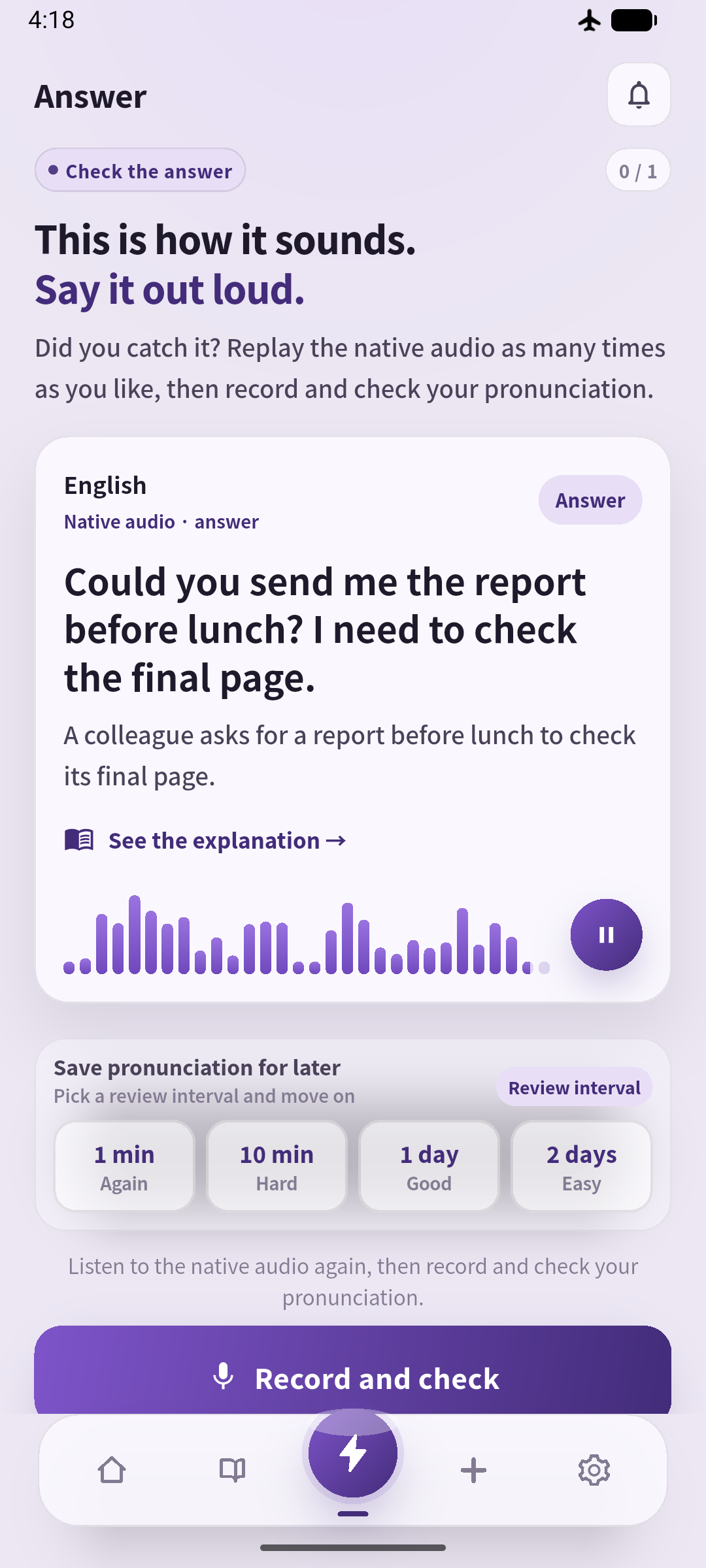
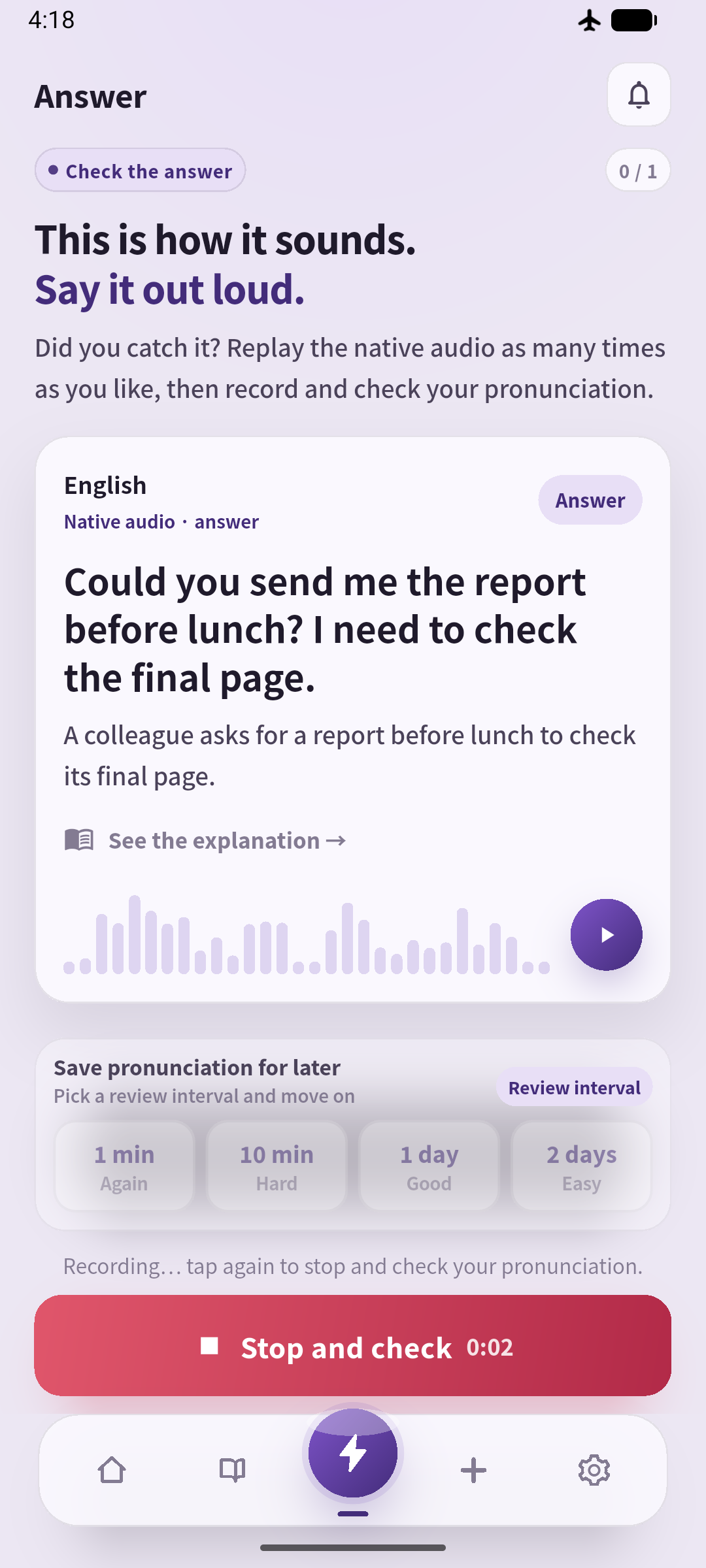
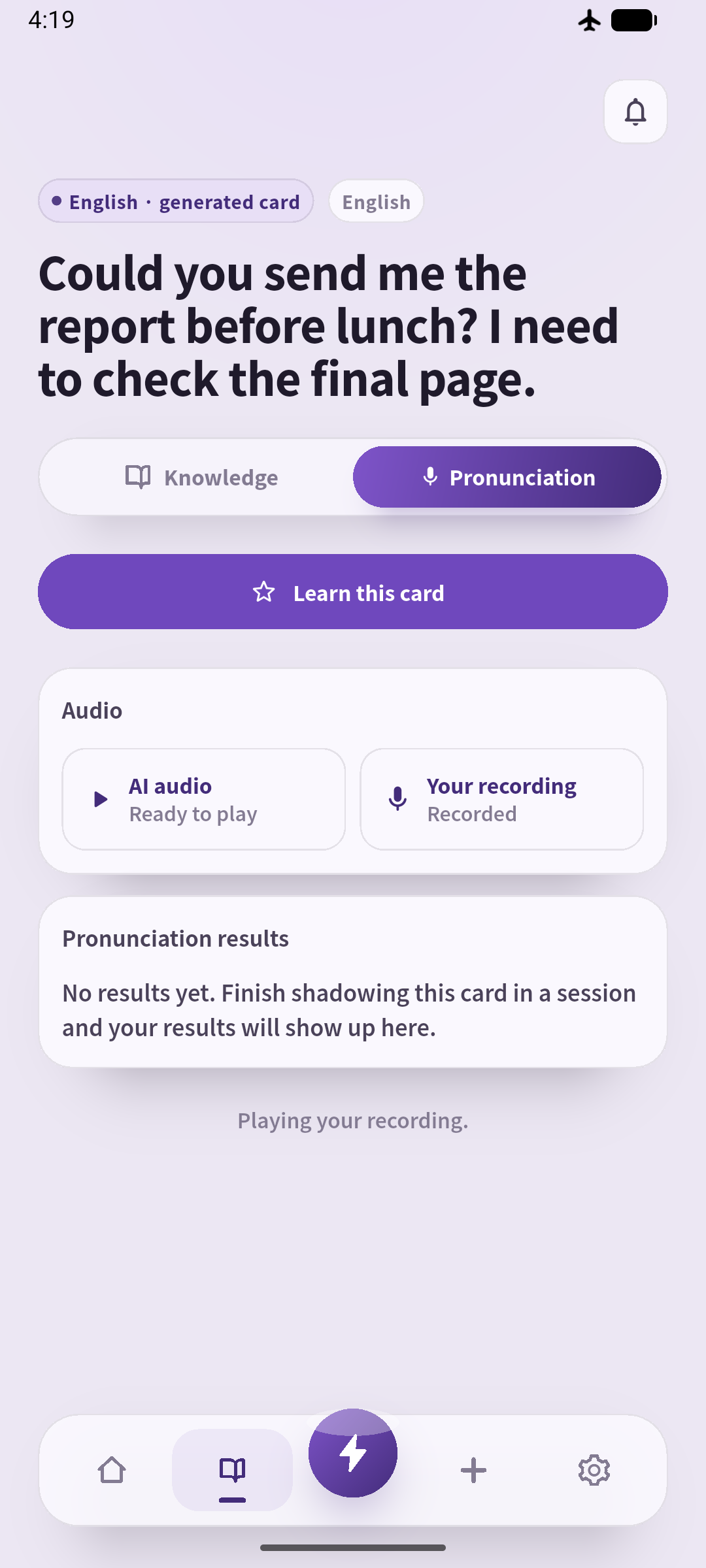
The same original sentences, from model to speaking, recording and comparison. Meaning and model audio were prepared for this article. The local test recording was linked to the card for the comparison display; external assessment was not run. These are not learner results.
Listen to the model, move to speaking practice and record one take. Replay it and compare send me the report. If you use scoring, treat the result as a pointer to what to listen to next, then check that section yourself. See what SpeakGain does.
A ten-minute start and a next-day check
Try two minutes for meaning, one for listening, two for speaking along, two for shadowing and three for recording and one repair. If time runs out, note the unfinished phrase. Do not rush all stages merely to hit ten minutes.
Tomorrow, make one attempt before listening to yesterday’s recording. Compare the same phrase. If it has become difficult again, return to short repetition. Once you can follow twice without dropping the target words, move to another comparable clip instead of waiting for a flawless imitation.
At the weekend, listen to an easy unpractised sentence and explain its message. Use any missed section as the next target. Keep “better on this recording” separate from “better on new material.” To use the phrase in conversation, move on to retrieving English sentences from a situation. If movies alone remain difficult, check why film dialogue is hard to understand.
Common questions
Can beginners start? Yes, if they understand the chosen sentence. If not, understanding and paused repetition come first.
How many repetitions work? End after you have repaired one target and checked a new recording. If five attempts make no difference, change the chunk or method before the sixth. There is no universal deadline for becoming fluent.
Does silent mouth movement count? It can prepare you to follow the sound, but it cannot show what your spoken voice does. Save the recording check for somewhere you can speak.
When should I change material? When the target words remain present and you can follow without reading. Spontaneously producing a reply is the next, separate task.
Today, finish one loop: record these two sentences, find one difference, repair it and record again.
To check meaning and pronunciation with the text visible, follow the English reading-aloud guide through one short passage, from understanding to recording comparison.
For keeping musical timing separate from ordinary speech, see learning English with songs, which finishes a sing-along with your own conversational sentence.
To choose a book, free audio or video for practice, compare levels and transcript access in our shadowing-material guide.
Sources
- Hamada (2014), classroom study, full text.
- Hamada (2016), phoneme perception and listening, public abstract.
- Hamada (2018), teaching guidance, full text.
- Foote & McDonough (2017), pronunciation study, full text.
5 English shadowing apps: our picks, free limits and prices
5 English pronunciation apps: our picks, and who should skip them