
TOEIC listening practice: diagnose four causes and train by Part
Published
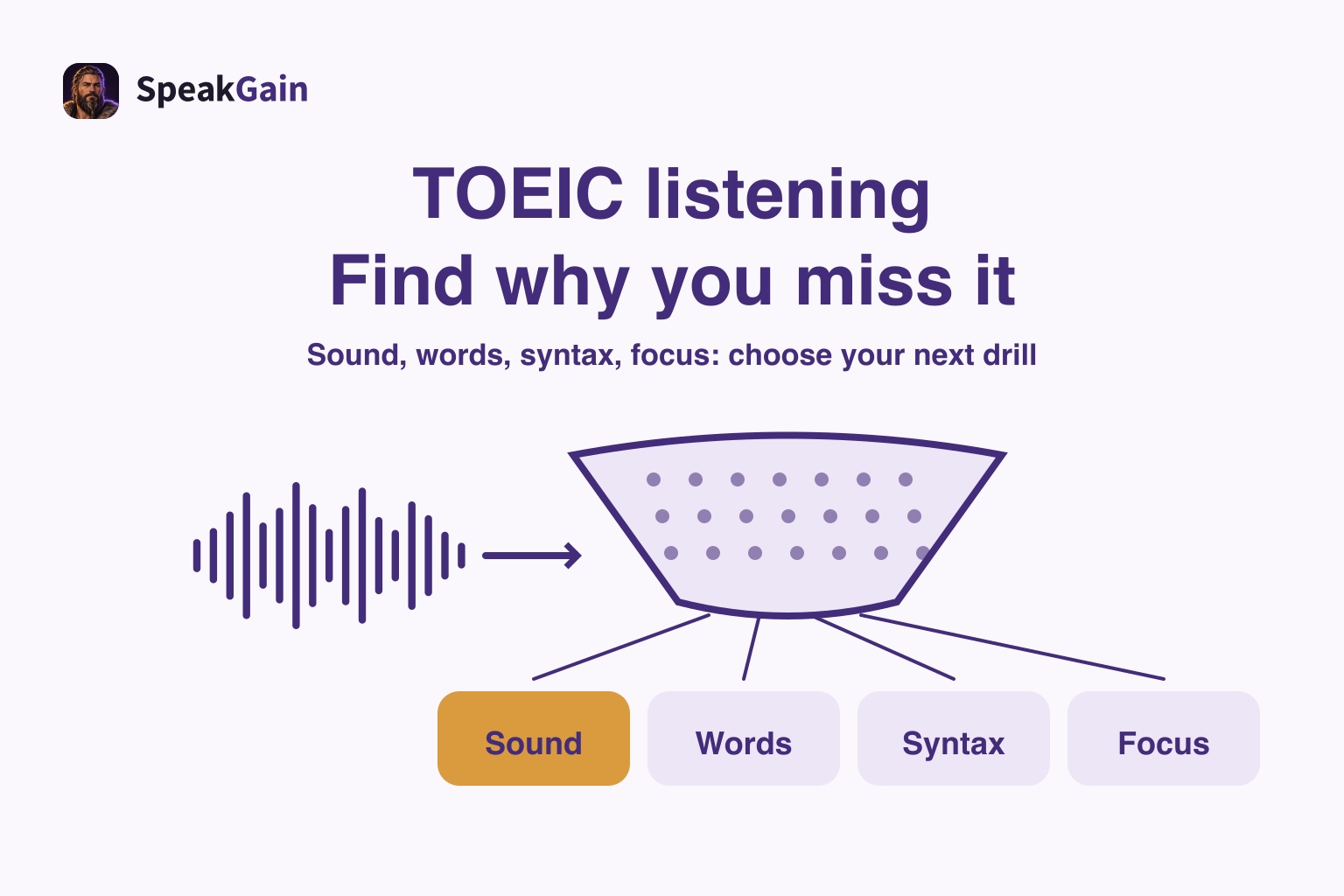
For TOEIC listening practice, work out whether a missed passage was caused by sounds, vocabulary, sentence structure, or attention and previewing. Write down one short sentence, check the transcript, then read aloud, speak along with the recording, and try shadowing when you are ready. For Parts 1–2, practise sentence and response decisions; for Parts 3–4, follow the purpose of the talk and what happens next.
This guide is for university students and working adults preparing for the paper-based TOEIC Listening & Reading public test described by Japan’s IIBC. Official format checked on 16 October 2026. It does not describe registration rules in your country or the online IP test. The categories, drills, time allocations, previewing suggestions and test-day decisions below are our editorial advice, not recommendations attributed to IIBC or ETS.
Official format: about 45 minutes, 100 listening questions
The time applies to the whole Listening section. IIBC does not give a fixed time for each Part on this page, so we do not invent one.
| Part | Content and playback | Questions | Time | Source |
|---|---|---|---|---|
| 1 | Photograph descriptions; four spoken options per photo, played once; descriptions not printed | 6 | Within the approximately 45-minute section; no separate Part time given | IIBC format |
| 2 | A question or statement and three responses, each played once; not printed | 25 | Same section total | IIBC format |
| 3 | Two- or three-person conversations, played once; three questions per conversation, four options; some questions combine audio and graphics | 39 | Same section total | IIBC format |
| 4 | Short talks such as announcements, played once; three questions per talk, four options; some graphic-linked questions | 30 | Same section total | IIBC format |
In Parts 3–4, the conversation or talk itself is not printed. Questions and answer options are printed, and the questions are also spoken. Separate replay-based study from practice with a single uninterrupted play. For Reading and overall scheduling, see our TOEIC study plan; this guide focuses on the listening review itself.
Diagnose the miss before choosing a drill
Knowing why an answer was wrong is more useful than adding another exercise indiscriminately. Ask what became clear when you opened the transcript.
| Cause | Sign | First drill | Check afterwards |
|---|---|---|---|
| Sound | Easy to read, but familiar words sound unfamiliar | Short dictation → compare text and audio → read aloud → overlap | Hide the text: can you recognise the sound and meaning? |
| Vocabulary | A word or phrase is still unclear in writing | Check meaning and use, then read the sentence with audio | Can you understand that word in another short sentence? |
| Structure | You know the words but need time to identify who does what | Identify subject, verb and meaning groups; read aloud in order | Can you state the person, action and timing in English word order? |
| Attention/previewing | Single sentences make sense, but reading options or dwelling on a miss loses the conversation | Reduce what you read; listen to a short conversation without stopping | Can you follow purpose and next action despite missing one word? |
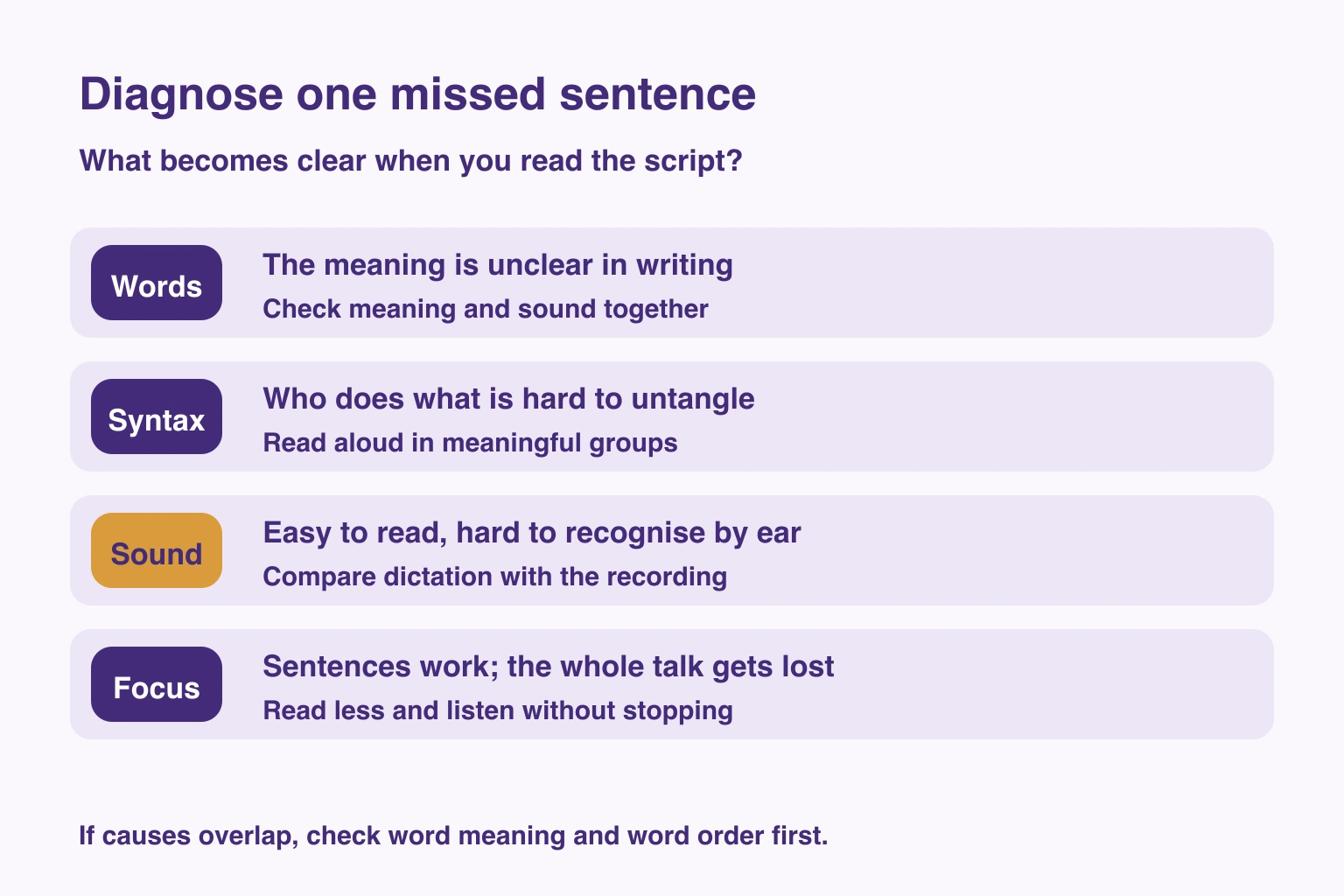
These causes can overlap. If both the word and its sound are unfamiliar, establish the meaning before comparing the audio. A correct answer remembered from yesterday does not prove comprehension. Review guesses and correct answers for which you cannot identify the supporting sentence, too.
“I feel like I’ll never understand it”: start with one blank
Today, choose one short sentence you missed in an official resource you already own. Listen once and write only the words you caught, leaving blanks. Listen once more, then open the transcript and label just one blank: sound, vocabulary or structure.
Check that point, read the sentence aloud with the text, then hide it and listen again. That is enough for the first session; you do not need a full transcript or immediate shadowing. Tomorrow, check the sentence without text again. Turn “45 minutes of incomprehensible audio” into one specific thing you can examine.
A sentence review: write, check, say, listen
This workplace sentence is our original example, not a TOEIC question or an official script:
I’ll send the revised schedule after the team meeting.
Meaning: I will send the updated schedule once the team meeting is over.
Identify what you missed: the action, the meaning of revised, or whether sending happens before or after the meeting. The suggested repetition counts below are practical stopping points, not promises of results.
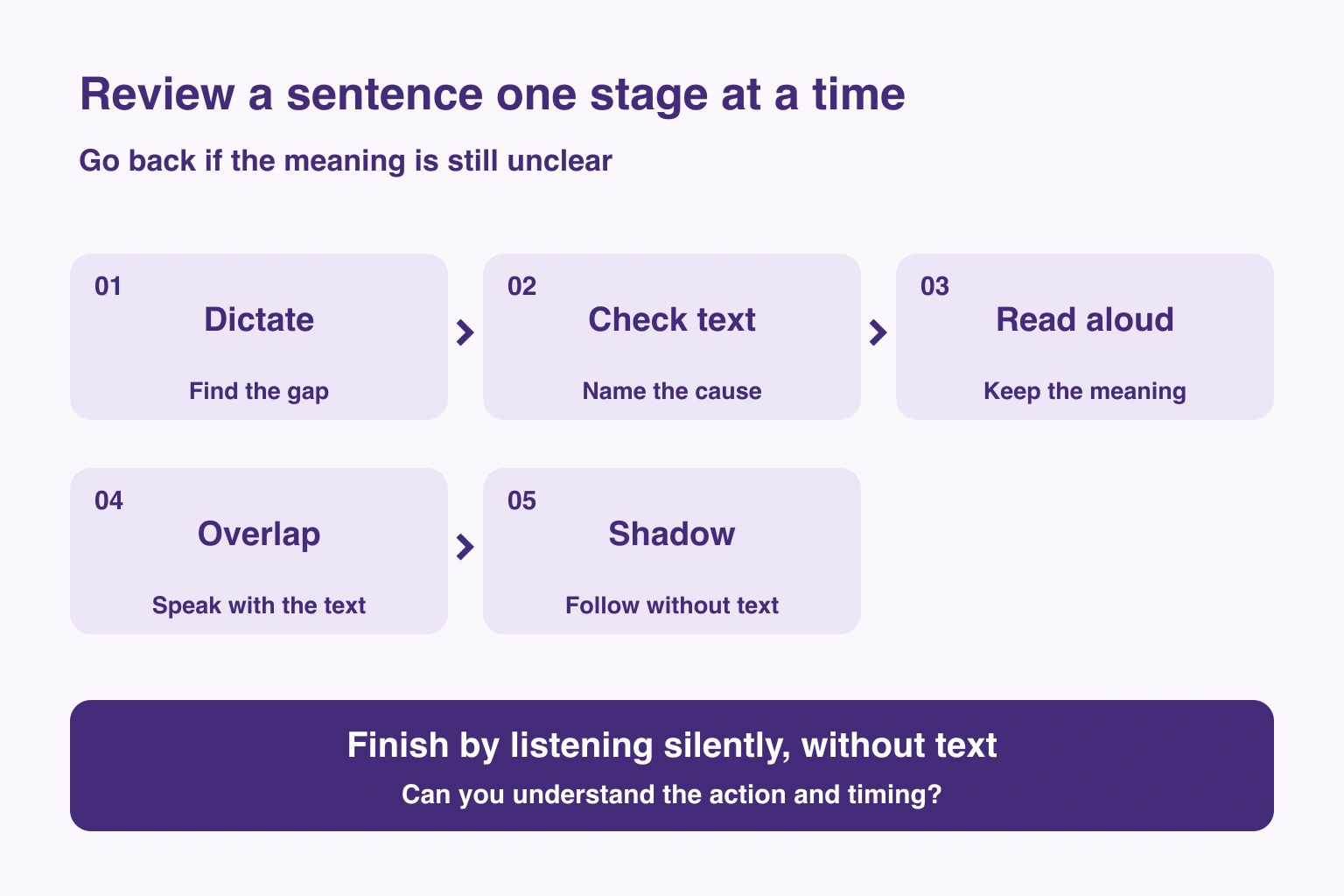
1. Use dictation to locate the gap
Write what you hear from one sentence or short meaning group. Approximate spelling is fine for the diagnosis. We would normally stop after two or three plays rather than spend the whole session guessing. If only revised is missing, focus there instead of rewriting a long conversation. For selecting passage length and general technique, see our dictation guide.
2. Check the script and name the cause
Do not just copy the correct text. If revised is unknown, check its meaning and underlying verb. If you knew it in writing, compare its actual sound. If the problem is after the team meeting, clarify how the time phrase modifies the action. Follow the text with the recording and select one small target. If too many words are unknown, move to a shorter passage rather than chase audio you do not understand.
3. Read aloud while keeping the meaning
Try the learning groups “I’ll send the revised schedule / after the team meeting.” This division is an aid to understanding, not a claim that the recording has a silent pause there. Start at a manageable pace, then return to the recording to check prominent and shortened sounds. Structure problems need word-order work; vocabulary problems need meaning as well as pronunciation. Our TOEIC vocabulary-book guide covers choosing and using a word book.
4. Overlap: speak with the recording
Keep the text visible and speak almost simultaneously with the audio. Notice where your reading falls behind, shorten that section and check its meaning again. If a player lets you slow down, use that for inspection and finish with the original speed. Check that you can explain the sentence rather than merely move your eyes along it.
5. Shadow a sentence you already understand
Hide the text and speak a little behind the recording. Try this after the meaning is clear and overlapping is reasonably manageable. Go back if it turns into sound imitation without comprehension; not every review must reach this stage. Finish by listening silently without text and checking the action and timing. The shadowing guide explains the wider method and workload choices.
Part 1: distinguish actions and states
Official format: six questions, four spoken descriptions per photograph, each played once; descriptions are not printed (IIBC).
Why it can be difficult: recognising an object’s name does not establish whether the action or state in the rest of the sentence matches the photo.
Drill: review one missed description, focusing on the verb and position or state as well as the noun. Work with the sound you actually confused rather than naming every possible detail in a picture.
Test-day decision — editorial advice: briefly inspect people, objects and positions before the recording; then listen through each description. Do not decide from one matching noun. Release uncertainty quickly enough to hear the next option.
Part 2: judge the response, not a repeated word
Official format: 25 questions; a question or statement and three responses are spoken once, with no printed text (IIBC).
Why it can be difficult: a short exchange gives little context to repair a missed word. Similar sounds or repeated vocabulary can distract from whether a response makes sense.
Drill: dictate the initial utterance, state what the speaker is asking or doing, then examine why a response fits. Include requests, suggestions and replies that do not supply a direct place or time.
Test-day decision — editorial advice: attend to the opening, but do not choose from a question word alone. Consider the whole communicative purpose. Return your attention to the next opening rather than replay the previous doubt in your head.
Part 3: follow purpose, problem and next action
Official format: 39 questions about conversations involving two or three people; three questions per conversation. Questions/options are printed, and some questions link audio and graphics (IIBC).
Why it can be difficult: you need to connect speakers, requests and changes while also reading. If individual sentences are clear, examine divided attention and fixation on an unknown word.
Drill: hear one conversation uninterrupted, then state its purpose, problem and next action. Review only the sentence where evidence was missed using the sequence above. Return that sentence to the full exchange and follow how the actions connect.
Test-day decision — editorial advice: if previewing, first identify what the three questions ask. Do not force yourself through all the options if that costs the opening audio. Follow the current speaker’s intention instead of mentally replaying a missing word.
Part 4: track a talk’s purpose and updates
Official format: 30 questions about short talks, three per talk, audio played once; printed questions/options and some graphic-linked questions (IIBC).
Why it can be difficult: information continues without speaker changes. Losing the purpose can leave you collecting disconnected numbers and nouns.
Drill: after listening, explain the audience, main point and required action. Review the opening if purpose was unclear, or the relevant small passage if only a number was missed. Locate evidence rather than memorise the whole script.
Test-day decision — editorial advice: use the opening to form a provisional situation, then update it with changes and requests. If there is a graphic, briefly identify what it represents before playback, without sacrificing the start of the talk.
Previewing is our editorial option, not official advice
The fact that questions are printed does not establish an official recommendation to read them in advance. Try questions-only previewing and previewing with options during practice. Choose the amount that still lets you hear the opening. If listening is unclear even without reading, repair sentence comprehension before trying to read faster.
For pacing across the test, including Reading, see TOEIC time management; here we focus on how much to preview and when to return to listening.
Use official audio for both first attempts and repair
IIBC provides PC audio downloads by textbook title for playback in computer audio software. Its official materials app page distinguishes free problem-book audio downloads from mock/study modes that require an in-app material purchase. Audio access and buying an app edition are different things. This is a report of official information, not a claim that we tested the books or app.
Use the tracks matching your own volume and its explanations/script. We would first make one owned conversation reviewable rather than keep adding new books.
- First attempt: close explanations and script; listen at original speed without pausing. Separate full-section stamina checks from short diagnostic sessions.
- Diagnosis: review mistakes and guesses; locate one supporting sentence, dictate briefly and assign a cause.
- Sentence repair: check meaning/order, read aloud, overlap and optionally shadow. Finish without text.
- Whole passage: return to purpose and next action. Mark answers you remembered rather than understood.
- Unseen check: combine later review with a different, unseen exchange. Familiar-item accuracy is not a predicted TOEIC score.
Do not republish official audio/scripts or upload whole materials to another service without permission. Our example is independently written. Original practice audio does not replace official recordings for checking the test’s voices and conditions.
Use SpeakGain to hear an original sentence before checking its text
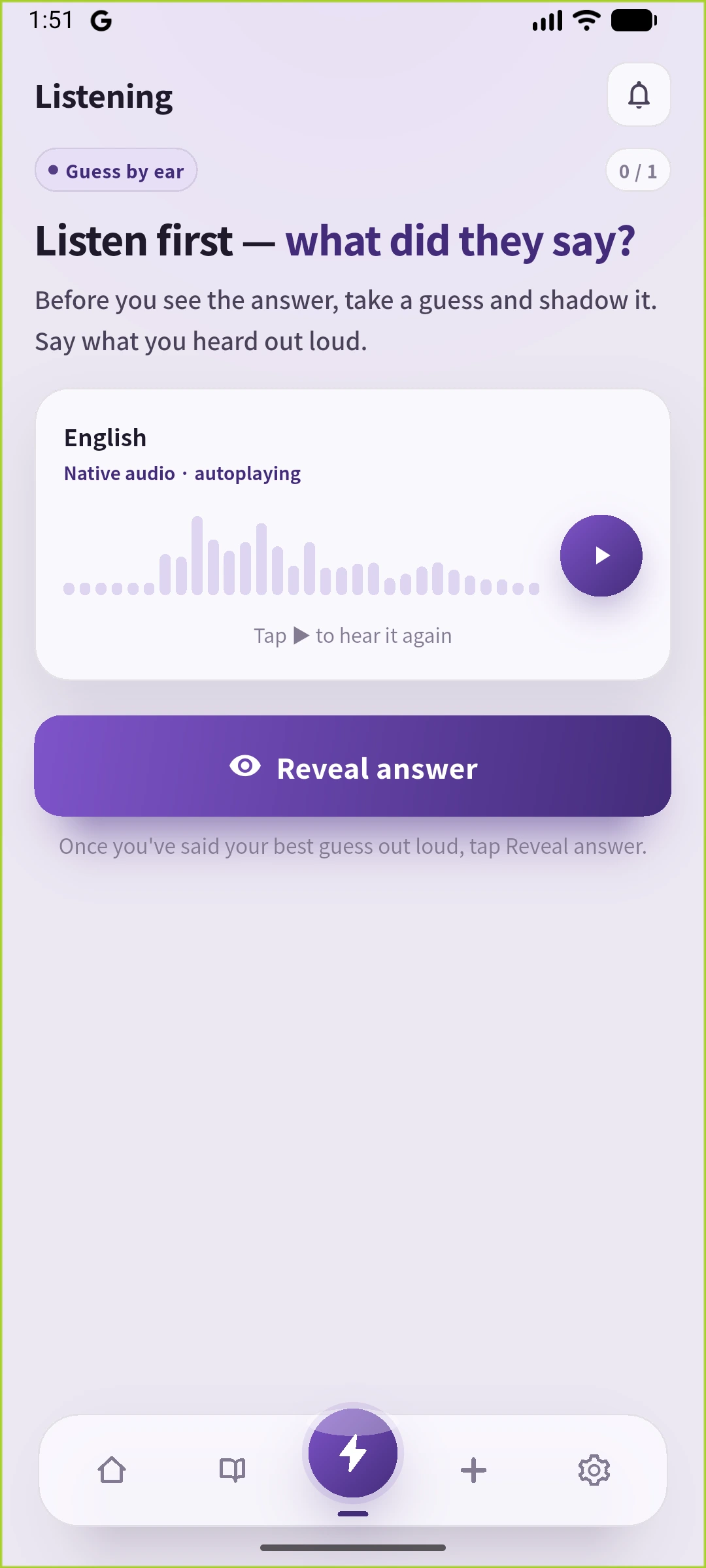
Separate from official-audio practice, SpeakGain can hold a sentence you write for listening and speaking. On the device, we saved the workplace example above once through Add, opened View in Library, and used Learn this card from Knowledge.
Listening hid the English text and showed reference audio with instructions to guess and say what was heard aloud. Reveal answer then displayed the saved original sentence on Answer. We verified that listening, speaking prompt and text-check flow; we did not record, assess pronunciation or submit a review interval.
The screenshot is the actual English UI. Its Native audio label refers here to Viking AI-generated reference audio, not a human native-speaker recording. This use of SpeakGain is not a TOEIC mock test, answer or pronunciation scoring, or score prediction, and does not replace official recordings. Use your own sentence rather than republishing an official script.
A 20-minute session alongside work or university
Our editorial example: three minutes on a short unseen exchange, five to diagnose one sentence, eight on reading/overlapping, and four on a text-free check and note. These are planning amounts, not an official timetable or score guarantee. Shorten the passage if it does not fit.
Start the next day by hearing yesterday’s sentence without text. If it remains unclear, revisit the cause; otherwise move on. During a quiet commute, check meaning and save speaking for home. When time permits, listen through an approximately 45-minute section to observe attention problems short drills do not reveal.
Record only date, Part, cause and one point to check tomorrow. If familiar sentences improve but new conversations do not, bring back short unseen listening instead of increasing repetitions alone. See the overall TOEIC plan for Reading and targets, and general English listening practice for broader material choices.
Common mistakes
- Passive playback as the whole plan: add a short focused comparison so you know what needs repair.
- Dictating everything: shorten to one sentence when writing crowds out diagnosis.
- Shadowing without meaning: return to the transcript and manageable overlapping.
- Counting remembered answers as listening skill: distinguish familiar improvement from unseen performance.
- Finishing previewing at any cost: reduce reading and return to the opening audio.
Frequently asked questions
Is passive listening enough?
We would not make it the main TOEIC preparation method. Set aside time to compare one unclear sentence with text and check meaning without it. Playback minutes alone do not identify a sound, vocabulary or structure problem.
When should I start shadowing?
When that sentence’s meaning is clear and speaking with the visible text is manageable. Use readiness on the sentence rather than a score threshold. Return to reading aloud if meaning disappears.
When should I open the script?
After an initial listen and a brief dictation attempt. We suggest stopping after two or three plays rather than prolonged guessing. Reading the whole script first hides what you missed on first hearing.
What if Parts 3–4 feel too fast?
Test whether one sentence is unclear too, or only a whole conversation. Repair sound, vocabulary and order for the former; reduce simultaneous reading and follow purpose/action for the latter. Notice whether you are waiting to finish translating each sentence before proceeding.
Do I have to preview questions?
We do not present it as an official requirement. Try a small amount that preserves your attention to the opening. Questions alone may be enough; compare during practice.
Where can I get official problem-book audio?
Use IIBC’s PC download page or official app information, matching the title and volume. Check current conditions and distinguish free audio from paid app editions.
How many repeats are enough?
No fixed number guarantees a result. Check the supporting sentence without text, the whole conversation’s purpose and a different unseen example. Do not equate three rounds with a perfect score.
Short drills or mock-style practice first?
Use more short repair when sentences are unclear even in writing. Add uninterrupted listening when single sentences are clear but attention fades later. Give each type a specific thing to test.
Editorial verdict: diagnose one sentence before adding more
We would choose a missed sentence from official audio already available to us, identify its cause and practise the stage that addresses it. Part strategy should clarify which information was needed, rather than promise a shortcut. Today’s finish line is one repaired gap and a text-free meaning check; combine that with opportunities to hear new passages.
Official references
All checked 16 October 2026. TOEIC is a registered trademark of ETS. This independent SpeakGain editorial guide does not imply approval or endorsement by ETS or IIBC.