
Learn English with songs: choose a track and turn singing into speaking
Published
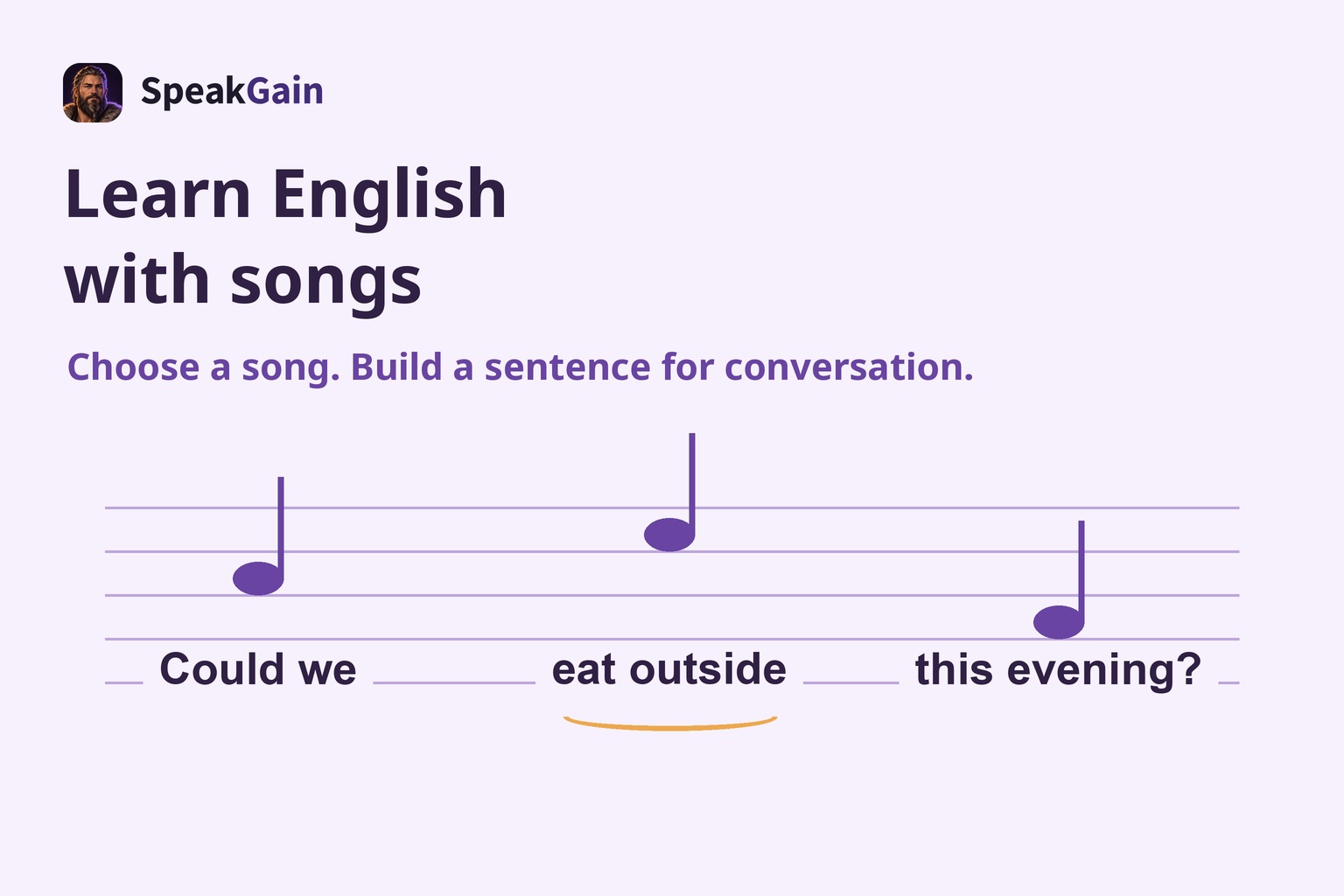
To learn English with songs, choose a track you can understand, listen for connected sounds, sing along, then write and say a sentence for your own life. Singing provides material to revisit, but singing a familiar track is different from understanding and answering someone in a new conversation. Check the voice, vocabulary, repetition and access to official or licensed lyrics as well as speed; start with a short section.
Every English example here was written by our editors, not taken from a song. Consult lyrics at the artist’s or label’s official publication or a licensed service; do not copy them into a practice app. Our shared example is Could we eat outside this evening? Imagine suggesting an outdoor meal to someone you know. It is not a translation or adaptation of a particular lyric. For a broader study plan, see how to study English.
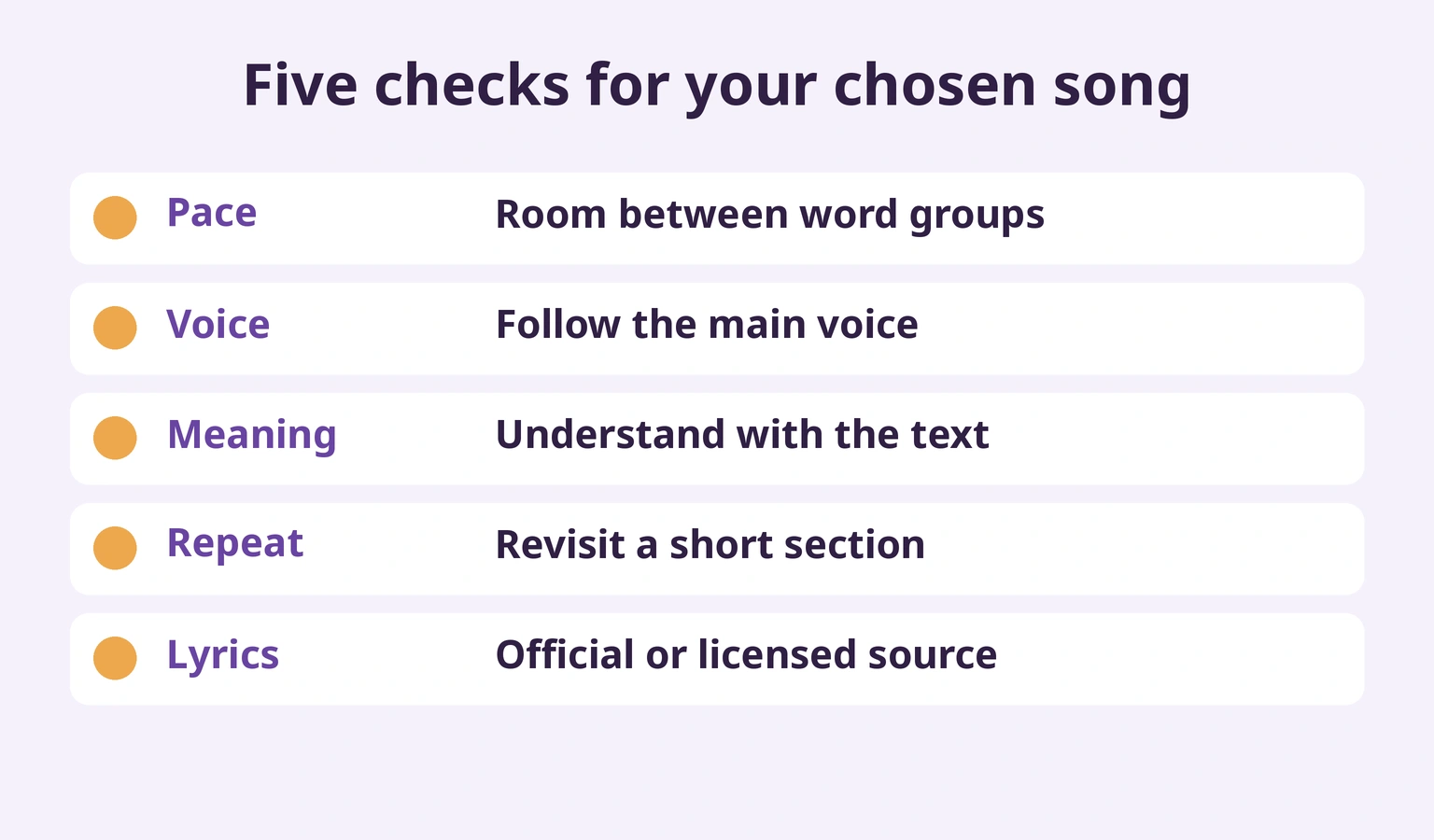
Choose a song using five checks
We would start with a short, understandable section of a song we already enjoy. This is an editorial choice, not a proven best genre. A slow beat can still contain densely packed words, stretched vowels or a voice hidden by accompaniment.
| Check | A manageable starting point | What to watch for |
|---|---|---|
| Pace and word density | Room to breathe between short groups | Judge the actual section, not just beats per minute |
| Voice clarity | You can follow the main voice and word onsets | Layered voices, processing and loud backing can obscure consonants |
| Vocabulary and meaning | The lyrics let you explain the main idea | If unknown words and metaphors hide the situation, change sections |
| Repetition | A short section is easy to revisit | Repeated sections may have different ornamentation; choose one occurrence |
| Lyrics source | Official or licensed lyrics match the recording | Check studio versus live versions; anonymous captions are not a reliable answer key |
For example, you may understand eat outside in writing but miss its boundary in sound. That is a useful, small task. Try listening, checking the meaning, then listening again. Note whether words, voice or density caused the difficulty. A common mistake is making the whole favourite song compulsory; keep it for enjoyment and narrow the study section.
Start with artist or label publications, official lyric videos or licensed lyrics displays. Spotify’s official documentation explains licensed provision and separate handling in Japan; it does not promise that every recording has lyrics. Check the version before treating a mismatch as a listening failure. Keep your own notes about the situation and sound, rather than reproducing lyrics.
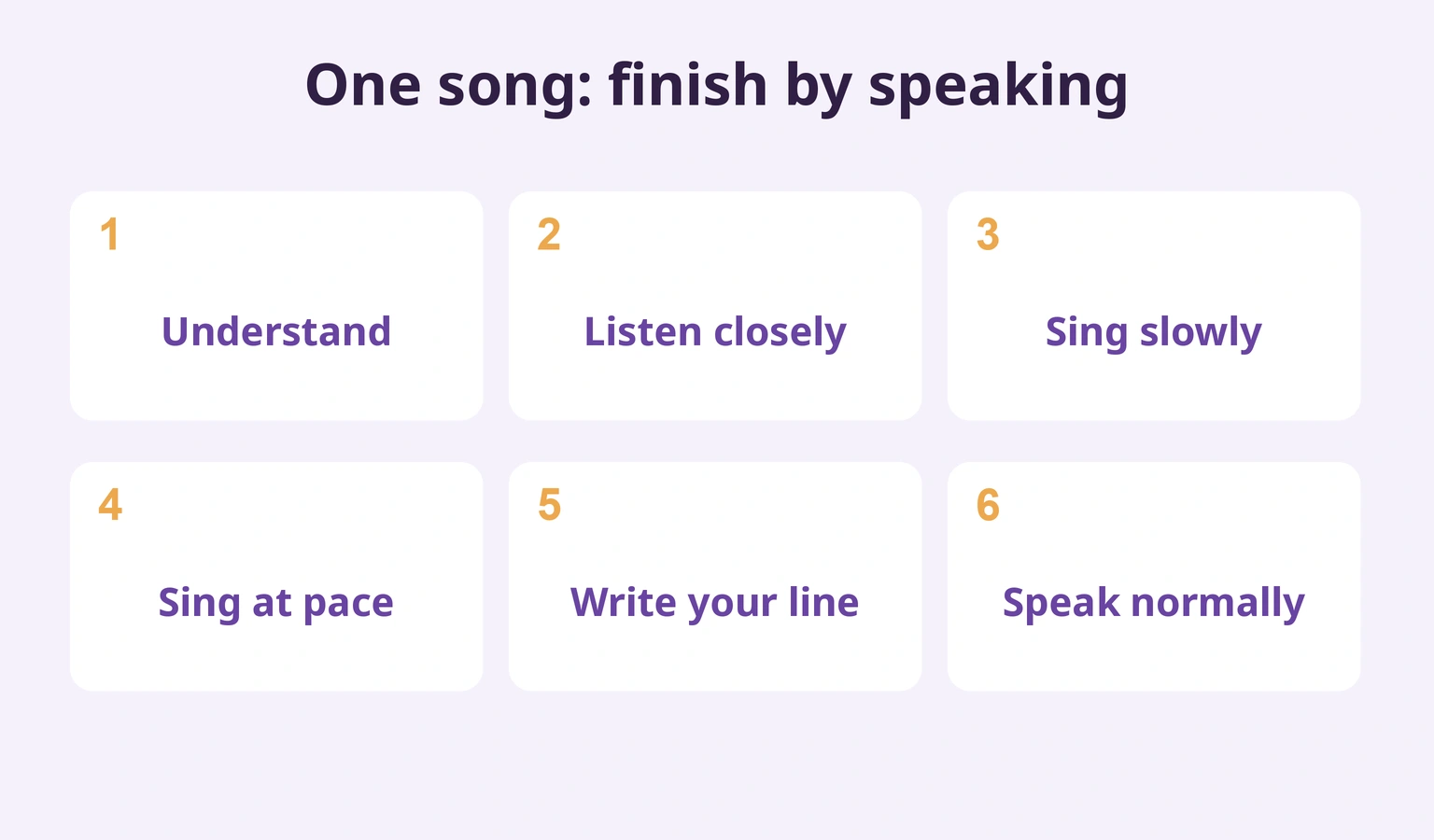
A six-step routine for one song
These timings are our suggested starting allocation, not experimentally established optimums. Repeat the same section next time if necessary.
| Stage | Action | Suggested time | If stuck |
|---|---|---|---|
| 1 Meaning | Identify situation, subject and action | 2–3 minutes | Choose a plainer section if the metaphor remains unclear |
| 2 Sound | Listen for one link or weak word | 2 minutes | Check the words, then replay their immediate context |
| 3 Slow sing-along | Work in short groups | 2 minutes | Speak the group first if singing is difficult |
| 4 Full sing-along | Return to the original pace, then the whole track if manageable | Length of chosen section or song | Keep just one focus |
| 5 Write a sentence | Rebuild one line’s idea for your own situation | 2 minutes | Decide what you want to communicate before writing |
| 6 Speak | Remove the melody and address an imagined listener | 1–2 minutes | Hear a spoken model separately |
1. Understand the meaning
Check who is doing what and how they feel. You need not settle every ambiguous metaphor. In Could we eat outside this evening?, the speaker suggests a shared meal outside. It can mean outdoors; if you mean specifically going to a restaurant, choose wording for that intention instead.
Close the words and explain the situation in your own language. If you cannot, return to the text. The common mistake is remembering the emotional mood while losing who wants what, or whether a statement is negative.
2. Listen for one connected boundary
Listen again and compare written spaces with the sound. CUNY Baruch’s connected-speech materials explain how words can run together in continuous speech. In our example, eat‿outside is a boundary to investigate: the final consonant leads into the next vowel. This is a listening target, not an acoustic analysis of a particular singer or generated voice.
Listen without text, check the words, then revisit that boundary only. Avoid treating a spelling-based or native-script approximation as the sound itself. Do not add pauses just because there are spaces. See linking and connected speech, or diagnosing listening difficulties when written meaning is also unclear.
3. Sing slowly in short groups
Use a comfortable pace and pitch. If playback speed is adjustable, a modest reduction can help you follow; if the sound becomes distorted, pause and work on a shorter group. You do not need the singer’s vocal range.
Our original sentence illustrates the operation: say eat outside, then Could we eat outside, then the full sentence. This does not set the sentence to any existing tune. Try the equivalent grouping in your chosen song. The common mistake is slowing down by stopping completely after every word and carrying those stops back into the full section.
4. Sing along at the original pace
Return to the recording and keep your one focus. Sing the full song if manageable, or just the chosen section. Our sentence equivalent is returning from two words to the complete question without losing the boundary.
Afterwards, note one thing you could follow. Hearing the singer while joining in does not prove you could produce the same words alone. Stop the track for the next stage. Following ordinary spoken English is a separate activity covered in shadowing step by step.
5. Write a conversational sentence of your own
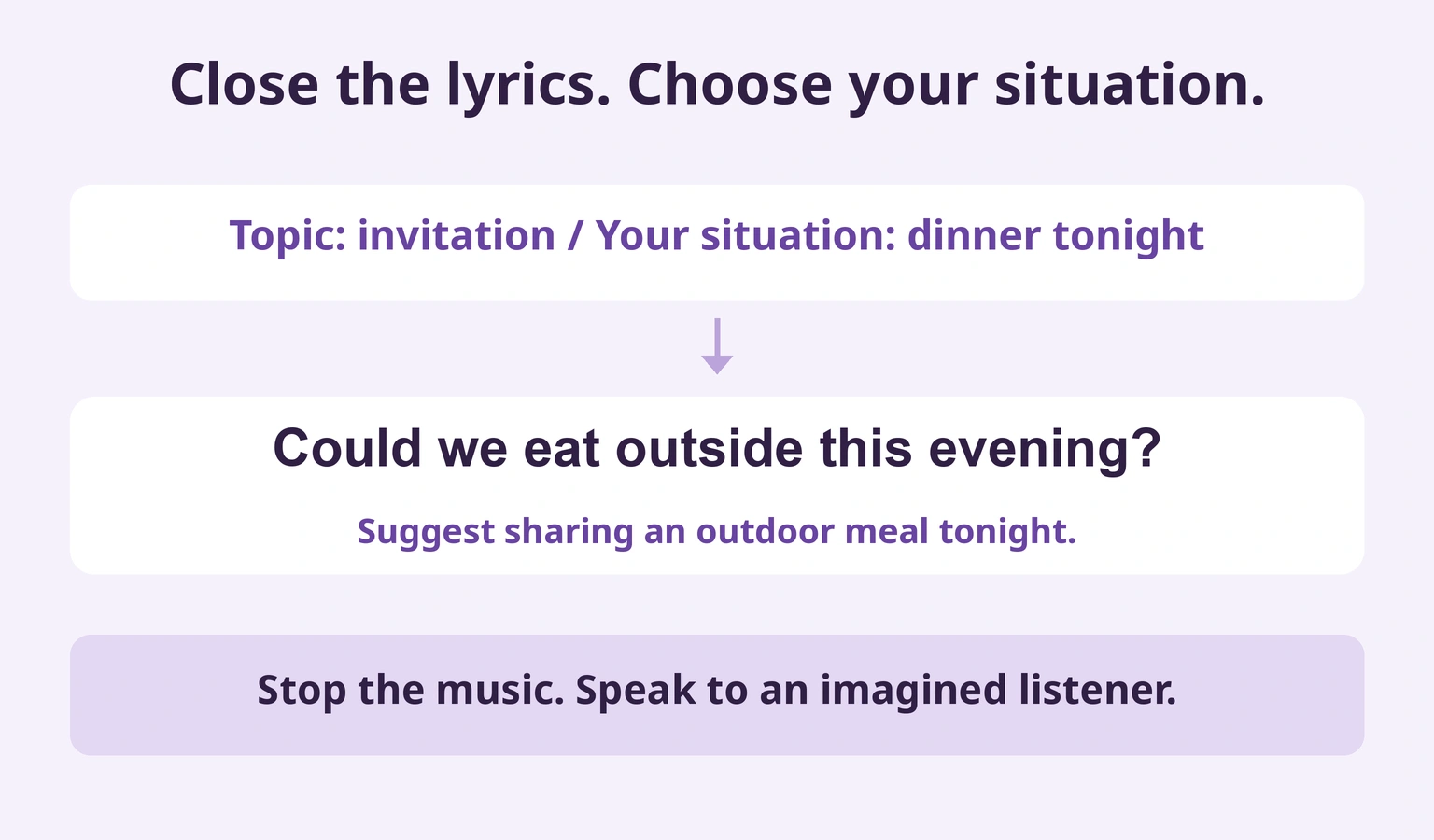
Understand the idea of one line, close the lyrics, and choose a person, time and purpose from your life. Write from that intention, rather than replacing a single word in the lyric. Check unfamiliar wording with a dictionary, conversation material or teacher.
If the broad topic is plans or invitations, our own dinner situation gives Could we eat outside this evening? Keep it short enough to use. Ask yourself who you would actually say it to. If nobody comes to mind, change the situation. A common mistake is keeping rhyme or a dramatic metaphor in an ordinary request.
6. Say it without singing
Stop the music and speak in your usual voice. In our example, outside may matter when comparing locations, while this evening may matter when discussing time. Decide prominence from the message, not the musical beat; intonation and stress offers a separate practice.
Hide the sentence and picture the meal. Say the suggestion once; next time, consider a reply or make a different sentence. Recalling the next part of a tune is not the same test as producing your own intention.
Song English and spoken English can differ
Check form and context before borrowing an expression. Artistic choices are not automatically errors, and some omissions occur in conversation too. These are original illustrations, not lyrics.
| Feature | Our example | Speech check |
|---|---|---|
| Missing words | Ready for a picnic? → Are you ready for a picnic? | Restore the complete question; do not assume any word may be omitted |
| Beat-driven emphasis | Imagine holding can on a musical beat in We can meet after lunch. | In an ordinary suggestion, can need not be prominent; contrast can change that |
| Rhyme-driven order | By the river, our lunch we share. → We share our lunch by the river. | Return to a clear conversational order |
Practise one change, such as restoring the subject and verb. Distinguish a word absent from the text from a present word pronounced weakly. The common mistake is treating musical timing as the general rhythm of English. Hear ordinary speech as well.
Save your own sentence in SpeakGain, then listen and say it
We made one card for Could we eat outside this evening? through the normal Add flow. On the device we followed Library → Knowledge → Learn this card → Listening → Reveal answer → Answer. Listening hides the sentence and instructs you to say what you heard aloud. Reveal answer then shows the same sentence, a generated English explanation and playback controls.
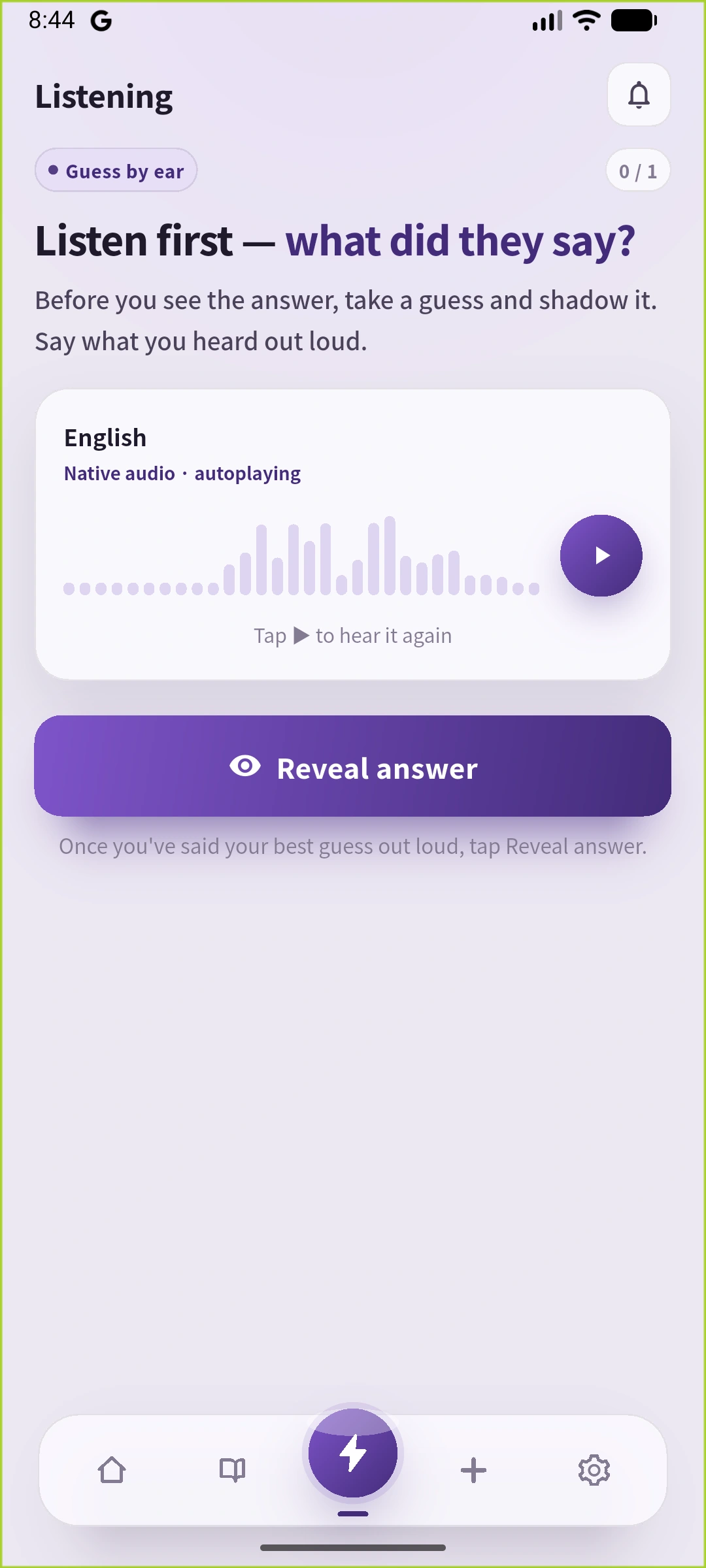
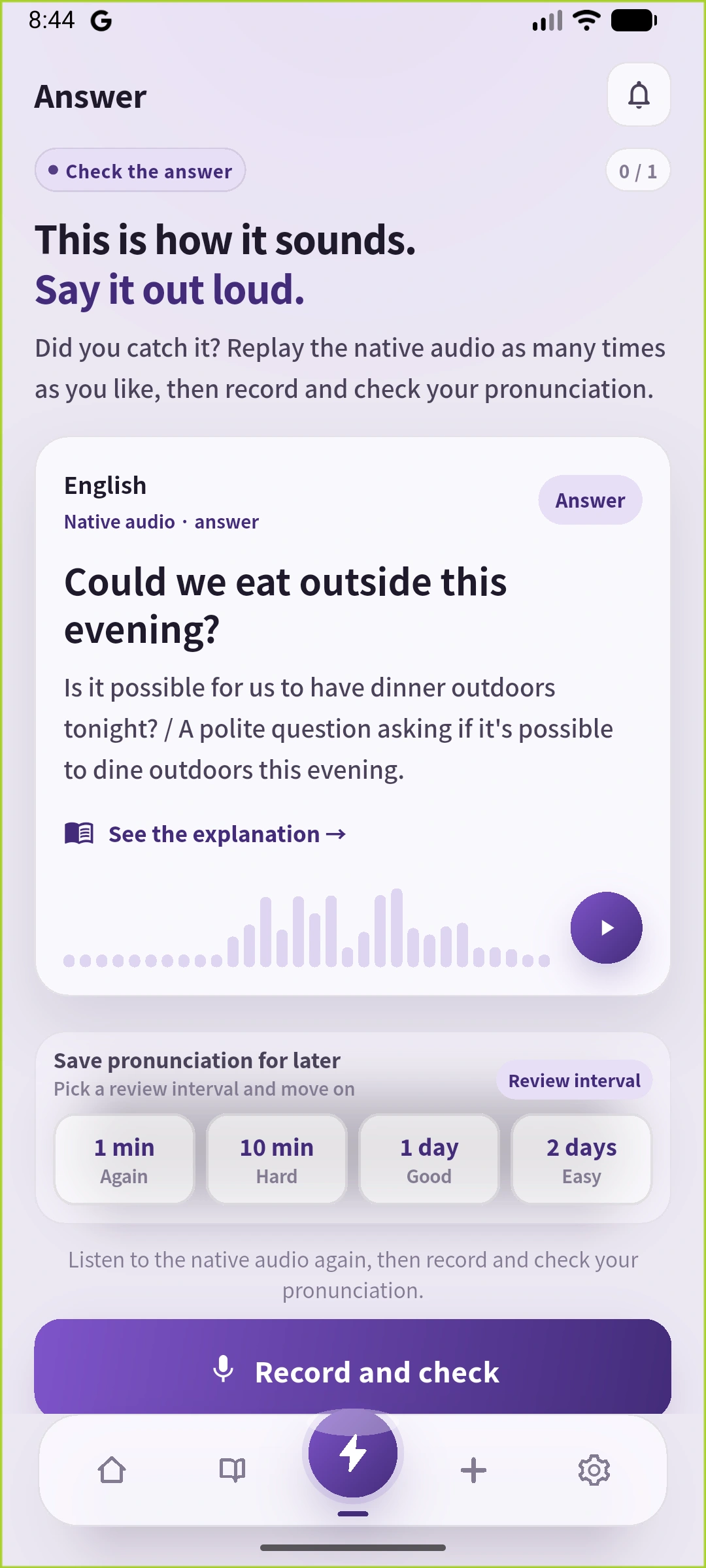
After listening, picture the dinner situation and make the suggestion with the music off. We selected 1 day / Good ourselves during verification; it chooses a review interval rather than grading an answer. Use this as a place to return to your own conversational sentence. The wider product guide is What is SpeakGain?.
A first-week plan
We would return to one short section for several sessions rather than collect tracks. This is a manageable schedule, not a fluency deadline.
| Session | Task | Record |
|---|---|---|
| 1 | Choose and understand a section | Why it fits |
| 2 | Hear one boundary and sing slowly | One sound target |
| 3 | Sing at pace and write your sentence | Listener and intention |
| 4 | Stop the track and speak from the situation | Where you needed help |
For our dinner example, use only the situation as your prompt. If you cannot say it, check the sentence and spoken model, then try again. Next week, hear a different short spoken sentence to avoid mistaking memory of one recording for broader listening ability. Enjoyment-only listening is fine; record it separately from completed meaning-and-speaking practice. Learning English with films uses visual context as another source of practice.
If musical timing keeps taking over, choose a short spoken alternative with our guide to English-learning podcasts.
Singing with children
An adult should check the content first. Choose a short, enjoyable section and allow listening, movement or a small vocal contribution without requiring reading and memorisation. After singing, connect an original everyday instruction to an action: Put the crayons away. Then put the crayons away together.
Try a brief sing-along, stop the track and use that ordinary instruction. A child can participate through movement on a day they do not want to sing. Correcting every sound can turn enjoyment into a test. This is our family practice suggestion, not an age-specific developmental claim.
What we would not recommend
We would not begin with uncomprehending passive listening alone or a whole very fast rap: the first hides what was understood, while the second combines speed, dense sounds and unfamiliar language. Rap can be useful when you understand and can follow a short section.
| Habit | Why change it | Next action |
|---|---|---|
| Background listening without meaning | Familiarity can be confused with comprehension | Check one idea, then listen without text |
| A very fast rap from the start | Too many difficulties arrive together | Study a manageable section while enjoying the rest |
| Memorising only a phonetic approximation | Original words and boundaries disappear | Compare correct spelling and actual sound |
| Counting singing as conversation | Melody may be a recall cue | Speak from your situation with music off |
| Copying every held vowel into speech | Musical duration may not match your message | Use a spoken model separately |
If eat outside remains hard, check whether meaning or the boundary is the problem before increasing repetitions.
What research supports
In a randomised study, 60 adults practised unfamiliar Hungarian phrases by speaking, rhythmic speaking or singing for 15 minutes. The singing group performed better on two tests requiring spoken recall and production. We inspected the publisher abstract of Ludke, Ferreira and Overy (2014), DOI 10.3758/s13421-013-0342-5.
This concerns short-term phrase learning, not passive listening to commercial music, children’s outcomes, long-term free conversation or our six-step schedule. For our sentence, distinguish saying it immediately from producing it next session without a tune. Do not replace the study’s active singing task with a claim about listening alone.
Frequently asked questions
Can songs alone make me conversational?
They do not establish that you can answer new questions. Add speaking from your own intention and listening to another person’s reply.
What makes a song suitable for beginners?
A followable voice, understandable meaning with lyrics, and a short repeatable section. Test the recording instead of relying on its fame or tempo.
Where should I check lyrics?
Use official artist or label publications or licensed services. Check that the version matches; anonymous captions are not enough.
Is rap unsuitable?
Not inherently. Begin with a section whose words, meaning and pace you can handle, rather than requiring a fast whole track.
What if I am embarrassed to sing?
Use a quiet voice or start by speaking with the rhythm. Keep a chance to say your own sentence aloud at the end.
Must I memorise every line?
No. Understanding and practising a short section, then producing your own sentence, is a complete small cycle.
Why can I sing but not understand conversation?
Melody and sequence may help recall; duration and emphasis can differ in speech. Check a short spoken recording separately.
How should parents start?
Check content, enjoy a short part together and connect an ordinary original sentence to an action. Do not make detailed correction the first goal.
Our editorial verdict
Choose one enjoyable, understandable section, notice one sound and finish with one sentence you wrote yourself. Try Could we eat outside this evening? as a real suggestion with no melody. Before perfecting a whole song, check that you can produce one intention of your own.
Sources
- Ludke, Ferreira & Overy (2014): publisher abstract; short-term adult phrase learning, not a test of our routine.
- CUNY Baruch: Linking & Connected Speech: connected word boundaries.
- Spotify: Managing your lyrics: licensed provision and Japan-specific handling, not universal availability.