
How to Learn English with Movies Without Pausing Every Minute
Published
To learn English with movies, separate watching from review instead of trying to catch every word. Pick a story you know, or one you can follow with subtitles in your first language. Pause only when a missing line blocks the plot or when you hear a short expression you would use yourself. After watching, check the line’s meaning and sound, try saying it, and recall it again later without the translation.
You do not need to rewatch the entire film three or four times. Use first-language subtitles to follow the plot, English captions to match sounds with written words, and no captions to test a short scene you already know.
Does watching movies improve your English?
Movies can provide useful language input, but watching alone does not guarantee progress. Sutton and Webb’s 2026 meta-analysis combined 56 experiments with 1,954 learners. It found learning gains after viewing second-language video, but results varied considerably, and entertainment video such as films and television produced smaller effects than educational video.
That makes film a source of contextual speech, not a graded course. A practical routine has four parts:
- choose a film and subtitle setting you can follow;
- keep interruptions to two clear cases;
- check a few short lines after watching;
- say and recall those lines later.
Step 1: Choose the film and subtitle setting
Start with a film you enjoy and preferably already know. Everyday scenes, available English captions, and easy pausing help. Test the first five to ten minutes. If you still lose the plot with English captions, use first-language subtitles or choose a more familiar film.
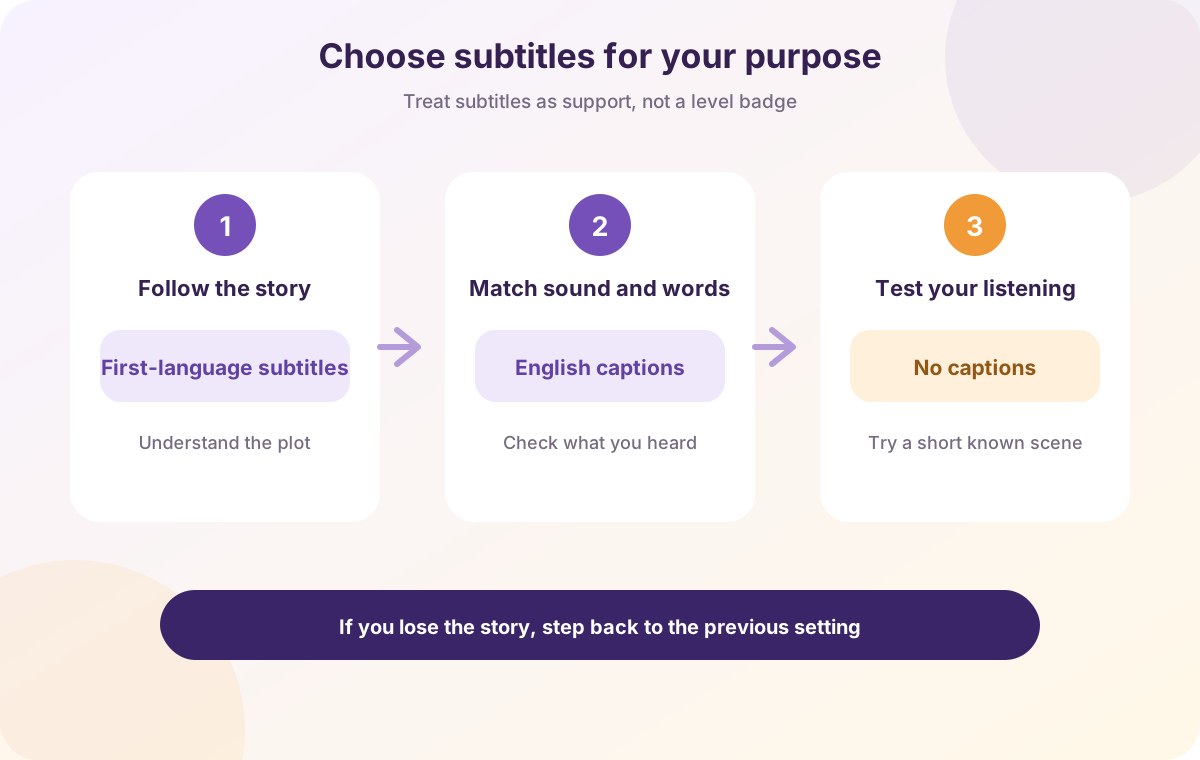
First-language subtitles help you follow the story. In Pujadas and Muñoz’s 2020 study, four classes of adolescent beginner EFL learners watched 24 television episodes over eight months. First-language subtitles supported content comprehension more than English captions. Prior vocabulary knowledge and the proportion of known words also predicted comprehension. This was not an experiment with adults watching one film, so it does not prove that one setting is always best. It does show why translated subtitles can be useful when the immediate goal is understanding the plot.
English captions help connect sound and spelling. Cintrón-Valentín, García-Amaya, and Ellis (2021) studied university learners of Spanish. All three captioned groups improved more than the non-captioned group on the target vocabulary, while production scores fell at a test roughly two weeks later. The language and materials differ from an English film, but the result supports using captions to notice word forms and adding later review rather than expecting one viewing to make them permanent.
No captions let you test a familiar scene. Turn them off for thirty seconds to two minutes after you understand the scene. Turn English captions back on to check. There is no need to endure a whole film without support.
Translated subtitles and English dialogue are rarely word-for-word equivalents. Use the former for the story and the latter to see the English that was actually spoken.
Step 2: Pause for only two reasons
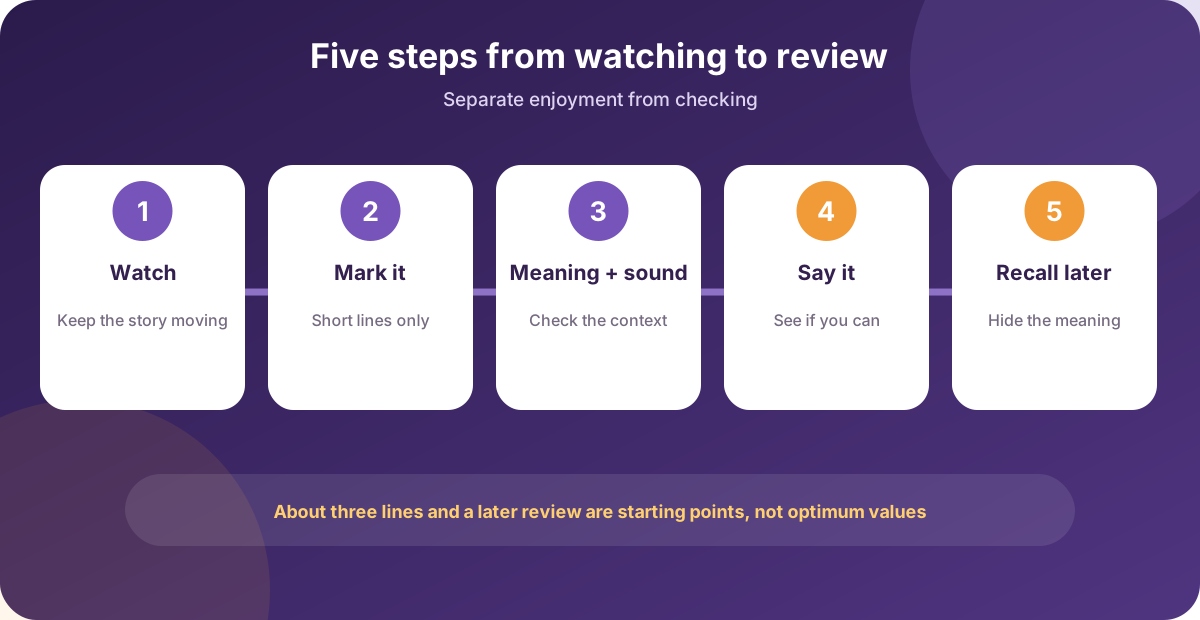
Stopping at every unknown word breaks the film’s rhythm. Pause or mark a time only when:
- the missing information prevents you from following the plot, or
- you have found a short line you would use yourself, such as a request, refusal, response, or way to express a feeling.
Guess the rest from the scene and keep going. A screenshot, timestamp, or quick note is enough to return later. As a starting rule, keep about three lines per viewing session. Three is an editorial guideline to keep the review manageable, not a research-derived optimum.
Step 3: Check meaning, sound, and register after the film
Keep the complete short sentence, its meaning in that scene, who said it to whom, and its register. Film dialogue can contain insults, dated language, or phrases tied to a particular character. Understanding a line does not automatically make it suitable for everyday use.
For example, imagine a fictional character ending an argument with “We can work this out.” Rather than storing only work out, note that the speaker is proposing that they solve a problem together. Then replay the sound or use text-to-speech and compare it with the English caption.
Film dialogue is copyrighted. Keep quotations short and for personal study; do not republish long exchanges or screenshots from the film.
Step 4: Say it, then recall it later
Read the sentence once, then say it after the audio. This speaking step is a practical check of whether you can produce a line you understand; the caption studies above did not directly test this routine. If one part is difficult, split the sentence and listen again.
Later, hide the meaning and try to recall it. Karpicke and Roediger’s 2008 foreign-language word experiment found that continuing to retrieve learned items produced better delayed retention than dropping them from practice. Karpicke and Bauernschmidt (2011) found that spaced retrieval produced much stronger one-week retention than massed retrieval, while no single relative pattern of spacing was inherently superior.
Reviewing the next day and again a few days later is therefore a simple starting schedule, not a scientifically optimal timetable for movie phrases. Extend the interval when recall is easy; shorten it when you forget.
Put a short line into SpeakGain
The routine above works with a film player, notes, and a dictionary. If you want to keep audio, explanation, speaking, and later review together, you can also use SpeakGain, the app we develop.
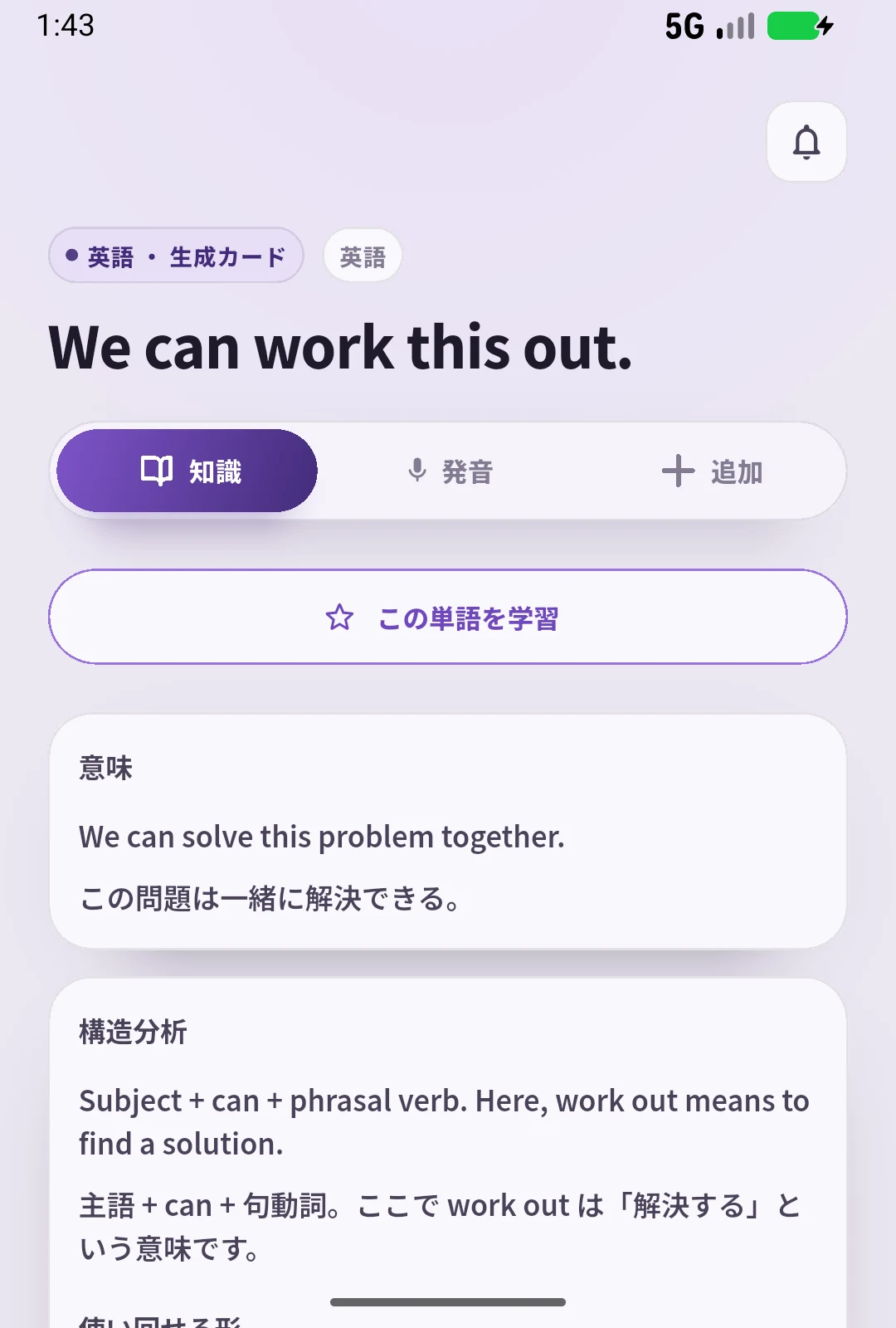
Enter a sentence yourself and SpeakGain creates a card with generated English audio and an AI explanation of its meaning, structure, paraphrases, and examples using the same pattern. Recording is optional; when you record, the online pronunciation assessment shows word-level feedback. Practice history and ratings determine which cards come up for review.
SpeakGain does not import movie subtitles automatically. You choose and enter the sentence. Its feedback is a practice aid; you do not need to imitate an actor’s voice.
What the studies measured, and what this article suggests
The studies measured learning from video, comprehension under different subtitle conditions, vocabulary outcomes from captioned video, and delayed retention from retrieval practice. They did not test this exact four-step movie routine.
Choosing about three lines, revisiting them the next day, switching captions for short scenes, and speaking each line are practical starting points. Adjust them to keep both the movie and the review sustainable.
Summary
- Choose a familiar film whose story you can follow.
- Use first-language subtitles for the plot, English captions for sound–word matching, and no captions for a short listening check.
- Pause only when the plot is blocked or a short line is worth keeping.
- After watching, check meaning, sound, context, and register.
- Say the line to test production and recall it on a later day.
Start with one scene you like. Keeping the viewing enjoyable makes it much more likely that you will finish the small review afterwards.
References
- Sutton, D., & Webb, S. (2026). The effects of audiovisual input on second language learning: A meta-analysis. Studies in Second Language Acquisition, 48(2), 571–595.
- Pujadas, G., & Muñoz, C. (2020). Examining adolescent EFL learners’ TV viewing comprehension through captions and subtitles. Studies in Second Language Acquisition, 42(3), 551–575.
- Cintrón-Valentín, M., García-Amaya, L., & Ellis, N. C. (2021). Investigating textual enhancement and captions in L2 grammar and vocabulary. Studies in Second Language Acquisition, 43(5), 1068–1093.
- Karpicke, J. D., & Roediger, H. L. III. (2008). The critical importance of retrieval for learning. Science, 319(5865), 966–968.
- Karpicke, J. D., & Bauernschmidt, A. (2011). Spaced retrieval: Absolute spacing enhances learning regardless of relative spacing. Journal of Experimental Psychology: Learning, Memory, and Cognition, 37(5), 1250–1257.