
How to learn English with anime: choose a show and turn one scene into speech
Published
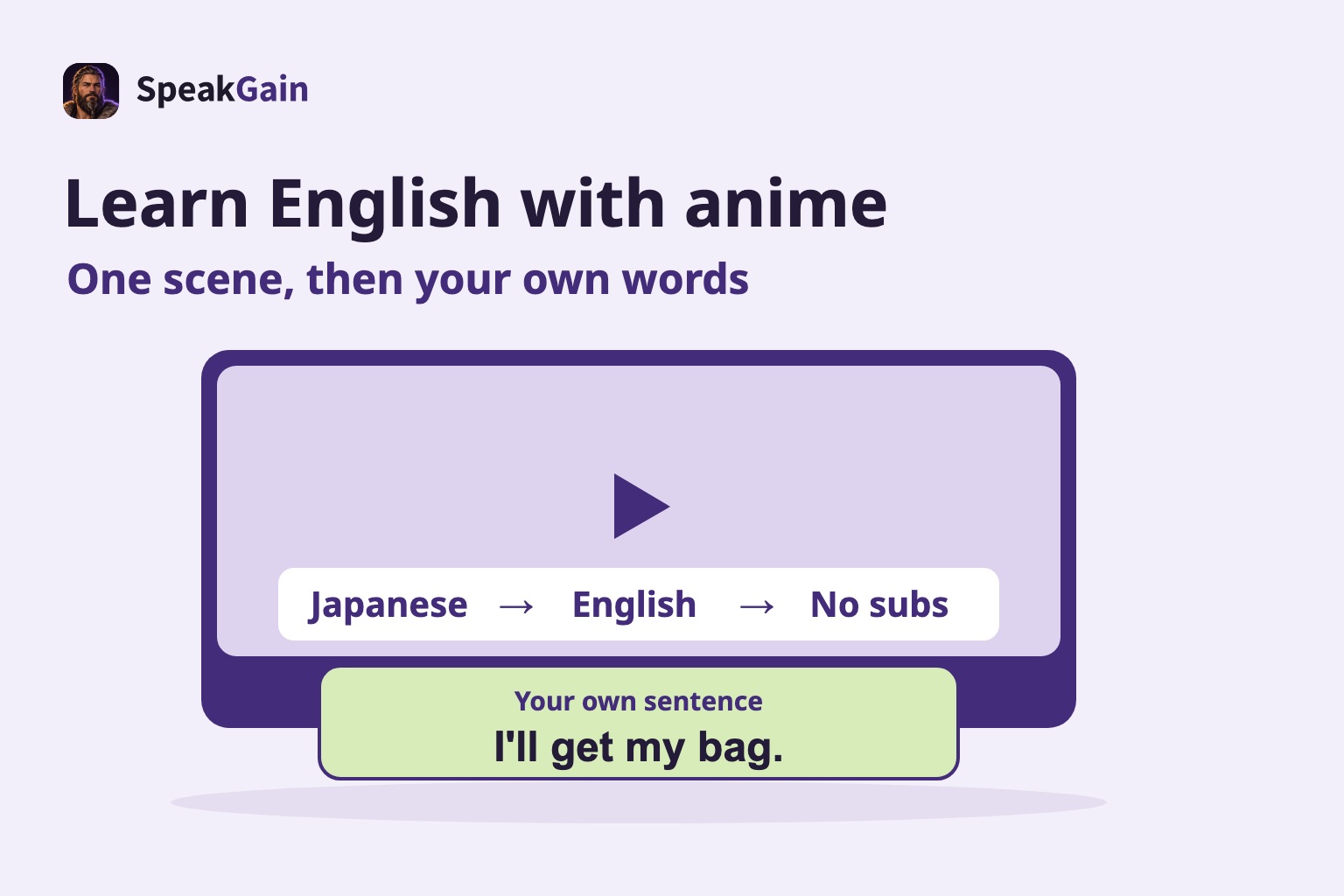
To learn English with anime, choose a show with everyday conversation and both English audio and English subtitles, then work with one 30–60-second scene. Keep the English audio on, use subtitles in a language you understand → English subtitles → no subtitles, then turn one speaker’s idea into a short sentence of your own and say it aloud. Animation can give spoken language a clear context, but watching alone does not replace practising what you want to say.
Japanese anime with an English dub and animation originally made in English can both be useful. This guide is for learners of English: the first subtitle pass might be in your first language, not necessarily Japanese. Every English example below is written by our editorial team; none is dialogue or a subtitle from a show.
To inspect written English at your own pace, compare our manga method: read an official chapter, then write and say your own sentence.
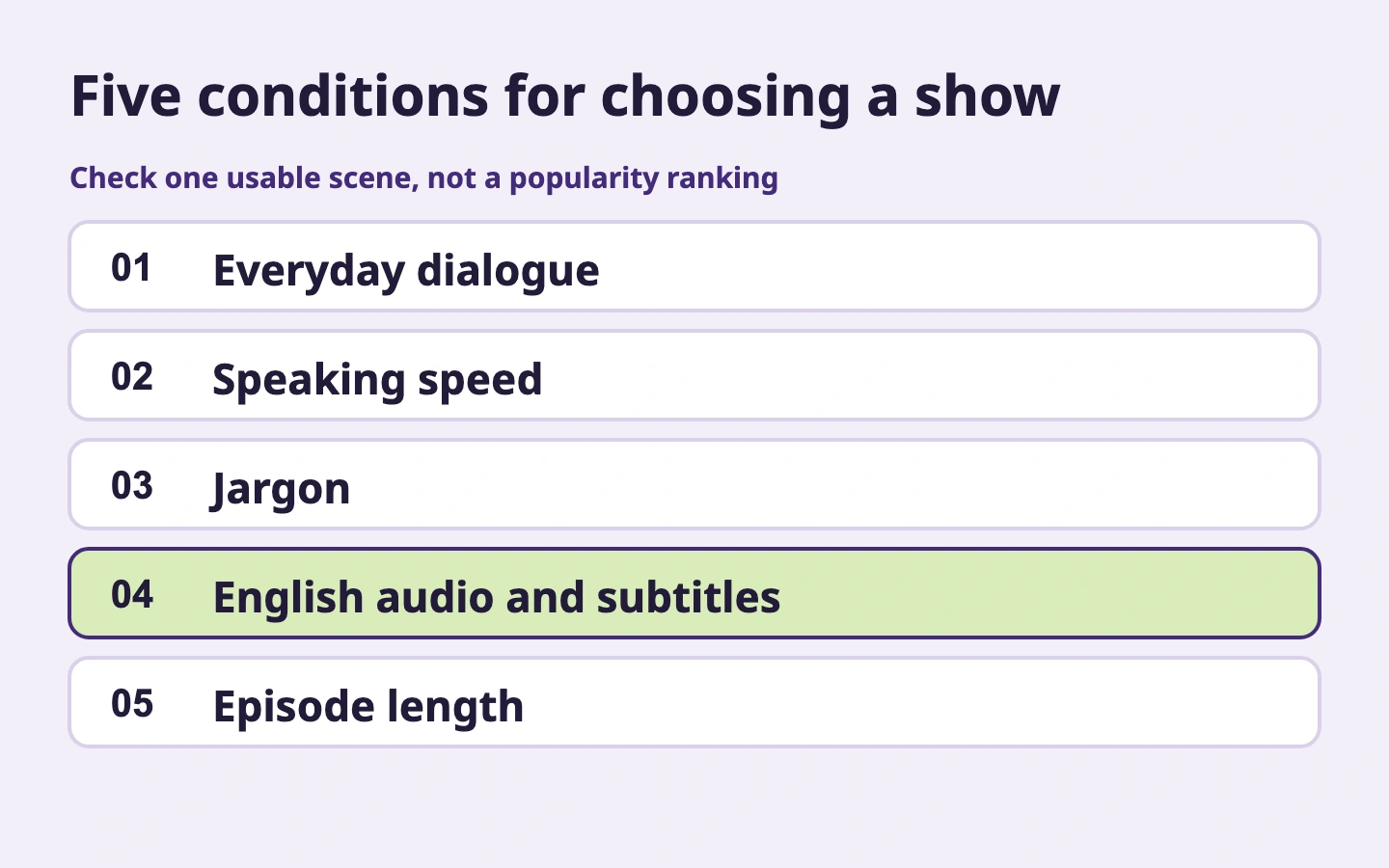
Choose by five conditions, not a ranking of titles
Try a short conversation in two shows you like. Check whether you can follow the purpose of the exchange, rather than deciding that all animation for children must be easy.
| Condition | A useful starting point | What to watch for |
|---|---|---|
| Everyday dialogue | Meals, plans, requests and ordinary tasks | Battle cries or long explanations offer fewer everyday exchanges |
| Speaking speed | With English subtitles, you can follow who means what | Children’s programmes can still have rapid jokes and wordplay |
| Jargon | The situation makes sense despite a few unknown words | Constantly researching invented terms takes time away from speaking |
| English audio and subtitles | Both are selectable for your episode, region and device | English text alone is not English listening; dub and subtitle wording may differ |
| Episode length | A manageable episode or a scene with a clear stopping point | You do not need to replay an entire episode |
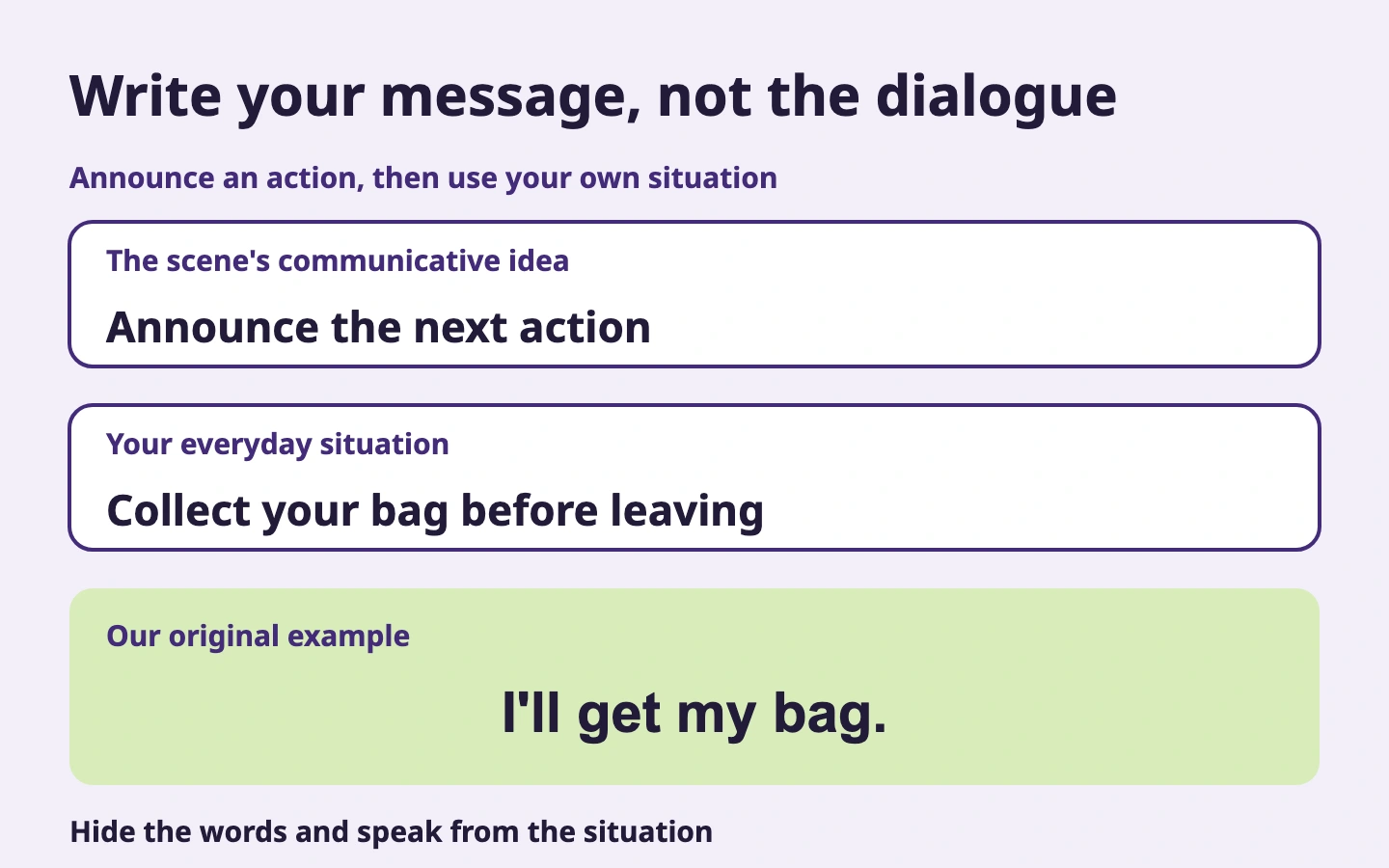
Our original example is I’ll get my bag. Imagine telling a friend what you will do before leaving. Look for a scene that gives you a similarly ordinary purpose; you do not need the show to mention a bag.
Practise: mark each condition “usable / check first / too hard today.” If English audio is unavailable, choose another starting resource for this listening routine. Common mistake: treating an age rating as a language level. Check the actual scene. If you also enjoy live action, compare our TV-series selection guide.
Which would we start with: Japanese anime or English-language animation?
Our editorial choice: start with a familiar Japanese anime if you like it and can select English audio and subtitles. Knowing the story leaves you with less to untangle. Otherwise, try an everyday scene from an English-language animation that interests you. This is a starting preference, not a universal effectiveness ranking.
Names you could investigate include SPY×FAMILY, K-On!, Peppa Pig and Bluey. These are title examples only, not guarantees about English tracks, difficulty or suitability for a child. Check your episode and language options yourself.
For a student, the useful purpose might involve a friend or school task; for an adult, plans or a small request. Practise: write one thing you want to communicate in your own life, then find a manageable exchange. Common mistake: trying to finish every recommended show before doing any speaking.
One scene, five stages: a 10–15-minute starting routine
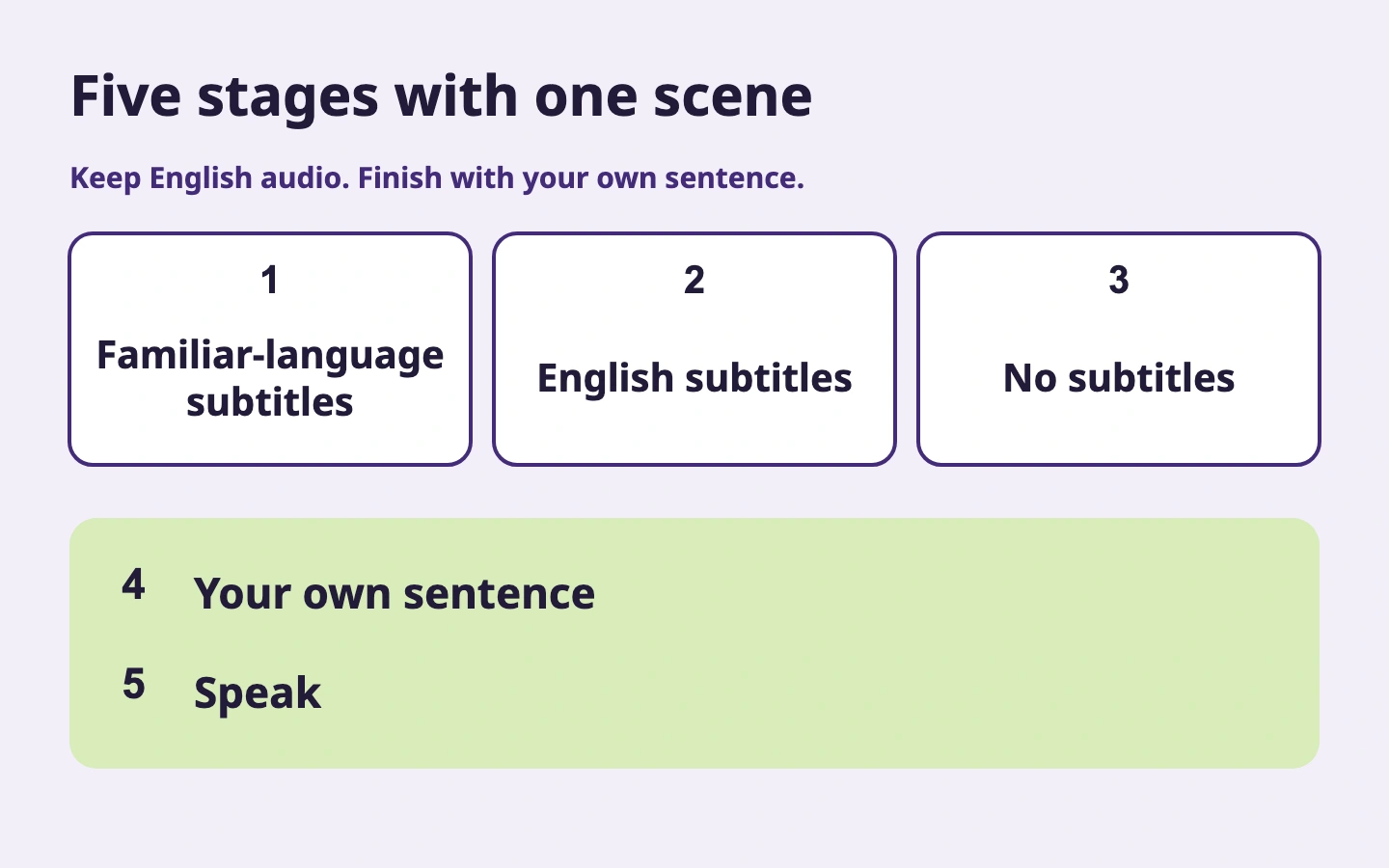
Choose about 30–60 seconds, keeping English audio throughout. The times below are our practical starting estimates, not research-established optimums. If you already understand the scene, shorten or skip the first subtitle pass.
| Stage | What to do | Starting time | If you get stuck |
|---|---|---|---|
| 1 Familiar-language subtitles | Identify who wants to communicate what to whom | 1–2 min | Pick a simpler exchange if the relationships are confusing |
| 2 English subtitles | Check one unclear sound against the words | 3 min | Do not force a dub to match differently worded subtitles |
| 3 No subtitles | Check the purpose and sounds in the same short scene | 1–2 min | Return to English subtitles for the unclear part |
| 4 Your own sentence | Choose one utterance’s idea and write a personal sentence | 3 min | Use familiar words; do not copy dialogue |
| 5 Speak | Read your sentence, then say it without looking | 2–3 min | Break it up or make it shorter |
Stage four is about taking an idea, such as announcing your next action, out of the scene and expressing your own situation. It is not extracting dialogue for a collection or sending subtitles to an audio generator.
1. Use familiar-language subtitles to understand the purpose
First establish the situation. In an invented learning scenario, someone is about to leave and needs to collect something. Our example I’ll get my bag. announces the speaker’s next action. You need to understand that purpose before examining each word.
Practise: close the subtitles and explain the purpose in a few words in your own language. Common mistake: stopping after a comfortable first-language viewing. Once the purpose is clear, try the same short scene with English text.
2. Use English subtitles to check one sound
Listen first, decide what was unclear, then use the text to check it. For our original sentence, ask who is getting the bag and what action is being announced. Checking one useful point is enough; you need not look up every unknown word in the scene.
Montero Perez and colleagues’ 2013 meta-analysis found benefits of second-language captions for listening comprehension and vocabulary learning. It does not establish that this exact anime routine develops conversation skills. Our stage sequence separates understanding, sound checking and speaking; it is an editorial practice proposal.
Practise: look away after checking the words and listen again. Common mistake: blaming your ears when the English dub and subtitles use different wording. Use another scene if a mismatch makes sound checking impractical.
3. Remove subtitles for a short check
Replay the same scene once without text. Separate what you know from the story from what you recognise in the English sounds. Understanding the plot while missing words tells you what to check next; it is not a reason to endure the whole episode without support.
For I’ll get my bag., hide the written sentence and listen for the announced action. Practise: return to text only for the unclear part, then listen again. Common mistake: treating no subtitles as proof of being advanced. Our guide to difficult film English explains other listening obstacles.
4. Leave the dialogue behind and write your own sentence
Choose one speaker’s communicative idea: asking, declining, or announcing an action. Set your own person, place and purpose, and use words you already know. Our worked sentence I’ll get my bag. fits a friend waiting by the door while you collect your things. It need not match a character’s words, timing or mouth movements.
Practise: write your situation first, then one short English sentence. Check meanings and register in a learner’s dictionary. Common mistake: keeping a character’s long or dramatic wording because it feels authentic. The goal is your message. Our English study-method guide can help you choose supporting practice.
5. Say it from the situation, not just from the page
Read your original sentence slowly, listen to a reference if you have one, stop the audio and say it yourself. You can practise I’ll get / my bag., then join it into I’ll get my bag. The slash is our practice mark, not a subtitle.
Practise: hide the English and use only the cue “tell a friend you are collecting your bag.” Try again the next day. Different words can still communicate the purpose successfully. Common mistake: counting readings without checking whether you can speak without the text. For following short stretches of audio, see our shadowing method.
How does dubbed English differ from ordinary conversation?
Treat a dub as an English adaptation of the scene’s intention, not a word-for-word replacement of the Japanese. Wording can change, and delivery may be adjusted to available time and mouth movements.
Netflix’s animation and anime dubbing guidelines discuss original intention, colloquial language and lip sync. These are that company’s production guidelines, not rules covering every dub. They also seek natural pronunciation; it would be misleading to say all dubbed English is unnatural.
The following are our own examples, not actual dub/subtitle comparisons:
| Purpose | Our original sentence | What changes |
|---|---|---|
| Ask for a little time | Give me a second. | A short, informal request |
| Explain a brief delay | I just need a moment. | Different length and rhythm for a related purpose |
| Announce an action | I’ll get my bag. | Your own next action is the focus |
| Ask someone to stay | Could you wait here? | The listener’s action becomes the focus |
Real conversation depends on your relationship and situation; screen dialogue also serves character, story and performance. English-language animation is scripted too. Practise: say two original examples calmly and decide which suits your friend or task. Common mistake: copying a character’s shout, command or exaggerated manner into an ordinary interaction.
Check English tracks in the service you actually use
Open your intended episode and check audio and subtitle choices in your region and on your device. Availability changes by title, region and time; no title named here is claimed to have a particular English track.
| Service | What to check | Official help, checked 15 October 2026 |
|---|---|---|
| Netflix | During playback, open Audio & Subtitles and select audio and text separately; controls vary by device | Audio and subtitles |
| Disney+ | Open the player’s language/settings menu and inspect the available choices | Video languages |
| Prime Video | Open the subtitle icon or separate audio control, depending on device; check subtitles separately | Alternative audio, captions |
An English subtitle option does not mean the audio is English, and English text may not match a dub. Practise: compare one short exchange, just as you would check I’ll get my bag. against a reference. Common mistake: buying a subscription based on an old recommendation. Check current options first. On a supported computer setup, our Language Reactor guide explains subtitle assistance and its limits.
Adjust the finish line for adults and children
For students and adults, finish by expressing your purpose without the written English. For a child, first check age-appropriate content and choose a short scene you can enjoy together. Do not make a child who is still learning to read keep up with fast captions or written exercises.
Our suggestion: connect a simple original sentence to a real family action. A parent can say I’ll get my bag. before leaving, then invite the child to join in if interested. Practise: adults use a situation cue; children can respond with an action or a short expression. Common mistake: turning every favourite show into a test, or applying our adult 10–15-minute study estimate as a universal screen-time rule for young children.
Keep a small practice plan
Begin with one scene, one purpose and one original sentence. On day one, try the five stages. On day two, recall your sentence from the situation and check the sound. On day three, use it in another personal situation; add a new scene only when you can finish the speaking step.
I’ll get my bag. can fit leaving home or getting ready to leave school. Practise: record only whether you watched, wrote and spoke without text. Common mistake: increasing viewing hours and saved sentences without ever speaking. For separating enjoyment from review in longer videos, see our movie-learning routine. These timings are editorial starting points, not guaranteed optimums.
If you also enjoy music, our song-to-conversation method separates singing sounds from an original sentence spoken normally.
Where SpeakGain fits: your own written sentence
You can start with playback controls and a notebook. If you want a place to keep your original sentence and return to listening and saying it, SpeakGain, which we develop, is an option. The practice sentence for this article is exactly I’ll get my bag., not copied dialogue or subtitles.
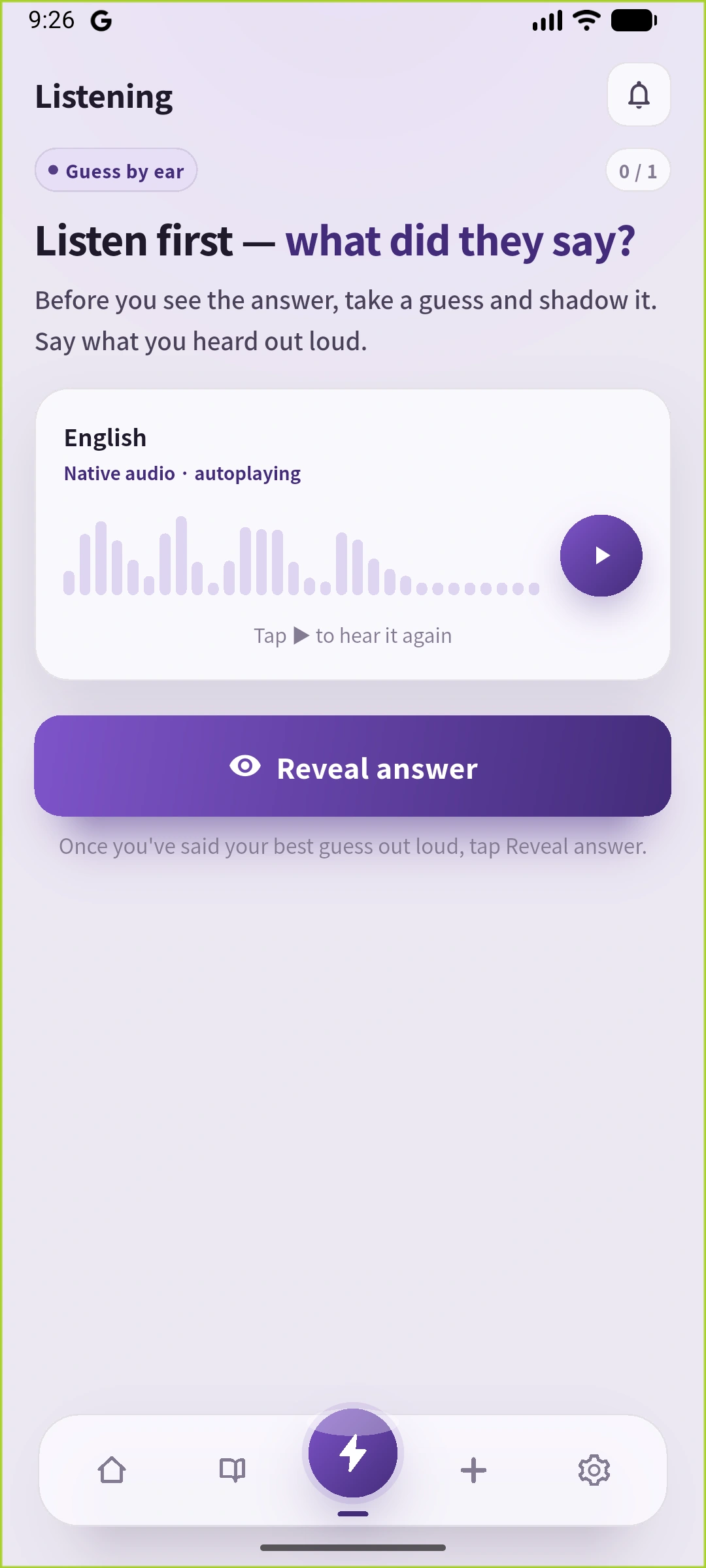
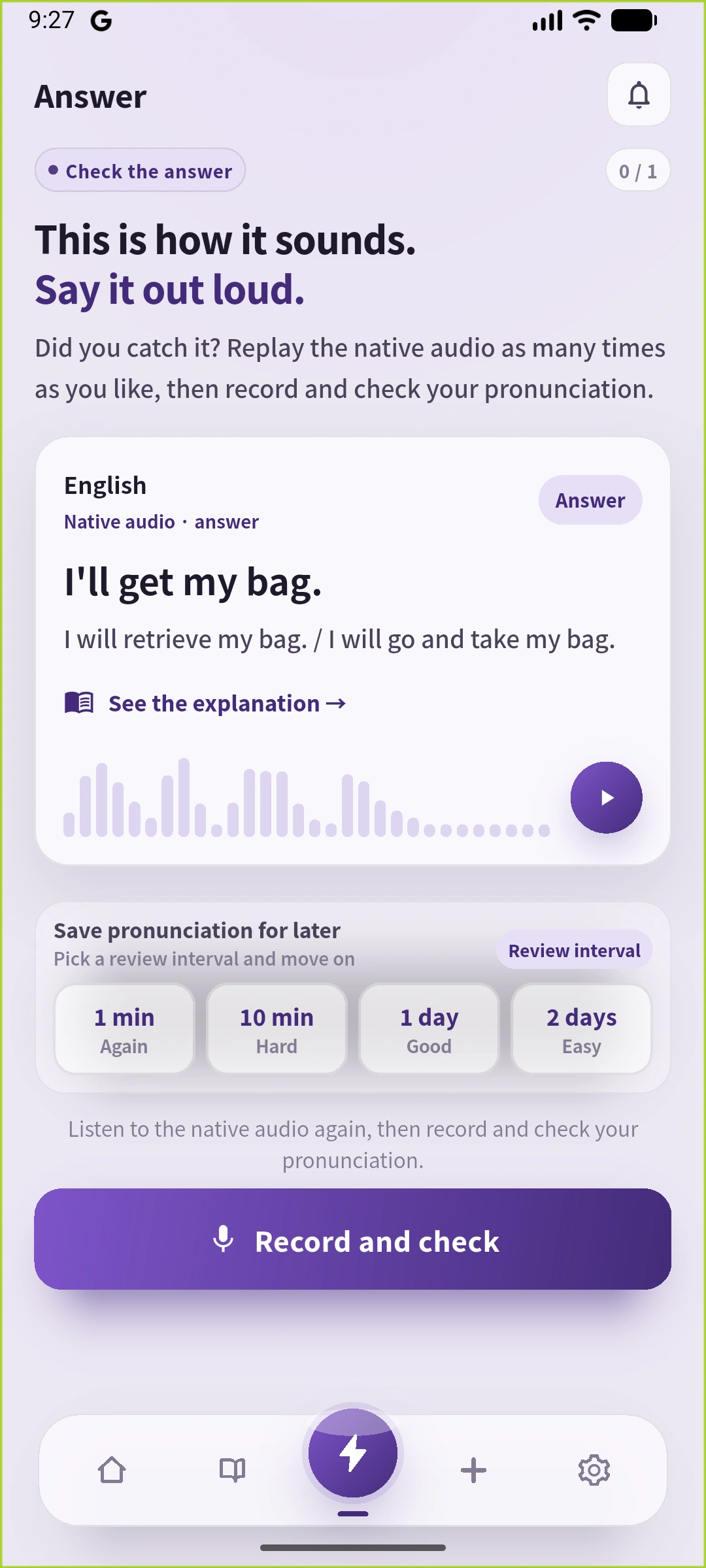
On SpeakGain’s English interface, we saved our own sentence through Add a card, then opened Library → Knowledge → Learn this card. Listening hid the written sentence and presented generated audio with a prompt to say a guess aloud. Reveal answer showed the saved sentence, an English explanation and playback controls.
For practice, listen, stop the audio and say I’ll get my bag. for your own situation. We also replayed the same audio on the answer screen. The screen’s Native audio label refers here to an AI-generated reference, not a recording of a human native speaker.
Viking reference audio for our original sentence — I'll get my bag.
AI-generated audio, not a recording by a human native speaker. Listen, pause and say the sentence for your own situation.
Methods we would not recommend
We would not use only first-language subtitles as the whole study routine: the sound-checking and independent-speaking stages are missing. We would also postpone fast, jargon-heavy scenes, because research into their fictional world can consume all the practice time. Enjoy them separately, or select an easier everyday exchange.
Our example I’ll get my bag. gives you a small, usable finish line. Practise: check that your routine includes sound checking and speech without text. Common mistake: copying large amounts of subtitles or converting every viewing session into homework. Keep enjoyable viewing and short deliberate practice separate.
Frequently asked questions
Is Japanese anime or English-language animation better?
Start with what you enjoy, can follow, and can access with English audio and subtitles. Check the scene rather than assuming the production country determines difficulty or naturalness.
Should subtitles be in English or my own language?
Use a familiar language for the situation, English for checking sounds against words, and no subtitles for a brief check. Keep English audio on. Skip the first pass if you already understand the scene.
Can adults use children’s animation?
Yes, if the topic interests you and supplies useful everyday purposes. Wordplay and fast speech may still be difficult. Write a personal sentence and practise saying it without text.
Can I use anime English in conversation?
Potentially, if the meaning and register suit the listener. Check strong commands, unusual character speech and specialist terms rather than copying them into daily life.
How do I select English audio?
Open the playback audio/subtitle controls and check English audio and English subtitles separately. Use the service’s official help and your actual episode’s options; availability varies.
What if the dub and subtitles are different?
They may use different translations. Do not force them to match. Choose a more suitable scene for sound–text checking and keep enjoying the original separately.
How many minutes or episodes per day?
Try about 10–15 minutes on one scene, ending with one self-written sentence spoken aloud. This is our starting estimate, not a universal optimum. Check what you can say again tomorrow.
Should beginners start without subtitles?
Not if they cannot follow the situation. Understand it with familiar-language subtitles, check English wording, then remove text briefly. Return to support whenever needed.
Our editorial verdict
Use a favourite scene as an entrance to speaking practice. Check the five selection conditions, change subtitle settings for a clear purpose, then leave the show’s dialogue behind and express your own situation.
Today, try I’ll get my bag. as your own message. Tomorrow, say it from the situation cue without looking. A small routine you can complete serves both your enjoyment of animation and your practice of using English.
Sources
- Montero Perez, M., Van Den Noortgate, W., & Desmet, P. (2013). Captioned video for L2 listening and vocabulary learning: A meta-analysis. System, 41(3), 720–739. Covers captions, comprehension and vocabulary, not a test of this exact five-stage routine.
- Netflix, Animation & Anime dubbing guidelines, and the service help pages linked above. Checked 15 October 2026. No particular show’s English-track availability is asserted.