
Learn English with manga: choose an official edition and turn one chapter into speech
Published
To learn English with manga, start with an official English edition of a Japanese title whose plot you know and whose everyday conversations you can follow. Check the story in Japanese or another language you understand → read the English chapter → mark one conversational purpose → write a short sentence for your own situation → say it aloud. Pictures can help you interpret written English, but reading alone does not replace listening or practising your own speech.
This guide is for students and adults who enjoy manga. You do not need to read Japanese: a familiar story or a legally obtained edition in your own language can support the first step. Every English example and practice situation here was written by our editorial team, independently of any manga. We reproduce no dialogue, pages, covers or character artwork.
Choose by four conditions, not a title ranking
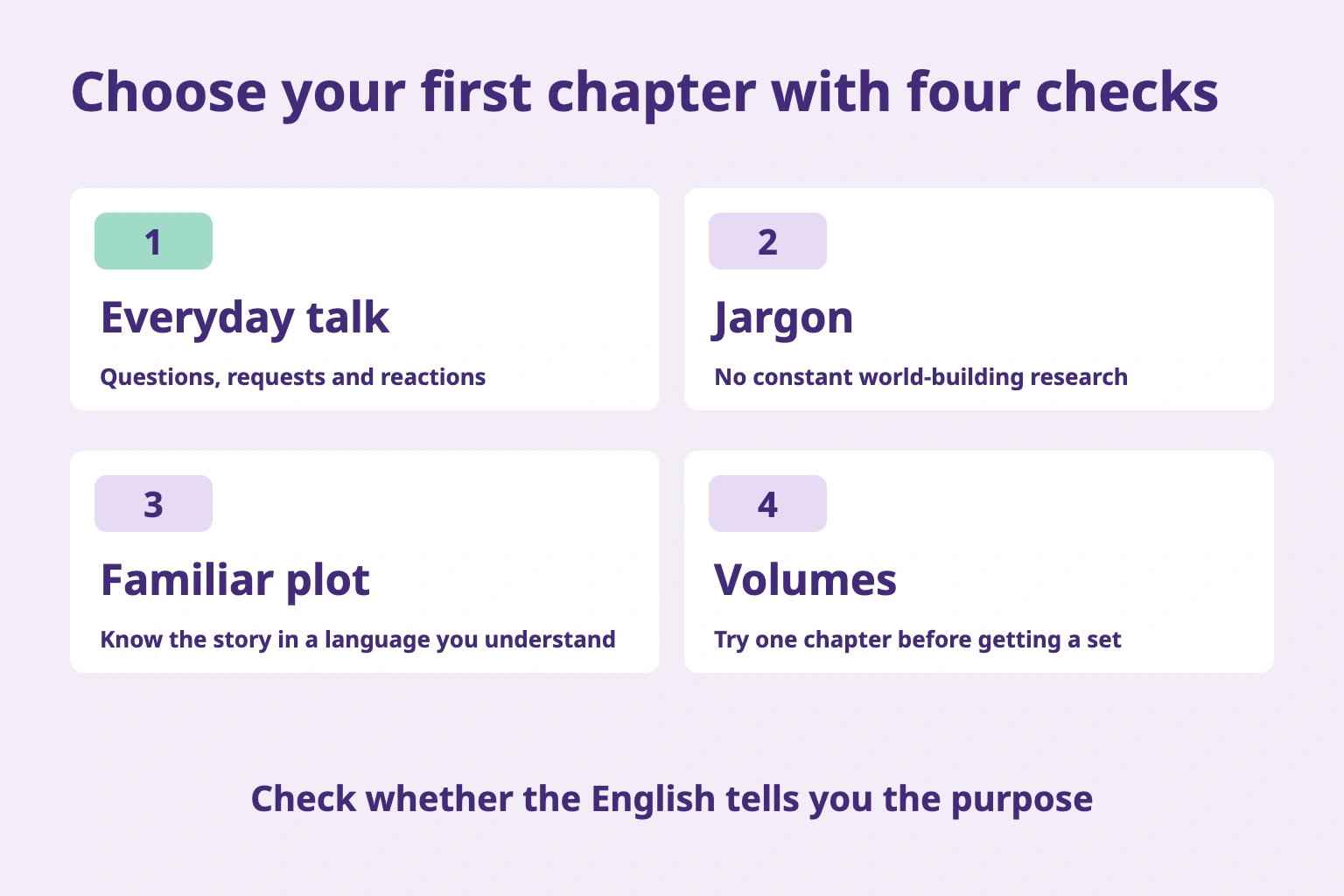
Compare a short exchange in two possible books using official previews when available. Ask whether the English tells you who wants to communicate what, rather than whether the pictures alone make sense.
| Condition | A useful starting point | Caution |
|---|---|---|
| Everyday dialogue | Questions, meals, plans, requests and reactions | Shouts and long explanations offer fewer ordinary exchanges |
| Jargon | You can follow the purpose despite some unknown words | Constantly researching fictional powers or technical terms can consume the session |
| Familiarity with the story | You already know the relationships and events | Remembering the plot is different from understanding the English |
| Volumes and stopping points | You can try one chapter before getting one book | Buying or finishing the whole series is not an entry requirement |
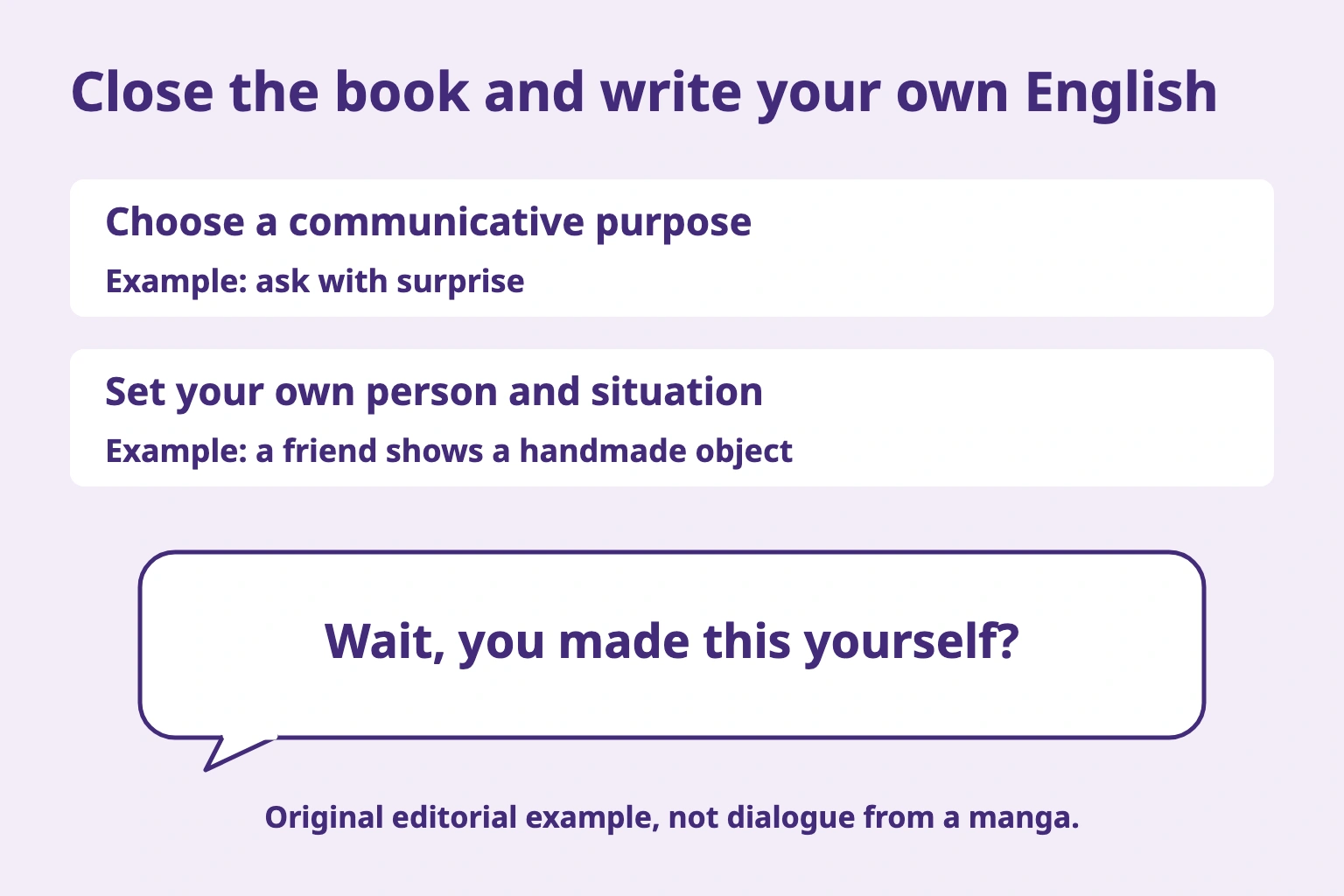
Our original example is Wait, you made this yourself? Imagine a friend showing you a small handmade object. You want to express surprise and check whether they made it. Look for similarly usable purposes, not necessarily that exact object or exchange.
Practise: mark each criterion “manageable / too much today.” One unfamiliar term need not disqualify a favourite; repeatedly researching the setting is a reason to choose a different passage. Common mistake: assuming a children’s title must contain easy English. Ellipsis, jokes and irony can make short balloons demanding. Compare our beginner English books if you need more controlled language.
Where would we start?
Editorial opinion: we would try a familiar story with short everyday exchanges, check an official preview, then get access to one chapter or one book. A long series can work if the chapter is manageable. We would postpone a dense explanation of the fictional world. This is a practical preference, not a measured difficulty ranking.
These are title-and-publisher examples only, verified on the publishers’ official sites on 15 October 2026:
| Title | Official English-edition publisher |
|---|---|
| Yotsuba&! | Yen Press |
| Spy x Family | VIZ Media |
The list does not promise beginner suitability, age appropriateness, stock or access in your region. Apply the four checks yourself. Practise: name one thing you might want to ask a friend this week. Common mistake: collecting recommended books before completing a single short practice session.
One chapter, five steps
Try about 15–20 minutes, shortening the reading to one exchange if necessary. These times are editorial starting estimates, not research-established optimums. If the plot is familiar, the first check can be very brief.
| Stage | What to do | Starting time | If it is too hard |
|---|---|---|---|
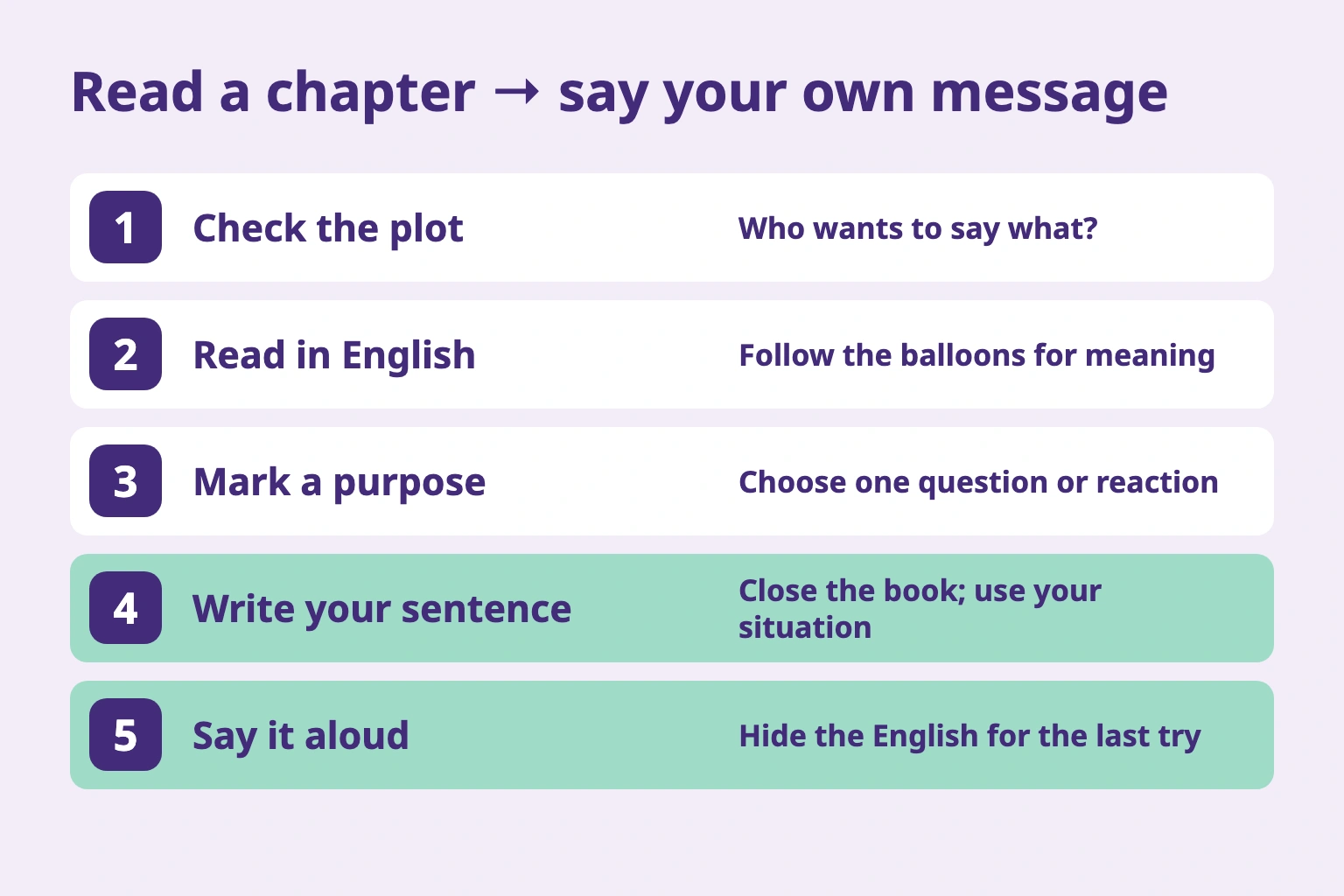
| 1 Check the plot | Identify who wants to tell whom what | 1–2 min | Use your familiar-language edition or your memory |
| 2 Read in English | Follow balloons for the main meaning | 5–8 min | Stop at a shorter exchange within the chapter |
| 3 Mark a purpose | Choose one question, request or reaction you might use | 2 min | Think of a real listener, not an unusual word |
| 4 Write your sentence | Close the book and write for your own situation | 3 min | Shorten it using familiar vocabulary |
| 5 Say it | Read it once, then hide the English and speak | 3–5 min | Practise in meaningful chunks, then join them |
A mark identifies a place in your own copy; it is not a dialogue transcription. For a library book, write a page number and a purpose such as “surprised confirmation” on your own note, rather than writing in the book. An e-book without annotation tools can be used the same way.
1. Establish the situation in a language you know
Briefly check events and relationships. Do not attempt to translate each balloon in advance. In our invented situation, a friend shows a handmade object and you want to express surprise. Understanding that purpose gives you something to look for in the English.
Practise: close the book and name the speaker, listener and purpose in a few words. Common mistake: continuing comfortably in your own language and never returning to English. Check only the passage you will use. Our bilingual-reading guide explains another way to consult a translation and return to the original text.
2. Read the English for the exchange’s purpose
Separate what you remember from what the English actually tells you. In Wait, you made this yourself?, identify who did the making and what the speaker wants to confirm. A list of word meanings is less useful here than recognising a surprised question.
Practise: state the purpose after one exchange. Look up a word if it blocks the plot or that purpose. Common mistake: stopping for every unfamiliar word until you lose the exchange. See handling unknown words while reading for deciding what needs attention now. If almost everything requires a lookup, change the passage or book.
3. Mark one question, reaction or request you could use
Choose a communicative purpose that fits your life, rather than a dramatic catchphrase or specialist explanation. For our example, the note can simply say “ask about a friend’s handmade object.” Keep the original wording in the book; your note does not need it.
Practise: picture someone you might say this to this week. Choose a different purpose if no listener comes to mind. Common mistake: marking so many passages that the next session becomes a large review backlog. One usable idea is enough for the first session.
4. Close the book and write a fresh short sentence
Set your own people, object and situation, then write with words you know. You are not replacing a noun in a character’s line or preserving the character’s mannerisms. Our team wrote Wait, you made this yourself? for the imagined handmade-object situation; it was not adapted from published dialogue.
Practise: write your intention in your own language first, then express it in one short English sentence. Reduce the amount of information if it grows too long. Common mistake: carrying a character’s insults, commands or theatrical voice into an ordinary exchange. Check meaning and register with a learner’s dictionary or a teacher when unsure.
5. Say it from a situation cue
Read your sentence slowly once. If you have reference audio, listen, pause, then say it yourself. A printed manga does not supply pronunciation: seeing a spelling is not a sound check. Use an audio dictionary for uncertain words.
Our sentence can be practised as Wait, / you made this / yourself?, then joined naturally. The slashes are practice marks, not instructions to pause heavily every time. A very forceful Wait can sound like stopping someone, so try a gentle, surprised question.
Practise: hide the sentence and speak from the cue “a friend shows me something they made.” Try again the next day. Common mistake: counting successful readings without ever testing speech without text. Our reading-aloud guide develops this distinction.
How manga translation differs from ordinary speech
Treat English manga as an adaptation of a story, not a word-by-word answer key for the Japanese. Localization considers readers, cultural references, humour and character voice. In this first-person interview, translator and localizer Matt Alt explains audience-related choices and the limits of literal correspondence. It is a practitioner’s account, not one rule governing every publisher.
The following language examples are all ours, not comparisons taken from a published edition:
| Point | Original example | What to check for your own speech |
|---|---|---|
| Localization | That works for me. can communicate that an arrangement suits you | Choose words for the intended message, rather than matching each word of your language |
| Sound effects | THUD labels a sound; I dropped my bag. describes an event | An effect printed near artwork is not automatically a spoken sentence |
| Forms of address | Thanks, Rina. / Thank you, Ms. Mori. | Names and titles depend on the relationship; Japanese honorifics do not map one-to-one |
Yen Press’s FAQ says house style can vary by work. Its statement about generally omitting honorifics concerns prose novels, so do not turn it into a manga-wide rule. Check the edition you have rather than assuming all English versions handle names alike.
Our worked example expresses surprised confirmation. For a calmer factual question, our alternative Did you make this yourself? may fit. Context and delivery matter even with a short sentence.
Practise: compare asking a friend and asking someone you have just met. Would you choose the same words and tone? Common mistake: labelling every difference from Japanese a mistranslation, or treating exaggerated character speech as a model for every conversation.
Where to find official English editions
Start on the English-edition publisher’s official title page. Confirm the title, publisher and English edition before checking a licensed e-book store serving your region or a library. Choose official editions to respect creators’ and translators’ rights and to read material with an identifiable publisher.
| Route | What to verify | Useful for |
|---|---|---|
| Publisher’s official site | English title, edition, volume and paper/digital information | Avoiding a different title or language |
| Officially licensed e-book store | Language, publisher, regional access, terms and readable zoom | Reading briefly and returning to the same passage |
| Public, school or university library | English-edition holdings, eligibility, reservations or requests | Trying material before buying a series |
Publisher entry points include Yen Press and VIZ Media. A digital edition listed by a publisher is not a guarantee that your country or account can buy it. We promise no regional stock, free chapters or library holdings. When comparing two languages, check chapter contents as well as the number printed on the volume.
Practise: before purchasing or reserving, match language, English publisher and intended volume/chapter. Common mistake: assuming an English-looking title means the book is in English, or buying a set because one library lacks it. Ask about a request or try another suitable book.
Paper or digital?
Editorial opinion: use whichever makes balloon text readable and returning to a passage easy. Paper may suit side-by-side comparison; digital zoom may help small lettering. An official copy you already have is a reasonable start.
Practise: read a brief exchange, go back and check one sentence. Common mistake: choosing a format before testing the actual lettering, navigation or regional terms.
Keep your own sentence for speaking
Write your sentence and its situation on separate parts of a note. Here that is Wait, you made this yourself? and “surprised by a friend’s handmade object.” Read once, cover the English, then say your message. If using a speaking tool, work with this independently written sentence.
Practise: listen to a reference if available, stop it, then speak from your cue. Common mistake: leaving audio playing while never saying anything yourself. You can still do the speaking step on a day without audio.
SpeakGain is our own app. We saved only the original sentence above as one card through the normal Add screen. In Library, we opened its Knowledge view and selected Learn this card. Listening hid the English and displayed a prompt to listen and say it aloud. We also verified that Reveal answer shows the saved sentence and that the play button replays the same audio.
For practice, listen to your self-written sentence, stop the audio and say it. Finish by speaking from just the cue about a friend’s handmade object. Work with a sentence for your own life, rather than dialogue from a book.
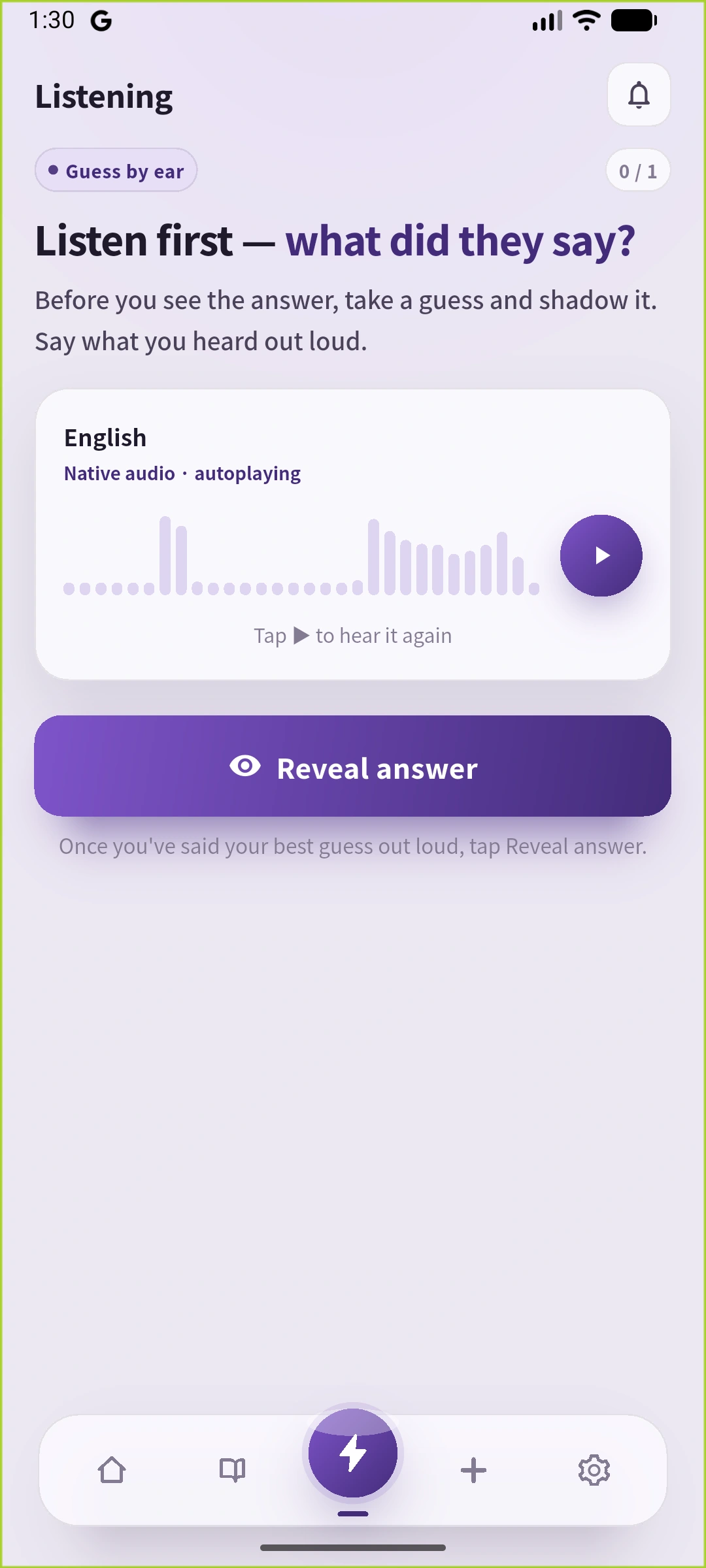
Viking audio for our original sentence — Wait, you made this yourself?
AI-generated Viking audio, not a recording by a human native speaker. Listen, pause and say the sentence for your own situation.
A small plan, and two methods we would avoid
The following is an editorial starting plan, not a promise of improvement after a fixed number of repetitions. Put the speaking step somewhere you can actually use your voice, whether after class or after work.
| Occasion | Task | Check |
|---|---|---|
| First session | Complete the five stages with one chapter or exchange | Did you find one personal purpose? |
| Next day | Speak from the situation cue | What can you say without the English? |
| Next reading | Briefly revisit the English passage | What do you understand from words, not just memory? |
| End of week | Say your sentence and choose another passage | Should the next passage be shorter? |
For our example, imagine receiving a handmade object and say Wait, you made this yourself? Communicating the purpose matters more than reproducing an identical string every time. Record what you understood and what you could say separately.
We would not look up every word immediately: repeated interruptions can turn the whole session into vocabulary processing. Prioritise what blocks the plot. We would not start with a jargon-heavy passage: deciphering the setting can leave no time for your own speech. You can still enjoy that title and use an easier everyday exchange for deliberate practice.
Practise: record one understood purpose and one message you said. Common mistake: measuring only pages read or words collected. If choosing the next book is hard, revisit how to choose your first English book.
Frequently asked questions
Which manga is good for beginners?
Look for ordinary conversation, manageable terminology and a familiar plot. Try an official preview; a title recommendation alone is not a language-level assessment.
Where can I buy English manga?
Check the English publisher’s official page, then licensed e-book stores available where you live. Libraries may offer a way to try a book first; check holdings and eligibility locally.
Is paper or digital better for studying?
Choose readable balloons and easy navigation back to a passage. Zoom and side-by-side comparison can matter more than format alone.
Should I look up every unknown word?
No. Start with words that block the story or purpose. If you need nearly every word explained, shorten the passage or choose easier material.
Can I use manga English in real conversation?
Some questions and reactions may fit, but sound effects, honorifics and exaggerated character voices are not universal conversation models. Write for your own listener and check register.
Is this suitable for children?
Only after an adult checks both content/age suitability and language demands. Pictures do not guarantee either. Try a short passage together.
Should I use anime instead?
Manga lets you inspect text at your own pace; English-audio anime supplies sound. The manga and dub need not use identical wording. Compare our anime learning method for audio/subtitle practice.
Will reading alone make me able to speak?
Reading and producing a message need separate practice. End with your own short sentence and a no-text speaking check; manga need not cover every part of your English study.
Our editorial verdict
We would begin with an official English edition of a familiar story and one manageable everyday exchange. Get through a chapter, choose a purpose, close the book and write for your own listener. Say it aloud and then from a situation cue. Wait, you made this yourself? is our small original example of that finish line, not a line to collect from a character. Keep both enjoyable reading and your own speech in the routine.
Sources
- Yen Press: Yotsuba&! and VIZ Media: Spy x Family: English-edition publishers checked 15 October 2026.
- Interview with Matt Alt: first-person localization practice, not learning-effect research.
- Yen Press FAQ: work-specific house style and library information; the prose-novel honorific policy is not a universal manga policy.