
6 English read-aloud materials: books, apps and free resources
Published
For an adult starting to read English aloud, our first free pick is British Council A1 listening; for a simple story in a book, consider Penguin Readers’ Starter edition of The Happy Prince if you can obtain a print copy with its resource code. If you already understand basic narrative English, choose a short scene from the audio edition of Love or Money?; for ready-made sentences on a phone, try Speechling. Choose material whose meaning you understand, with matching model audio, a section you can finish and content you want to revisit.
These six recommendations cover two books, two apps and two free websites. The order is not a ranking. Third-party descriptions are based on official information, checked on 14 October 2026, rather than purchases or hands-on app reviews. We separate published specifications from our editorial judgments and omit numerical prices. Our own SpeakGain is one option for preparing a sentence you want to say.
To choose a book for conversational patterns and situations, see our conversation-book guide and its personal-sentence routine.
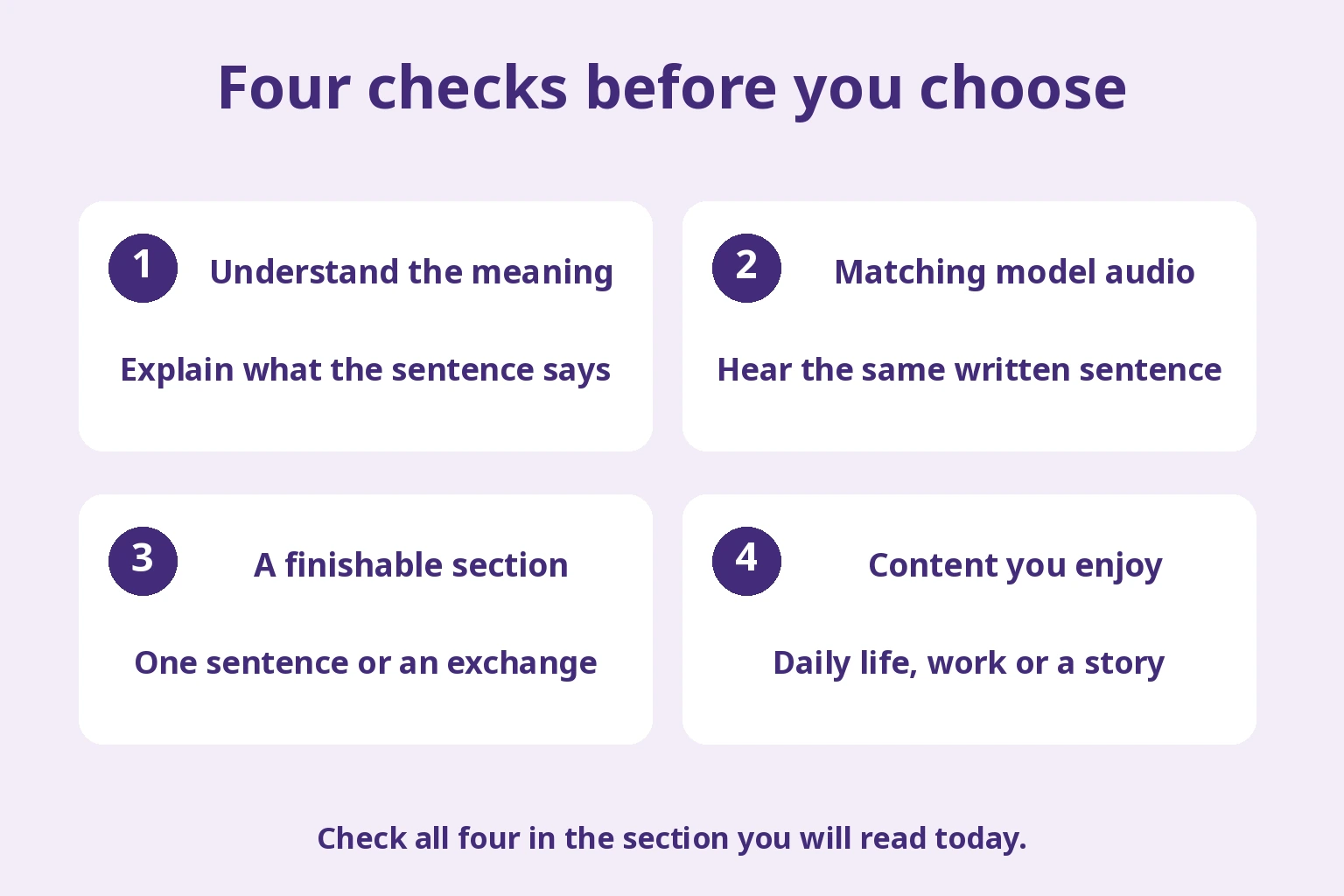
Four checks before choosing a material
Understand the meaning. After checking a translation or explanation, can you say who is speaking and what the sentence conveys? An unfamiliar word is manageable; a paragraph you still cannot explain is too difficult for your main read-aloud material. Reading it repeatedly does not replace understanding it.
Find audio of the same text. A recording of a different adaptation will not reliably match the page in front of you. Check the edition, resource code and download conditions before buying. Distinguish human recordings from generated model audio.
Choose a finishable section. One sentence or an exchange is a valid starting unit. You do not need to finish a book, video or news article in one practice session. Leave enough time to listen, read and return to one difficult phrase.
Choose content you will return to. A work request, daily routine or story you enjoy gives you a reason to open the material tomorrow. Do not buy a demanding book merely because it is famous. The read-aloud guide explains the practice sequence; this article helps you choose the text.
Six options compared
Provider levels are separate systems. Oxford Stage 1 and VOA Level 1 are not equivalent qualifications. A trial is also different from ongoing free access.
| Material | Type | Level | Model audio / access | Best for | Caution |
|---|---|---|---|---|---|
| The Happy Prince, Penguin Readers Starter | Paid print book | Starter; 350 headwords | Official site, account and print-book code | A simple adapted story | E-book purchases do not unlock the resources |
| Love or Money?, Oxford Bookworms MP3 Pack | Paid book/audio pack | Stage 1; 400 headwords | Follow the pack’s audio instructions | A short scene from a mystery | Ordinary text-only edition differs; murder theme |
| Speechling | App/Web; free tier and paid plans | Beginner to advanced material | Recorded sentence audio on app/Web | Ready-made short sentences | English coaching excluded from free coaching |
| SpeakGain | App; paid Pro and limited trial | Editorial fit: can prepare a meaningful sentence | Generated audio for an entered sentence | Your own everyday English | Not a structured beginner course |
| British Council A1 listening | Free website | A1 Elementary | Lesson recording and Transcript | Short daily/work conversations | Instructions are in English |
| VOA Let’s Learn English – Level 1 | Free website | Designed for beginners | Lesson video, conversation audio and text | A sequence of conversation lessons | Do not confuse the course with news articles |
Official sources are linked in each section. For instruction on individual sounds, use our pronunciation-app comparison instead. Here, the decision is where to obtain a readable text and its model audio.
1. The Happy Prince: a simple story, with a specific print-edition condition
Who it suits: someone who wants an adapted story rather than disconnected drills. We suggest the learner edition as a book option, not Oscar Wilde’s unadapted text. A story can provide a reason to return without making every page a practice assignment.
Verified facts: Penguin Readers lists this as a Starter reader with 350 headwords, ISBN 9780241588826, and MP3 resources on its official title page. Its FAQ explains that unlocking needs registration, sign-in and the code inside a physical book. The page contains inconsistent CEFR labels, so we use the series level rather than repeat either number.
Caution: buying an e-book does not include the online resource access described for print copies. Before ordering, use the title page’s country/distributor selector and check the exact edition and code. A distributor listing is not a stock or delivery guarantee. If you cannot obtain the matching package, begin with the free websites below rather than import a book just to start practising.
Read-aloud use: understand a short part of the story, obtain its matching audio through the official instructions, listen, then read that part aloud. Stop at a natural scene boundary. We have not purchased or tested the unlock process ourselves.
2. Love or Money?: choose one scene rather than the whole book
Who it suits: a learner who understands basic narrative English and enjoys a mystery. It is a different choice from a grammar course or a collection of everyday replies.
Verified facts: Oxford University Press lists the MP3 Pack, ISBN 9780194620499, as Stage 1, 400 headwords and a paperback with audio. Headwords describe the grading vocabulary, not the total number of words. The official product and catalogue distinguish the audio pack from the ordinary reader.
Caution: the story concerns a murder; skip it if that theme is unwelcome. Confirm local availability of this particular audio edition rather than assuming every regional printing includes it. OUP’s historical MP3 guide describes an access-code download; the instructions and deadline supplied with your actual pack take precedence.
Read-aloud use: first follow the scene silently, identify the speakers, listen to the corresponding recording, and read a short exchange. Our beginner-book recommendations discuss finishing a book; here we recommend the matching audio and a small practice unit. Do not make reading every page aloud a condition of enjoying the story.
3. Speechling: choose from prepared sentences
Who it suits: someone who wants a sentence to practise without writing one first. A phone or browser can be a convenient way to work in small units.
Verified facts: Speechling’s guide describes beginner through advanced content and recordings by professional voice actors. Its pricing page lists the curriculum, male/female recordings, voice comparison and Android/iOS apps in the free tier, alongside paid services.
Caution: English coaching is excluded from the free coaching offer. We have not installed or captured the app for this article and do not rate its feedback quality. Confirm regional store access if you need an app; the provider also offers a website.
Read-aloud use: select a sentence you understand, hear the recording and read the written words aloud. If using the advertised recording comparison, focus on one place where you paused or lost a word. You do not need to turn every attempt into a score.
4. SpeakGain: prepare a sentence from your own life
Who it suits: someone who already has a short sentence they want to say. For a predefined syllabus, choose a course or book first; for prepared sentences, Speechling may suit you better.
Official information: our SpeakGain introduction describes manually entering English, keeping it as a card, listening to generated audio, speaking and returning for review. A-opt provides the app. Its published selling terms describe paid Pro and an initial two-week trial; check your store’s current terms rather than assume a permanent free plan or a universal regional price.
Caution: you choose the sentence. This is not our recommendation for a complete grammar syllabus or human-recorded narration. The model audio is AI-generated, not a recording of a native speaker. The purpose here is to prepare meaningful text with an audio model.
Read-aloud use: our original practice sentence is I read a short story aloud before breakfast. Use it for the scene of reading a short story before breakfast. Check the intended meaning and start with this one sentence instead of entering a book.
On the dedicated Android device, we entered the English sentence through the normal Add form and submitted Add a card once. The card reached ready with its explanation and model audio. We observed this study sequence:
- Open the created card in Library, go to Knowledge and choose Learn this card.
- Listening initially hides the English and presents the reference audio first. For read-aloud practice with the text visible, choose Reveal answer.
- Answer displays the saved English and reference playback control. Check the words against the model and read the sentence aloud yourself.
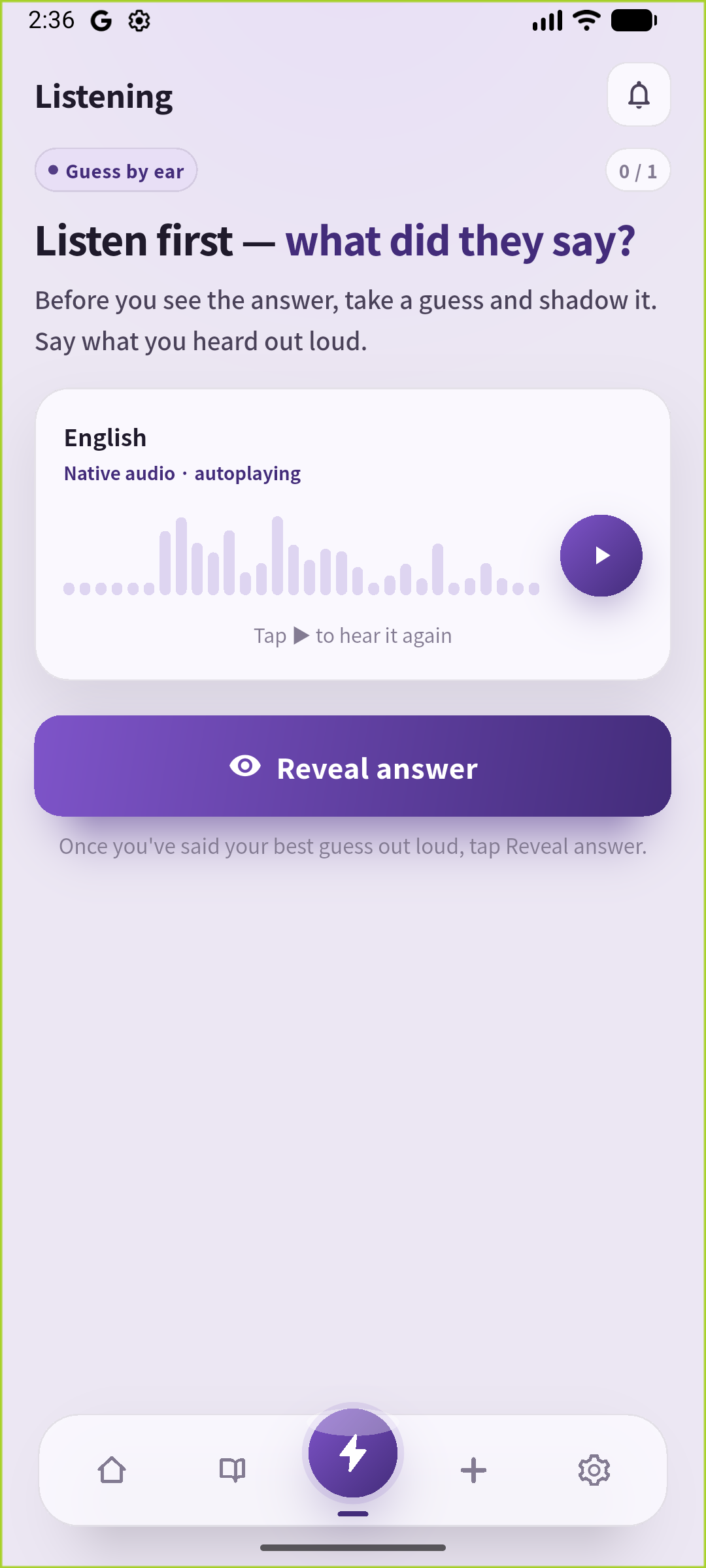
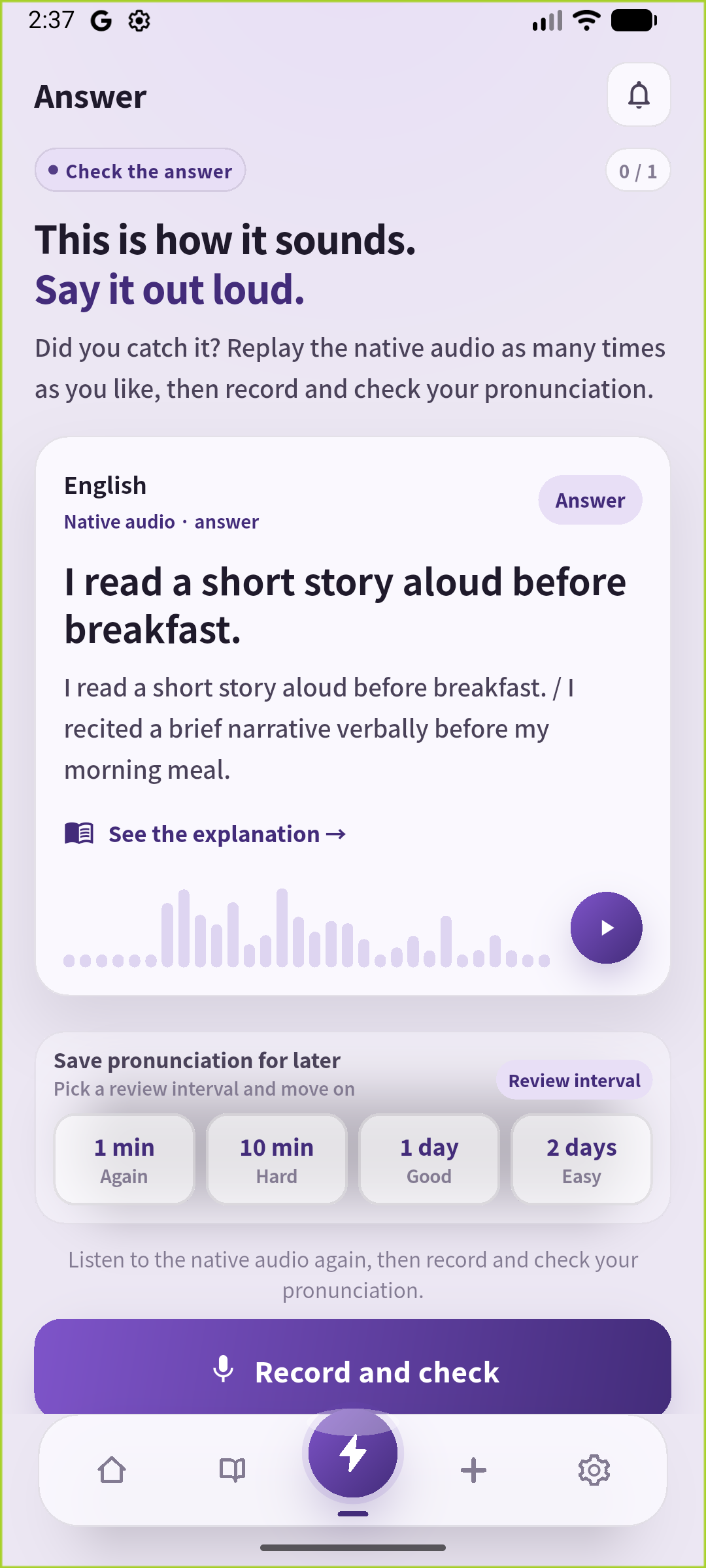
Viking model audio generated for this one card. This is AI-generated audio, not a recording of a human native speaker.
5. British Council A1 listening: our first free choice
Who it suits: an adult who wants a short everyday or workplace conversation before buying anything. It helps you select a scene rather than search endlessly for an impressive text.
Verified facts: the official A1 collection contains recordings and comprehension tasks. The inspected lesson, A request from your boss, has a Transcript, audio instructions, tasks and a worksheet link, and is marked A1 Elementary.
Caution: English instructions can themselves be difficult. Do not assume an A1 label means no unfamiliar workplace words. These are public web resources; access can depend on your network and region. No third-party media playback test is claimed here.
Read-aloud use: identify one request and response, check their meaning, listen and read each role. If a long request is too much, start with a short reply. Completing every exercise is not a prerequisite for using an understandable exchange.
6. VOA Let’s Learn English: follow a conversation course, not a news feed
Who it suits: someone who likes recurring characters and an order to follow. It is our free course option for beginners interested in American English.
Verified facts: VOA’s official introduction describes a 52-week beginner course designed by certified American English teachers. Lesson 1: Welcome! includes conversation text, video, speaking/pronunciation sections and a direct conversation MP3 link on a public lesson page.
Caution: Level 1 is the course’s own label, not Oxford Stage 1 or a guaranteed CEFR level. The course schedule does not promise fluency in 52 weeks. VOA news articles are not all beginner lessons.
Read-aloud use: watch enough to understand the scene, then choose one introduction or exchange. Check the written conversation against the audio and say it yourself. Tomorrow, return to that exchange before expanding the section.
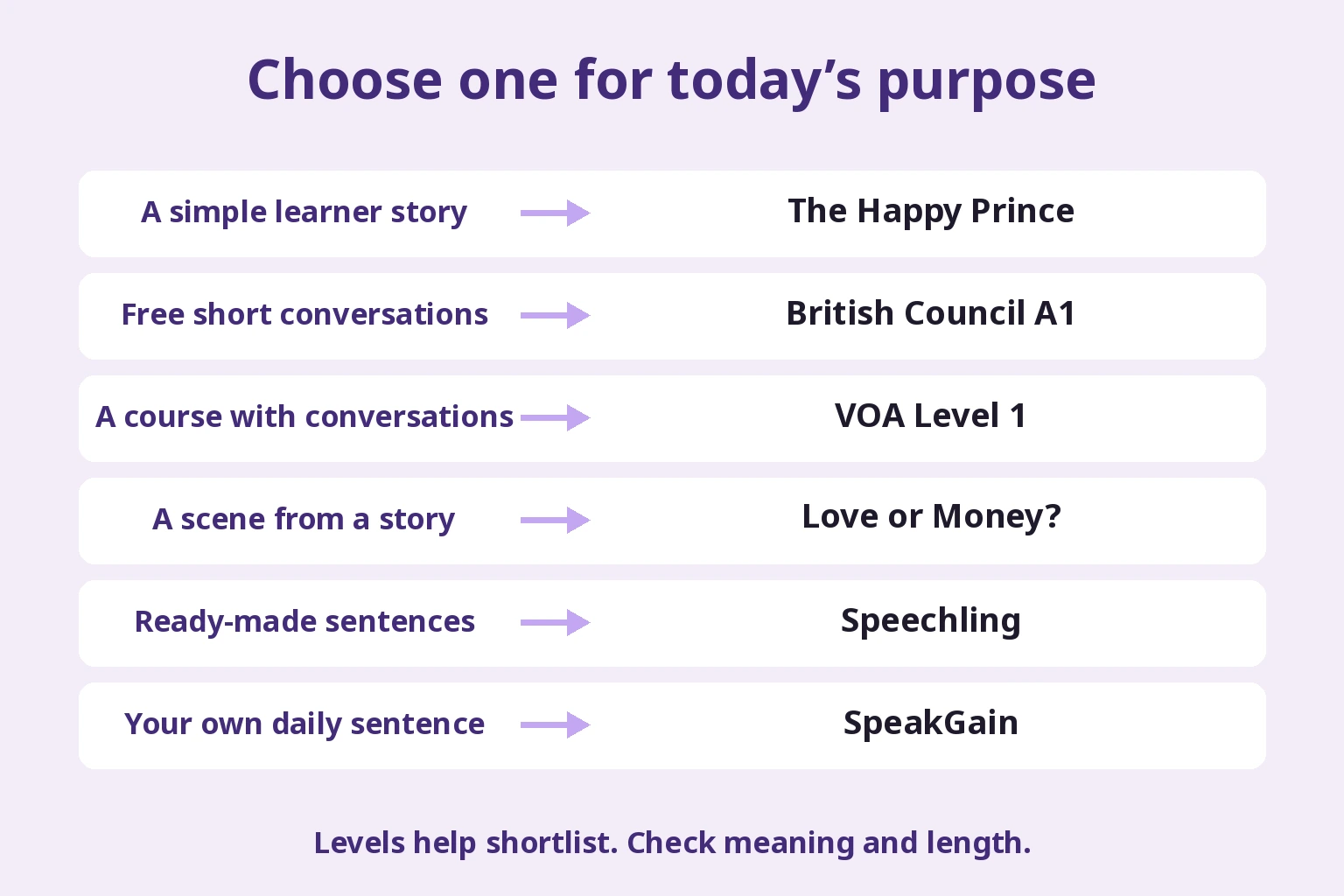
Choose one for today
Start free with British Council for short conversations, or VOA for ordered lessons. Consider the Penguin print reader if its resources and local supply fit; choose Oxford for a mystery scene you can already understand. Use Speechling for prepared sentences and SpeakGain for your own meaningful sentence.
We do not recommend material that requires constant dictionary work, text without matching model audio as a first choice, or an entire long news article for a beginner. A familiar topic does not remove difficult syntax. Reduce the practice section or move to easier material before buying another app.
Understand a short section, listen, read aloud and revisit one difficult part. Add more only when that cycle fits the time you have. See the study-method hub for the bigger plan, choosing a first book for book difficulty and shadowing guide or shadowing apps when you want to practise following audio without reading.
Frequently asked questions
Can I use an old school English textbook?
Yes, if you understand it and can legally access audio matching the exact edition. Check the publisher; do not assume every textbook comes with free audio. Start with a conversation or paragraph.
Which free resource should I try first?
British Council A1 listening for a short exchange with text and audio. Choose VOA Level 1 if you prefer an ordered video-based course.
Is an app better than a book?
Choose a book if you want to stay with one text; an app if you prefer prepared short units or your own sentence. Neither format automatically makes practice more effective.
Is news suitable?
Yes, when you understand it, have matching audio and can shorten the section. Long articles are not our starting choice for beginners.
How do I know a text is too hard?
After checking explanations, try to describe what a short section says. If you still cannot do that, or run out of time before speaking, choose easier material.
Do different editions include the same audio?
Do not assume so. Check the ISBN and audio conditions. Penguin’s print code and e-book purchase differ; Oxford’s MP3 Pack and text-only reader differ.
How many pages should I read?
Begin with a finishable cycle rather than a page count. One sentence or exchange is enough to test whether meaning, audio and speaking connect.
Our editorial verdict
British Council A1 is our first free pick; VOA is the course alternative. For a book, choose the Penguin Starter print edition with its resource code when available, or Oxford’s audio pack once a mystery scene is manageable. Speechling supplies prepared sentences; SpeakGain fits a sentence you want to say yourself. Choose one material, finish one short cycle and change it only when you can name the reason it did not fit.