
TEAP Speaking preparation: format, criteria and four-part practice
Published
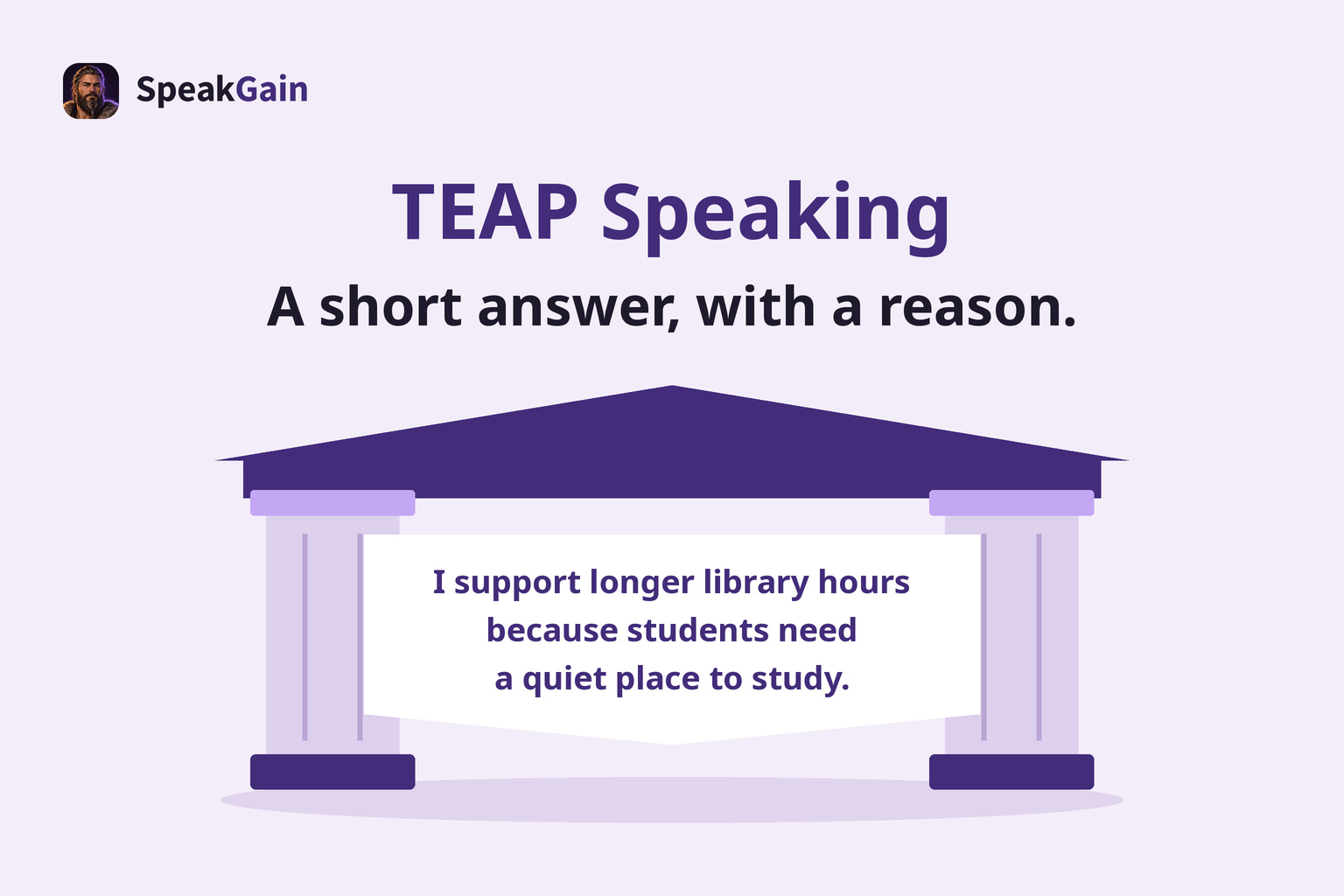
TEAP Speaking is a one-to-one interview lasting about ten minutes, with four parts: personal questions, an interview you lead, a speech, and topic-based questions. Its official criteria cover pronunciation, grammar, vocabulary, fluency and interactional effectiveness; the reported Speaking score is 20–100. Start by recording a short answer with one relevant reason, then listen to check that it answers the question (official format, criteria, scores).
This guide is for students considering university admission in Japan, particularly those in their final two years of high school, and their parents. TEAP was jointly developed by Sophia University and the Eiken Foundation of Japan; it was designed with university entrance and academic English in mind (about TEAP, purpose). All test facts below were checked on 14 October 2026. The examples, answer structures and practice plan are our editorial suggestions, not official questions or guaranteed answers.
Format, parts and time
| Format | Parts | Official time | Assessment |
|---|---|---|---|
| One-to-one interview with an Examiner | Parts 1–4; Parts 1 and 4 contain multiple questions | About 10 minutes overall | Pronunciation, grammatical range/accuracy, lexical range/accuracy, fluency, interactional effectiveness |
The session is recorded or filmed continuously from entry to exit; recordings are used in assessment by certified raters. Sources: format and samples, criteria, checked 14 October 2026. A recorded interview does not mean answering alone into a computer.
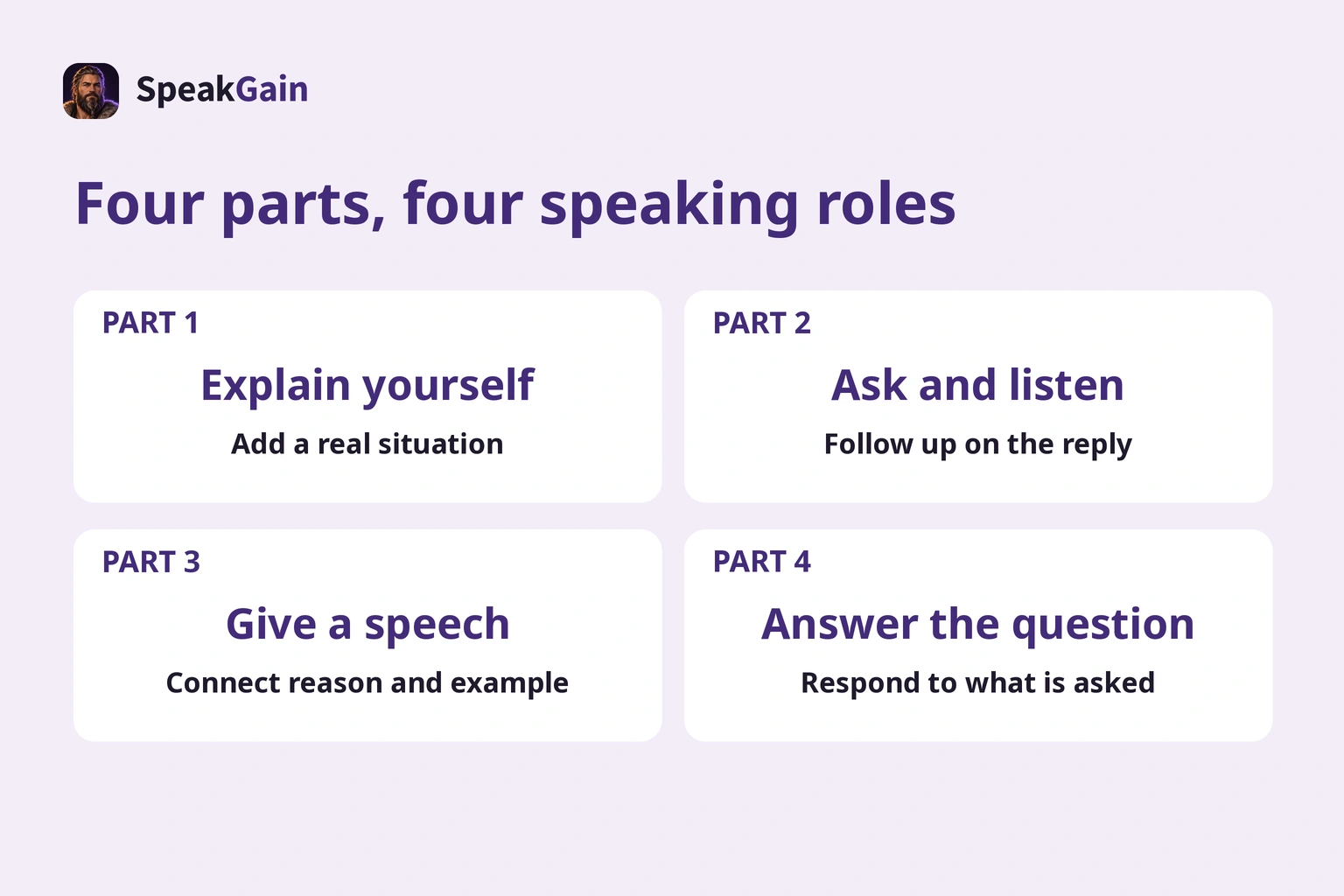
| Part | Official task | Our practice structure | Individual timing |
|---|---|---|---|
| 1 | Explain yourself through questions about your life | Answer → reason or situation | Not stated in the inspected overview/sample cards; total question count also unstated |
| 2 | Interview the Examiner in a role play and lead the dialogue | Ask → listen → follow up | Preparation and task seconds not stated in those materials |
| 3 | Give a coherent speech on one theme | Position → reason → example → conclusion | Preparation and speaking seconds not stated in those materials |
| 4 | Answer multiple questions on given topics | Answer → reason → useful detail | Per-answer seconds and total question count not stated there |
Source: official overview and samples, checked 14 October 2026. We do not fill these gaps with third-party timings. Follow the actual Examiner’s instructions. Our practice time limits below are editorial exercises.
If you also take a school-based test, consult our GTEC Speaking guide and check your particular test type separately.
Criteria and scores: do not turn a recording into a mark
| Official criterion | Our listening check |
|---|---|
| Pronunciation | Can someone understand the words without reading them? |
| Grammatical range and accuracy | Are the action, person and time clear? |
| Lexical range and accuracy | Does the word fit your meaning? Can you explain a missing word? |
| Fluency | Does the explanation keep its thread despite pauses? |
| Interactional effectiveness | Does your next question or comment respond to the other speaker? |
The published rubric has B2, B1, A2 and Below A2 rows. Briefly, B2 describes understandable speech, natural pace and effective interaction; B1 describes basic communication with hesitation or dependence on the Examiner; A2 describes stronger language constraints and frequent communication difficulties; Below A2 describes no response or very limited communication. Read the original for the full descriptions. These are not a homemade score calculator.
The general TEAP explanation states an A1–C1 measurement range for the four skills. That is different from the four rows shown in the Speaking rubric: A1/C1 Speaking descriptions are not provided in that table. TEAP itself gives scores and bands rather than pass/fail. The report uses 20–100 per skill; TEAP CSE is a separate learning/guidance scale. Fixed deductions per error and weights for these five criteria are not stated in the inspected pages.
Check each university’s official admissions requirements for your year, faculty and route. We do not list university cutoffs. Look for individual-skill requirements and submission rules as well as the overall score. Parents can help check the correct year’s document rather than treating an old score table as current.
Part 1: explain one thing about yourself
Required: answer personal-life questions (official tasks). Our structure: answer, then a reason or real situation.
I enjoy cooking with my brother because we can try new recipes together.
The sentence says that cooking with a sibling is enjoyable because you can try recipes together. Replace the activity and family detail with your own life.
Solo practice: write three topic labels in your own language: a recent habit, something you enjoy outside school, and something you want to try. Pick one without writing a full English script; record 20–30 seconds. That duration is our practice suggestion, not an official answer limit. Listen to the first sentence: does it give the requested information? Try a different detail tomorrow.
Common mistake: reciting your whole introduction regardless of the question, or switching to future plans when asked about a hobby. Fix relevance before adding vocabulary.
Part 2: listen before asking the next question
Required: lead an interview in a role play. Our structure: question, response, relevant follow-up. Our original home-practice setting is a university club interview:
What do members do at a typical meeting?
We practise short presentations.
That sounds useful. How do you help new members prepare?
The final question follows the mention of presentations. It is not a reproduction of the official topic card.
Solo practice: record two different answers as the partner, play one, and ask a follow-up based on what you heard. Because you made the recording, it cannot recreate an unpredictable conversation fully; occasionally ask a teacher or family member to play the partner. Split a long double question into two clear questions.
Common mistake: reading a memorized question list without listening. The official B2 interaction description specifically mentions incorporating the Examiner’s answer into your next question or making relevant comments (rubric). Check the connection before increasing the number of questions.
Part 3: connect your reason and example
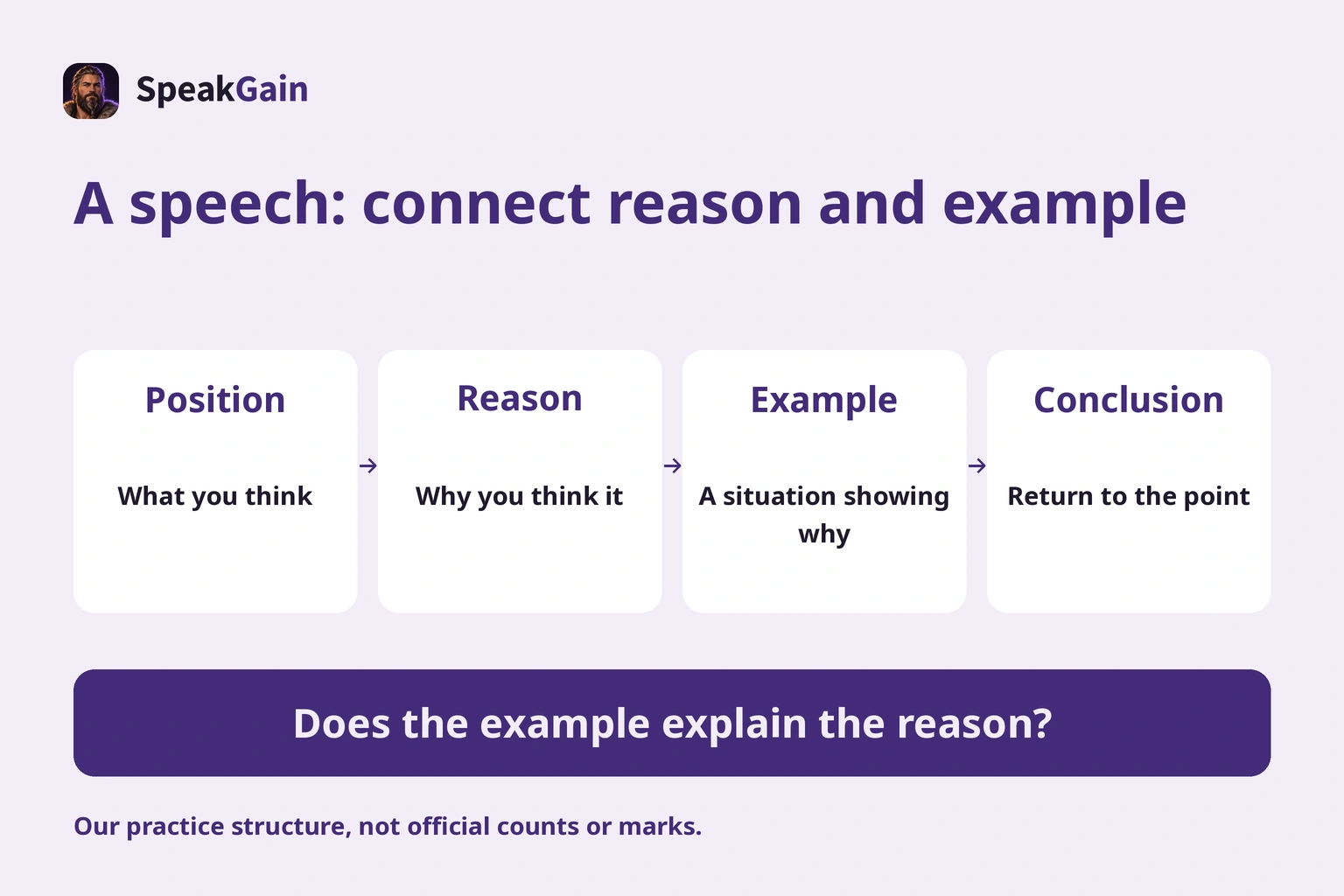
Required: a coherent speech on one theme. Our structure: position, reason, example, conclusion. Our original topic is increasing pair work in lessons:
I support pair work because explaining an idea helps me understand it better. For example, I can notice a missing step when I explain a maths problem to a classmate. That is why I would like more chances to learn in pairs.
The example explains how telling a classmate the steps of a maths problem can reveal a missing step. It supports the reason rather than adding an unrelated story.
Solo practice: use three keywords, then hide them and record. Begin with a 45–60-second practice window; this is not an official test limit. Ask whether a listener could explain your reason afterwards. Remove details that do not support it.
Common mistake: memorizing a polished script but being unable to start on a slightly changed topic, or adding a second reason that contradicts the first. Build one clear connection first.
Part 4: answer the question actually asked
Required: respond to several topic-based questions. Our structure: answer, reason, optional clarification. Our worked example concerns longer school-library opening hours:
I support longer library hours because students need a quiet place to study.
For example, it can be hard to concentrate in a busy home.
The main sentence supports longer hours because students need quiet study space; the next sentence gives one possible situation at home. The main sentence is also the shared one-sentence practice example throughout this article.
Solo practice: approach the same topic from three directions: your view, benefits to users, and difficulties in implementing it. Choose one and record an answer without a full script. Rephrase the reason in familiar words.
Common mistake: giving the same agreement statement when the question asks for a problem. Saying “because” is insufficient if the explanation does not support the answer.
Solo review and a four-week plan
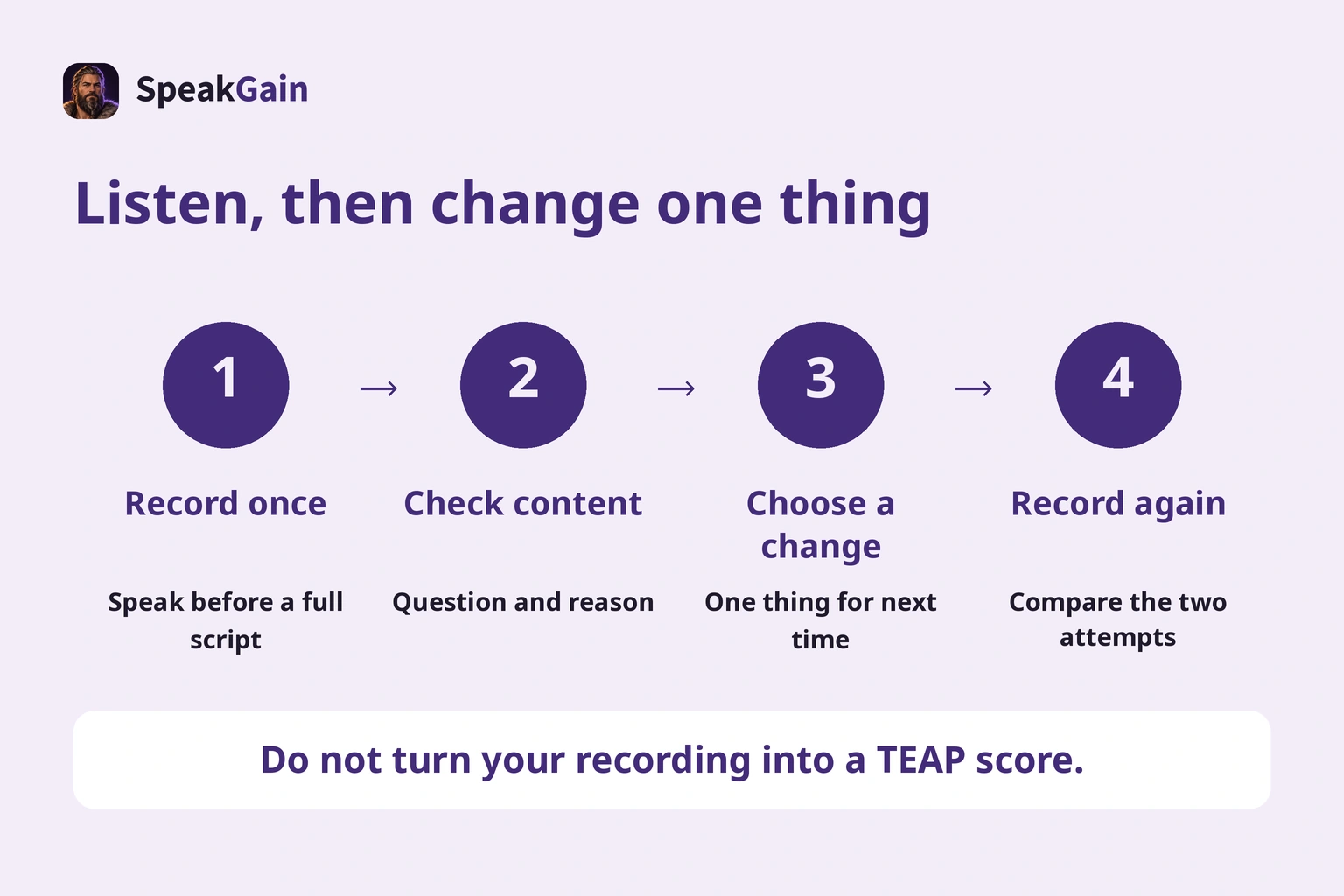
Record once, listen for content, listen for the delivery, choose one change, and record again. Keep the first attempt: only saving your best performance hides where you got stuck. Note the date, part and one change; avoid spending the session rewriting a perfect transcript. For uncertain language, give a teacher a short recording and one precise question. See our speaking practice methods for everyday practice beyond the exam.
| Week | Main work | Keep at week’s end |
|---|---|---|
| 1 | Inspect official samples, try all four roles, practise short personal answers | Initial recording and a sticking point for each part |
| 2 | Form questions and follow up on different answers | Two exchanges using different partner responses |
| 3 | Connect opinions, reasons and examples; change topics | Before/after recordings and one change |
| 4 | Follow the official instructions through the sequence; revisit the weak part | Final recording and test-day preparation notes |
This is our allocation suggestion, not a four-week score promise. Start with about 15–20 minutes a day and adjust around schoolwork and other skills. With less time, retain the sequence of format check, one correction and a run-through. Our exercise durations do not make an official mock test. The official sample page warns that its response video differs in some details from the actual interview. Check the current test guidance and admission ticket: waiting time is separate from the approximately ten-minute interview.
Listen to one short sentence with SpeakGain
Use the library sentence for listening and speaking without looking at the words. On the device, we saved our own sentence through Create, opened Knowledge from Library, and selected Learn this card. Listening played the audio with the sentence hidden. Reveal answer opened Answer with the sentence and its explanation. We also checked that the playback button on Answer replayed the same audio.
The clip below is AI-generated Viking audio made from this sentence. It is neither official test audio nor a human model answer. Listen, say it without reading, then add your own reason or example.
I support longer library hours because students need a quiet place to study.
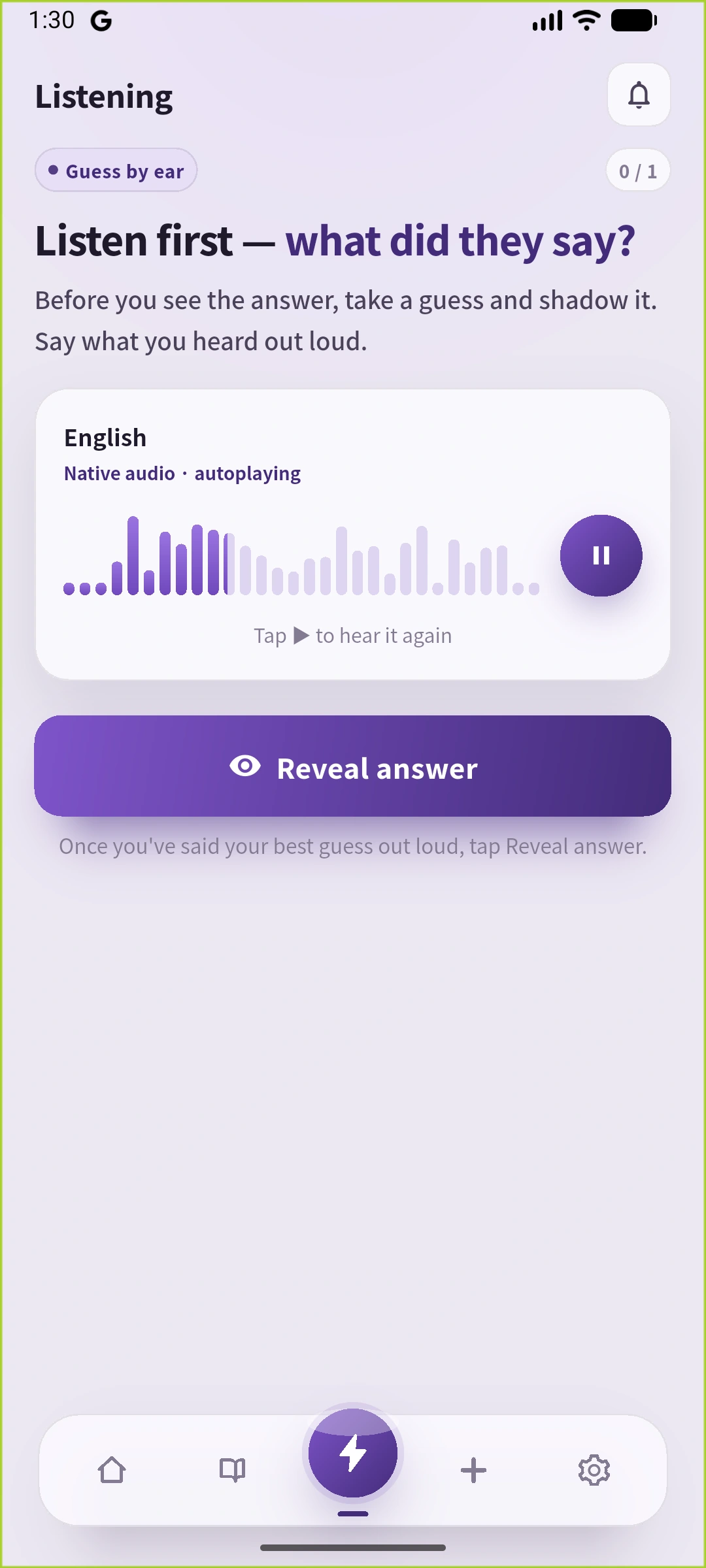
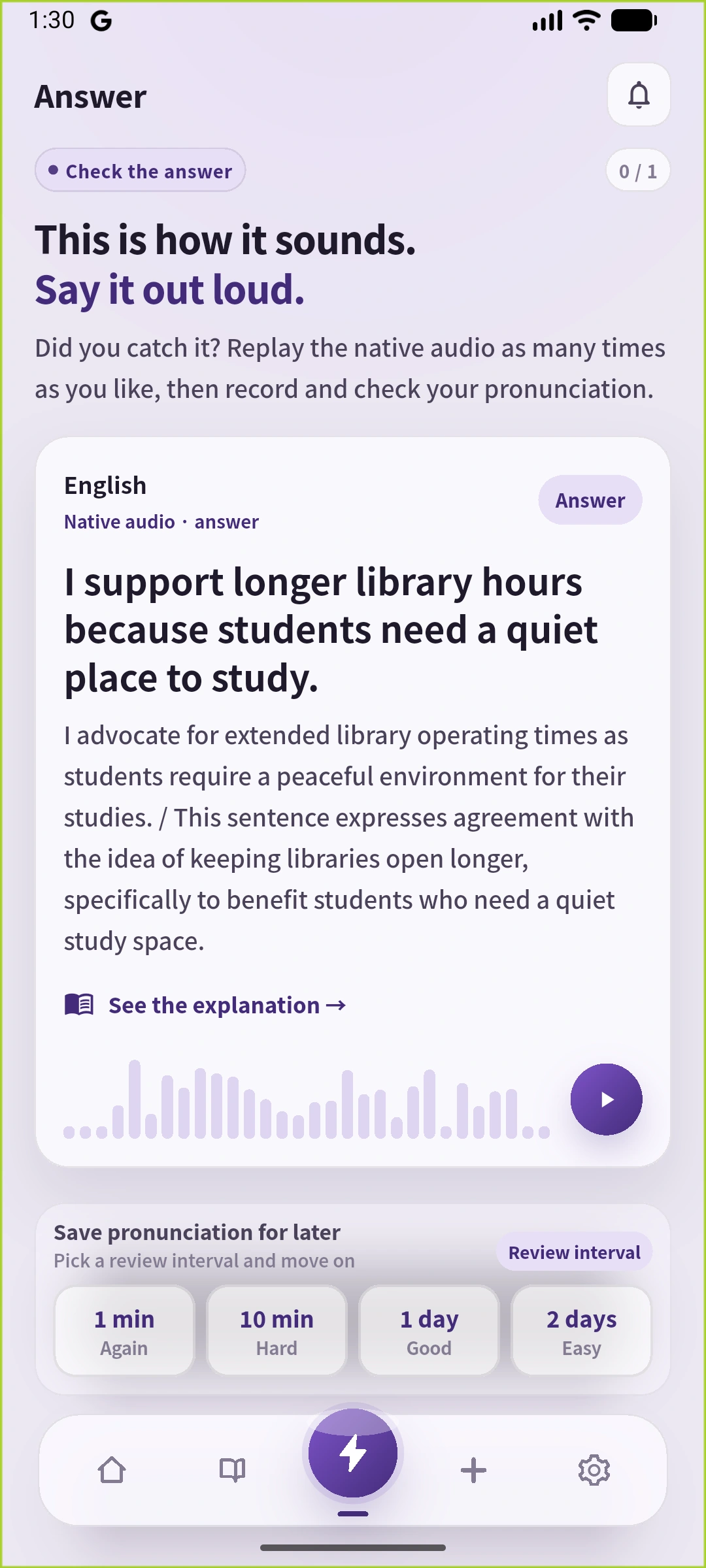
We verified saving one sentence, listening, revealing it and replaying it. This is not presented as a TEAP mock test or assessment of answers or pronunciation. Practise the four test roles and review your own recordings separately. See what SpeakGain is for a broader introduction.
Methods we do not recommend
We do not recommend memorizing long model answers: changed questions require you to choose new content, and Part 2 requires listening. Learn short useful structures and use your own details. We also avoid stuffing answers with unfamiliar vocabulary, fixed “recovery tricks”, or unsupported claims about guaranteed points for volume or repetitions. First make the explanation understandable; then expand the language you can use accurately.
FAQ
Is TEAP Speaking face to face?
It is a one-to-one interview with an Examiner, recorded or filmed (official format).
What score do I need, and what is the average?
Check your university’s official requirements. No current whole-population Speaking average is stated in the overview, rubric and report explanation inspected here. Do not use old anecdotes as a current average or a common pass mark.
Can I ask for repetition?
A fixed allowance and deduction rule are not stated in the inspected TEAP materials. The rubric includes signalling communication difficulties. Practise a brief clarification followed by an answer; do not import Eiken’s rules or promise unlimited penalty-free repetition.
What if I cannot think of an answer?
Our suggestion is to choose a position you can explain with one familiar reason. If the question itself is unclear, clarify that before building an opinion.
Must I always give two reasons or examples?
No universal number is stated in the inspected official materials. Our structures are practice aids; relevance matters more than filling slots.
Can Eiken interview practice replace TEAP preparation?
We recommend practising TEAP’s roles separately, particularly the candidate-led interview. Our Eiken Grade 2 and Pre-1 guides address those exams. We do not convert their scores into TEAP marks.
How early should I start, and must I record?
Start speaking when you know you will take the test. Our four-week plan is adjustable; recording is our recommendation, not an official home-practice requirement or a score guarantee.
Is SpeakGain a TEAP mock test or scoring service?
This article does not present SpeakGain as either. Keep one-sentence practice separate from official-format run-throughs; app use does not guarantee a score or provide TEAP/pronunciation assessment here.
Our verdict
Prioritize a relevant short answer and a follow-up that uses the other person’s response. Try all four roles, then spend more time on the part where you stop. Today, say the library sentence without reading it, add one relevant detail, and respond to a recorded partner answer with a related question. Finish by choosing one change for tomorrow.
For other exams, consult our IELTS Speaking and TOEFL Speaking guides. Share everyday speaking practice, while keeping each official format separate.
Official references
Checked 14 October 2026: TEAP purpose/developers, format and official samples, Speaking criteria, score/band explanation, score report, test guidance. Official questions, artwork and audio are linked, not reproduced. This independent editorial guide is not an organizer endorsement or an admission/score guarantee.