
How to study for TOEFL: the 2026 format and plans for 60, 80 and 100
Published
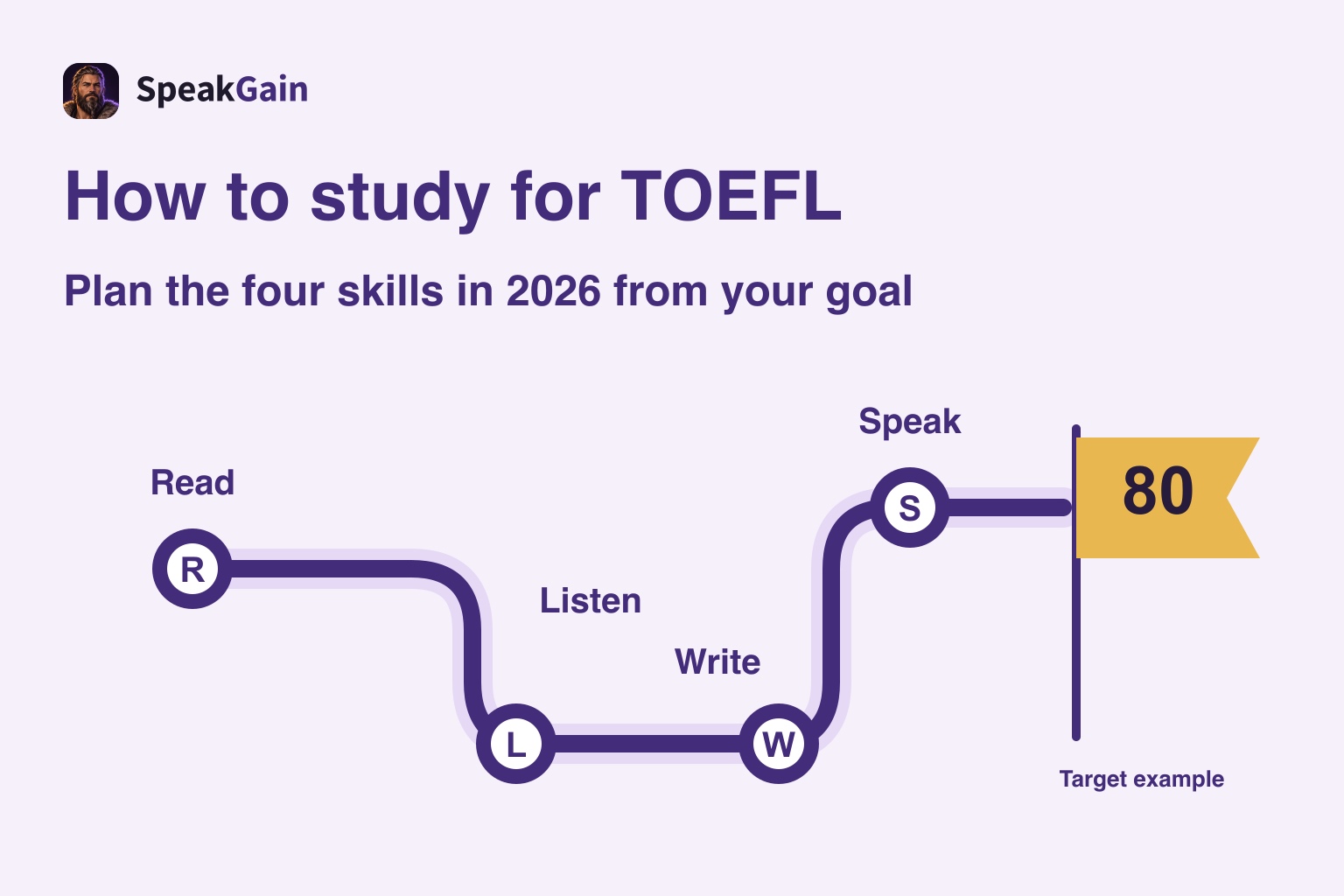
Start your TOEFL iBT preparation by checking your application requirements, trying the current official samples in all four skills, and alternating focused practice with unfamiliar tasks. The test changed on January 21, 2026, so check that your materials cover the present task types and scoring. A plan for 60, 80 or 100 should depend on your starting point and available time, rather than a promise to reach a score in a fixed number of months (ETS format, scores).
This guide is for university applicants, exchange students and scholarship candidates, including adults preparing alongside work. Test facts come from ETS and ETS Japan; study blocks, time allocations and the practice sentence are our editorial suggestions. Official information checked October 15, 2026. This is about TOEFL iBT, not TOEFL ITP.
The current 2026 format
The official structure gives these approximate base answer times. Directions are additional: ETS advises allowing about two hours overall, and time/items may vary as the test adapts.
| Section | Current tasks | Approximate answer time | Reported score | Source |
|---|---|---|---|---|
| Reading | Complete the Words; Read in Daily Life; Read an Academic Passage | 30 min | 1–6, half-bands | ETS Reading |
| Listening | Listen and Choose a Response; Listen to a Conversation; Listen to an Announcement; Listen to an Academic Talk | 29 min | 1–6, half-bands | ETS Listening |
| Writing | Build a Sentence; Write an Email; Write for an Academic Discussion | 23 min | 1–6, half-bands | ETS Writing |
| Speaking | Listen and Repeat; Take an Interview | 8 min | 1–6, half-bands | ETS Speaking |
Score reporting follows the ETS score guide. Reading and Listening use two-stage adaptive delivery: performance in the first module affects the difficulty of the second. Writing and Speaking are linear (specifications, p.2). A practice percentage is not a direct score converter.
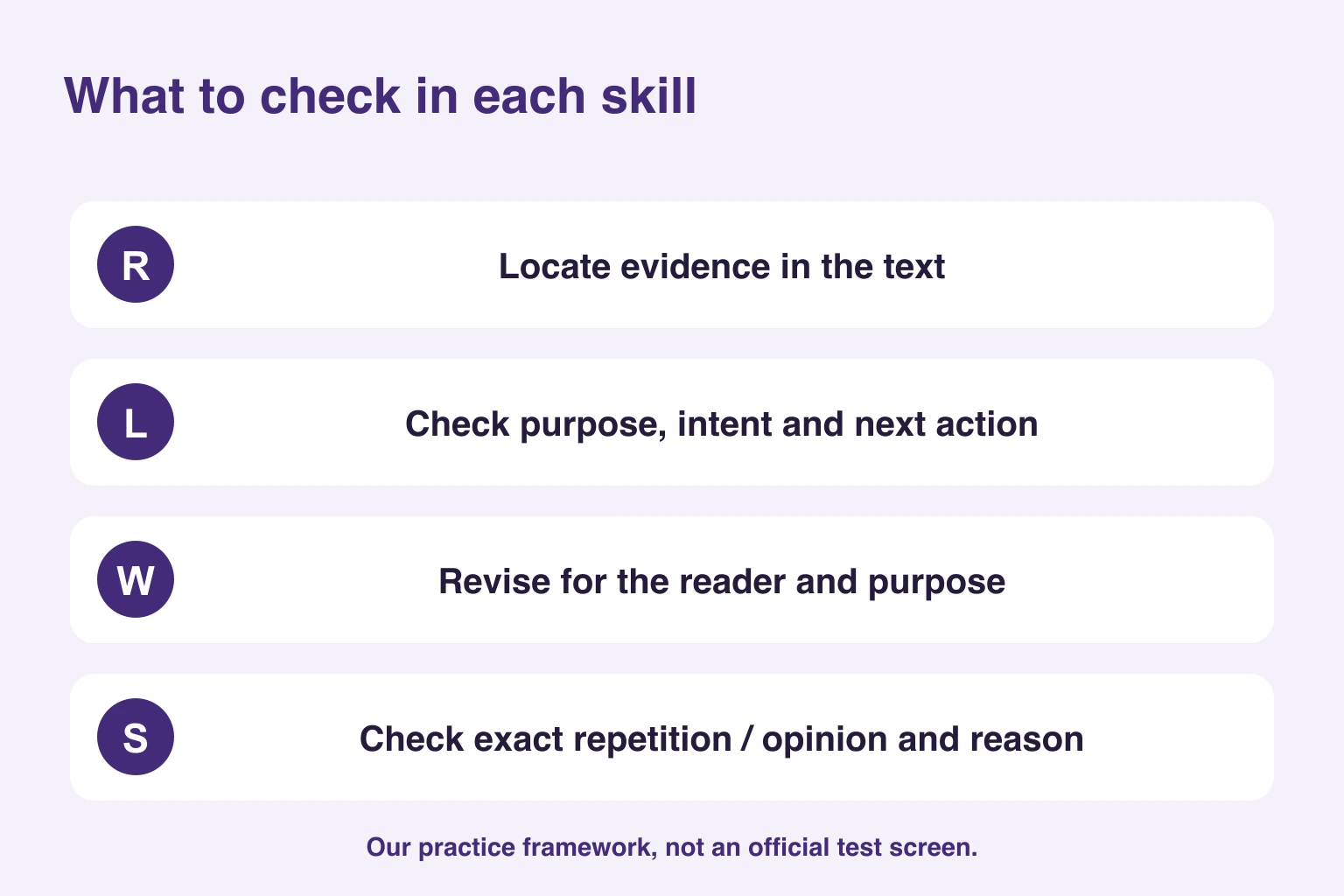
Our practice framework, not an official test screen.
What do 60, 80 and 100 mean on the new scale?
Each section and the overall score use 1–6 in half-point increments. The overall score is the four-section average rounded to the nearest half-band. During the two-year transition after January 2026, reports also include a comparable overall 0–120 estimate, described by ETS as the midpoint of its corresponding range. Do not assume the old four 0–30 section scores are still reported (ETS).
| Traditional target label | Position in the official concordance | Application caution |
|---|---|---|
| 60 | Within band 3.5’s 58–71 range | A 3.5 alone does not prove a 60 requirement is met |
| 80 | Within band 4’s 72–85 range | A 4 alone does not prove an 80 requirement is met |
| 100 | Within band 5’s 95–106 range | A 5 alone does not prove a 100 requirement is met |
These intervals follow the boundaries in the ETS table; they are not exact equivalences. Do not multiply a band by 20. Compare the official reported values with the institution’s current requirements and ask it how to interpret its threshold.
Target-score study blocks: editorial examples
The following periods are review blocks, not required times to reach a score. Repeat or extend a block if your starting level, skill requirements or available hours demand it. No row guarantees a result.
| Target label | Initial review block and workload: editorial | Main focus |
|---|---|---|
| 60 | 8 weeks; 5–7 hours/week | Basic vocabulary and sentence structure; short texts/audio; try every task and reduce missed instructions |
| 80 | 8–12 weeks; 7–10 hours/week | Explain reading/listening evidence; write and speak for the stated purpose; add time to the skill furthest from requirements |
| 100 | 12 weeks; 10–14 hours/week | Maintain accuracy on unfamiliar tasks; develop reasoning and explanations; review writing/speech against official criteria and outside feedback |
A learner already close to the required level needs a different schedule from someone rebuilding the basics. Use our general study guide to make the workload sustainable and pre-departure English practice to connect exam preparation with studying abroad.
Week one: record the requirement and your current difficulties
List the program’s overall score, section minimums, accepted test delivery and deadline. ETS sets no universal pass score: institutions set their own requirements. Do not assume every scholarship follows the university’s general admission page.
Open the current Interactive Sample from the ETS Japan preparation hub. Try a little of every task. Record whether you misunderstood the task, lacked vocabulary, understood too slowly, or ran out of time. The sample does not display a score, so use it to locate work rather than invent a predicted band.
For each error, write one likely cause and the next practice action. Being unable to understand a sentence and misunderstanding a paraphrase in an answer choice call for different follow-up work. You need a useful diagnosis, not a self-issued official score.
Reading: connect vocabulary to evidence
Official format and assessment. The three tasks involve completing partly missing words, reading everyday documents and reading academic passages. ETS describes contextual vocabulary, main ideas, details and implied meaning (Reading). The specification classifies these as machine-scored tasks, rather than a spoken-response rubric.
Common stumbling points. Recognizing a word in a vocabulary list does not ensure you can select its form in context. Matching a word in the passage to a word in an option can also hide a changed subject, condition or negative.
Practice method. After answering, locate the supporting text and explain why it supports the answer. For a vocabulary mistake, check spelling, word class and neighboring words, then write your own short sentence. For a distractor, note “not in the text” or the changed condition. Begin with accurate explanation; add timing later.
Official material. Use current samples and the Reading part of Full-Length Practice Tests linked from ETS Japan. Reuse answered passages for close reading, but reserve unfamiliar material to check first-attempt performance. Memorizing a passage is different from reading a new one well.
Listening: check purpose as well as individual words
Official format and assessment. Response selection, conversations, announcements and academic talks test meaning, intent, details, organization and inference (Listening). These are selected-response tasks in the specification; your notes are not a separately scored essay.
Common stumbling points. You may hear individual words but miss what the speaker wants, or follow the topic while missing a changed arrangement. Separate a sound-recognition problem from a meaning or intent problem.
Practice method. On the first attempt, listen before checking the script. After answering, note the purpose, evidence and likely next action. During review, consult the transcript and replay the short sentence that caused trouble; say it aloud once you understand it. Full transcription of every recording can consume the time you need to review meaning, so use dictation selectively.
Official material. The updated samples in the official hub include audio/transcript resources. Label script-first work as supported practice and script-free first attempts as unfamiliar-task checks. See our listening guide for a fuller diagnosis process.
Writing: repair sentence structure, emails and discussion separately
Official format and criteria. Build a Sentence reconstructs sentences/questions; Write an Email serves a practical purpose; Academic Discussion develops a contribution to an online discussion (ETS Writing). Practice Test 1, printed pp.28–29 specifies seven minutes for the email and ten for discussion.
The Writing rubric considers purposeful elaboration, vocabulary/syntax and, for email, appropriate social conventions and organization. Discussion needs a relevant, developed contribution. Its 0–5 response ratings are not the reported 1–6 section bands.
Common stumbling points. Memorizing a long essay does not practice word ordering. An email needs to address the recipient and requested actions, while an opinion without a reason leaves discussion underdeveloped.
Practice method. Break a mistaken sentence into subject, verb and modifiers. Before an email, identify the recipient, purpose and information/action needed. Before discussion, decide how your view relates to the existing ideas, then support it with a reason and example. Save both drafts and revisions. Ask a teacher or another reader what remains unclear instead of requesting only a guessed score.
Official material. Pair current Practice Test 1 with the Writing rubric. Review task fulfillment, concrete support and one unclear sentence each time. Difficult vocabulary is less useful than conveying the required message accurately.
Speaking: schedule both repetition and personal responses
Official format and criteria. Listen and Repeat requires exact reproduction; Take an Interview asks about experience/opinion (ETS Speaking). The rubric distinguishes accurate, intelligible repetition from relevant elaboration, pace and language use in an interview.
Stumbling points and practice. Free speaking alone does not train exact repetition; repetition alone does not train explanation. For repetition, review missing or changed words. For interview practice, check whether you answered the question before adding your reason.
Use the current official samples and rubric. Our dedicated TOEFL Speaking guide covers timing and recording methods in detail. In this whole-test plan, keep a weekly record showing that you practiced both tasks.
A short opinion-and-reason example
This is our original practice sentence, not an official question response or a certified high-score answer:
I prefer reviewing my notes after class because it helps me spot gaps.
Understand the opinion and reason, hide the sentence, and say it from meaning. Then change the reason to fit your own experience and add a concrete example. The sentence is a starting point, not a complete Speaking or Writing answer to memorize and paste into any task.
Listen to this sentence with SpeakGain
On the device, we created one card for the original notes sentence through the normal Add flow. Library → Knowledge → Learn this card opened Listening: the English was hidden, the model audio played, and the screen asked us to guess and say what we heard before choosing Reveal answer. Answer displayed the exact sentence we had entered.
Use SpeakGain here for listening to and saying the short sentence; develop reasons and examples separately. This demonstration does not establish a TOEFL mock test, answer or pronunciation scoring, or a score prediction.
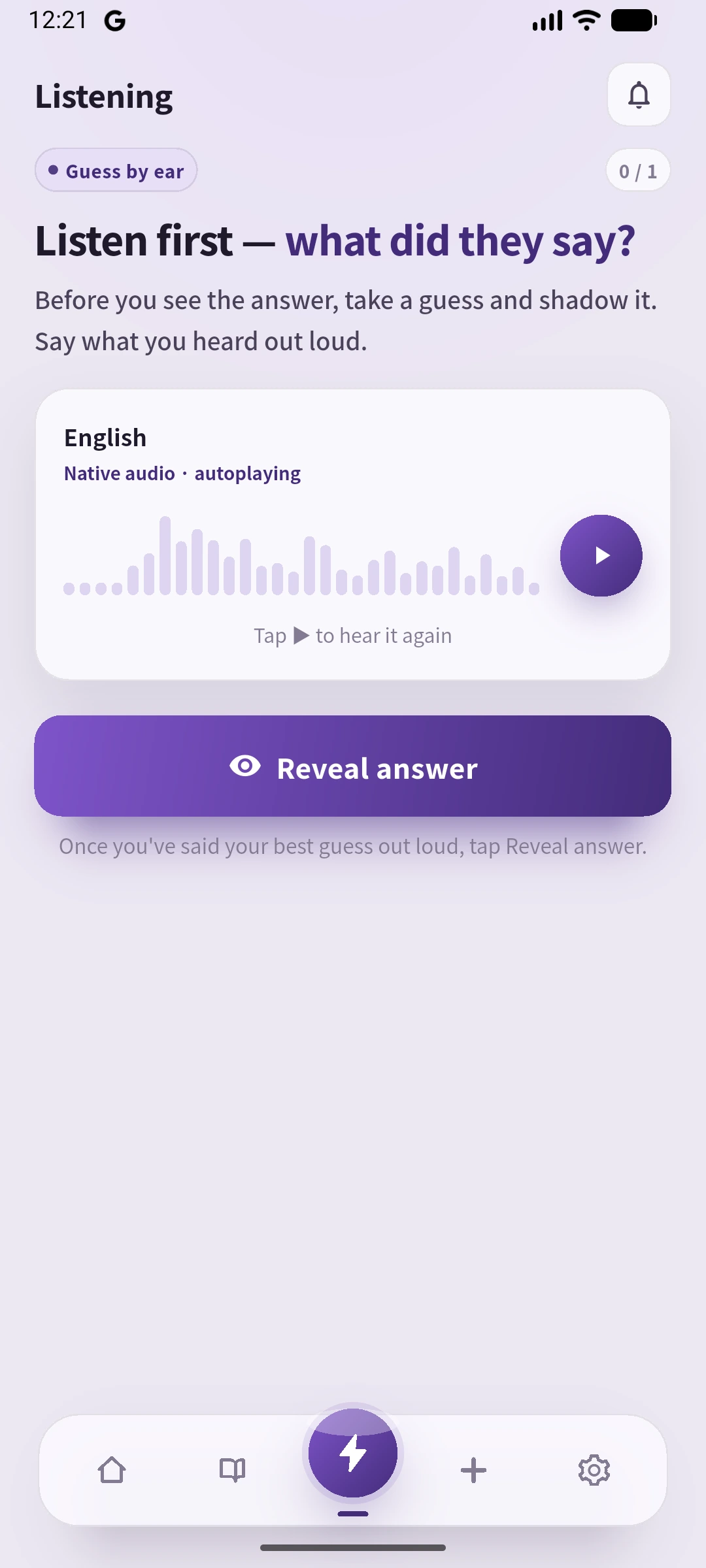
Listen to the worked example
AI-generated Viking model audio for the same original sentence shown above.
Our editorial plan for an 80 target
Our opinion: with eight hours weekly, begin with Reading 2h, Listening 2h, Writing 1.5h, Speaking 1.5h, and error-log/plan review 1h. This is a starting allocation, not an ETS recommendation or a score formula.
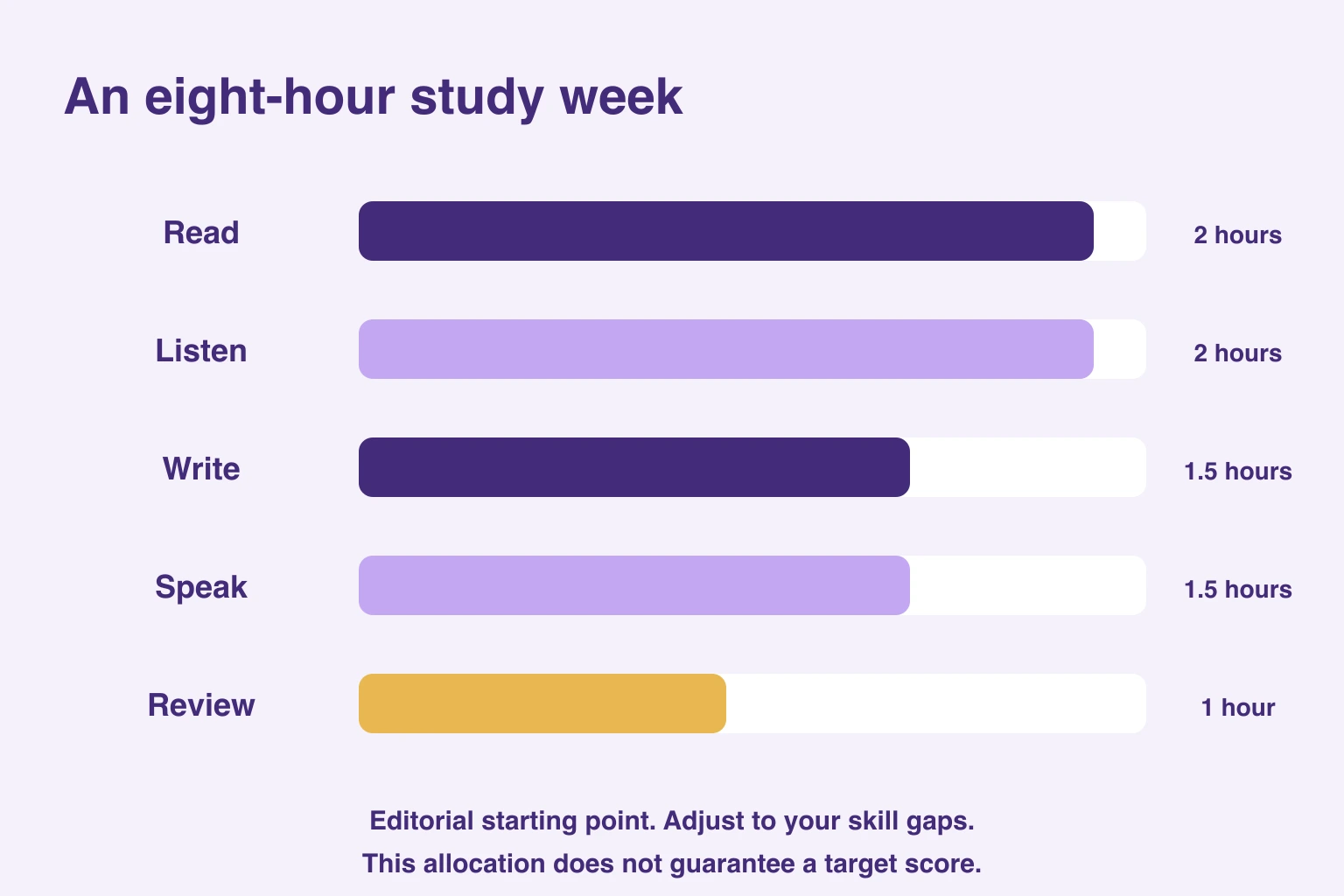
Adjust the allocation to your section requirements; it does not guarantee 80.
One option is five one-hour weekday sessions and a three-hour weekend block. Pair practice with correction during the week; use the longer block for unfamiliar tasks, writing revisions and listening back to speech. Every day need not contain all four skills, but every week’s record should.
In the first two weeks, separate format unfamiliarity from language gaps. In the next two, move additional time toward the skill furthest from the requirement. If reading is comfortable but emails omit essential points, more long passages are not the priority. If you write clearly but miss spoken intent, review short exchanges.
Every four weeks, compare hours spent with work you can do on a first attempt. Remembering practiced answers is progress in review, not equivalent evidence of unfamiliar-task performance. If considering paid official resources, check current-format coverage, scoring and access terms before purchase.
Use official resources for a specific job
| Resource | Officially described features | Our suggested use |
|---|---|---|
| Interactive Sample | Current tasks; no score display or answer review | Learn the tasks and interaction first |
| Full-Length Practice Tests 1 and 2 | Full-length experience and question/answer PDFs; email entry; no score display or answer review | Use one early, reserve the other for an unfamiliar check |
| Updated Overview and Sample Tasks | ETS Japan lists tasks, audio, scripts, Japanese translations and sample responses | Review a difficult task; Japanese explanations are optional support |
| Speaking/Writing Scoring Guides | Official response criteria | Identify what to repair in your response |
Sources: ETS Japan, Writing, Speaking. These resources are not all scored mock tests. A public formula converting PDF correct-answer counts into bands is not officially specified in the sources checked. We do not rank commercial books or reproduce official test questions.
Methods we do not recommend
- Memorized long templates: they can produce off-topic material and do not train exact repetition. Build a relevant answer from the question.
- Old-format books as the entire plan: old Integrated Writing and four-task Speaking practice do not cover today’s sentence building, email and repetition. Older language practice may supplement current official tasks.
- Mock tests only: a test identifies a problem; revision and focused practice address it. Keep the corrected sentence or error explanation.
- Deliberately missing questions to manipulate adaptation: the checked official sources provide no basis for treating this as a scoring advantage. Focus on understanding and answering each question.
These are editorial judgments about practice design, not official performance guarantees.
Home Edition versus a test centre
ETS offers a test-centre computer and live-proctored Home Edition. At home you must prepare the equipment and room. ETS requirements prohibit headphones/headsets and specify speakers, an appropriate microphone, a private room and approved erasable note-taking. Practice once in the conditions you will actually use.
The official country list includes the US, UK and many other locations, but a language version is not a booking guarantee. Check your actual country, current appointment availability, ID conditions and institution acceptance before paying. Scheduling guidance recommends testing at least two to three months before the earliest admission deadline (ETS); that is application planning, not a claim that this much study will achieve a target.
Frequently asked questions
What changed in 2026?
Task types and score reporting changed; Reading/Listening became two-stage adaptive. Use the current structure, not an old Writing/Speaking task list.
Is band 4 exactly 80?
No. The official concordance associates it with 72–85. Check your reported values and the institution’s requirement, not a self-made conversion (ETS).
Can I prepare independently for 80 or 100?
You can use official samples and criteria independently. A guaranteed study duration for either target is not officially specified in the sources checked. Get outside feedback when you cannot judge clarity yourself.
How many months do I need?
Base your plan on current ability, section gaps and weekly time. Our blocks are review intervals, not standard completion times. Update them after unfamiliar tasks.
Can I begin with free official materials?
Yes, using the resources above. Distinguish free task familiarization from score-producing assessment; the listed samples do not show scores (ETS Japan).
Should I choose TOEFL or IELTS?
Check what your program accepts first. Then consult our test comparison and IELTS Speaking preparation for differences, rather than selecting from rumored score conversions.
If you are also considering IELTS, our IELTS study plan explains how to allocate practice across its four skills.
Our verdict
Try current official tasks, record your requirements and weaknesses, then schedule practice with a correction step. For reading/listening, preserve evidence; for writing/speaking, preserve the original and improved response. Add resources only when a specific gap requires them. Today, identify one stumbling point and decide what you will repair tomorrow.
Official references: format, scores, preparation, Writing criteria, Speaking criteria. TOEFL and TOEFL iBT are registered trademarks of ETS. This independent article is not an official ETS course. Checked October 15, 2026.
To choose a vocabulary resource and connect remembered words to all four skills, see how to choose and learn from TOEFL vocabulary books for official comparisons and five practical checks.