
IELTS study plan: four skills, target bands and official practice
Published Updated
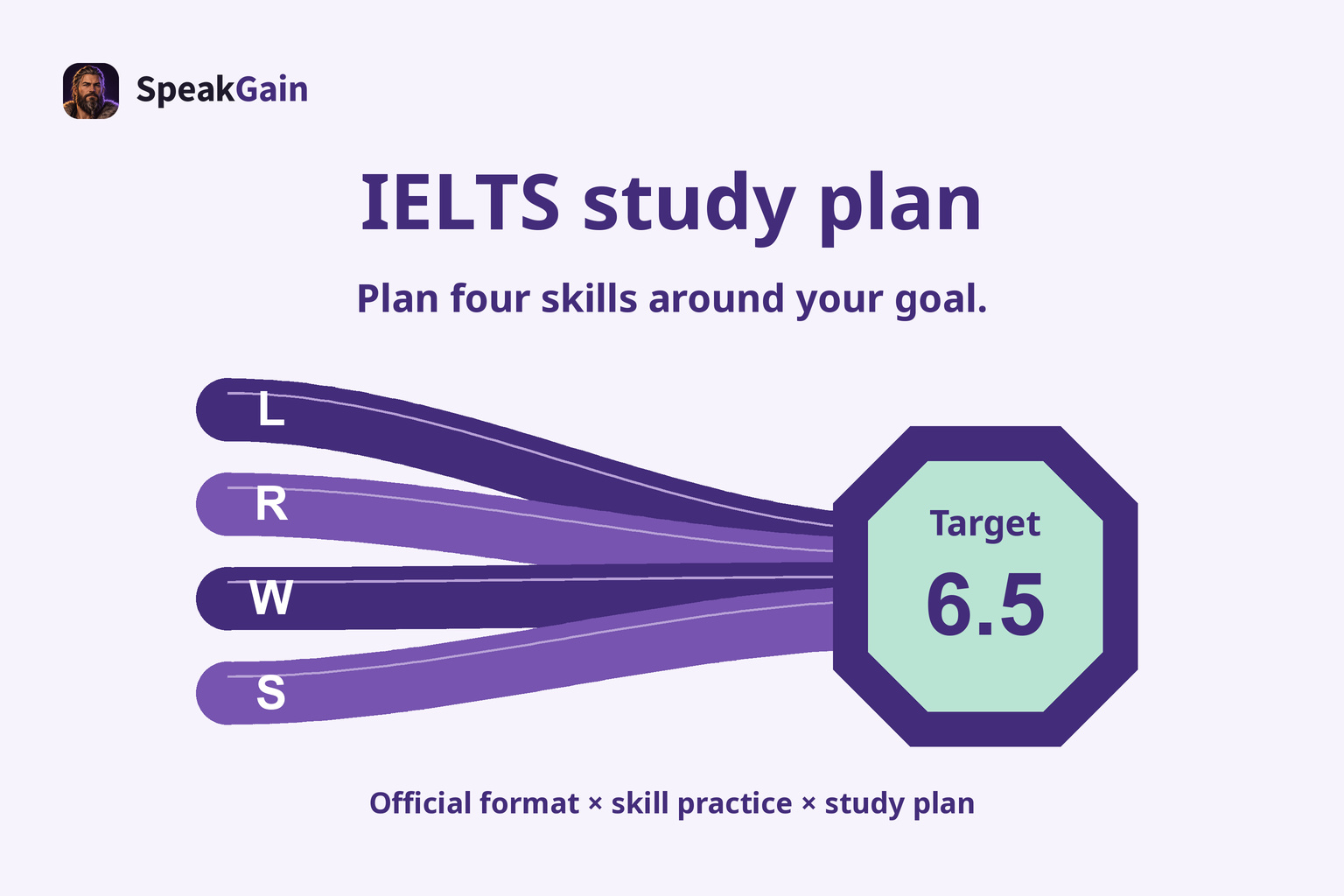
Start IELTS preparation by checking the test type, overall band and minimum skill scores required by the organisation receiving your results, then use official samples to identify your current gaps. Our recommendation is to review the evidence behind Listening and Reading errors, rewrite Writing against the assessment criteria, and record, review and repair Speaking. A target such as 5.5, 6.5 or 7.0 does not determine how many months you need: the periods below are editorial planning horizons, not promises of improvement.
For task-specific steps and revision against the public criteria, see our IELTS Writing guide.
If you are still choosing a test, read our English-test comparison. For language you will need beyond admission, see English preparation before studying abroad. This guide organises all four IELTS skills; detailed Speaking techniques remain in our IELTS Speaking guide.
To choose IELTS vocabulary materials, see our book and app guide for official band/module information and steps from a word to your own sentence.
Format first: time, questions and assessment
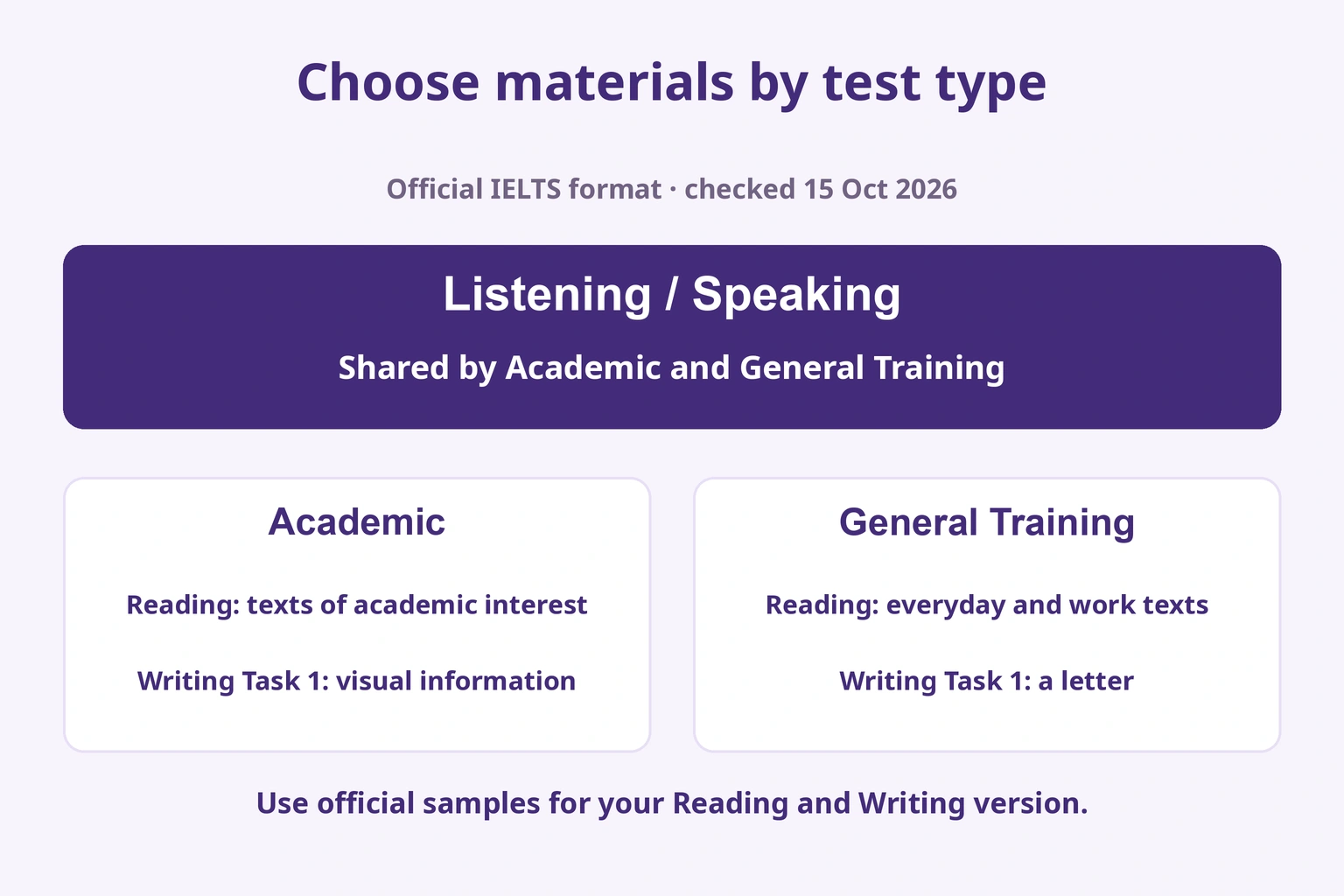
Academic and General Training share Listening and Speaking; Reading and Writing differ. Official guidance positions Academic for undergraduate/postgraduate study and professional registration, and General Training for migration or below-degree study/training. Check the receiving organisation’s actual requirement rather than choosing from the purpose alone (Academic, General Training). Official facts in this article were checked on 15 October 2026.
| Skill | Time | Questions/tasks | Assessment | Official source |
|---|---|---|---|---|
| Listening | About 30 minutes | 40 questions, four parts | One mark per correct answer, converted to a band | Format |
| Reading | 60 minutes, including answer transfer | 40 questions, three sections | One mark per correct answer, converted to a band | Academic, General Training |
| Writing | 60 minutes | Two tasks; at least 150 and 250 words respectively | Task achievement/response, coherence/cohesion, vocabulary, grammatical range/accuracy | Academic, General Training |
| Speaking | 11–14 minutes | Three parts; fixed total question count not stated officially on the inspected page | Fluency/coherence, vocabulary, grammatical range/accuracy, pronunciation | Format |
The older paper Listening allowance of ten minutes for transfer does not automatically apply to computer testing. Reading’s 60 minutes already include transfer. Follow the actual delivery instructions, not a mixture of paper and computer timings (official overview).
Planning for 5.5, 6.5 or 7.0
These are periods to plan and review, not the time required to reach a band. A universal study duration for each target is not stated officially in the inspected sources. Adjust for your starting point, available hours, deadline and minimum skill requirements.
| Target | Initial horizon — editorial suggestion | Main work |
|---|---|---|
| 5.5 | Provisionally plan 2–3 months; review every two weeks | Understand instructions, strengthen basic grammar/vocabulary, finish responses, explain your errors |
| 6.5 | Provisionally plan three months; review every two weeks | Prioritise skills below the required minimum; develop relevant reasons and evidence |
| 7.0 | Provisionally plan 3–6 months; review every two weeks | Sustain accuracy and clear argument under time pressure; seek criterion-based feedback when needed |
A learner already scoring 7.0 in some skills needs a different allocation from someone struggling to understand paragraphs. Compare saved first attempts with unfamiliar tasks later. If the deadline is fixed, count usable hours and reassess feasibility; do not turn a calendar into a guarantee.
Overall is an average; skill minimums are separate
The band scale runs from 0 to 9; 0 describes not attempting the test. Overall is the mean of the four section bands, rounded to the nearest whole or half band. An average ending in .25 rounds up to the next half; .75 rounds up to the next whole (official scoring).
Our invented example of Listening 7.0, Reading 6.5, Writing 6.0 and Speaking 6.0 averages 6.375, giving Overall 6.5. It would still fail a hypothetical requirement of 6.5 in every skill. This is arithmetic, not a particular institution’s admission rule. Record type, Overall, each minimum and deadline separately. Listening/Reading raw-score thresholds vary slightly by test version; General Training Reading usually needs more correct answers for the same band. Treat conversion examples as guidance, not a permanent lookup table (scoring details).
Listening: diagnose the missed information
Official format and criteria. Four parts contain 40 questions; recordings play once. Everyday and educational/training situations are included, with accents such as British, Australian, New Zealand and North American. Correct answers earn one mark (official format).
Common stumbling points. Knowing a written word but not recognising its sound differs from missing a correction, spelling the answer wrongly or ignoring the word limit. Calling them all “poor listening” hides the next useful practice.
Our method. Make the first attempt without pausing. Select one error, replay the short relevant section, then use the transcript to identify the cause: unknown language, connected sounds, changed meaning, spelling or instructions. Practise that short passage according to the cause, then listen again without text the next day. We would not transcribe an entire recording simply to accumulate pages. Our listening study guide explains the broader repair process.
Official materials. Use the audio, answer keys and transcripts linked from the Academic samples or General Training samples. Keep an unfamiliar set for a later check; remembering the answer is not fresh listening evidence.
Reading: find the evidence and the paraphrase
Official format and criteria. Both versions have 40 questions in three sections over 60 minutes. Academic uses non-specialist texts of academic interest; General Training includes everyday, workplace and general-interest material. Each correct answer earns one mark (Academic, General Training).
Common stumbling points. Matching identical words without reading their relationship, importing outside knowledge and spending too long on one question all obscure comprehension. In True/False/Not Given tasks, contradiction differs from missing information (question types).
Our method. Time a first attempt and mark uncertainty. During review, pair each answer with its location in the text and the paraphrase connecting it to the question. Separate vocabulary, syntax, negation/comparison and missing-information errors. If a paragraph is incomprehensible, study it closely before trying another timed passage. Neither translating every sentence nor scanning keywords alone should become your only routine.
Official materials. Select Reading from your own version’s Academic or General Training samples. Review lucky correct answers too. Reading the other version may be useful language work, but it is not a diagnostic of your own test.
Writing: answer the task, then rewrite
Official format and criteria. Both tasks must be completed in 60 minutes. Task 1 requires at least 150 words; Task 2 at least 250. Academic Task 1 describes visual information; General Training Task 1 is a letter. Task 2 responds to a viewpoint, argument or problem. Official guidance suggests about 20/40 minutes; Task 2 contributes twice as much as Task 1 (Academic, General Training). Within each task, the four criteria carry equal weight (assessment).
Common stumbling points. Listing every number without an overview, forgetting a letter’s purpose, or giving an opinion without developing its reasons. Substituting difficult words does not repair an irrelevant answer.
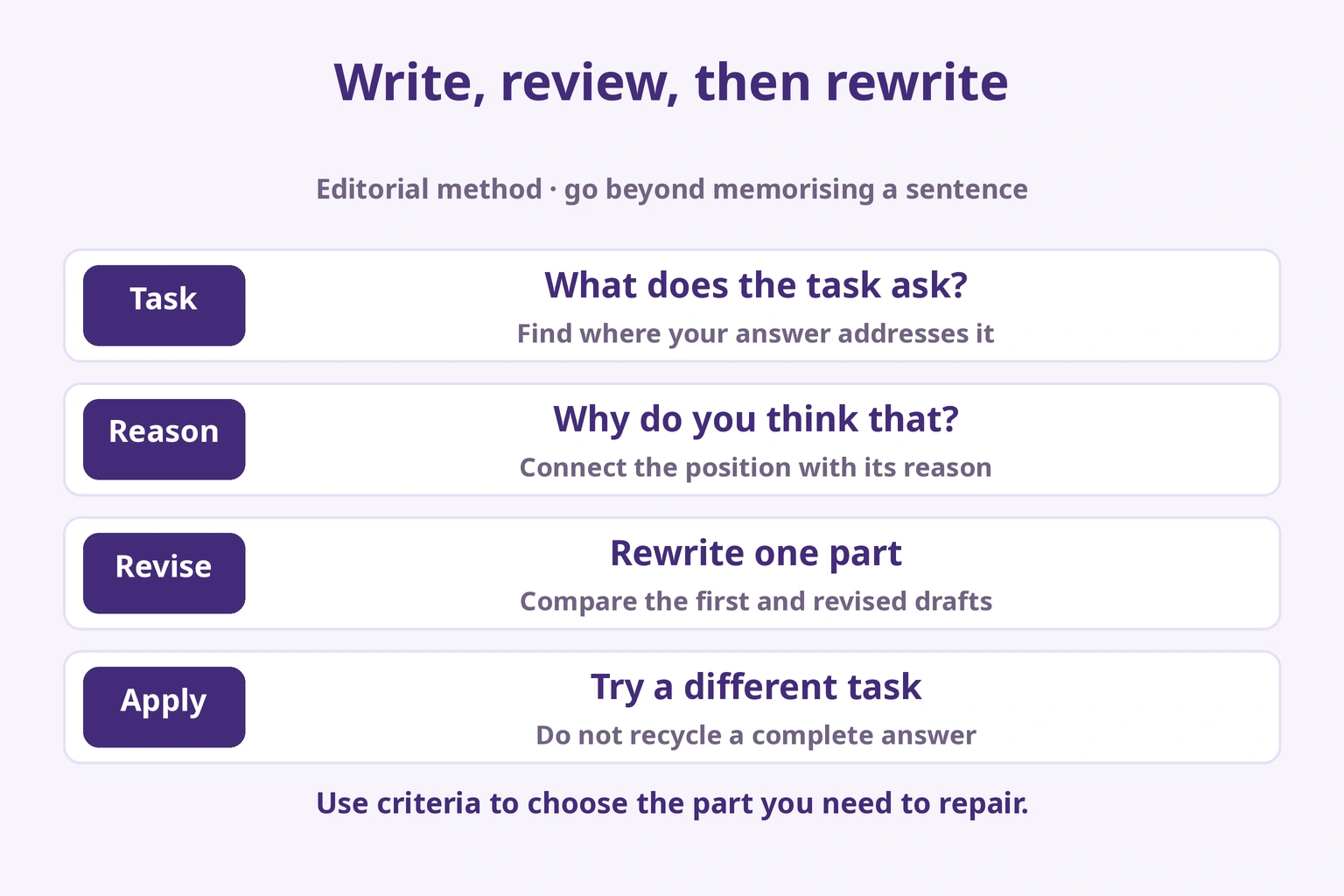
Our method. State what the task asks and sketch each paragraph’s purpose. After writing, focus one revision on task response and another on a recurring language problem. Save both versions and check whether the same fault returns in a new task. Our original sentence below illustrates an opinion and reason; it is not an official question, a complete essay or a band-certified answer.
I believe cities should plant more trees because they make streets cooler.
The position is to plant more trees; the reason is cooler streets. When relevant to a task, develop who benefits, where and under what conditions. Consider maintenance or limitations without inventing statistics or research.
Official materials. Read the public Writing descriptors alongside official sample answers/comments from the sample hub. Task 2 band 6 may show insufficiently developed ideas; band 7 describes a developed position and supported ideas. These are not counts of fancy words. If you cannot judge your response, ask a knowledgeable reader to compare first and revised drafts against the criteria.
Speaking: reserve time to listen to your recording
Official format and criteria. An examiner assesses a recorded, three-part, 11–14-minute interview covering familiar questions, a long turn and a related discussion. The four criteria have equal weight (format, scoring).
Common stumbling points. Reasons disappear when speaking, a memorised story replaces the question, or recordings accumulate without review. Speed alone does not show whether the listener can follow the argument.
Our method. Answer and record, listen, repair one point, then try a different question. With the trees sentence, express the position and reason without reading and add a relevant local example. Do not force that sentence into every topic. See the IELTS Speaking guide for Part 2 preparation and Part 3 discussion. If you also need TOEFL Speaking, practise its format separately.
Official materials. Use Speaking samples and public descriptors. Band 6/7 differences include sustained coherence and flexible language. A separate 6.5 descriptor is not stated officially in this public PDF; one smooth answer cannot establish your Speaking band.
Use SpeakGain for the short sentence
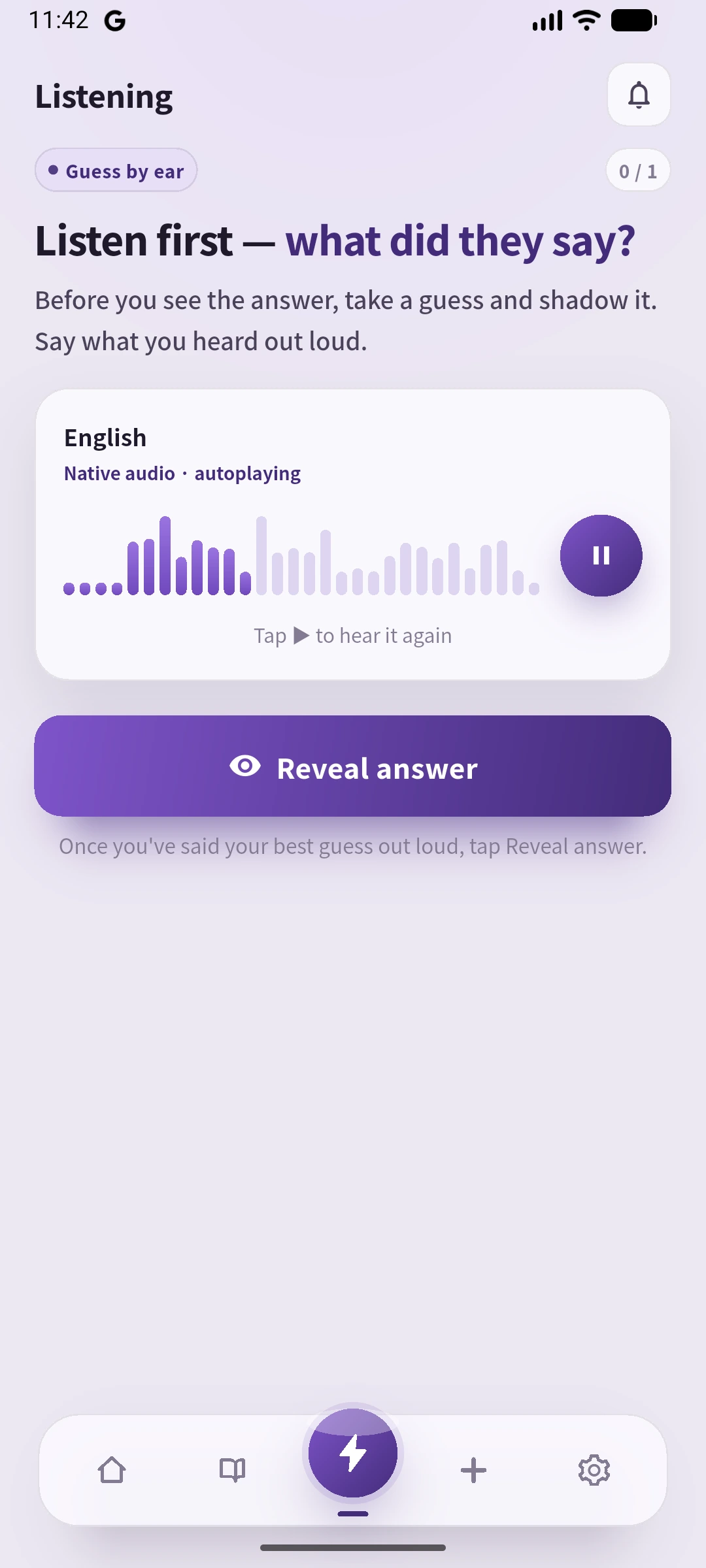
On the device, we added the original trees sentence through the normal Add flow. Library → Knowledge → Learn this card opened Listening: the English was hidden, the model played, and the screen asked us to guess and say what we heard before using Reveal answer. The answer screen showed the exact sentence.
Use SpeakGain for this listen-and-say step; develop reasons and examples separately. This demonstration does not establish an IELTS mock, answer scoring, pronunciation assessment or band prediction.
Listen to the worked example
AI-generated Viking model audio for the same original sentence shown above.
How we would plan for 6.5 — editorial opinion
We would allocate repair time to the skill below the receiving organisation’s minimum before adding more work to a favourite skill. With five weekday sessions of 45 minutes and one 90-minute weekend session, the total is 315 minutes: Listening 55, Reading 55, Writing 100, Speaking 65 and reviewing records 40. These are starting allocations, not an experimentally optimal formula. Include rewriting in Writing and listening back in Speaking.
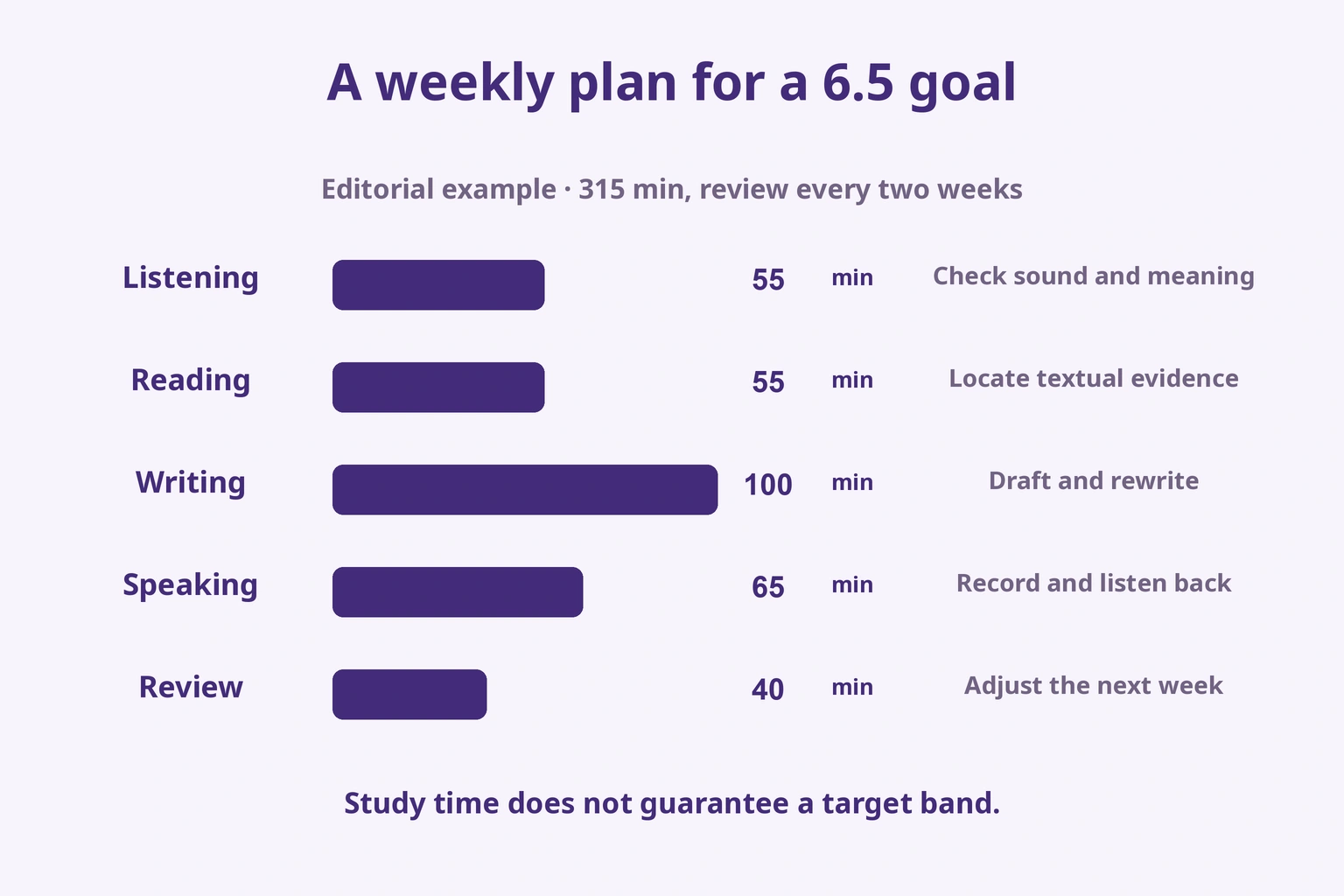
The weekend session could contain 60 minutes of Writing and 30 minutes of rewriting, both within the 100-minute Writing allocation, with Writing/Speaking elsewhere in the week. Save errors, unfinished work, overruns and repaired points. Two weeks later, use a new task to decide what moves. If Writing still misses the question while Listening is stable, transfer a practice slot to Writing. If comprehension is weak, reserve time for foundational grammar and vocabulary. Short 15-minute sessions are practical, but retain opportunities to complete longer tasks under time limits.
Use official materials by purpose
Start with your version’s IELTS.org samples (General Training), the British Council’s free four-skill practice, and the public Writing/Speaking descriptors. Use samples to understand task types, keys/transcripts to review, descriptors to select a revision goal, and computer familiarisation to rehearse the interface. Some samples are short exercises; they do not produce a certified overall score. Check access conditions rather than assuming every booking benefit is free to everyone.
We do not rank preparation books. Before buying more, check whether existing material matches your version and provides the answer support/audio you need; finish its useful review work first.
Methods we do not recommend
Memorised whole-answer Writing templates: a rehearsed paragraph can miss the actual task, while task response remains assessed. Learning a paragraph’s role is useful; applying the same finished text everywhere is not our recommendation.
Mock tests only: they expose time and error patterns but leave no time to repair sounds, syntax and undeveloped reasons. After a mock, select an error, practise briefly and check it again.
Hunting “guaranteed band” phrases: vocabulary appropriacy and accuracy matter alongside range. We would prioritise a clear relevant reason and a natural paraphrase over an unfamiliar impressive expression.
Computer and paper: follow current delivery guidance
The IELTS Partners’ 5 March 2026 update announces migration away from paper from mid-2026, with exact timing varying by market. Selected markets offer Writing on Paper within the computer test; this is distinct from the former fully paper-based test. Skills assessed, test construct and score interpretation remain unchanged. This English guide serves readers in different countries: the update does not establish availability at your particular centre. Confirm the booked mode and Speaking appointment with the centre; do not assume Writing on Paper is offered everywhere. Practise reading, entering and checking answers on the official computer familiarisation resource (British Council).
Frequently asked questions
Can I reach 7.0 through self-study?
No learning method guarantees it. We recommend comparing your work with the criteria and getting outside feedback where self-evaluation is uncertain. A universal self-study period to 7.0 is not stated officially in the inspected sources.
What differs between Academic and General Training?
Reading and Writing differ; Listening and Speaking are shared. Check the receiving organisation’s required type (official overview).
How many months for 6.5?
The target alone cannot tell you. Our three-month horizon is a provisional plan to review every two weeks, not a required duration or a promise.
Which official materials should I use first?
Your test version’s samples, keys/transcripts, free British Council practice, and public descriptors for productive skills. Choose material according to the error you need to investigate.
What if Speaking is the only low skill?
Confirm its required minimum and add recording/review time using our Speaking guide. Improving Overall through another skill does not meet a separate Speaking minimum.
Can I still study with printed material?
Yes for understanding and review, but our recommendation is also to practise the mode you will actually book. Do not confuse current Writing on Paper with the old paper test (delivery update).
Our final verdict
Check requirements, learn the official format and give all four skills a place in the week. Return to evidence for Listening/Reading, revise Writing/Speaking, then test the repair on something unfamiliar. Today, choose one official sample, save your first answer and identify one thing to fix tomorrow. Keep the plan accountable to your work rather than a promised timetable.
Official format, assessment, materials and delivery sources checked 15 October 2026; links appear beside each claim. Plans, periods, allocations and the original example are editorial. IELTS and IELTS logos are registered trademarks of the IELTS Partners; no official questions or artwork are reproduced here.