
IELTS Writing: Task 1, Task 2, assessment criteria and useful structures
Published
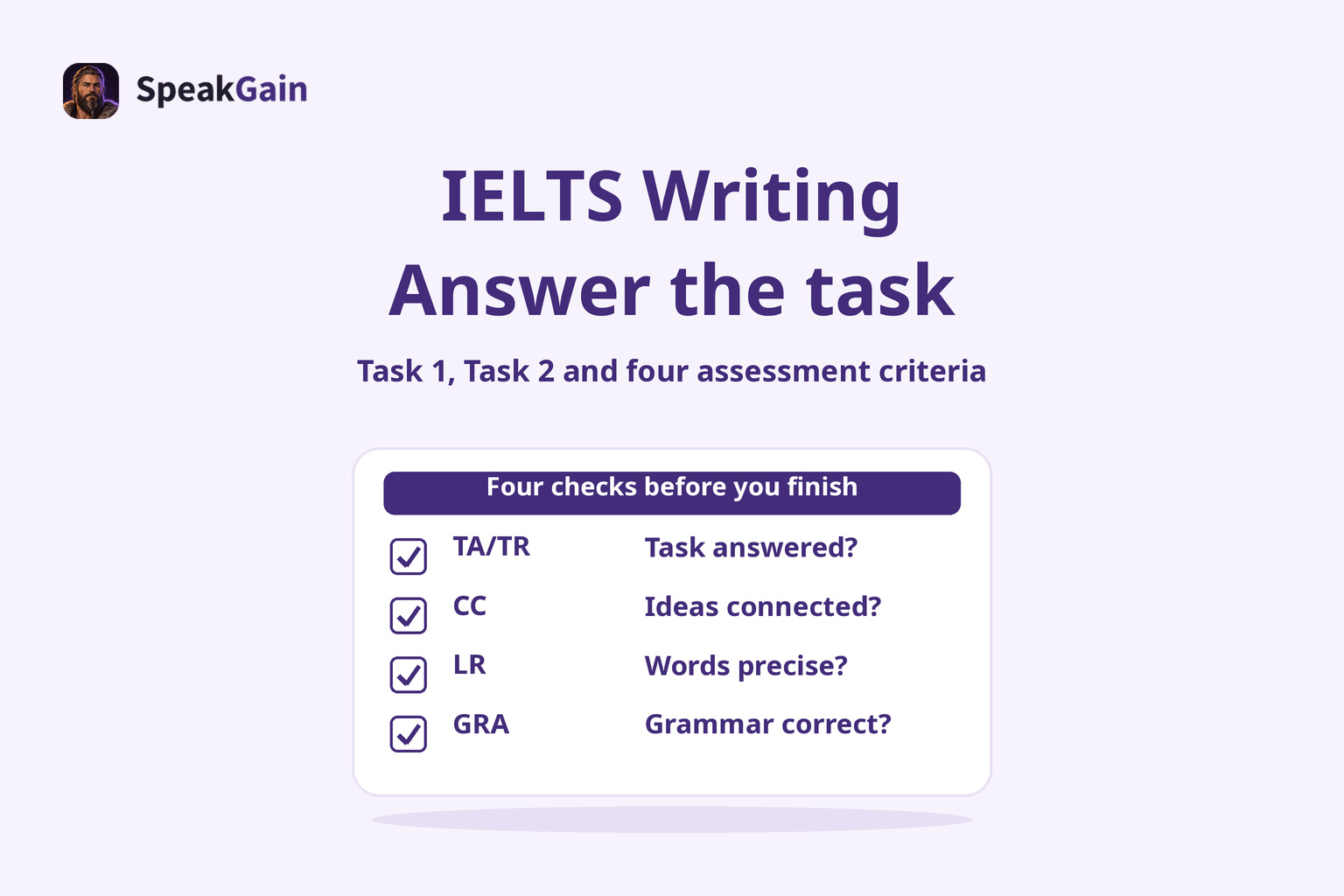
IELTS Writing asks you to describe visual information or write a letter in Task 1, then write an essay responding to a viewpoint, argument or problem in Task 2. The four assessment areas are task achievement or response, coherence and cohesion, vocabulary, and grammatical range and accuracy, so start by answering the actual question and supporting your comparisons or reasons. Our editorial advice is to use a template as a plan for the roles of paragraphs, rather than paste memorised paragraphs into every answer.
This guide is for students and adults working towards 6.0–7.0 for study, migration or professional registration. Keep your overall preparation in the IELTS study plan and oral practice in the IELTS Speaking guide. All fictional data, practice situations and passages below were written afresh for this article. They are not official or past questions, and we assign no band scores to our examples.
Tasks, word counts and timing
There are two tasks in 60 minutes. Task 1 requires at least 150 words; Task 2 at least 250. Official guidance allocates about 20 and 40 minutes respectively, and Task 2 carries twice the weight of Task 1. Official facts were checked on 16 October 2026: Academic format, General Training format.
| Task | Version | What you write | Minimum and guidance | Official source |
|---|---|---|---|---|
| Task 1 | Academic | Description or summary of a graph, table, chart or diagram | 150 words; about 20 minutes | Academic |
| Task 1 | General Training | A letter addressing a situation and three specified points | 150 words; about 20 minutes | General Training |
| Task 2 | Both | An essay responding to a viewpoint, argument or problem | 250 words; about 40 minutes | Academic / General Training |
Our starting allocation is 3 minutes planning, 14 writing and 3 checking for Task 1; 5, 30 and 5 for Task 2. These are editorial practice timings, not official subdivisions. A universally optimal paragraph count or planning split is not stated in the official sources checked. Checking time belongs inside the 60 minutes.
Four criteria: turn the public descriptors into questions
Task 1 uses Task Achievement (TA); Task 2 uses Task Response (TR). The other three criteria are shared. Within each task the four are equally weighted (official scoring). The descriptor summaries below come from the public Writing descriptors; the mistakes and checking methods are our editorial application.
| Criterion | Public description, summarised | Mistake to watch for | How to check |
|---|---|---|---|
| TA / TR | Select relevant features or fulfil the letter’s purpose; develop a position answering the essay question | No overview, missing letter point, unsupported claim | Match each instruction to the sentence answering it |
| Coherence and Cohesion (CC) | Logical progression and connections within and between paragraphs | Connectors without a logical relationship | Summarise each paragraph in one line and follow the sequence |
| Lexical Resource (LR) | Range, precision, appropriacy, spelling and word formation | A rare synonym with the wrong meaning or collocation | Check the intended meaning and neighbouring words |
| Grammatical Range and Accuracy (GRA) | Varied structures used accurately, including punctuation | An elaborate sentence with unclear clauses | Identify subjects, verbs and clause boundaries |
For Task 2, the public band 6 description allows for insufficient development or support; band 7 describes a clear, developed position and extended, supported main ideas. This is not a count of impressive phrases. Read the full descriptors, including their limitations, rather than infer a score from one strong sentence. A separate 6.5 descriptor is not stated in this official PDF (descriptors).
Academic Task 1: select features, then support comparisons
Official task and criteria
This is a visual-information task. TA concerns selecting important features, illustrating them accurately and comparing relevant information, rather than inventing explanations outside the data (format, key assessment criteria).
Our writing steps
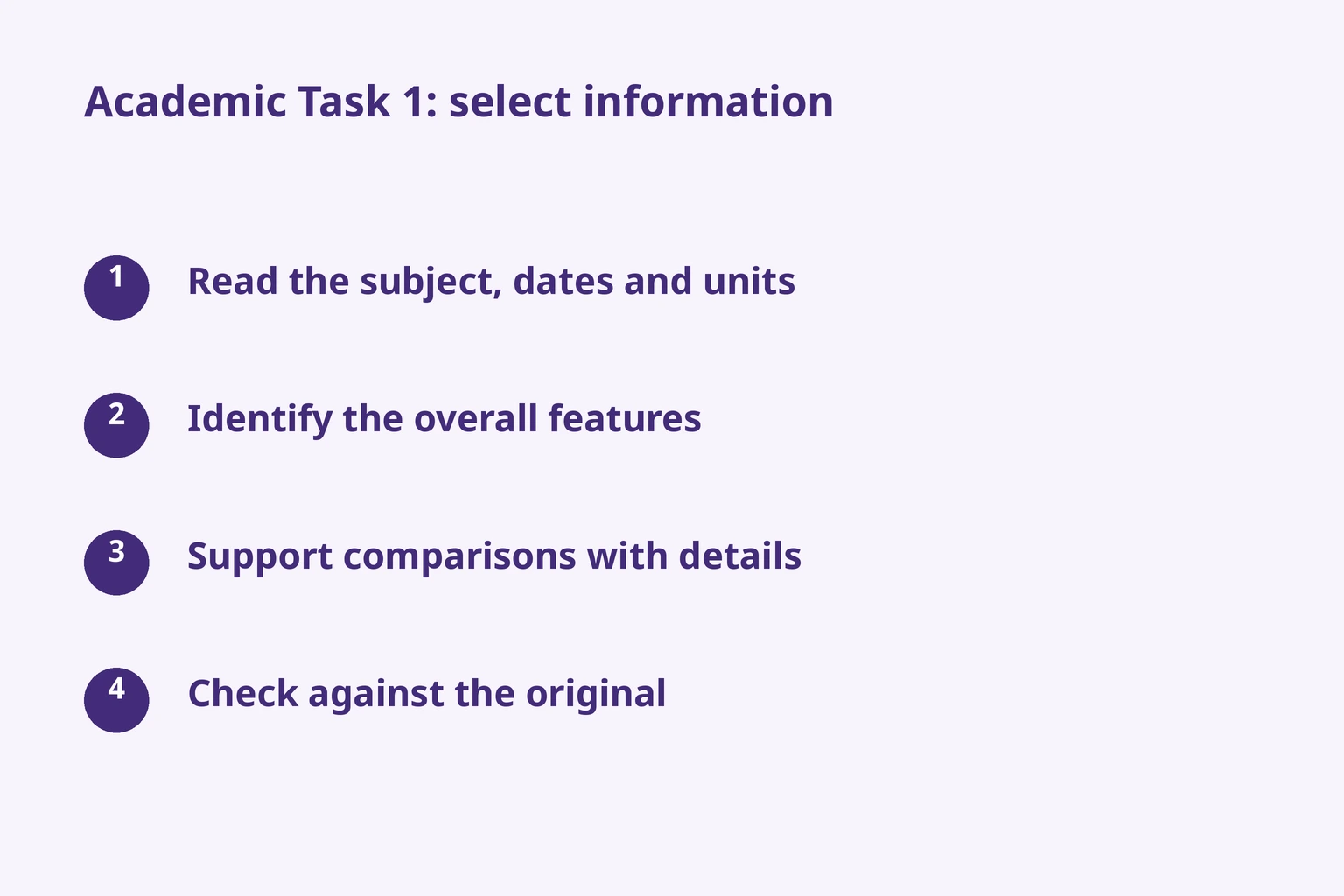
- Note the subject, dates and units. Distinguish a number of visitors from a percentage.
- Identify the overall features: changes, rankings, similarities or differences.
- Group information that can be compared. Do not simply read every number from left to right.
- Write an introduction, overview and supporting details. This is a useful structure, not a mandated number of paragraphs.
- Compare the completed text with the original data, including tense and units.
A short original example
These invented figures represent average weekly visitors to three sports centres in 2021 and 2025. They are not real research or a test question; the facility names remain English labels.
| Facility | 2021 | 2025 |
|---|---|---|
| Riverside sports centre | 240 | 360 |
| Hilltop sports centre | 180 | 210 |
| Central sports centre | 320 | 300 |
Overall, weekly attendance rose at two of the three sports centres, while Central recorded a small decline. Riverside had the largest increase, from 240 to 360 visitors, and became the busiest centre in 2025.
This extract is not a 150-word answer. It identifies the two increases and one decline, then supports Riverside’s change and ranking. A complete practice answer would introduce the subject and dates and compare Hilltop and Central in more detail. Do not add a price rise as the cause of Central’s decline: no cause appears in the fictional data.
Common mistakes and self-review
Our checks target missing overviews, mismatched units, and confusing an absolute increase with a percentage increase. For a process, organise stages rather than force a rising/falling-data template; for a map, track changes and locations (visual inputs).
- Does the overview communicate the main picture?
- Do details support the features you selected?
- Are periods and units comparable?
- Have you invented causes, opinions or predictions?
- Does your full practice response meet 150 words?
Use the official Academic samples to experience the real format. Close a sample answer before making your own selection of information.
General Training Task 1: write to the person and cover all three points
Official task and criteria
You write a letter. TA covers a clear purpose, all three required points with relevant development, appropriate format and consistent tone (format, criteria). A friend and a workshop coordinator call for different choices; a graph-style overview is not the organising principle.
Our writing steps
- Identify the recipient and your relationship.
- State the purpose: a request, explanation, invitation or another required function.
- Make a note for each of the three points. If one contains two requirements, cover both.
- Add details that help the recipient understand or act: dates, circumstances or preferences.
- Check that the opening, body and closing use a consistent level of formality.
A short original example
Our invented situation asks a pottery-workshop participant to request a different session: explain the booking, the reason and the preferred alternative date.
Dear Workshop Coordinator,
I am writing to ask whether I could move my pottery session from 12 November to 19 November. My employer has scheduled a training day on the original date, so I will be unable to attend. If the later session is full, I would be happy to join a waiting list.
Kind regards, Aya Mori
This is a short extract, not a complete 150-word response. It connects purpose, a concrete explanation and a request. To practise a complete letter, add relevant booking details and availability instead of unrelated personal history.
Common mistakes and self-review
A long greeting can conceal an unclear request; a detailed explanation can still omit the preferred alternative. Mark each required point in the prompt and its corresponding sentences in your answer.
- Is the purpose clear near the start?
- Is each point developed with relevant detail?
- Can the reader tell what you want them to do?
- Is the tone consistent throughout?
- Is your full response at least 150 words of connected prose?
The length and prose requirements are in the official format. Use the General Training samples to practise identifying the situation, audience and three points before reading another answer.
Task 2: explain how a reason supports your position
Official task and criteria
An essay responds to a viewpoint, argument or problem. TR considers response to the question, position, development and support, and conclusions. Relevant examples may come from your experience (Academic, General Training, criteria).
Our writing steps
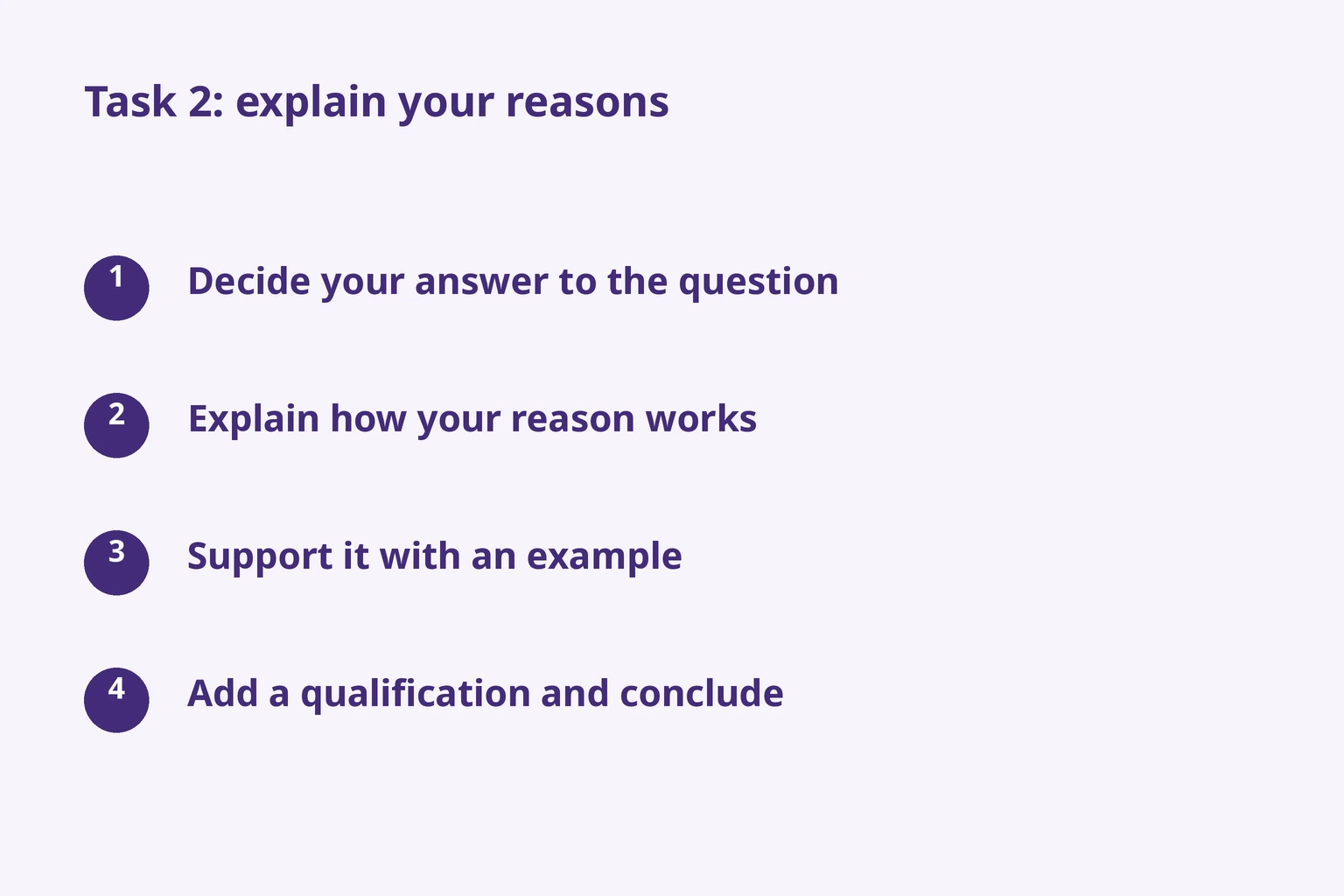
- Separate the question’s demands. An opinion, both views, and causes plus solutions require different answers.
- Write your answer in one sentence before drafting.
- Pair each reason with an explanation of how it works and a relevant example.
- Address other perspectives when required, making clear whose view each is.
- Derive the conclusion from the discussion instead of introducing a new reason at the end.
A short original example
Our invented practice topic asks whether public libraries should open later on a few days each week. The following is an extract below 250 words, not a complete exam answer.
Public libraries should offer evening opening hours on a few days each week. Longer library hours help working adults study after work. A person whose shift ends at six may be unable to use a library that closes at the same time. Staying open later would give that person a quiet place to read or take an online course.
However, extra opening hours require staff and funding. Rather than extending every evening immediately, a council could test two late openings each week and record how many people use them. This would make it possible to expand access while checking whether the service meets a real local need.
Our worked sentence is Longer library hours help working adults study after work. The next sentences explain the mechanism: a person whose shift ends at closing time cannot otherwise use the library. The second paragraph introduces staffing and cost, then a limited trial. No invented study or statistic is presented as evidence. This is an illustrative editorial opinion, not a universal policy recommendation.
Common mistakes and self-review
Writing that libraries matter to education does not by itself answer a question about opening hours. Other checks include an example without explanation, one of two requested views only named, and a conclusion that reverses the position.
- Have you answered every part of the question?
- Is your position consistent from introduction to conclusion?
- Does each reason explain why or how?
- Does each example support the same issue?
- Does the full essay meet 250 words while leaving checking time?
The official samples and examiner comments help compare your impressions with the public criteria. Do not transfer their scores to our extracts.
Templates: keep the structure, replace the content
Our editorial template is a set of paragraph jobs. Academic Task 1 moves from subject to overview to details; a GT letter from purpose to required points and closing; Task 2 from an answer to developed reasons, any required alternative view and a conclusion. None fixes the number of paragraphs for every prompt.
A memorised paragraph about technological change will not support a position on library opening hours unless its relevance is actually explained. This can leave a TR gap; unusual vocabulary cannot repair that gap and still needs to be precise under LR. This is our interpretation of the public criteria, not a list of prohibited phrases.
Knowing useful short expressions and collocations differs from memorising an entire response. A fixed deduction for one connector or memorised phrase is not stated in the official sources checked. The official format warns severely against plagiarism; planning a structure is not the same as copying another source (official warning).
Self-review alone: four passes
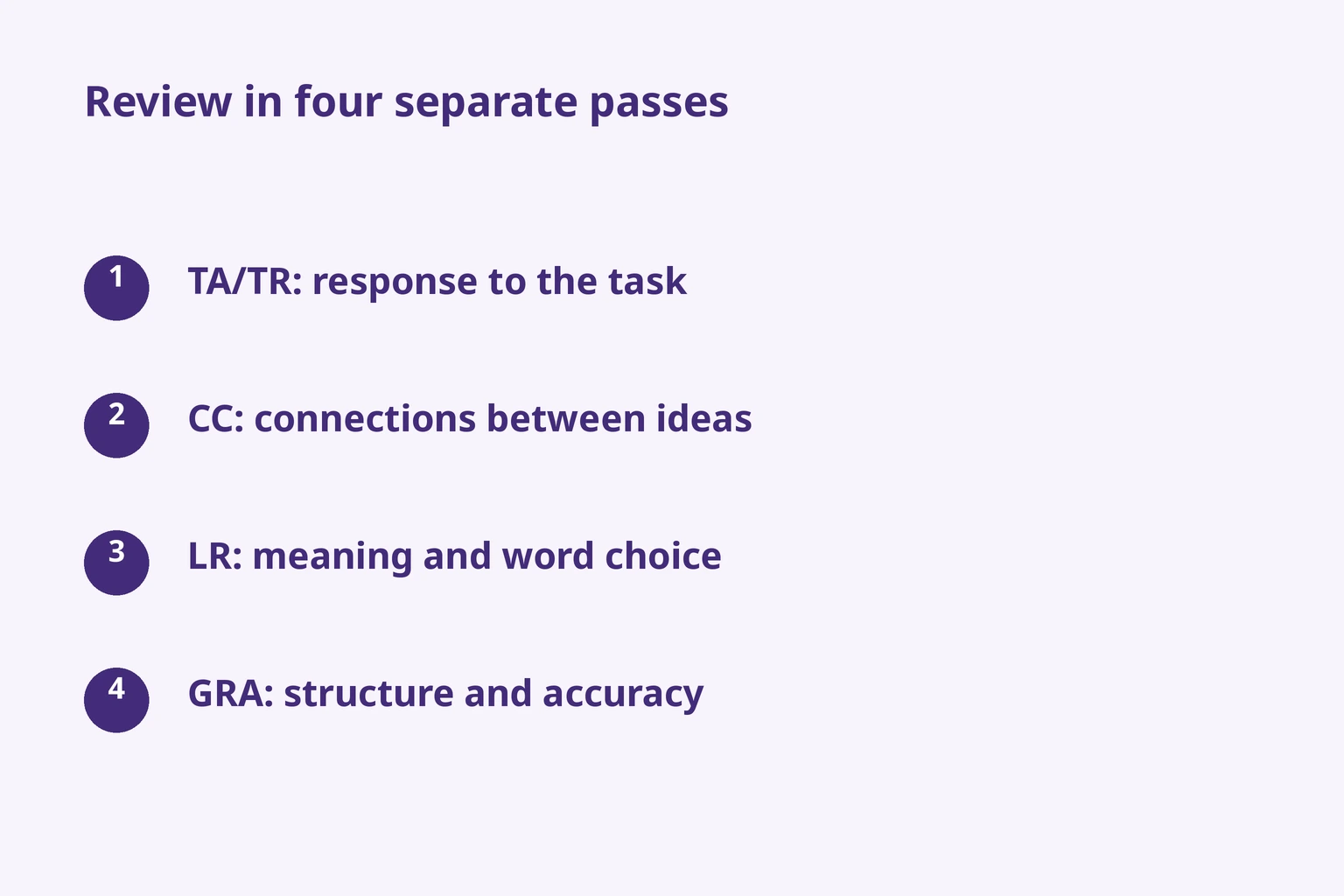
- TA/TR: match instructions to sentences and mark missing requirements, unsupported assumptions and undeveloped reasons.
- CC: give each paragraph a one-line label, then read the labels in order. These are practice notes, not headings to insert into your exam answer.
- LR: check that substitutions preserve meaning and collocation. Do not replace every repeated noun automatically.
- GRA: trace subjects, verbs, tense and clauses. Split an overextended sentence if necessary.
For the library example, first check the answer about opening hours, then the connection between work schedules and access. Only then inspect plural hours and the use of would. Save the revision separately and record one sentence explaining a change.
Keep meaning-preserving substitutions in the paraphrasing guide, everyday short-writing habits in the diary and writing-app guide, and different exam requirements in the Eiken Grade 1 writing guide. Do not import another exam’s word counts or rubric into IELTS.
For choosing vocabulary materials, see the IELTS vocabulary-book guide; here the focus is precise use in your answer rather than a larger list of rare words.
If using AI or a correction service, our approach is to ask what fails to answer the prompt and why a suggested word changes meaning. Check the explanation against the original text and public criteria. Do not treat a displayed estimate as an official result. We have not tested prediction accuracy here, and this is not a service recommendation. Remove personal or workplace information before sharing a draft.
Our two-week practice plan
This editorial plan builds a writing-and-revision routine; it is not a promised route to a band in fourteen days. A universal preparation duration or a score gain from this plan is not stated in the official sources checked. Practise the Task 1 version you will take.
| Days | Editorial practice | Keep |
|---|---|---|
| 1–2 | Read the format and criteria; attempt both tasks | First drafts, time and omissions |
| 3–4 | Review and rewrite Task 1, starting with TA | Overview/comparisons or letter points/tone |
| 5–6 | Develop one Task 2 reason with explanation and example | Before and after development |
| 7 | Compare drafts against four criteria | At most two priorities |
| 8–10 | Attempt an unseen official sample with task timings | Recurring mistakes |
| 11–12 | Correct recurring language issues and rewrite a paragraph | Reasons for changes |
| 13 | Complete both tasks in 60 minutes including review | Time use and unfinished work |
| 14 | Review both scripts and plan the next week | Next practice and questions for help |
Separate drafting and checking across days if needed, but keep a full timed session. The overall study plan covers allocation across skills.
Methods we do not recommend
- Memorising set paragraphs or predicted answers: the question may change, leaving irrelevant content.
- Padding word count: repeating a claim does not develop its reasoning and consumes checking time.
- Forcing rare words: imprecise meaning or collocation weakens the evidence of vocabulary control.
- Producing only first drafts: you never practise decisions about revision.
These are editorial judgments based on the multiple demands of the public descriptors, not guarantees about individual scores.
Take one written sentence into listening and speaking
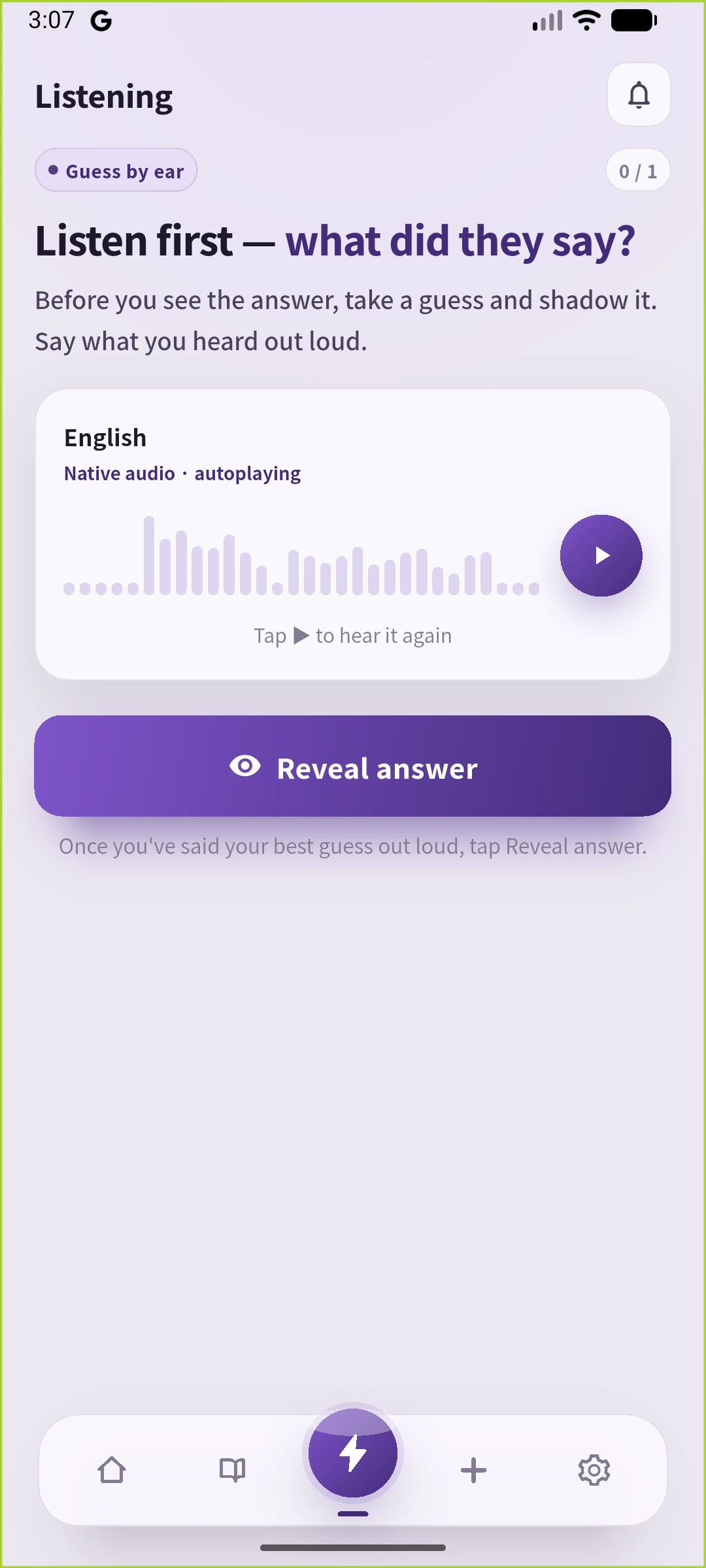
We saved our original sentence “Longer library hours help working adults study after work.” as one card through SpeakGain’s normal Add flow. On the device, Library → View → Knowledge → Learn this card opened Listening with the sentence hidden. It instructed us to listen, guess and say it aloud before selecting Reveal answer. Answer displayed exactly the sentence we had saved.
Use this step to listen to and repeat your sentence; develop the next reason or example yourself. The actual screenshot uses English controls: Reveal answer displays the saved sentence. We verified saving, playback and revealing the answer, not IELTS essay correction, answer or pronunciation assessment, or band prediction.
Listen to the original example
Viking AI-generated audio reading the original editorial sentence above.
Frequently asked questions
Can I use a template?
Use paragraph roles as an editorial planning aid, then choose relevant content again. An officially approved universal template or fixed phrase-penalty table is not stated in the sources checked. Consult the public descriptors.
What if I write too little or too much?
The minima are 150 and 250 words. Short answers may provide insufficient language evidence for higher bands. Exceeding the minimum itself is not penalised, but excessive length can reduce relevance or checking time. A fixed deduction per missing word is not stated in the official format checked (Academic format).
Which task should I start with?
A universal required starting order is not stated in the official format checked. Complete both. Our starting practice is about 20 minutes for Task 1 and 40 for Task 2, then adjust using timed attempts (format).
Must I follow the exact planning split above?
No. Official guidance is about 20/40 minutes; our planning/writing/checking subdivisions are editorial. Include all of them inside 60 minutes.
Do I need difficult vocabulary?
LR covers range and appropriate, accurate use (scoring). We prioritise words you can use precisely over unfamiliar substitutes.
Can I review without a teacher?
Start with four separate passes and record why you revise. Take the unresolved points, original prompt and both drafts to a third party when useful. Your estimate or a tool’s display does not establish an official band.
Does typing versus writing on paper change the task?
The current Academic sample page says tasks, timing and scoring are the same for IELTS on computer and IELTS on computer (Writing on Paper); responses are typed or handwritten. Writing on Paper is available where offered. Check current booking information rather than relying only on older paper-test advice.
Our editorial verdict
Build answers you can revise, rather than a collection of paragraphs to recite. First repair the overview and comparisons, the letter’s purpose and three points, or the essay’s answer and supporting explanation. Then check vocabulary and grammar. Keep the difference between first and revised drafts, and try an unseen question to see whether you can identify the same issue again. Public criteria guide that work; they do not guarantee a 6.0 or 7.0 result.
Official references
Checked 16 October 2026; the descriptor PDF itself is dated May 2023: Academic format, General Training format, public band descriptors, key assessment criteria, scoring, Academic samples, General Training samples.