
IELTS vocabulary books: choose by band and test type, then learn to use words
Published
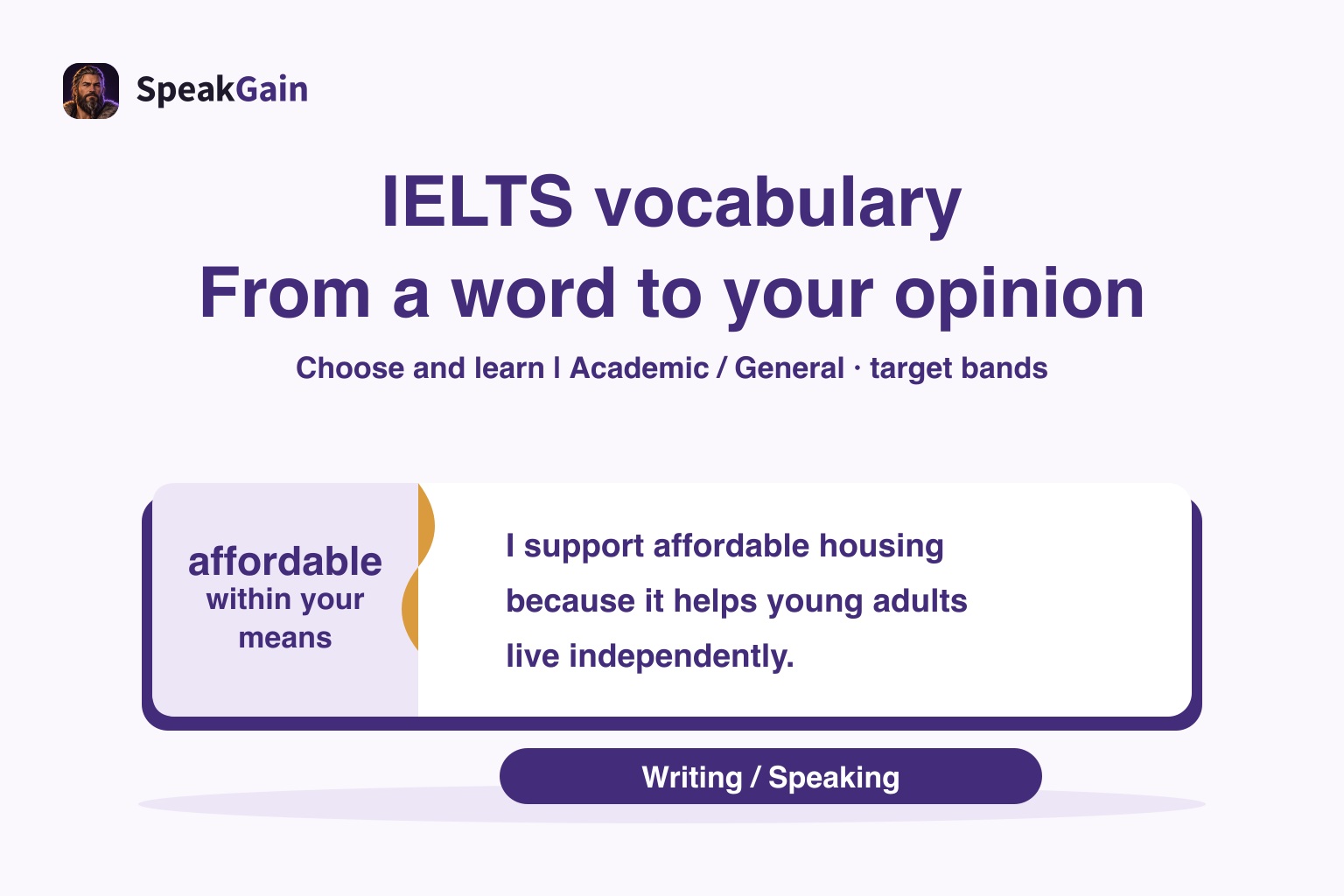
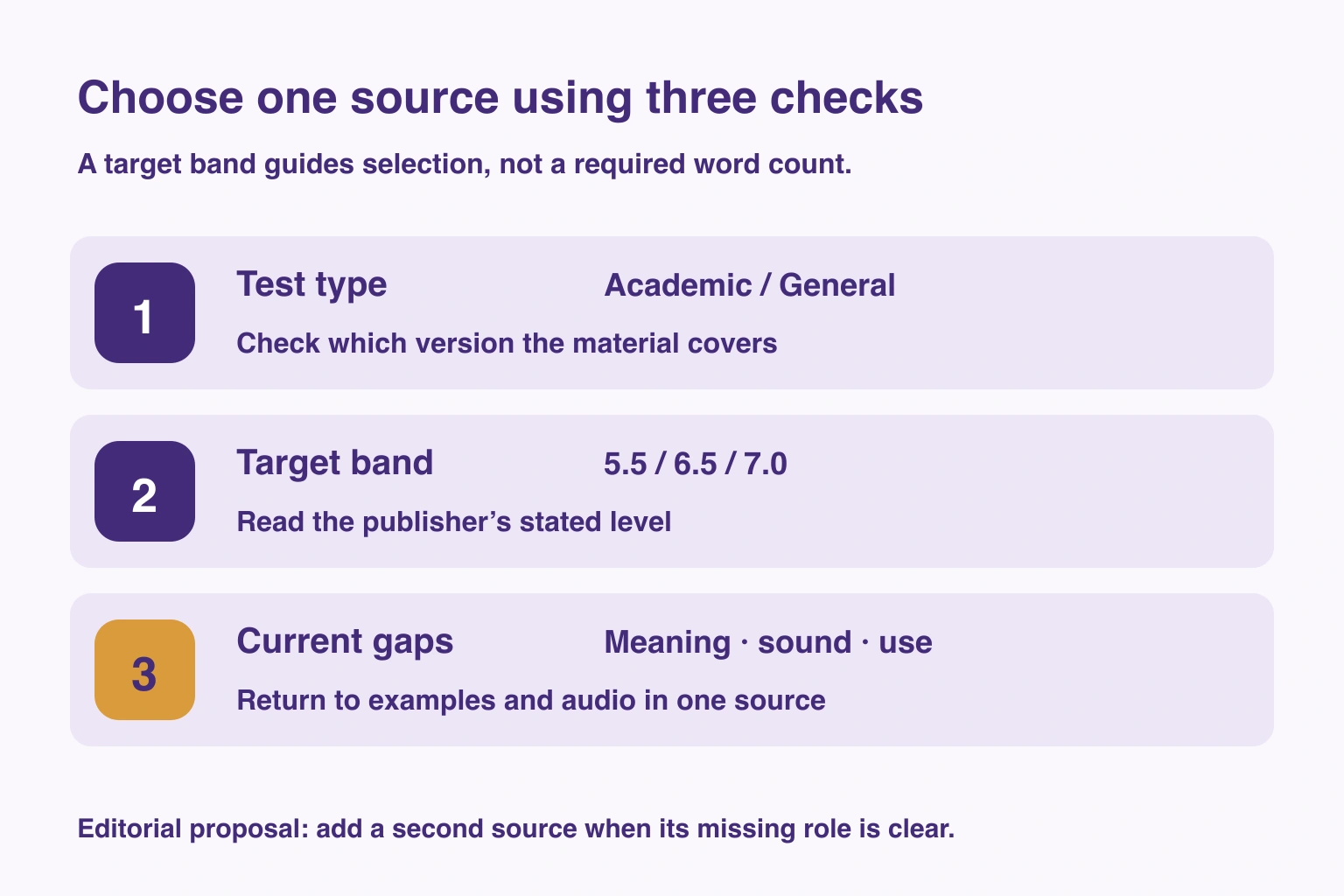
Choose one IELTS vocabulary book or app that fits your Academic or General Training test, your target band and the gaps you currently have. Our editorial approach is meaning → example → sound → your own opinion-and-reason sentence → spaced review, checking recognition in Reading/Listening separately from use in Writing/Speaking. The official sources we checked do not state a fixed number of words required for bands 5.5, 6.5 or 7.0; a book’s entry count is not that requirement.
Vocabulary books and an app: choose by purpose
This comparison covers one Japanese-language book and international English-language materials. Facts come only from publisher/provider pages, checked on 16 October 2026. These are not hands-on or reading reviews. “Suits” is our editorial judgment, not a ranking.
| Name | Publisher/provider | Entries, officially stated | Band / Academic–General, officially stated | Audio | Features in official information | Suits, in our view | Checked |
|---|---|---|---|---|---|---|---|
| Practical IELTS Vocabulary 3500, revised Japanese edition | Obunsha | 3,500: 1,000 basic + 2,500 important words | Academic; sections labelled 5.0, 5.5, 6.0, 6.5, 7.0, 7.5+ | British pronunciation; downloads / Eigo no Tomo | Japanese explanations, related words, 100 Speaking/Writing expressions | Japanese readers who want a level-based starting point | 2026-10-16 |
| IELTS Vocabulary Up to Band 6.0 | Cambridge University Press | Not officially stated | Up to 6.0; both modules | Downloadable listening/pronunciation activities | Contextual reading/listening, four-skill exercises, progress checks | Learners aiming around 5.5–6.0 who can study through English | 2026-10-16 |
| IELTS Vocabulary For Bands 6.5 and above | Cambridge University Press | Not officially stated | 6.5+; both modules | Downloadable listening/pronunciation activities | Contextual vocabulary, four-skill exercises, common errors | Learners working toward 6.5/7.0 who need usage practice | 2026-10-16 |
| Collins Vocabulary for IELTS | Collins | Not officially stated | Current 5–5.5, aiming for 6+; Academic | Free downloadable audio | English definitions/examples, practice tasks and revision units | Learners who want to check understanding through unit exercises | 2026-10-16 |
| Magoosh IELTS Vocabulary Flashcards App | Magoosh | Older app introduction: 600+; web page: 200 | Numeric band and module not officially stated | Word-pronunciation audio in app introduction | Parts of speech, definitions, examples, difficulty decks, progress | Short vocabulary reviews alongside separate sentence practice | 2026-10-16 |
Magoosh’s app introduction was published in 2017, whereas its web flashcard page says 200 words. We do not treat those as the same current inventory. Check the version you intend to use; we did not register for or operate third-party apps. Book titles and publisher sections describe coverage, not promised results.
Five steps for remembering a word
| Stage | What we suggest | Check |
|---|---|---|
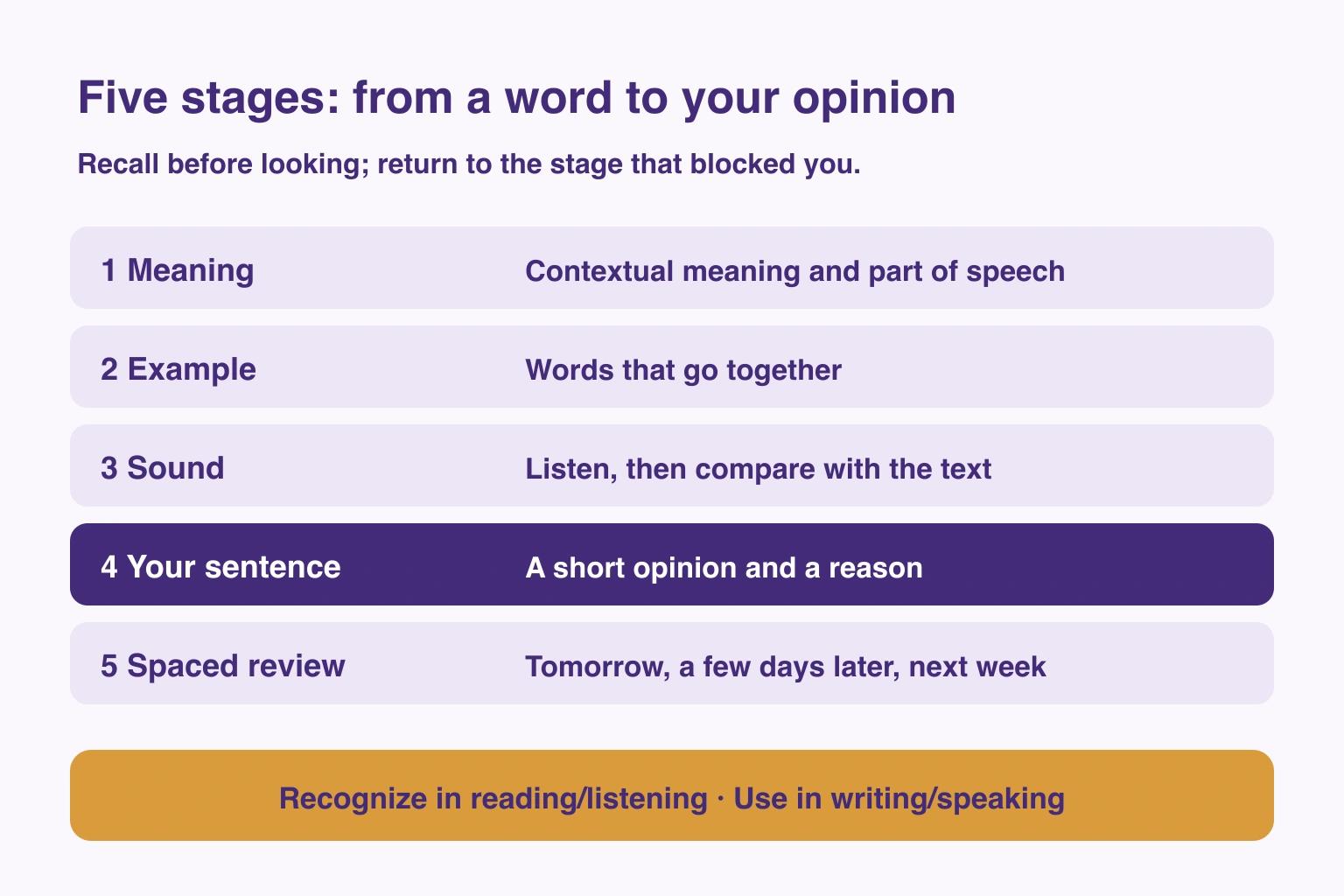
| Meaning | Identify one contextual meaning and part of speech | Explain it without looking at a translation |
| Example | Read the whole idea and the word combination | Explain what the sentence says |
| Sound | Listen, compare with text, then say it | Understand the short sentence without seeing it |
| Your sentence | Write a short opinion and a reason | Explain your choice of word and say the sentence |
| Spaced review | Start with tomorrow, a few days later and next week | Recall before looking; adjust to what you forget |
Those intervals are our practical example, not a universally optimal schedule. Shorten the gap when recall fails. The wider method is in how to memorize English words; this guide focuses on choosing IELTS materials and returning vocabulary to each skill.
Academic or General Training: what changes?
Share a vocabulary foundation, then practise the texts and tasks for your test. The official Academic information identifies university study and professional registration as purposes and confirms that Listening/Speaking are shared while Reading/Writing differ. Check the test type and individual skill requirements with the receiving institution; do not decide from “migration” or “study abroad” alone.
Academic Task 1 describes visual information; General Training Task 1 is a letter. Both have an essay in Task 2 (official samples). Our suggestion is to practise comparison/change language for Academic and purpose-appropriate tone for General letters. Neither replaces the other test’s tasks.
The Obunsha and Collins books in the table specify Academic. Their words are not forbidden in General, but we would not present those books alone as complete General preparation. Cambridge explicitly covers both. Students should not rely only on specialist terms from their major; professionals should not restrict vocabulary to their job. Overall scheduling belongs in our IELTS study plan.
Choosing for bands 5.5, 6.5 and 7.0
Use the target band to choose a starting range, then check your present gaps. The public Writing descriptors and Speaking descriptors describe vocabulary range and use, not a required inventory of memorized words.
| Target | Our selection priority | Officially labelled starting point | Required word total |
|---|---|---|---|
| Around 5.5 | Basic meanings and examples you can understand | Obunsha basic/5.5 sections; Cambridge Up to Band 6.0 | Not officially stated in the checked sources |
| 6.5 | Other meanings, combinations and sound recognition | Obunsha 6.5 section; Cambridge 6.5+ | Not officially stated in the checked sources |
| 7.0+ | Precise choice and meaning-preserving paraphrase | Obunsha 7.0+ sections; Cambridge 6.5+ | Not officially stated in the checked sources |
Collins describes a current level of 5–5.5 and a target of 6+, not a guarantee of 6.5. Distinguish an entry level from a goal. If examples remain too difficult after checking meanings, return to a basic range in a language you understand. If translations are easy but you cannot use the words, check combinations and your own sentences before adding a harder book.
What does “official” mean here?
The IELTS preparation hub directs learners to British Council, IDP IELTS and Cambridge English. Cambridge’s vocabulary series is published by the publisher within that test-partner organization; its series page verifies the two levels and both modules.
We do not infer British Council or IDP endorsement for Obunsha, Collins or Magoosh merely from “IELTS” in a title. A publisher having a separately endorsed practice book does not make its vocabulary book endorsed. Confirm official/endorsed status for the individual product. Partner-produced materials also do not guarantee a band or establish a required word count.
For print or apps, choose one main source you can revisit for examples and audio. Check download/access conditions. An app’s multiple-choice success does not demonstrate recall without choices. Our vocabulary app guide handles the broader comparison.
Worked example: one word, your opinion and a reason
We wrote this sentence for this article. It is not copied from a test or book, nor certified as a model answer.
I support affordable housing because it helps young adults live independently.
1. Meaning: Here, affordable means reasonably priced or within someone’s means. Think about who can afford the housing rather than equating it only with “cheap.” Confirm the adjective’s meaning in a dictionary or your main material, then explain it without the definition.
2. Example: Affordable describes housing. Identify what the speaker supports and why. If a familiar word does not come with a usable noun combination, review that combination. Keep a publisher’s example separate from sentences you write yourself.
3. Sound: With your material’s audio, listen for the idea, read to locate the missed section, then say the short sentence. Listen again without text. Focus on understanding the opinion and reason, not simply speaking faster.
4. Your sentence: Choose something you can explain. Reconstruct the opinion and reason without looking at the English. If you struggle, organize the subject, view and reason before trying a complete recitation. An essay needs development and relevance to the prompt; a Speaking answer must answer the actual question. Do not insert the same sentence everywhere.
5. Review: Tomorrow, recall the view and reason before looking. Record whether you forgot the meaning, sound or combination, and return to that stage. Repeat after a few days and next week, adjusting gaps. Finally check understanding in unfamiliar material and official practice.
Check your own sentence with SpeakGain
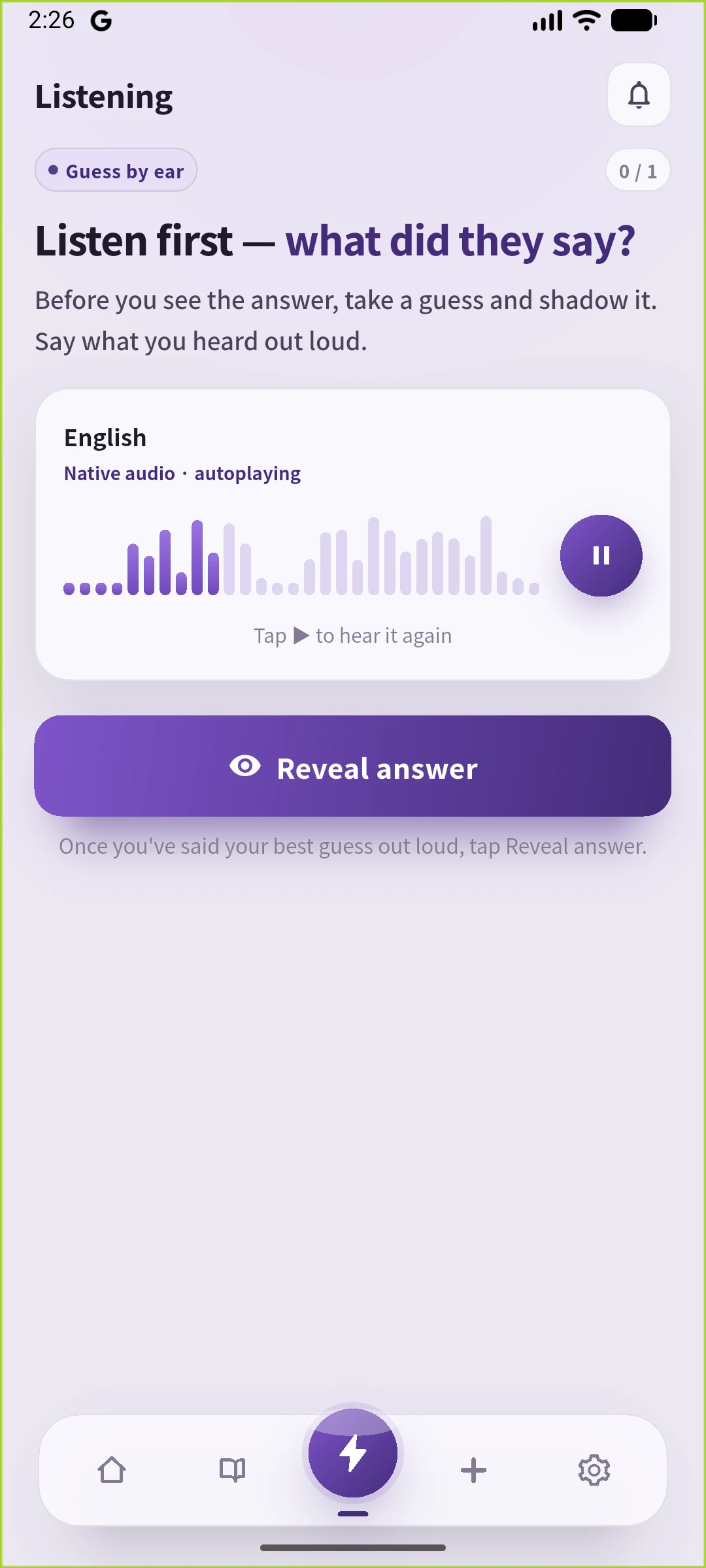
On the device, we saved the original sentence above as one card through the normal Add flow. From Library, View opened Knowledge; Learn this card led to Listening. Listening hid the sentence and prompted us to listen, guess what was said and say it aloud. Reveal answer opened Answer and displayed the exact saved sentence.
Our suggestion is to listen to this short sentence, identify what is supported and why, then say it yourself. Use the editorial spaced-review proposal above, and continue checking meaning and usage in actual IELTS tasks with official materials.
Opinion and reason: Viking AI reference audio
AI-generated audio of the original sentence above. Pause, explain the opinion and reason, then say it yourself.
Return words to the four skills
Reading: recognize meaning and evidence
IELTS scoring information says Reading is marked by correct answers; it does not rate your own vocabulary under Lexical Resource. Academic texts may have more difficult vocabulary or style. In practice, check words needed for the answer’s evidence, alternative meanings and paraphrases between text and question. Then try a new passage rather than relying on a remembered answer.
Listening: recognize sound and the answer form
Listening is also marked by correct answers (scoring); official samples include completion tasks. Listen to a short section and compare it with text. A word understood in print needs sound-recognition practice, not necessarily a new meaning. For written responses, also check spelling, singular/plural and the task’s word limit. Hearing one keyword is not the same as understanding the message.
Writing: appropriate, accurate vocabulary
In the public Task 2 descriptors, Band 6 includes generally adequate, appropriate vocabulary; Band 7 includes flexibility/precision and awareness of style and collocation. Spelling and word formation also matter. Our practice suggestion is a short opinion/reason first, then a paragraph answering the task. Paraphrase where useful without replacing words with near-synonyms that change meaning.
Speaking: retrieve words and paraphrase
The public descriptors include sufficient vocabulary for extended discussion and paraphrase at Band 6; Band 7 includes flexible topic use, style/collocation awareness and effective paraphrase. Pronunciation is a separate criterion. Practise a short opinion without text, continue with another accurate expression if a word does not come, then review the missing combination or sound. The longer method is in IELTS Speaking preparation.
Our three-month vocabulary plan toward 6.5
This is an editorial proposal, not a forecast or guarantee. Adapt to starting level, available time and skill requirements; use the IELTS study plan for overall preparation.
| Period | Vocabulary work | Check before progressing |
|---|---|---|
| Month 1 | Confirm module/gaps; choose one source; review basics with meaning, examples and sound | Explain example meanings without a translation |
| Month 2 | Keep that source; write short opinions/reasons and check audio recognition | Track writing/speaking use separately from recognition |
| Month 3 | Return to unfamiliar official practice; review words that caused difficulty | Understand in context and retrieve appropriate expressions |
Start with an amount you can review. On a 20-minute day, divide time between recall, examples/audio and one sentence; this duration is not an official prescription. Busy adults can keep a previous sentence in review without adding words. Each week separate unknown meanings, missed sounds and uncertain usage. Not every recognized word needs a long composition, but words you want to produce need retrieval practice.
Methods we do not recommend
Rare words just to impress in Writing: inappropriate meaning or collocation can weaken precision; the public descriptors assess use as well as range. Several books at once: review becomes scattered; add another only when its missing role is clear. Translation drills as the whole four-skill plan: meanings are a useful stage, while listening recognition and productive word choice still need checks. We also would not write long essays for every word: decide which words you mainly need to recognize and which you want to use.
FAQ
How many words are needed for 5.5, 6.5 or 7.0?
The checked official sources do not state one fixed total. Entries in a book describe its contents, not a band threshold. Check performance through official tasks and public descriptors.
Do Academic and General need separate books?
Not necessarily; some materials cover both. Share the foundation and practise the correct Reading/Writing tasks. Do not relabel an Academic-only book as General-specific.
Which book would you choose for 6.5?
One with accessible examples and audio that also lets you review basic gaps. Cambridge 6.5+ is an English-language candidate; Obunsha’s relevant sections are a Japanese-language option. Neither label guarantees results.
Can a TOEFL or Eiken wordbook substitute?
Use it for shared vocabulary if you already have it, then identify gaps in IELTS tasks. Its coverage is not automatically equivalent. See our TOEIC vocabulary book guide for another exam-specific comparison.
App or print?
Whichever supports examples, audio and recall before looking. Paper plus accompanying audio is also an option. Check your ability to write/say a sentence separately from app results.
Should I use difficult words in Writing?
Use words whose meaning, register and combinations fit. Unfamiliarity alone is not a reason to substitute them; precision and spelling also appear in the descriptors.
I know the word but cannot say it. What next?
Add a short opinion/reason, attempt it without text, and identify whether the block is a combination or sound. Return to the relevant example; do not force memorized lines into unrelated questions.
Editorial verdict
Choose one source by module, target and current gaps. For 6.5, we would still confirm basic meanings, examples and sound, then create a short opinion and reason. Test recognition in unfamiliar Reading/Listening material and appropriate retrieval in Writing/Speaking. Today, review one word and sentence; tomorrow, recall before looking. Add another resource when practice reveals a specific gap.
Official sources and scope
- Obunsha
- Cambridge
- Collins
- Magoosh
- Magoosh (web)
- IELTS
- Writing — Lexical Resource
- Speaking — Lexical Resource
Checked 16 October 2026. Selection advice, practice steps and the three-month plan are editorial opinions. IELTS and related marks belong to the IELTS Partners. This is not an official IELTS article.