
English before studying abroad: a 3-month, 1-month and 1-week speaking plan
Published Updated
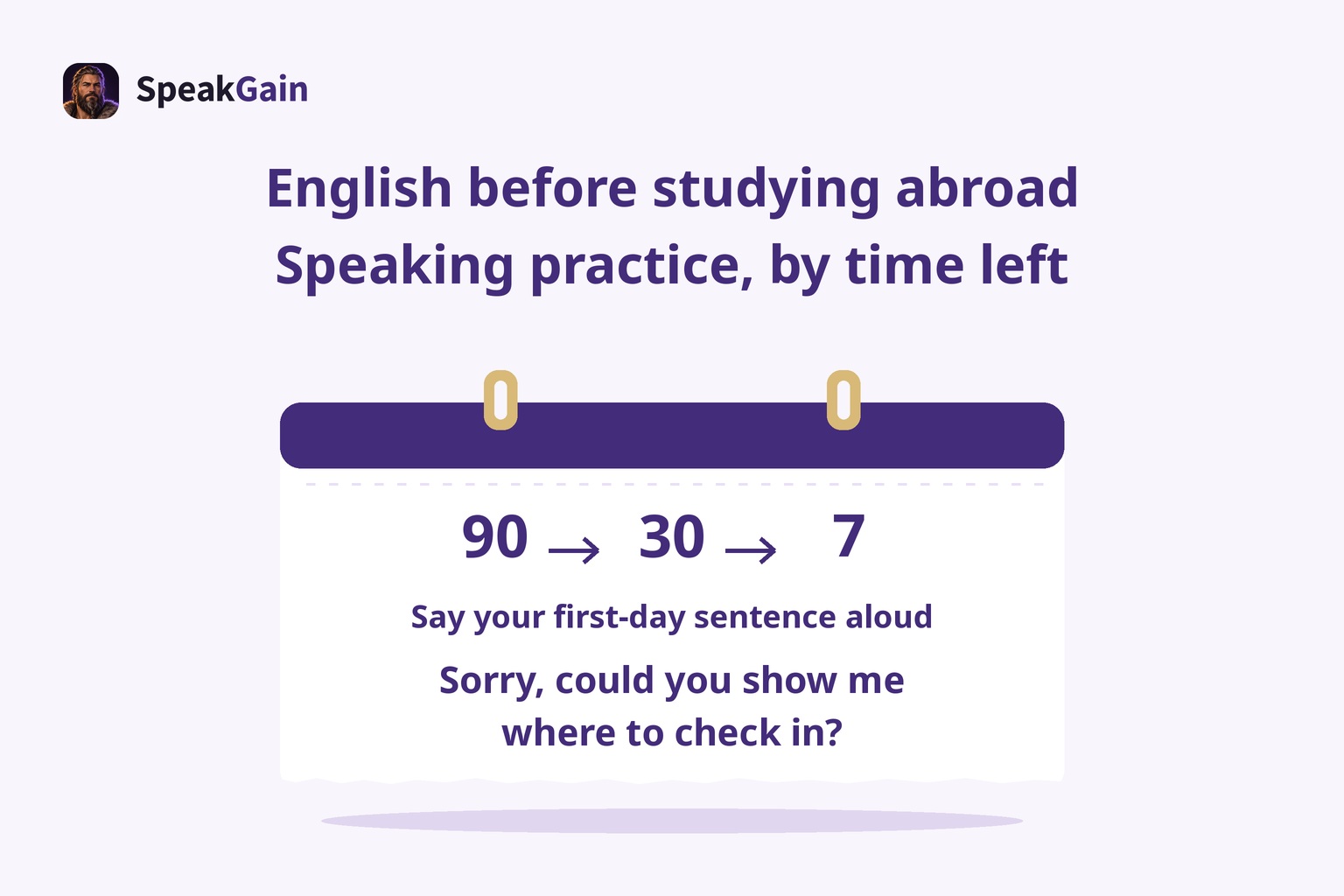
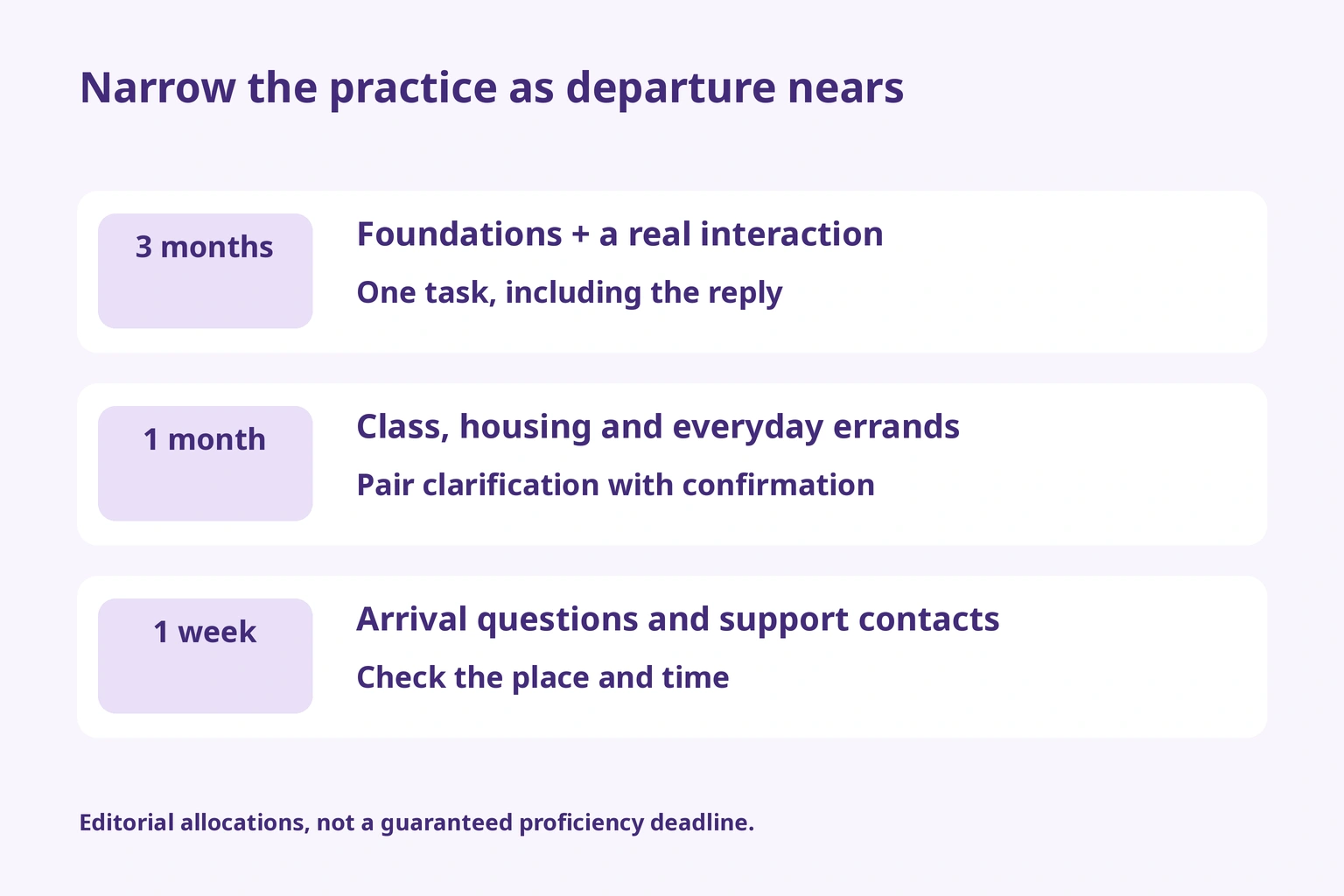
Before studying abroad, prepare short sentences you will actually use in your first week, say them aloud, and practise checking the other person’s reply. Our editorial suggestion is to combine foundations with speaking to people when you have three months, narrow the situations with one month, and prioritise arrival questions and support contacts with one week. If you are already abroad and freeze, restart with one line for joining a class discussion or asking what you missed.
This guide is for learners heading to an English-medium language school, exchange programme or working holiday, including teenagers, university students and adults with little speaking experience. Write down three practical tasks before drafting a long introduction: finding reception, checking an instruction, or asking to join someone. The examples are written by our editors; the schedule is a suggested allocation, not a measured fluency deadline.
If your application requires IELTS, our IELTS study plan helps you allocate practice across all four skills and the required minimum bands.
For whole-test preparation, use our TOEFL study plan to organize all four skills and official materials around your target.
How much time is left? Your speaking countdown
Start at the row that matches your departure date. You do not need to complete every earlier stage first.
| Time left | Priority | Suggested daily practice | Sentence to prepare |
|---|---|---|---|
| 3 months | Revisit the grammar and sounds needed for first-week tasks; arrange practice with a person | 15 minutes: meaning and sound 5, recall without text 5, change a detail 5. Try the task with someone weekly | Could you help me find my classroom? |
| 1 month | Focus on class, accommodation and everyday errands; add a reply-checking line | 15 minutes: yesterday’s difficulty 5, speak from the situation 5, check an unexpected reply 5 | Do you mean I should come back tomorrow? |
| 1 week | Prepare arrival questions, requests to repeat and support contacts | 10 minutes: say the sentence, change a place or time, ask again; check your contacts | Sorry, could you show me where to check in? |
Try a sentence before looking at it. If the meaning is unclear, revisit the relevant knowledge; if you understand it but cannot produce it, practise starting from the situation. The roadmap to speaking English explains the broader sequence.
Three months: review foundations and book a real interaction
It is tempting to finish a grammar book before speaking. We would practise one task with a person from the first week, alongside revision, because we want to discover whether the difficulty is producing our question or understanding the reply.
Sentence: “Could you help me find my classroom?” Add “I’m looking for room twelve.” when you know the number. Check meaning and sound, listen once, pause and say it. Hide the sentence and imagine that you cannot find your class. Then ask a teacher, tutor or practice partner to answer.
Try more than one reply: another floor, or a direction to reception. A note is fine for the first attempt; on the second, try without it and return to it if needed. Record whether you established the location, rather than only counting minutes spoken.
Common mistake: treating correct grammar exercises as proof that you can ask the question aloud. Keep grammar practice, but use it in a task. Equally, do not leave an unclear sentence unresolved after a conversation. We would begin with introducing ourselves, checking a location and making a household request, then repeat each under changed conditions before adding more.
One month: practise three situations and check the reply
Departure paperwork can squeeze your study time. Choose three situations from your actual first week. Exchange students might include course registration; working-holiday travellers might substitute housing or workplace contact.
Sentence: “Do you mean I should come back tomorrow?” Use it when the person has explained a later visit and you want to check that you understood the day. If you understood nothing, ask them to repeat first.
Practice: pair a starting question, a repair request and a final confirmation. Have your partner say Friday instead of tomorrow, then change your confirmation. Solo practice can prepare a response, but leave an opportunity to check understanding with a person too. Break a long explanation in your first language into small tasks: ask again, then confirm the day.
Common mistake: rehearsing a polished question and nodding at any answer. A successful question does not establish when or where to return. Finish by saying what you will do and checking that understanding.
One week: prepare arrival questions and a route to help
Plan for a tired arrival or a connection that is not yet working. Keep your meeting place, time, address and support contact accessible in writing. Younger travellers can check with a parent or programme leader whom to contact when something goes wrong.
Worked sentence: “Sorry, could you show me where to check in?” This is for a place where you know an arrival check-in is required, such as a school reception or residence. Do not use “check in” as a universal name for attendance or every office procedure.
Practice: imagine reaching reception, greet someone and ask. Hide the text, say it again, then continue with “Could you say that again more slowly?” If the location remains unclear, show a map and ask “Could you point to it on this map?” Keep written information available even without audio.
Common mistake: rushing through every saved phrase. Stop after the question and listen. Confirm current arrival arrangements with the school or accommodation provider. Detailed travel situations belong in airport and immigration English.
Four first-week situations
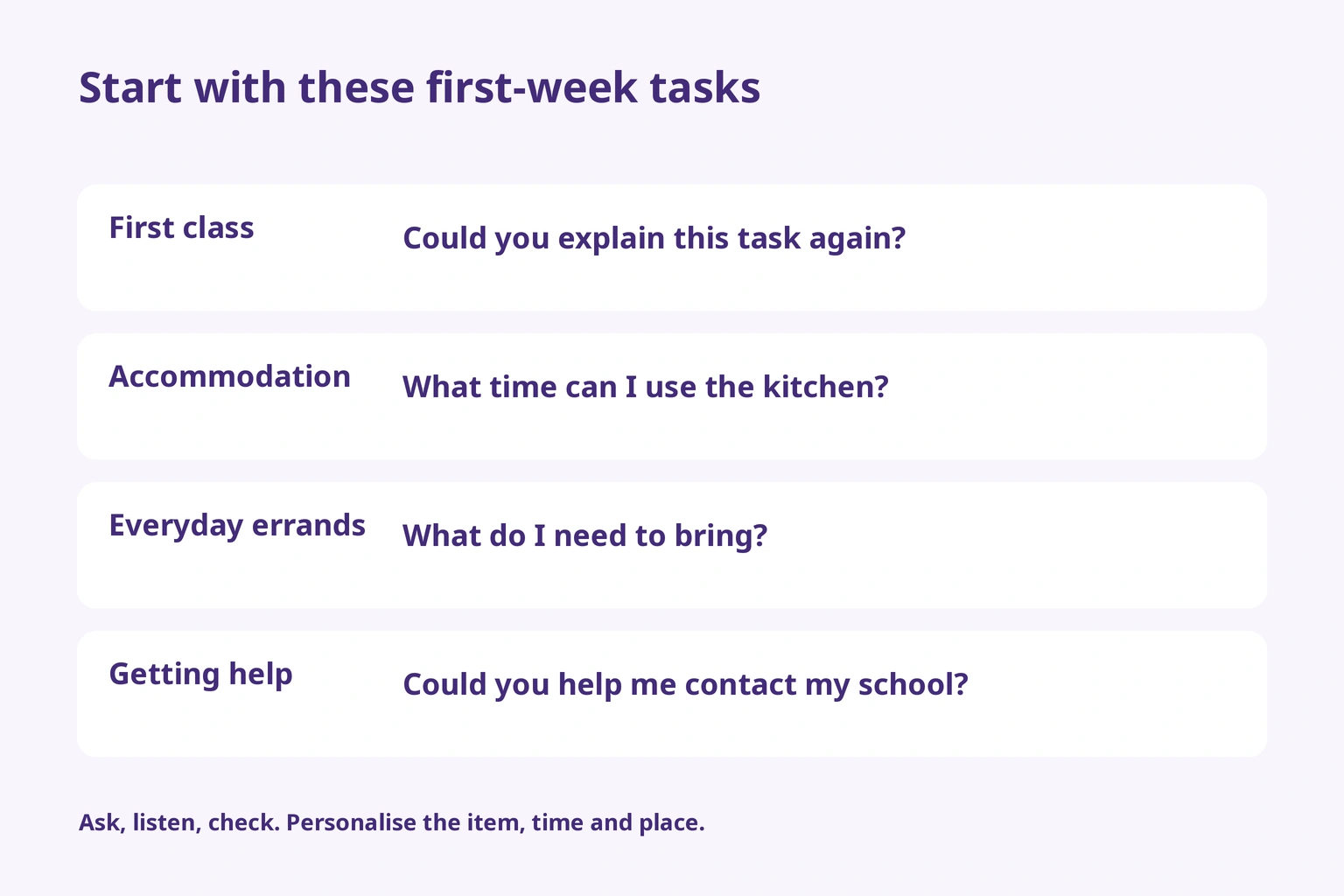
Choose a sentence for your own first day; do not memorise the whole table.
| Situation | Core sentence | What to personalise |
|---|---|---|
| First class | Could you explain this task again? | The task or instruction you need explained |
| Residence or homestay | What time can I use the kitchen? | The facility and time |
| Shop, bank or phone SIM | What do I need to bring? | The procedure and items required |
| Asking for help | Could you help me contact my school? | Your school or residence contact |
First class: you may understand the topic but miss the instruction. Ask “Could you explain this task again?” while indicating the task, then check “Should we work in pairs?” if that is what you understood. Practise this exchange before class. Waiting because everyone else has started writing is a common trap.
Accommodation: ask “What time can I use the kitchen?” Practise replacing kitchen with laundry room and repeating the time you hear. Do not infer permission from another resident’s behaviour or assumptions about a country. For meals, requests and shared routines, use homestay English.
Everyday errands: identify the procedure, then ask “What do I need to bring?” Practise repeating each item and asking for an unfamiliar name in writing. Requirements come from the provider’s official instructions, not the example. Returning with only the items you happened to catch is the mistake to avoid.
Help: “Could you help me contact my school?” can accompany a school name and the contact you prepared. Practise showing it and checking the suggested method. Explain the problem briefly, but also say what help you need. Keep emergency contact arrangements from your school and accommodation accessible.
Prepare your name and one topic separately with introducing yourself in English.
Already abroad and unable to speak? Restart where you stopped
Separate three difficulties: your sentence does not come, the reply is unclear, or there is no opportunity to speak. Choose yesterday’s one difficulty and today’s one action.
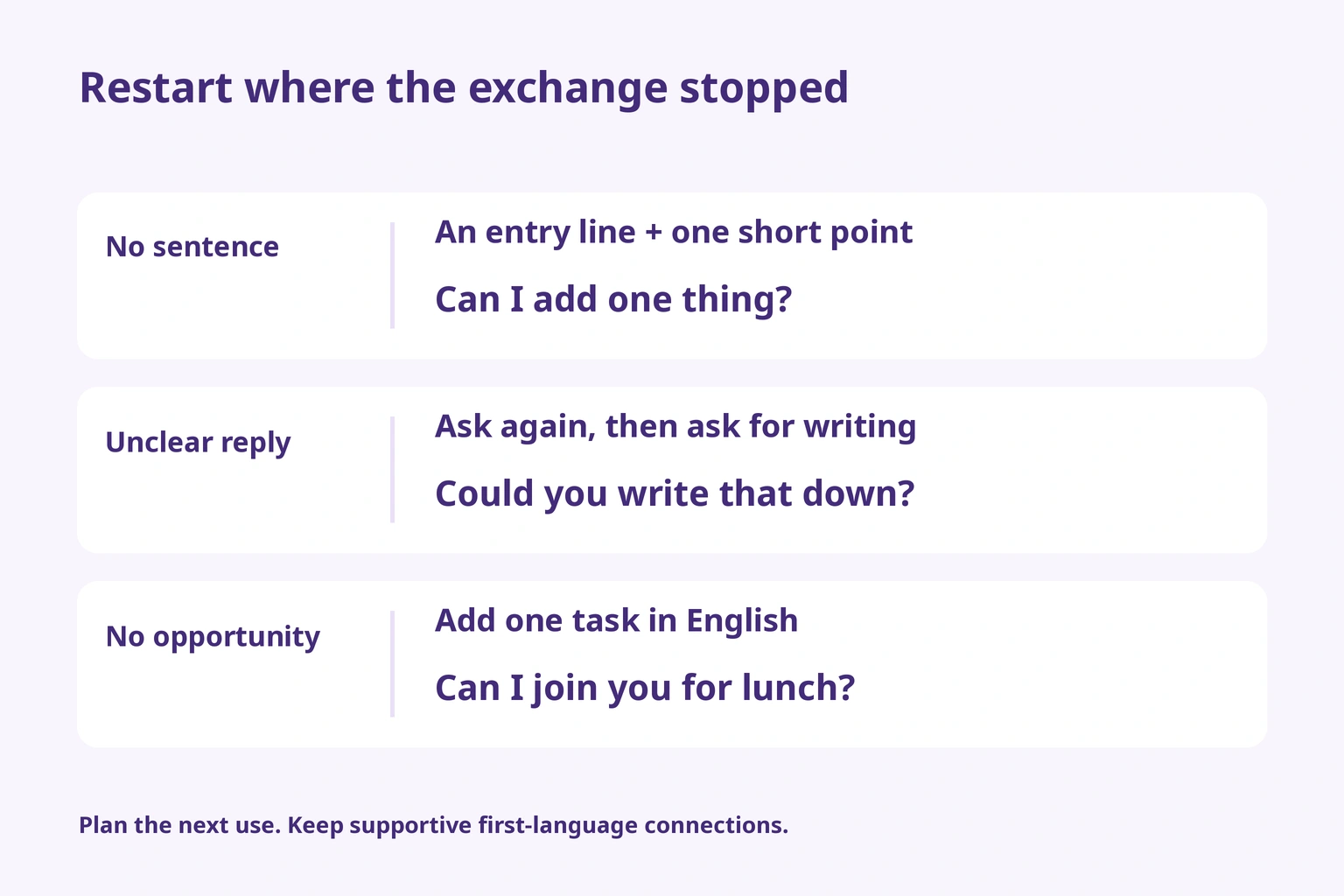
Class participation: a discussion may move on while you compose a complete argument. Prepare “Can I add one thing?” and a short point such as “I think we need more time.” Write one idea about the topic, hide it and try both sentences together. If participation remains difficult, discuss a suitable way to contribute with the teacher. Making the speech longer does not solve the problem of starting it.
Understanding replies: prepare “Could you write that down?” Ask for a slower repetition first, then use writing when needed and confirm your interpretation. British Council guidance recommends clarification and mutual understanding checks. It does not test this countdown or the app. Read the guidance. Do not nod at an unknown time, location or required item.
A first-language-only routine: our opinion is to preserve supportive friendships and add one task in English, rather than avoiding people who share your language. Prepare “Can I join you for lunch?” and one topic you can discuss. Choose a time, respect a refusal and try another opportunity. Nationality is not a measure of a person’s value as a conversation partner. A vague promise to “speak English today” needs a concrete situation.
At work, understanding the current instruction comes before social practice. Try “Could you show me the first step?” and check the demonstration. Proceeding without understanding is not a speaking challenge to reward.
Check school requirements separately
Being able to manage a short interaction does not prove eligibility. Check your school’s and programme’s official entry and placement information, including documents, deadlines and arrival arrangements. This article lists no scores. UBC’s official English requirements illustrate institution-owned guidance, not a rule for other schools or exchanges.
Prepare “Where can I find the placement test information?” Practise adding your actual programme and checking the page you are given. An old travel account is not a replacement for current official instructions. Plan requirement checking and speaking practice as separate tasks.
Hear it, say it, then try without the text
Save the worked sentence, “Sorry, could you show me where to check in?”, with its reception scenario. Check the meaning, listen, pause and say it, hide the text, then practise checking a reply. On the next day, try recall first and revisit only what stopped you. Finally, use it with a person; speaking-practice methods help you choose the combination.
The common mistake is counting plays instead of checking what you can do. Distinguish “said it with text”, “said it without text” and “checked the person’s reply”. Do not make speaking faster the main target.
Use SpeakGain to hear and study your arrival sentence
We added “Sorry, could you show me where to check in?” once through SpeakGain’s normal Add a card flow and checked the actual study screens. Use it here to keep your sentence and hear its audio.
- We opened the new card in Library, chose Knowledge, then Learn this card.
- Listening hid the sentence and played audio first. The screen instructed us to say what we heard before choosing Reveal answer.
- Reveal answer opened Answer with the saved sentence, a generated English explanation, playback controls and review intervals.
- We selected Good once and checked that the review count increased by one. The next visible screen was Listening.
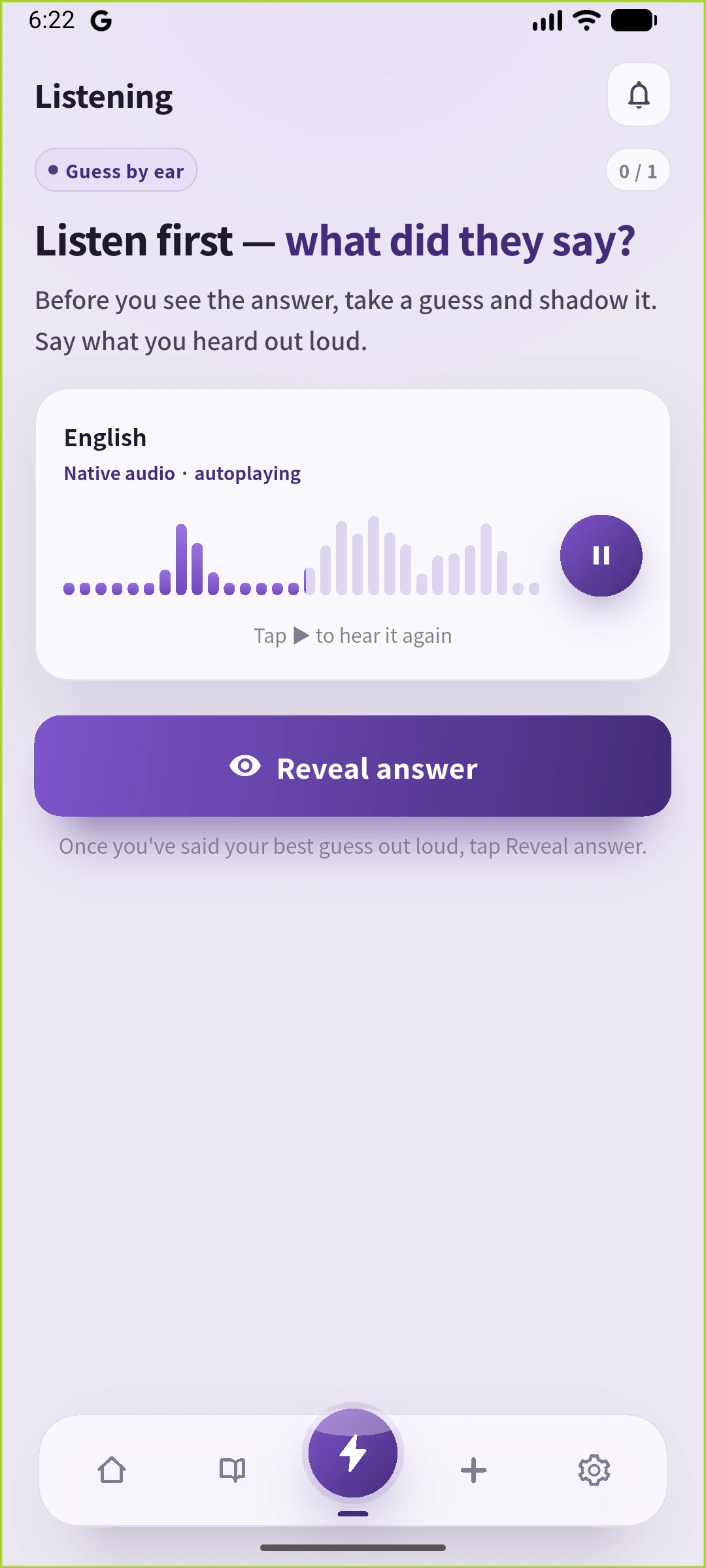
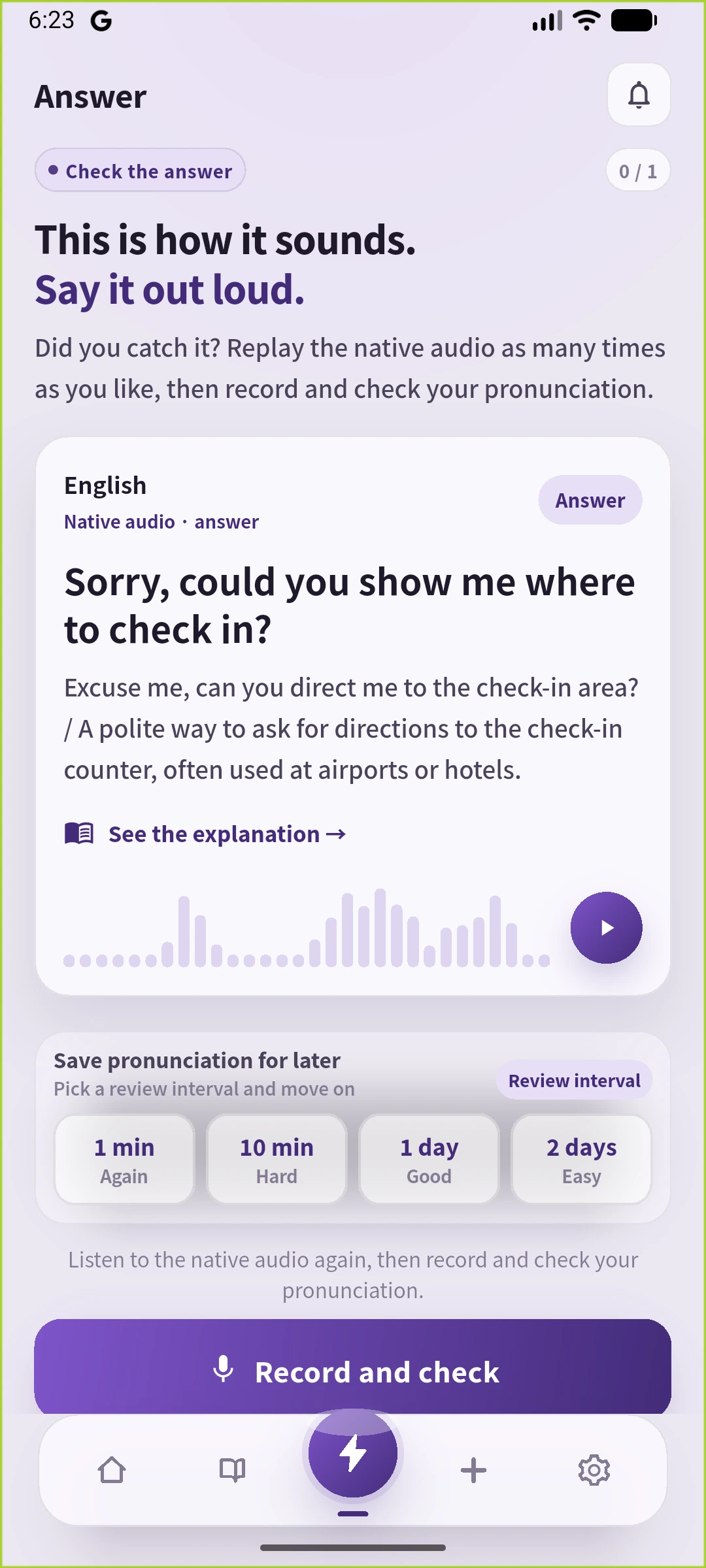
This clip was generated for this one card; it is AI audio, not a human native speaker’s recording. Native audio in this app example refers to generated audio.
After listening and saying the sentence, our editorial practice is to try without the text and ask a real person the same question, checking their reply. The verified flow prepares a sentence; we do not present it as a conversation partner or answer/pronunciation scoring, nor as a guarantee that you will speak by departure.
Preparation we would not recommend
Only vocabulary and grammar drills: keep the foundations, but add an actual task. Use a word in “I’m looking for room twelve.” and change the number. Knowledge and a spoken request need separate checks.
Memorising dozens of phrases as the goal: choose questions for an identifiable use, add a repair line and confirm the answer. Increase your set when your actual situations expand.
Waiting for the overseas environment to do everything: even abroad you can have days with no English interaction. We would rehearse one sentence before departure and schedule one place to use it after arrival. These are editorial choices, not guarantees about speed or an assertion about any nationality.
Frequently asked questions
How well should I speak before leaving?
Check official admission rules. For everyday preparation, try an introduction, a location or instruction question, a request to repeat and a request for help. Free conversation is not a prerequisite for starting preparation.
Grammar or conversation first?
If you do not understand your sentence, check its grammar and vocabulary. If you do, say it and try the task with someone, then review what failed. We suggest doing relevant foundations and interactions together.
Should I take online lessons?
They are an option for practising replies. Tell the teacher the task and that you may use notes. Try last lesson’s blocked sentence again; lesson count alone is not the goal. Paid lessons are not compulsory for everyone.
For choosing your first lesson task and reviewing it, see online English lessons for beginners.
Is one week enough?
It cannot guarantee complete conversation skills. It is enough time to begin preparing essential arrival questions, repair lines and support information. Try one first-day sentence before starting a whole phrasebook.
What if I only talk to people who speak my language?
Keep that support and add one planned English-language task. Check an assignment after class or invite someone to lunch; specify when and why.
What if I cannot contribute in class?
Practise “Can I add one thing?” plus one short point. If the instruction is unclear, request an explanation first. Ask the teacher about participation when needed.
Does this apply to a working holiday?
Repair and help requests carry over. Replace school tasks with housing, phone or workplace instructions when relevant. Check work and contract conditions separately through official guidance.
Our editorial verdict
Whether you have three months or one week, choose one first-day task and practise the question, repair and confirmation. What stops you in that exchange tells you which grammar, words or sounds to revisit tomorrow. Judge preparation by starting a sentence, checking the reply and requesting help—not simply the number of phrases collected. If you freeze abroad, return to that specific task and plan your next attempt.
Sources
- British Council: Six tips for speaking English internationally: communication guidance, not a trial of this schedule.
- UBC: English language competency: an example of official institutional entry information. Check your own programme.