
English for a homestay: 8 core sentences and practice before departure
Published
For a homestay, prepare to introduce yourself, ask about household routines, explain food needs, share plans, request help, say no and give thanks in short English sentences. Choose a core sentence for each of eight scenes, then replace the name, time, food or request with your own information. Before departure, read it, personalise it, hide the English and say it aloud, then practise asking again if you do not understand the reply.
This guide is for learners staying with a family abroad, including teenagers, university students and adults; parents can help prepare, but the traveller needs to say the sentences themselves. All examples are our own editorial practice examples. Ask your actual host family and programme about their arrangements: a national stereotype cannot tell you their shower, laundry or curfew rules. The one-week plan is a way to organise preparation, not a promise of fluency or safety.
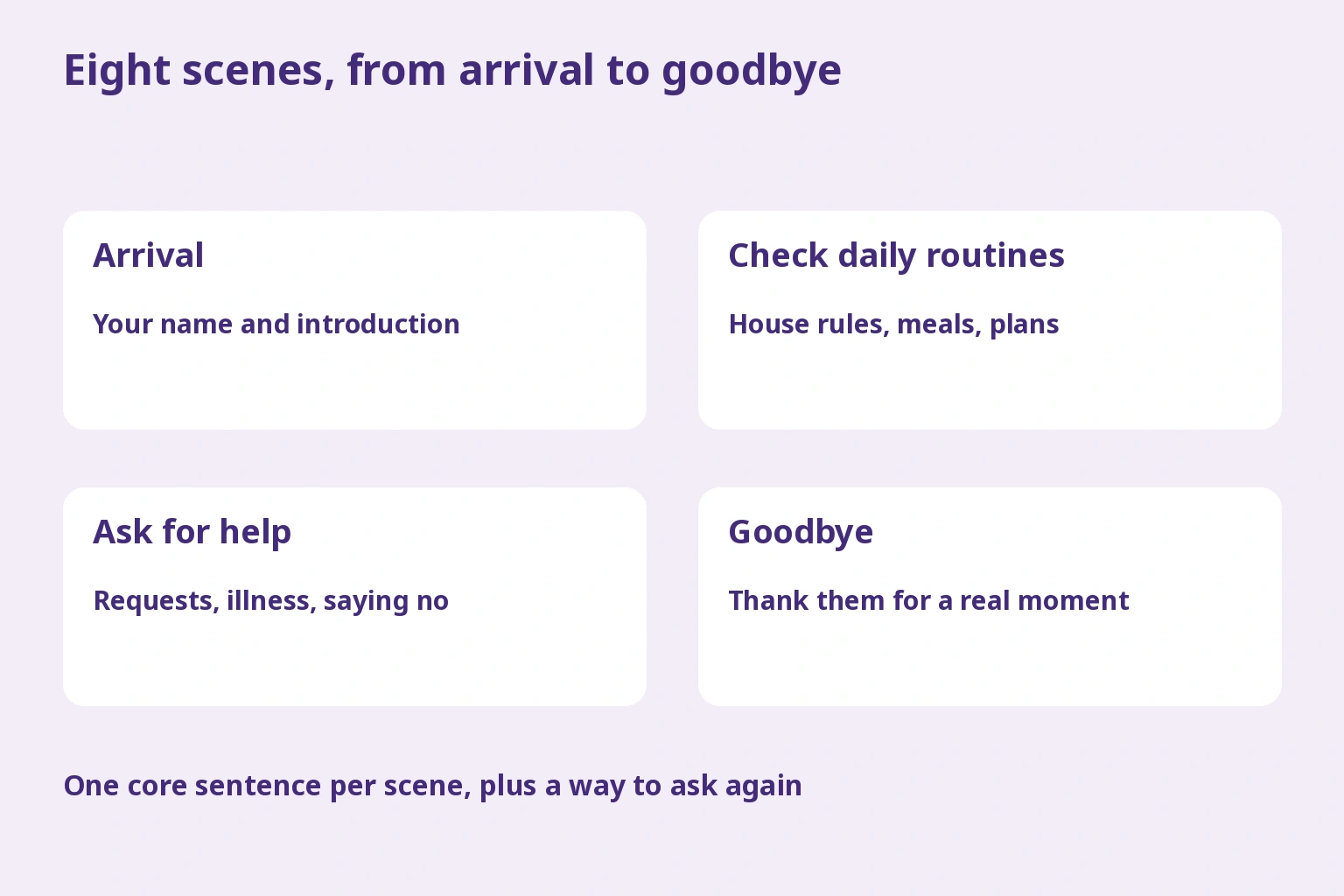
What English do you need? Eight everyday scenes
Start with one useful sentence per scene. Add the second sentence only if it fits your needs; you do not need to memorise the whole list.
| Scene | Core sentence | Personalise | Caution |
|---|---|---|---|
| Arrival and introductions | Please call me Hana. | Preferred name | Ask how to address your hosts |
| House rules: shower, laundry and coming home | Is it okay if I take a shower before dinner? | Action and timing | Confirm the actual family’s rules |
| Meals and food you cannot eat | I can’t eat peanuts. | Food and your actual reason | Distinguish allergy from preference |
| Sharing plans and dinner arrangements | I’ll be home at six today. | Day and return time | Discuss dinner and changes too |
| Requests and help with household things | Could you show me how to use this? | The object or operation | Permission and instructions differ |
| Feeling unwell or having a problem | I’m not feeling well. Could you help me contact my school? | Your condition and support contact | Confirm emergency contacts beforehand |
| Saying no and apologising | No, thank you. I’m full. | Your real reason | Do not disguise food restrictions |
| Goodbye and thanks | Thank you for making me feel welcome. | A real shared experience | Confirm practical departure details |
A line you can use throughout the stay is Could you say that again, please? — ask them to repeat. If repetition still does not help, ask for the time, name or instruction in writing. Saying a question does not mean you have understood its answer.
1. Arrival and introductions
When you arrive, greet your hosts and give the name you want them to use. You do not need to deliver a long speech about school, hobbies and career plans before letting them reply.
Core sentence: Please call me Hana. — Tell them your preferred name. I’m still learning English, so please speak slowly. — Explain what would make the conversation easier.
Your version: Please call me Ren. — Replace Hana with the name you use. If you add a hobby, choose one you can talk about rather than a polished paragraph someone else wrote. You can ask how to address your host with “What should I call you?” Do not guess from a title or a family relationship.
If you do not understand: Could you write your name down, please? — Ask to see the spelling of their name.
Common mistake: Memorising a long introduction, then restarting it whenever someone asks a question. Stop after the first sentence and listen. A friendly greeting and a practical request can be separate sentences.
For more practice, see introducing yourself in English.
2. House rules: shower, laundry and coming home
Your host may show you the house when you arrive. If you are tired, ask about what you need now, and keep the remaining answers in a written note.
Core sentence: Is it okay if I take a shower before dinner? — Ask permission to shower before dinner. What time should I be home? — Ask when you are expected home.
Your version: Is it okay if I do my laundry tomorrow? — Change the request to laundry tomorrow. Confirm the suitable shower times, laundry day and method, and how to agree your return time. “Before dinner” works only when you know when dinner is. There is no need to assume that families in a particular country all use the same schedule.
If you do not understand: Could you write the time down, please? — Ask for the time in writing.
Common mistake: Hearing yes and assuming you know all the conditions. Ask one question, check the reply, then ask the next. Permission to use something does not automatically explain its timing or how to leave it afterwards.
3. Meals and food you cannot eat
At meals, you may be offered food or asked about tomorrow’s menu. Prepare any food restrictions before departure and confirm with the school or organiser how they will be shared with the host.
Core sentence: I can’t eat peanuts. — State a food you cannot eat. I’m allergic to peanuts. — Use this only if you really have that allergy.
Your version: I can’t eat pork. — Replace the ingredient with your restriction. Do not use allergy as a stronger way to describe dislike. For a smaller serving, “I’d prefer a smaller portion, please.” expresses a preference. Knowing a dish’s name does not confirm its ingredients; this English example alone cannot establish that a meal is safe for you.
If you do not understand: Could you write the ingredients down, please? — Ask for the ingredients in writing.
Common mistake: Saying “Anything is fine” out of politeness when a real restriction exists. Give the condition first, then discuss options. If important information remains unclear, use your agreed support contact.
4. Sharing plans and dinner arrangements
After class, you might go shopping or meet friends. Check the family’s and programme’s expectations about permission and who to contact before treating a plan as settled.
Core sentence: I’ll be home at six today. — State today’s planned return time. Is it okay if I have dinner with my friends tonight? — Ask about having dinner with friends.
Your version: I’ll be home at five tomorrow. — Change both the day and the time. Separate reporting an agreed plan from asking permission for a new one. Show the time in writing if morning and evening could be confused. Before going out, ask how to notify them of a change and whether you will join dinner.
If you do not understand: Could you show me how to contact you, please? — Confirm how to contact the host.
Common mistake: Assuming a return time also tells your host whether to cook for you. If delayed, do not postpone contacting them while composing a long explanation. “I’ll be late” can start the message; add what you know. Six o’clock is an example, not a suggested universal curfew.
5. Requests and help with household things
A washing machine, key or internet connection can be hard to describe in words. Show the object and ask for one specific action.
Core sentence: Could you show me how to use this? — Ask for a demonstration. Could you help me with this? — Ask for help with the thing you show.
Your version: Could you show me how to use the washing machine? — Name the washing machine explicitly. If permission to use the appliance is not settled, ask that first. After a demonstration, check the sequence you need to follow before using it. A polite request allows the host to reply; it does not guarantee they can help immediately.
If you do not understand: Could you show me again, please? — Ask to see the demonstration again.
Common mistake: Saying only “Laundry, please” when you mean instructions, not asking someone to wash your clothes. State what you need. Asking to see an action again may work better than hearing the same explanation repeatedly.
For more practice, see making requests in English.
6. Feeling unwell or having a problem
If you feel ill, cannot get into the house or have a problem with the stay, start with the current situation and the help you need rather than translating the entire story.
Core sentence: I’m not feeling well. Could you help me contact my school? — Say you feel unwell and ask for help contacting school. I need to speak to my homestay coordinator. — Ask to speak to the person responsible for your homestay.
Your version: I feel sick. Could you help me contact my coordinator? — Use your actual coordinator as the contact. Prepare your name, address, current location and the contact you need in writing. Confirm the school or agency’s ordinary and out-of-hours emergency contacts before departure. If the problem concerns your host, have a way to contact support directly without going through them.
If you do not understand: Could you write down what I should do next, please? — Ask for the next action in writing.
Common mistake: Being too embarrassed to ask anyone outside the household. These sentences do not diagnose symptoms or decide whether an emergency exists. Follow the programme’s agreed emergency procedure and confirm local emergency numbers from official destination guidance; do not reuse another country’s number.
7. Saying no and apologising
You may want to decline another serving or an invitation, or apologise for coming home late. Gratitude, refusal and apology are separate tasks.
Core sentence: No, thank you. I’m full. — Decline another serving because you are full. I’m sorry I’m late. — Apologise for being late.
Your version: Thank you for inviting me, but I need to study tonight. — Thank someone for the invitation and give your actual reason. Use a reason that is true. If you were late, apologise once, explain what is needed and discuss how to communicate next time. Before accepting or declining an unclear invitation, confirm its day and purpose.
If you do not understand: Do you mean tonight? — Check which evening they mean.
Common mistake: Using “Maybe” to avoid saying no, leaving the decision unclear. English does not require a blunt speech: a short thank-you followed by a clear decision can work. Do not infer a family’s preferred style of refusal from a national stereotype.
For more practice, see apologising in English.
8. Goodbye and thanks
On the final day, prepare thanks separately from returning keys and checking the pickup time. A specific memory is more useful than trying to perform an emotional speech.
Core sentence: Thank you for making me feel welcome. — Thank them for helping you feel welcome. I really enjoyed cooking with you. — Thank them for an activity you actually enjoyed.
Your version: I really enjoyed talking with you after dinner. — Replace cooking with a real moment after dinner. Choose an activity you really shared. If giving a present, “This is a small gift from my hometown.” is a simple introduction; a gift is not a universal duty. Check any rules for bringing the item into the destination separately using official guidance.
If you do not understand: Could you write that down, please? — Ask for an unclear departure instruction in writing.
Common mistake: Concentrating on reading the thank-you perfectly and forgetting where to return the key or when to leave. Finish those arrangements, then give the short thanks in your own voice.
For more practice, see saying thank you in English.
Turn the core sentence into your own household question
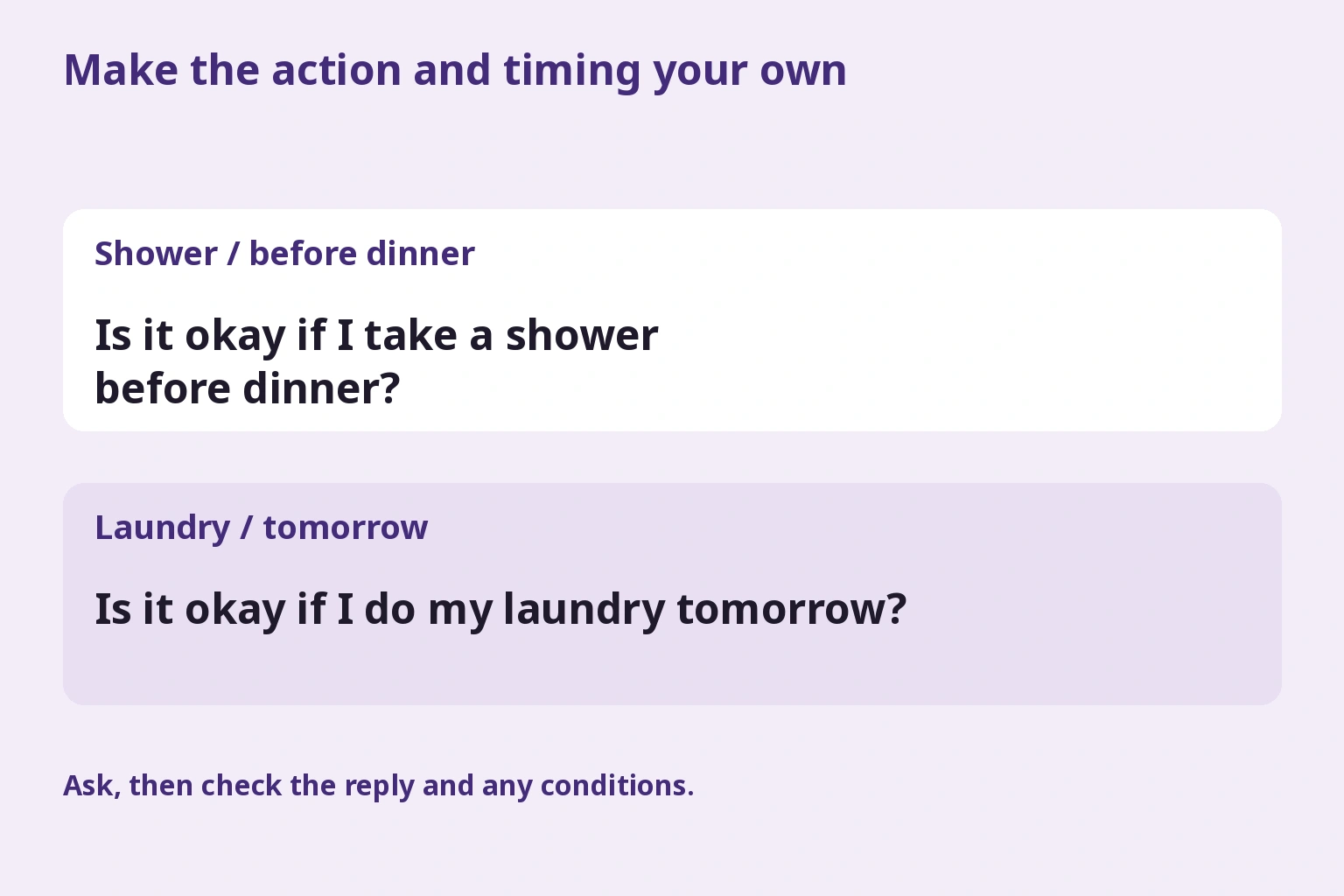
Keep the question structure and change one action and one time. In the shower sentence, “take a shower” says what you want to do and “before dinner” says when. The goal is a real question you might ask, not a catalogue of interchangeable phrases.
- Write one actual need in your own language: for example, doing laundry tomorrow.
- Replace the action with “do my laundry” and the time with “tomorrow”.
- Read the sentence once, then hide it and say it from a cue such as ‘ask about doing laundry tomorrow’.
- Imagine that you do not understand the reply, and practise asking again too.
Is it okay if I do my laundry tomorrow?
A yes or no may have conditions attached. Do not invent the host’s rules in a rehearsal. Practise what you will do when you need clarification, including asking for important times in writing.
Prepare the journey to the household separately with English for travel / English for airports and immigration.
One week before departure: from reading to speaking from a cue
Our editorial priority is food needs, household questions and support contacts before polishing an introduction. Use this schedule to divide preparation into manageable tasks; with less time, put health and daily-living needs first.
| When | Prepare | Say aloud | Check |
|---|---|---|---|
| 7 days before | Contacts and food needs | Food restriction and help request | Traveller and parent know how to contact support |
| 6 days before | Shower, laundry, return questions | Replace actions and times | No invented national household rules |
| 5 days before | Name and one hobby | Say your name, pause, listen | Can start without a script |
| 4 days before | After-class plans | Return time and dinner request | Day, time and contact method clear |
| 3 days before | Requests, refusal, apology | One need, then a clarification | No automatic agreement |
| 2 days before | Choose your eight useful lines | Speak from cues and listen to a recording | Fix one place where you stopped |
| Day before | Address, contacts, travel details | Two difficult lines and asking again | A contact note available without battery |
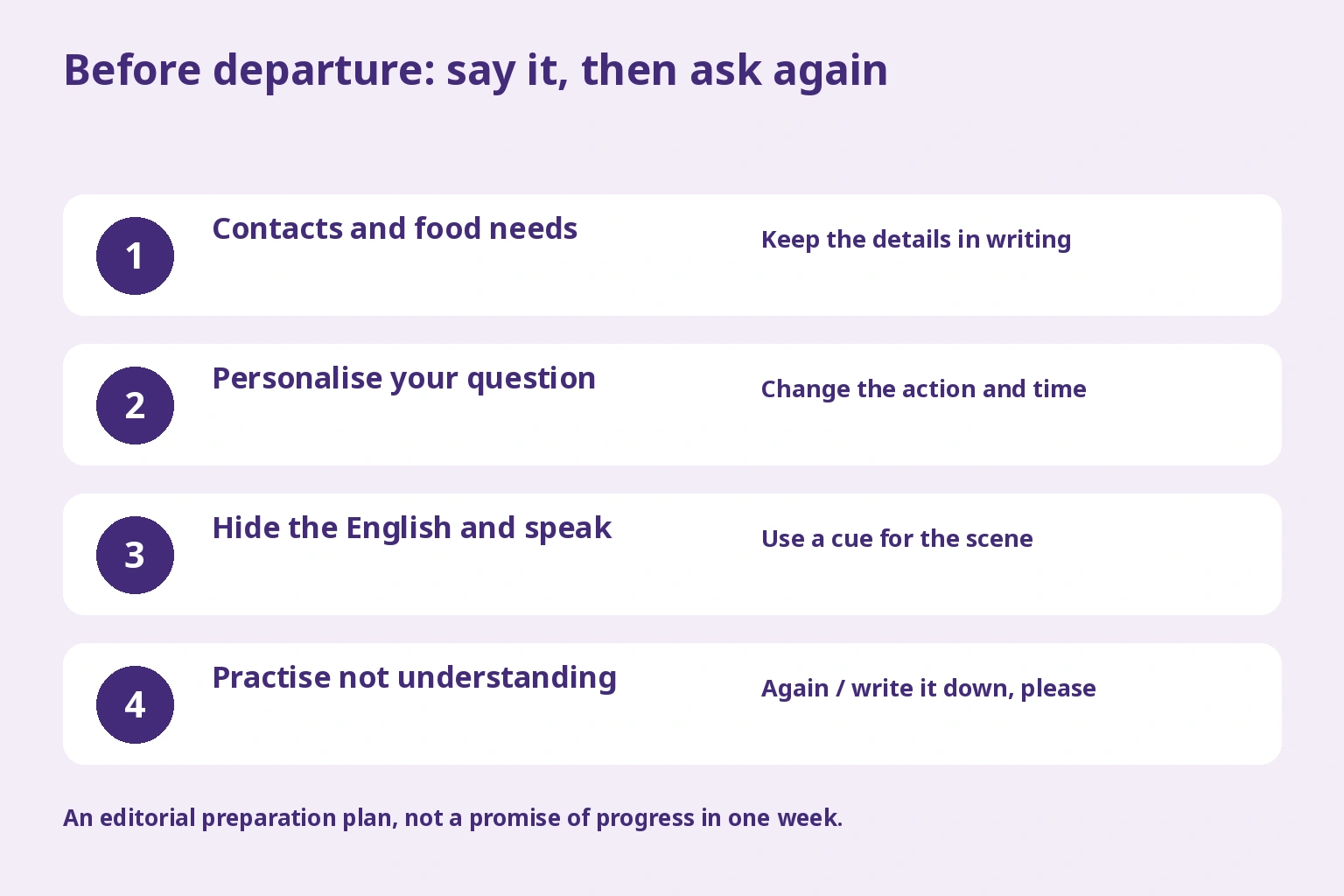
A parent or friend can give a situation cue and wait for you to respond instead of reading the answer for you. When listening to your own recording, choose one check: the time, the negative in can’t, or whether the request reached its end. Clear necessary information matters more here than reading a long paragraph smoothly.
Save a personal sentence and listen: SpeakGain on the device
As an example of keeping a short sentence for pre-departure practice, we added the same shower question in SpeakGain. The following steps were checked on the dedicated device.
- Enter the English sentence in the normal Add screen and select Add a card.
- Open the new card’s Knowledge screen in Card library, then select Learn this card.
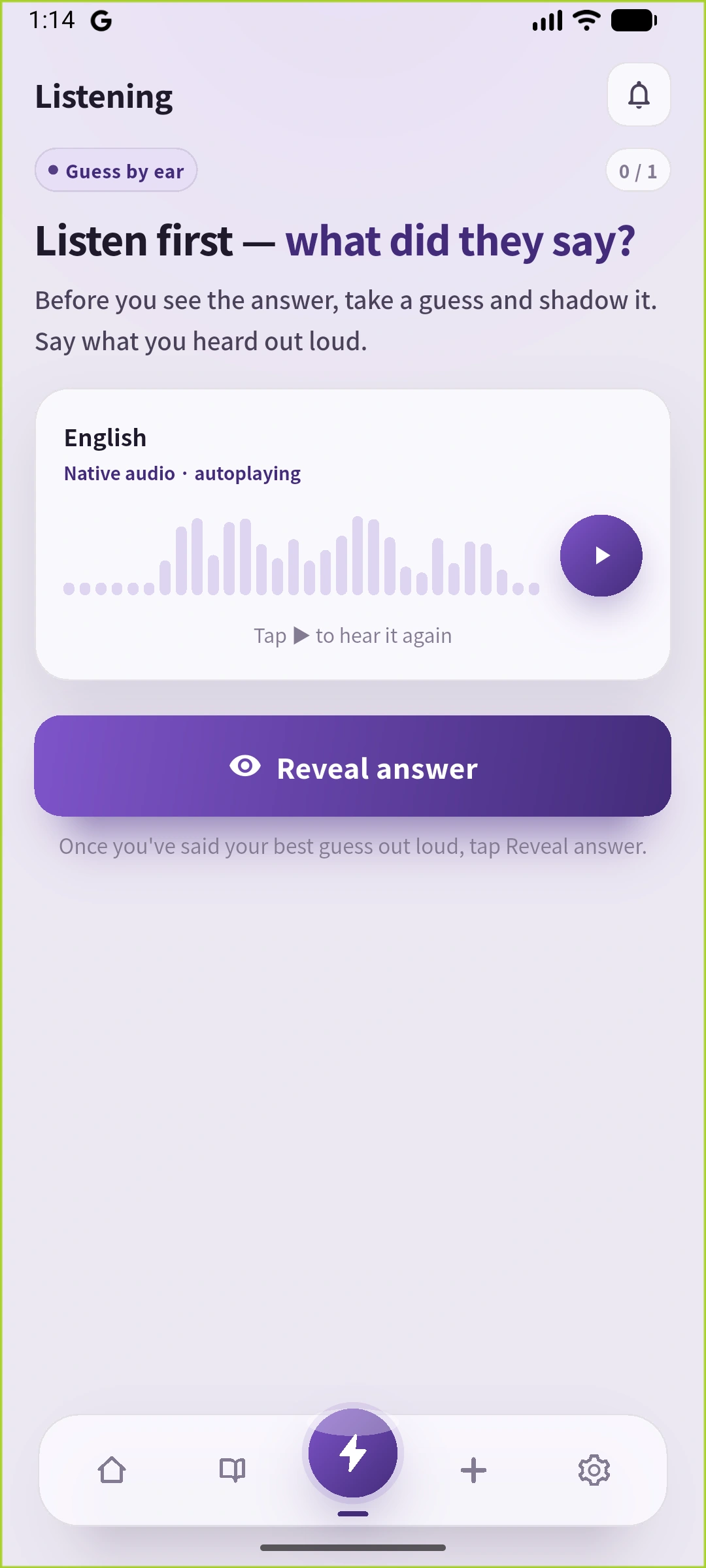
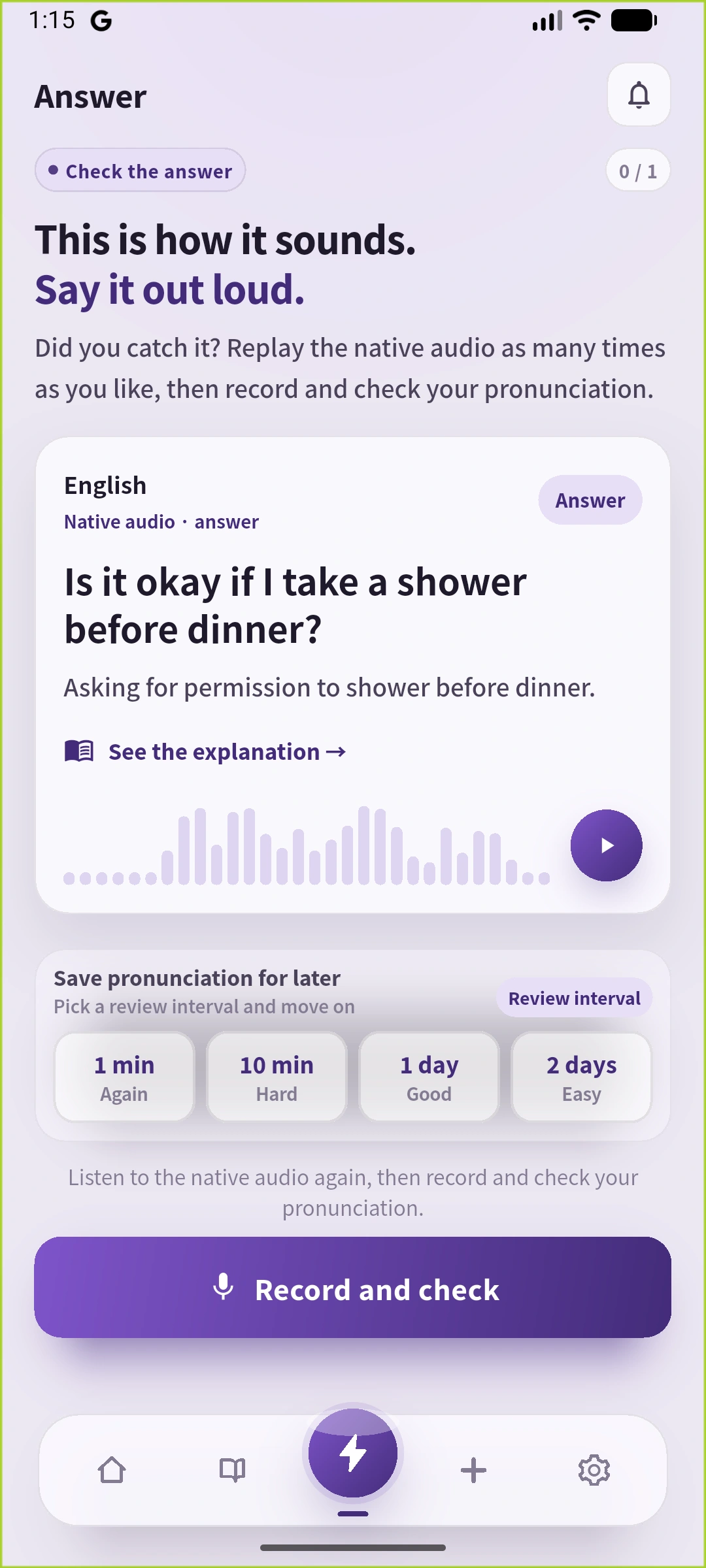
- Listen in Listening and say what you heard without seeing the English. Select Reveal answer to view the saved sentence and explanation in Answer.
This card started in Listening. Answer displayed playback and review-interval choices; we selected Good once and confirmed that a review was recorded.
Listen to this sentence
For your own practice, listen, hide the text and say it from a cue such as ‘ask about a shower before dinner’. That is our editorial exercise. In the household, you still need to check the host’s actual reply and ask again when unclear.
Preparation we do not recommend
Memorising dozens of phrases at once. It can push your actual food needs, return time and help request out of your practice time. Start with one useful line per scene, then add what you need.
Treating national stereotypes as household rules. A general description of a culture cannot answer for this family or programme. Prepare questions and space to note replies instead.
Practising smiling and nodding when confused. A friendly response is not the same as agreement about a time or food condition. Ask again, request written details and check that important information was understood.
Frequently asked questions
Can I do a homestay if my English is weak?
Check the programme’s entry and support conditions. You can prepare short lines for food, routines, help and asking again, but cannot assume every situation will work without English. Prepare support contacts too.
What should I ask my host first?
Start with what you need now: shower, laundry, meals, return time and how to contact them about changes. Ask separately and keep important replies in writing.
How do I explain food I cannot eat?
Name the ingredient and your real reason. Use the allergy sentence only for an actual allergy, and confirm how the information is shared before departure.
What if I cannot understand the answer?
Ask for repetition; if that still fails, ask for writing or another demonstration. Do not confirm a condition that is unclear.
What can I say when giving a gift?
‘This is a small gift from my hometown.’ You can add what it is. Check destination import rules separately; do not assume every household expects a gift. This is a small gift from my hometown.
Should I only ask my host when something goes wrong?
No. Confirm school or agency support and emergency contacts in advance, including direct contact for a problem you cannot discuss with your host.
Will one week make me fluent?
No such result is promised. The week is for choosing your sentences and contact methods and testing whether you can start from a situation cue.
Our verdict: prepare a sentence and how to check its reply
Choose personal sentences for eight household scenes, together with clarification lines and support contacts. Put food needs, routines and getting help ahead of a polished introduction. Say the shower question, change it for your situation, and then practise asking again: Is it okay if I take a shower before dinner?
If you are leaving to study abroad, use the pre-departure speaking plan to choose priorities for three months, one month or one week and prepare a first-week sentence.