
Travel English: core lines for eight scenes and practice before departure
Published
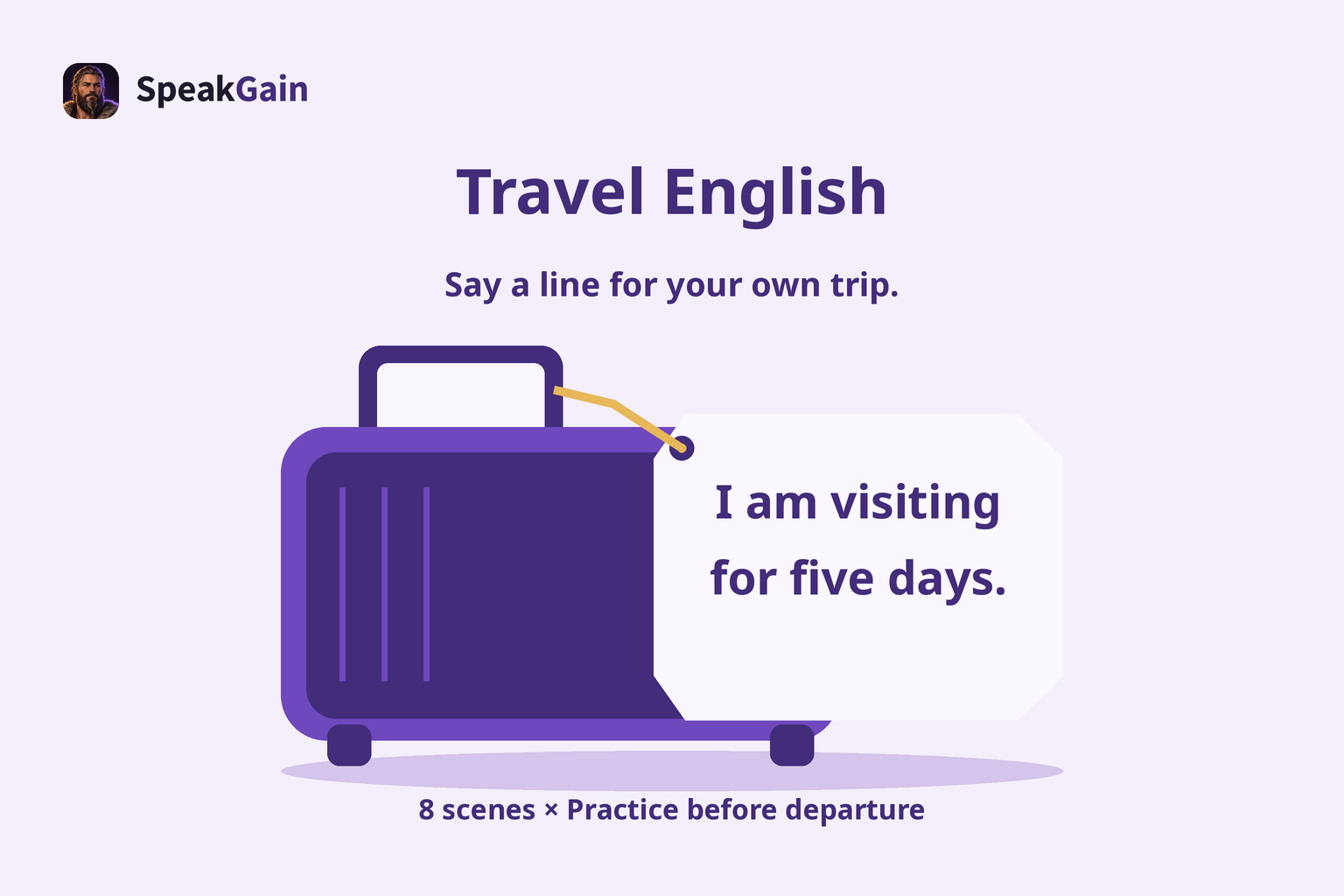
Prepare travel English by choosing short lines for eight scenes, changing the names and numbers to your itinerary, and saying them aloud before you leave. You can travel without fluent English, but that does not mean every situation will work without language support. Our editorial starting point is about twenty useful lines plus requests to repeat, slow down or write something down.
This guide is for travellers who do not speak English as their first language, including first trips, solo travel and family holidays. The aim is to communicate a need and check the response. The examples are our own practice lines; names, hotels and numbers are fictional. Twenty lines, two weeks and five minutes a day are editorial suggestions, not a guarantee of fluency or a complete solution to every travel problem.
For a stay in a host family’s home, English for a homestay adds questions about showers, meals and coming home to your travel preparation.
What English should you prepare first? Eight scenes, eight core lines
Choose one line for each scene you will actually use. Then add the clarification lines below. Say place names, numbers and negatives slowly enough to be heard, and keep the matching written information ready.
| Scene | English | Intended meaning | Delivery tip |
|---|---|---|---|
| Airport | Where is the check-in counter for this flight? | Ask where to check in for the flight you are showing. | Show the flight number. |
| Immigration | I am visiting for five days. | State that your visit lasts five days. | Replace the number of days. |
| Transport | Does this train stop at Central Station? | Check that the train serves your intended station. | Show the station’s spelling. |
| Hotel | I have a reservation under Sato. | Help reception find a booking made in Sato’s name. | Match the booking confirmation. |
| Restaurant or café | Could I have this sandwich, please? | Order the sandwich you indicate. | Point to the selected item. |
| Shopping | How much is this bag? | Ask the price of the bag you show. | Check the displayed amount too. |
| Directions | Could you show me where we are on this map? | Ask someone to mark your current position on your map. | Open the map before asking. |
| Trouble | I have lost my backpack. Could you help me? | Report a missing backpack and ask for assistance. | Name the missing object first. |
1. Airport: identify your flight
| Core line | Meaning |
|---|---|
| Where is the check-in counter for this flight? | Ask where to check in for the flight you are showing. |
| Is this the line for baggage drop? | Check whether this queue is for dropping checked luggage. |
| What time does boarding start? | Ask for the time passengers start getting on the plane. |
Adapt to your trip: Keep the flight number, date and destination together. If you have no checked bag, omit the baggage-drop line. For a connection, distinguish the first flight’s information from the next one.
Delivery: Get the person’s attention, then show the booking screen. Repeat the number or time you heard and check the current display or staff guidance.
Common mistake: Departure time and boarding time are different questions. Do not treat an example line as a rule about airport procedures or assume a gate will stay unchanged.
2. Immigration: answer with your actual plans
| Core line | Meaning |
|---|---|
| I am here for a holiday. | Explain that the purpose of your visit is a holiday. |
| I am visiting for five days. | State that your visit lasts five days. |
| I am staying at the Riverside Hotel. | Identify the hotel where you will stay. |
Adapt to your trip: Replace the purpose, five days and the fictional hotel with facts. If you are not travelling for a holiday, do not use that answer. Keep your first accommodation and full route available separately.
Delivery: Answer the question asked rather than reciting all three lines. If you do not know what was asked, request clarification before answering. Show the hotel’s official name and address when needed.
Common mistake: Do not say yes to a question you did not understand or change your facts to fit a memorised example. English practice and checking travel formalities are separate tasks.
The UK government’s border guidance describes questions about the reason for a visit. Canada’s ENF 4, section 8.8 (PDF) includes purpose, duration and accommodation among question examples. These are examples of question types, not a universal script. Check your destination’s official guidance separately; this article does not determine entry or visa requirements.
3. Transport: check before boarding
| Core line | Meaning |
|---|---|
| Does this train stop at Central Station? | Check that the train serves your intended station. |
| Which platform should I go to? | Find the platform you need. |
| Could you take me to this address, please? | Ask a driver to go to the address you show. |
Adapt to your trip: Change Central Station to your real station, or train to bus. For a taxi, save the exact address. Where names repeat, include the district or branch.
Delivery: Ask before boarding. Confirm the platform number and show the station’s spelling if pronunciation is difficult. Speak to a driver at a suitable moment without distracting them.
Common mistake: A city name is not necessarily your stop. A map pin without a written station name or address can be unclear. Check the reply before getting on.
4. Hotel: give the booking name
| Core line | Meaning |
|---|---|
| I have a reservation under Sato. | Help reception find a booking made in Sato’s name. |
| Could you keep my bags until check-in, please? | Ask whether your luggage can be stored before check-in. |
| What time is check-out? | Find the time you must check out. |
Adapt to your trip: Replace Sato with the name on the reservation, even if a companion booked it. Choose the bag-storage question only if it matters to your arrival time.
Delivery: Say the name slowly and show the confirmation. Under introduces the booking name here. Keep the checkout time in writing for your companions too.
Common mistake: Asking for a service does not mean it is available or free. Check the answer and any terms. For more short requests, see making requests in English.
5. Restaurant or café: point and order
| Core line | Meaning |
|---|---|
| Could I have this sandwich, please? | Order the sandwich you indicate. |
| Could I have the bill, please? | Ask to settle the restaurant bill. |
Adapt to your trip: Change this sandwich to your chosen item and add the quantity if needed. The bill line is for a situation where you ask to pay after eating; payment procedures differ.
Delivery: Point, name one item, then listen to the staff’s confirmation. For family orders, pause between items. Practise the details with ordering in English rather than memorising another long list here.
Common mistake: Do not point at one item while naming another. If the staff asks about a choice you do not understand, request written options before confirming.
6. Shopping: confirm the item and price
| Core line | Meaning |
|---|---|
| How much is this bag? | Ask the price of the bag you show. |
| Do you have this in a smaller size? | Ask for the same item in a smaller size. |
Adapt to your trip: Replace bag with the item you intend to buy, and smaller with larger if appropriate. Omit the size line if clothing or sizing is not part of your trip.
Delivery: Check the amount in writing, including the currency and final amount to pay. Show the actual item when asking about a size.
Common mistake: Hearing part of a price is not the same as confirming the charge. Asking whether a size exists is also different from deciding to buy.
7. Directions: use the same map
| Core line | Meaning |
|---|---|
| Could you show me where we are on this map? | Ask someone to mark your current position on your map. |
| Is the museum within walking distance? | Check whether walking to the museum is practical. |
Adapt to your trip: Replace the museum with the exact place you want. Open a map showing both where you are and where you are going. Save the official name.
Delivery: Make the map large enough for the person to point to it. If walking distance is unclear, confirm the time too. Review landmarks and turns in directions in English.
Common mistake: Hearing left or right does not tell you which junction was meant. Ask for the position on the map instead of walking on an assumption.
8. Trouble: state the problem first
| Core line | Meaning |
|---|---|
| I have lost my backpack. Could you help me? | Report a missing backpack and ask for assistance. |
| My flight is delayed. What should I do next? | Explain a flight delay and ask about the next action. |
| I feel unwell. I need medical help. | Say that you are ill and need medical assistance. |
Adapt to your trip: Change backpack to the lost object or flight to train. Keep the colour, last location, time and booking details ready. Describe how you actually feel; the health line is for requesting help, not medical advice.
Delivery: Start with what happened and what help you need. A picture can distinguish a lost item. For illness, communicate the need for help and your location before trying a long explanation.
Common mistake: Translating the whole story first can hide the main need. For a delay, confirm the next action with the transport provider’s current guidance rather than inferring it from a phrase book.
What if you cannot catch the answer?
Ask again, ask for a slower pace, or ask for writing. These three lines work across the eight scenes.
| Core line | Meaning |
|---|---|
| Could you say that again, please? | Request another repetition. |
| Could you speak more slowly, please? | Request a slower speaking pace. |
| Could you write it down, please? | Request the information in writing. |
If repeating does not help, move to writing. Compare the number, time or place name with your own information. Practise the request itself before departure so that an unclear answer does not automatically turn into yes.
How do you make the lines fit your itinerary?
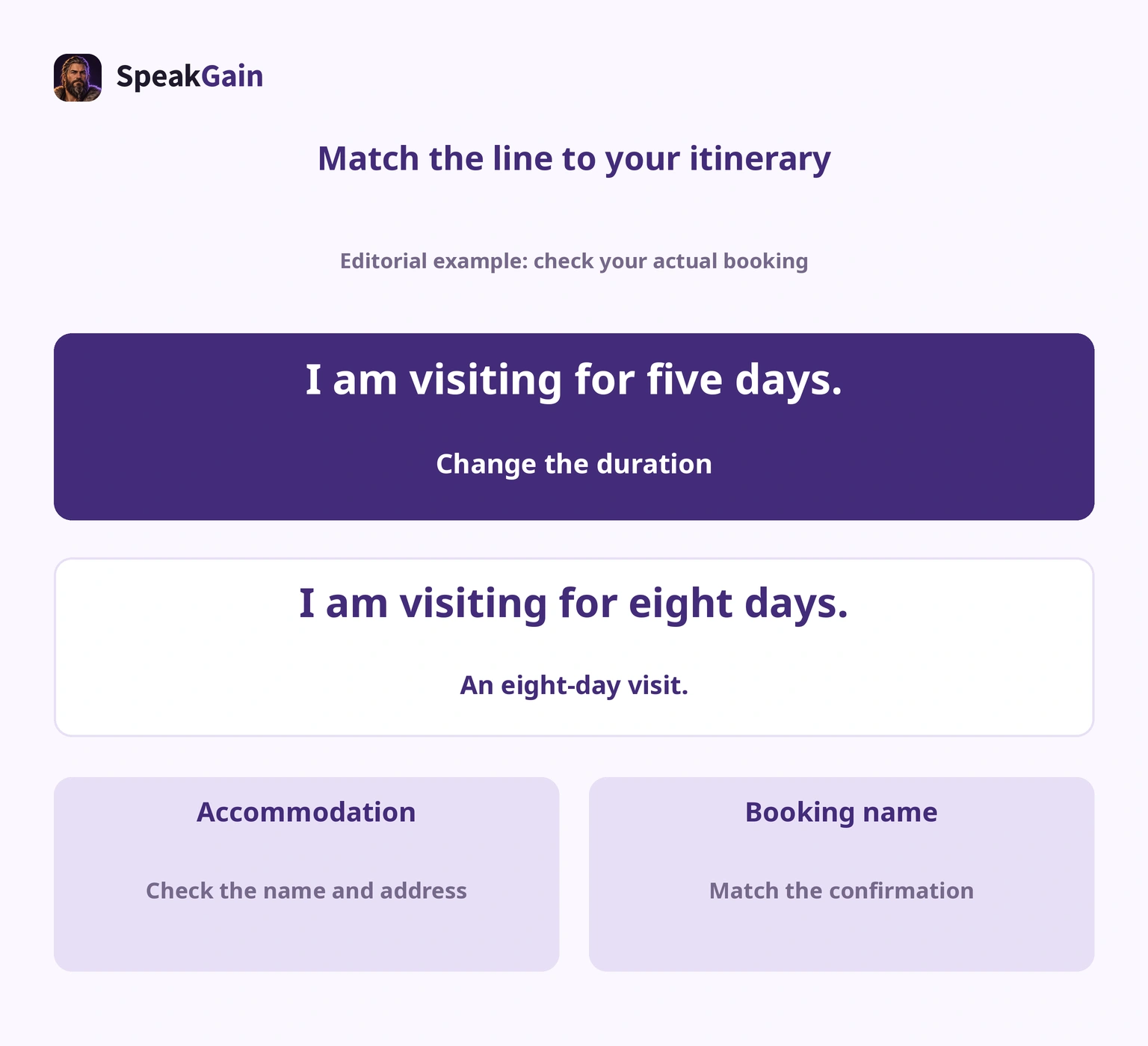
Keep the structure and change the facts. If your visit lasts eight days, replace five days with eight days. Write your first day in order, choose one line for each need, and check station names, dates and booking names against the original documents. Add a cue in your own language, hide the English and try saying it. Decide what to say and what to show: a short question aloud, a long address on screen. Share essential accommodation details with companions; for solo travel, keep a copy you can access without a connection.
Can you rely only on a translation app?
Our editorial view is to combine speaking with written support. Practise short, repeated needs such as a booking name, an order or a clarification request. Use translated text and original documents for longer explanations, detailed conditions or difficult addresses. Break a long message into one need at a time and check the response. Showing a translation is not proof that both people understood the same thing. Keep important bookings and short lines accessible if your connection or battery is unavailable. This is a use-case recommendation, not an app comparison.
What should you practise before departure?
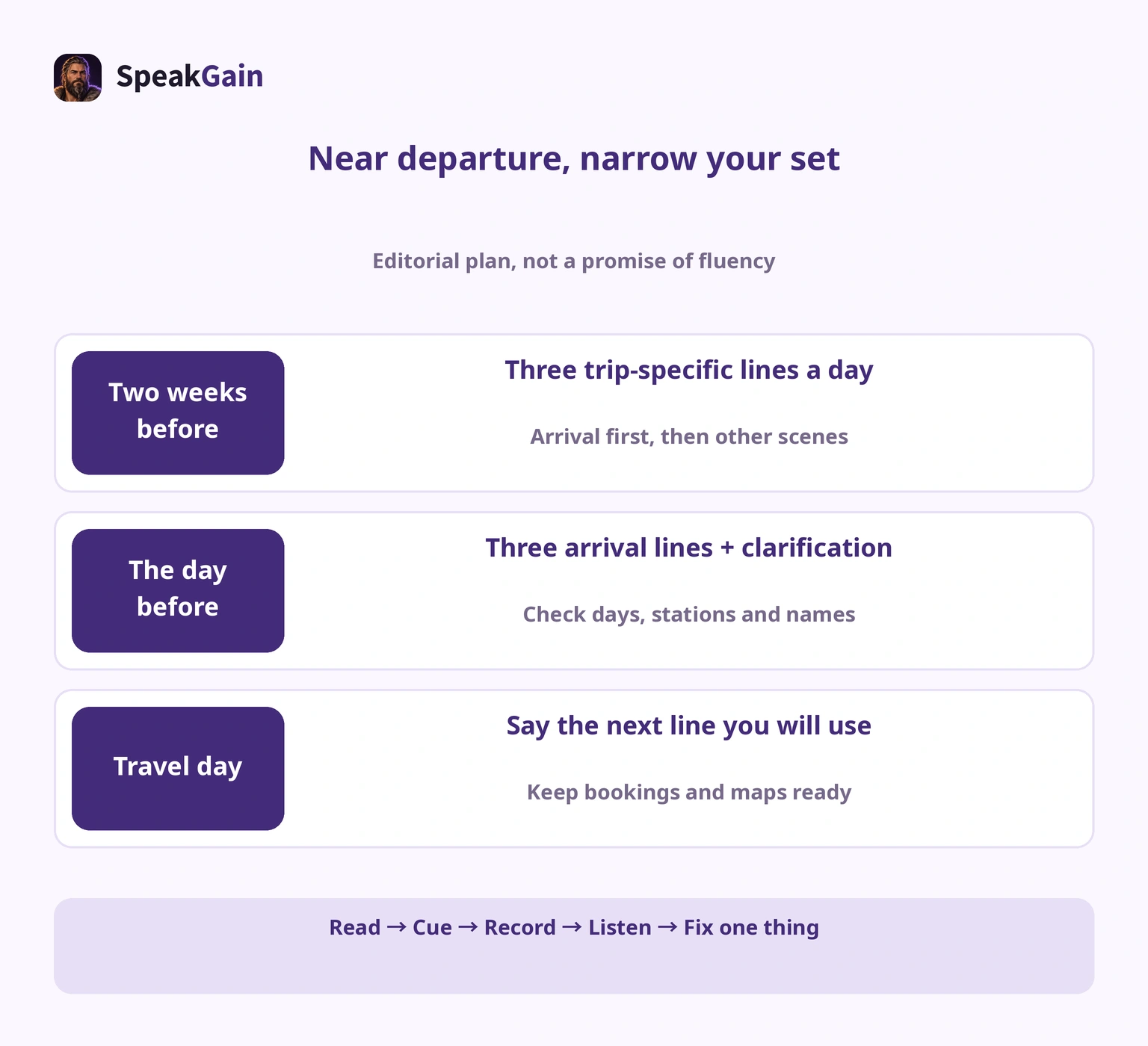
Use the same loop: read aloud → speak from a cue → record → listen → fix one thing. Choose three lines each day. The schedule below is an editorial plan, not a measured promise of learning speed.
Two weeks before: choose and adapt
Use the first two days to select and adapt your lines. On days 3–7, focus on the airport, immigration, transport and hotel. On days 8–12, add food, shopping, directions, trouble and clarification. Use the remaining days for lines that still stop you. A five-minute example gives one minute each to reading, speaking from a cue in your own language, recording, listening and repeating after one correction. Check a meaningful detail such as the days or station name rather than every sound at once.
The day before: narrow the set
Choose three arrival-day lines and the clarification requests. Run the same loop, then compare them with the latest bookings. If the itinerary changed, change the numbers too. If you only start now, do this small set rather than trying to fit two weeks of work into one night.
Travel day: prepare the next line
In a suitable quiet moment, say the next line you will need and have its supporting document ready. If there is no time to record, look at the word that stopped you and say the line again. Do not let practice distract you from announcements or procedures. In the real interaction, looking at your written line is fine; the goal is to communicate and confirm, not to pass a memory test.
Saving one itinerary line in SpeakGain
Use it after you have prepared your own English line. We added I am visiting for five days. once through the normal Create flow. Check the duration yourself before saving it.
The verified sequence was Library → Knowledge → Learn this card → Listening → Reveal answer → Answer. Listening hid the English while the audio played. Answer showed the line, an English explanation and playback. A cue in your first language can be kept separately on paper.
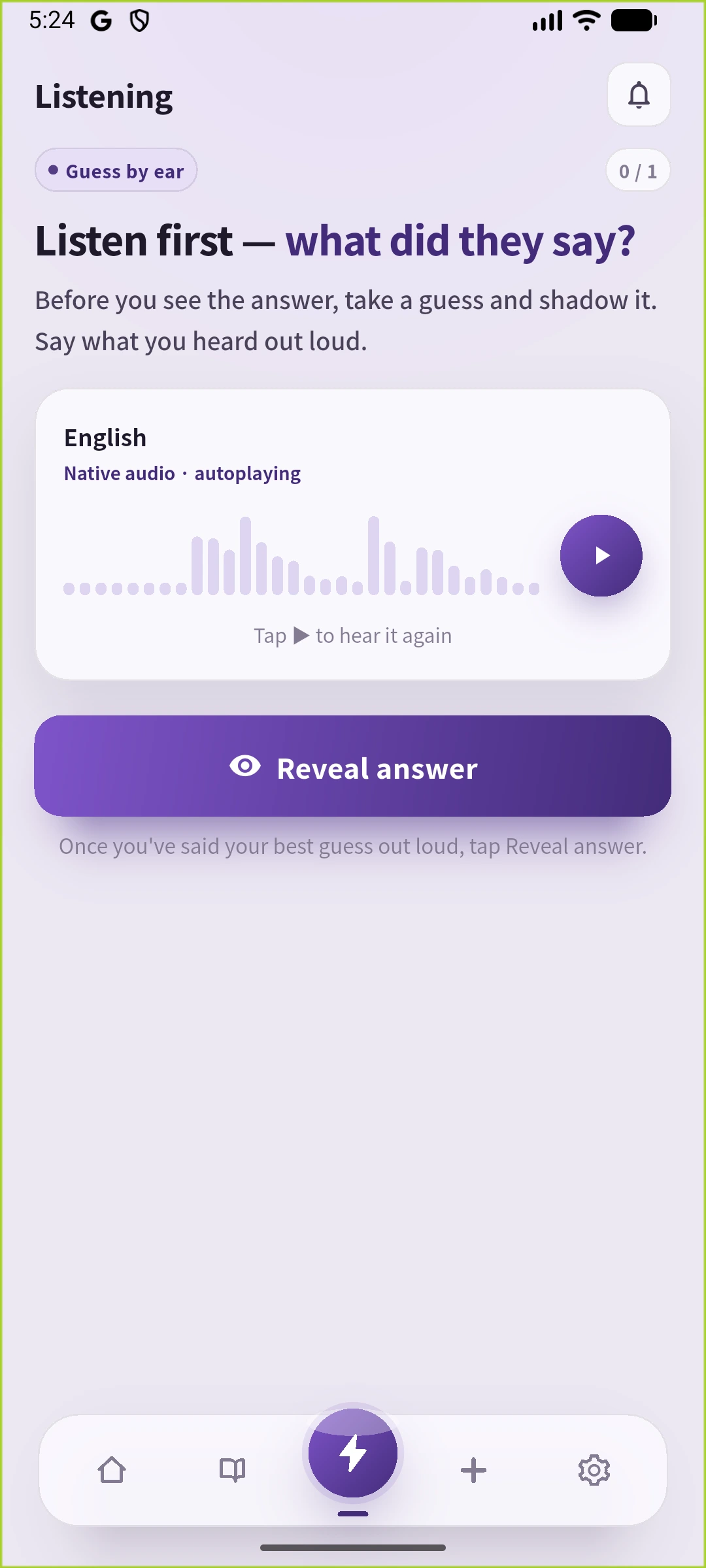
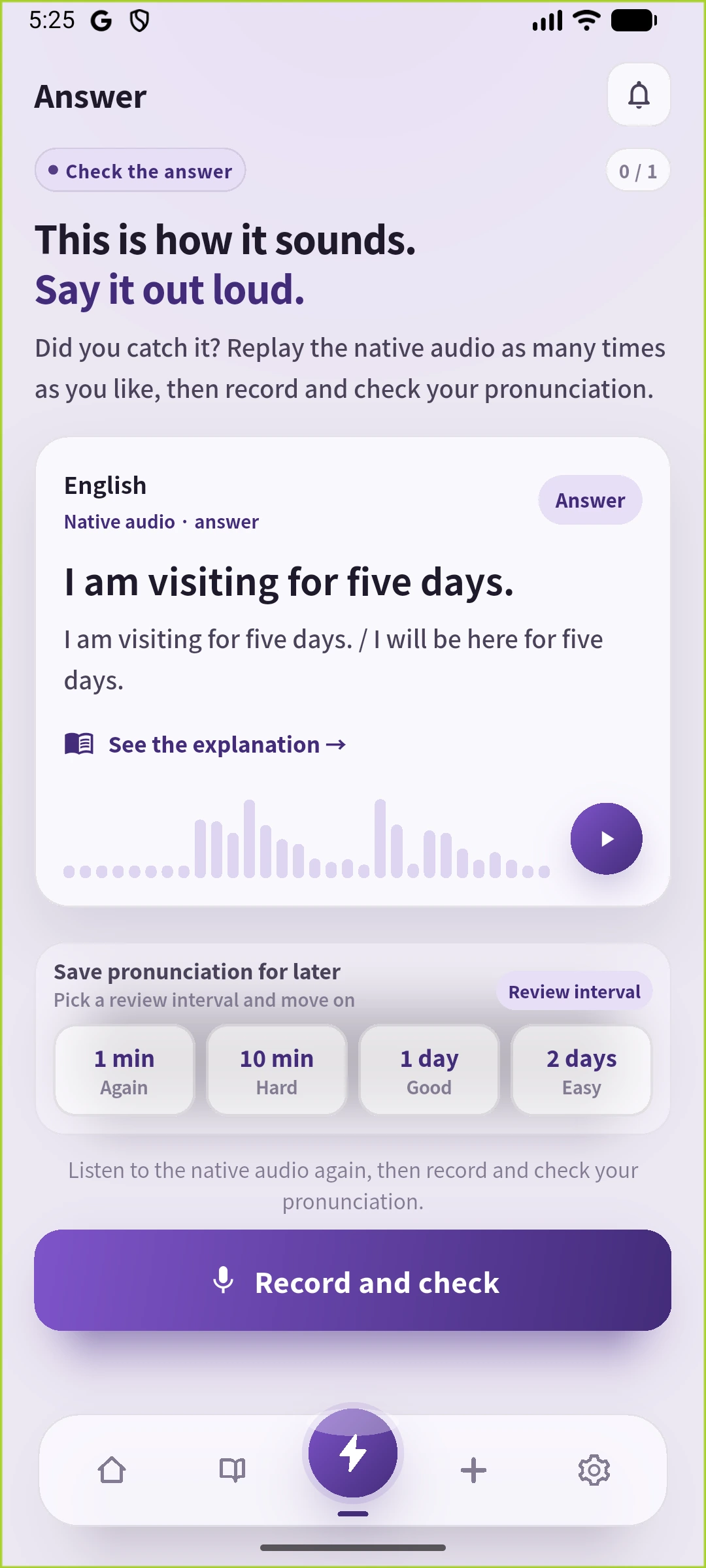
Answer displayed Again, Hard, Good and Easy review intervals and a Record and check control. However, our action did not reach the recording or evaluation screen, so that part remains unverified. Use an available recording tool for the practice loop. The clip below is AI-generated Viking audio created once for this card. The Native audio label in the UI does not mean a recording by a human native speaker.
I am visiting for five days. — My visit lasts five days.
We verified saving this line, its audio, Listening and Answer. We did not demonstrate travel translation, interpreting or role-play. See what SpeakGain is when deciding how to use it.
Which mistakes should you fix first?
Do not try to memorise the whole phrase book or make every request elaborate. Begin with three real needs plus clarification. Understanding a written line is different from saying it from a cue. Check names, numbers and negatives before polishing every sound. If a line fails on the trip, note the detail that stopped you and practise that one next time; when English words will not come out offers a related way to work from a cue.
For getting attention or apologising after a mistake, see apologies in English. The customer-service English guide gives the staff’s perspective on confirming a request.
Travel English FAQ
Can I travel if I do not speak English confidently?
Yes, but language support may still be needed. Prepare short lines, clarification requests, written bookings and contact methods for getting help.
Is a translation app enough?
We recommend combining it with a few spoken lines. Use text for detailed information and check the other person’s answer; keep essential information accessible offline.
What will immigration ask?
Prepare to explain purpose, duration and accommodation, but questions vary. Use your real plans and check official government guidance. These answer patterns do not guarantee admission.
What should I say when I did not understand?
Start with Could you say that again, please? Ask for slower speech if needed, then ask for writing when repetition is still unclear.
How early should I start?
Our suggested plan starts two weeks before, for five minutes a day. Starting the day before is still useful: select three arrival lines and practise the same loop.
Should I memorise an approximate spelling of the sounds?
Do not rely on that alone. Listen to English audio, compare your recording and keep proper names and numbers available in writing.
For the airport part of your trip, airport and immigration English goes deeper into question-specific answers, eight scenes and recording practice before departure.
Editorial verdict: take a line and a way to confirm
Choose about twenty lines from eight scenes, adapt them to your trip and practise saying them. We recommend preparing arrival-day needs first, asking again when a reply is unclear, and confirming numbers and places in writing. Today, write three lines for your visit duration, transport and booking name. Say them from cues, record and fix one detail. The next step is communicating a real need, not learning a more impressive phrase. For a longer routine, see how to study English.