
Airport and immigration English: short answers and pre-trip practice
Published
For airport and immigration English, prepare short, truthful answers about your purpose, length of stay, accommodation, work, return flight and belongings. Match each answer to your itinerary, ask again when you do not understand, and show the relevant document. Before departure, read your answer aloud, answer from a question cue, record, listen back and fix one thing.
The aim is to answer the question you were asked, rather than recite your whole trip. The hotel, dates, occupation and duration below are editorial practice examples: replace them with your own facts. These phrases do not determine entry permission or what you need to declare. For meals, shopping and other parts of your trip, see English for travel.
Six immigration questions and answer patterns
Start with the topic of the question. Answer one thing clearly and wait for a follow-up. This table is a preparation framework, not a list every officer will ask.
The Canadian ENF 4 manual, sections 7.5 and 8.8 contains examples about visits and travel information; section 8.8 concerns secondary examination. We use it to identify topics, not to predict every interview. GOV.UK border guidance is an official place to check the relevant procedure.
| Topic | Example question | Short answer pattern | What to personalise |
|---|---|---|---|
| Purpose of visit | What is the purpose of your visit? | I am here for a vacation. — State your actual reason for visiting. | Replace vacation with the actual purpose. |
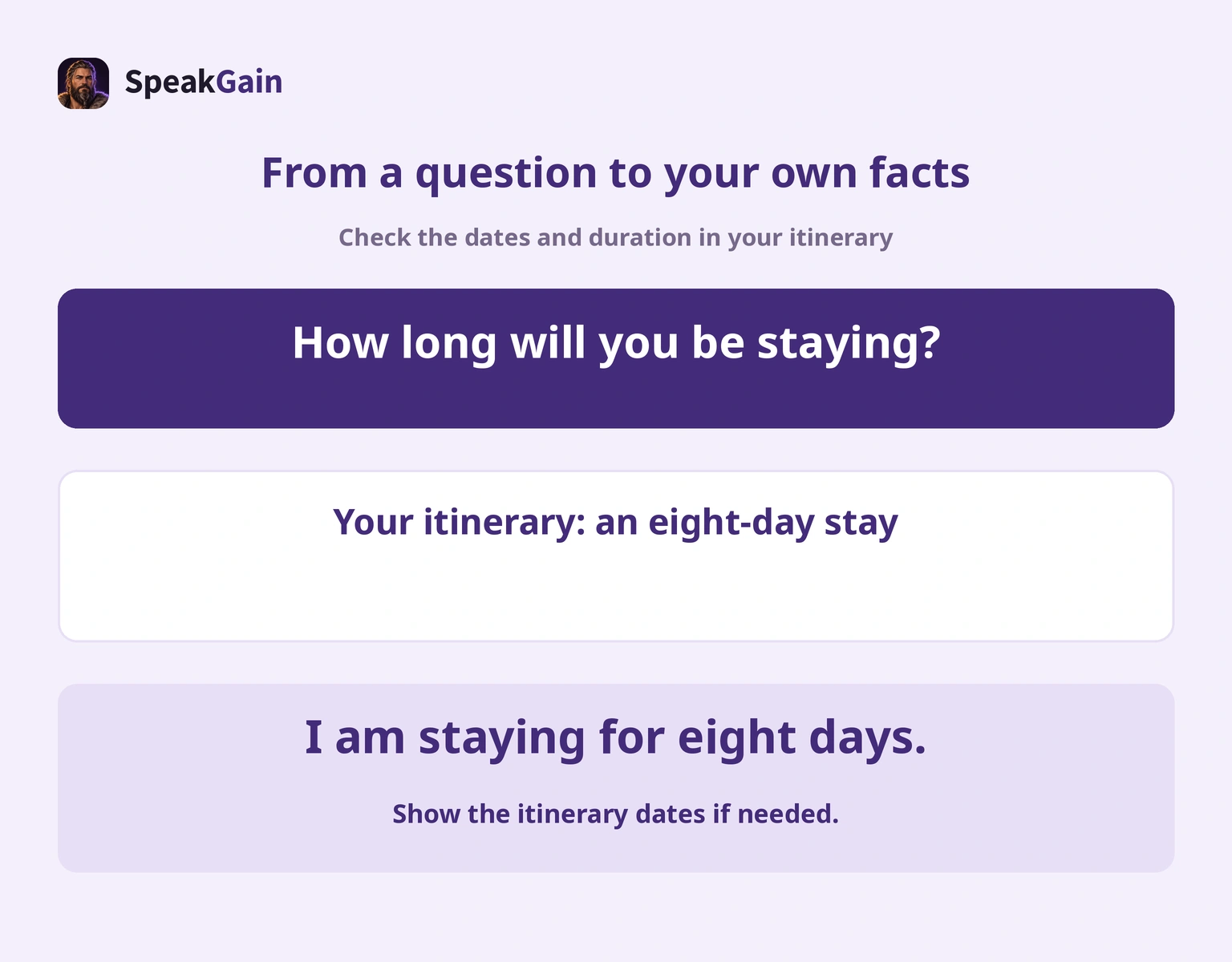
| Length of stay | How long will you be staying? | I am staying for eight days. — Give the duration shown by your itinerary. | Replace eight with your planned number of days. |
| Where you are staying | Where will you be staying? | I will be staying at the Parkside Hotel. — Name the accommodation you have arranged. | Replace the example hotel and have its address ready. |
| Occupation | What do you do for work? | I work as an engineer. — State your real occupation. | Replace engineer with your actual work or status. |
| Return or onward flight | When is your return flight? | My return flight is on October 22. — Give the date on your booking. | Replace the date; use onward flight when that is your plan. |
| What you are carrying | What are you carrying in your bag? | I have some food in my bag. — Identify an item you actually have. | Replace food with the actual item; check declaration procedures separately. |
Eight airport scenes and one useful line for each
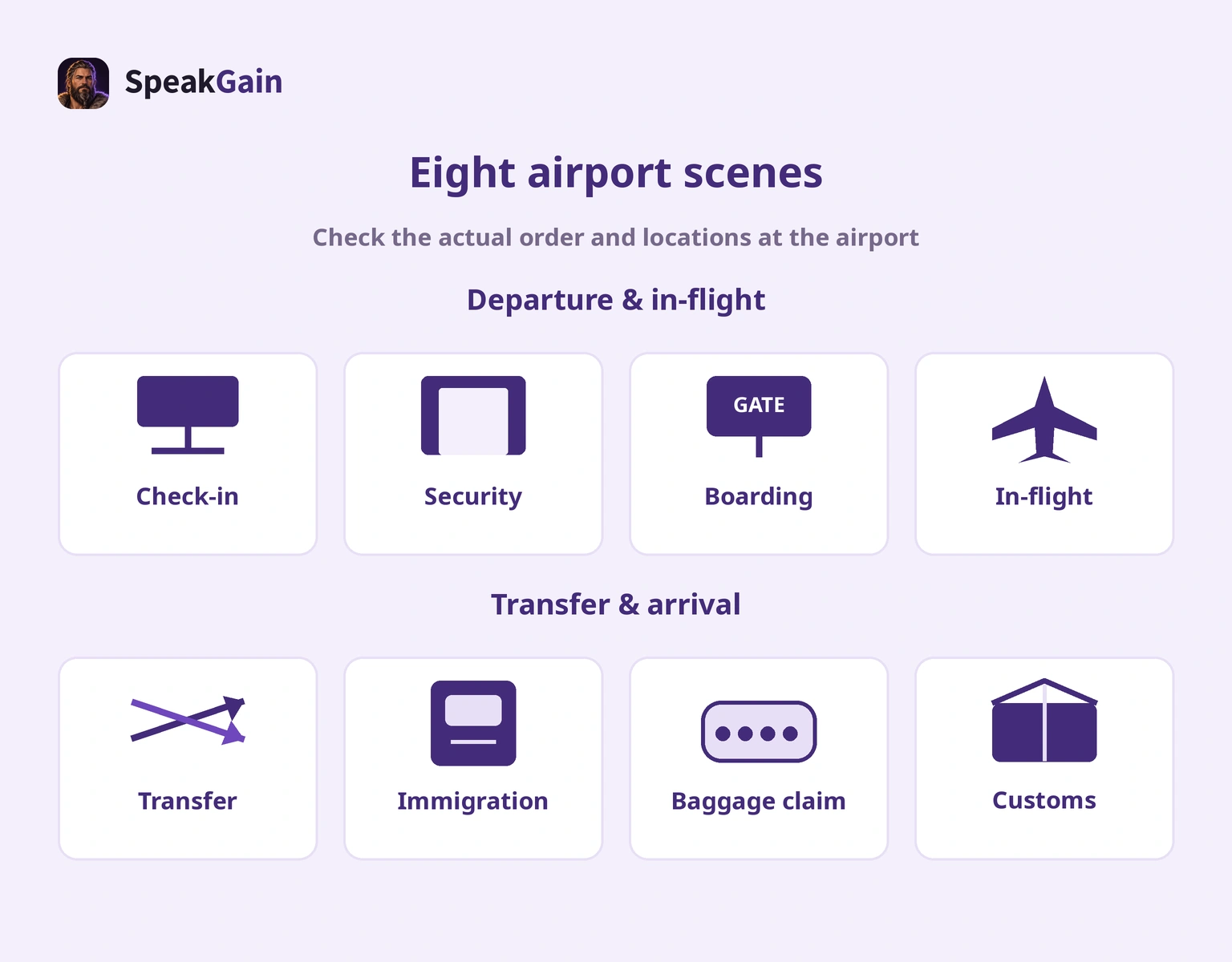
Pick the scenes that apply to your trip. Actual locations and order depend on the airport and route; this is not a mandatory sequence.
| Scene | Core line | What it does | Information to have ready |
|---|---|---|---|
| Check-in | I would like to check in for this flight. | Ask to check in for the flight. | Booking and flight details |
| Security | Should I take this out of my bag? | Ask whether an item should come out. | The specific item |
| Boarding | Is this the right gate for this flight? | Confirm the gate for your flight. | Flight number and current board |
| In-flight | Could I have some water, please? | Ask politely for water. | One request |
| Transfer | Where do I go for my connecting flight? | Ask where to go for a connection. | Next flight and time |
| Immigration | I am staying for eight days. | Answer a question about duration. | Your itinerary |
| Baggage claim | My checked bag has not arrived. | Report a checked bag that did not arrive. | Baggage receipt |
| Customs | I have some food in my bag. | Explain what is in your bag. | Actual contents and official declaration guidance |
Adapt immigration answers to your own itinerary
Link each question to a fact, then turn that fact into a short answer. The document is a way to support details such as dates and addresses, not a substitute for understanding the question.
Purpose of visit
Example question: What is the purpose of your visit?
Short answer: I am here for a vacation. — State your actual reason for visiting.
Listen for purpose, visit or why. A vacation is only one possible reason; choose the example that matches what you will actually do.
| English example | Meaning or use |
|---|---|
| Why are you here? | Another question about purpose. |
| I am here to attend a conference. | Use for an actual conference visit. |
| I am here to visit my sister. | Use for a visit to your sister. |
| I am here to study English. | Use for an actual English-study visit. |
| I will also visit some museums. | Add only if asked about other activities. |
Adapt to your trip: If you are visiting family, attending an event or studying, say that actual purpose. Add another activity only when it is relevant to the question.
Delivery tip: Say the main purpose first. Keep supporting details ready and show a relevant reservation when asked.
Common mistake: Do not say vacation simply because it is the easiest phrase, or add an unrelated speech about your entire trip.
Length of stay
Example question: How long will you be staying?
Short answer: I am staying for eight days. — Give the duration shown by your itinerary.
Listen for how long or when you leave. Duration and departure date are related, but they answer different questions.
| English example | Meaning or use |
|---|---|
| When will you leave? | A question about departure date. |
| I leave on October 22. | Give your own departure date. |
Adapt to your trip: Compare arrival and departure dates with your booking. Replace eight with your own duration and practise the departure date separately.
Delivery tip: Make the number and days clear. If they ask for a date, give the date and show the itinerary if needed.
Common mistake: Do not copy eight days from this page when your trip has a different length, or mix nights with days without checking.
Where you are staying
Example question: Where will you be staying?
Short answer: I will be staying at the Parkside Hotel. — Name the accommodation you have arranged.
Listen for where or staying. Start with the actual accommodation rather than describing the entire city.
| English example | Meaning or use |
|---|---|
| Here is the address. | Offer the actual address. |
| I will be staying with a friend. | Use for arranged accommodation with a friend. |
| I will stay there for the first two nights. | Clarify the first part of a multi-stop stay. |
Adapt to your trip: Replace Parkside Hotel with your booking. If you stay with a friend, say that and have the address available. For multiple stops, identify the first stay when asked.
Delivery tip: Say the name slowly. Show the address on the reservation instead of trying to spell a long address from memory.
Common mistake: Do not invent a hotel, present an old booking as current, or list all accommodation before the officer asks.
Occupation
Example question: What do you do for work?
Short answer: I work as an engineer. — State your real occupation.
Work and occupation ask about your current role. Student and retired are possible patterns when they describe you.
| English example | Meaning or use |
|---|---|
| What is your occupation? | Another question about work. |
| I am a university student. | Use only if you are a university student. |
| I am retired. | Use only if you are retired. |
Adapt to your trip: Replace engineer with your real role. Use the student or retired example only if it is accurate.
Delivery tip: Use a familiar job title first; explain briefly if asked. You do not need to memorise your full employment history.
Common mistake: Do not confuse a question about your occupation with your purpose of travel, or choose an impressive job that is not yours.
Return or onward flight
Example question: When is your return flight?
Short answer: My return flight is on October 22. — Give the date on your booking.
Return and onward describe different routes. Answer from your actual reservation.
| English example | Meaning or use |
|---|---|
| Do you have a return ticket? | A question about a return booking. |
| Yes. Here is my booking. | Show the actual reservation. |
| My next flight is to Seoul on October 22. | Use for an actual onward flight; replace city and date. |
Adapt to your trip: Change October 22 to your booked date. If the next flight is to another country, describe that onward flight instead of calling it a return home.
Delivery tip: Say the date distinctly and show the booking. Ask again if you are unsure which flight they mean.
Common mistake: Do not invent a return ticket, reuse a sample date, or assume that naming a flight answers an entry requirement.
What you are carrying
Example question: What are you carrying in your bag?
Short answer: I have some food in my bag. — Identify an item you actually have.
Carrying and food can refer to the items you actually have. This line explains contents; it does not decide whether they are allowed.
| English example | Meaning or use |
|---|---|
| Do you have any food? | A question about food. |
| I am not sure whether I need to declare this. | Ask about declaration when you are unsure. |
Adapt to your trip: Replace food with the actual item and keep its description available. If you are unsure about declaring it, ask using the uncertainty line below.
Delivery tip: Answer accurately and show the item or document when instructed. Check the destination government’s guidance before travel.
Common mistake: Do not memorise “nothing to declare” as a universal answer or hide uncertainty behind an automatic no.
When you did not catch the question
It is fine to ask them to repeat. Understanding the topic matters more than answering immediately with the wrong fact.
| English example | Meaning or use |
|---|---|
| Sorry, could you say that again? | Ask for the question again. |
| Could you speak a little more slowly, please? | Ask for a slower repetition. |
| Are you asking about my hotel? | Confirm the topic you think you heard. |
| Could you show me where to go? | Ask for a direction you can see. |
| Here is my travel itinerary. | Show the itinerary to support details. |
| One moment, please. | Ask for a moment to find a document. |
First ask for repetition or slower speech. If you caught only hotel, confirm that topic. Use polite request patterns for further requests; a brief apology such as Sorry is enough to introduce a repeat request.
For a brief apology before asking again, see apologies in English; if a connection problem needs a call, use English phone calls. For an answer that stalls, when English words will not come out shows how to simplify and practise one line.
Choose a line for the airport scene
The eight scenes below separate different tasks. Do not confuse baggage problems with immigration answers or customs declarations.
Check-in
Short answer: I would like to check in for this flight. — Ask to check in for the flight.
| English example | Meaning or use |
|---|---|
| Where can I check in for this flight? | Ask where to check in. |
| I have one bag to check. | State that you have one bag to check. |
| Where should I collect my bag? | Confirm the collection location. |
Adapt to your trip: Show the flight booking; replace this flight with the number if needed. Use the extra lines for the check-in location or one checked bag.
Delivery tip: Say the task first, then show the booking. Confirm where to collect the bag if the route is unclear.
Common mistake: Do not use an immigration-purpose answer at check-in or assume baggage arrangements without asking.
Security
Short answer: Should I take this out of my bag? — Ask whether an item should come out.
| English example | Meaning or use |
|---|---|
| Should I take my laptop out of my bag? | Ask about your laptop specifically. |
Adapt to your trip: Point to the item; replace this with my laptop or the actual object.
Delivery tip: Ask a short question and follow the staff member’s current instructions. Ask again if you did not understand.
Common mistake: Do not treat a practice phrase as a universal security rule or remove items based only on this article.
Boarding
Short answer: Is this the right gate for this flight? — Confirm the gate for your flight.
| English example | Meaning or use |
|---|---|
| When does boarding begin? | Ask about the start of boarding. |
Adapt to your trip: Check your actual flight number against the current display and ask about that flight.
Delivery tip: Show the boarding pass and say the flight number clearly; ask when boarding begins if needed.
Common mistake: Do not rely only on a previously saved gate or confuse boarding time with departure time.
In-flight
Short answer: Could I have some water, please? — Ask politely for water.
| English example | Meaning or use |
|---|---|
| Could I have a blanket, please? | Ask politely for a blanket. |
Adapt to your trip: Replace water with the actual item, such as a blanket. Make one request at a time.
Delivery tip: Speak clearly at a normal volume. If the answer is unclear, ask again politely.
Common mistake: Do not combine several unrelated requests or assume the item is available or included.
Transfer
Short answer: Where do I go for my connecting flight? — Ask where to go for a connection.
| English example | Meaning or use |
|---|---|
| Do I need to collect my bag here? | Confirm the baggage step for this route. |
| I missed my connecting flight. Could you help me? | Report a missed connection and ask for help. |
Adapt to your trip: Show your next booking; ask where to go and separately whether to collect your bag.
Delivery tip: Say next flight details slowly. If you missed a connection, state that fact and ask for help.
Common mistake: Do not assume every transfer uses the same route or that baggage always goes straight through.
Immigration
Short answer: I am staying for eight days. — Answer a question about duration.
Adapt to your trip: Use the six question topics above; choose the answer for the question you actually heard.
Delivery tip: Answer one fact, wait for the next question, and show supporting details when needed.
Common mistake: Do not recite all six answers at once or make up details to fill a silence.
Baggage claim
Short answer: My checked bag has not arrived. — Report a checked bag that did not arrive.
| English example | Meaning or use |
|---|---|
| Where is baggage claim for this flight? | Ask where baggage claim is for your flight. |
Adapt to your trip: Keep the baggage receipt and flight information ready. Use the location question if you have not found baggage claim.
Delivery tip: Describe the problem first and show the receipt. Ask where to report it if necessary.
Common mistake: Do not confuse a missing checked bag with a carry-on item or guess an exact outcome or compensation.
Customs
Short answer: I have some food in my bag. — Explain what is in your bag.
| English example | Meaning or use |
|---|---|
| I am not sure whether I need to declare this. | Ask when you are unsure about declaring an item. |
Adapt to your trip: Use actual contents. Ask whether you need to declare an item when you are unsure.
Delivery tip: Describe the item accurately and use official guidance for the procedure. Show it when instructed.
Common mistake: Do not use a universal yes/no or assume that “some food” tells you whether an item is permitted.
Practice before departure: five small steps
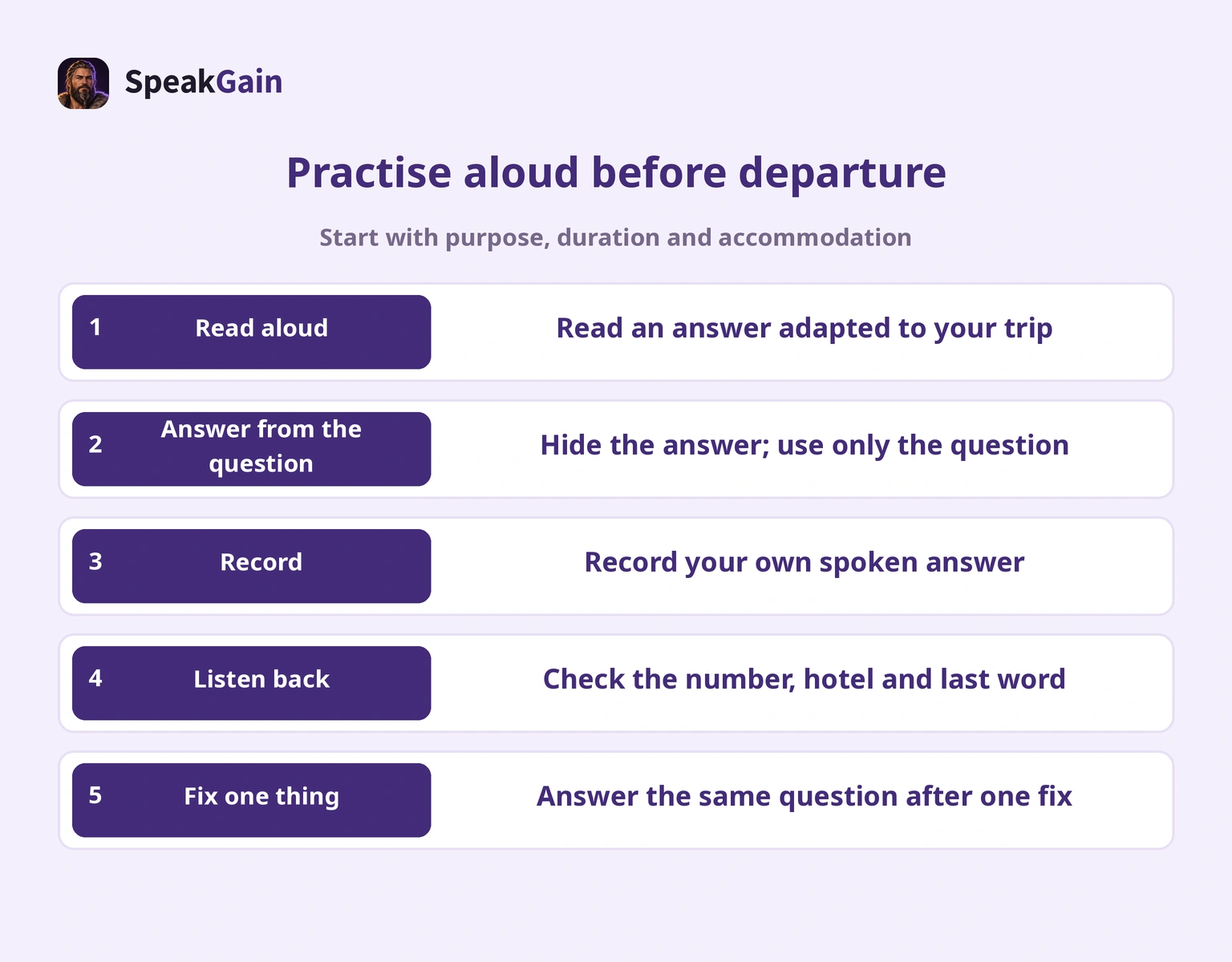
This is an editorial practice plan, not a government procedure or a measured promise of learning results. Start with purpose, duration and accommodation, then add the remaining topics.
-
Read aloud. Replace the sample details with your itinerary. Read each short answer aloud and check names, dates and numbers against the booking.
-
Answer from the question. Hide the answer. Look at or hear only the question, identify its topic, and say your own answer. Shuffle the questions so you cannot rely on a memorised order.
-
Record. Use a recorder to capture one answer and a repeat-request line. Keep documents with personal details out of recordings shared with others.
-
Listen back. Check whether the number, hotel name and final word are clear. Compare what you said with your itinerary as well as with the written sentence.
-
Fix one thing. Choose one change: a number, a missing word or a rushed ending. Say the corrected answer from the same question cue and record it again.
Repeat the same question after correcting one thing. Once an answer is clear, practise a different question cue and one repeat-request line. For a wider routine, see how to study English.
A few days before departure
Prepare the six facts and the relevant documents. Practise your three core answers first, then add only the airport scenes on your route. A short session you can complete is better than an unfinished list.
On the day of departure
Recheck dates and accommodation after any booking change. Say the three core answers and one repeat-request line aloud once. Keep the documents accessible; the exercise is preparation, not a script that must be followed.
What we verified in SpeakGain
We created one new practice card in SpeakGain through its normal Create flow, using the same sentence shown on the boarding pass. We verified this path on the dedicated Android article device:
Library → Knowledge → Learn this card → Listening → Reveal answer → Answer
In Listening, the sentence was hidden while the Viking model audio could be played. Reveal answer opened the Answer screen, showing the sentence and explanation. The screenshots use the English interface; the captions here explain what is visible.
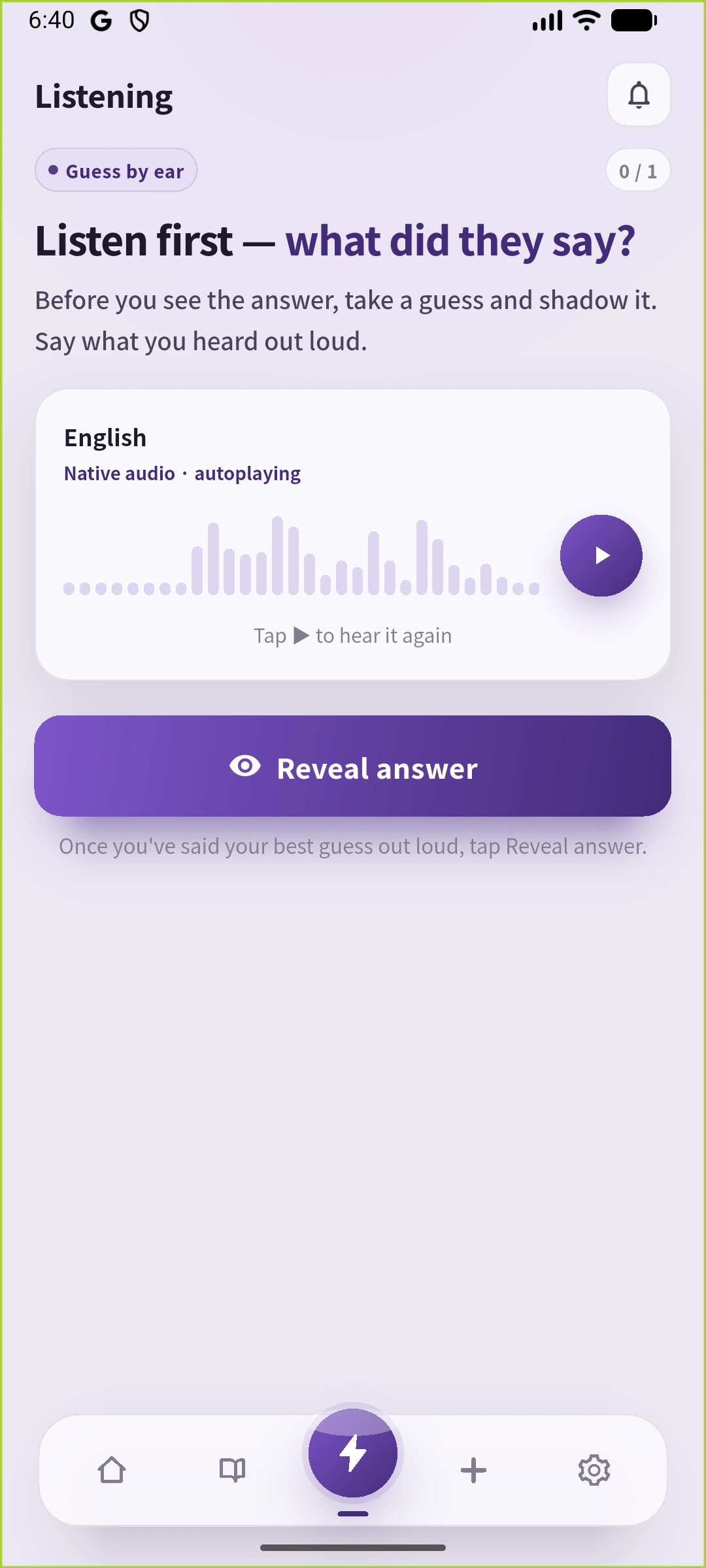
I am staying for eight days. — Give the duration shown by your itinerary.
The same Viking audio is reused in every language. Listen to the model, then practise your own truthful duration.
We also tapped Record and check. In this capture, the screen remained on Answer, so we did not verify a recording result or pronunciation feedback. Use a separate recorder for the recording and listening-back steps above.
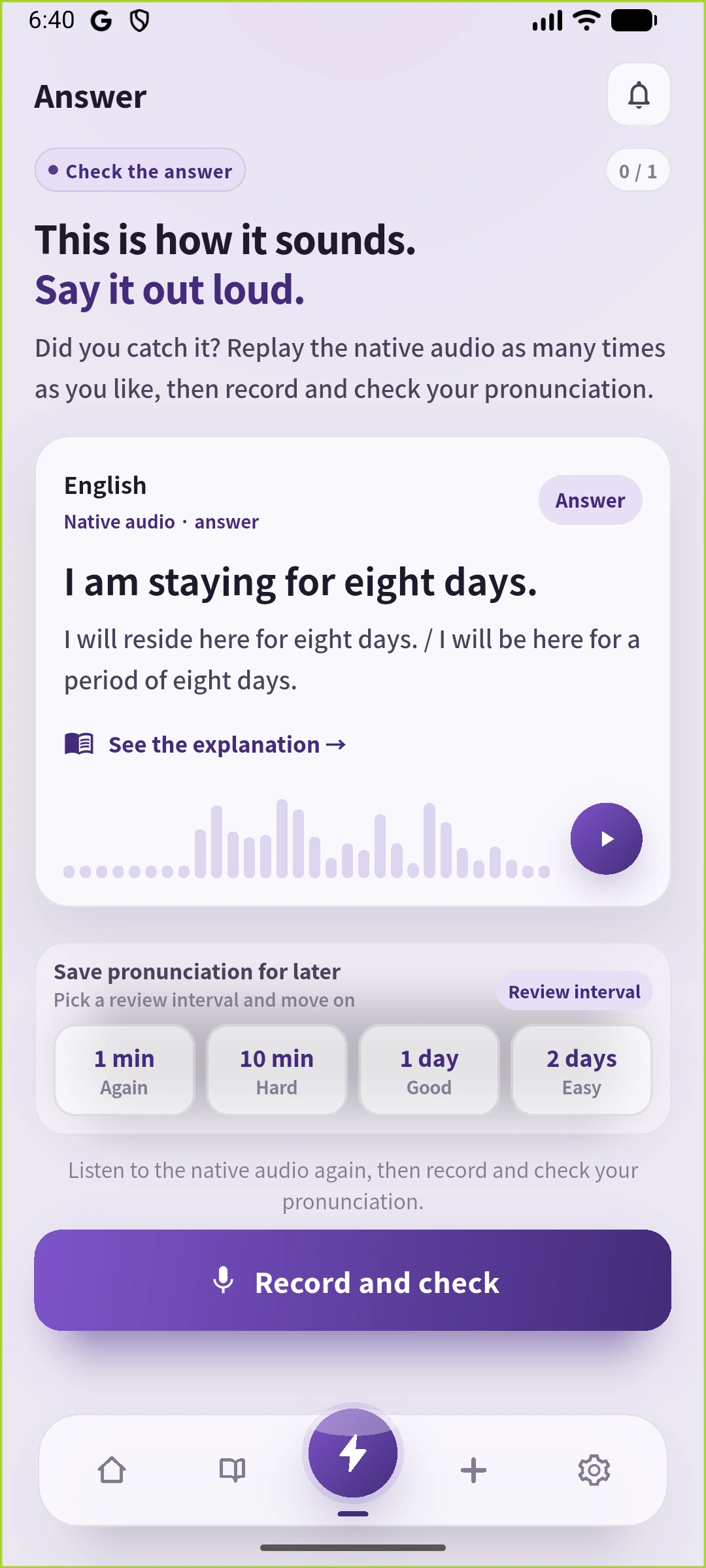
The verified use is saving a prepared sentence, hearing its model audio and revealing the answer. SpeakGain is not presented here as an immigration role-play, translation or interpreting service. Replace eight days with your itinerary when preparing your own line; the sample card is an example, not a universal answer. See what SpeakGain is for the wider product description.
Check procedures with official government sources
Entry, visa and declaration procedures differ by destination and travel circumstances. This article teaches English answer patterns and does not state those rules.
Use the government pages below to check your own destination and journey. Showing a booking or speaking clearly does not guarantee admission. The UK, Canada, US and Australia links are examples of official sources, not a complete country directory.
| Official source | Page |
|---|---|
| UK: border guidance | UK: border guidance |
| Canada: ENF 4 examination manual (PDF) | Canada: ENF 4 examination manual (PDF) |
| United States: non-immigrant visa guidance | United States: non-immigrant visa guidance |
| UK: bringing personal goods | UK: bringing personal goods |
| Canada: traveller guidance | Canada: traveller guidance |
| Australia: entering the country | Australia: entering the country |
| Australia: bringing items in | Australia: bringing items in |
Links checked on 11 October 2026. Recheck before departure and follow the destination government’s current guidance. The Canadian manual includes secondary examination material; it is not a prediction of questions for every traveller.
Frequently asked questions
What should I prepare first for immigration English?
Prepare your real purpose, duration and accommodation, plus a line asking for repetition. Then add work, return or onward flight, and belongings. Short truthful answers are the starting point.
Do I need to answer in a full sentence?
The examples use short sentences to make practice easier. Answer the question clearly and accurately; do not add a long introduction merely to sound fluent. Give more details if asked.
What if I do not understand the officer?
Ask them to repeat or speak more slowly. Confirm a topic you partly caught, and show a relevant itinerary or reservation. Do not guess and give an unrelated answer.
Can I memorise eight days and the sample hotel?
Only as a language pattern. Replace both with your own trip before using the sentence at an airport. Practise the changed facts, including pronunciation of the actual hotel name.
What if I am visiting several cities?
Have the itinerary and accommodation details ready. Answer the specific question about the relevant stay, and clarify the first accommodation or next stop when asked. Do not recite every booking unprompted.
Can I always say nothing to declare?
No universal answer is provided here. Describe what you actually carry and check the destination’s official declaration guidance. Ask if you are unsure about an item.
Does SpeakGain provide an immigration interview simulation?
We did not verify that. We verified a saved card, Listening, model audio and Reveal answer. A recording result was not reached, so the practice plan uses an independent recorder.
Does this article explain visa or entry requirements?
No. It provides English practice patterns and official links checked on 11 October 2026. Check the government guidance for your destination and circumstances before departure.
Can I pass immigration without fluent English?
Fluency and the entry decision are different matters. We cannot promise admission or that no English will be needed. Prepare your facts, repeat requests and documents, and check your destination’s official guidance.
Is Sightseeing a good answer for everyone?
Only use it when sightseeing is your actual purpose. For a conference, study or family visit, say the true reason instead. Choose an easy sentence that matches your facts.
What if my accommodation is not decided?
Do not invent a hotel or call an unbooked room reserved. Check your itinerary and the destination’s official guidance before departure; this language article does not decide how an unsettled booking is handled.
May I show a translation on my phone?
Ask the officer and follow their instructions rather than assume phone use is allowed. Practise: May I show you this on my phone? Check the meaning of any translated text; SpeakGain is not being proposed as an interpreter.
Do automated gates remove the need for English preparation?
Our editorial advice is to keep your short answers and repeat-request line ready. Check official information for the airport and destination; do not assume you will have no questions to answer.
Editorial verdict: prepare facts, then practise saying them
Prepare purpose, duration, accommodation and a repeat-request line first. Match them to your booking, answer from the question cue and listen to one recording. Then add the remaining topics and the airport scenes you need.
We recommend a short answer that matches your facts, followed by further detail when asked. Memorising every phrase, calling every visit a vacation or using a blanket declaration answer can disconnect your words from your trip. Keep the itinerary ready and ask again when necessary.
References
- UK: border guidance
- Canada: ENF 4 examination manual (PDF)
- United States: non-immigrant visa guidance
- UK: bringing personal goods
- Canada: traveller guidance
- Australia: entering the country
- Australia: bringing items in
The question grouping, English practice examples, diagrams and practice plan are our editorial work. The government sources support procedural checking and question-topic context; they do not endorse this learning plan.
If you are leaving to study abroad, use the pre-departure speaking plan to choose priorities for three months, one month or one week and prepare a first-week sentence.