
54 English phone-call phrases: each stage, spelling and asking again
Published
For an English phone call, introduce yourself, explain or ask about the purpose, connect the caller or take a message, check important details, then thank the other person and close. If you miss something, say “Could you say that again, please?” Ask for names to be spelled and numbers to be read one digit at a time.
If you need to discuss prices, delivery or terms, use English negotiation practice to adapt one sentence per stage to your company and rehearse a reply to push-back before the meeting.
Our editorial choice is to learn five jobs first: introduce yourself, ask for someone, ask again, take a message and close. A convincing “yes” is not useful if you have not understood the request. Aim to leave accurate information and a clear next action, rather than speak without pausing.
For conversations with several colleagues, practise entering an English meeting discussion and checking the next action.
1. Choose the next action before the phrase
An incoming work call needs a company and name; an outgoing call needs your name and purpose. Someone available can take the call; someone unavailable may need a message. Asking again belongs anywhere in this flow.
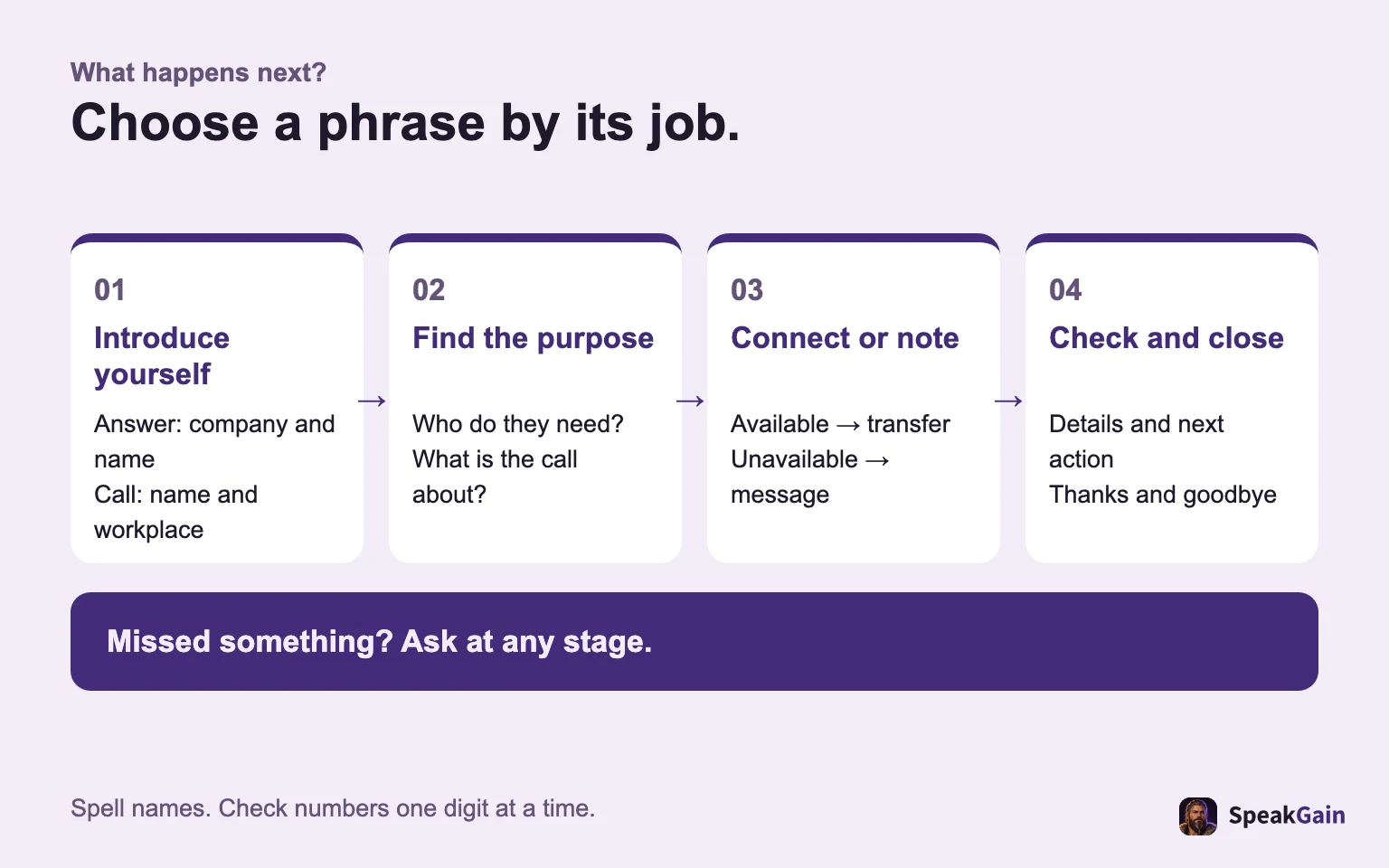
Your five starting lines are “Hello, this is Haruka from Maple Studio”, “Could I speak to Alex, please?”, “Could you say that again, please?”, “Can I take a message?” and “Thank you for your help. Goodbye.” Names and companies here are fictional practice material.
The tone labels below are editorial guidance, not a universal politeness score. Cambridge explains that could is more polite than can in requests; it does not make can automatically rude. Can, could or may?.
2. Phrases for answering, calling and passing on a message
Answering: identify the right contact
For work, name the company and yourself, then ask how you can help. “Hello?” can be enough on a personal phone. You do not need to recite a long greeting before hearing the purpose.
7 phrases for answering: meaning, situation and tone
| English | Meaning | Use it when | Tone |
|---|---|---|---|
| 1. Hello? | Answer a personal call | Picking up your own phone | Neutral |
| 2. Maple Studio, Haruka speaking. | Identify the company and yourself | Answering for work | Neutral |
| 3. Good morning, Maple Studio. | Greet and identify the company | A morning work call | Neutral |
| 4. How can I help you? | Invite the caller’s purpose | Starting an enquiry | Neutral |
| 5. May I ask who's calling, please? | Ask who is calling | The caller has not introduced themselves | Polite |
| 6. Could I have your name, please? | Ask for the caller’s name | Checking identity | Polite |
| 7. Speaking. | Confirm you are the person requested | Someone asks for you | Neutral |
“Speaking” answers “Could I speak to Haruka?” when you are Haruka. It is not an all-purpose first greeting. Follow your workplace’s agreed call-handling procedure.
Calling: name, workplace and reason
Prepare “This is … from …” and “I’m calling about …” together. For a booking, specify the date, time and number of people, rather than give a bare number.
8 phrases for calling and booking
| English | Meaning | Use it when | Tone |
|---|---|---|---|
| 8. Hello, this is Haruka from Maple Studio. | Give your name and workplace | Opening an outgoing call | Neutral |
| 9. Could I speak to Alex, please? | Ask to speak to Alex | Requesting a person | Polite |
| 10. Is Alex there? | Ask whether Alex is there | A familiar contact | Casual |
| 11. I'm calling about tomorrow's delivery. | State the reason for calling | Explaining your purpose | Neutral |
| 12. Is now a good time to talk? | Check whether the timing is convenient | A direct call to someone | Neutral |
| 13. I'd like to make an appointment. | Ask to book an appointment | Making an appointment | Neutral |
| 14. I'd like to change my reservation. | Ask to alter a booking | Changing an existing reservation | Neutral |
| 15. Could you put me through to the sales team, please? | Ask for the sales department | Requesting a transfer | Polite |
“For six people, at seven p.m.” keeps headcount separate from time. Practise your name in the English self-introduction guide, then move directly to the call’s purpose.
Transferring and holding: explain the wait
Tell the caller whether you are checking or transferring. Thank them when you return. Do not promise a connection before you know the person can answer.
7 phrases for transferring or putting someone on hold
| English | Meaning | Use it when | Tone |
|---|---|---|---|
| 16. One moment, please. | Ask for a brief wait | Before a quick check | Neutral |
| 17. Could you hold for a moment, please? | Ask the caller to stay on the line | Putting someone on hold | Polite |
| 18. I'll check if Alex is available. | Say you will check availability | Before promising a connection | Neutral |
| 19. I'll put you through to Alex. | Say you will connect the caller | A transfer has been confirmed | Neutral |
| 20. I'll transfer your call to the sales team. | Say where the call will go | Transferring to a department | Neutral |
| 21. Thank you for holding. | Acknowledge the wait | Returning from hold | Neutral |
| 22. I'm sorry, Alex isn't available right now. | Say the person cannot take the call | A connection is not possible | Neutral |
Cambridge’s telephone lesson shows asking for someone, holding, connecting and offering a message. These examples organise those functions around a fictional workplace. If a wait is becoming long, offer a message or another contact method.
Absence and messages: promise only your own action
If you do not know when a colleague will return, say so. “I’ll give Mina your message” commits to passing it on; it does not guarantee that Mina will immediately call back.
9 phrases for absence, messages and callbacks
| English | Meaning | Use it when | Tone |
|---|---|---|---|
| 23. Alex is in a meeting at the moment. | Explain a confirmed absence | The person is in a meeting | Neutral |
| 24. I'm afraid Alex is out of the office today. | Soften news of an absence | The person is away today | Polite |
| 25. I'm not sure when Alex will be back. | Say the return time is unknown | You cannot verify a schedule | Neutral |
| 26. Can I take a message? | Offer to record a message | You are answering | Neutral |
| 27. Would you like to leave a message? | Invite the caller to leave a message | Checking the caller’s preference | Polite |
| 28. Could I leave a message, please? | Ask to leave a message | You are calling | Polite |
| 29. Could you ask Alex to call me back? | Ask for a callback | Leaving a request | Polite |
| 30. Could I have your number, please? | Ask for a callback number | Recording contact details | Polite |
| 31. I'll give Alex your message. | Commit to passing on the message | Finishing a message | Neutral |
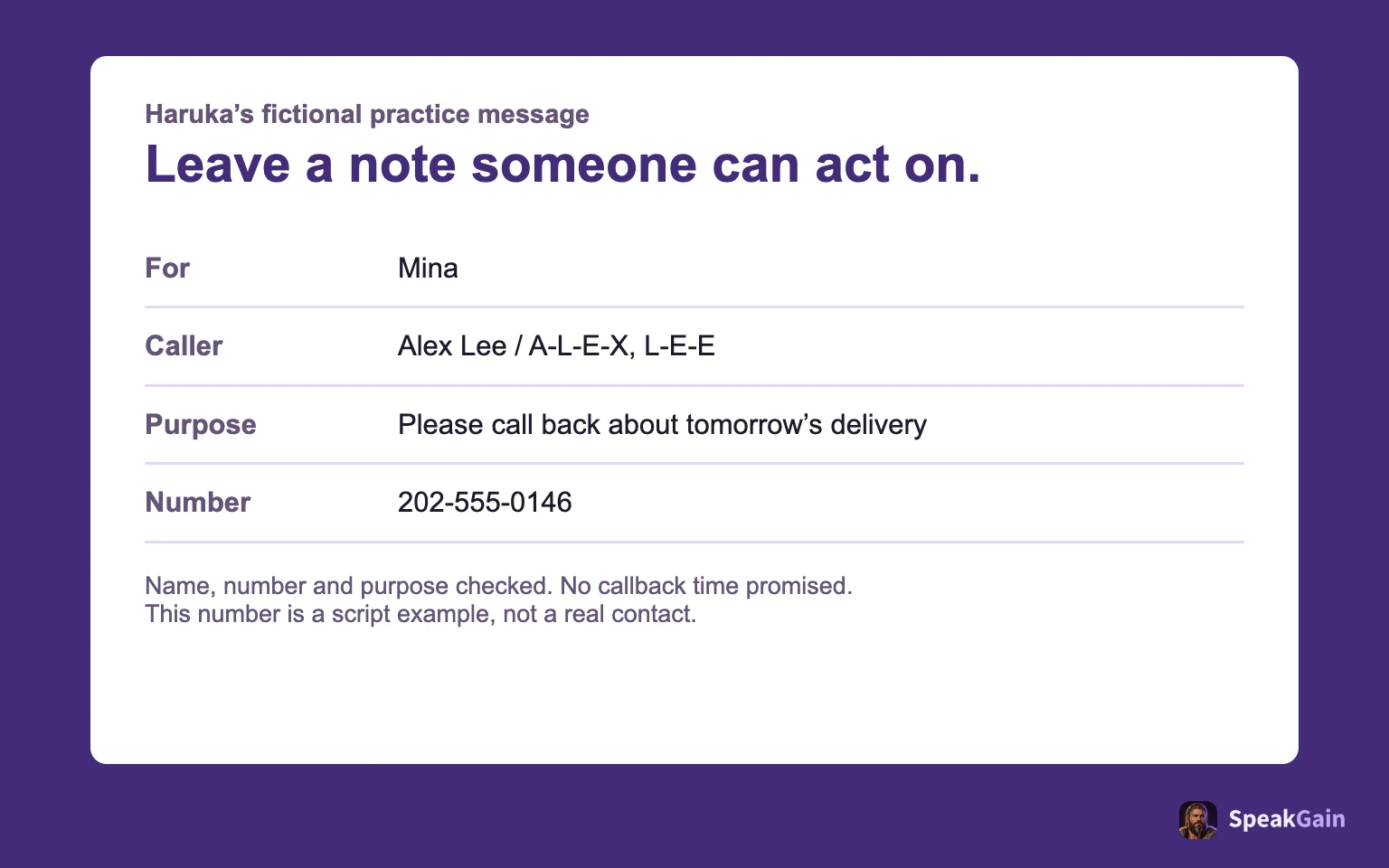
The person answering takes a message; the caller leaves one. Record the recipient, caller, purpose, contact details and any deadline. Avoid guessing a return time or sharing unnecessary personal details.
3. When you cannot hear or understand
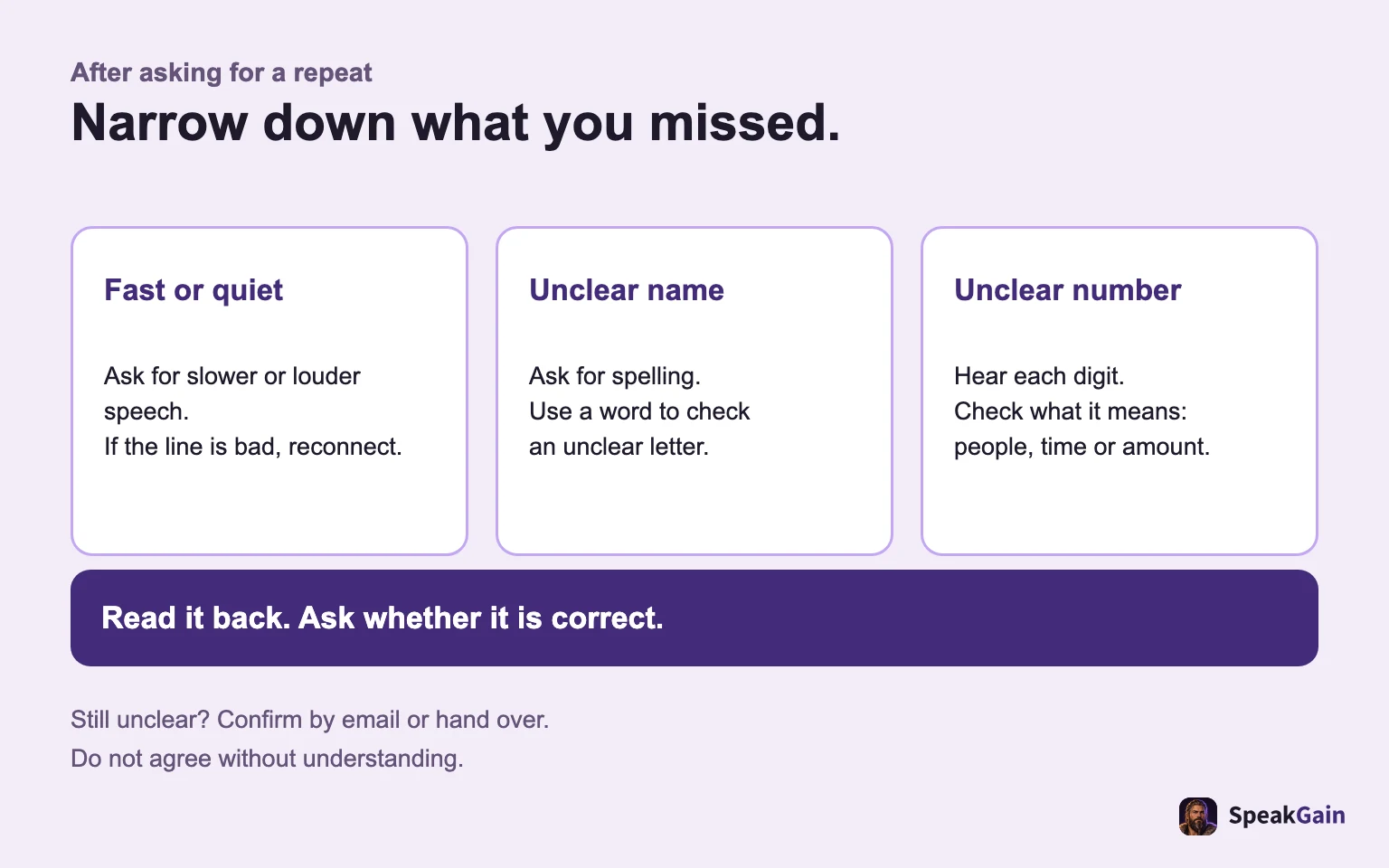
Ask once, narrow down the missing part, change its form if needed, then read it back. “Your name” or “the last two digits” is easier to check than asking for the same long explanation again. This is our practical sequence, not a rule about how many times you may ask.
Separate a sound problem from a meaning problem
Quiet sound needs louder speech; fast speech may need a slower pace; a poor connection may need a new call. If the words were audible but unclear in meaning, ask for another explanation.
8 phrases for repetition and connection problems
| English | Meaning | Use it when | Tone |
|---|---|---|---|
| 32. Sorry, I didn't catch that. | Say you missed what was said | You did not hear clearly | Neutral |
| 33. Could you say that again, please? | Ask for the words again | You need a repeat | Polite |
| 34. Could you speak a little more slowly, please? | Ask for slower speech | The pace is too fast | Polite |
| 35. Could you speak up a little, please? | Ask for louder speech | The voice is too quiet | Polite |
| 36. I didn't catch the last part. | Identify the part you missed | Only the end is unclear | Neutral |
| 37. Could you explain that in another way? | Ask for a different explanation | You heard it but did not understand | Polite |
| 38. You're breaking up. | Describe intermittent sound | The connection cuts in and out | Neutral |
| 39. The connection is bad. Could I call you back? | Suggest reconnecting | The line is poor | Polite |
“Catch” can mean successfully hearing what someone said. “Speak up” concerns volume, not speed. Cambridge catch, speak up.
Check names, numbers and what a number means
Do not guess whether a surname is Lee or Leigh. Ask for spelling. If a letter is unclear, “B as in Ben?” uses a familiar word to check it; change the word if the other person does not recognise it.
9 phrases for spelling, digits and written confirmation
| English | Meaning | Use it when | Tone |
|---|---|---|---|
| 40. Could you spell your name, please? | Ask for the letters in a name | Checking an unfamiliar name | Polite |
| 41. Is that B as in Ben? | Check B using a familiar word | A letter is ambiguous | Neutral |
| 42. Could you say the number one digit at a time? | Ask to hear individual digits | Checking a number | Polite |
| 43. Was that fifteen or fifty? | Offer two possible numbers | You heard fifteen or fifty | Neutral |
| 44. Could you repeat the last two digits, please? | Ask for only the unclear digits | The last two digits are missing | Polite |
| 45. Let me read that back to you. | Announce that you will read back | Verifying notes | Neutral |
| 46. Just to confirm, that's Friday at three p.m., right? | Confirm day and time | Checking an arrangement | Neutral |
| 47. Which time zone is that? | Ask which time zone applies | Calling across regions | Neutral |
| 48. Could you email me the details, please? | Ask for written details | Spoken details remain uncertain | Polite |
British Council’s spelling lesson includes letter-by-letter checking and repeated letters. “Double E” means two Es; you can still confirm “E, E” if that is clearer.
For the practice number 202-555-0146, say “two zero two / five five five / zero one four six”. This is a script example, not a real contact. We recommend practising with zero first; if a caller says “oh”, check whether they mean 0. If fifteen/fifty is still unclear, check the digits: “One five?”
For appointments, add the date, a.m./p.m. and time zone. A written example is “Friday, October ninth, at three p.m., Tokyo time.” Do not assume the other caller’s “afternoon” is yours.
The example address [email protected] reads “alex dot lee at example dot com”: dot is ., at is @, hyphen is -, and underscore is _. Check the spelling and read back the entire address.
The British Council booking dialogue illustrates six people being mistaken for six o’clock. Hearing a number is not the same as knowing its purpose.
If another repeat still leaves a critical detail uncertain, change the method. Use spelling for names, email for amounts or delivery dates, and a responsible colleague for decisions outside your role. Two attempts is a practice guideline, not an etiquette limit. Agree where the email will go and who acts next. Use the listening practice guide for preparation; during a real call, checking takes priority.
Closing: confirm the next action, then thank and say goodbye
6 phrases for ending a call
| English | Meaning | Use it when | Tone |
|---|---|---|---|
| 49. Is there anything else I can help you with? | Check for any other request | You are answering | Neutral |
| 50. That's all, thank you. | Say the purpose is complete | You are calling | Neutral |
| 51. Thank you for calling. | Thank the caller | Closing an incoming call | Neutral |
| 52. Thank you for your help. Goodbye. | Thank the person who helped | Closing after assistance | Neutral |
| 53. I'll send you an email to confirm. | Confirm your next action | You can send the email | Neutral |
| 54. Thanks. Talk to you later. Bye. | Close a familiar call | Friends or close colleagues | Casual |
Choose “Thank you for calling” when you received the call, or “Thank you for your help” after someone helped you. Confirm any agreed date or action before closing.
4. Five wording fixes, with limits
Check identification, requests and roles
| Wording to reconsider | A useful replacement | Why |
|---|---|---|
| I am Haruka. | This is Haruka. | Telephone identification convention; I am is not wrong in all introductions. Cambridge |
| May you repeat that? | Could you repeat that, please? | A request to another person uses can/could; distinguish May I asking permission. Cambridge |
| Repeat! / Wait! | Could you say that again, please? / One moment, please. | Bare imperatives can sound very direct. Cambridge |
| Speak up, when you mean slow down | Could you speak more slowly, please? | Volume and speed are different. Cambridge |
| Can I leave a message? from the receptionist | Can I take a message? | Match leave/take to the caller/recipient roles. Cambridge |
For English learners, expanding a request is often better than adding only “please” to a command. Still, short phrases are not automatically rude, and can is not forbidden. Check the wording, tone and relationship together. These are verified usage distinctions, not rules invented from a literal translation.
5. One person, one short call: Haruka takes a message
In this fictional call, Mina is in a meeting. Haruka needs to pass on Alex Lee’s request about tomorrow’s delivery, with a checked callback number. She is not expected to solve the delivery issue herself.
The short call script and each line’s job
| Speaker | English | What the line does |
|---|---|---|
| Haruka | Maple Studio, Haruka speaking. How can I help you? | Identify the company and invite the purpose. |
| Alex | Hello, this is Alex Lee. Could I speak to Mina, please? | Give a name and ask for Mina. |
| Haruka | I'm sorry, Mina is in a meeting. Can I take a message? | Explain that Mina is busy and offer a message. |
| Alex | Yes, please ask Mina to call me back about tomorrow's delivery. | Ask Mina to call about tomorrow’s delivery. |
| Haruka | Could you say that again, please? | Ask for a repeat rather than guess. |
| Alex | Tomorrow's delivery. Could Mina call me back? | Repeat the topic and callback request. |
| Haruka | Of course. Could you spell your name, please? | Ask for the spelling of the caller’s name. |
| Alex | Alex Lee. A-L-E-X, L-E-E. | Give both names letter by letter. |
| Haruka | Thank you. Could I have your number, please? | Ask for the callback number. |
| Alex | Two zero two, five five five, zero one four six. | Give each digit of the practice number. |
| Haruka | Let me read that back: 202-555-0146. A message for Mina about tomorrow's delivery. Is that right? | Read the number and purpose back. |
| Alex | That's right. Thank you. | Confirm that the note is right. |
| Haruka | I'll give Mina your message. Thank you for calling. Goodbye. | Promise to pass on the note and close. |
If a deadline matters, add “When would you like Mina to call you back?” Then separately check Mina’s availability. The short script demonstrates one task; it does not suggest that every business call is this short.
Hide Haruka’s replies and use Alex’s lines as prompts. Decide which job comes next, then speak. Change the name, recipient or purpose one at a time. A different reply can work if it carries out the right action.
6. Hear a line, say it, then retrieve it in context
Step 1: listen to three useful lines
These clips were generated with SpeakGain’s Deep-voiced Viking. First listen without looking and identify the job. Then read, listen again and say the line. Finishing the request clearly matters more than speed.
Could you say that again, please? — Ask for a repeat
Could you spell your name, please? — Check the spelling of a name
Can I take a message? — Offer to take a message
Step 2: save the line that stopped you
If the difficulty was an unfamiliar name, choose the spelling request; if a colleague was absent, choose the message offer. SpeakGain can save an entered English phrase as a card and provide generated audio for practice. See what SpeakGain does for the product overview.
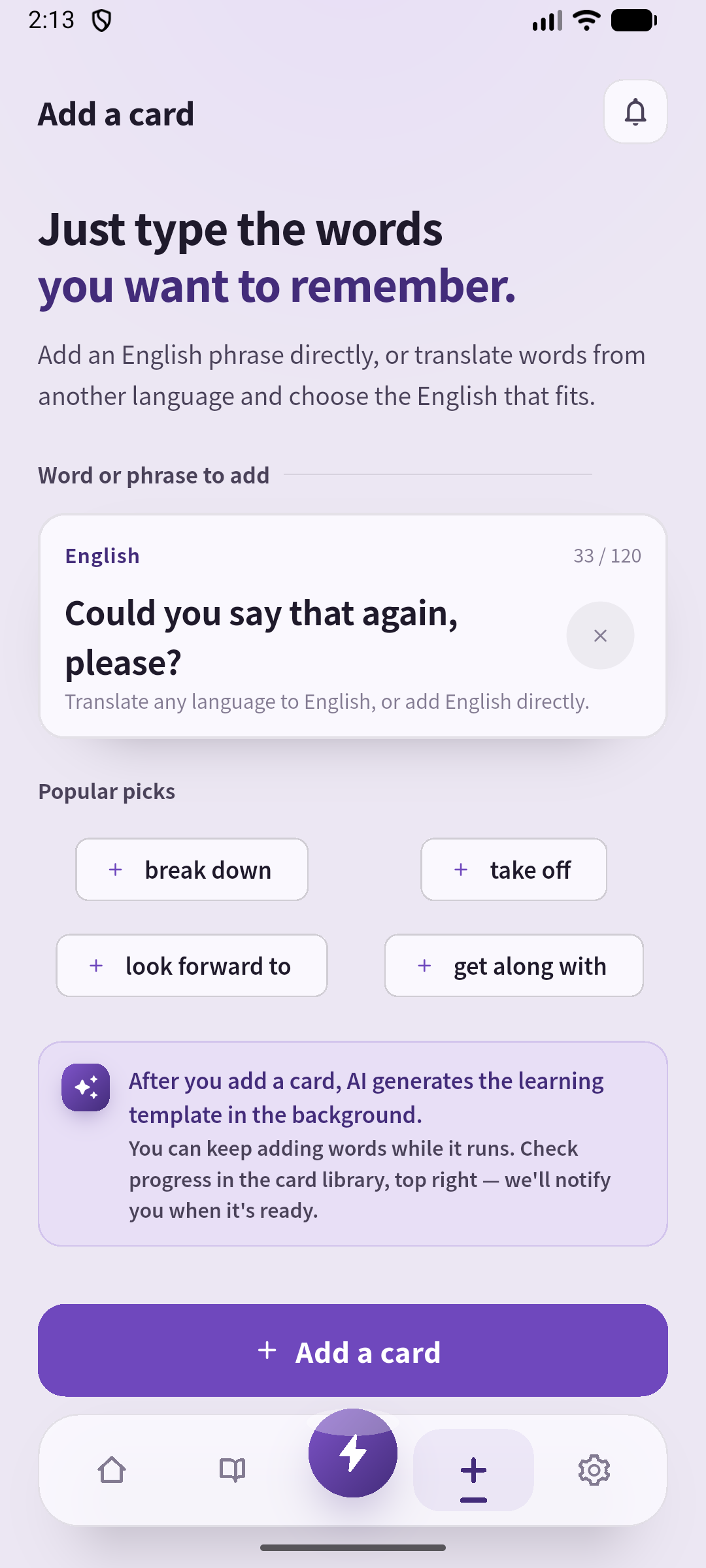
Keep the practice set focused
Do not save every phrase simply because it might be useful. Start with the line you needed in the script: say it while looking, say it without looking, then use it for a new purpose. Prepare before the call and keep a short checklist nearby. AI sentence audio does not reproduce a live caller’s responses, range of accents or conversational timing.
Step 3: move from imitation to a reply without the script
Listen on the saved card’s audio screen, repeat, then hide it and respond to Alex. If you record yourself separately, check that important words such as name and please remain audible and the request is complete.
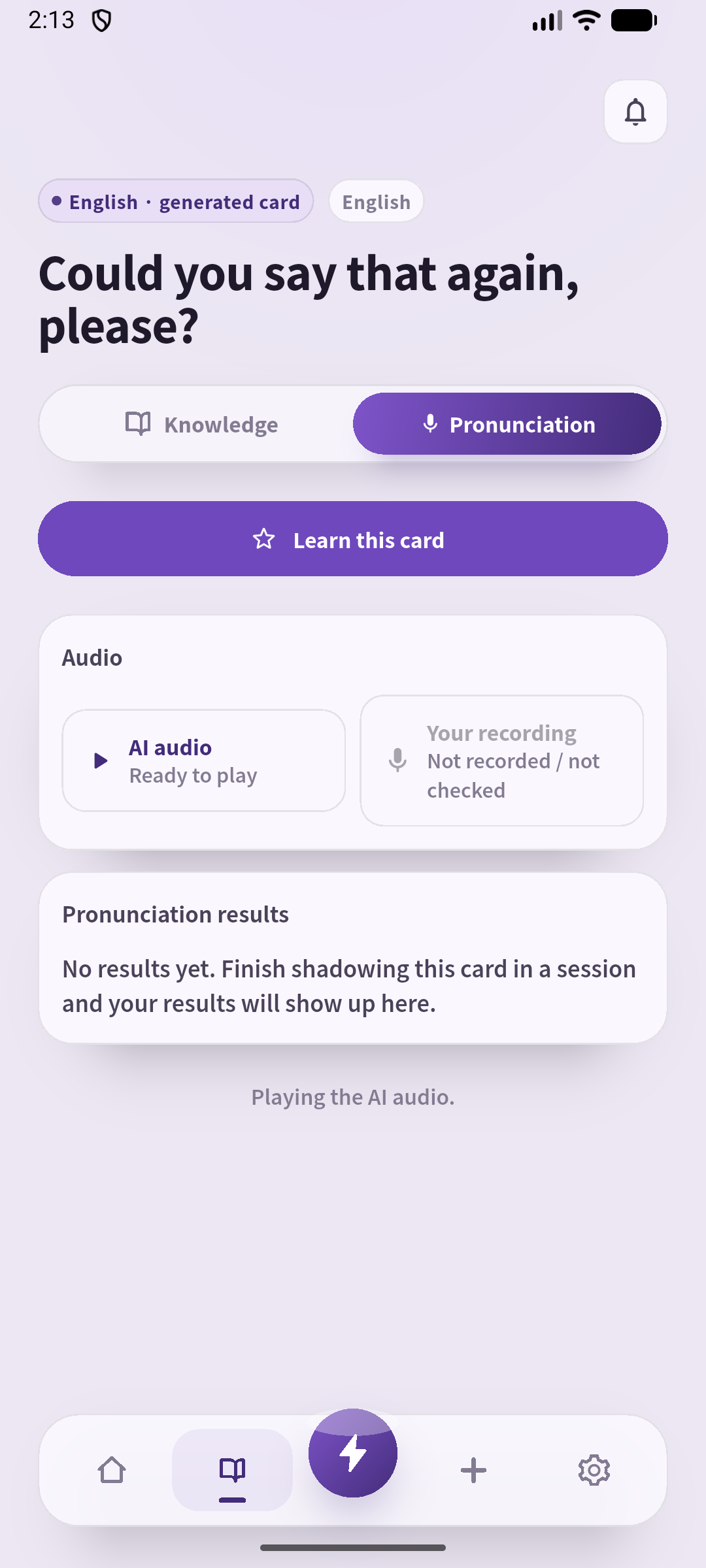
What the research measured, and how we use it
Karpicke and Roediger’s 2008 study compared foreign-vocabulary learning conditions. Its abstract reports a substantial delayed-recall benefit from repeated testing after an item was learned, unlike further study alone. Publisher abstract. We inspected the abstract; it did not test telephone English or Viking audio.
Our practical interpretation is to keep a moment for recalling a reply from the caller’s purpose, rather than only reading it aloud. It is not evidence of guaranteed fluency or a fixed number of days to improvement. Try a different order the next day, then practise with a teacher or colleague without seeing their face. Compare your written message with what they actually intended.
For trouble producing sentences, see the speaking practice roadmap; for listening responses, see English backchannel responses. A backchannel should not stand in for checking a detail you missed.
Questions learners ask
What is the English equivalent of a first phone greeting?
For a personal incoming call, start with “Hello?” For work, name the company and yourself. When calling, say “Hello, this is …” and state the purpose. The same greeting does not cover every role.
Is it rude to ask again more than once?
Accuracy matters more than pretending to understand. Narrow the part you need and change to written confirmation if necessary. No fixed number of repeats determines politeness.
What if nerves make every phrase disappear?
Keep “Could you say that again, please?” on a small note and say it once before the call. Then identify whether you need the name, number or meaning. A long apology about your English is less useful than a precise check.
Should I always choose could instead of can?
Could is a useful polite option for requests to unfamiliar people. Can appears in normal phrases such as “Can I take a message?” Practise an appropriate tone and follow your workplace’s procedure.
Choose one real purpose for your next call. Rehearse the introduction, a request to repeat and a check of the details. For your wider plan, use how to study English.
For apologies, attention requests and thanks, see how to apologize in English and choose a phrase for the situation.
For a visitor asking the way, use giving directions in English to practise one action, a landmark and a check.
For caring replies and your own sick-day notice, practice the short examples in get-well wishes and talking about feeling sick.
If you are preparing for an overseas assignment, use our work-and-life speaking plan to choose first-week sentences and practice for accompanying family members by the time you have left.