
English for an overseas assignment: prepare first-week work and life sentences with six, three or one month left
Published
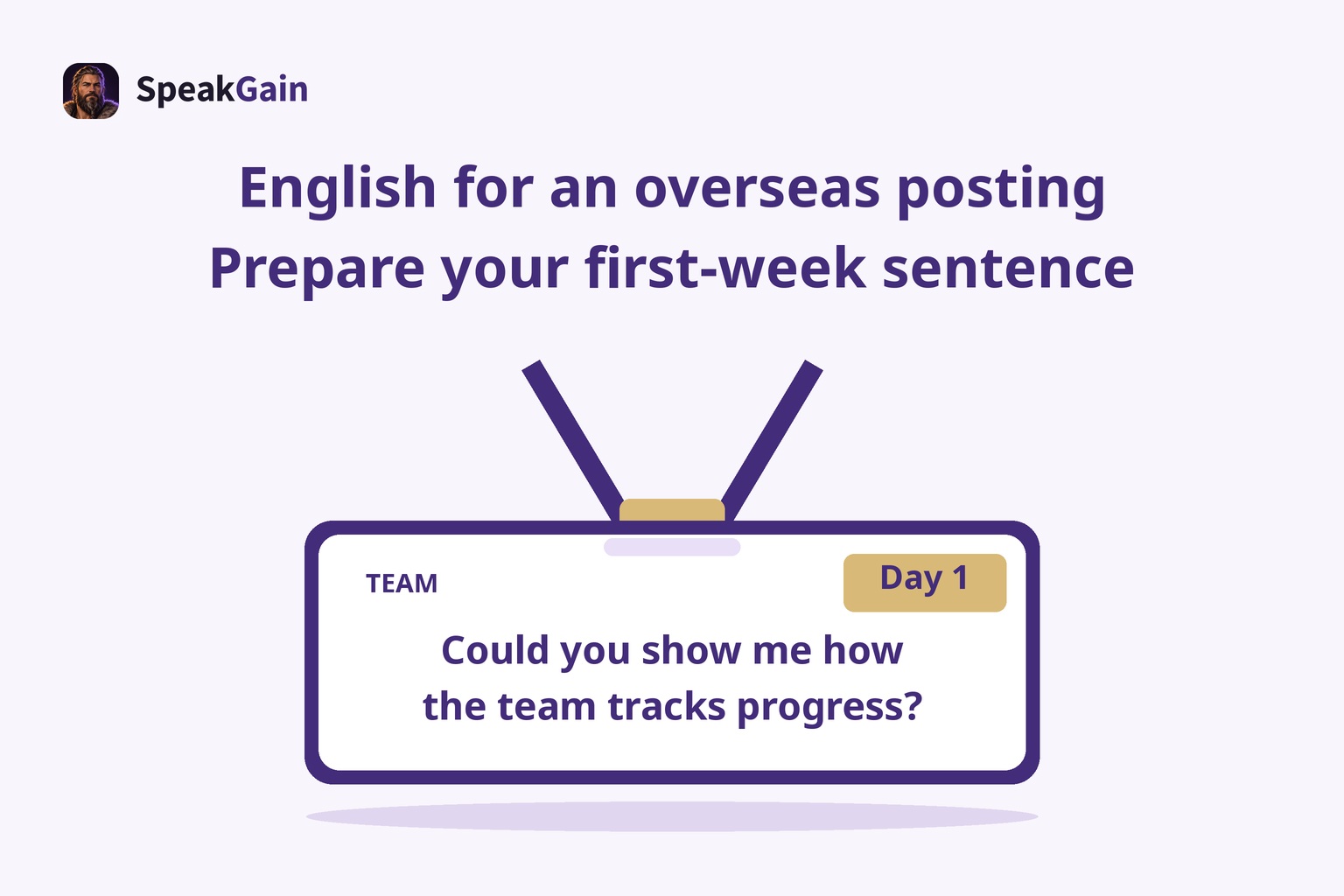
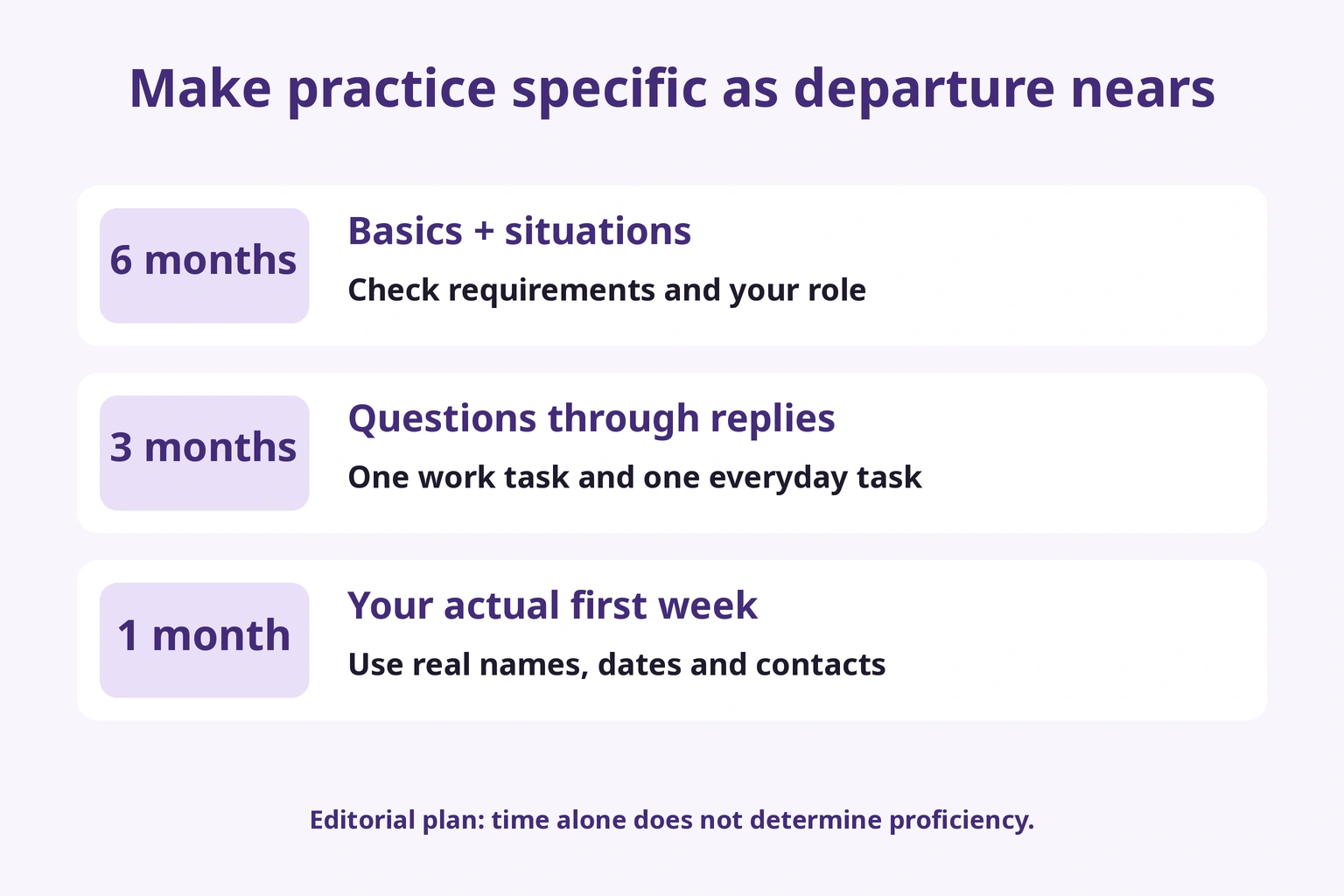
For an overseas assignment, check your employer’s requirements, then prepare short sentences for the work and everyday tasks you will actually handle in your first weeks. With six months left, rebuild the basics and select situations; with three months, practise questions, replies and checks; with one month, focus on your actual first-week schedule. Prepare separate sentences for accompanying family members, and turn difficulties after arrival into the next day’s speaking practice.
This guide is for employees being posted to an English-using workplace and families moving with them, including people who can write an email but hesitate to speak. The time allocations, number of situations and order below are editorial proposals, not proficiency standards or a promise of fluency by departure. We wrote the English examples for this article; replace the duties, dates and procedures with your own facts.
What should you do with six, three or one month left?
Handover work and moving arrangements compete with study time. Decide which task you are rehearsing, rather than simply scheduling “English”. For a team introduction, start with “I’ll be working with the operations team.” and replace the team name.
| Time left | Priority | Example daily practice | Sentence to prepare |
|---|---|---|---|
| 6 months | Check requirements and duties; rebuild short sentence patterns | 20 minutes: basics 5, make your sentence 5, listen and say it 10 | I’ll be working with the operations team. |
| 3 months | Select first-week work and life tasks; practise replies and checks | 20 minutes: yesterday’s sentence 5, situation practice 10, note difficulties 5 | Could you walk me through the next step? |
| 1 month | Use actual names, appointments and dates; retrieve the sentence from the situation | 15 minutes: imagine the task 5, speak without the text 5, check a reply 5 | Who should I contact about this? |
If you have only a month, do not compress a six-month course into it. Pick one work task and one everyday task. Look up the grammar needed for those sentences, then return to speaking. A common mistake is opening a different course every day without saying tomorrow’s sentence once.
First-week sentences: work and everyday life
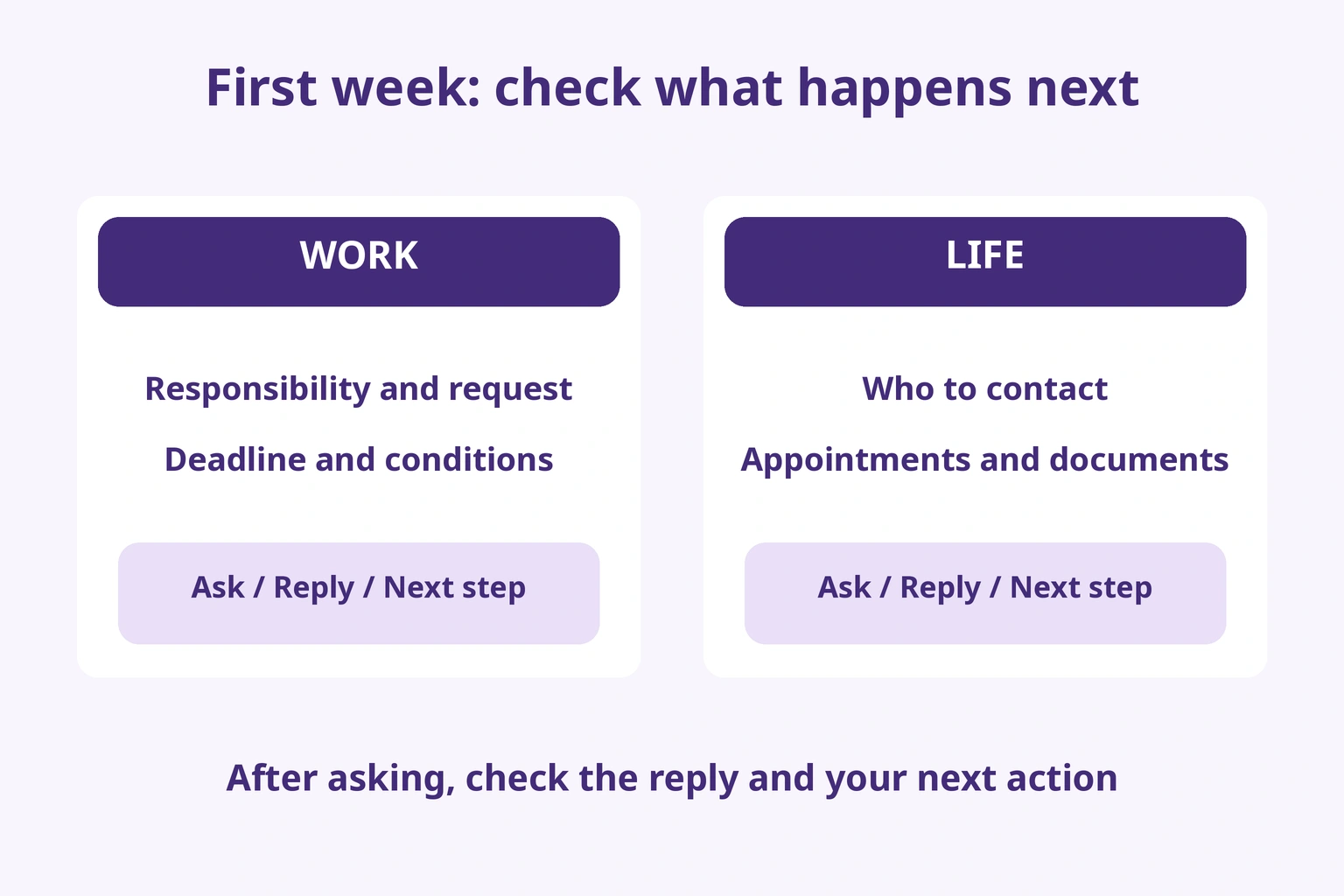
Team introductions and housing or bank appointments can overlap just after arrival. Choose one work situation and one everyday task that you will handle, then replace the information in these core sentences with your own facts.
| Situation | Core sentence | Replace with your facts |
|---|---|---|
| Introduce yourself to the team | I’ll be working with you on the inventory project. | Your actual project, rather than just your job title |
| Say something in your first meeting | Could I check the deadline for my part? | The item you need clarified |
| Ask a direct report or team member | Could you send me a brief update by Thursday? | Task, deadline and required format |
| Confirm with a client | Can we confirm which version you need? | Version, document, quantity or date |
| Explain a phone call | I’m calling about our appointment tomorrow. | The actual purpose and date |
| Situation | Core sentence | Adaptation |
|---|---|---|
| Housing and utilities | Who should I contact if the heating stops working? | The actual appliance; check contact details and hours |
| Bank | What documents do I need to open an account? | The transaction; check the document names in the reply |
| Clinic | I’d like to book an appointment with an interpreter, if available. | Whether you need an interpreter and which language |
| Children’s school | Who should I contact if my child is absent? | Absence, lateness or collection arrangements |
Say the chosen sentence without reading and practise confirming the next action from the reply. The common mistake is treating recognition of a table entry as finished preparation. The detailed sections below explain practice and mistakes for each situation.
Turn the countdown into specific practice
Six months: identify the role and the gaps
Contact with the overseas team may begin before your duties are final. Prepare: “What will my main responsibilities be?” Ask about language requirements, meetings, responsibilities and local support. Use your usual internal language when asking your employer; the English line also prepares you for the local contact.
Practise your name, department and current work in short sentences. After “I work in sales.”, add one product or customer group. If you cannot form the sentence, revisit the relevant subject–verb pattern instead of waiting to finish a whole grammar book. The mistake to avoid is covering every possible travel topic before your actual work. See building a speaking foundation.
Three months: what our editors would practise first
Training can give you plenty to listen to while leaving little time to ask your own questions. Our editorial choice would be one introduction, one work clarification and one everyday task. They connect directly to the first week and make the practice gaps visible; three is not a scientifically established optimum.
Prepare: “Could you walk me through the next step?” A partner might answer, “Send the form to the admin team.” Read your question once, hide it, ask from the situation and confirm the action in the reply. Alone, write two fictional replies and alternate them. With a partner, change the department or date. Repeating a script in the same order can leave you unprepared when the answer changes.
One month: rehearse actual appointments
Housing handover and the first workday now have real dates. Prepare: “Who should I contact about this?” Replace “this” with the actual issue, such as “the internet connection”, when context is unclear.
Choose tomorrow’s task, say the opening sentence without reading, then add “What do I need to bring?” Practise the names and address aloud too. Record what you need to do next. The common mistake is collecting new phrase books just before departure and abandoning the sentences you already selected.
What English level does an expatriate employee need?
Ask your employer; we do not set a universal TOEIC threshold. Clarify the required test, deadline, interview and duties instead of borrowing a score from a general article. Prepare: “What language requirements apply to this role?”
IIBC’s official explanation says TOEIC Listening & Reading measures listening and reading. A score alone does not check whether you can ask a colleague to do something on day one. If your employer requires it, reserve time for test preparation and separate time for speaking. Practise “I’ve finished the first draft.” with your own deliverable, then add what remains unfinished. The mistake is doing only test drills and never explaining your work aloud. If your employer uses a different assessment, follow that criterion rather than treating TOEIC as mandatory.
WORK: prepare a sentence for the first weeks
Introductions and explanations often dominate the start. Separate stating your role, clarifying a deadline, making a request and checking client information. The detailed meeting or negotiation procedures belong in the linked guides.
Introduction and meeting: state the role, then clarify
You may be asked what you will handle after stating your name. Prepare: “I’ll be working with you on the inventory project.” Replace the project, practise name–role–one question, and ask a partner to question you about your work. Use English self-introductions for the detailed structure.
In a meeting, use “Could I check the deadline for my part?” when that information is genuinely missing. Practise from the agenda and follow a reply with “So my deadline is Thursday, right?” Waiting silently can leave your task unclear; asking an irrelevant question simply to use a practised phrase is another mistake. Follow the workplace’s turn-taking rules. See speaking up in English meetings.
Requests and clients: include the task and deadline
A vague “the usual thing” may not identify the work. Prepare: “Could you send me a brief update by Thursday?” Add “on the stock check” if needed. British Council describes “Could you …?” as a polite request pattern; a manager need not always use an imperative.
Write the task, recipient and deadline before practising. Try an answer saying Thursday is impossible, then decide what you can change or must check. For a client, ask “Can we confirm which version you need?” and repeat the version in the reply. Do not polish politeness while leaving out the task, or mistake a question for an agreement. Confirm important details in writing under your work procedures. See English negotiation practice for discussing terms.
Phone: give the purpose and check the information
Without visual cues, names and times may need repetition. Prepare: “I’m calling about our appointment tomorrow.” Give your name first. Have a partner change the time, then ask “Did you say ten thirty?” Keep a note of the purpose and items to check, rather than reading a complete script. Do not guess a number and say yes. See English phone calls.
LIFE: housing, bank, clinic and children’s school
Your employer’s support contact and each local provider can tell you the actual procedure. These are practice questions, not a list of required documents or promises that a service is available.
Housing and banking: ask for the next step
You might know how to use an appliance without knowing whom to contact when it breaks. Prepare: “Who should I contact if the heating stops working?” Choose your actual appliance and first explain the problem, for example “The hot water isn’t working.”
For banking, practise the document question and fictional replies, then ask “Could you write that down?” You need not memorise an assumed list; check the real provider’s requirements. The mistakes are learning nouns such as “bank” without a task sentence, and forgetting to record whom to contact or what to bring.
Clinic and school: ask for support and the contact method
Prepare: “Could you explain that in simpler words?” when an explanation is unclear. Ask the clinic about interpretation before the appointment; the example does not establish availability. Practise one task you handle: booking, asking for clarification, or reporting absence. For school, add the child’s name to “My child will be absent today.” and confirm how to send it.
Do not answer yes to an explanation you have not understood or put adult procedures entirely on a child. Adults should prepare to request support. This article does not provide diagnosis, treatment or school admission rules; avoid placing medical or personal details in public practice material.
Accompanying family: choose each person’s tasks
When the employee is at work, another adult may need to contact a repair service or school. Their practice need not copy meeting English. Prepare: “Could you tell me who to speak to about this?” It opens a request for help without requiring a full explanation immediately.
Discuss responsibilities and preferences rather than assuming a spouse handles every household procedure. Each adult selects one task, says the opening line, answers one question and asks for repetition if needed. For children, adapt to age and real school life: “Can you help me find my classroom?” is a possible request. Do not compare children with adults or impose the same phrase count. Preparing only the employee, or treating every family difficulty as a language problem, leaves practical support and responsibilities unresolved.
Turn your own sentence into speaking practice
A new team may use a progress system you have not seen. Our worked example is:
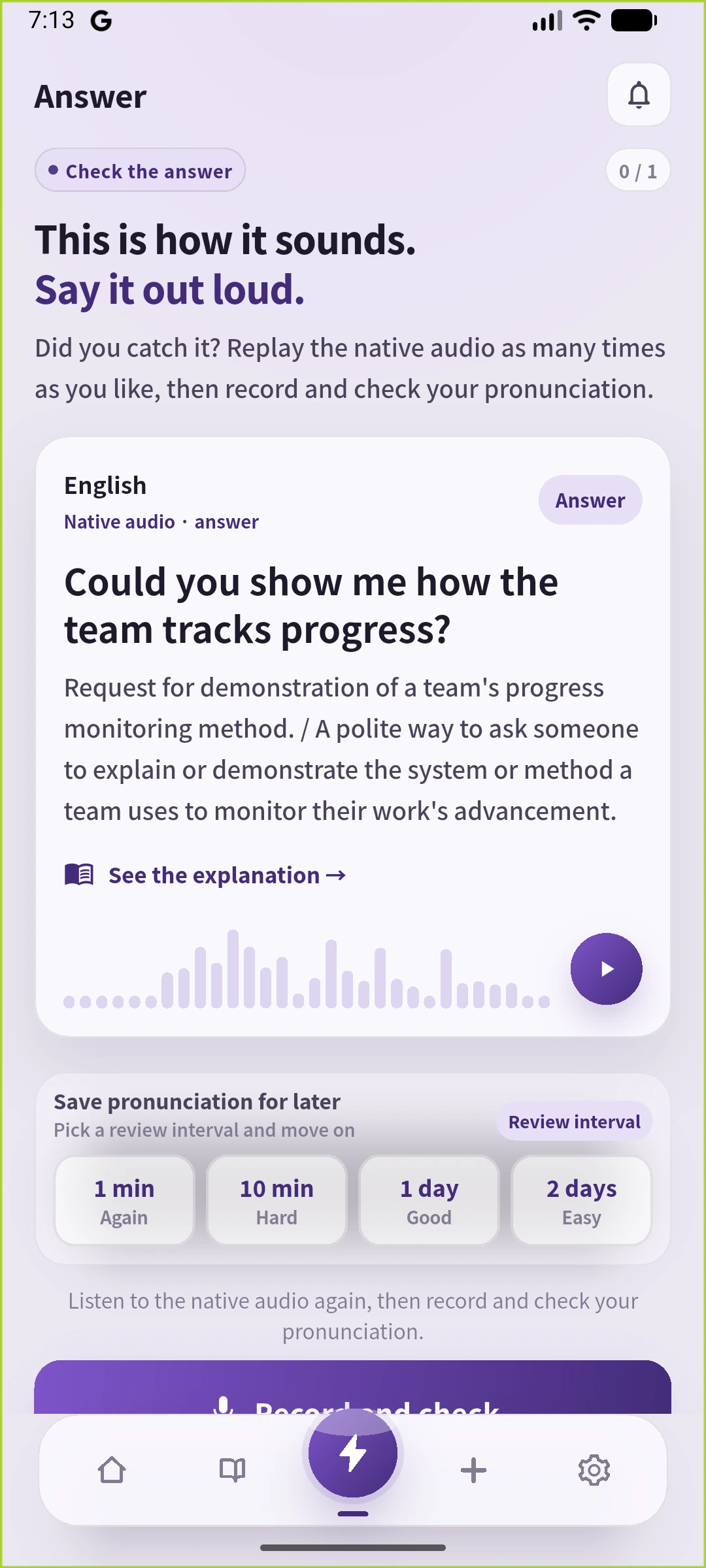
Could you show me how the team tracks progress?
You are asking to be shown a process. Replace “progress” with “customer requests” if that fits your role; if you already know the system, ask the specific question instead. Check the meaning, listen if audio is available, say the sentence and then hide it. Imagine needing to see the team’s progress process and retrieve the line from that situation. Practise “Could you show me” and “how the team tracks progress?” separately first, then join them.
We entered the sentence above in SpeakGain’s normal Add screen and created one card with Add a card. From Library we opened its Knowledge view, then Learn this card. The screens shown use the English interface.
Listening hid the sentence and automatically played the generated audio. Listen, say what you heard yourself, then use Reveal answer.
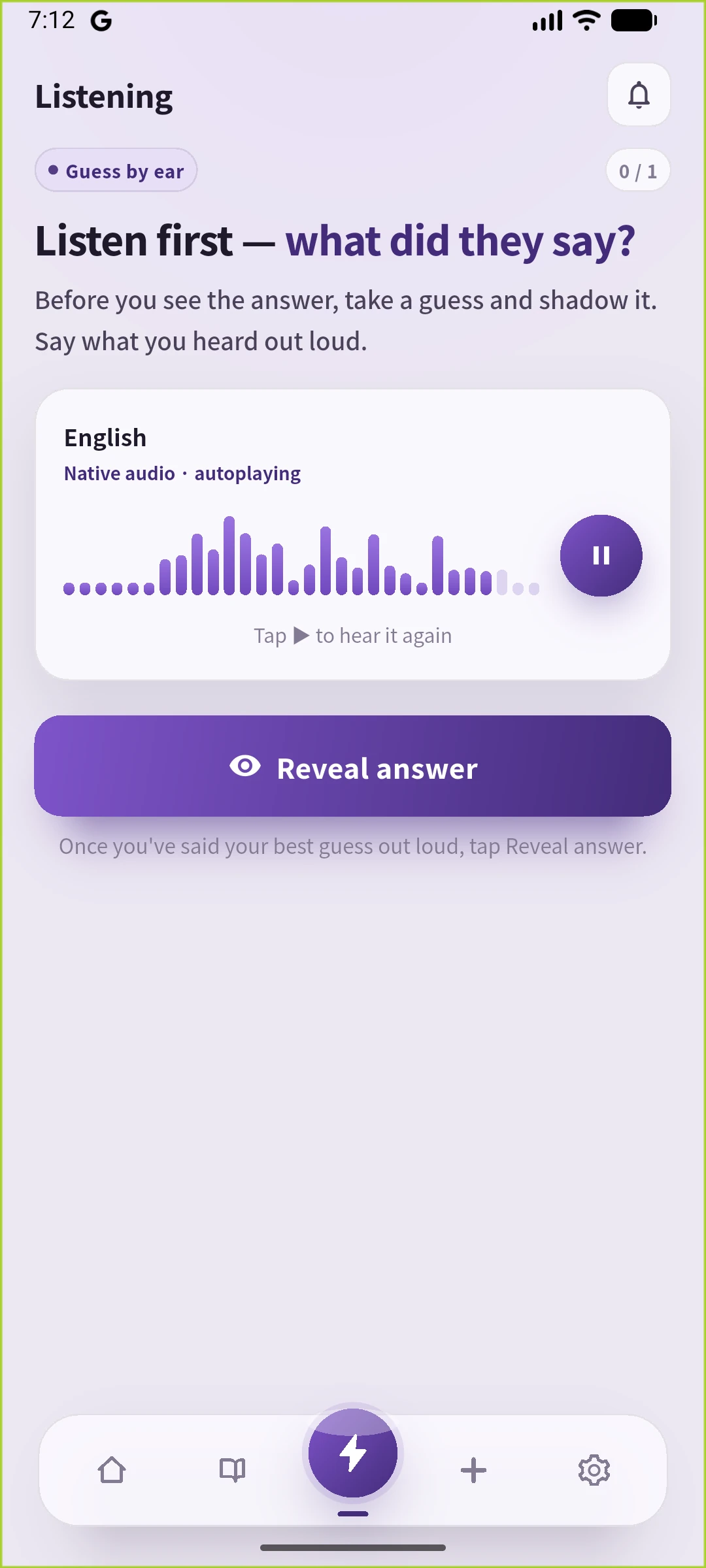
This is AI-generated audio for the same sentence, made with SpeakGain’s Deep-voiced Viking voice. It is not a human native-speaker recording. The Native audio label in these screens refers to this generated clip.
Could you show me how the team tracks progress?
After Reveal answer, Answer showed the saved sentence, a generated English explanation, a playback control and review-interval choices. You choose the interval yourself. We selected 1 day / Good once to continue the review. Here we use the app to support saving, listening, speaking aloud yourself and checking the sentence.
The mistake is treating imitation of a sound as complete workplace preparation. Practise a follow-up to “Which part are you working on?” with your own task. Sentence rehearsal and responding to changing information both belong in the plan.
Keep improving after arrival
Work and daily life may run largely in your stronger language; being abroad does not schedule speaking for you. Prepare: “Could I check one thing before we finish?” when you have a real question.
Our proposal is to record one thing you could not say, one reply you heard and one thing to check next. Generalise private customer information rather than entering confidential details into a service. Next morning, imagine the task and say the line without the text. After using it, note what communicated successfully and what needs changing.
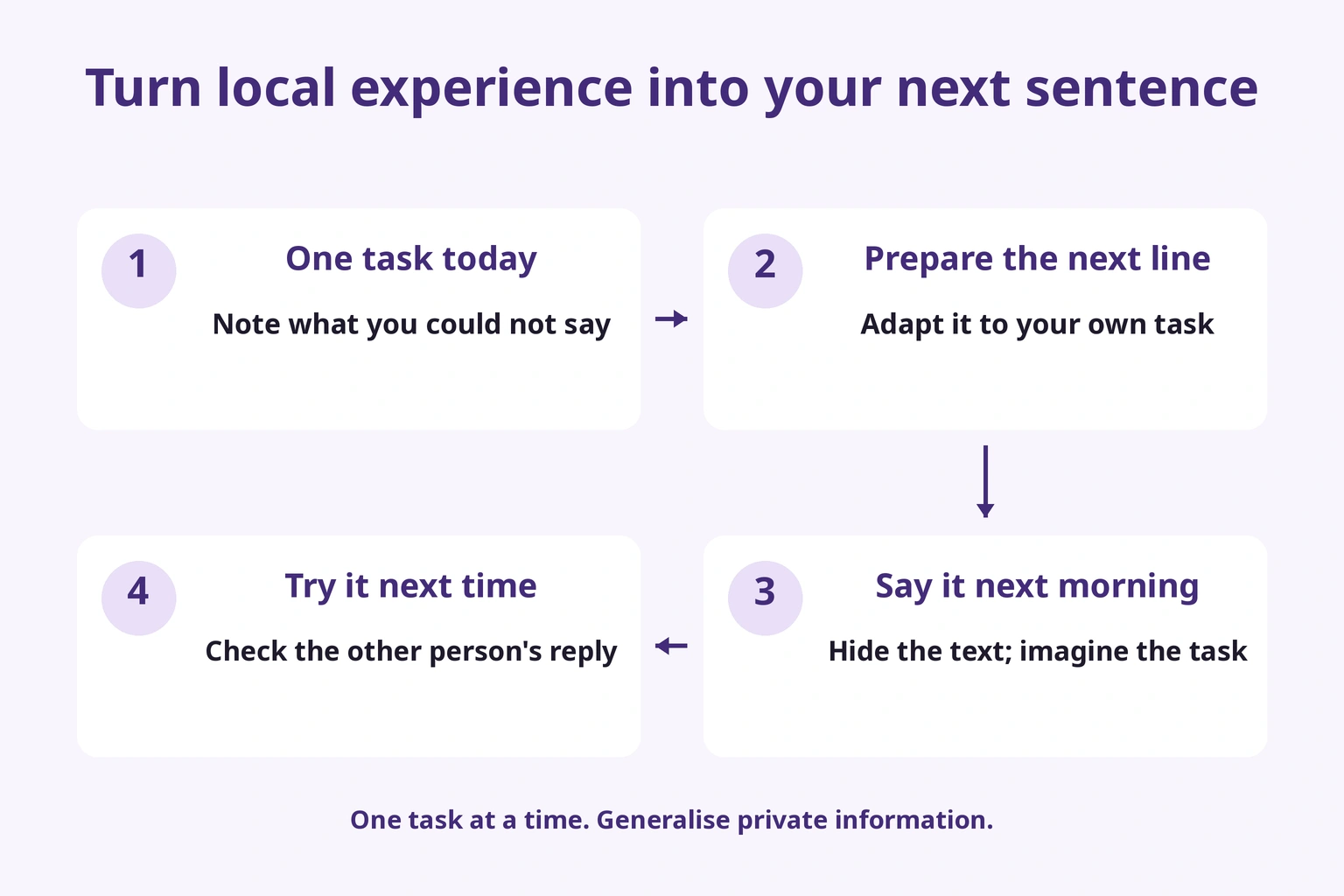
Change a deadline or appointment time in practice. British Council’s understanding-checking lesson illustrates repetition and checking what you understood; our daily cycle is an editorial application, not an experimentally validated schedule. Do not wait for the location alone to make you fluent. Keep the support of people who speak your language and choose a specific task to handle in English. See planning daily English study.
Preparation we do not recommend
When speaking feels difficult, adding more material can feel reassuring. Prepare: “Could you clarify what I need to do first?” Try saying it from the task, rather than merely recognising it.
We do not recommend TOEIC drills alone. Meet the employer’s test criterion, but allocate separate practice for requests, replies and clarifications. We also do not recommend memorising dozens of unrelated phrases alone. It leaves adaptation to your role and unexpected replies unpractised. Choose one relevant line, change the noun or date and practise one follow-up question. The mistake is measuring progress only by pages completed while leaving your first appointment unprepared. These are editorial opinions about preparation, not claims that tests or phrase books have no value.
Frequently asked questions
What TOEIC score is required?
Ask your employer about its test, threshold and deadline. There is no universal score in this guide; listening and reading preparation does not replace rehearsing your spoken tasks.
Can I be posted abroad with weak English?
That depends on the employer and role. Confirm the requirements and support, then identify the first-week tasks you cannot yet say.
How many minutes a day with three months left?
Our example is 20 minutes, not a guaranteed amount for reaching a level. On a busy day, rehearse one task without reading; schedule assessment preparation and partner practice separately.
What should I prepare if I cannot speak in meetings?
Pick one real agenda question, such as “Could I check the deadline for my part?”, and practise confirming the reply under the team’s meeting rules.
What if I only speak my stronger language locally?
Keep useful support relationships. Choose one task to ask about in English, prepare it, then review what happened instead of trying to eliminate those relationships.
What should my spouse and children learn?
Choose their own everyday tasks and requests for help. Do not assign everyone the employee’s business English or the same workload.
Is English enough outside English-speaking countries?
Check the languages used at work and local services. A posting to a non-English-speaking country also requires local-language preparation; this guide covers English practice only.
What does “expat” mean?
Cambridge Dictionary describes an expatriate as someone living outside their own country; expat is an informal shortened form, not a term limited to company postings. “Overseas assignment” describes the work assignment. In introductions, explain what you will do for the team.
Editorial verdict: work backwards from the first week
With three months left, we would select the first week’s work and everyday tasks and practise them through a reply, rather than plan to finish “all of English”. Meet the employer’s requirements and connect speaking to actual appointments. This is our judgment, not a guarantee of speaking ability by arrival.
Choose one task today, adapt one sentence and say it aloud. Then prepare a question for an unexpected reply. Continue the same cycle after arrival, and let each family member prepare for their own responsibilities and support contacts.
For a student preparing classes and arrival procedures, English before studying abroad also organises speaking practice by time remaining.
Primary references and official lessons
- IIBC: TOEIC Listening & Reading: what the test measures, not a universal posting threshold.
- British Council: can and could: request patterns.
- British Council: Checking understanding: clarification examples, not evidence of three-month outcomes.
- Cambridge Dictionary: expatriate: word meaning.