
English for negotiation: seven core sentences to adapt and practise before a meeting
Published
Prepare for an English negotiation or sales meeting with one short core sentence for each of seven stages: opening, checking needs, proposing, discussing terms, making a conditional concession, deferring or declining, and confirming the next steps. Replace the quantities, prices, dates and approval limits with your own company’s facts, then practise the sentence and a reply to push-back aloud before the meeting. Confirm agreements and contract terms in writing; a spoken phrase alone does not establish that the details have been settled.
This guide is for people who work with overseas clients, suppliers or colleagues and worry about sounding too blunt or too hesitant. The goal is to distinguish what you can offer, what depends on a condition, and what still needs approval. The examples are original editorial practice sentences with fictional numbers. The seven stages and one-week plan are our preparation framework, not a rule that every meeting follows or a promise of success.
For entering a discussion, use our guide to speaking up in English meetings. For serving people at a counter, see customer service English. Here, we focus on discussing business terms.
Which English sentences should you prepare first?
Choose one line per stage and replace the information before practising. At stage six, use a holding reply when the answer is unknown and a clear refusal when the limit is already established.
| Stage | Core sentence | What to personalise | Politeness note |
|---|---|---|---|
| Opening | Thank you for meeting with us today. | Participants and agenda | Thank them, then propose the starting point |
| Needs | Which matters more for this order: price or delivery time? | Order and two priorities | Allow another answer |
| Proposal | We suggest starting with a trial order of 200 units. | Trial plan and quantity | Suggest rather than command |
| Terms | Could we review the delivery date first? | Date, pricing basis and currency | Keep the figures clear |
| Conditional concession | We could reduce the unit price if you order 600 units. | Unit price and order size | Say the whole if-condition |
| Defer or decline | I need to check that with our finance team. / We can’t reduce the price on this order. | Approver, deadline or refusal scope | Separate unknown from unavailable |
| Written next steps | I’ll email a summary of the proposed terms today. | Sender, terms and send date | Distinguish proposals from confirmed items |
The British Council’s can/could reference distinguishes polite requests, offers and suggestions. That supports the grammatical uses below, not a claim that one modal verb wins negotiations. The choices and exercises here are editorial recommendations.
1. Open with thanks and a shared purpose
What happens: Thank the participants and propose a starting point. Small talk can be brief; a busy partner does not need a long personal conversation before the agenda.
Core: “Thank you for meeting with us today.” Follow with “Shall we start with your delivery requirements?”
Personalise and adjust politeness: Change “us” to “me” if you are attending alone. For a systems project, try “Shall we start with your plans for the new system?” If time is limited, say “We have 30 minutes, so I’d like to focus on the delivery schedule.” This explains a constraint without ordering the other person around. If small talk fits, “How has your week been?” is enough to begin; listen to the answer rather than finishing a memorised script.
Push-back: If they want to discuss price first, “Of course. Let’s start with the price.” If you cannot change the order, explain the specific reason.
Common mistake: Treating small talk as compulsory, or guessing someone’s style from their nationality. Use this person’s replies, role and time constraints instead.
2. Check what matters most
What happens: Find out whether the difficulty is the total budget, unit price, delivery or another requirement before proposing a solution.
Core: “Which matters more for this order: price or delivery time?” For a more open question, “What is your main priority for this order?”
Personalise and adjust politeness: For an internal project, use “Which matters more for this project: the launch date or the scope?” Choose two things your team can actually adjust. A two-option question is an opening, not a restriction on what the person may say. “Could you tell us your main priority for this order?” softens the request without burying it in several hedges. Confirm a firm requirement separately: “Do you need all 600 units by 20 November?”
Push-back: If both matter, “Understood. Which requirement has less flexibility?”
Common mistake: Asking a question that already assumes the answer. Avoid “You only care about price, right?” The British Council’s negotiating lesson recommends preparing objectives and asking about the other party’s needs. Our short questions put that advice into a speaking exercise.
3. Offer one proposal they can evaluate
What happens: State a concrete starting arrangement, then listen. Explain specifications with a document rather than reciting the entire product description.
Core: “We suggest starting with a trial order of 200 units.” Then ask “Would that work for your team?”
Personalise and adjust politeness: Replace the trial quantity with your actual initial plan. An internal version is “We suggest testing the system with one team first.” Add one relevant reason: “It would let us check the packaging before a larger order.” “We could start with a trial order of 200 units.” presents an option; “We suggest …” makes your recommendation explicit. Neither requires commanding the buyer with “You must …”.
Push-back: If the trial does not fit the schedule, “What starting quantity would fit your schedule?” If quantity is not the issue, ask about timing or whether a trial is needed.
Common mistake: Offering four alternatives before receiving a response. Start with one. For a longer explanation, practise with our English presentation guide; for a missing technical word, use paraphrasing in English.
4. Discuss price, delivery and payment one item at a time
What happens: Name the issue you are discussing. A number is not enough: both sides must know the currency, unit and what is included.
Core: “Could we review the delivery date first?” For a price check, “Is that 18 US dollars per unit, excluding shipping?”
Personalise and adjust politeness: Replace “delivery date” with “payment schedule” or “unit price”. Change 18, the currency, the unit and the shipping treatment to match the actual quotation. Do not add “excluding shipping” just because it appears in the example. Use a question to negotiate the sequence, but state a confirmed limit clearly: “The earliest delivery date we can offer is 20 November.” Adding “maybe” to a known limit can suggest there is still flexibility.
Push-back: If they need it earlier, “Which items do you need first?” Offer partial delivery only after checking that it is feasible.
Common mistake: Confusing fifteen and fifty, “by 20 November” and “on 20 November”, or dispatch and arrival. Ask “Did you say fifteen or fifty units?” and compare the written numbers. Confirm the delivery location too. If you cannot share a screen, prepare English phone-call checks.
5. Keep the concession and its condition together
What happens: Explain what you might change and what the other party would need to do in the same sentence.
Core and shared practice sentence: “We could reduce the unit price if you order 600 units.” This is a proposal to consider. It does not specify the discount or establish final approval.
Personalise and adjust politeness: For a specific authorised proposal, “We could offer 18 US dollars per unit if you order 600 units.” Replace the price, currency and quantity. If approval remains necessary, add “This would be subject to approval from our finance team.” Do not assume “could” alone communicates your approval process. “We can offer … if …” may state an approved capability more directly, but changing the modal does not determine whether a contract has formed.
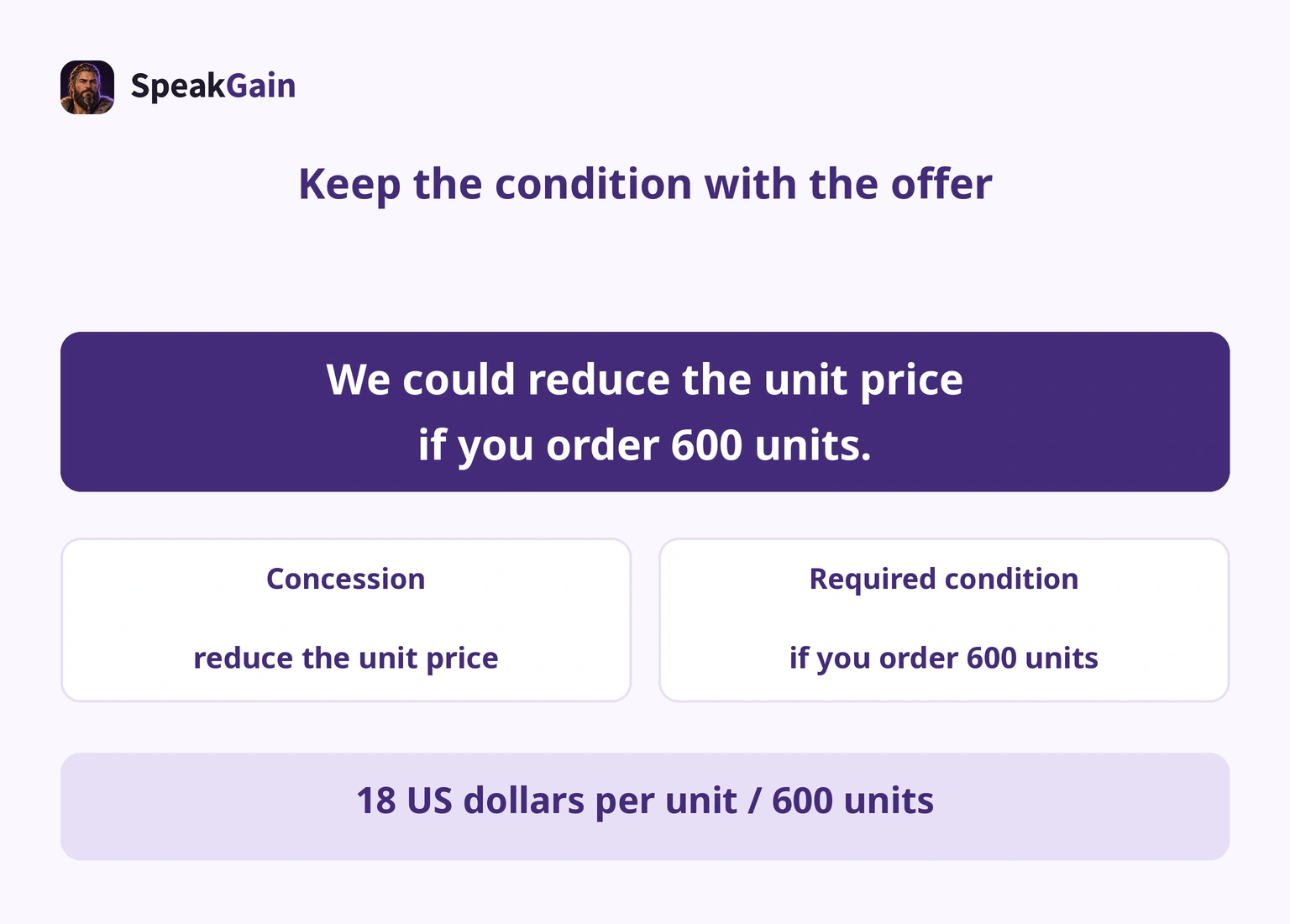
Push-back: If they cannot increase the order, “What quantity can you commit to?” Check what you can offer for that quantity before promising the same discount.
Common mistake: Finishing after “We could reduce the unit price.” or making the if-clause too quiet to hear. Practise both parts. State “unit price” when you mean price per item rather than leaving the pricing basis unclear.
6. Separate a holding reply from a refusal
What happens: Defer when information or approval is missing; decline when the limit is already known.
Core: “I need to check that with our finance team.” / “We can’t reduce the price on this order.”
Personalise and adjust politeness: Replace the team with “my manager” if appropriate. Add a realistic deadline: “I’ll get back to you by 3 p.m. Tokyo time tomorrow.” Put the date and time zone in the follow-up email too. For a refusal, “I’m afraid we can’t reduce the price on this order.” adds a brief cushion, while keeping “can’t” audible. Specify the true scope of the restriction; do not invent a general company policy. Offer an alternative only if it is available. See polite requests in English for related request-and-reply practice.
Push-back: If they demand a decision today, “I can’t confirm that without approval.” Repeat the established limit calmly if it has not changed.
Common mistake: Saying “We’ll think about it.” without an owner or reply date, or “We’ll try.” when the answer is no. If the promised deadline slips, explain the status and give the next contact time.
7. Confirm the details and next steps in writing
What happens: Separate discussed ideas, pending approvals and confirmed details, then assign an owner and deadline.
Core: “I’ll email a summary of the proposed terms today.” Follow with “Could you confirm the details in writing?”
Personalise and adjust politeness: Change the sender and date to the actual plan. “Proposed terms” means a proposal, not a settled agreement. List quantity, unit price and currency, tax and shipping, delivery destination and arrival date, payment terms, approver and response deadline. Identify the quotation version rather than writing only “same as last time”. Use “I’ll email …” for your own action; “I might email …” leaves the action uncertain.
Push-back: If they say to proceed immediately, “Let’s confirm the terms in writing before we proceed.”
Common mistake: Recording every idea as agreed, or treating “Sounds good.” as sufficient confirmation. Confirm agreements and contract terms in writing. Do not decide legal effect or contract formation from these phrases alone. Follow your company’s process and consult its legal or contracts team where needed.
How can you be polite without making the message vague?
Ask when you are requesting a discussion, attach conditions to proposals, and state established limits directly. “Lower the price.” commands a change; “Could we discuss the unit price?” opens a discussion. It still does not specify your target price, so explain the relevant quantity or budget next.
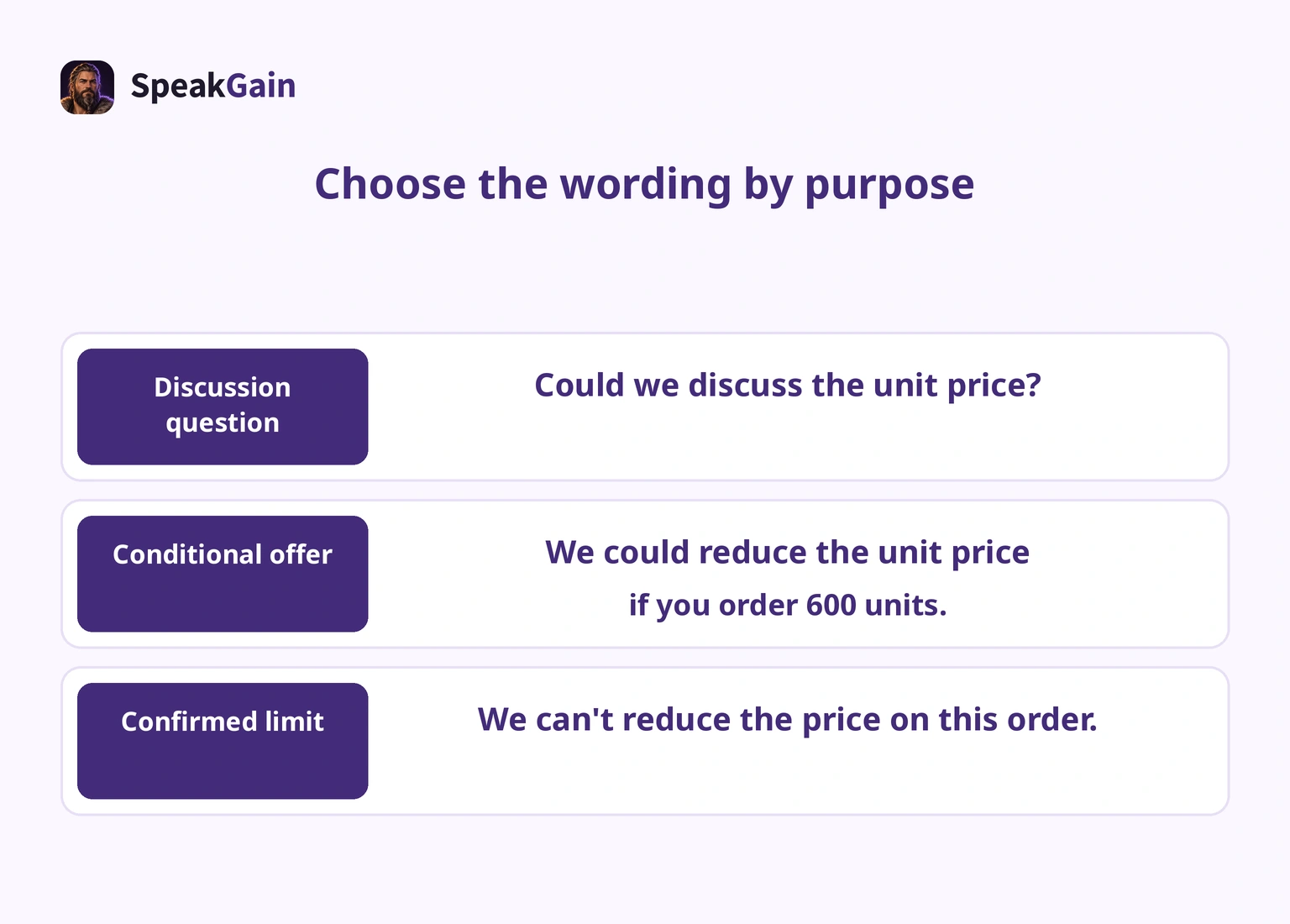
If a change is impossible, “It might be a little difficult.” can leave room for a different interpretation. State what you cannot do, then an available alternative. Politeness includes tone and allowing time to respond; it is not a universal ranking of modal verbs. Before translating a deferential expression from your first language, decide whether you mean an offer, a genuine pending decision or a refusal.
A one-week pre-meeting practice plan
This is our allocation of preparation time, not a promise of becoming a skilled negotiator in seven days.
| Day | Preparation and aloud practice | Finish when… |
|---|---|---|
| 7 days before | Check objectives, fixed limits and authority; say the purpose in one sentence | You can explain what the meeting should decide |
| 6 days before | Select one line per stage and replace products and quantities | You understand every word |
| 5 days before | Read the quotation numbers, currency, units and dates aloud | You can repeat and check them |
| 4 days before | Practise the concession, if-clause and holding reply | You do not promise beyond approval |
| 3 days before | Prepare replies to two reactions: too expensive and too slow | You can move to a clarification |
| 2 days before | Rehearse with a colleague who changes the quantity | You notice and confirm the new number |
| The day before | Check the terms memo and written follow-up; say three priority lines | Conditions and negatives remain audible |
Read a sentence, say it, hide it and retrieve it from a situation cue, then record it and fix one point. A phone’s recorder is sufficient. Prioritise hearing 600, the if-condition and “can’t” rather than correcting every sound at once. Ask a colleague to change 600 to 400; practise checking the new number and deferring if it is outside your authority.
Keep one sentence for listening and aloud practice
Start with the sentence you will actually need: “We could reduce the unit price if you order 600 units.” It joins the possible concession and its quantity condition. Follow your company’s information rules; practise with fictional quantities rather than entering confidential prices or client names into a service. Check the meaning before repeating it.
In SpeakGain, we saved this exact sentence as one card through the normal Add screen. We opened Library → Knowledge → Learn this card and verified generated-audio playback in Listening, where the English is hidden. Listen and say your attempt aloud, then use Reveal answer to open Answer: it displays the saved sentence and an English meaning explanation. We also verified replay, review-interval choices and a normal review record after selecting Good.
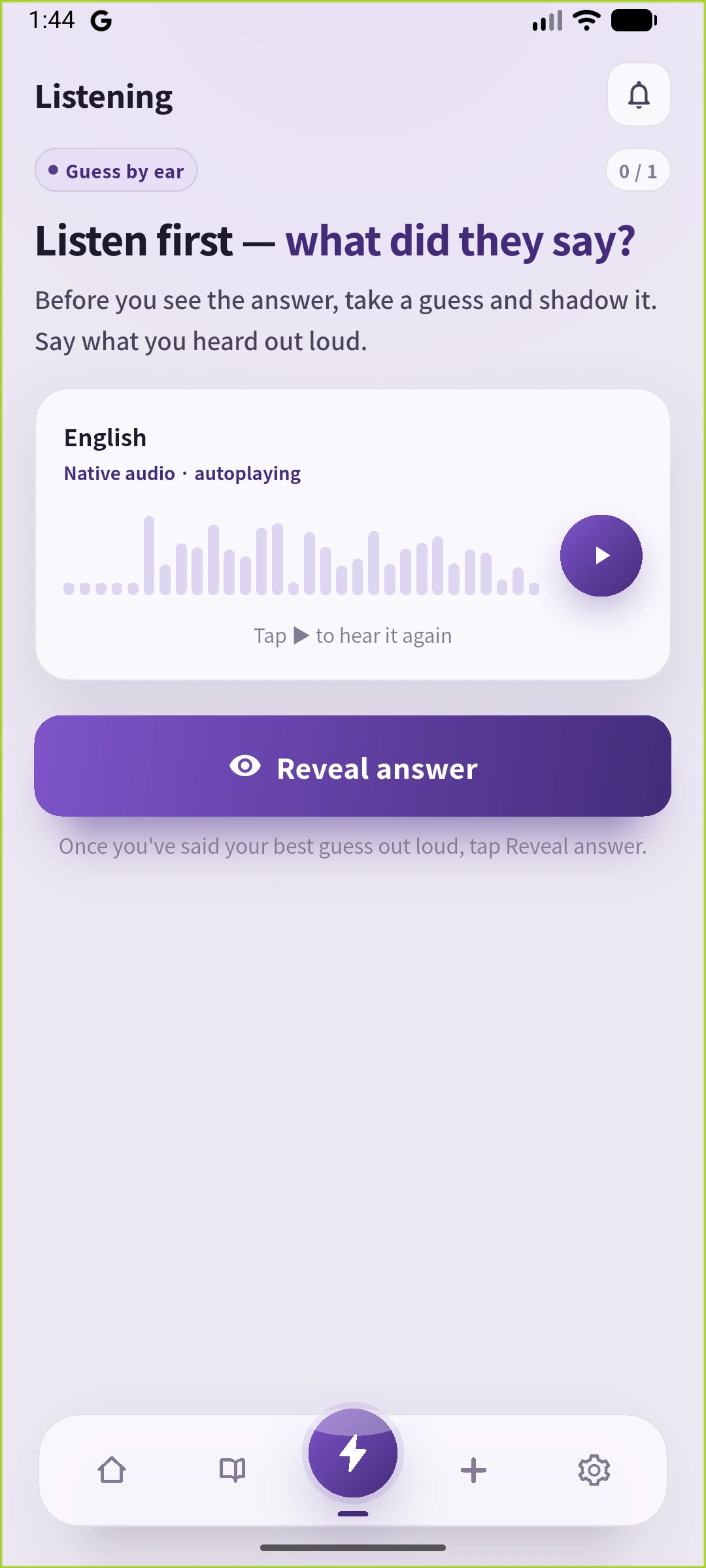
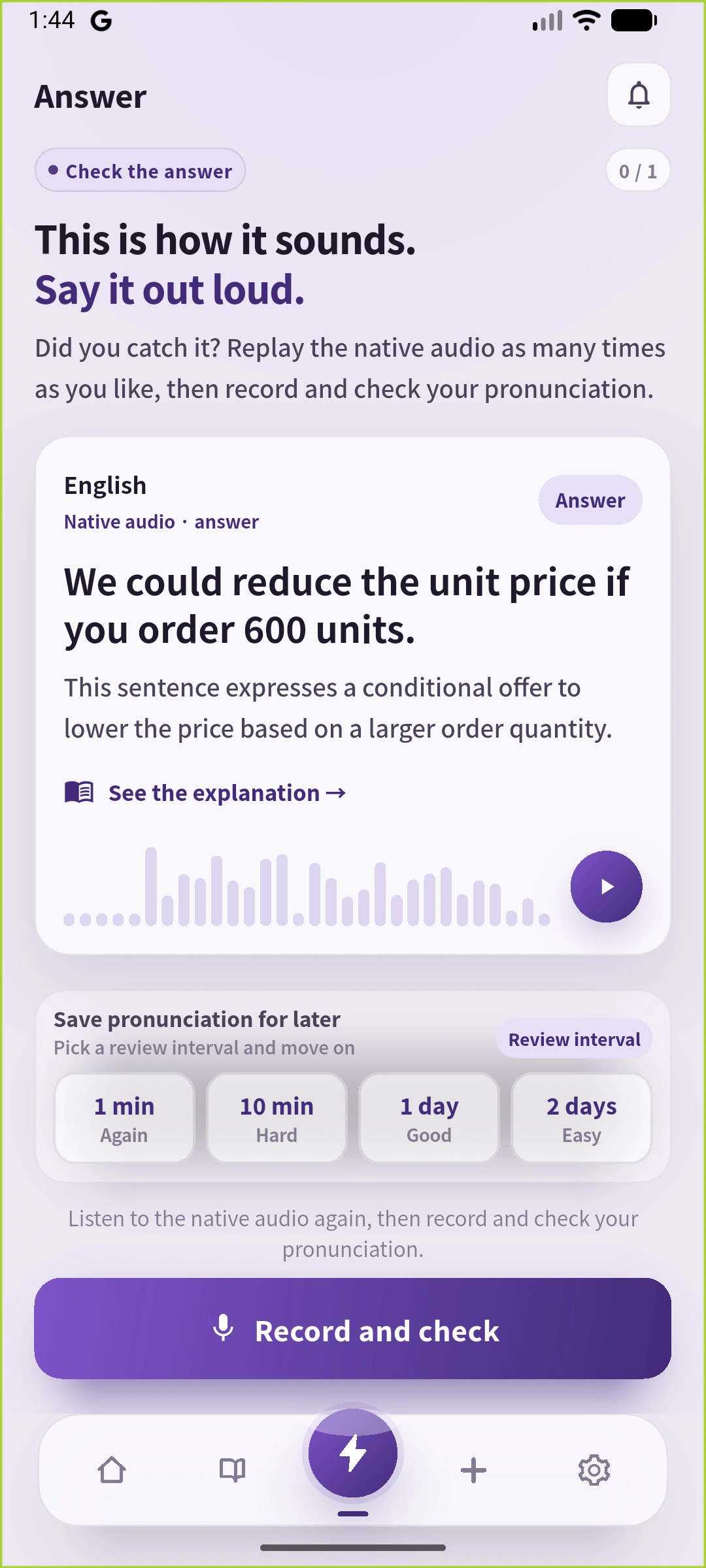
Use this demonstrated flow to keep, hear, say and check your own sentence. We did not verify learner-recording or assessment results, and do not present it as a conversation partner, an answer or pronunciation grader, or a fluency guarantee. Despite the screen’s Native audio label, the clip below is AI-generated Viking audio, not a recording of a human native speaker.
Preparation methods we do not recommend
Memorising dozens of phrases first: choosing between similar lines can crowd out practice with your actual numbers and deadlines. We would first choose one per stage and prepare the reply. This is an editorial priority, not a research claim that memorisation never helps.
Aggressive “tough negotiator” scripts: invented ultimatums and blame do not explain your authority or the other party’s needs. A clear refusal may be necessary; intimidation is not our speaking-practice goal.
Predicting behaviour from nationality: ask this person’s priorities and approval process. Roles, budgets and deadlines vary between individuals.
Polishing English while ignoring the quotation: a natural sentence can still promise something your company cannot provide. Check the facts before speaking and confirm them in writing afterwards.
FAQ
How do I avoid sounding too forceful?
Use a question to open a request, give one relevant reason and wait. Keep confirmed limits clear rather than adding hedges to every sentence.
What if I cannot answer immediately?
Name the person or team you need to check with and give a realistic deadline and time zone. Update the other party if the answer is delayed.
How do I politely refuse a discount?
“I’m afraid we can’t reduce the price on this order.” states the scope. Add a real alternative if one exists; do not leave false hope with “We’ll try.”
How do I check a number I missed?
“Did you say fifteen or fifty units?” distinguishes the options. Verify the written number, currency, pricing basis and delivery meaning.
What belongs in the meeting and what belongs in email?
Use the meeting to ask and explore terms. Use writing to confirm details, pending items, owners and deadlines; sending an email is not itself receiving confirmation.
Should we use an interpreter?
Our recommendation is to discuss an interpreter early if you cannot reliably confirm important conditions. Consider value, technical detail, complexity and participants’ understanding. Arrange scope and confidentiality, and keep your contracts review separate.
What should I practise if I have less than a week?
Start with a proposal, a holding reply and a written-confirmation request, plus a number check. Check your authority and rehearse one objection.
Editorial verdict
We would prioritise an offer with your own terms, a holding reply for approval and a sentence moving the details into writing. Then add needs questions and checks for price, quantity and dates. For the shared practice sentence, say the if-clause clearly and return to checking when the quantity changes. Aim for accurate terms and a useful next action, not a clever script or a guaranteed win.
Sources
- British Council: can and could: requests, offers and suggestions.
- British Council: Negotiating: preparing objectives and asking about needs. The seven-stage and one-week frameworks are editorial recommendations.
If you are preparing for an overseas assignment, use our work-and-life speaking plan to choose first-week sentences and practice for accompanying family members by the time you have left.