
How to introduce yourself in English: examples and your own 30-second introduction
Published Updated
Introduce yourself in English with a greeting, your name, your role or studies, one specific detail and a closing. For example: “Hi, I’m Maya. I work in customer support. I enjoy cycling. Nice to meet you.” Change the details to your own facts and stop when the other person starts speaking.
To follow your introduction with an experience or thanks, use short English speech preparation to build the rest of the message and its ending.
If you need a script now, choose one of the five situations below. If you want to prepare your own introduction, make a short version first, time it aloud, then practise saying it before you play the model again. Thirty seconds is a preparation target, not a rule for every conversation. A meeting round may need only your name and role; an interview may need a longer account of relevant experience. Our editorial recommendation is to prepare a short core and keep extra details for questions.
For a hiring interview, English interview preparation connects your introduction to the role and adds motivation, experience answers and recording practice.
To prepare for what follows your first greeting, English for a homestay connects a short introduction with questions about household routines.
If you are starting tutor-led online lessons, use the beginner format guide and first-10-lesson plan to choose support and prepare one useful sentence.
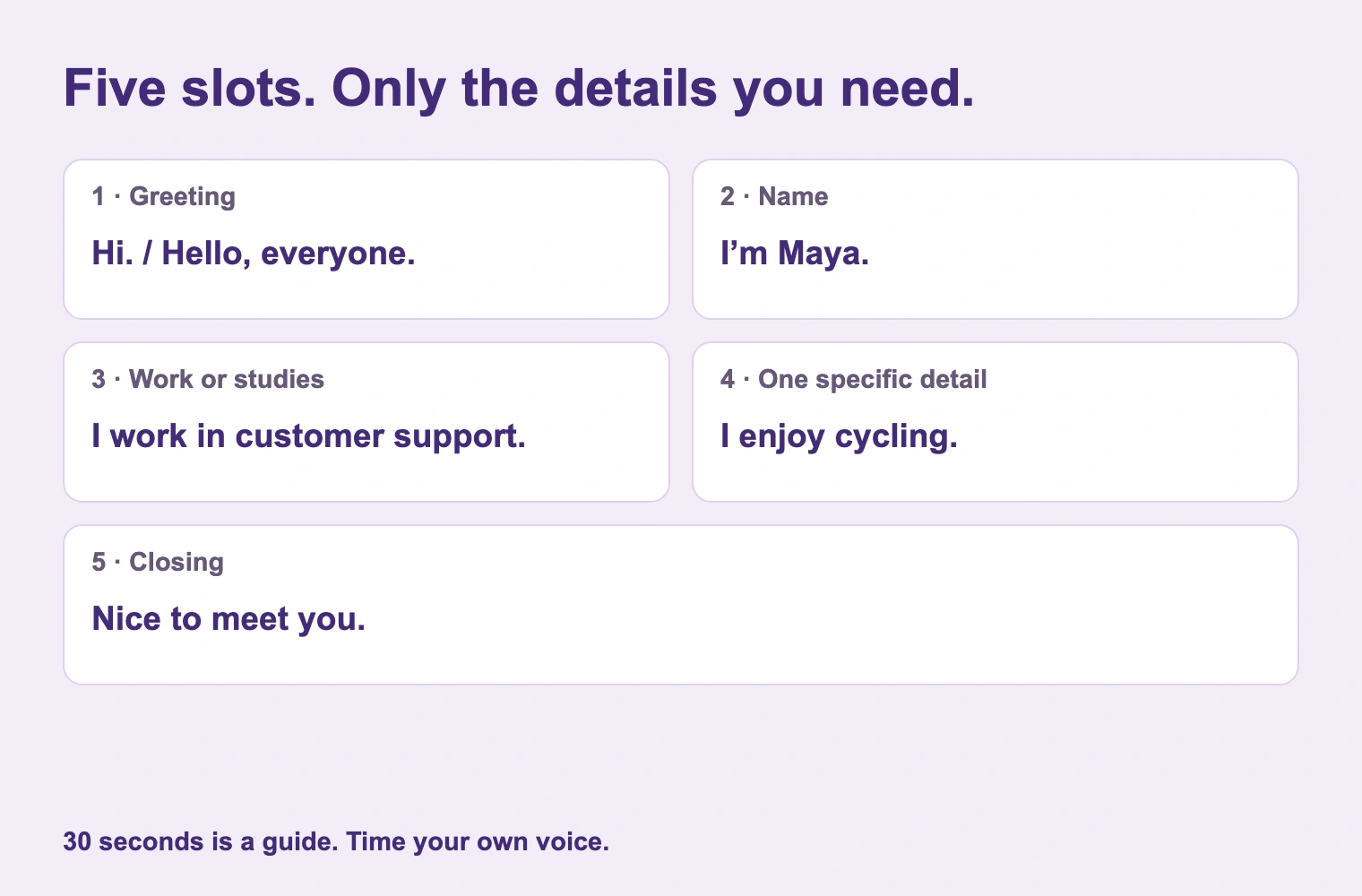
1. Five slots. Only the details you need.
Use these slots as choices, not a list of everything you must disclose. Work colleagues need to know what you do; a teacher needs to know what you want to practise. You can omit your age, family details and hometown when they do not help the conversation.
| Part | English example | Meaning / what to change |
|---|---|---|
| Greeting | Hi. / Hello, everyone. | Choose a greeting for the person and setting. |
| Name | I'm en-introduction.m4a. Please call me en-introduction.m4a. | Use the name you want people to say. |
| Work or studies | I work in [field]. / I study [subject]. | State your real job field or subject. |
| One specific detail | I help [people] [do something]. / I enjoy [activity]. | Give the listener one thing they can ask about. |
| Closing | Nice to meet you. / I’m looking forward to working with you. | Greet a new person or signal a future collaboration. |
You do not need a new English name. Say the name you use and, if helpful, explain how you want to be addressed. “Please call me Maya” is a preference, not a requirement to shorten your name. Cambridge’s introduction guide confirms both “I’m…” and “My name is…”. Our preference for a short opening is editorial, not a ban on “My name is”.
2. Work
For a new team, introduce your responsibility before your personal history. For an external contact, explain what they can contact you about. You do not need to list every position you have held. These two examples serve different listeners: a colleague joining the same work and a customer needing a contact.
New team: complete example
Hi everyone, I'm Maya. I work in customer support in Toronto. I help customers use our products. I'm looking forward to working with you.
Meaning: Maya names her support role in Toronto, explains that she helps customers use the products and looks ahead to working with the team.
Customer contact: complete example
Hello, I'm Maya from the support team. I'll be your contact for account questions. Please let me know if you need help. It's nice to meet you.
Meaning: Maya is the support contact for account questions. She invites requests for help and greets the customer.
Extra lines and follow-up questions
| English example | Meaning / what to change |
|---|---|
| I mainly work on product documentation. | Use this when documentation is your actual responsibility. |
| What do you work on in this team? | Ask the colleague about their role. |
3. Online lesson
Give the teacher one achievable goal for today. A request such as practising a work explanation tells them more than apologising for your entire English level. If you need a slower pace, ask directly; asking for help is part of the conversation. The second version is for a learner preparing to travel rather than a work meeting.
First online lesson: complete example
Hi, I'm Maya from Canada. I work in customer support. I'm learning English to talk with customers abroad. Today I'd like to practise explaining my job.
Meaning: Maya identifies her country and job, then asks to practise explaining that job because she talks with customers abroad.
Beginner preparing to travel: complete example
Hello, I'm Maya. I'm a beginner in English. I'd like to practise a short introduction for travelling. Could you speak slowly and ask me one question at a time?
Meaning: Maya says she is a beginner, gives a travel goal and asks for slow speech and one question at a time.
Extra lines and follow-up questions
| English example | Meaning / what to change |
|---|---|
| Could you say that again, please? | Request a repeat instead of guessing the question. |
| Could you ask me a follow-up question? | Move from a memorised introduction to a response. |
4. School / study abroad
In an exchange class, your subject and one interest can connect you with classmates. With someone you have just met on campus, a shared class may be enough. Choose information you are comfortable sharing; being asked to introduce yourself does not oblige you to explain your family or finances.
Exchange class: complete example
Hi everyone, I'm Maya from Canada. I'm an exchange student studying environmental science. I'm interested in renewable energy. I'm looking forward to learning with you.
Meaning: Maya is an exchange student from Canada studying environmental science, with an interest in renewable energy.
New classmate: complete example
Hi, I'm Maya. I study design and enjoy photography. I'm new to this campus. Are you taking the design class too?
Meaning: Maya studies design, enjoys photography and asks whether the listener takes the same class.
Extra lines and follow-up questions
| English example | Meaning / what to change |
|---|---|
| I’m interested in renewable energy. | Name a specific interest you can discuss. |
| What do you like about this course? | Invite a classmate’s view. |
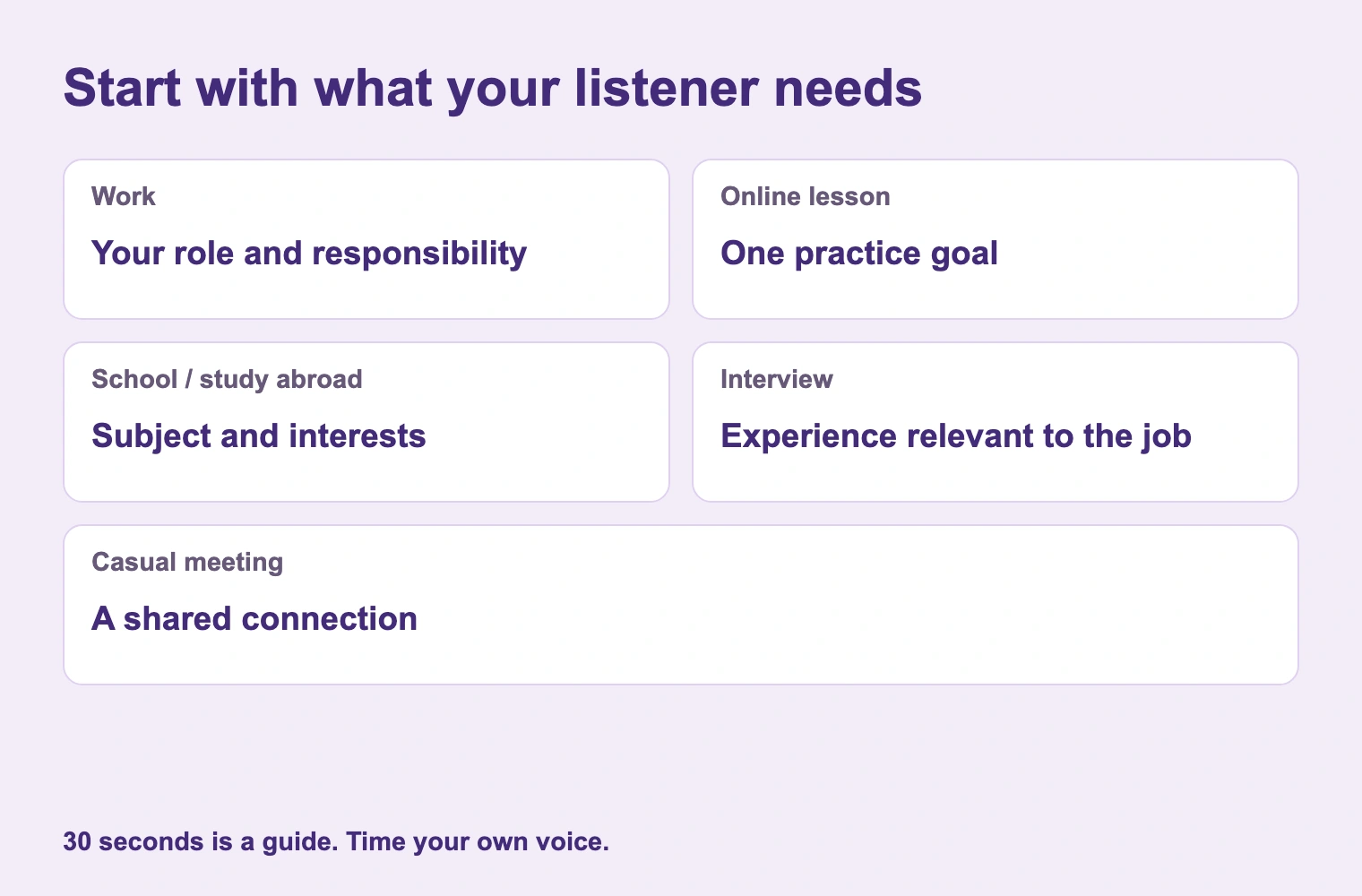
5. Interview
Treat these as opening answers, not a complete response to every interview question. State a real task, then be ready to explain what you did. An experienced applicant can name relevant work; a recent graduate can use a real class project. Do not add a result or responsibility simply because it sounds impressive.
Experienced applicant: complete example
Hello, I'm Maya. I have three years of experience in customer support. I help new customers set up their accounts. I'd like to bring that experience to this role.
Meaning: Maya has three years of support experience and connects helping customers set up accounts with the job she wants.
Recent graduate: complete example
Hello, I'm Maya. I recently graduated in business. In a class project, I organised our team's schedule. I'd like to develop those skills in this position.
Meaning: Maya describes a real scheduling role in a business class project and wants to develop those skills.
Extra lines and follow-up questions
| English example | Meaning / what to change |
|---|---|
| For example, I helped a new customer set up their account. | Move into a real example of your actions. |
| Would you like me to describe the project in more detail? | Check how much detail the interviewer wants. |
6. Casual meeting
Start briefly, explain your connection to the event and give the conversation back. Do not recite your work biography at a walking group unless someone asks. A hobby works better as a real topic you can discuss than as a decorative line copied from a template.
A friend’s gathering: complete example
Hi, I'm Maya. I know Alex from work. I enjoy cycling on weekends. How do you know Alex?
Meaning: Maya explains that she knows Alex through work, offers cycling as a topic and asks about the listener’s connection.
A walking group: complete example
Hi, I'm Maya. This is my first time with this walking group. I came with a friend. Have you been here before?
Meaning: Maya is new to the walking group, has come with a friend and invites the other person to talk about their experience.
Extra lines and follow-up questions
| English example | Meaning / what to change |
|---|---|
| Sorry, what was your name again? | Ask again when you missed the name. |
| Do you have a favourite trail? | Follow up on a shared interest in walking. |
7. Check grammar without treating every preference as a rule
For an international English-learning audience, we separate an incorrect form from a correct phrase that could be more specific. These are checks for this task, not claims that all speakers of one language make the same mistakes.
| Check | Use instead / another option | Why |
|---|---|---|
| I am work in support. | I work in support. | Use the simple present for your regular job; am does not belong before this base-form work. |
| I enjoy to cycle. | I enjoy cycling. | When a verb follows enjoy, use the -ing form. |
| My name is Maya. | I’m Maya. | Both are valid. The shorter version is an option for a conversational opening, not a correction. |
| I’m a hard worker. | I helped customers set up their accounts. | The first is grammatical. Our interview recommendation is to add an action you can explain, rather than leave a broad claim unsupported. |
The British Council’s be reference distinguishes be with a noun/adjective and be + -ing. The BBC grammar transcript explains enjoy + -ing. The name choices are checked in the Cambridge guide linked above. The advice about specific interview actions is our editorial judgement.
8. Maya builds her own short introduction
Maya is a fictional practice example, not a customer testimonial. She works in support in Toronto and wants to introduce her job in an online English lesson, then answer one question. Her facts are a name, a support role, cycling and an international-customer goal. She leaves her entire employment history out of the first version.
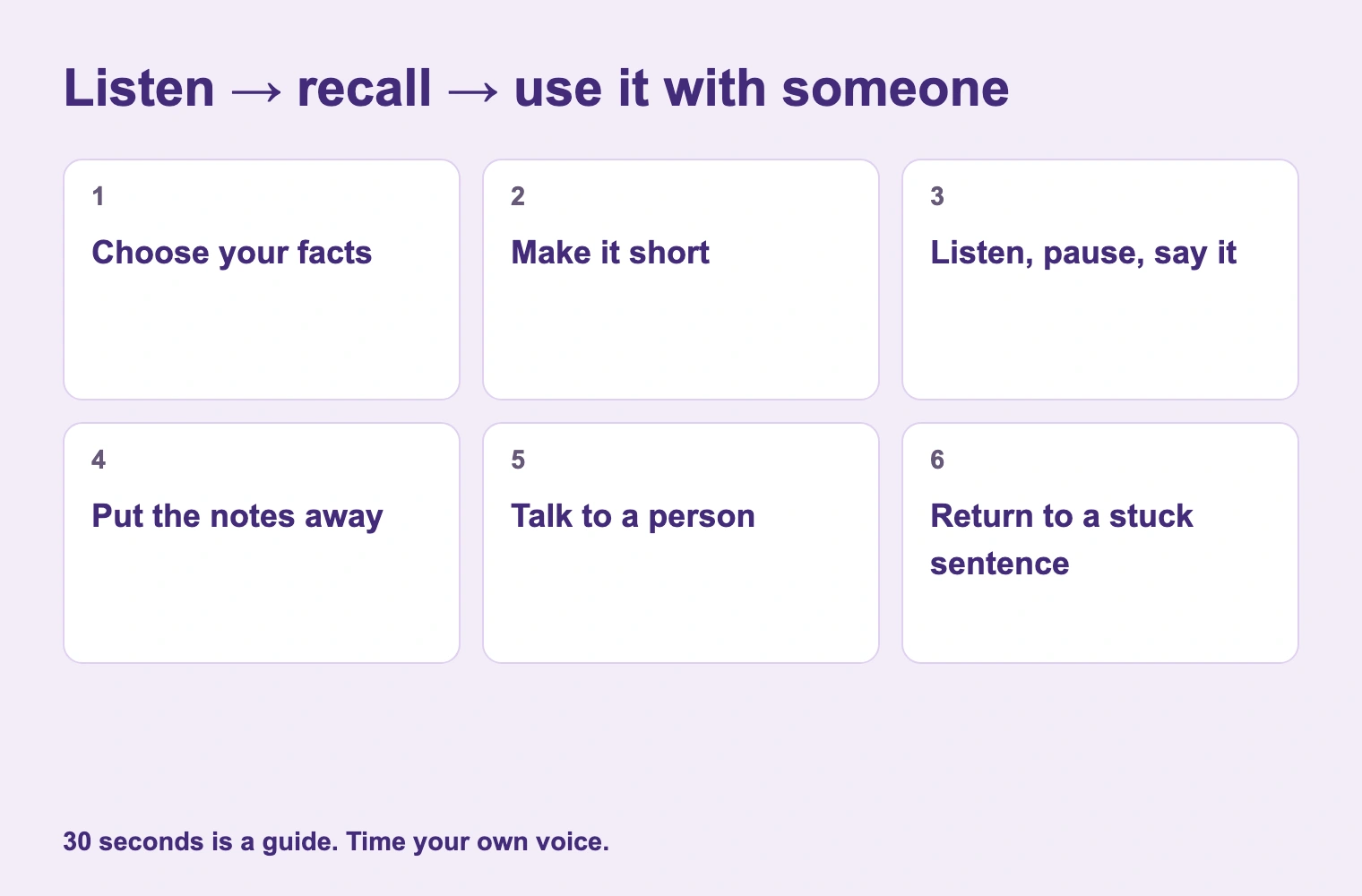
1. Choose your facts / Make it short
Maya writes these four chunks. The last question deliberately invites interaction in a lesson; in a work meeting she would choose a closing about working together. A script is useful only when every detail is hers and she can explain what it means.
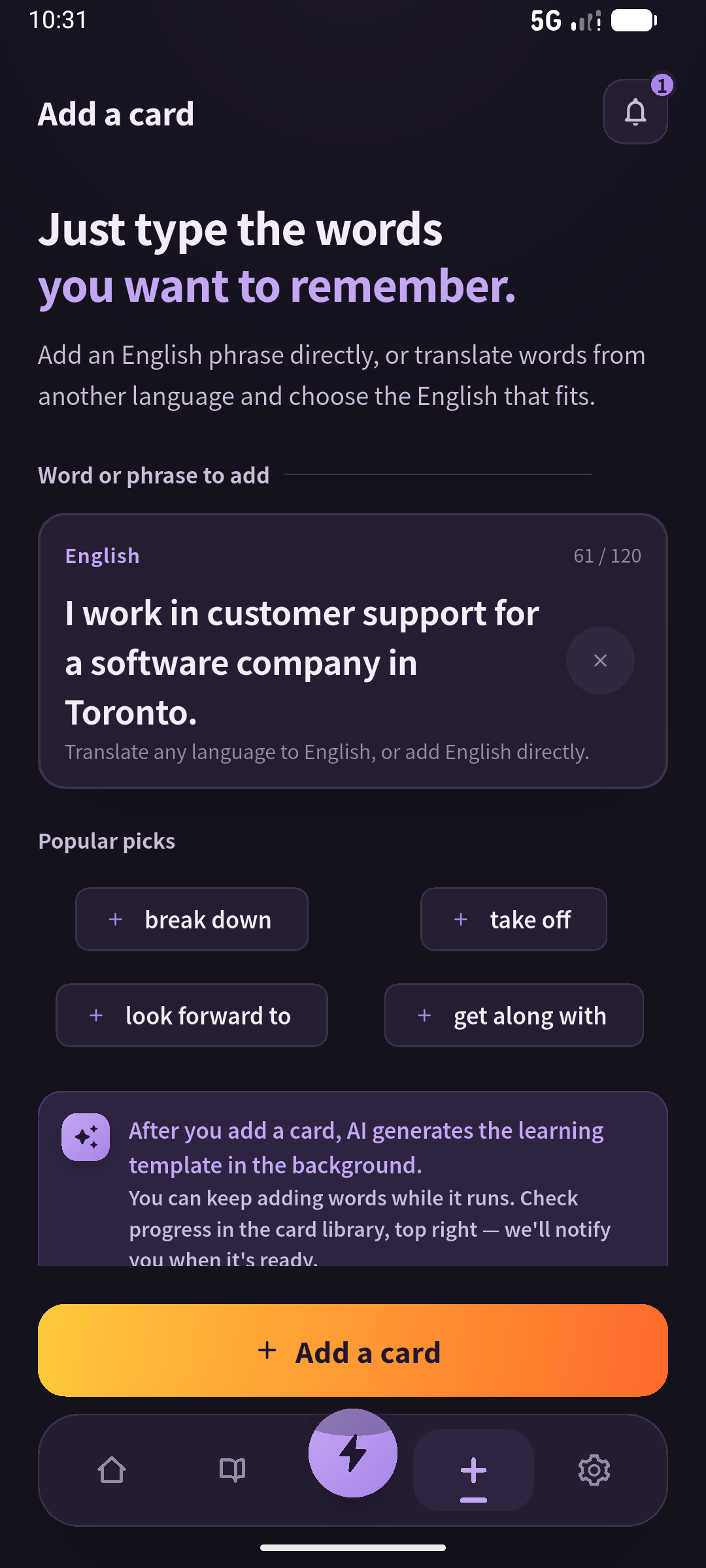
Hi, I am Maya. Please call me Maya. I work in customer support for a software company in Toronto. I enjoy cycling. I am learning English to help our international customers. It is nice to meet you. What would you like to practise today?
In plain language: Maya greets the teacher, names her support job in Toronto, mentions cycling and explains her international-customer goal. She then asks what they will practise.
Time this with your own voice. If it takes much longer than 30 seconds, remove the hobby or extra question before speaking faster. If it takes less, do not fill time with irrelevant details. Word count and the model’s duration cannot predict your own timing.
2. Save your own sentences in SpeakGain
She enters each chunk in the app’s normal Create flow. Keep long introductions in short cards, so one difficult sentence can be practised on its own. The work sentence below is the second chunk. If your own wording is uncertain, check its meaning with a dictionary or teacher before practising it.
3. Listen, pause, say it
The recording below joins the four actual card WAVs generated with Deep-voiced Viking. Speed, pitch, gain and silence have not been changed. Listen for the names and phrase boundaries, pause, then say one chunk. You do not have to keep up with the full recording before practising a sentence.
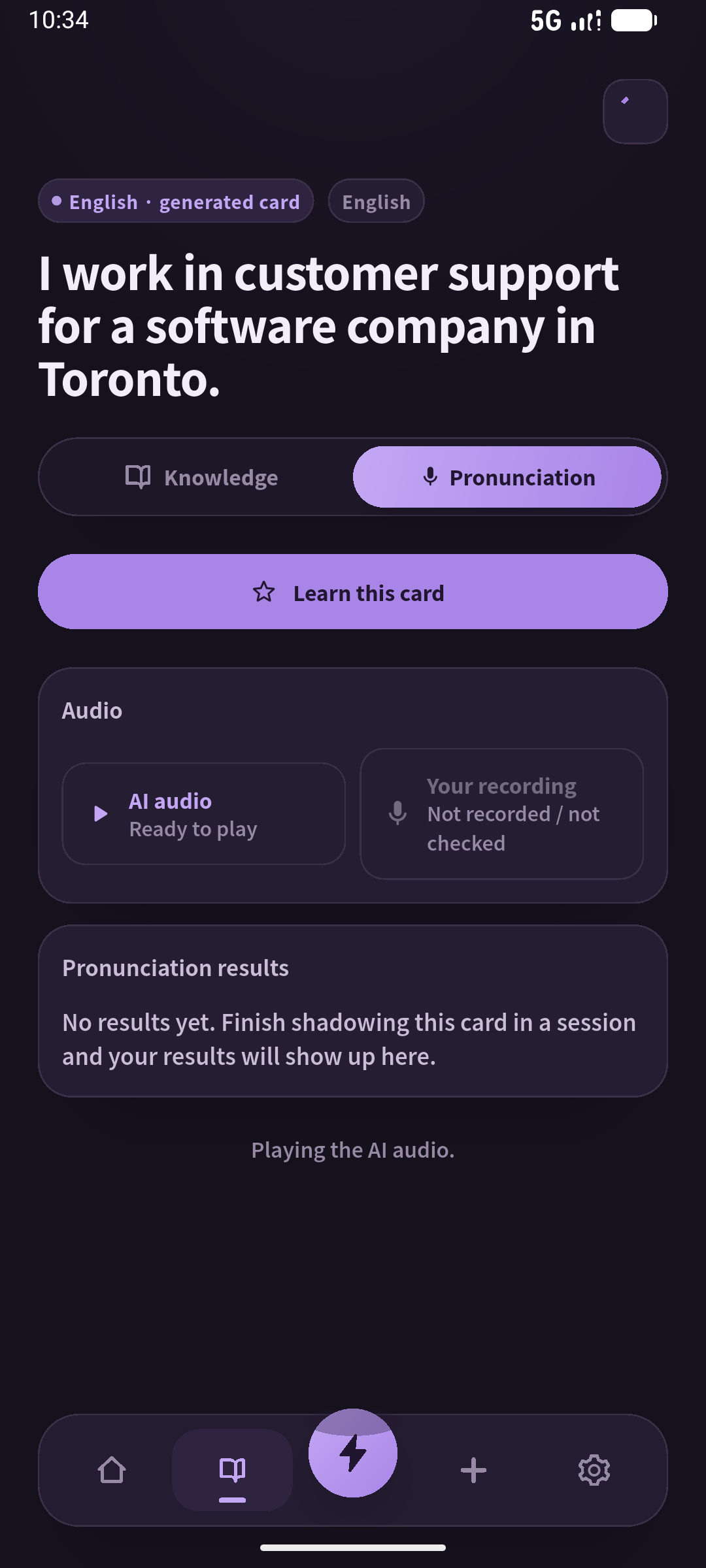
Choosing Viking is a preference for a practice voice. We do not claim it improves memory or conversation more than another voice.
4. Put the notes away
Before replaying, Maya closes the script and tries from the situation alone: “first lesson; name, job, goal”. If she gets stuck on the customer sentence, she checks that chunk and tries again. Being able to echo a model and being able to begin without a prompt are different observations.
What to record after a try
| Part | Meaning / what to change |
|---|---|
| Listen, pause, say it | Could I say one chunk after stopping the model? |
| Put the notes away | Could I start and include the job and goal without notes? |
| Talk to a person | Did the listener understand my role and ask a question? |
| Return to a stuck sentence | Which sentence or question will I practise next? |
5. Talk to a person
Maya uses the introduction with a teacher and asks for a question about her work. This is a proposed practice exchange, not a measured outcome. She notes whether the listener understood her role and whether she could answer. Later she tries on another day and changes the middle for a colleague rather than only repeating the same script.
A possible follow-up exchange
Teacher: What do you help customers with?
The teacher asks about the task, rather than requesting the whole script again.
Maya: I help them use our software and set up their accounts.
Maya answers the specific question.
Maya: Could you say the next question again, please?
She can ask for repetition rather than pretending to understand.
9. What the research does—and does not—support
Thirty seconds and the Viking voice are editorial choices. The following studies inform the recall, spacing and repeated-speaking checks. None directly tests this app-based self-introduction routine or guarantees transfer to real conversation.
Recall: original paper inspected
Karpicke and Roediger (2008) studied 40 Swahili–English word pairs. Continuing retrieval after a successful answer supported one-week recall more than dropping those items from testing and continuing study. We inspected the original paper. This is vocabulary recall, not a test of self-introductions; we use it as a reason to check speaking without looking separately from reading. Source
Spacing: abstract only
Cepeda and colleagues (2006) synthesised 317 experiments with 839 assessments. The abstract reports that learning interval and retention interval jointly matter. We inspected only the PubMed abstract. It does not establish one universal review calendar; returning on another day is our practical proposal. Source
Repeated speaking: abstract only
De Jong and Perfetti (2011) studied 24 ESL learners giving four-, three- and two-minute speeches. The publisher abstract reports maintained gains at post-test only in the repeated-topic group. Abstract only: this is not a 30-second task, passive listening or proof of a Viking-voice advantage. Source
Questions before your first introduction
What if I only have one sentence?
Use a greeting, name and relevant role: “Hi, I’m Maya from customer support.” Keep your longer version for when there is time.
Must I include my age?
No. Include details that serve the situation and that you are comfortable sharing. An age line is an option, not a required slot.
How many words is 30 seconds?
Your pauses and speaking speed affect the duration. Start with a short draft, say it aloud and measure it. Do not race to meet a word count.
What if I forget the script?
Keep the name, role and reason for speaking. Ask for a moment if needed. After the conversation, practise the sentence that failed rather than expanding the whole introduction.
To practice the opening and ending of a conversation, use English greetings and replies to How are you? to choose a reply and one short update.
Should I use contractions?
I’m is an option for everyday speech; I am is also valid. Prioritise being understood and choosing real details over imitating every feature of the recording.
Keep practising
- Choose the next study task
- Plan your speaking practice
- Review an online lesson
- When you know a word but cannot say it
- Practise sentences you want to use
- What SpeakGain does
Choose a situation, make the facts yours and rehearse a short version. Check it without notes, then leave room for the other person’s question. The aim is a conversation you can enter, not a perfect speech you can only recite.
Keep talking after an introduction: choose a short English response
For a practical call, use English phone-call phrases and how to ask again to rehearse introductions, messages, spelling and number checks.
For apologies, attention requests and thanks, see how to apologize in English and choose a phrase for the situation.
To move from introducing yourself to giving a talk, prepare your purpose and outline with the guide to presenting in English.
For the Japanese phrase yoroshiku onegaishimasu, choose an English line by what you mean: a greeting, a request, future teamwork or thanks.